Pesticide App Regulations Part 1
Last week was the kickstart to meeting season for me and it was great to see those of you at pesticide trainings and the Nitrogen Challenge meeting. For this column, I wanted to share a little more detail about the changes for this coming growing season regarding pesticide label language and requirements for the endangered species act (ESA) to mitigate drift and runoff. The information below came directly from a CropWatch article (https://go.unl.edu/skj7) written by Dr. Milos Zaric with UNL Agronomy, Greg Puckett with the UNL Pesticide Office, and Craig Romary with the Nebraska Dept. of Ag. Next week I will simplify this into specific steps to help you be in compliance for the 2026 growing season.
“Both Enlist One® and Liberty® ULTRA include ESA compliance requirements on their labels. These are not optional; they are enforceable use directions intended to protect federally listed species and their habitats (as well as other non-target plants and animals) from potential exposure due to off-target pesticide movement.
Before applying any listed product with ESA compliance requirements, applicators must consult the EPA BLT (Bulletins Live Two) map web tool to determine whether any application restrictions apply to the time and location of their planned application. A valid bulletin must be obtained within six months of the application, and the version specific to the planned month of application must be followed.
When applying multiple pesticide products as a tank mix, applicators must follow the most restrictive label requirements, including any ecological spray drift, runoff and erosion mitigation measures associated with either product. This added responsibility means users must verify compliance before making applications, particularly when operating in areas designated as vulnerable under the EPA’s mitigation framework.
The runoff and erosion mitigation measures will have a point system: each mitigation measure carries a point value, and to comply, the points for each site must meet the points for the product. Ecological spray drift mitigation will have a starting distance for a buffer or setback. Each mitigation measure allowed by the label will reduce that starting distance by a specific percentage. Depending on the level of mitigation implemented, buffer distances may be reduced — and in some cases to 0 feet — if the cumulative mitigation credits meet or exceed the required threshold.
Understanding and implementing these practices helps maintain compliance, reduce off-target movement, protect threatened and endangered species, their habitats, and other non-target plants and animals, and ensures continued access to essential row-crop protection products. This list is not exhaustive, and as new products are introduced or re-evaluated during registration renewal, they may include updated ESA-specific language and additional mitigation requirements.”


2026 Pesticide Training
Pesticide Training: This is the big year for pesticide training where the majority of people in the State need private applicator certification. There are a number of trainings available if you’re unable to attend the dates/times in the county you reside in. All trainings are listed at: https://go.unl.edu/psep26.
I apologize for the confusion and need to correct something I wrote regarding pesticide training. What I shared was the way we had always been taught was the law, but I was told by Nebraska Dept of Ag this week that the way it’s been written doesn’t share the whole information. When it says certified applicators are ones who “purchase and use restricted use pesticides”, the “purchase” is referring to “purchase by a retailer”. Thus, for those of you who are solely relying on a Coop or ag retailer to apply your restricted use pesticides and you are not applying them yourselves, you technically do not need a private applicator license. Feel free to call if you have specific questions regarding your situation.
The first trainings in York are this Thursday, January 15th at 9 a.m. and 1 p.m. at the Cornerstone Event Center (Fairgrounds) in York. We have been asking for RSVP to 402-362-5508 to save on the time for registration at the door, but walk-ins are welcome. Attendees need to bring a valid driver’s license or legal identification and $60/person. Those who are recertifying should also bring your NDA barcode letter, but we have other paperwork if you don’t have that for some reason.
If you don’t prefer to do the face to face training, other ways one can certify as a private applicator include an online self-study course and exam (cost $100) or attend the all-day Crop Production Clinic (cost $110) RSVP: https://agronomy.unl.edu/cpc/.
Crop Production Clinics: Especially for commercial and non-commercial applicators, Crop Production Clinics is the easiest way to recertify for the 00 and 01 categories. Please register at: https://agronomy.unl.edu/cpc/ for the location you wish to attend.
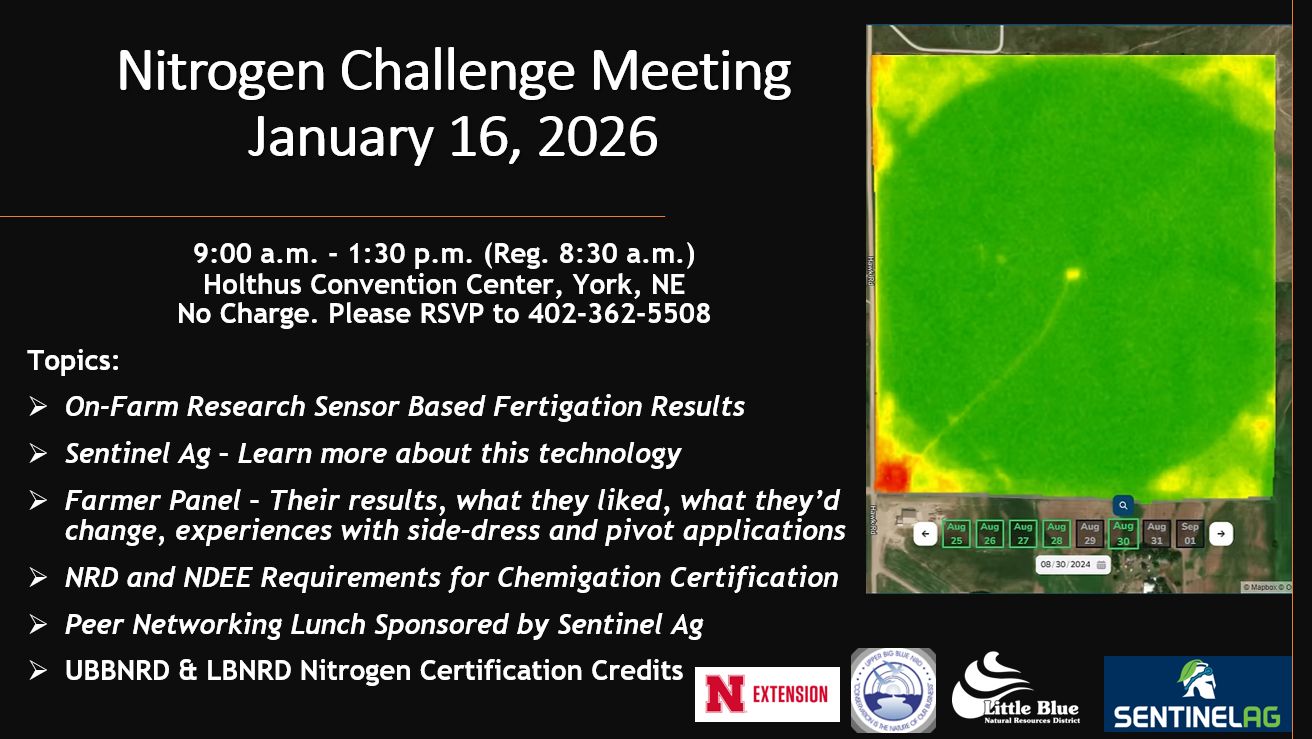
Also a reminder of the Nitrogen Challenge this week on Friday, Jan. 16th beginning at 9 a.m. at the Holthus Convention Center. If you’re interested in learning more about better managing nitrogen resources on your farm and most likely saving on nitrogen inputs, I hope you will consider joining us. Please RSVP to 402-362-5508 for meal count.
Reducing Nitrogen Inputs
With higher input costs and low commodity prices, I’ve been thinking how to be of help to the farm community I serve during these times. A small group of farmers and I met before Christmas. We talked about the difficulties the farm economy is facing yet also talked about realistic things that can be done to save money right now. One of those is around nitrogen and thus, we planned a Nitrogen Challenge Meeting on Jan. 16th at the Holthus Convention Center in York beginning at 9 a.m. The goals of this meeting are to share the research-based results from using in-season nitrogen management via Sentinel Ag, understand how to use this technology, and share testimonies from growers utilizing this technology. They wanted to create a peer network of famers supporting farmers during the growing season with this technology-so the first step will be a peer networking lunch sponsored by Sentinel Ag. The NRD is providing nitrogen certification credits. There is no charge but please RSVP for the meal count to 402-362-5508 or jrees2@unl.edu.
Why have I stressed nitrogen so much? In the Upper Big Blue NRD newsletter, Terry Julesguard wrote an article about nitrogen in the NRD based on the information provided by the Phase 2 and 3 reports. You can read the full article at: https://www.upperbigblue.org/increased-nitrogen-efficiency-brings-new-questions. In this excerpt Terry shares, “The numbers that stand out are the residual nitrate nitrogen in the soil:
- Corn-on-corn field increases from 33 lbs/A average to 86 lbs/A, an increase of 202%.
- Corn/bean rotation field increases from 32 lbs/A average to 86 lbs/A, a 212% increase.”
I know most farmers are seeking to do their best. The data is showing we’ve increased soil nitrate post-season by over 200%, meaning we’re overapplying N. We talk about the nitrate legacy from past generations, but this is the legacy we’re leaving right now in the soil for our kids and grandkids.
Soil tests in this area of the state from the 2025 season are showing residual soil nitrate is available to reduce the amount of nitrogen applied next growing season. This provides an opportunity to save on nitrogen input costs. No agronomist, including myself, can tell you exactly how much nitrogen you will need because we don’t know the weather/soil conditions for each piece of ground each year. This is why sensing what the plant needs is so powerful using technology like Sentinel Ag.
We have an opportunity to change the nitrogen story now-with us! On-Farm research with Sentinel Ag (2022-2024) in our part of the State showed an average 56 lb N/ac savings without impacting yields, while leaving an average of 5 ppm Nitrate in the top two feet. No other product or practice has proven that in our area of the State via on-farm research. It’s about using technology to manage the nitrogen the plant needs to the best of our ability. Thus, the Nitrogen Challenge in which I’ve asked growers to consider only applying a base rate pre-plant of 50-100 lb N/ac and apply the rest of the nitrogen in-season using a sensor-based technology like Sentinel Ag. Sentinel Ag uses satellite imagery to sense when a corn plant is becoming nitrogen stressed before our eyes can see it. The research was originally developed at UNL and the grad student (Jackson Stansell) then developed a company (Sentinel Ag) around it. Please consider learning more by joining us for the Nitrogen Challenge meeting on Jan. 16th. Farmer testimonials at: https://go.unl.edu/f3si.
January 2026 Events
Hoping you and your family had a blessed Christmas and wishing you a wonderful 2026! Winter program brochures are being mailed and can be viewed at: https://jenreesources.com/upcoming-events/. Please contact the Extension Office hosting the event you’re attending.
It’s also Extension reporting time and I appreciate those who share thoughts about my work via this survey. If you’re willing, please go to https://www.slido.com/ then enter 4EXT in the code area. Thanks!
Custom Rates Survey: Many people utilize UNL’s custom rates publication to get an estimate for charging or compensating for various farm-related operations. The survey is available from now until mid-January. If you provide custom services and agricultural operations and are willing to provide input, please sign up to receive the survey at go.unl.edu/tbky. Data will be gathered and summarized in the 2026 report. Thank you for your help!
Crop Production Clinics offer recertification for pesticide applicators (commercial, non-commercial applicators) in addition to updated crop and pest management information. The closest to this area include: Jan. 14 near Mead, Jan. 16 in Beatrice, Hastings on Jan. 21, York on Jan. 22, and Kearney on Jan. 27. This year, only the locations in York, Kearney, and Norfolk will be hosting the second room that features information on cropping systems, digital ag, agribusiness, and water and nutrient management. More info. and RSVP at: https://agronomy.unl.edu/cpc.
Pesticide Training: A common question is, “Do I need to renew my license if the coop is applying the chemicals and I’m not?” The answer to this is, no as long as you are not applying any restricted use pesticides at all. A certified pesticide applicator needs a license if you are using restricted use pesticides. I’m teaching the trainings at York, Seward, and Fillmore counties and helping David Wangila with some of the trainings in Clay, Nuckolls, and Thayer counties. It is helpful for RSVP to the county you wish to attend the training even though you can also walk in.
Nitrogen Challenge Meeting will be held on Friday, Jan. 16th at the Holthus Convention Center in York beginning at 9 a.m. The goals of this meeting are to share the research-based results from using in-season nitrogen management via Sentinel Ag, understand how to use this technology, and share farmer testimonies from growers utilizing this technology. There will be a peer networking lunch sponsored by Sentinel Ag to develop a peer network of growers using this technology. There is no charge but we need an RSVP for the meal count. Please RSVP to jrees2@unl.edu for the time being.
Jan. 22 Corn and Soybean Expo will take place on Thursday, January 22, 2026 at ENREEC near Mead (1071 County Road G, Ithaca, NE 68033). The program will kick off at 8:30 a.m. and will finish up at 3:00 p.m. The goal is to help producers plan for next year’s growing season. There is no registration fee.
Jan. 28 Corn Production Clinic will be held at the Fairgrounds in Aurora. More details will be shared in the future.
Joy and Praise
Today I was thinking of the gifts of joy and praise. Watching the children sing and share in our church’s children’s Christmas program filled my heart with joy! People in our church then shared testimonies of praise for what God has done in our lives through the recent sermon series in Jonah. All the testimonies contained joy and praise in spite of a few of them bringing many of us to tears. We have a number of friends who have unexpectedly lost family members the past two weeks. Other friends and family are facing illness and hoping to spend this Christmas together. It’s hard to lose family members any time of the year, especially around holidays. A few friends were grieving family members who passed earlier this year not being with them this Christmas and a few others were grieving family members who passed several years ago. Perhaps some of you can relate to these situations too?
The National Institute of Health published a study in May of 2025 about the complexities of joy. The authors shared, “Joy was perceived as a distinct, profound emotion, often intertwined with gratitude and love. Barriers to joy included negative relationships, societal pressures, and emotional burdens, whereas fostering positive relationships, engaging with nature, and cultivating self-awareness were identified as key strategies for sustaining joy.” The study also shared the resiliency of joy…that participants experienced joy in spite of good or difficult times…that choosing joy produces resilience.
In this study, “Participants consistently shared that connection was fundamental to their experiences of joy, emerging from connection with others and sharing values, meaning, and purpose. Being connected to oneself, especially the authentic self, and being open to a range of emotions, were deemed crucial for experiencing joy. Connection to nature and the environment was significant, particularly for those who felt disconnected from people. Feeling connected to something larger than oneself and engaging in loved activities such as hobbies and spiritual practices were important for experiencing joy. Periods of diminished joy coincided with a loss of connection in various ways.”
It’s good to see research continue to show the benefits of connection producing joy. Life is hard and grief is a funny thing in how it shows up so randomly. It made me think about what I shared at Thanksgiving about intentionality in time with others as life isn’t guaranteed. A couple girlfriends and I talked about this again today…that we want to be intentional with the most important things and in living with joy and gratitude. We wanted to be more intentional with family, friends, and those hurting around us.
Wishing you and your family/friends Christmas blessings with joy and praise in the midst of whatever you may be facing. I’m also grateful for the Savior of the World who was born to die that we might live!
Winter Program Brochures have been mailed by several area counties or will be mailed after Christmas. Please RSVP to the county office where you’d like to attend the meeting being hosted. You can also find the list of winter events at: https://jenreesources.com/upcoming-events/.


Ranching for Profit School
This past week my husband and I had an incredible experience attending the Ranching for Profit School. It’s a fairly intense business training but really more than that. He had attended the school a few years ago and we chose to go together this year so I could better understand the economic concepts we were using on the farm. It’s exciting to see how the concepts, in addition to the peer group of other businesses, is helping transform our farm!
Ranching for Profit School began in 1983 and its mission is to help create Healthier Land, Happy Families, More Profitable Businesses. I think many of us can resonate with this. Specifically, the mission is about our purpose, our “why”. I’ve had a personal mission statement for decades, but it’s important for our businesses to have a statement as well. Why? It helps us with decision making and keeps us grounded in the good and difficult times. The mission should encompass the customer value, the owner value, and core principles (values). Our vision is what we want. I appreciated how the teachers kept asking us, “What do you want?” We can’t make wise decisions if we don’t know what we want to aim for. They shared, “If you can see it in your head and feel it in your heart, you can hold it in your hand.” Every business on my team left with an action item to work on our Mission/Vision. I think that’s an important item for all of us to consider for ourselves personally as well as professionally.
For the economic concepts, we were taught a way to determine gross margin per unit. This allows us to evaluate enterprises (each crop and/or class of livestock) side by side to understand where we were obtaining the most value. If we’re going to be profitable, we need to think about the value we’re creating. It’s a way to help us consider the things we should be doing more or stop doing altogether. We also learned strategies to determine how to increase the value of each enterprise.
We were challenged to think about any paradigms keeping us from moving forward. Paradigms are a lens from which we view the world. They’re subconscious beliefs we’re often unaware of. An example many can relate to is, “Hard work leads to success”. However, how many of us work incredibly hard yet aren’t profitable? Often working even harder isn’t possible or practical. We all have paradigms that impact our daily decisions and relationships. Some paradigms can be positive, but others can paralyze our decision-making. Paradigms lead to action which leads to results. Thus, they suggested if we wanted to change our result, we needed to look at our paradigms. Sometimes we can’t see the things right in front of us that need attention because of our paradigms. This is also where it’s important to have trusted peers and advisors who we allow to speak into our lives to help us see what we can’t. One unfortunate story shared how an owner’s deeply rooted paradigm resulted in an operation going bankrupt, in spite of others speaking into the situation using the economics. It made me wonder how quickly that could happen, particularly during really tough economic times such as now in farming. It was helpful for me to become more aware of paradigms I have and hopefully this thought is helpful to you too.
If any of this sounds of interest to you, I’d encourage you to check out the Ranching for Profit website at: https://ranchingforprofit.com/. While the school was designed for ranchers with livestock and grazing/haying enterprises, there are a number of farm and other businesses who attend because of the solid business principles that can be applied anywhere.
Dr. Kohl’s Ag Update
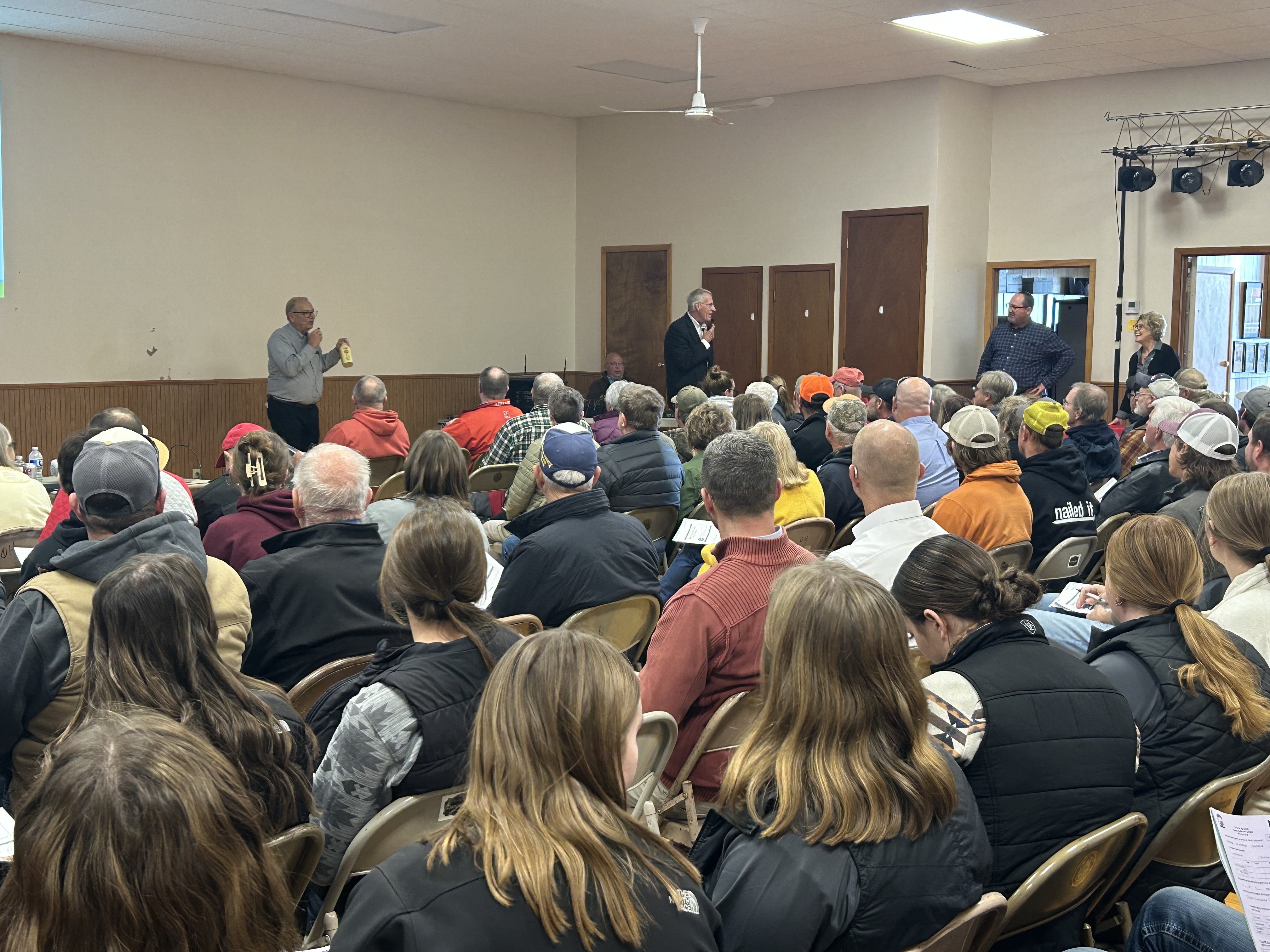
This week, I’m sharing an article that my colleague, Brandy VanDeWalle wrote on December 5, 2025 about “Ag Update and the Road Ahead” by Dr. David Kohl’s presentation at the recent Farmers and Rancher’s College Program. Brandy writes,
“Recently at a Farmers & Ranchers College program, Dr. David Kohl shared his global perspective on current events and how they influence U.S. agriculture—insights that are always incredibly valuable. One of the highlights of his presentation was a “SWOT analysis” of the United States. While many businesses routinely use SWOT analyses to evaluate strengths, weaknesses, opportunities, and threats, it was fascinating to consider how this framework applies to an entire country.
Kohl noted that one of the United States’ greatest strengths is its abundant natural resources. Together, the U.S. and Canada hold 20% of the world’s water supply. The nation’s extensive river system also provides an efficient means of transporting goods. Additional strengths include a solid capital structure, legal system, and property rights; the global role of the U.S. dollar in trade; a strong educational system; an entrepreneurial economy; and the country’s historic position as a global influencer since World War II.
Weaknesses cited include political polarization, inconsistent policies, and declining trust in institutions. The U.S. also faces an aging population combined with a reactive healthcare system, a growing federal deficit, substantial budget obligations, a service-dependent economy, a widening concentration of wealth and income, and aging infrastructure paired with supply chain challenges.
Kohl highlighted that North America has tremendous potential when the U.S., Canada, and Mexico work together—representing 5% of the world’s population but 29% of the global economy. Additional opportunities include improving proactive healthcare to enhance quality of life, cultivating next-generation leadership at all levels, advancing as a global leader in applied technologies, and strengthening natural resource and environmental management.
Among the threats, Kohl warned of the likelihood of a catastrophic technology event that could disrupt major industries or even the country itself. He also identified the risk of a “brain drain,” as scientists and researchers leave the U.S. due to issues such as funding uncertainty, instability, perceived anti-science sentiment, and heavy recruitment from other global powers including the EU and China.
Dr. Kohl emphasized the critical importance of human interaction and communication. While artificial intelligence and other technological tools can help reduce workloads, they can never replace genuine human relationships. He reminded attendees that people need connection and purpose. Quoting a favorite saying, he noted, “It is better to have a good neighbor than their farm,” reinforcing the idea that being kind and building strong relationships matter far more than acquiring more land or expanding a business.
In conclusion, he provided leadership principles that stand the test of time:
- Change occurs bottom up, not top down.
- Manage the controllables, manage around the uncontrollable.
- Quick money builds ego – disciplined principle-based strategy/activity results in resiliency, nimbleness, agility and character.
- If you are going to lead, you must read!
- Success is often measured in dollar signs. Significance is giving back and making a difference in people’s lives.
- A successful culture and society must have success in agriculture.
It was great to see over 30 FFA members and community college students in attendance which Dr. Kohl praised and asked them each to share what they learned. He praised the 4-H and FFA programs for providing youth a purpose and developing life skills.”

Reflections on Gratitude
With the growing season ending and the transition to winter programming beginning, I’ve been reflecting on gratitude, and the gifts of time, health, relationships, and seasons.
My husband and I, along with many of you, were so grateful to finish this harvest season! In spite of disappointing yields, I heard several farmers say they were looking forward to gathering with family on Thanksgiving and counting their blessings. That’s a great attitude as we are truly so blessed!
Regarding seasons, I’m ironically finding much gratitude in the nights turning darker earlier to allow for rest on the farm. You don’t have to agree; I truly believe that’s a gift God gave to us in farming communities who go so hard most of the time. The beauty found in each season was recognized by a beautiful, warm day last Sunday and white snow against green evergreens this Sunday!
Many family and friends in my life are struggling with health concerns; most likely in yours too. It’s daily reminded me how easy it is to take health for granted and be grateful for the health I have. Health is more than just physical; it’s also mental, emotional and spiritual. Life is so short and not guaranteed! Relationships are so important and can be fragile. This led me to think about relationships in my life and the need to be intentional in giving time to others. It’s so easy to be “busy” but are we “busy about the right things”? I’ve written names of people to connect with and now need to be intentional in doing that. What about you? Are there people in your life who could benefit from the gift of intentional time spent catching up?
As I reflect on this year and walk alongside of people, it seems like there’s increasing divisiveness, uncertainty, fear, anxiety, depression, and stress. For encouragement, fear and anxiety can’t succeed in the midst of gratitude. Gratitude produces Joy! When we focus on gratitude and choose joy, there’s no room for worry, discontentment, or fear for the focus is no longer on ourselves.
If we chose to live with gratitude, how would it change us and our perspectives? Would we be less prone to complain and get discouraged when things go wrong? Would we be less likely to argue and more likely to extend kindness and grace to others? How would it impact the divisiveness we see in our country, our communities, our families?
So how do we choose to live with gratitude? A start can be to intentionally seek at least one thing each day for which to be thankful. At first it can be difficult and perhaps awkward. For some, it’s hard to even think of one thing. Perhaps a starting point can be gratitude for one’s home, bed, food, vehicle, job, friend or family member, etc.? Over time of practicing this, one’s perspective can change to even finding gratitude as things go wrong. I’m not good about this all the time, but it sure helps my mindset and increases my perspective when I choose gratitude even when things go wrong. Perhaps others can relate to this?
Ultimately, my hope is that we can experience more joy each day in the everyday moments as we intentionally seek to live with gratitude. And, that this joy can be extended via kindness, grace, compassion to others around us.
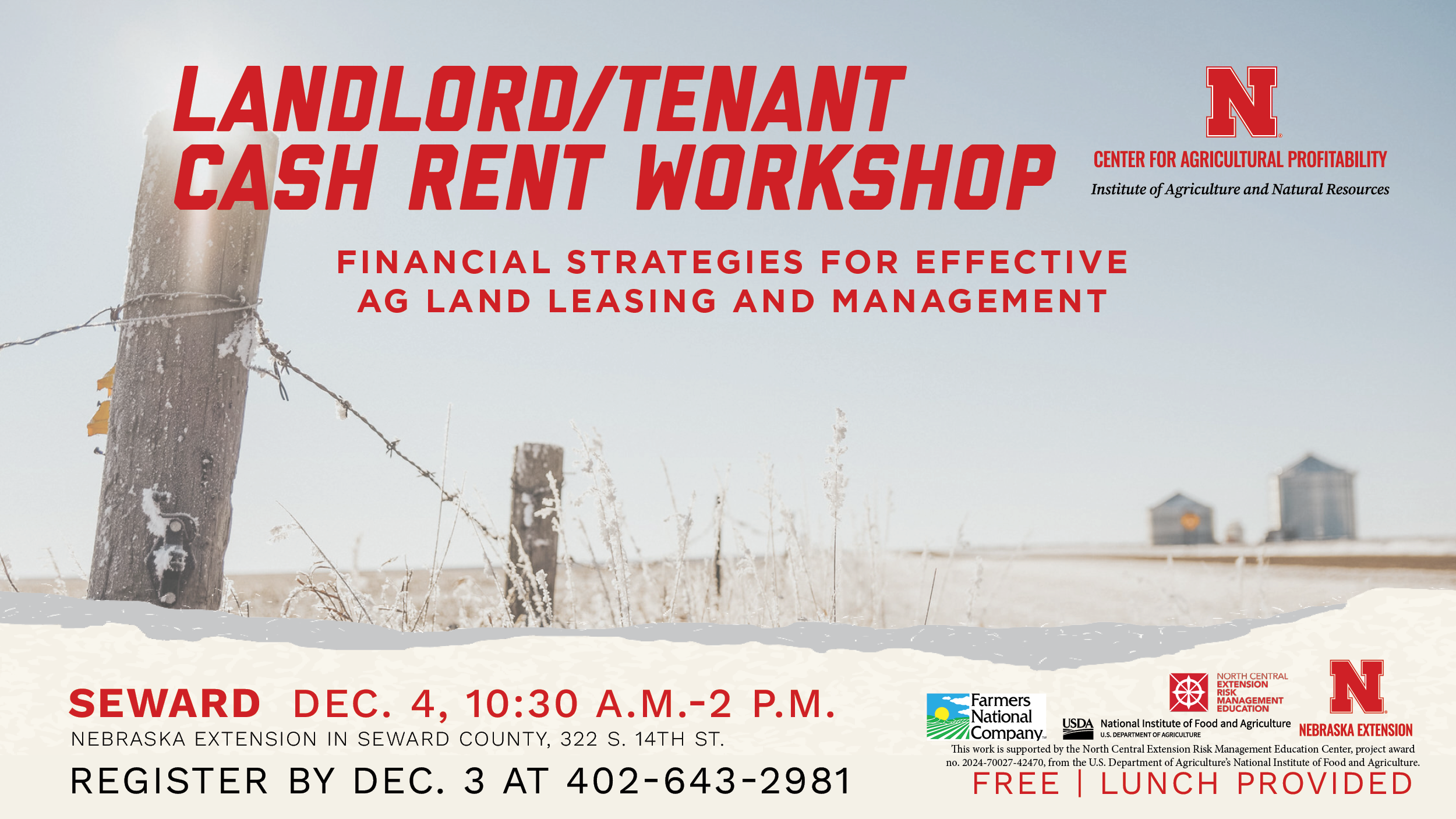
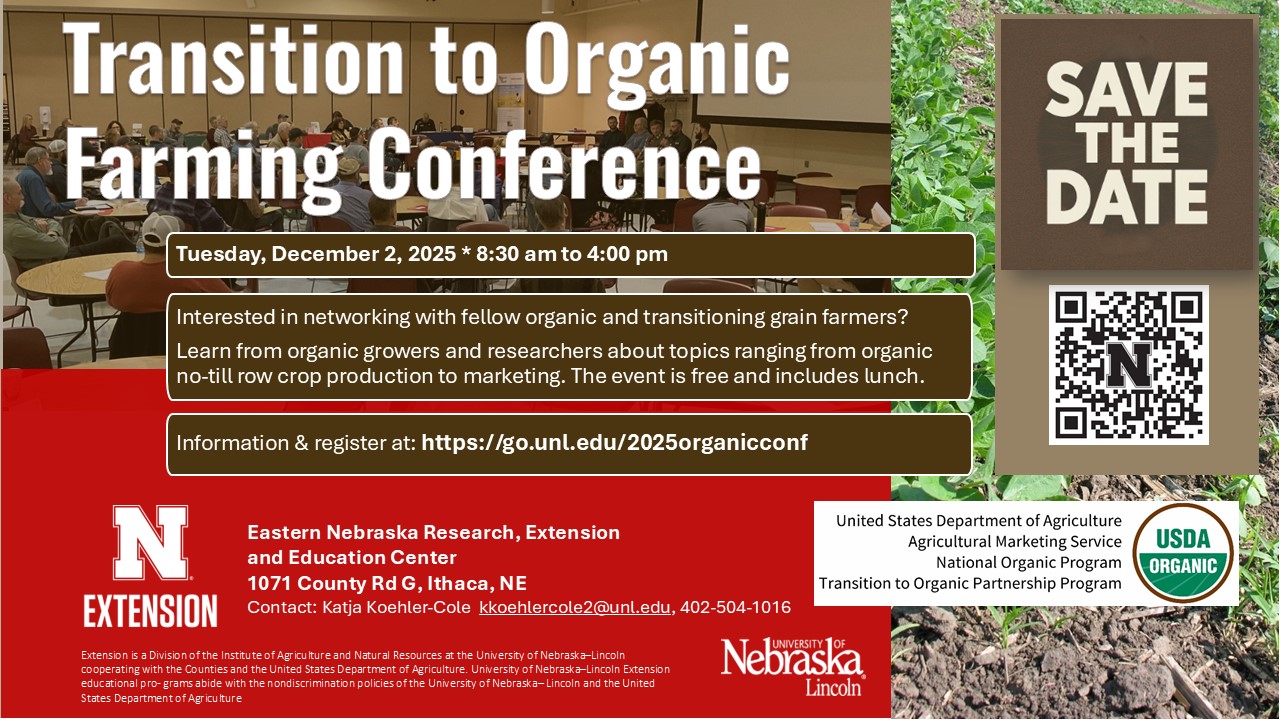
Reminder of several programs this week: Organic Conference Dec. 2 near Mead, Dr. Kohl at 1 p.m. at the Bruning Opera House on Dec. 3, and the Landlord/Tenant cash rent workshop at 10:30 a.m. at the Seward Co. Extension Office on Dec. 4.


JenResources 11/24/25
Wishing everyone a blessed Thanksgiving! Here are some Thanksgiving food safety tips, recipes, and wellness activities from UNL Extension Food faculty: https://food.unl.edu/article/thanksgiving-central/.
Nitrogen Reduction Incentive Act Deadline has been extended to December 15, 2026. With a late harvest, this will help producers who desired to get an application in to try a practice on their farms that would reduce nitrogen rates by 40 lb N/ac. The online application form can be found at: https://app.smartsheet.com/b/form/090982880f3e47c196a83ea1928158c7. Additional information regarding this program can be found at: https://dnr.nebraska.gov/lb-1368-nitrogen-reduction-incentive-program.
Organic Conference: Are you interested in learning more about organic farming, are in the transition process or are already a certified organic producer? We invite you to join us for our third annual “Transition to Organic Farming” conference on December 2, 2025, at the Eastern Nebraska Research and Extension Center near Mead. This is a great event that brings together producers, extension, industry, non-profits, and researchers. Online registration is now open and is free due to funding from our sponsors, the USDA Transition to Organic Partnership Program (TOPP) and Nebraska Extension. Click here to register: https://enreec.unl.edu/2025-transition-to-organic-farming-conference/.
Farmers & Ranchers College: The Agricultural Update and the Road Ahead with Dr. David Kohl will be held on December 3, 2025, at the Opera House in Bruning, NE at 1:00 p.m. There is no charge for this program due to the support of the Farmers and Ranchers College sponsors. This session will connect the dots between today’s economic landscape and your business decisions on the ground. Practical financial and management strategies will be shared to help you adapt, lead, and succeed, regardless of the economic cycle. This is versatile for a wide range of groups including lenders, producers, agribusiness owners, and students. More info. at: go.unl.edu/farmersrancherscollege.
Landlord/Tenant Cash Lease Workshop in Seward December 4 will be held for landowners and operators from 10:30 a.m. to 2 p.m. Dec. 4, at the Extension Office in Seward, 322 S. 14th St. The meeting, titled “Financial Strategies for Effective Agricultural Land Leasing and Management” will cover current Nebraska cash rental rates and land values, best practices for agricultural leases, and other contract considerations. The meeting will also include financial considerations for farm succession and transition and offer an opportunity for those in attendance to have their leasing questions answered. Lunch will be provided, sponsored by Farmers National Company. There is no charge to attend, but registration is required by Dec. 3 by calling the Extension Office at 402-643-2981. More information about cash rental rates, leasing and farm and ranch transition can be found on the Center for Agricultural Profitability’s website, https://cap.unl.edu.
2025 Yields Part 2
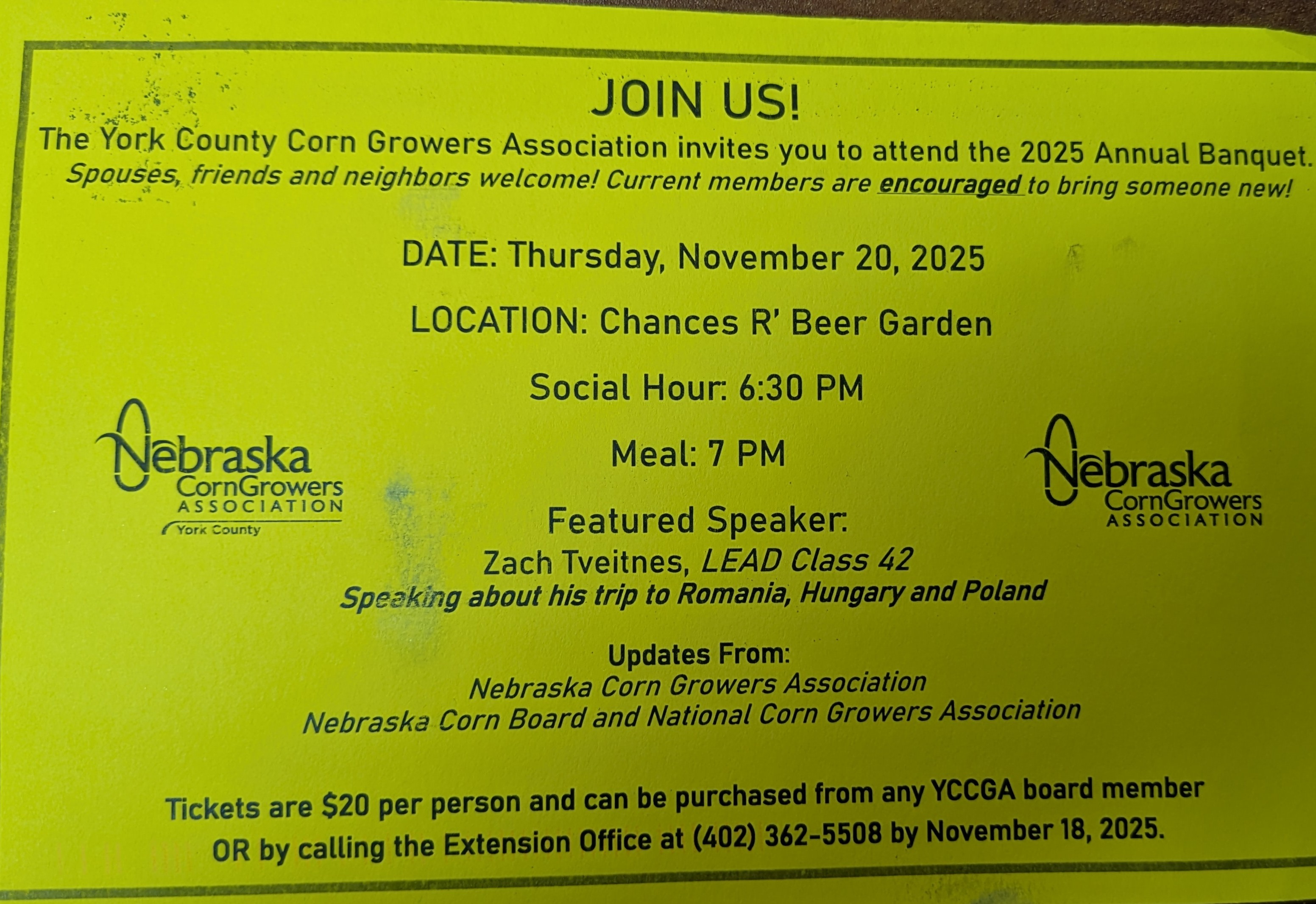
York County Corn Grower Banquet will be held Thursday, November 20th at Chances ‘R in York. Social at 6:30 p.m. with meal at 7 p.m. Tickets are $20 and can be reserved at the Extension Office at (402) 362-5508 or contacting a York Co. Corn Grower Director.
In last week’s column, we walked through the growing season providing perspectives of what may have caused yield loss. I mentioned that while people are looking for solutions, increased nitrogen rates, more fungicide applications, and tillage are not the answers for higher yields. In conversations, those were the “solutions” people were trying to provide. Several asked me for any patterns from observations and conversations I’ve had. That’s what I will attempt to share in this column. There’s a number of field situations where only 150 lb N and one fungicide application resulted in above-average yields. In those situations, correlations included balanced overall nutrition where nitrogen was reduced, TIMELY fungicide application, and not over-irrigating.
I realize quite a bit of tillage has occurred. Gently, please remember the wind events we receive each spring. I encourage you if you have tilled, to consider covering the ground with cereal rye. March 2025 was the windiest March on record in Nebraska and I remember several accidents due to poor visibility. I realize this is a hard topic. Tillage will not control southern rust as that fungus doesn’t overwinter in residue. It will help with the tar spot fungus, but there are other management considerations including hybrid and not over-applying nitrogen and irrigation.
Reduced nitrogen: It was interesting walking our on-farm research studies where we had nitrogen ramps this past year and observe the correlation between less southern rust in the lower nitrogen rates and more southern rust in the higher nitrogen rates. Dr. Bob Gunzenhauser observed the same thing this past year and posted a photo on X showing two hybrids and the variation of southern rust compared to nitrogen rates.


Timely fungicide application: There were people with better yields (250+) who applied only one fungicide while others applied two. I didn’t hear too much from those who applied three to five applications. Some applied two fungicide timings of two different generic products and did just as well as the higher priced products with one application. The key was not applying the fungicide too early so there was some later season residual. Some applied a second fungicide around late dough to early dent stage this year and that seemed to work for hybrids that were more prone to southern rust. The keys were knowing the hybrid, not having excess nitrogen, and proper irrigation management.
Irrigation Management was perhaps the thing that was most frustrating for growers. We started the season off so dry after several years of being dry. So, it’s easy to be in the mindset of irrigating. Anytime non-irrigated fields yield the same or more than irrigated fields, it’s often due to over-irrigation. Irrigation events often occurred before rain events this year. This year’s relative humidity was also very high, thus, the crop didn’t use as much water. Because of that, we were keeping some soils too wet by irrigating which, both Dr. Tom Hoegemeyer and I believe, added to the crown rot and stalk rot issues we experienced. Dr. Hoegemeyer also wrote a recent article reflecting on “60 Harvests – Changes I Have Seen — Nebraska Soil Health Coalition“.
Final thoughts, there’s not one answer but a combination of factors that impacted fields this year. There’s also a lot of farmers hurting with the combination of low yields, low commodity prices and high input costs. Hundreds of thousands of dollars were lost per field in several situations. For those involved and/or interacting with the farming community, please reach out to each other and check in with each other. Please know you’re not alone and there’s always help and hope if you’re struggling. 988 is Nebraska’s suicide and crisis lifeline. There’s also a number of people who have announced retirements or will be announcing them. It’s important to be supportive. Conversations I’ve had with growers this year include: retiring to avoid taking on additional debt, wanting to scale back to reduce debt and stress, and retiring due to health reasons-both physically and anxiety/stress. It’s important for those retiring to retire “to something” by staying active in some way.


 JenResources