Category Archives: Nitrogen
One Red and Nitrogen Challenge
One Red: At Husker Harvest Days, a new program was rolled out called One Red. From the website and brochure it says “The ONE RED Ag Data Bank & Grants Program is a voluntary Nebraska program that combines a secure Ag Data Bank with potential payments, grant opportunities, and support from Approved Service Providers. It is designed around eligible fields, participating acres, qualifying practices, equipment, and technology.” https://oneredag.com/
Producers can qualify if they have at least 80 cumulative acres located within the following eligibility areas: irrigated acres, NRD Phase II and higher management areas, and designated Wellhead and Source Water Protection Areas throughout Nebraska (see the website). For now, interested producers can go to the website and put their name in as being interested. Putting one’s name in as “Interested” doesn’t mean a producer has to enroll in One Red and also doesn’t guarantee that the producer qualifies.
What I appreciate about how the program has been designed is that the data provided by the farmer is owned by the farmer and only aggregated data is shared in reports. It’s also one of the only programs I’ve seen that pays for technology – such as technology to improve irrigation scheduling and application, nitrogen sensing, and to allow software programs to talk to each other. The overall goal is to help farmers improve water quality through better irrigation scheduling, nitrogen application, and soil health practices. When the program money runs out, it’s hoped that growers will still be connected to each other via peer networks. While nothing is perfect, I’m hopeful it can help more farmers try practices to be better stewards of water and soil without taking on as much financial risk.
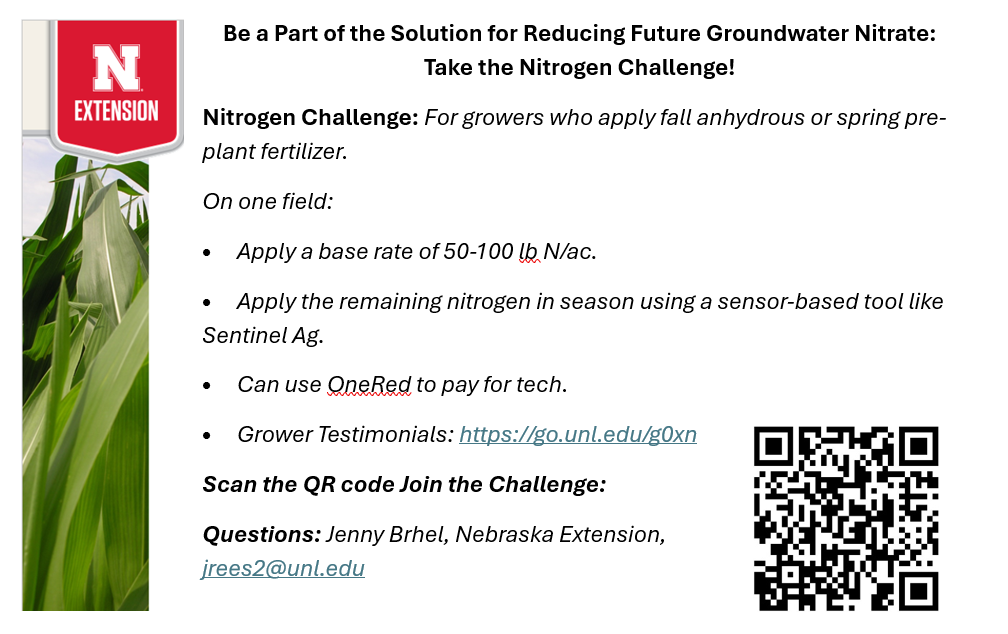
Nitrogen Challenge: In November 2023, after years of research, I asked producers and their advisors to consider a Nitrogen Challenge. The Challenge is this: for growers who apply fall anhydrous or spring pre-plant fertilizer, on one field, apply a base rate of 50-100 lb N/ac. Apply the remaining nitrogen in-season using a sensor-based tool like Sentinel Ag.
Why do I keep encouraging this Challenge? Because it’s UNL’s recommendation backed by solid research…it’s the only thing we’ve found that consistently reduces the amount of nitrogen growers apply without significantly impacting yield. That’s how we change the groundwater nitrate story for the future! As we think of input prices rising again for 2027, as we think of our rural and urban communities dealing with rising nitrates in groundwater, as we think about the future we leave behind for our children and grandchildren, I ask growers to consider the nitrogen challenge for 2027. I’m only asking growers to consider this for 1 field using the smaller base rate and Sentinel Ag in season and see how it works for you. This works for both irrigated and non-irrigated fields. And, growers can utilize the One Red program to help offset any costs. Brian and I use Sentinel Ag on all our non-irrigated corn fields. It’s incredible to see the satellite imagery show mineralization spikes and how the plant reacts by increasing the nitrogen sufficiency index in-season. I don’t know who will continue to champion this Challenge in Extension after I leave. As a farmer, I plan to continue working with farmer peer mentors who have championed this Challenge on their own farms. Their testimonies are found here: https://go.unl.edu/g0xn. The “why” of cleaner groundwater for future generations is clear for all of us. Will you join us? You can go to this website to sign up for the Nitrogen Challenge: https://crm.sentinelag.tech/nitrogen-challenge. For questions, please contact me directly.
Also, an Open House is planned for me on Sept. 30th from 4-6 p.m. at the Cornerstone Event Center at the York County Fairgrounds. Memories and pictures are being collected by Laurie Linabery and can be emailed to: llinabery2@unl.edu.

Nitrogen observations
I’ve enjoyed hearing from farmers the past month about a few observations they’ve seen in their fields. The observations involve the difference between higher and lower nitrogen rates applied. The first observation was like I’ve shared in the past: less disease when less nitrogen was applied to fields. The comments have come from producers who were comparing either whole fields of theirs or strips within fields where nitrogen rates varied from 60-100+ lbs less nitrogen per acre. I was really pleased to hear farmers are noticing this observation for themselves in fields!
The second observation is fields looking good in spite of reduced nitrogen applied to some fields. All the producers who have provided this comment are using Sentinel Ag to aid in their nitrogen management. There’s a handful of producers who have been using Sentinel Ag for years with only 60-100 lb N/ac on their irrigated fields. In the past month, producers have also wondered about applying extra N due to recommendations of others or when one Sentinel indicator block would trigger but the others wouldn’t. In those cases, I’ve always recommended to only put on strips or a pie with the pivot that covered one indicator block but not the other. Prove it to themselves whether they needed the additional nitrogen or not.
We’ve had some consistent rains this growing season of 0.1-0.2” in the area and have been blessed with the larger rains the end of July and more recently. There’s quite a bit of research showing mineralization flushes when rains/irrigation of 0.5-1” are received (as long as the soil was at 50-80% field capacity). The small rains of 0.1-0.2” and the heavy morning dews I think are also contributing to mineralization bursts on the soil surface as a key to mineralization is wetting/drying cycles. Wetting and drying cycles on the soil surface lead to nitrogen and carbon cycling by the microbes.
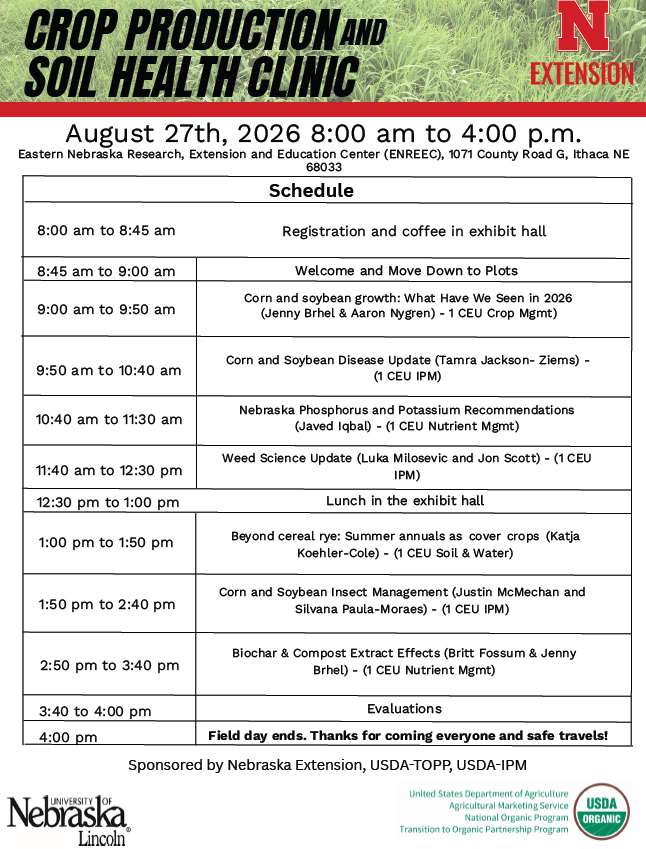
Crop Production and Soil Health Clinic will be Aug. 27th at ENREEC near Mead from 8 a.m.-4 p.m. This is a hands-on, research-based event focused on improving corn and soybean profitability through regenerative farming practices and better soil management. Topics include update on what we’ve seen with corn/soy this season, weed/disease/insect management, nutrient efficiency, cover crops, and biochar/compost extract effects. Designed for producers, crop advisors, agronomists and ag professionals, the program offers real-world tools to address pest resistance, reduce input costs and build more resilient cropping systems. To view the schedule and register, please click on the link: https://enreec.unl.edu/2026CropAndSoilHealthClinic/. The registration fee is $35 for those not needing CCA credits and $75 for those needing CCA credits. Fees include training, lunch, and reference materials. The training will be held rain or shine (bring rain gear).
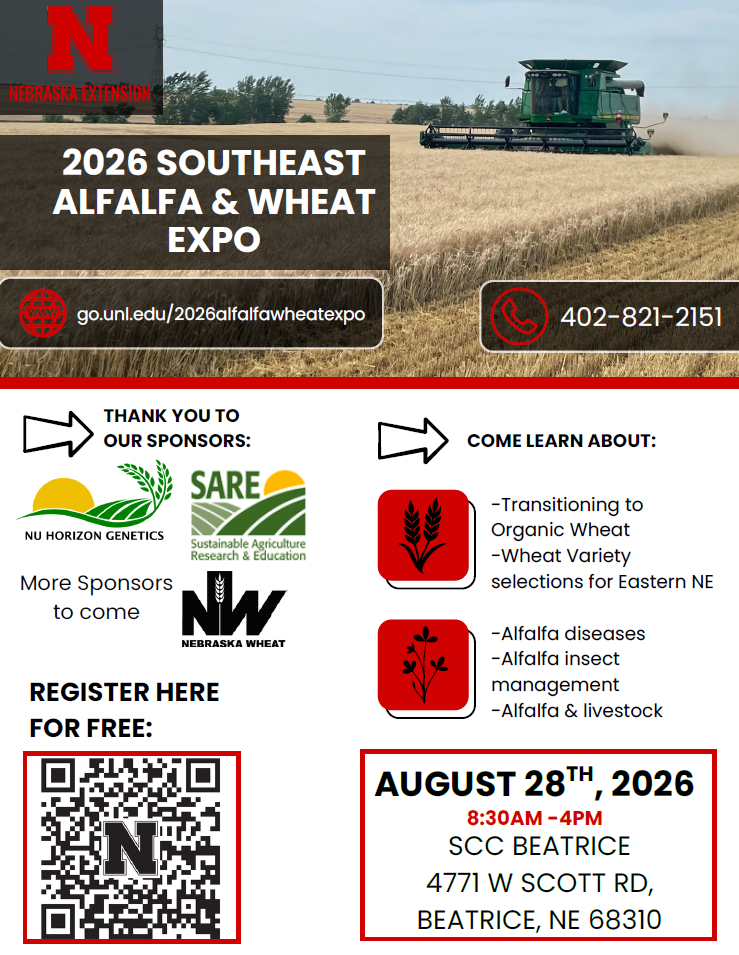
Wheat and Alfalfa Expo will be held on Aug. 28th from 8:30 a.m.-4:30 p.m. at Southeast Community College in Beatrice. The morning sessions will focus on wheat production and disease management. The afternoon sessions will focus on alfalfa management. The program will also feature an alfalfa producer panel, providing attendees with an opportunity to hear directly from farmers about their experiences and management practices. Attendees can choose to stay for the entire program or come and go at their convenience. There is no charge, but please RSVP for meal count at: go.unl.edu/2026alfalfawheatexpo or contact Matheus Ribeiro at mribeiro2@unl.edu or 402-441-7180.
Nitrogen Management in 2026
With the increasing nitrogen prices, there’s a great opportunity to take the Nitrogen Challenge by trying sensing-based technology on your farm this growing season to help with nitrogen management. How does it work?
- Apply a pre-plant base rate to your field between 50-100 lb N/ac.
- Apply any additional nitrogen the plant needs in season using a sensing based technology like Sentinel Ag.
For the pre-plant base rate, I know only 50-100 lb N/ac is a hard adjustment for many, but in order to use the sensing technology, you really need to have a base rate no more than 120 lb N/ac.
Then somewhere on half of your field, apply a strip of 30 lb N/ac less than your base rate and a strip right next to it of 60 lb N/ac greater than your base rate. Repeat these two strips on the other half of the field. For example, if your base rate is 100 lb N/ac, the low base rate would be 70 lb N/ac and right next to it would be a high strip of 160 lb N/ac. Make sure there’s a high/low paired strip on each side of your field.
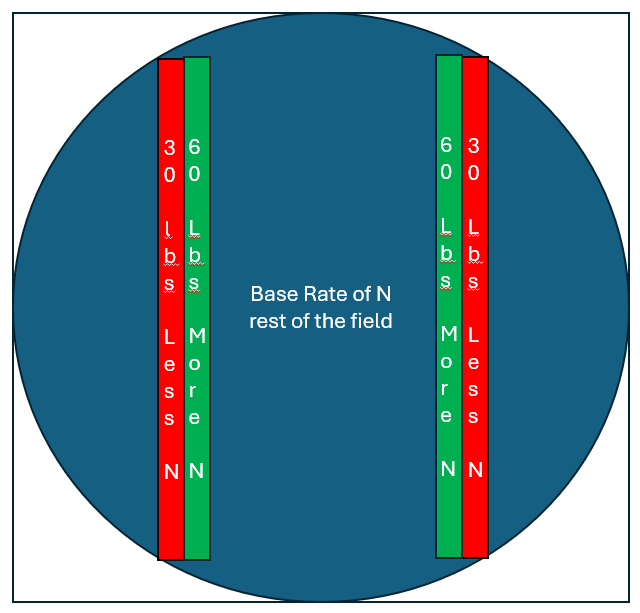
The next step is using a sensing technology like Sentinel Ag to monitor when your plants need any additional nitrogen in season. How do you get started? You can go to: https://www.sentinelag.tech/contact to contact Sentinel Ag and connect with a customer service provider.
From there it’s a matter of getting your field(s) into the system and imagery will be received each day during the growing season when cloud cover isn’t a hindrance. Our on-farm research growers since 2022 have saved on average 52 lb N/ac. We’ve had growers locally use Sentinel Ag who never applied additional nitrogen in the growing season. That usually only happens when there’s already high residual nitrate in the soil. However, it’s a great way to utilize that already existing nitrate and to avoid it leaching to the groundwater.
I also stress this as a nitrogen management tool beyond just reducing the amount of nitrogen applied. The satellite imagery has shown when terminated cover crops released their nutrients to the growing crop. We’ve also seen situations where growers added a 60 lb N/ac in-season rate at the correct timing during rapid growth phase and increase yields by 20 bu/ac. Those are things that we as agronomists can’t predict as we can’t predict mineralization for each field nor can we see the light spectrums that the sensors on the satellites can see that detect stress. It’s a beautiful thing how technology is allowing decades of research to become very practical and usable for growers!
So, for those frustrated by nitrogen prices, this is a great year to try in-season nitrogen management for yourself! And, for anyone using Sentinel Ag this year, we’re beginning peer mentoring groups. What does this mean? It can be scary and hard to try new technologies. Growers who have been using Sentinel Ag have volunteered to serve as peer mentors to other interested growers. We plan to help with understanding the imagery, fertigation, and just walk alongside each other to help with confidence in decisions and what we’re seeing. There’s much power in peer learning! If you’re interested in being a part of the Sentinel Ag Peer Mentoring Groups, please contact me at jrees2@unl.edu. We hope to get started by the end of March/beginning of April.
Richard Ferguson has retired after 40 years of service as a UNL Extension Soils Specialist and he will be greatly missed! His retirement celebration will be this Friday, March 20th from 2-4 p.m. at the Goodding Learning Center at UNL’s East campus. There’s also an online book for well-wishes at: https://go.unl.edu/ferguson-retire.
Reducing Nitrogen Inputs
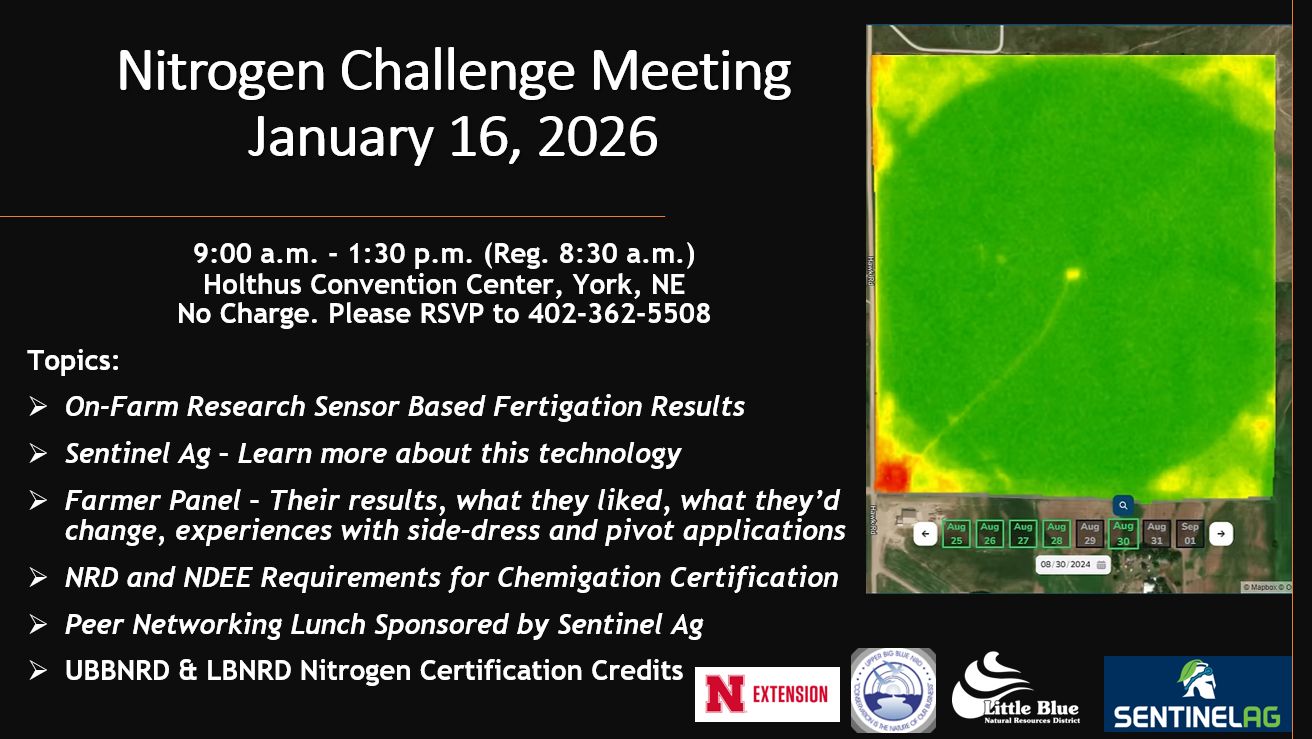
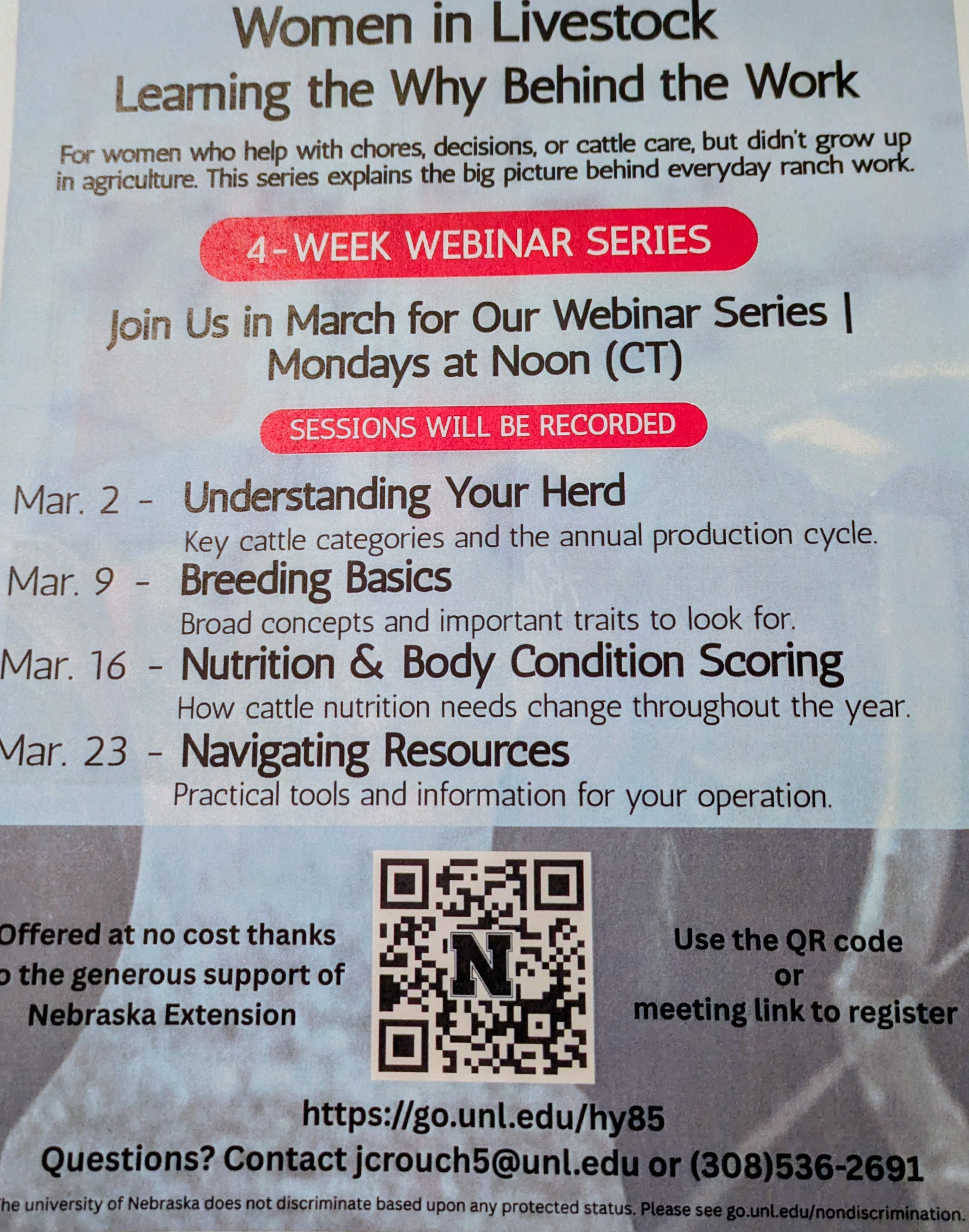
With higher input costs and low commodity prices, I’ve been thinking how to be of help to the farm community I serve during these times. A small group of farmers and I met before Christmas. We talked about the difficulties the farm economy is facing yet also talked about realistic things that can be done to save money right now. One of those is around nitrogen and thus, we planned a Nitrogen Challenge Meeting on Jan. 16th at the Holthus Convention Center in York beginning at 9 a.m. The goals of this meeting are to share the research-based results from using in-season nitrogen management via Sentinel Ag, understand how to use this technology, and share testimonies from growers utilizing this technology. They wanted to create a peer network of famers supporting farmers during the growing season with this technology-so the first step will be a peer networking lunch sponsored by Sentinel Ag. The NRD is providing nitrogen certification credits. There is no charge but please RSVP for the meal count to 402-362-5508 or jrees2@unl.edu.
Why have I stressed nitrogen so much? In the Upper Big Blue NRD newsletter, Terry Julesguard wrote an article about nitrogen in the NRD based on the information provided by the Phase 2 and 3 reports. You can read the full article at: https://www.upperbigblue.org/increased-nitrogen-efficiency-brings-new-questions. In this excerpt Terry shares, “The numbers that stand out are the residual nitrate nitrogen in the soil:
- Corn-on-corn field increases from 33 lbs/A average to 86 lbs/A, an increase of 202%.
- Corn/bean rotation field increases from 32 lbs/A average to 86 lbs/A, a 212% increase.”
I know most farmers are seeking to do their best. The data is showing we’ve increased soil nitrate post-season by over 200%, meaning we’re overapplying N. We talk about the nitrate legacy from past generations, but this is the legacy we’re leaving right now in the soil for our kids and grandkids.
Soil tests in this area of the state from the 2025 season are showing residual soil nitrate is available to reduce the amount of nitrogen applied next growing season. This provides an opportunity to save on nitrogen input costs. No agronomist, including myself, can tell you exactly how much nitrogen you will need because we don’t know the weather/soil conditions for each piece of ground each year. This is why sensing what the plant needs is so powerful using technology like Sentinel Ag.
We have an opportunity to change the nitrogen story now-with us! On-Farm research with Sentinel Ag (2022-2024) in our part of the State showed an average 56 lb N/ac savings without impacting yields, while leaving an average of 5 ppm Nitrate in the top two feet. No other product or practice has proven that in our area of the State via on-farm research. It’s about using technology to manage the nitrogen the plant needs to the best of our ability. Thus, the Nitrogen Challenge in which I’ve asked growers to consider only applying a base rate pre-plant of 50-100 lb N/ac and apply the rest of the nitrogen in-season using a sensor-based technology like Sentinel Ag. Sentinel Ag uses satellite imagery to sense when a corn plant is becoming nitrogen stressed before our eyes can see it. The research was originally developed at UNL and the grad student (Jackson Stansell) then developed a company (Sentinel Ag) around it. Please consider learning more by joining us for the Nitrogen Challenge meeting on Jan. 16th. Farmer testimonials at: https://go.unl.edu/f3si.