Monthly Archives: July 2026
Aug. 2026 Field Days
South Central Ag Lab Field Day will be held on Tuesday, August 11, from 8:45 a.m. to 3:10 p.m. (Registration at 8:30 a.m.) at the SCAL research farm. Through interactive topics, growers will gain insights into practical applications they can consider incorporating into their own operations. Attendees can tailor their schedule by selecting from various presentations and interactive demonstrations. Lunch will be provided, and attendees can earn Continuing Education Units (CCA credits). Preregistration is appreciated by Sunday, Aug. 9, to assist with lunch planning. Visit go.unl.edu/scalfieldday to register and for program details.
Dr. Salvador Ramirez II is the keynote speaker during lunch. He will discuss how soil organic carbon (SOC) in irrigated continuous corn is shaped by how tillage, residue management, and cover crops interact. Stacking conservation practices like no-till, full stover retention, and cover crops enhances SOC compared to conventional systems. Ramirez will provide a first-hand account of what the USDA-ARS is learning in biomass studies and how the practices could look in grower fields.
Timely topics include: Evaluating the Critical Time of Hairy Vetch Termination for Control of Palmer Amaranth in Sorghum and Popcorn; Overlapping Residual Herbicide Program for Control of Palmer Amaranth in Soybean; Updates on Insect Pests in Eastern Nebraska; What’s Below the Surface? Matching Corn Hybrids, Seeding Rates, and Nitrogen for Better Performance; Irrigation Management Strategies; Soybean Disease Management for South Central Nebraska; and Corn Disease Update: Why 2026 is So Different from Last Year?
Soybean Management Field Days will be held Aug. 11, 2026, through Aug. 14, 2026. The educational event continues its long tradition of providing practical information on soybean production, crop management, and marketing while helping growers improve their farming decisions.
Evening meetings will be held Tuesday, Aug. 11, 2026, at the West Central Research, Extension and Education Center (WCREEC), North Platte; Wednesday, Aug. 12, 2026, at the Herbig Brothers farm, Central City; and Thursday, Aug. 13, 2026, at the Mike Gropp farm, Crete. Registration begins at 5:30 p.m., followed by programs from 6–8 p.m.
The final session takes place Friday, Aug. 14, 2026, at the Eastern Nebraska Research, Extension and Education Center (ENREEC), near Mead. Registration begins at 9:30 a.m., with the program running from 10 a.m. to 2 p.m.
Topics throughout the week include weed control, irrigation, fertility, insect and disease management, iron chlorosis, soybean gall midge research, and financial management. Attendees can also meet representatives from the Nebraska Soybean Board and the Nebraska Soybean Association.
The events are free to attend with support from NSB. Organizers ask participants to pre-register at least two days before each field day using the online registration form or by calling 402-624-8030. Additional info. on the SMFD homepage (go.unl.edu/soydays).
Japanese Beetle and Food Safety Update
Japanese Beetle Control: This week I had an increasing number of calls about Japanese beetles. In crops, watch silk clipping in corn. Tasseled corn threshold: three or more Japanese beetles per ear, silks have been clipped to less than ½ inch, and pollination is less than 50% complete. Soybean threshold is 20% defoliation once flowering occurs. It’s been interesting seeing beetles defoliating palmer, waterhemp, smartweed, etc. Too bad we couldn’t train them to just eat the weeds!
For homeowners, it’s best to avoid the beetle traps as they actually attract beetles to your location. There’s a number of organic and conventional control products sold in local farm stores, lawn/garden centers, Wal-Mart, and Ace locally.
First, Please Read the Label on any product before you purchase it to make sure:
1: the product says it controls Japanese beetle adults
2: the product is labeled for where you wish to apply it (vegetables, trees, ornamentals, fruit trees, berries, etc.). For example, there are two types of “Sevin” with different active ingredients. One says you can apply it to Virginia creeper and Boston ivy and the other does not. Because of this, using the wrong insecticide has caused damage and even death to plants when they weren’t labeled. Also, applying an insecticide to vegetables when it’s not labeled for vegetables can result in you not being able to safely eat produce from your garden.
3: follow all pre-harvest intervals (PHI) for when you can safely harvest vegetables, fruits, and berries after a product is applied.
4: seek to apply pesticides when there’s lower risk to pollinators such as
I reposted the blog that I wrote a few years ago regarding the local products I found that help with Japanese beetle control. It’s not an exclusive list, but hopefully it’s a start to help. It can be found at: https://jenreesources.com/2022/07/05/japanese-beetle-organic-and-conventional-products-found-locally/. Know that many products applied to flowering plants to kill Japanese beetles can also impact pollinators. Beetles are also effectively controlled by knocking them off into buckets of soapy water, particularly around dusk or dawn.
Even after applying pesticides, beetles will continue to emerge and fly in from grassy areas (ditches, lawns, pastures) for a good 4-10 weeks. Plants that are being chewed on elicit responses signifying they’re in trouble. It’s those responses that signal other beetles to come. Even though linden, fruit, and other trees and plants are rapidly defoliated, they should not die.
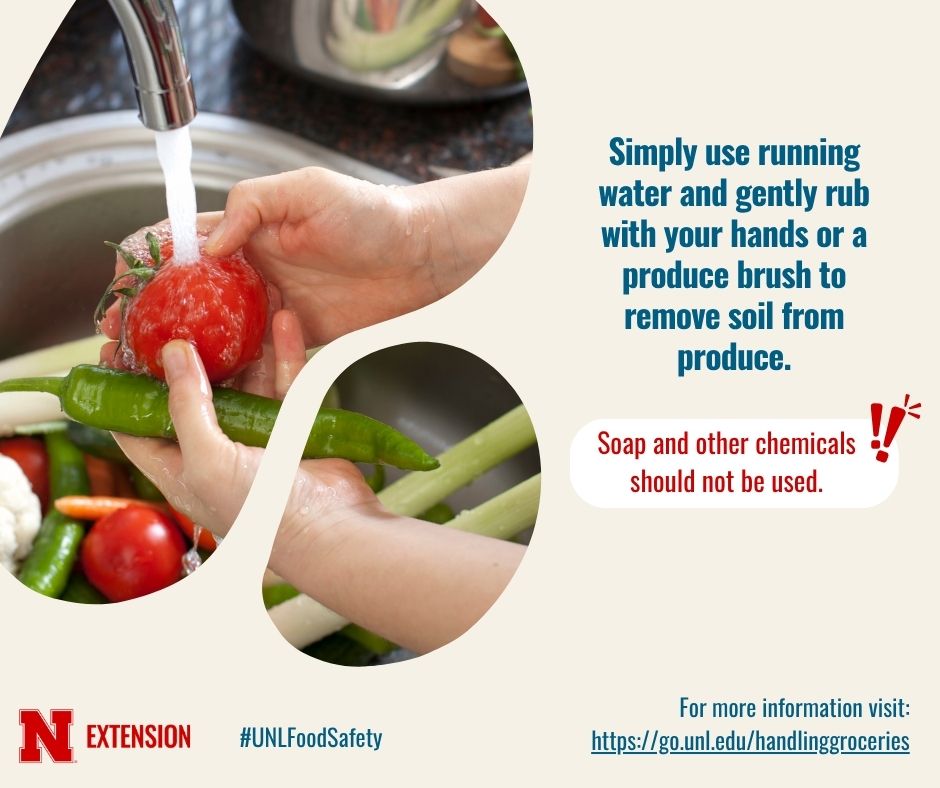
Safe Handling of Produce: This is from our UNL food safety team, “While concerns about contamination are understandable, we shouldn’t let fear keep fresh produce off our plates. Fruits and vegetables are vital to a healthy daily diet; instead of avoiding them, we simply need to practice safe handling and proper washing. Fresh produce may become contaminated with dirt and bacteria at any point during its journey from farm to table. Washing produce before preparing and eating can remove bacteria that may cause foodborne illness. Simply use running water and gently rub with your hands or a produce brush to remove soil from produce. Using soap, bleach and other non-food grade chemicals may make you sick and is NOT recommended. For more information: https://go.unl.edu/handlinggroceries.
National Meeting Reflections
I was gone a few days last week serving as the National North Central Vice Chair for Agronomy at our National Association of County Agricultural Agents conference. It is always an uplifting time to interact with colleagues throughout the U.S. and to reflect on “my why” for being in Extension.
Often it was reiterated the importance of 4-H and FFA in shaping the future agriculture workforce. It was emphasized by USDA and Industry speakers in addition to the keynote speaker Temple Grandin that we need to be intentional in providing youth opportunities and be thinking about where that could lead in 10 years when they leave for college. I think about how 4-H was such an important part of my life. It was through 4-H that I learned the importance of public speaking, leadership, healthy competition, and plant ID skills. I desire to instill that love of plants and science into youth as well! It would be good to consider ways to partner with others in agriculture to speak into youth.
Artificial Intelligence was a topic of conversation from the USDA and Industry speakers. We also discussed dealing with unintended consequences of AI. The reality of a wrong answer being provided by AI and Chat GPT is real and I saw that first-hand with wrong herbicide applications this year to non-liberty tolerant corn. Companies are racing to train their own AI tools using data and technical sheets with the power of google in the background. While I consider myself fairly innovative in the things I try, I’ve been much more hesitant to jump on the AI bandwagon, even though I recognize there are many positive tools to help. My concern is the need to balance information from a tool with still talking with people to fact-check. Yet, we were also challenged that if our research-based information is not showing up when people query AI, then we’re not making our information known in a world that is constantly adapting to technology.
Dr. Temple Grandin is a distinguished professor of animal science at CSU and a highly functioning autistic. She shared the importance of visual, mathematical, and verbal thinkers and how we need all of them. She also shared that we need to provide youth opportunities for different experiences so they can better explore their interests. If it wasn’t for her aunt having a farm and Temple spending some summers on it, Temple wouldn’t have learned an appreciation for livestock and most likely wouldn’t have pursued a career in animal science. She shared there was scene in the HBO movie made about her life that is the most powerful scene to her. It’s when she walked up to the man and handed him her business card asking if she could write for his publication. She shared how that launched her career in allowing her to share about animal behavior and livestock facility design. It allowed her to begin building credibility and respect.
I was reflecting on that too in how blessed I’ve been that 22 years ago, a few area newspaper editors allowed me to write a weekly column for them. They gave me a chance to share what I was seeing in the fields and in providing timely agricultural and horticultural information. I am grateful to those editors for that opportunity! And, I’m grateful to those of you who read this column. It’s something that I find so humbling….when there’s so much information available to people to choose from, there’s still people who will take the time to read what I write. That gets back to “my why”. I joined Extension to serve people…to help people everyday to the best of my ability. It can definitely be challenging with the assortment of calls received and in being spread so thin, like many are. Since March, beyond the normal assortment of questions, I’ve received questions about planting cover crops for forage in wildfire and hail damaged areas, questions about decisions after hail, and field visits for three weeks on herbicide damage complaints. I’m grateful people utilize Extension with their questions and also don’t take that for granted. It does take a lot out of a person and it was good to get away for a few days just to be encouraged to keep going in serving people. Ultimately, at a time when University and Extension budgets are challenged, I just wanted to thank those of you who find value in and support Extension.
Considerations at Tasseling
Happy 250th Birthday America!!! Grateful for the wisdom and vision of our forefathers. We are truly blessed! May we reflect on our blessings and remember that freedom isn’t free!
With tasseling beginning or nearing for most fields in the area, sharing a few reminders of questions I typically receive. Some of you saw uneven corn emergence, thus plant stages vary in some fields. Pay attention to fungicides/insecticide pesticide labels regarding adjuvants/surfactants that can be used and their timing to avoid any potential crop injury. Not all plants in a field may be at tassel, thus waiting till brown silk/milk if no disease/insects are present can help the later plants be at tassel while also potentially reducing the chances of needing another fungicide app.
Fertigating during pollination: I’m sharing this based on what we knew from previous corn genetics, but I’m unsure if pollen shed from weaker tassels in some of today’s hybrids may be impacted by any products applied during pollination. With that note, we have said fertigation during pollination is ok and generally should be still. Dr. Tom Hoegemeyer had shared that pollination mostly occurs between 8:30 a.m. and noon. Heat kills pollen when the temperature is 90°F to 95°F and is seldom viable past 2 p.m. That leaves lots of time to run pivots, apply N, etc. when it won’t harm pollination. The UNL recommendation for fertigation is to use 30 lb of N with 0.25″ of water or 50-60 lb of N with 0.50″ of water. With a high capacity pump, you can apply up to 60 lb of N in 0.25” of water.
Western Bean Cutworm: It’s been time to be scouting corn for western bean cutworms. When scouting, we typically find western bean cutworm egg masses on upper leaf surfaces of corn leaves with masses containing 50-85 eggs. Normally we’re taught to look at the upper portion of the plants closer to the tassels, but with silks emerging prior to tassels most of the time, I tend to also find masses on leaves around the ear leaf and sometimes directly on the husks (especially during periods of high heat). Egg masses are white and raised when newly hatched; they turn a purplish color when they’re getting closer to hatching. Links to light trap data are below:
- West Central Research and Extension Center, North Platte
- South Central Agricultural Lab, Clay Center
- Eastern Nebraska Research and Extension Center, Mead
Japanese Beetles in crop fields: Adults emerge from grassy areas (lawns, pastures, road-side ditches for at least 4-6 weeks (up to 10). Even if you treat, they can come back. Threshold is 30% defoliation on vegetative corn. Upon silking, the threshold is 3 or more beetles/ear with silks clipped to less than ½ inch and pollination is less than 50% complete. Soybean threshold is 20% defoliation at reproductive stages; sometimes defoliation looks bad but regrows quickly even when not using an insecticide. Usually the beetles congregate in borders first or areas in the field and not whole fields. Some consider a border app. Spidermites can also be flared upon insecticide applications.
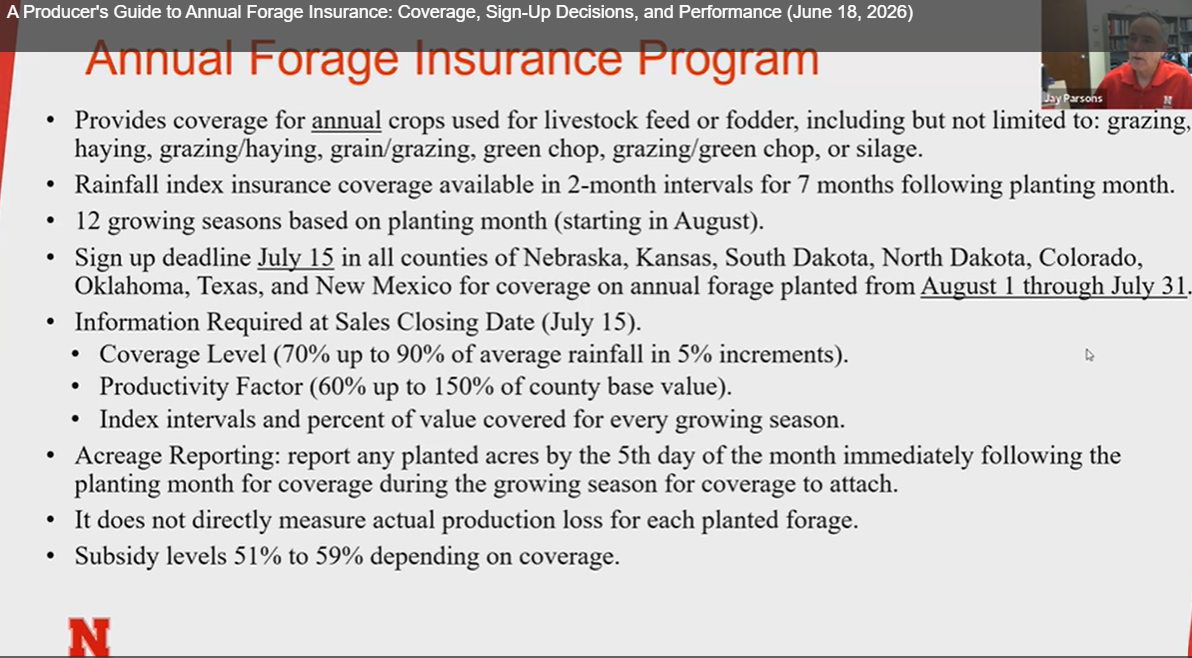
Annual Forage Insurance is a precipitation risk management tool available for annual forages planted on cropland with intended use as livestock feed or fodder. With so many impacted by drought, wildfires, and now hail, wanted to share on this opportunity. The insurance is available in all counties of Nebraska. It is a rainfall index product much like the popular Pasture, Rangeland, Forage (PRF) insurance. The sign-up period for annual forages planted from August 1, 2026 through July 31, 2027 is currently open until July 15, 2026. A recent webinar discussing this opportunity can be found here: https://cap.unl.edu/annual-forage-insurance-webinar-2026/.
| Extension Job Opportunities Do you enjoy helping people, learning, teaching, being objective, and enjoy each day not being the same? If so, Extension may be a great career opportunity for you! We’re seeking team members for Platte County and Adams County. Applications can still be submitted after the deadline (case of Adams Co.) as the search committees can continue to review applications until the position is filled. Platte Co: https://employment.unl.edu/postings/100978 Adams Co: https://employment.unl.edu/postings/100656 Minimum Requirements: Master’s degree in agronomy, crop science, plant sciences, or a closely related field (extension educator) OR bachelor’s degree in agronomy, crop science, plant sciences, or a closely related field (extension instructor). If hired as an instructor, the incumbent will be expected to make satisfactory progress toward and complete a master’s degree within the initial five-year appointment period. Demonstrated knowledge of production agriculture, cropping systems, water management and irrigation, agronomics, precision/digital agriculture, and/or agricultural sustainability. Strong teaching, communication, and relationship-building skills, with the ability to translate research-based information into practical educational programming for diverse audiences in formal and/or non-formal educational settings. Demonstrated ability to develop and deliver educational programs, outreach activities, applied training programs, and educational content through presentations, publications, digital resources, web-based platforms, and/or social media. Ability to work collaboratively with producers, Extension specialists, industry partners, community stakeholders, and multidisciplinary teams. |


