Monthly Archives: June 2026
Hail Damage Father’s Day Weekend 2026
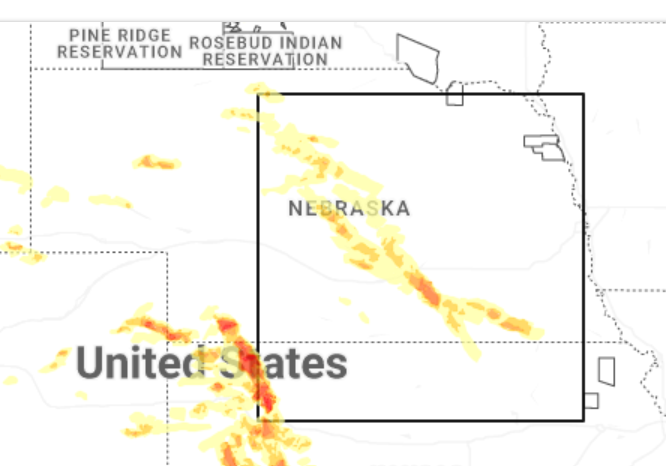
Been praying for those impacted by this weekend’s storms and my heart has been heavy for you all. It is so hard to see beautiful crops destroyed so quickly, especially right now with sidedressing, cultivating, and post-season herbicide apps applied. It’s also difficult to see the damage to homes, buildings, bins, pivots, vehicles, and livestock. I haven’t personally seen the damage yet, so am sharing some experiences and things to look for based on the photos some have shared with me. This is a longer article, but sharing what I’ve learned from earlier season hail storms in 2022-2024. This week’s cooler weather could slow any plant recovery, but that will be something to watch for until insurance adjusters can come and assess crops.
Helpful Resources
- HailKnow Website (has 6 sections including assessing damage): https://cropwatch.unl.edu/hailknow
- Webpage: https://cropwatch.unl.edu/hail-know/assess-my-damage
- Infographic: https://cropwatch.unl.edu/Hail/Images/HailKnow-Damage-Assessment.png
- Assessment Video: https://cropwatch.unl.edu/hail-know/video-hail-damage-assessment
- Corn GDD Tool: https://mrcc.purdue.edu/tools/corngdd
- Bean Cam Replant App: https://ipcm.wisc.edu/apps/beancam/
What to Do Now
- Look at fields to see damage extent. Know what growth stage the field was in at time of the storm.
- Call crop insurance.
- Call an agronomist or review resources to anticipate what to look for in plant recovery.
- Flag plants in the field to assess recovery. This greatly aids in learning and has helped me tremendously! Taking a picture now and a week later of the same plants also helps.
- Hand plant some soybeans in the ground in the next few days at depths from 0.5-2″ to assess how they react to herbicides in corn fields.
- Consider options on what to do if the crop is totaled or not including herbicides applied, crop rotation restrictions, marketing and crop insurance, weed control going forward, etc.
Assessing Damage to Corn
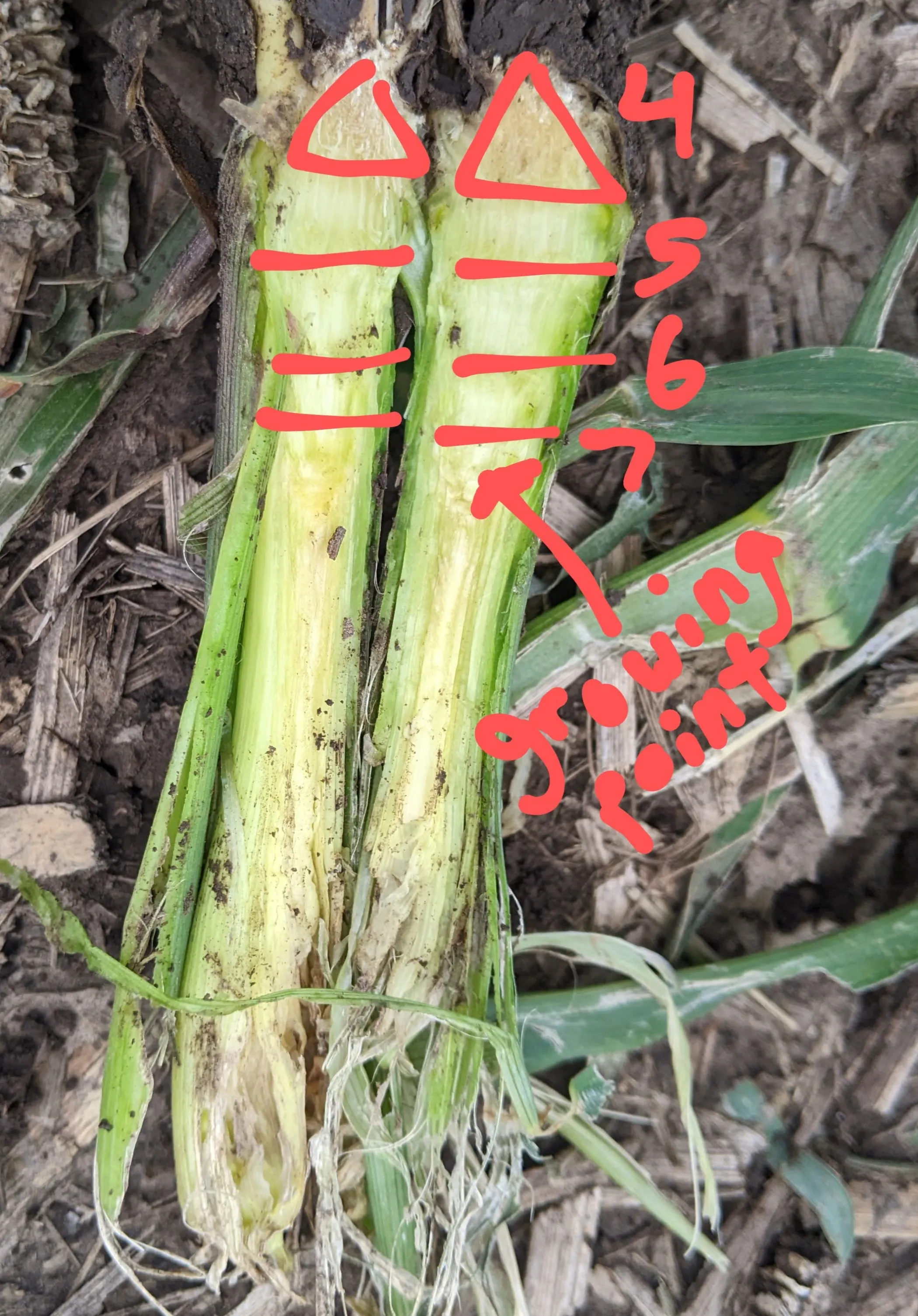
Hearing a range of damage from plants that are stubs to broken off plants. The growth stage of the plant will be key in these decisions in addition to the amount of damage to the crops. It’s important to know the growth stage at the time of the storm. You may have an idea on the growth stage from crop scouting reports. You can also do this yourself by finding the tallest plant standing in an area and dig it up (if available). What I describe here is the agronomic method of counting collars and nodes which is different from the leaf method that crop insurance will use. Slice open the plant to view the growing point. Every leaf on a corn plant is attached to a node. There’s 4 nodes where the first 4 leaves attach in a triangle at the base of the plant. Then there’s a small gap and you will see a line that marks node 5 followed by a larger gap and a line that marks node 6. Because of the cooler soil temps this year, I’m finding smaller gaps between nodes 4 to 5 (nodes are closer together than the photo below). Pulling collard leaves back, they will snap off at whichever nodes they are attached to (which can help you in determining the more advanced growth stages from 6 to 8 leaves). The growing point doesn’t come above ground till typically V5-V6. Corn in the area is mostly past this stage at the V8-11 stages.
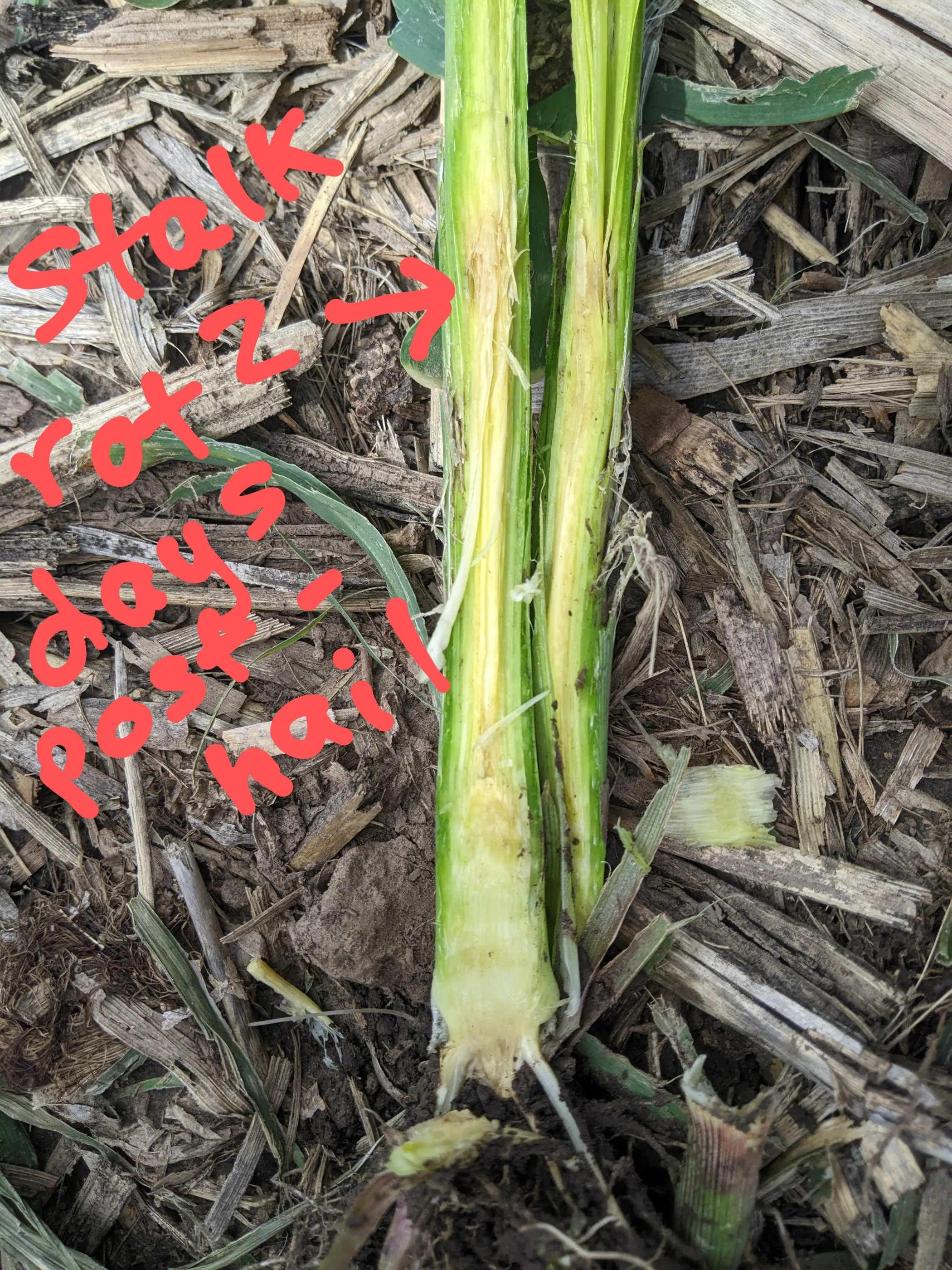
Next take stand assessments by counting 1/1000th of an acre. I actually feel corn plants at the base as I count to see if they feel firm (likely to survive) or mushy (not likely) and only count plants which appear most likely to survive. I also keep track of which ones are questionable. It will also be important to look for plants that have bacterial top rot set in. In the past, we’ve had to talk with crop insurance adjusters to not count those plants; many adjusters are more aware of this, but sharing so you can have that discussion if needed.
From the 2022 and 2023 hailstorms, we were using a factor of 10 bushels/ac for each plant that we felt would survive. Depending on the situation, we were often keeping stands of 15-20 plants (15,000-20,000 plants/ac even in irrigated fields). I know in the end, some wished they would’ve replanted and others were pleasantly surprised with the yields. Honestly, harvest was sickening in many fields with the amount of palmer present. Weed control is the most difficult and a layby of a residual herbicide using drops could be helpful, depending on residual load already in the field. We also had some growers interseed cover crops like brassicas and annual ryegrass to help keep weeds down. It does provide a different look than most want, but it kept weeds down and produced some nice forage (again depending on herbicides). That is a discussion with crop insurance but interseeding is allowed in the RCIS rules and can help with uptaking excess nitrate and with weed control.
Regarding fungicides, we don’t recommend them from the standpoint that hail doesn’t create fungal diseases. At some point, they could be helpful to aid in stalk strength. However, if you’re considering this in the next few weeks, consider proving it to yourselves with on-farm research this year so we do have data for the future. All you do is spray fungicide in enough width so two 2 combine passes can be obtained. Then skip an area for at least 2 combine passes. Then treat again and repeat across the field. Fungicide Protocol for Hailed Corn and Soybean. Please let your local Extension educator know if you’re interested in this!
Timing of fungicide app: ISU did a study to simulate hail damaged corn at tassel stage within an average of 3 or 8 days post-hail. They didn’t find the timing to provide any yield effects. They also didn’t find a statistical yield increase (90% confidence level) in fungicide application to hail damaged plants vs those which weren’t hailed although they also reported a numerical increase in 12 of the 20 fields. They also interestingly found that hail damaged crops had less foliar disease than non-hail damaged crops in their 3 year simulated hail-damage study.
Replanting Corn
For those who end up with totaled fields and need to replant corn back to corn based on herbicide restrictions and/or contracts, I’ve put together a chart for Clay Center data using the GDD tool developed for the MidWest as a partnership through several Universities. This tool can be found at: https://mrcc.purdue.edu/tools/corngdd and can be used with weather station data closest to any of you reading this. Just select your area, alter the Planting Date, Relative Maturity, and look where the full black layer line occurs compared to the average 30 year frost line.
Achieving 150-200+ bu/ac replant corn is possible with these shorter-season hybrids. Things to be aware of: Replant corn will struggle with late-season insects and disease. We saw earworms severely damage replant corn in 2022 and the damage resulted in increased ear molds, particularly fusarium. Be aware of this for any food grade corn that you have on contract to reduce potential problems with mycotoxins like vomitoxin. We also had early frost in 2022, so much of the corn did not achieve black layer prior to frost (was anywhere from 1/4-3/4 starch line). Anticipating this, I drove a route prior to frost to document where the starch line was in plants and documented what happened in the coming weeks. The plants will prematurely form the black layer. We’re often told that premature black layer formation would impact test weight of the kernels. I also did an informal, anonymous survey where growers shared where their corn was at the time of frost and what their moisture and test weight was at harvest. Surprisingly, test weights were mostly above 52# at moisture from 17-22% that had been 1/2 starch or beyond at the time of frost. When dried down to 15.5%, test weights ranged from 55-58#. Food grade white corn that was beginning dent to 1/4 starch at time of frost was the most affected with test weights at 45-52#. I didn’t hear of any Coops not honoring the contracts because of this, but am unsure of dockage for individual situations. I’m not saying what was found for us regarding test weight will always be the case, but it’s good information to know what was experienced in our situation with more recent hybrids. Replant corn for high moisture corn or silage for livestock feed is also an option.
| Clay Center, Ne Data Avg. 28F frost Oct. 24 | Relative Maturity | 75 | 80 | 85 | 90 | 95 |
| Planting Date | GDD to R6 | 960 | 1917 | 2038 | 2159 | 2280 |
| June 28 | Sept. 18 | Sept. 27 | Oct. 7 | Oct. 20 | ***Nov. 12 | |
| July 1 | Sept. 23 | Oct. 3 | Oct. 14 | ***Oct. 31 | *** | |
| July 5 | Sept. 30 | Oct. 11 | Oct. 26 | ***Dec. 1 | *** | |
| July 10 | Oct. 11 | ***Oct. 26 | ***Dec. 1 | *** | *** | |
| ***Date is beyond average 28F frost event of Oct. 24. |
***indicates the black layer date is beyond the average 28F average first frost of October 24.
Data from Corn GDD Tool: https://mrcc.purdue.edu/tools/corngdd
Assessing Soybean
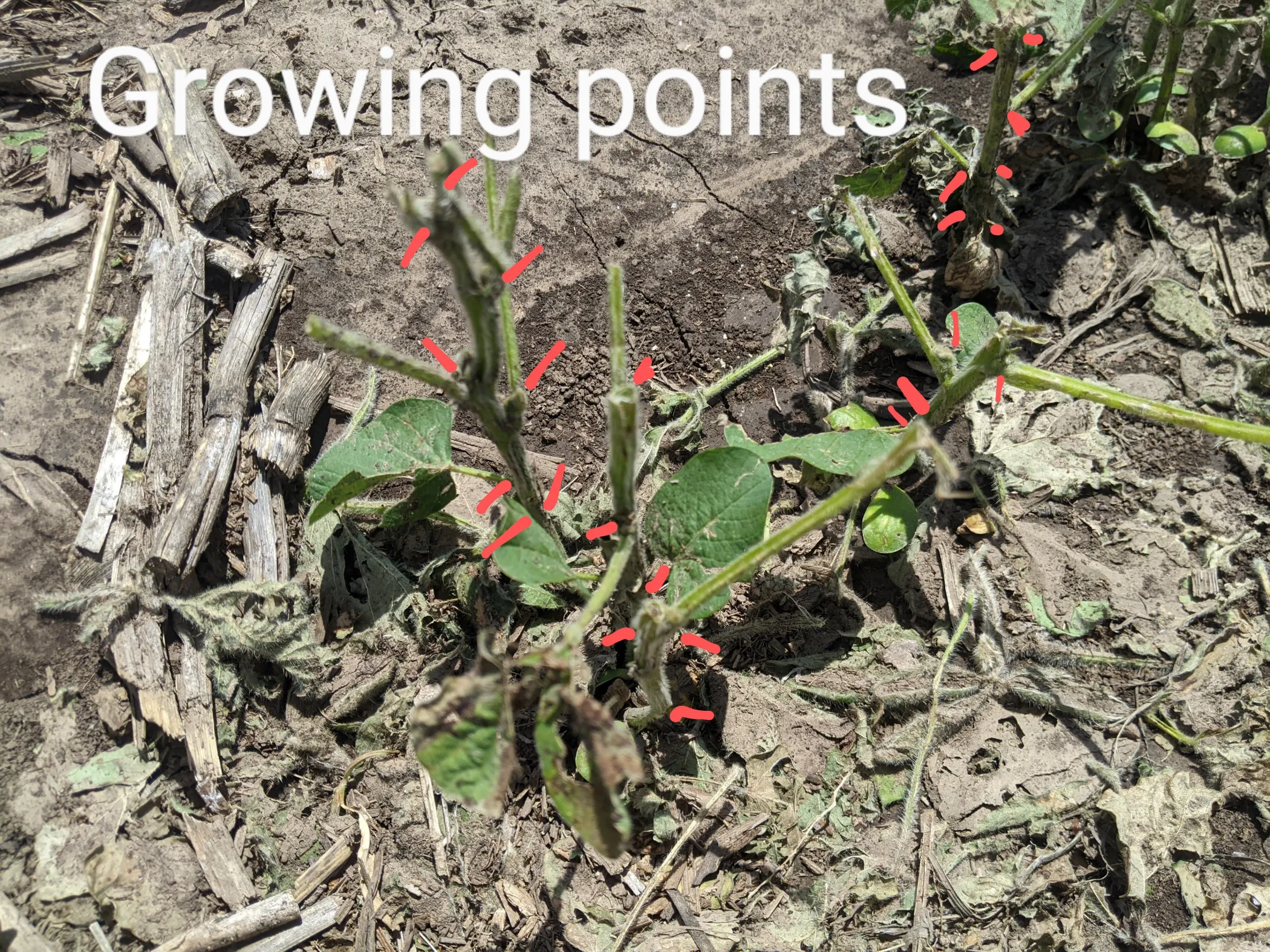
Soybeans were in the late vegetative to early reproductive stages with today being the longest day of the year. I know people want to write them off now, but it’s incredible what they will do with some sunshine and 7-10 days. Soybean is incredibly resilient because there’s multiple growing points available on the plants (depending on the height and the damage to the outside of the stems). Each field is a field by field assessment, though. UNL and University of Wisconsin recommend leaving stands of 50,000 plants/ac. The bigger issue is weed control. Check out this cool app from University of Wisconsin on replanting bean decisions: Bean Cam Soybean Replant App.
Replanting Soybean
If changing from corn to soybean in the replant decision, maybe it’d be wise to poke some soybeans in the ground now just to see how they fare with the herbicide that’s been applied? And maybe you try poking them in at different depths? We normally recommend planting 1.75-2″ based on UNL research, but when we’ve replanted after hail, we’ve typically recommended to plant around 1″ to hopefully be above any herbicide band that moved into the soil (if planting into a corn field) and to hopefully get the beans out of the ground quicker.
The following article shares considerations for soybean when planting mid-June or after: https://go.unl.edu/20ry. In summary of it, for maturities, UNL recommends to stick with as similar maturity as possible till around June 15 and then consider switching to 0.5-1.0 maturity group less. Different thoughts on row spacing. Drilling or 15″ can close canopy sooner but the tradeoff can be potential for white mold if you have a history of that disease. 30″ also allows for cultivation for weed control with application date restrictions on certain herbicide-tolerant bean traits. Wider rows should hopefully close canopy unless the beans get hit with off-target herbicide. Seeding rates are also debated. Many sources recommend to increase them by 10% (up to 20% if drilling) after early June if normally seeding 140K or less (Iowa State didn’t find a yield benefit to increasing seeding rates if seeding more than that in late June). Also, a fungicide seed treatment can be helpful when replanting soybean as phytophthora in particular tends to show up, regardless if you’re planting into a corn stand or a bean stand. If you’re debating whether or not to replant into an existing soybean stand, you could also consider replanting some areas at an angle and leaving some areas as an on-farm research study. Please reach out to your local Extension educator if you’re interested in this.
Other Options
Should any fields be totaled, some may be interested in planting cover crops for grazing or just weed/erosion control in them. Looking at the herbicide labels and also the Weed Guide for rotation restrictions can help with making planting decisions for different species. Planting a cover crop in spite of that restriction is the risk the producer takes as to if the seed will germinate and survive or not. We’ve learned a lot regarding herbicides and tolerance to cover crops after working with growers with interseeding research and after numerous hail storms. We often recommend utilizing mixes to allow for diversity and aid in something growing. Regarding grazing restrictions, the herbicide grazing restriction technically stays with the crop it was applied to…so any corn or soybean plants/residue would have the grazing restriction. It’s important to be aware of these restrictions before considering seeding an annual forage crop to ensure you’re not grazing a field off-label. Warm season cover crop species and/or mixes can be used this time of year. For crop producers who are not familiar/comfortable with livestock, I’ve tended to recommend pearl millet because it doesn’t have the prussic acid risk with frosts like sorghum species due. However, there’s now prussic acid free sorghum sudangrass hybrids that can be purchased that doesn’t carry that risk during frost. There are a number of warm season cover crop mixes available from cover crop dealers depending on your specific goals and needs.
I truly wish everyone the best with decisions. This amount of loss takes a huge toll. Each situation is unique in damages received, crop insurance taken, amount of grain forward contracted, and other life things occurring. What I know for me is that my faith in God, my belief that He is in control, and His continued faithfulness to me is what has sustained me. Tears can be healing. Just would encourage you to also find a healthy way to take care of yourself such as talking to a trusted friend, prayer, journaling, exercise, or participating in a hobby. Wishing you all the best as you assess damage and make decisions for the remainder of the growing season.
Wellbeing Tips:
(Adapted from: Gilbert Parra, PhD; Holly Hatton-Bowers, PhD, and Carrie Gottschalk, LMHP, MS)
How Much Time do You Have?
2 Minutes:
- Breathe
- Stretch
- Laugh
- Doodle
- Acknowledge one of your accomplishments
- Say no to a new responsibility
- Look out the window
- (adapted) Faith based prayer
5 Minutes:
- Listen to music
- Have a cleansing cry
- Chat with a co-worker, friend, or family member
- Sing out loud
- Jot down dreams
- Step outside for fresh air
- Go for a brief walk
- Enjoy a snack or make a cup of coffee/tea
- (adapted) Read faith-based devotional
10 Minutes:
- Evaluate your day, Write in a journal
- Call a friend
- (adapted) Meditate, Prayer, Devotional
- Tidy your work area
- Assess your self-care
- Draw a picture
- Listen to soothing sounds/music
- Read a magazine
Additional References to Previous Articles with Photos
Early Season Tar Spot 2026
Tar spot of corn was found in several Nebraska counties this past week. You can see the full map at: https://cropprotectionnetwork.org/maps/tar-spot-of-corn. Samples can be sent in to the UNL Plant and Pest Diagnostic Lab if you’re unsure and want to confirm. So far we’re only seeing it at low incidence of a few lesions on plants.
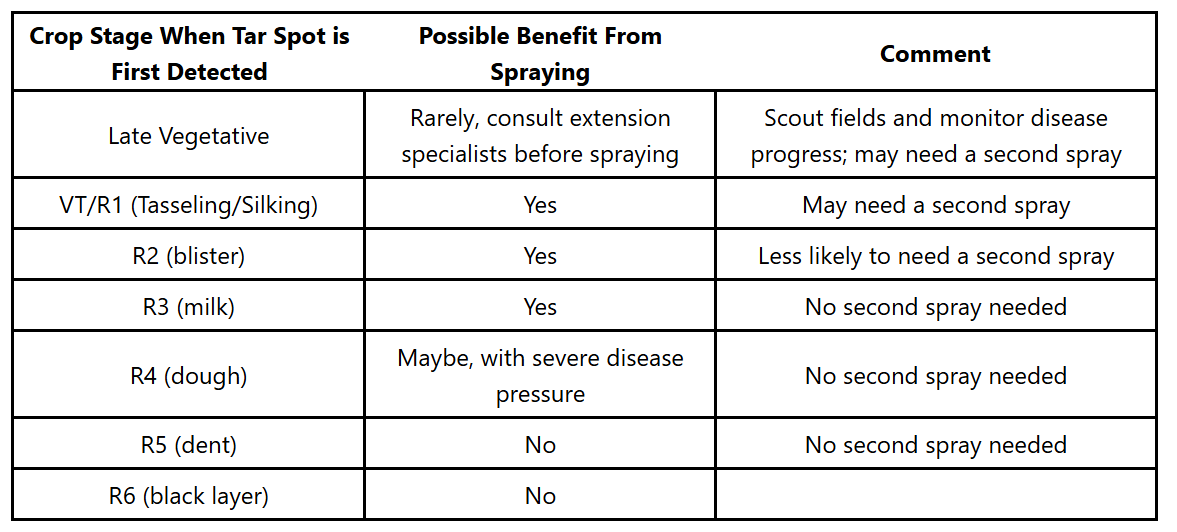
In this week’s UNL CropWatch, our Extension Plant Pathologists shared, “We do not recommend fungicide treatment at these early stages. Results from multi-state fungicide trials summarized on the Crop Protection Network show that treatment during the vegetative stages — V6 through V11 — was not economical even though disease had already begun.
Fungicide applications made between VT–R1 through R3 (milk) or occasionally early R4 (dough) stages were the most effective at controlling tar spot and had the best chance of generating a favorable net return. In those experiments, fungicide applications made to corn before tar spot severity exceeded 5% on the ear leaf by early R4 were still economical. Applications made after disease on the ear leaf exceeded 6% at application were not economical. Additionally, products with a mixture of active ingredients from two or more fungicide classes were most effective.”
You can see a photo of what 5-7% disease severity looks like at https://jenreesources.com/wp-content/uploads/2025/06/when-to-spray.png. There’s also a yield/price/fungicide risk assessment tool that allows you to compare the ROI of a fungicide application: https://connect.doit.wisc.edu/cpn-roi-tools/.
Considerations for now:
1-Scout fields and wait till a 5% threshold on leaves before applying fungicide
2-Observe fields as to which hybrids have more tolerance to tar spot
3-When irrigating, consider less frequent and deeper irrigations, https://go.unl.edu/vipj
4-Consider plant nutrition instead. I will focus on a series of plant nutrition articles in the coming weeks. Please contact me in the meantime if you’re interested in knowing more about this option.
The fungus that causes tar spot prefers temperatures in the 60-70F range, leaf wetness of at least 7 hours, and relative humidity above 75%. That’s why we can see it early in the growing season and then again later in the growing season. We will continue to see this favorable environment for the coming week. Once the environment (especially higher temperatures) is no longer favorable, the fungus isn’t able to grow and reproduce and that’s why we didn’t see lesion development throughout the summer in 2025. Susceptible host, pathogen able to infect, and the correct environment all have to come together at the same time for disease development.
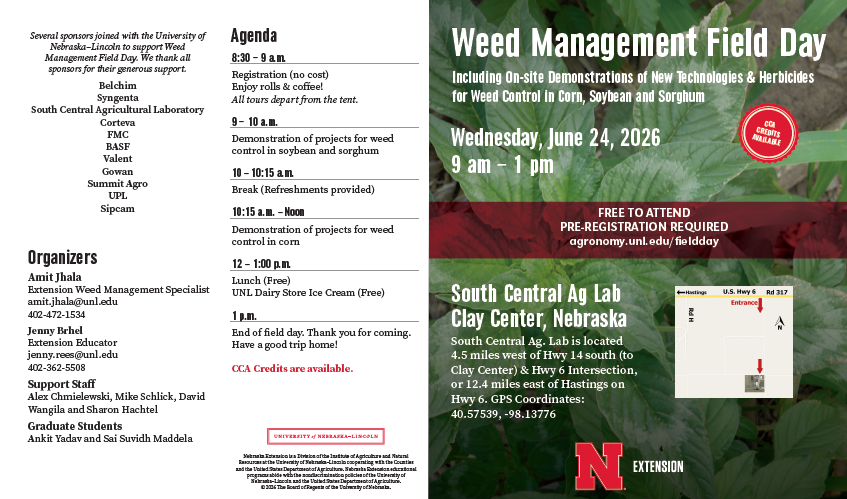
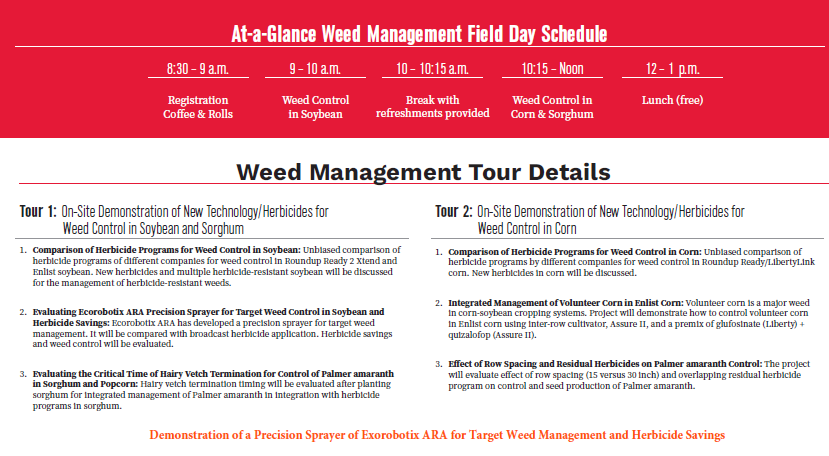
SCAL Weed Science Field Day: Just a reminder of the Weed Science Field Day at SCAL near Clay Center on June 24. Attendees will see weed control options for corn, soybean, and sorghum with chemical and cover crop tools. The Ecorobotix machine will be showcased as another precision spraying tool. No charge, walk-ins are welcome, but RSVP is preferred for meal count to: https://agronomy.unl.edu/fieldday.


Farm and Ranch Transition Workshop
Farm transition, succession, and estate planning are some of the most important topics I feel we face in agriculture, yet they are too often not prioritized. Life is so short and there’s no guarantee of tomorrow.
Communication is one of the most important first steps in this process, but sometimes we all need a little help in how to communicate with family members and what topics to communicate about.
An upcoming program called “Returning to the Farm or Ranch” is scheduled from 8 a.m. to 5 p.m. June 26 at the Extension office in Lincoln, 444 Cherrycreek Road. Participants will hear from agricultural law, tax and financial professionals, while also engaging in activities focused on communication, goal setting and long-term planning. The event is part of ongoing efforts by the Center for Agricultural Profitability and the Nebraska Land Link program to support agricultural producers, landowners and beginning farmers across Nebraska.
“Transition planning in agriculture often involves more than legal documents and financial decisions,” Anastasia Meyer, Extension Ag Economist said. “It also requires families to communicate openly about goals, expectations and the future of the operation. This workshop will provide practical guidance for those beginning the process, as well as those looking to strengthen an existing plan.”
Topics will include: Estate and transition planning; Family communication strategies; Goal setting for the operation and family; Building a professional transition team; Financial and legal considerations; and Identifying next steps for succession planning.
Returning to the Farm or Ranch is intended for farm and ranch families at all stages of the transition process, including operations without a formal succession plan already in place. Families are encouraged to bring all relevant stakeholders to the workshop. The registration fee is $85 per person if pre-registered, or $100 at the door. Lunch will be provided. Registration is open through June 26 at: https://forms.cloud.microsoft/Pages/ResponsePage.aspx?id=xAPQGhOJLkyxIGKu-ItszXfqsJvZFaJJsPVUUVntov5UMlFWV0ZRTU05TTBRUEMxMkpLSEVIRFBOSS4u.
Introductory Farm/Ranch Transition Workshops:
Prior to Returning to the Farm or Ranch on June 26, families are encouraged to attend Getting Started with Estate and Succession Planning, a one-hour pre-workshop designed to help agricultural families better understand the estate and succession planning process and navigate conversations around the future of their operation. There is no additional cost to attend the one-hour workshops and they are open to anyone, regardless of whether you plan to attend the full-day program on June 26.
The free introductory Getting Started with Estate and Succession Planning workshop will be offered online and in-person in Lincoln on two different dates, with registration required:
- Virtual Workshop: Getting Started with Estate and Succession Planning, Wed., June 17, 12:30-1:30 p.m. Central Time. Register for the virtual workshop.
- In-Person Workshop: Getting Started with Estate and Succession Planning, Thurs., June 25, 5:30-6:30 p.m. Central Time at the Extension office in Lancaster County, 444 Cherrycreek Road, in Lincoln. Register for the in-person workshop.

Water Quality Impacts Pesticide Performance
Grateful for the rain! With the anticipation of many post-herbicide applications occurring this week, just a reminder to make sure you know the specific herbicide traits each field has to avoid incorrect products applied and potential crop damage. The remainder of this column will be about the importance of water quality in pesticide applications, but is a brief overview. Additional resources are mentioned at the end. Water quality including pH, hardness, bicarbonate, and turbidity can make a difference on the efficacy of the pesticide. One always needs to read the pesticide label to determine what pH is best for the spray solution and also any other factors it mentions about water quality for the most effective pesticide application.
For example, do you check the pH of the final pesticide solution before it gets sprayed on the field? As a quick reminder, a pH of 7.0 is neutral. Above that is alkaline (basic) and less than 7.0 is acidic. Many of us have well water that is more alkaline. For example, my well water has a pH of 8.0. In general, herbicides, insecticides, and fungicides perform best in slightly acidic water (if the label doesn’t mention a specific pH assume between a pH of 5.5-6.5). Many herbicides are formulated as weak acids. Reading the pesticide label is important, though, because some pesticides like sulfonyurea herbicides and copper fungicides need slightly alkaline solutions.
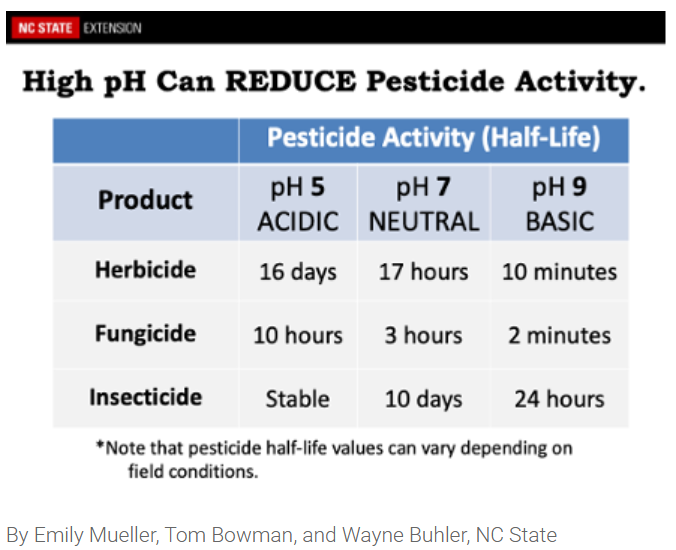
Why is the pH important? The pH of the pesticide solution can impact the product performance including rapidly reducing the pesticide half-life. The half-life of a pesticide is the time it takes for that product’s active ingredient to degrade 50% in the environment. For example, a herbicide’s half life can go from just 10 minutes in a pH solution of 9.0 to 16 days at a pH solution of a 5.0. That’s one of the reasons why one should check the pH of the water using a pH meter before a buffering agent and any pesticide is added to the tank. It’s good to test the pH as various products are added to the tank and before the final solution is sprayed onto the field.
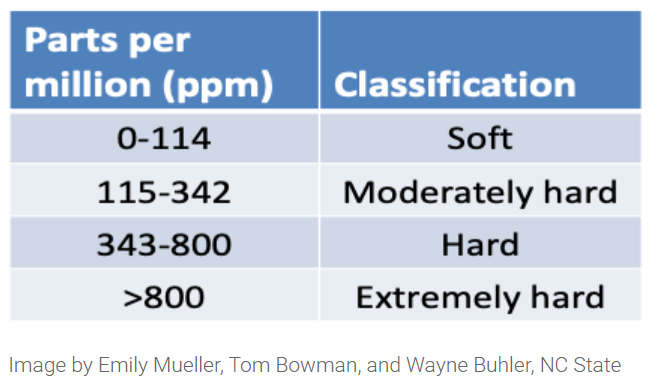
Water hardness can also impact pesticide performance by creating a poor mix, not allowing the product to dissolve in water, or reducing the pesticide half-life. Water hardness mostly indicates the amount of calcium and magnesium in the water, but aluminum, iron, sodium, and potassium are also positive ions that can bind to the pesticide potentially forming precipitates. Water hardness should in general be below 342 ppm. Water quality can be tested by sending a water sample to a laboratory.
The following are some corrective measures from North Carolina State University that can be taken to help correct poor water quality in pesticide solutions:
- “Add buffering solution to correct for improper solution pH.
- Add acid or buffering solution to correct for high alkalinity.
- Add ammonium sulfate (AMS) or 30% nitrogen to correct for hard water. (Generally, add 8.5 to 17.5 lbs dry AMS per 100 gallons water or 1.25-2.5% by volume of liquid fertilizer such as 28%N, 32%N, or 10-24-0).
- Mix pesticides in the field and apply within two hours.
- Filter turbid water or water with high organic compounds.
- Find an alternative water source if mitigation is not feasible.”
For those who’ve asked about using citric acid to adjust pH, University of New Hampshire shares, “Citric Acid (granulated): A food-grade acidifier. Example: 2 oz per 100 gal typically lowers pH from ~8.3 to ~5.4 (always test to confirm).” This guide from Purdue University on Water Quality and Pesticide Performance can also be a helpful resource that goes into more detail: https://www.extension.purdue.edu/extmedia/ppp/ppp-86.pdf.