Monthly Archives: April 2026
Frost Damage and Planting
Praising the Lord for some rain! It’s incredible how quickly planting occurs and how much is done. This past week was mostly spent looking at frost damage to wheat, rye, oat, and cover crop forages. Frost damage is worse in fields that are drought and/or moisture stressed and those that have poor stands and/or a poor canopy.
- At 24°F for two hours during jointing in wheat can cause leaf yellowing/burning, death of the growing point, and splitting or bending of the lower stem.
- At 28°F for two hours during boot in wheat can cause the florets to be sterile, heads to be trapped in the boot, damage to the lower stem, leaf discoloration/burning, and odor.
What I’m looking for in the fields: Look for any new growth from the main stem and tillers in the small grains. Split some stems and look to make sure the growing point with the developing head is yellow-green and firm, not brownish and mushy. The good news is that while one tiller may be injured, others on the plant may be ok. The mixture of normal and late tillers can cause uneven maturity though and potential grain yield reduction. Also notice the stem nodes. I have seen even in the better areas of some fields, if the wheat was fairly tall, that some of the lower stem nodes are becoming discolored and splitting. This can cause those tillers to fall over. Those tillers can still provide some nutrient transport to the head, but the lodging can be a pain at harvest and yield reduction will occur. For more information, the following is an article from 2020, but the info. on damage and what to look for is still relevant: https://go.unl.edu/2h7z.
Looking at the week ahead, for those who are planting, be aware of planting windows. We have some cold nights coming after some cold rains this weekend where soil temps have dropped. We say to avoid planting corn 48 hours before a cold snap and soybeans 24 hours before a cold snap. That’s assuming the seed is planted into moisture and begins the germination process. Corn seed needs to absorb 35% of its weight in water and soybean seed needs to absorb 50% of its weight in water in order to complete the initial imbibition (water uptake phase) and be capable of withstanding drops in soil temperatures after that.
Drone Dispatch: Dirk Charlson, our Extension Educator for Digital and Precision Ag, is releasing a newsletter called the Drone Dispatch. Published on the first Tuesday of each month, this newsletter is a product of Nebraska Extension, created to support producers, professionals, and communities using unmanned aerial systems (UAS). Across Nebraska, drones are already transforming agriculture, infrastructure, and emergency response. With that growth comes both opportunity and responsibility and this newsletter is here to help you navigate both. Let’s fly safe, fly smart, and keep Nebraska on the leading edge of drone innovation. If you would like to subscribe to The Nebraska Drone Dispatch, suggest a story or upcoming event, or would like your business or organization featured, please complete the contact from at go.unl.edu/TheNEDroneDispatch.
Forage Resources for Drought and Wildfire: We continue to hear of the need for forage resources between the drought and wildfire impacted areas in Western Nebraska. If you have available pasture and/or cover crop or other forages that you’re willing to custom graze cattle on, please list those resources on both of these places: https://www.pasturematch.com/ and https://nebraskagrazingexchange.com/.
UNL Agronomy/Horticulture Retirements will be celebrated on May 8th with a reception from 2-4 p.m. at the Goodding Learning Center, Plant Sciences Hall at UNL East Campus. Rhae Drijber retires June 30 after 32 years of service. Daren Redfearn retires May 6 after 12 years and Jerry Volesky retires June 30 after 31 years of service to the University of Nebraska–Lincoln. The online guestbooks can be signed at:
https://go.unl.edu/redfearn-retire
https://go.unl.edu/drijber-retire
https://go.unl.edu/volesky-retire
Spring Cold Snaps: How to Handle Your Yard Before and After a Late Frost
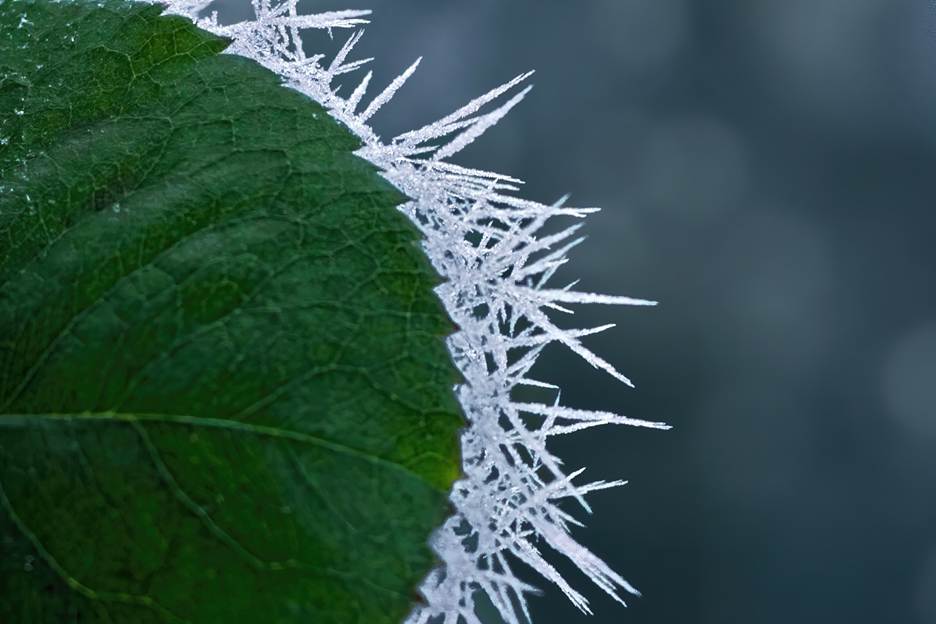
Frost can form as ice crystals on plant leaves when temperatures fall below 32-36 degrees Fahrenheit. Photo from Pixabay.com.
By Rachel Anderson, Extension Educator of Horticulture in Lancaster, Cass, Otoe, Seward, and York Counties
Often, the last frosts (32-36°F temperatures) and freezes (28-32°F temperatures and below) of spring pass through our landscapes without much notice or cause for concern. However, such events can affect yards, gardens, trees and lawns in undesirable ways. Follow these tips to minimize damage from cold snaps as winter recedes.
Don’t plant too early.
Check the weather forecast before the average last frost date of the year, which is mid- to late April in southeast Nebraska. As long as nightly low temperatures are set to stay above 32-36°F for the next ten days, you should be safe to plant outside. Exceptions are dormant trees and shrubs as well as many hardened-off cool-season vegetables and annuals, which can be planted earlier in April.
Check that what you plant is proven hardy for your area.
Flowers, grasses, shrubs, trees and other perennials must be adapted to our region’s climate to grow back year after year. Make sure plants are rated for USDA Hardiness Zone 5 or below for eastern Nebraska to ensure survivability through the cold months.
Locate fruit trees and other early blooming woodies in a protected place.
Fruit trees such as cherries, peaches, and plums can fail to produce a crop in years when their flower buds have been damaged by a spring frost or freeze. Help prevent this at planting time by selecting hardy, later-blooming varieties. Locate the plants on north and east facing slopes or sides of structures, which warm up slower in spring, to help delay budbreak until after frost season. This approach can also work for early-blooming, tender-flowered ornamentals like magnolia and forsythia.
Don’t walk or work on frosty lawns.
Avoid walking or driving on lawns with frost on them, as this can damage plant crowns and result in turf browning and dieback. Mowing or fertilizing is not recommended, either.
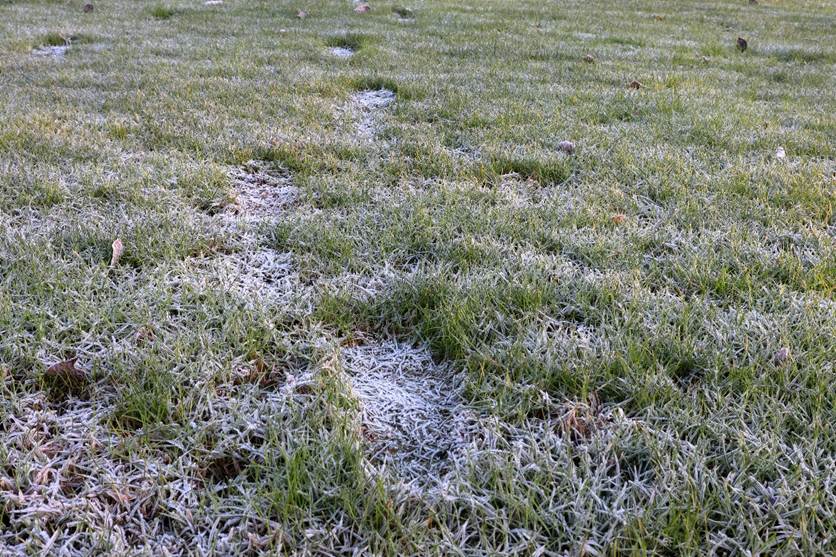
Walking on a lawn with frost can cause damage that shows up as footprint-shaped dead spots during spring green-up. Photo from Adobe Stock.
Wait to cut back old foliage.
Leaving last year’s stems standing on flowers, grasses, and other herbaceous perennials provides insulation from cold and wind over the winter while serving as habitat for beneficial insects. Don’t remove such material until after the last spring frost (especially with rose and berry canes) or leave at least 9 inches of clearance above plant crowns when cutting back to maintain some protection.
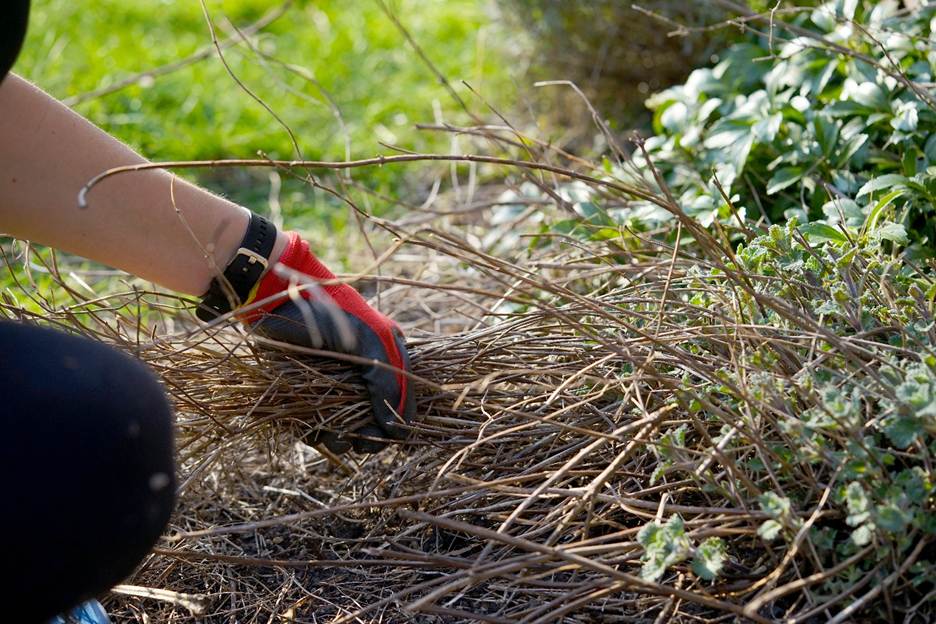
Last year’s stems can be left standing until after the last frost of spring or cut back to 9-12 inches to provide insulation to plant crowns and help prevent frost heaving. Photo from Pixabay.com.
Remove winter mulch and plastic trunk guards.
If you applied extra mulch last fall to protect vulnerable plants over the winter (such as strawberries), make sure to remove it as soon as green growth starts again this spring. Keep in mind that you will need to temporarily reapply such mulch ahead of any forecasted frost or freeze to prevent plant damage.
Plastic trunk collars (typically made of white PVC) put around tree trunks to safeguard against frost cracking over the winter also need to be removed for the growing season. Do this as soon as the risk of frost has passed so that moisture doesn’t get stuck behind the wrap, bringing pest insects or disease.
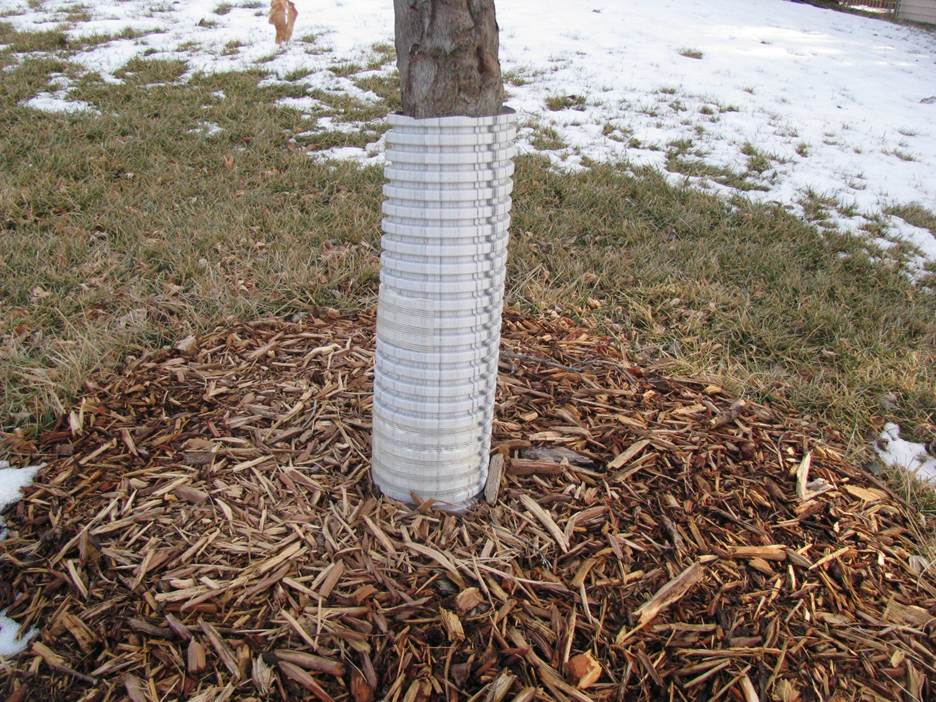
Remove plastic trunk collars for the growing season as soon as the risk of frost has passed to prevent moisture and pests from collecting behind the wrap. Photo from John Fech.
Signs of Frost Damage and Next Steps
Watch for the following symptoms of plant injury after a late frost or freeze and practice good plant health care to help with recovery. This means keeping plants and trees mulched well past the edge of their leaf canopy with 2-4 inches of shredded wood or leaves, straw, or pine needles (not rubber or rock) and providing deep, infrequent watering so the soil is moist, not soggy or dry. Do not apply fertilizer and refrain from spraying herbicides in the vicinity to minimize the chance of drift while the plant recovers.
Herbaceous Plants
Frost-damaged foliage of non-woody plants first develops a water-soaked appearance, then wilts and collapses, finally turning white, brown or black. For hardy perennials, cut off the foliage after it dies. New shoots will appear on their own in a few weeks. Tender plants such as annuals, tropicals and vegetables, however, typically don’t survive such injury and will need to be replaced.
Frost Heaving
Poorly-rooted perennials can be pushed up out of the ground as the soil freezes and thaws over winter, which can be fatal. Unfortunately, by springtime the damage has been done and you’ll likely have to replace the plants.
Lawns
Damage to lawns from frost alone is rare in Nebraska; however, you may see grass that fails to green up where it was subjected to vehicle or foot traffic over the winter. This often shows up as dead spots in the shape of tire marks or footprints. To help your lawn recover, give it extra time before mowing and cut at a higher height. If the damage turns out to be severe, take steps to mitigate the soil compaction before replacing the grass.
Trees and Shrubs
Trees and shrubs native to the northern Great Plains are well-suited to weather extremes and rarely suffer damage from spring frosts, even if they occur later than usual. However, frost injury to trees and shrubs is possible, especially for less hardy species as well as recently planted woodies that haven’t had time to heel in. In any case, facilitate plant recovery by practicing regular watering and mulching and control pests as needed during the summer to avoid additional stress.
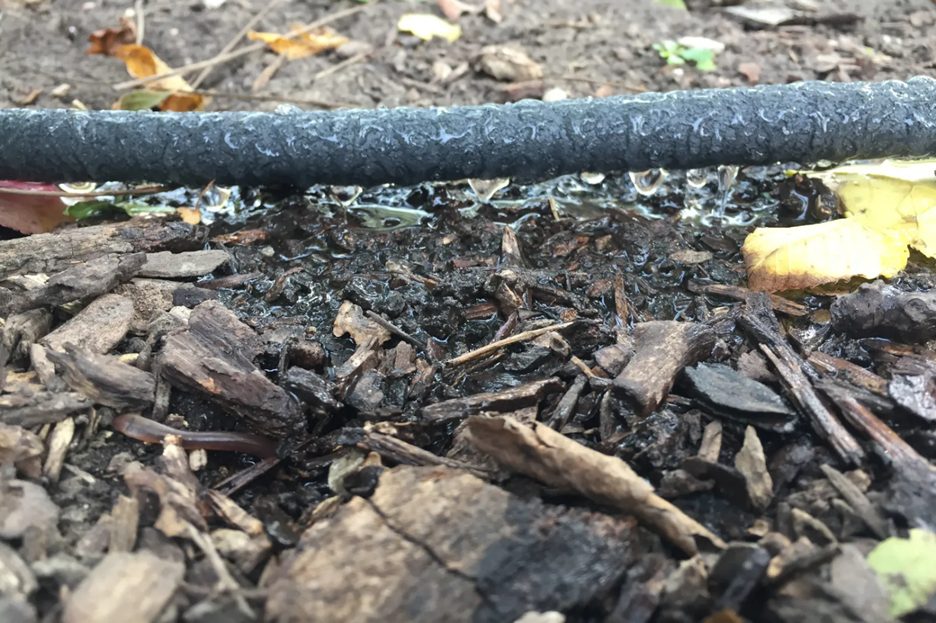
Mulching with shredded hardwood and using a soaker hose to provide deep, infrequent watering are standard care practices that can help trees and shrubs recover from frost damage. Photo from John Fech.
LEAVES: Frost-damaged leaves that have already emerged from their buds at first appear water-soaked and may be darker green in color even as they dry up, sometimes turning black or brown. Frost-damaged leaves that haven’t emerged yet will exhibit browning or leaf tatter later when they eventually grow, which should not be mistaken for insect or disease problems. Do not prune out damaged leaves—allow the plant a few weeks to re-leaf on its own.
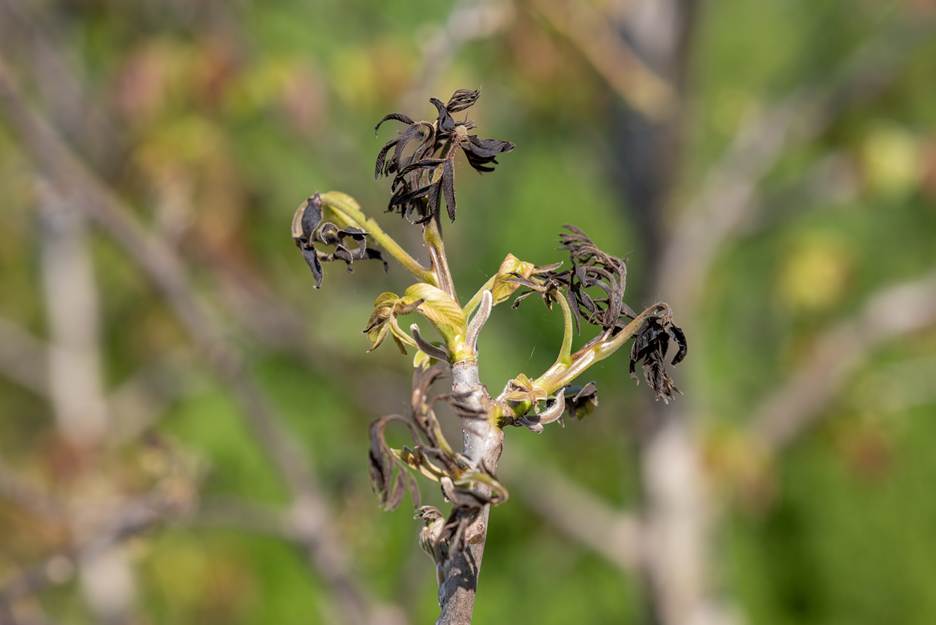
Frost damage exhibited by the blackened, curled new shoots of a young walnut tree. Photo from Adobe Stock.
FLOWERS: Frost-damaged flower buds turn dark brown, shriveled or dry, while open flowers go brown, limp and mushy. Woody plants do not regrow new flower buds if the original set is damaged. In the case of fruit trees, such damage provides an entry point for serious diseases like fire blight, so plan to treat accordingly. Otherwise, a loss of flower buds has little negative impact on overall tree and shrub health and doesn’t require intervention.
TWIGS: Frost-damaged twigs and branch tips typically turn darker in color and develop a sunken and wrinkly, ribbed surface. Woody stems exhibiting such symptoms will likely not recover and should be pruned out in late spring after the plant has had time to recoup. To check the extent of the damage, gently scratch a small area of bark away with your fingernail. If you see green tissue, the branch is alive and should be left on. If underneath the bark is brown, the branch is dead and should be pruned back to the closest live bud or side branch.
Frost Cracking on Tree Trunks
Frost cracks that separate a trunk’s bark from its inner wood can appear over winter on some trees. While healthy specimens can close cracks in time with callus tissue, such a wound on a tree already struggling may mean it will never thrive. To increase chances of recovery, follow good care practices related to watering and mulching and do not apply paint or wound dressing. Remove any ragged edges or loose hanging bark from the crack with a clean cut using a sharp, sterilized knife.
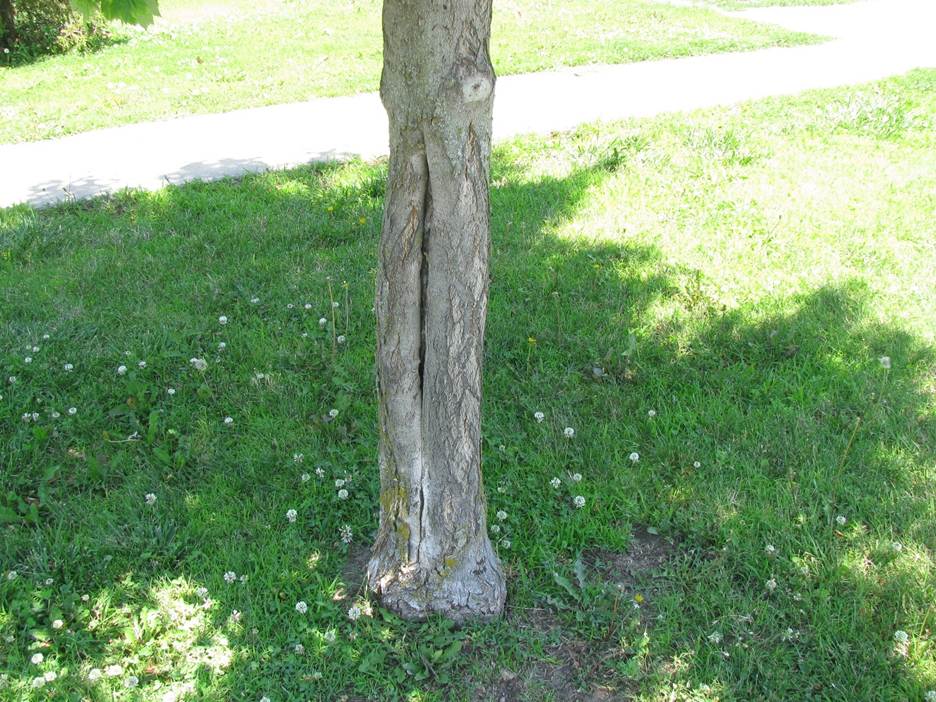
Damage from frost cracking, shown here as a split along the trunk, can severely impair a tree’s long-term health. Photo from John Fech.
Evergreens
Symptoms of frost damage to evergreens can appear right away as dying and curling shoot tips, sometimes occurring only on the windward side of the plant. Or it can show up later as wilting and browning of new growth that is often mistaken for herbicide damage. Streaks of white sap on branches can also indicate freeze injury. As correction, prune any curled tips and dead twigs back to a live bud or side branch and provide regular watering and mulch.
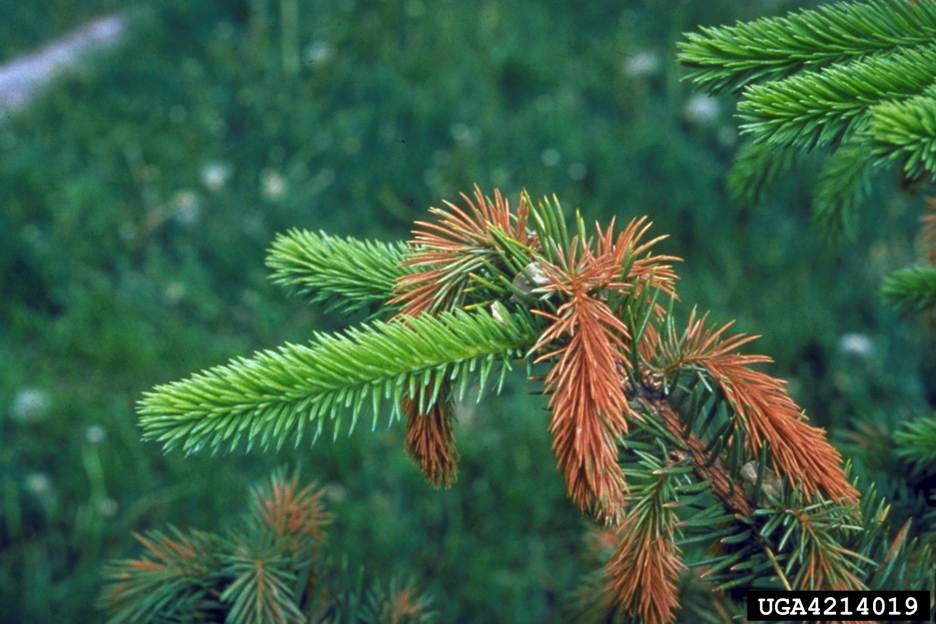
Browning and curling of new shoot tips can be a sign of frost injury on evergreens, as with this spruce tree. Photo from Minnesota Department of Natural Resources, Bugwood.org.
2026 Planting Considerations and Soy Seed Treatments
The warmer air, wind, and warming trend of soil temperatures have allowed for planting to begin for some. Last week I mentioned watching the soil moisture where seed will be placed as pre-irrigation may be necessary with the lack of rain most of us received. The winds continue to remove surface moisture and each field varies in soil moisture at seeding depth.
The decisions we make at planting impact the entire season. Aiming for fit soil conditions that are proper and even soil moisture where the seed is placed, warming trend of soil temperatures, and even planting depth are important. We saw how uneven emergence was last year with uneven moisture at the seeding depth. I recommend putting corn and soybeans in the ground at 2” (our research recommends 1.75” for soybean). This allows for buffered soil moisture and temperature conditions when planting. Bob Nielsen, emeritus professor at Purdue said corn can be seeded 2.5-3” deep if that’s where uniform soil moisture is located in order to achieve uniform germination and emergence, particularly for non-irrigated fields. Don’t plant soybean below 2.5”.
Since 2004, we’ve shared the importance of planting soybean early (mid- to late-April or first week of May) to increase yields. We often hear a preference of planting corn and soybeans in as close to 50°F or greater soil temperatures as possible. Below 50°F, I prefer to see corn planted on a warming trend of 5-7 days. The consideration is for soil temps in the mid-40’s on a warming trend with no chance of a cold snap (cold rain/snow) within 8-24 hours for soybean and 48 hours for corn. The time-frame is due to the imbibition (critical water uptake) time-frame for corn and soybean. Soil temps for your field can be monitored by using a thermometer or checking out CropWatch soil temps at: https://cropwatch.unl.edu/soiltemperature.
Soybean Seed Treatments: From 2023-2025, growers have conducted 11 site-years of Nebraska on-farm research soybean seed treatment studies (Table 1). The studies were conducted in Seward, York, Polk, Hamilton, and Clay Counties with planting dates ranging from April 23 to May 30. The goals for the growers were to evaluate the economics and yield resulting from the seed treatments. Some of these growers also desire to move away from traditional fungicide/insecticide seed treatments due to potential impacts to pollinators, soil health, and human health. Some were also interested in any increased plant health due to early seed and microbial associations with a biological seed treatment that may have influenced a healthier rhizosphere microbiome (Berendsen, 2012). Only yield and any presence of disease was assessed.
Results: The results of Table 1 show that in only 1 site-year (Seward-1 2025) the yield of the full company seed treatment out-yield the biological or untreated seed with which it was compared. The cost of the treatments varied by grower due to the products applied to the seed and the seeding rate. Planting dates varied on the year and location, with the locations in 2024 receiving more spring rainfall with later soybean planting. The locations in 2025 were generally planted into warm, dry soil conditions. Soybean disease was not observed as a problem in any of these on-farm research fields even though several of the locations in 2023 and 2024 had a history of white mold. Try this yourself! This is easy to do by splitting a planter or skipping planter passes with treated vs. untreated seed. Please contact me if you’re interested in trying this for on-farm research! Full article: https://go.unl.edu/uyp7.
Treatments Used:
- Full company seed treatment (Cost: $13.72-29.00/ac)
- Untreated Seed (No Cost)
- Biological seed treatment in all the locations other than the two listed in the next bullet point (created and treated by one of the growers): blend of 2 oz PhycoTerra® ST, 1 oz Heads Up®, 1 oz N-Gage Ultra ST, 0.75 oz Bio ST VPH in 100 gal solution. In a second tank, 2 oz of Exceed Soybean inoculant was used per 100 gal only for this treatment. Cost: $9.00-$9.20/ac
- Two other biologicals used included a seed treatment by Elevate Ag (Clay 2025) (Cost: $34/ac) and a home-made compost extract seed treatment (Lancaster 2025) ($0.63/ac).
Table 1. Eleven Site-Years of Nebraska On-Farm Research Seed Treatment Yield Data
| Location, Year | Number of Reps | Planting Date | Full Company | Biological | Untreated | Full Company Cost ($/ac) | Biological Cost ($/ac) |
|---|---|---|---|---|---|---|---|
| Seward, 2023 | 6 | May 2 | 62A | 61A | no data | $28.00 | $9.20 |
| York, 2023 | 6 | May 10 | 66A | 67A | no data | $28.00 | $9.20 |
| Hamiliton, 2023 | 6 | May 22 | 69A | 68A | no data | $16.63 | $9.20 |
| Seward 1, 2024 | 4 | May 10 | 71A | 69A | 70A | $27.00 | $9.00 |
| Seward 2, 2024 | 6 | May 30 | no data | 70A | 70A | no data | $9.00 |
| Polk, 2024 | 4 | May 27 | 77A | 75A | no data | $17.10 | $9.20 |
| Clay, 2025 | 6 | May 5 | 71A | 68B | 70A | $18.50 | $32.14 |
| Seward 1, 2025 | 4 | April 29 | 76A | 73B | no data | $29.00 | $9.00 |
| Seward 2, 2025 | 3 | April 28 | 76A | no data | 75A | $13.72 | no data |
| York, 2025 | 3 | April 28 | 77A | no data | 76A | $13.72 | no data |
| Lancaster, 2025 | 4 | April 23 | 63A | 63A | 63A | $18.51 | $0.63 |
Table 1 Note: Same letters are not statistically different at 90% confidence level. Analyzed by each individual location.
Berendsen, Roeland L., Pieterse, Corne´M.J., and Bakker, Peter A.H.M. August 2012. The rhizosphere microbiome and plant health. Trends in Plant Science Vol. 17, No. 8, pg. 478-486.
Wildfire Info. and Pre-Irrigation
Custom Grazed Forage for Wildfire & Drought: I’ve received questions from farmers who originally planned to terminate rye and oat cover crops to plant corn or soy ask whether they could instead use the forage for livestock affected by the wildfires, and whether they should plant additional forages. Some producers who have not committed to buying corn seed or fertilizer also asked about planting annual forages for grazing. They asked how to connect with ranchers in need and how custom grazing payments would work while they still need to cover cash rent or property taxes on the land.
Director Vinton, Nebraska Department of Agriculture, shared that custom grazing and cattle care would need to be paid by the producer/rancher with the livestock. She suggested that any producers who have cover crops they desire to have custom grazed or other forage resources to place them on PastureMatch: https://www.pasturematch.com/. If you’re seriously interested about grazing your covers or planting annual forages for custom grazing, particularly for those impacted by wildfire and drought, please get the resources listed on PastureMatch.
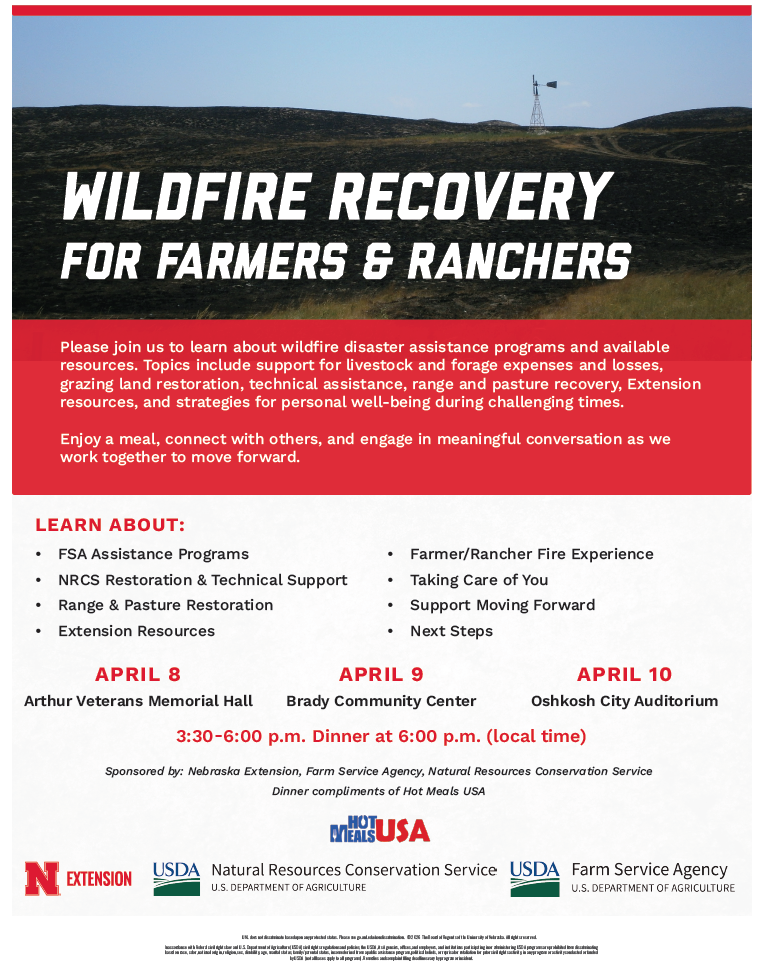
Wildfire Recovery Meeting: While I realize many in our portion of the state haven’t been impacted directly by the wildfires, many of us have friends/family who have been impacted. Please share the following with them. Nebraska Extension and two federal partner agencies will hold informational meetings on wildfire recovery April 8-10 to help farmers and ranchers learn about available resources and address local needs. The meetings will all be held from 3:30-6 p.m. (local time) on April 8 at the Arthur Veterans Memorial Hall; April 9 at the Brady Community Center; and April 10 at the Oshkosh City Auditorium. The program will include information on wildfire disaster relief programs and technical assistance, grazing and cropping options, recovery resources, mental health support and next steps. A meal will be served at 6 p.m. at all locations by Hot Meals USA to encourage group conversation and idea sharing. The meetings will include presentations by Nebraska Extension professionals and representatives from the U.S. Department of Agriculture’s Farm Service Agency (FSA) and Natural Resources Conservation Service (NRCS). All are welcome! Nebraska Extension has wildfire recovery information online at https://disaster.unl.edu/. Nebraska FSA wildfire resources are linked at fsa.usda.gov/ne in the Spotlights section.
Pre-Watering: So grateful for the rain we received last week and praying we continue to receive rain! A concern I’ve had going into the planting season is a seedbed with even moisture. Every field has different planting conditions and growers will need to check each field. Reflecting on 2025, I should have recommended pre-watering for those who could irrigate prior to planting. Why? The entire growing season is set up with planting – the soil conditions need to be fit for the best outcome. Soil conditions include proper planting depth into even moisture and temperature which will allow for quick, even germination. For both irrigated and non-irrigated fields in 2025, there were too many seeds planted into varying degrees of soil moisture last spring. We put the crop into the ground quickly in this part of the State due to the warm and dry soils. We then thought watering the crop up would be the best solution. I truly feel we would’ve had better success with evener stands if we would’ve put seed into more uniform soil conditions. The unevenness of stands plagued us all year showing up extra painfully as a component of yield loss at harvest. I’m also thinking about the potential for nitrogen burn on corn roots. Typically this can be a problem when less than 2” of moisture are received since nitrogen application of 180 lb N/ac or more. It won’t take a lot of water; the goal is to reach the moist soil layer beneath. For example, if a field has dry soil at 5″, consider irrigation or determine if rainfall events have allowed for moisture in the seed zone down to 5″. We have more chances for rain this week. I’m just saying to watch the soil moisture in your individual fields and consider pre-watering if we don’t receive additional rain before planting this year.
So grateful for Jesus as fully God and fully man living a perfect life, dying for me and all of us to pay for our sin, and defeating death by rising again! He is our only Living Hope!!! Easter Blessings to you all and your families!


