A Soil Health Journey
Monday morning my body woke up at 4 a.m. That’s normal for some people, but not for me. However, it was normal for me to wake up between 2-4 a.m. every Monday morning when I hadn’t finished my column on a Sunday night to get it completed in time for newspapers 😊
The past week was a whirlwind. I had wanted to finish well at UNL and last week included completing previously made commitments; will still finish harvest and reports with all my on-farm research cooperators. I’ve enjoyed being on the farm with Brian! And, I’m working some part-time hours as a Producer Research Lead for the Nebraska Soil Health Coalition, which closely aligns with both Brian and my goals in walking alongside others in their soil health journeys.
Since that is one goal Brian and I have, let’s talk about soil health. Defining soil health is difficult as there’s not an agreed upon definition. Soil is comprised of chemical, physical, and biological properties. The health part is the ability (continued capacity) to function as a vital living ecosystem sustaining plants, animals, and humans over time (via NRCS and numerous universities).
Six general soil health principles were adopted over time and are in continual revision by various entities:
- Minimizing Disturbance (reducing tillage, reducing chemical inputs)
- Keep the Soil Covered (protecting the soil with crop residue and/or cover crops)
- Maximize Biodiversity (diverse crop rotations, multi-species cover crops, diverse biology)
- Keep a Living Root Year-Round (active plant roots in the soil as long as possible)
- Integrate Livestock (add grazing animals where appropriate to the land to cycle nutrients and manage residues)
- Know Your Context (management is tailored to one’s specific climate, soil type, goals)
I think this is where soil health gets overwhelming to some as the principles can seem like a checklist and one’s Context trumps everything. That’s why I’ve referred to soil health as a journey.
We are all on journeys in life…physical, emotional/mental, spiritual, learning, etc. The start/beginning and destination are both important parts of a journey. However, it’s the time between the two where things happen. We change. We learn, grow, fail, succeed.
I think of life as interconnected with plants, humans, and animals. The soil sustains life for all of us. At a fundamental level, I think many seeking soil health journeys believe that healthy soil can lead to healthier plants, animals, and people.
I’ve watched how ag can quickly divide instead of unite. As I think of soil health, there can be a stigma that a person has to farm a certain way to be included. To me, there’s room at the table for all, and I don’t see soil health tied to a specific farming label.
There’s room to start with one thing. What is your concern? What is your goal?
- Those concerned about groundwater nitrate for future generations can start by reducing the amount of nitrogen applied. Using a tool like Sentinel Ag can help.
- Those concerned about soil erosion may consider reducing tillage or adding a cover crop in the off season.
- Those concerned about excess residue can work with a neighbor to graze livestock.
What one thing could be the next step to address a concern or goal in your soil health journey?
My Last Extension Column
I didn’t manage to get this written before leaving Extension; this is my last column for Extension. Thank you to all who have read what I’ve written through the years! It truly is humbling to know people read this column when there’s so many sources from which people can choose information.
I’ve reflected a lot. I’ve been sad at times to leave Extension and the people I’ve served, and, I’m excited for this next adventure to spend more time with Brian on the farm.
In reflecting, I keep coming back to gratitude. Through the years, some of the most impactful columns I’ve written (according to reader comments) talked about gratitude…how gratitude helps reduce anxiety and stress, how gratitude helps with one’s mood and outlook, how gratitude is the most endearing quality a person can have (and all of those statements are backed by research!). Please keep this in mind this harvest season! In spite of the challenges ahead, we truly are so blessed!
I’m grateful for a career in serving people and I’m looking forward to serving in my next one as well. I’m grateful for all the relationships and the people who have cared deeply for me. This has been exhibited throughout my career, but especially this past month through all the thoughtful notes, emails, cards, calls, texts, and the large turnout for the celebration. I’ve been somewhat overwhelmed and apologize if I haven’t gotten back to you. Thank you all for caring so well for me!
There’s a quote that stuck with me early in my career. It says, “People don’t care how much you know until they know how much you care”. How true! I wasn’t initially planning to leave my Extension career quite yet, and it was the clear next path. My husband and office team shared with me that it should be hard … that when a person cares deeply for others and in serving others, tears will and should flow at times. Change can be hard yet change can also bring blessing!
I’m grateful that relationships continue regardless of how careers change. Many showed me the truth of that when I moved from the Clay County area to the York/Seward area. I’m grateful to still be in an ag career and have the opportunity to still serve farmers, just in a different way.
I’m grateful for how Jesus changed my life! I was a sinner in need of a Savior. Jesus lived the perfect life, paid the penalty I deserved on the cross, conquered death and rose again! I recognized I couldn’t earn my way to heaven – that Jesus is the only way – and placed my faith, trust, and repentance in Him alone for my eternal salvation (Ephesians 2:8-9). He loved each of us that much to go to the cross for us! My hope is that if you don’t know for sure where you will spend eternity that you’d reach out for a conversation as I’d love to share more with you. My cell phone will remain the same (402) 440-4739.
While this is my last column for Extension, I’m not going to stop writing. Perhaps not every week, but I plan to write about soil health and things Brian and I are learning. I’m excited to take a deep dive into plant/human/animal nutrition, learn how to verify our compost and compost extracts via microscopy, and better understand root causes of plant problems instead of treating symptoms. If you’re interested in learning with me, you can enter your email into the “follow my blog by email” at https://jenreesources.com/. With this, thank you for the encouragement, relationships, and support of me these past 22.5 years! It’s been a blessing and I’m grateful – Jenny
Harvest Grain Quality Concerns 2026
I’ve been thinking of the grain quality concerns and safety with the upcoming harvest. We all know how crazy it’s soon to get with harvest. Unfortunately, most of the corn and soybean are ready now at the same time. It’s hard to know how to prioritize harvest. Normally, we’d go by percent stalk rot in a field of corn and percent moisture in both corn and soybean. Perhaps there’s still ways to prioritize based on those factors, but now we have the additional concern of looking at grain quality as well in both crops. The following article has tips as one faces harvest these coming weeks: https://cropwatch.unl.edu/harvest-2025-prep-guide-minimize-losses-disease-stressed-corn/.
For stalk rot assessments: Push at least 100 corn plants to arm’s length about 30 degrees from vertical. If plants bend below the ear and don’t snap back upright, they have a greater chance of lodging at or prior to harvest if there’s high wind events or heavy rain. I prefer the pinch test in which one squeezes the lower internodes to assess stalk strength and check for stalks that are easily crushed by hand.
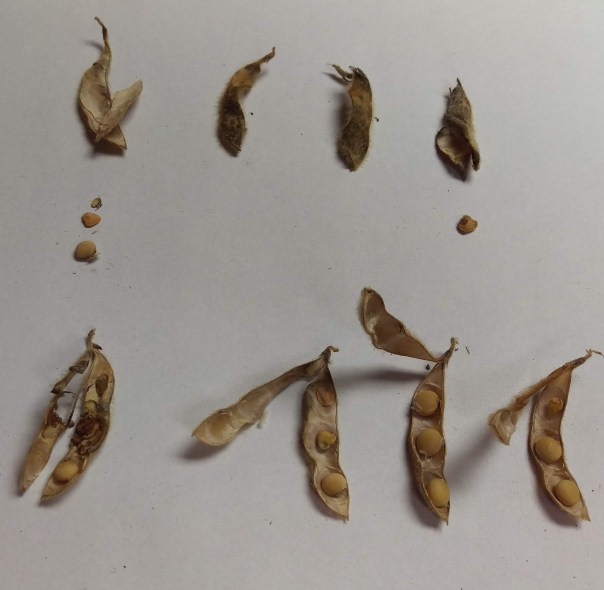
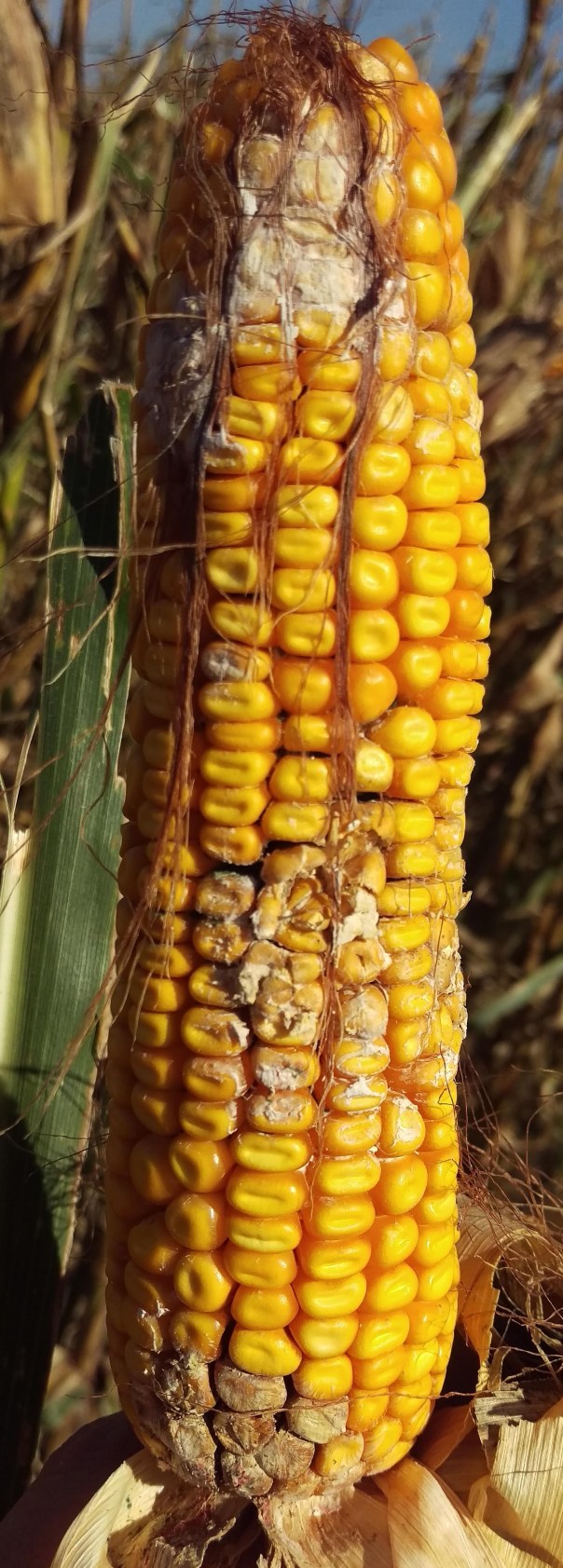
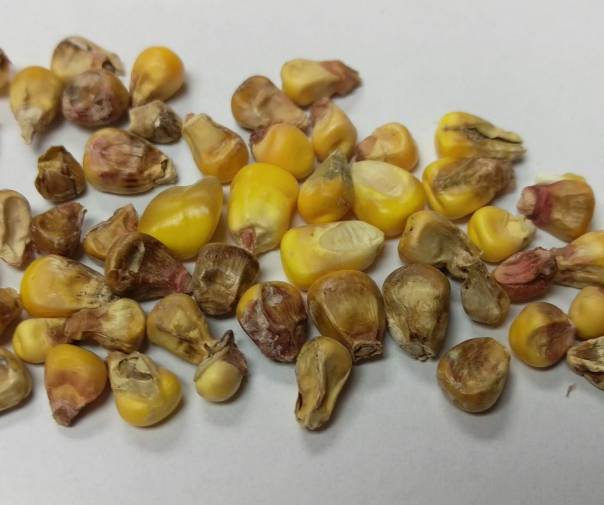
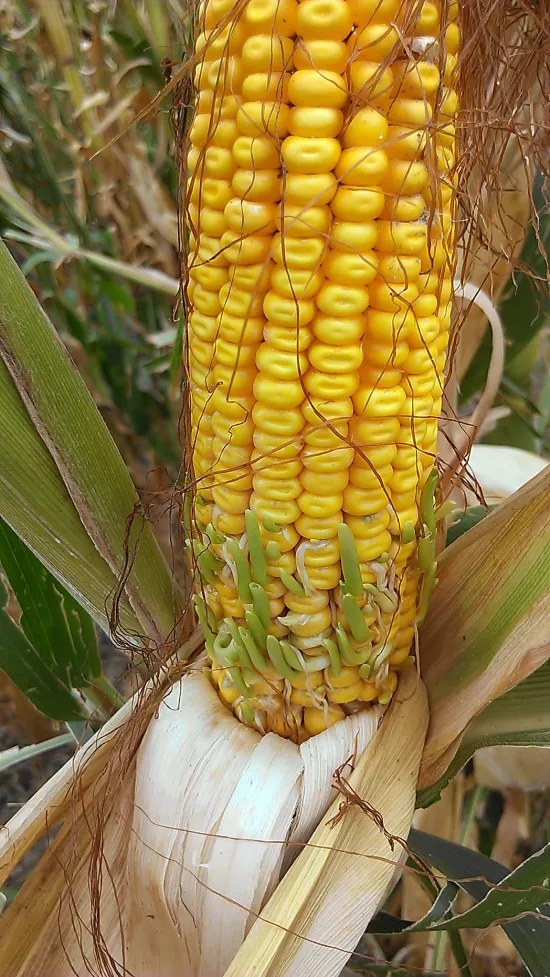
Both corn and soybean have sprouting occurring in the field. In corn, this is particularly occurring where ears are upright with tight husks. With soybean, it’s occurring where the beans in the pods dried down to 13% or less and rewetted to at least 50% of their seed weight with the rains. There’s also a number of fungal kernel rots occurring in corn. Fusarium and giberella have a white/pink/red fungal growth. The presence of the fungus doesn’t guarantee mycotoxins are present, but potential mycotoxins that can be associated with these fungi are vomitoxin and fumonisin. White fungal growth that overtakes an ear and makes it feel very light is diplodia. There are no mycotoxins associated with it. There’s also a number of “lesser fungi” that cause cob rots that we’re also seeing this season.
It’s important to know what’s impacting the corn ears prior to harvest, binning corn, or taking it to the elevator. If a particular hybrid is more impacted by kernel rot than another, make sure not to put that corn in the same bin as corn with better quality. Grain affected by ear rot diseases and mold are less suitable for storage. Use or sell affected grain first and store the highest quality corn possible. Grain needs to be cooled to 55F and at 13-14% moisture in order to stop Fusarium and other fungi from continuing to grow in the bin. More info. at this resource: https://cropprotectionnetwork.org/publications/storing-mycotoxin-affected-grain
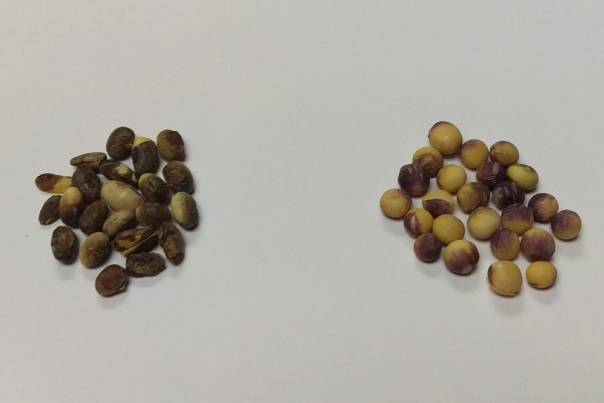
For soybeans, it’s also important to know if the variety in the field is impacted by things like purple seed stain or Phomopsis seed decay, which can cause elevators to reject soybeans. If you’re noticing discolored soybeans, talk to the elevator beforehand. Both of these conditions are variety related so keep track of which varieties you observe these conditions in.
Set combine fans to blow out as many broken/damaged kernels from insects, fungi, or sprouting as possible. Adjust combine settings to reduce harvest losses due to brittle kernels. Aim to start harvesting fields at a higher moisture (above 17%).
It will be a dirty harvest as secondary fungi can turn the leaves and stalks a blackish color. Fungal spores may behave like dust and aggravate respiratory illness or symptoms in sensitive individuals. Consider wearing dust masks or respirators when working in affected fields or around grain, such as in grain bins. Check air filters on equipment operating in conditions with a lot of dust and spores. Keep fire extinguishers close at hand. Take breaks as needed — and care for your mental, emotional and physical well-being. Be careful on roads: use headlights especially on gravel roads and check intersections before proceeding through them in the country. The Nebraska Rural Response Hotline is 800-464-0258 and is available for emotional support, legal and financial assistance, and disaster relief. Wishing everyone a safe harvest and hoping yields aren’t impacted too much from the challenges.

Corn Observations



Grain Storage
There’s over 25 species of fungi that can produce ear molds with the majority of them ceasing growth at 14% moisture within the kernel. For short term storage of moldy grain, drying to 15% moisture as quickly as possible can greatly slow additional fungal growth within the grain bin. The table below shares the days required to dry corn to 15% moisture with 1.0 cfm/bu and various temperature and humidity conditions. More info. at this resource: https://cropprotectionnetwork.org/publications/storing-mycotoxin-affected-grain

“Since drying time is directly proportional to the airflow, the producer can calculate the estimated drying times when using airflows other than 1.0 cubic foot of air per minute per bushel (cfm/bu). For example: Table II shows when drying corn from 18 percent to 15 percent moisture with 50F and 50% relative humidity air, the estimated drying time is 12.5 days using a 1.0 cfm/bu airflow. If the airflow is 1.25 cfm/bu, the estimated drying time would be 12.5 days / 1.25 = 10 days. For 1.5 cfm/bu, the drying time would be 12.5 days / 1.5 = 8.3 days. For 0.8 cfm/bu, the drying time would be 12.5 days / 0.8 = 15.6 days.” Source: Management of in-bin natural air grain drying systems to minimize energy cost.
- Management of in-bin natural air grain drying systems to minimize energy cost
- UNL CropWatch Grain Storage Resources
- Managing large grain bins for potential mycotoxin contamination
Mycotoxin Information
In 2026, we’re primarily seeing Fusarium and Gibberella species which have the potential to produce mycotoxins. Thus, the information below is directed at those fungal species and mycotoxin levels that can be associated with them. Again, the presence of fungi does not automatically mean a mycotoxin is present.

The following toxins can be produced from species of Fusarium and Gibberella. Source: Corn Ear Rots, Storage Molds, Mycotoxins, and Animal Health, Iowa State publication, 1997.
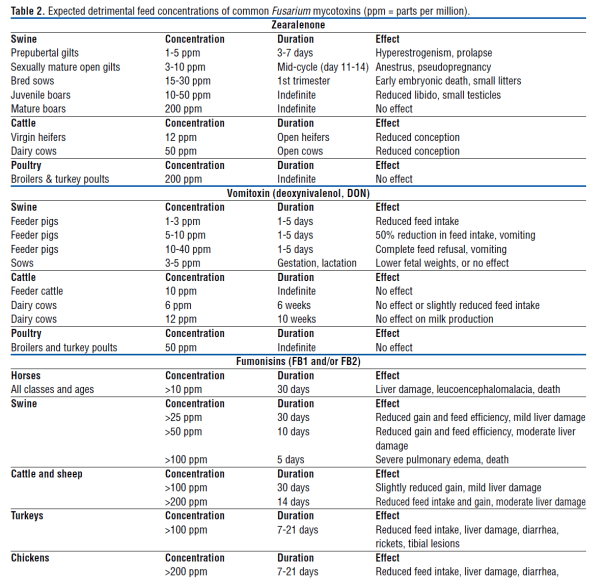
Source: Corn Ear Rots, Storage Molds, Mycotoxins, and Animal Health, Iowa State publication, 1997.
Farm Bill Decisions 2026
With the announcement that growers can sign up for the 2026 Farm Bill, I’ve received a few questions this past week. I don’t know if some of you are interested in trying to sign up during this rainy period or if you’d prefer to wait till closer to the December 11th deadline.
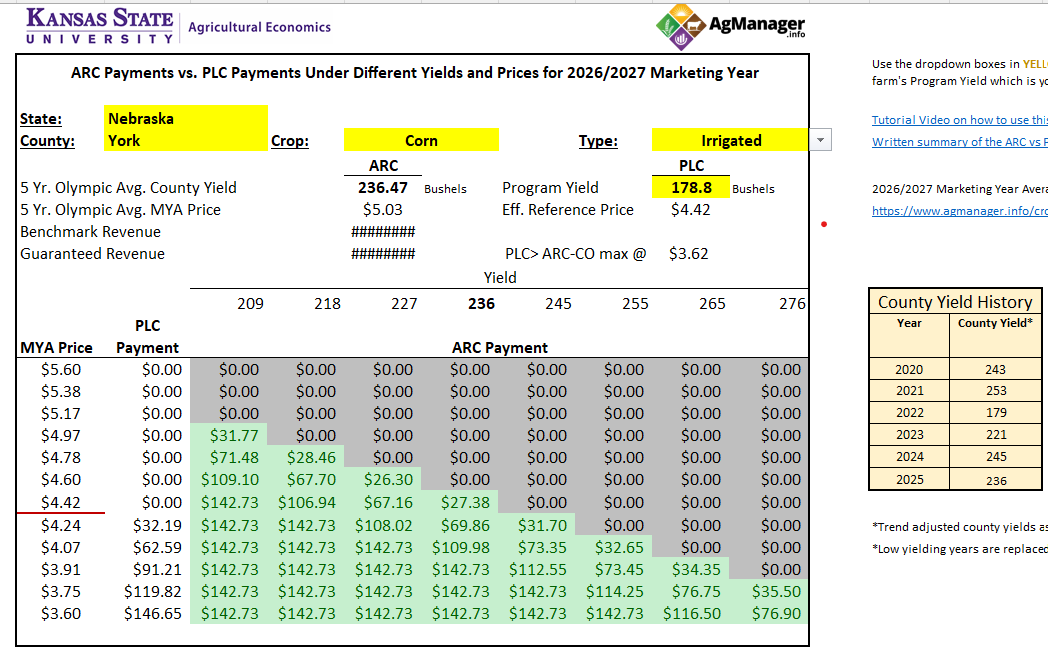
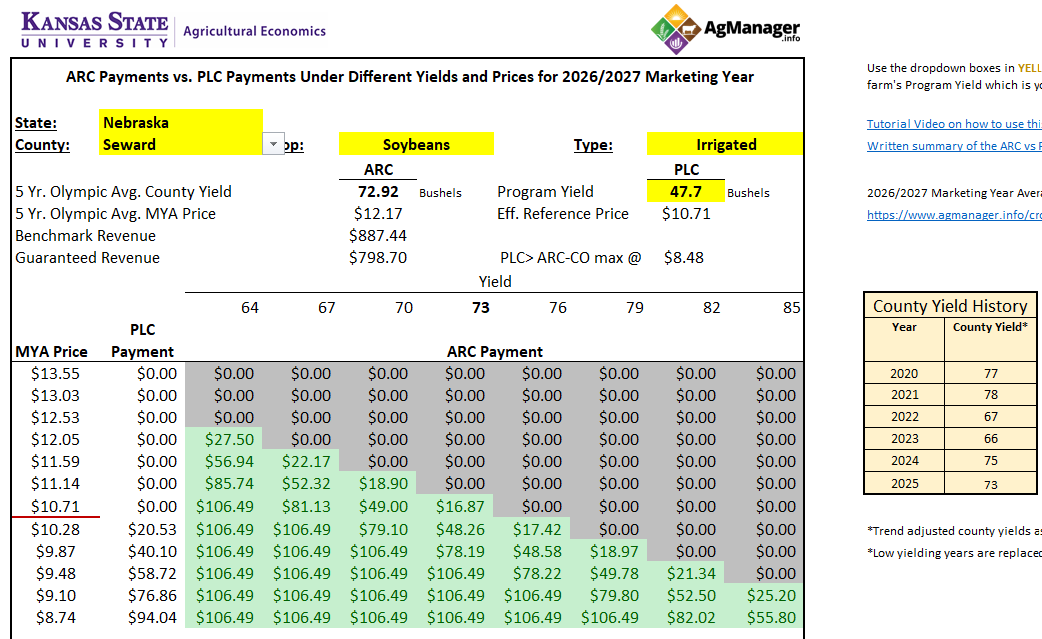
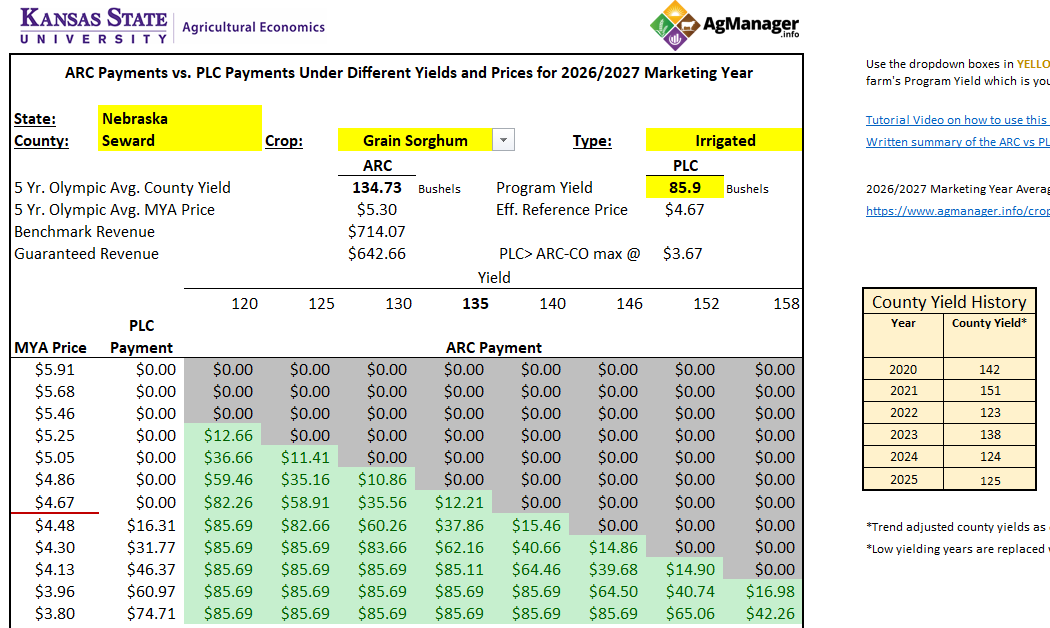
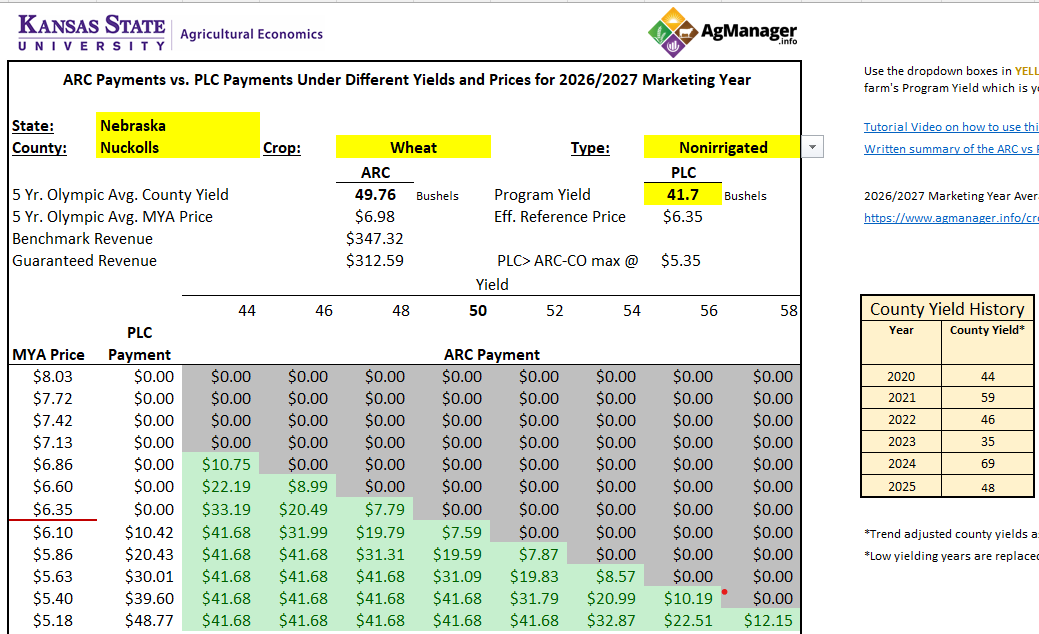
The blessing in this later signup is the ability to look back and have more information. By waiting to see how yields look in a county and in learning more about price, it can give indication how these factors may impact ARC-CO vs. PLC. However, it is important to make a decision prior to December to help the FSA Offices out with their work load. For those wishing to sign up now vs. waiting, there are pretty good indications on directions by using the Ag Manager spreadsheet from K-State at: https://www.agmanager.info/ag-policy/farm-bill-0/tradeoff-between-20262027-arc-and-plc. When you download the spreadsheet from this site, be sure to put in your state, county, and either Irrigated or Non-Irrigated. If you select “All”, that only works in counties without much percentage of either irrigated or non-irrigated acres. If no numbers appear in the chart, you need to select either irrigated or non-irrigated.
In general as of this moment, looking only at price and barring a major reduction in price or county yields dropping off, ARC-CO looks best for corn and soybean. PLC looks best for wheat and either program would work for milo (but ARC-CO in general provides greater support).
For corn, the PLC reference price is $4.42 with the ARC-CO effective price at $4.53; so, ARC-CO would trigger the soonest at county average yields and have a higher paid price compared to PLC unless the market year average price would tank to $3.62, in which PLC would pay more regardless of county average yields. Currently, the market year average (MYA) price is $4.80. So, for ARC-CO to trigger, county average yields would need to decrease or the MYA price would need to decrease to $4.42.
For soybean, the PLC reference price is $10.71 with the ARC-CO effective price at $10.95. It’s most likely that there will be no payment from soybean with the current MYA price at $12.00 unless county level yields or MYA price tanks. However, ARC-CO will trigger sooner than PLC for corn.
For sorghum, both ARC-CO and PLC are options to consider. The PLC reference price is $4.67 with the ARC-CO effective price at $4.77. With the MYA price currently at $4.60, both programs will currently provide price support. ARC-CO provides greater price support early but maxes out sooner and PLC can provide greater price support in the event that prices tank further (at $3.80).
For wheat, the PLC reference price is $6.35 while the ARC-CO effective price is $6.28. With the current MYA price at $6.40, PLC actually triggers and provides price support sooner than ARC-CO at current county average yields. If county average yields for wheat are lower (which most likely they are for much of the State), then ARC-CO provides greater price support than PLC. Both ARC-CO and PLC are fairly even as one looks at the charts, so asking your county FSA office for the county wheat yield for 2026 will help you in making the decision for wheat acres.
No one can predict what market year average prices and county yields will do, but the following information is provided to hopefully help you better understand the tradeoffs in making the decisions on the base acres you have. UNL will be providing Farm Bill Update webinars and meetings beginning in October, so please be watching for announcements on those events from https://cap.unl.edu and https://cropwatch.unl.edu. Taking a few moments playing with the spreadsheet I mentioned above from K-State is also incredibly helpful to see how price and yields impact the farm bill program decisions. That spreadsheet is what I’ve used to help share information on the Farm Bill all these years – so searching for it from K-State can be of help to you in the future. Here’s wishing you the best as you make these upcoming decisions!

One Red and Nitrogen Challenge
One Red: At Husker Harvest Days, a new program was rolled out called One Red. From the website and brochure it says “The ONE RED Ag Data Bank & Grants Program is a voluntary Nebraska program that combines a secure Ag Data Bank with potential payments, grant opportunities, and support from Approved Service Providers. It is designed around eligible fields, participating acres, qualifying practices, equipment, and technology.” https://oneredag.com/
Producers can qualify if they have at least 80 cumulative acres located within the following eligibility areas: irrigated acres, NRD Phase II and higher management areas, and designated Wellhead and Source Water Protection Areas throughout Nebraska (see the website). For now, interested producers can go to the website and put their name in as being interested. Putting one’s name in as “Interested” doesn’t mean a producer has to enroll in One Red and also doesn’t guarantee that the producer qualifies.
What I appreciate about how the program has been designed is that the data provided by the farmer is owned by the farmer and only aggregated data is shared in reports. It’s also one of the only programs I’ve seen that pays for technology – such as technology to improve irrigation scheduling and application, nitrogen sensing, and to allow software programs to talk to each other. The overall goal is to help farmers improve water quality through better irrigation scheduling, nitrogen application, and soil health practices. When the program money runs out, it’s hoped that growers will still be connected to each other via peer networks. While nothing is perfect, I’m hopeful it can help more farmers try practices to be better stewards of water and soil without taking on as much financial risk.
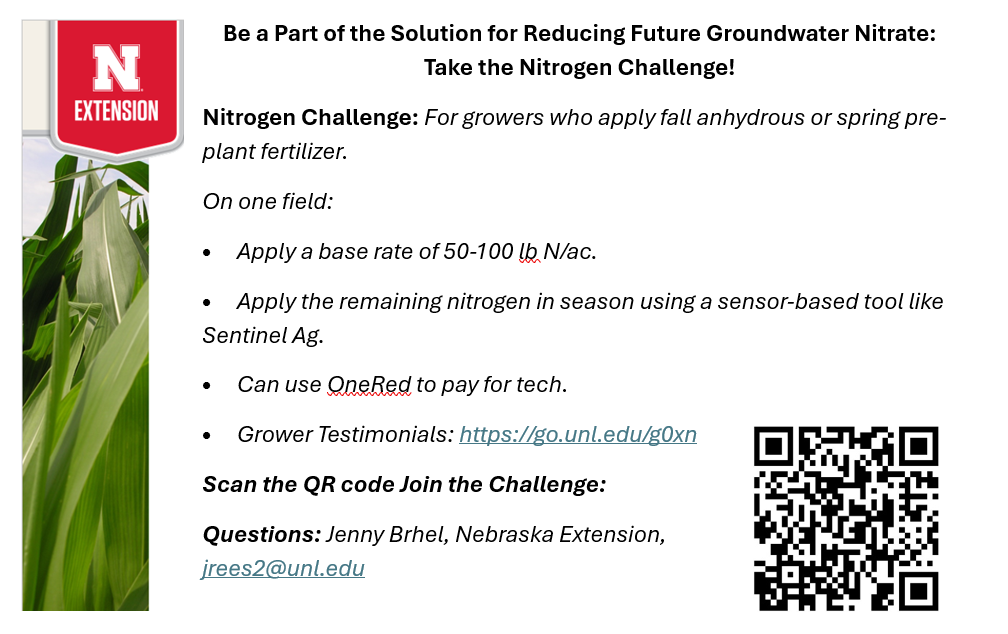
Nitrogen Challenge: In November 2023, after years of research, I asked producers and their advisors to consider a Nitrogen Challenge. The Challenge is this: for growers who apply fall anhydrous or spring pre-plant fertilizer, on one field, apply a base rate of 50-100 lb N/ac. Apply the remaining nitrogen in-season using a sensor-based tool like Sentinel Ag.
Why do I keep encouraging this Challenge? Because it’s UNL’s recommendation backed by solid research…it’s the only thing we’ve found that consistently reduces the amount of nitrogen growers apply without significantly impacting yield. That’s how we change the groundwater nitrate story for the future! As we think of input prices rising again for 2027, as we think of our rural and urban communities dealing with rising nitrates in groundwater, as we think about the future we leave behind for our children and grandchildren, I ask growers to consider the nitrogen challenge for 2027. I’m only asking growers to consider this for 1 field using the smaller base rate and Sentinel Ag in season and see how it works for you. This works for both irrigated and non-irrigated fields. And, growers can utilize the One Red program to help offset any costs. Brian and I use Sentinel Ag on all our non-irrigated corn fields. It’s incredible to see the satellite imagery show mineralization spikes and how the plant reacts by increasing the nitrogen sufficiency index in-season. I don’t know who will continue to champion this Challenge in Extension after I leave. As a farmer, I plan to continue working with farmer peer mentors who have championed this Challenge on their own farms. Their testimonies are found here: https://go.unl.edu/g0xn. The “why” of cleaner groundwater for future generations is clear for all of us. Will you join us? You can go to this website to sign up for the Nitrogen Challenge: https://crm.sentinelag.tech/nitrogen-challenge. For questions, please contact me directly.
Also, an Open House is planned for me on Sept. 30th from 4-6 p.m. at the Cornerstone Event Center at the York County Fairgrounds. Memories and pictures are being collected by Laurie Linabery and can be emailed to: llinabery2@unl.edu.
High Heat and Early Harvest
Thank you for all the kind messages! The heat pushed crops along and harvest has started. There’s been a lot of top dieback seen this year in corn (when the top 4-5 leaves lose their green color and appear more bleached and dead in appearance). However, I’m not necessarily seeing anthracnose as the cause of that and UNL Plant and Pest Diagnostic Lab is also not seeing much in the way of anthracnose either.
We know high heat impacts photosynthesis, respiration, and other plant processes. I was also thinking about the heavier rain events seen in some areas prior to the high heat (coupled with growers also irrigating prior to the rains). So I’m also wondering if we are seeing some root stress from reduced oxygen in the soil coupled with the high heat that caused the top dieback to occur faster in plants? I also realize there’s crown rot in fields that adds to the complexity of this along with late season tar spot (in which hybrid susceptibility is showing).
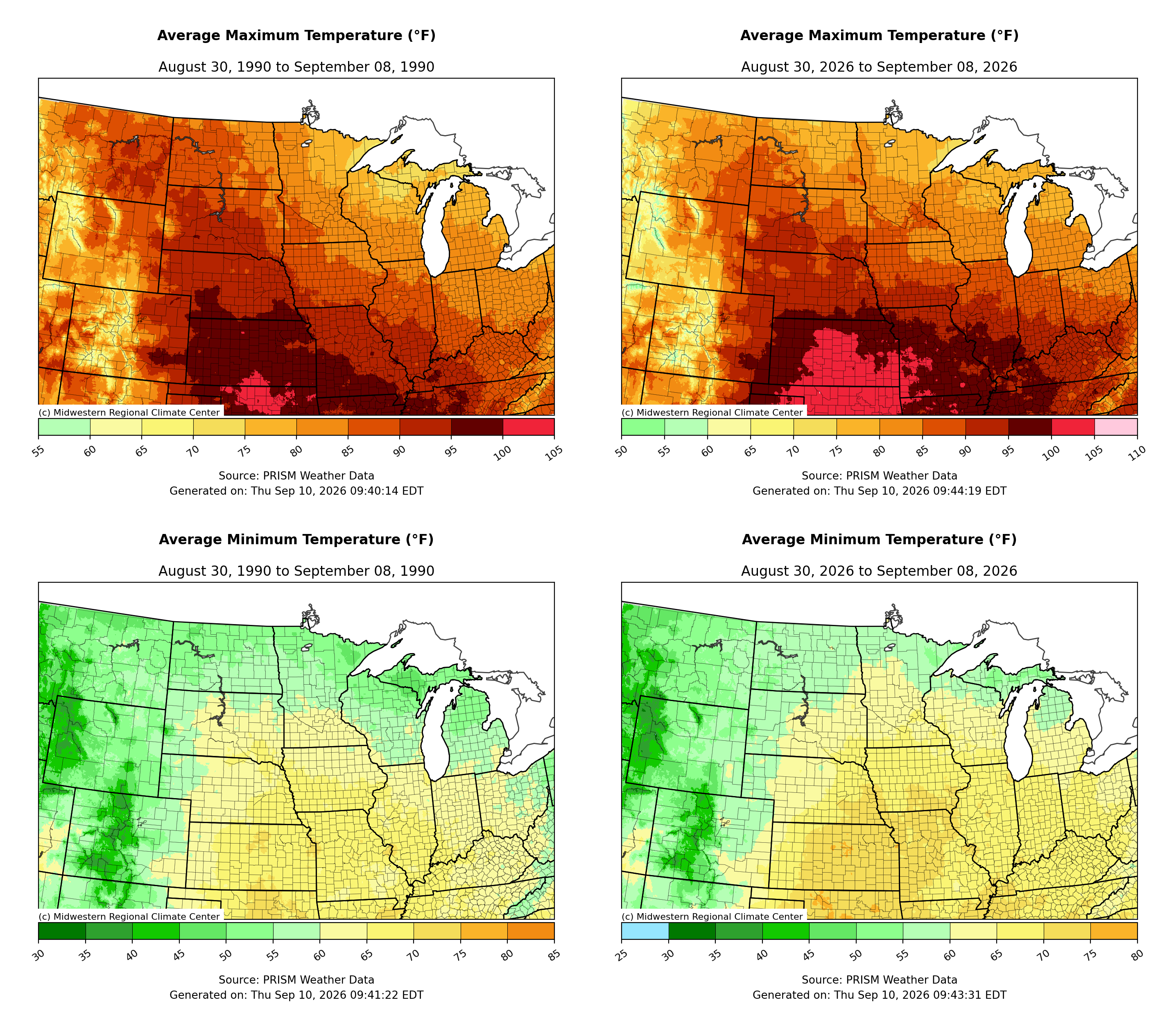
Regarding the weather data, Eric Hunt, UNL Extension Statewide Climatologist, shared an article at: https://nsco.unl.edu/news/recent-heat/. He shared, “the previous 10 days were warm statewide and it was easily the hottest stretch of weather in 2026 for south central and southeast Nebraska. Average temperatures were above 80°F for most locations south of the Platte River and were close to 85°F in places like Lincoln, Omaha, and Falls City. For Omaha and Lincoln the last 10 days were the hottest stretch of weather since 2012 and in Omaha, this was the second longest streak of maximum temperatures over 90°F in the last 50 years.” Minimum temperatures have been well over 70°F with some nights not getting below 80°F. Corn needs a reduction of temperature to at least 70°F to accumulate sugar from photosynthesis instead of burning it to keep the plant cooler during the night. He also shared a comparison with me between the same stretch of weather data (Aug. 30-Sept. 8) in 1990 vs. this year, which were very similar to each other. 2026 shows higher night-time temps for the same stretch, though.
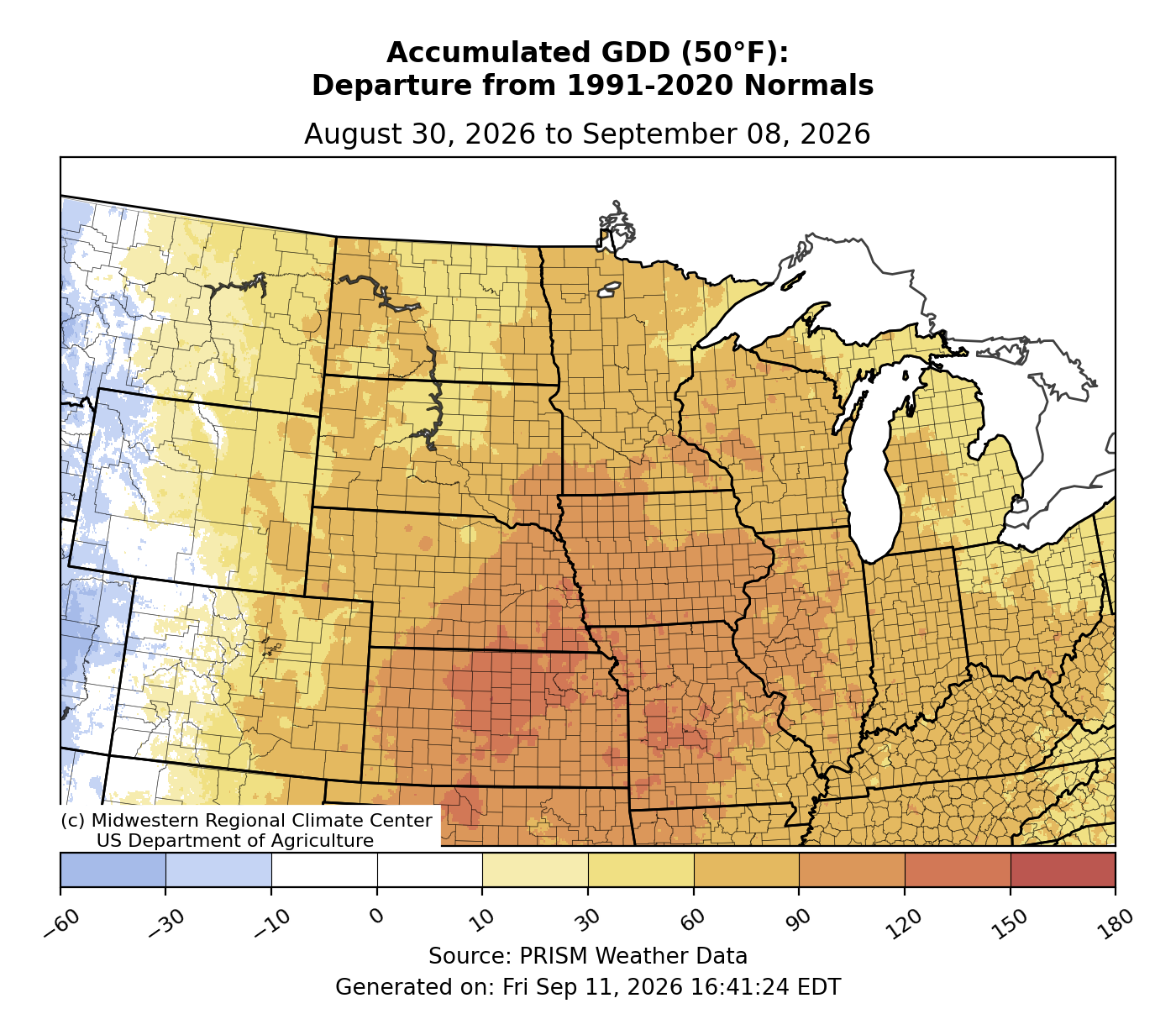
The heat has led to accumulated growing degree units which has pushed the crop ahead of pace. A number of growers shared how quickly the corn moisture is dropping. Upon reaching physiological maturity (black layer), most corn hybrids are around 30% moisture. It’s possible we are losing as much as 0.8-1.0 percentage points/day (prior to the cooler, moist spell this coming week). Dr. Bob Nielsen, Extension Emeritus Corn Specialist from Perdue shared, “It is not uncommon for grain moisture to decline more than one percentage point per day over a period of days when conditions are warm, sunny, windy and dry.” Research that he and others conducted back in the 90’s showed that when corn matures also impacts drydown rate. Corn that matured in late August had a daily average drydown rate of 0.8 percentage points per day while corn that matured in late September averaged 0.4 percentage points per day.
I received many comments (prior to top dieback) from growers about how soon their husk leaves were turning brown. That’s one of the characteristics of quicker drydown. Others include: lower husk leaf number and thinner husk leaf, how well the husk covers the ear (less coverage allows for faster drying), how tight the husk is (as looser husks will increase moisture loss), and how fast the ear turns down vs. remaining upright. While we can’t do anything about the weather and how it impacted the hybrids, we can watch kernel moisture in fields to prioritize harvest. Also watch stalk rot. I’m seeing something interesting where the internode around the ears is rotted first in fields. Unsure if others are noticing that too? While I mostly talked about corn, soybeans are rapidly maturing too and moisture should be watched on them too. I know this isn’t the way any of us wanted to end the season. Here’s hoping that yields are better than expected in spite of all of this and may you have a safe harvest as well!
Research by Dr. Bob Nielsen, Purdue. https://www.agry.purdue.edu/ext/corn/news/timeless/GrainDrying.html

Next Chapter
I’ve been blessed beyond imagination. For the past 22.5 years I’ve had the opportunity to serve people to the best of my ability, build deep relationships and friendships, learn each day, walk alongside growers with on-farm research that mattered to them, share information a variety of ways, work with amazing office team-mates/colleagues/volunteers/boards, and help speak into the lives of youth. It’s been an amazing career and one I will look back upon fondly throughout my life.
It was my dream job to work in the fields with farmers, do research, teach, learn, build relationships, serve people, and each day was something different with challenges and questions. I never imagined leaving Extension. It was the career I never knew existed until my graduate professor, Dr. Jim Partridge, asked me “why not Extension?” when I told him about my dream job. I’m so grateful for how God directed my paths with all the people He put in my life!
And, He continues to direct my paths as He promises in Proverbs 3:5-6 upon trusting Him and not leaning on my own understanding. The past several years, I’ve chosen a word to study/focus on. The word God gave me this year was “Surrender”…surrender my life and will to God. Surrender is hard! Yet through another challenging growing season, God was moving me to surrender even my career.
I’ve chosen to leave Extension. It hasn’t been an easy decision, and it’s one I’m at peace with. The greatest difficulty in this decision is knowing there will be an impact to those who have relied on information provided and the relationships developed over the years.
My hope for the University and Extension in the future is that it will reignite a focus as a land grant institution to serve the needs and challenges our people face. I also hope it can remain objective for the sake of the people we serve. I believe an objective third party is still needed for research and mediating problems. My hope is that in the difficulty of the ag and university economy that outside money, pressures, and especially threats don’t influence the objectivity of research and the messages shared. There’s understandably tension when research-based information doesn’t align with company messages to sell, which has occurred for ages with disagreement yet respect. And, as I share this next part, there’s still many respectful relationships my colleagues and I share with industry professionals.
The increasing challenge to a growing number of us in Extension is with threats received and the pressures to alter messages/control the narrative/silence research from individuals within companies and entire companies. I never compromised sharing messages based on research nor in sharing the research. I haven’t known my colleagues to compromise either. The one time I wasn’t objective was when I came out against utility scale solar and I stand by that decision as a human. No one wants to see problems happen in fields. When they have occurred with hybrids, varieties and various other situations, there wasn’t always research to explain them. I did my best taking time looking at numerous fields to figure them out and to be as respectful as possible yet also truthful in the process. I’m also human and there’s times I could’ve done better. My hope is that growers will continue to trust the University and Extension for the research produced and messages shared and continue to seek the professionals there for second opinions when they encounter difficulties. My hope also is that industry respects the role of an objective Extension and University, because that is in the best interest of all of us, particularly our constituents.
God gave me such a gift and beauty from ashes in bringing Brian into my life as my husband! We are incredibly aligned in our values, beliefs, and how we think about ag and life. Since marriage, I’ve felt torn each day between being on the farm with him and serving all of you. I’ve tried to do both and I’m not able to give that much of me both ways – it’s not sustainable. In praying through this, God helped move me towards letting go of Extension and choosing to be on the farm. I’m so excited for this next chapter to partner even greater with Brian! – to build our dreams of helping others build their soils through plants, animals, and biology and walking alongside others in their soil health journeys.
My last day with Extension will be September 30th. I will be at Husker Harvest Days on Tuesday and Thursday if you’d like to connect there. There will also be an open house on Sept. 30th from 4-6 p.m. at the Cornerstone Events Center, Fairgrounds in York. Memories and pictures can be shared with llinabery2@unl.edu.
With this, I say Thank You! Thank you to all of you who trusted me to help you with various problems, advice, input, talk through things through the years. Thank you to all of you who challenged my thinking, kept me humble, and helped me grow. Thank you to all of you who have become deep supporters and friends. Thank you to all of you who participated in on-farm research throughout my career, allowed me to work with your youth, and who partnered with me on activities like fair, etc. I don’t have the words. Just incredibly grateful; thank you.
Fall Cover Crop Options
The past few weeks I’ve received several questions on fall planted cover crops. As we think about fall cover crops and cover crops in general, one’s goals determine what a person does. Because we’re limited after corn and soybean harvest with time before frost, our options are also limited too. I’ll share a few practical mixes for the fall.
A cover crop mix of oats and brassicas may be of interest for those wanting fall forage, erosion control, winter annual weed control, and/or a cover crop that terminates with frost. To obtain these benefits, planting now through Sept. 15 at the latest would be best. For those in corn/soy systems, an option could be to try flying on cover crop seed. Normally we see good results around 50% of the time. With the heat this week most likely pushing crops to mature faster and the moisture we’ve been receiving, this may be an option to consider this year. Seeding rates do need to be increased when broadcast seeding cover crops. One note, if you have traditionally seen a lot of crickets in your field, we have observed how they will eat newly broadcasted cover crop seed on the ground. Another note, some desiring nitrogen production have flown on hairy vetch either alone or in a mix with oats/brassicas. That can also be done, just note that broadcast seeding rates need to be increased (25-30 lb/ac for hairy vetch broadcast vs. 10-20 lb/ac drilled) which can make that seeding more expensive.
Goals of spring forage, erosion control, weed control, and nitrogen production without the concern of winter termination: winter cereal crops such as cereal rye and triticale with hairy vetch or Austrian winter peas are an option. For those needing a third species to comply with various programs, a brassica can be added at 0.5 lb/ac. Winter cereals or a mix of a winter cereal with hairy vetch can result in a great weed control program suppressing weeds like henbit and marestail. Vetch can suppress bindweed in fields.
On our farm, we seed a mixture of a small amount of rye with a higher rate of hairy vetch before our corn each year (15 lb/ac hairy vetch and 15 lb/ac of cereal rye). We’ve found this works for us in providing some diversity of root structure, good establishment, and a lower carbon:nitrogen ratio to allow the vetch to break down quicker. This year, we terminated pre-plant due to wanting to preserve soil moisture in a dry spring. The hairy vetch was just beginning to flower and I took biomass samples at termination. The results showed 120 lb N/ac in the biomass and we estimate around half of that is available the first season for the growing crop. We then no-till planted the corn into the vetch/rye stand which laid down like a mat for excellent weed control that is still seen today. We utilized melted urea as our nitrogen source in-season and one field only has 20 lb N/ac on it. All our corn fields are monitored by Sentinel Ag to view any plant nitrogen needs in-season. We also hoped the Sentinel data would show when mineralization from the cover crop was occurring. We did see that on the nitrogen sufficiency indexes after we’ve received some larger rain events that allowed for mineralization to occur.
As growers think about their goals and input costs for the next growing season, a cover crop may be a tool for a goal you have. Particularly, a cover crop like hairy vetch before corn is a way to help reduce nitrogen costs for the next growing season while also helping with weed and erosion control and providing other soil health benefits.
Humidity and Temperature Impacts
It’s been another interesting year weather-wise. There’s been a number of concerns about tip-back, lack of pollination, and how quickly corn is maturing. Some were also asking why we hadn’t seen white mold this year when it was cloudy during the early soybean flowering stages.
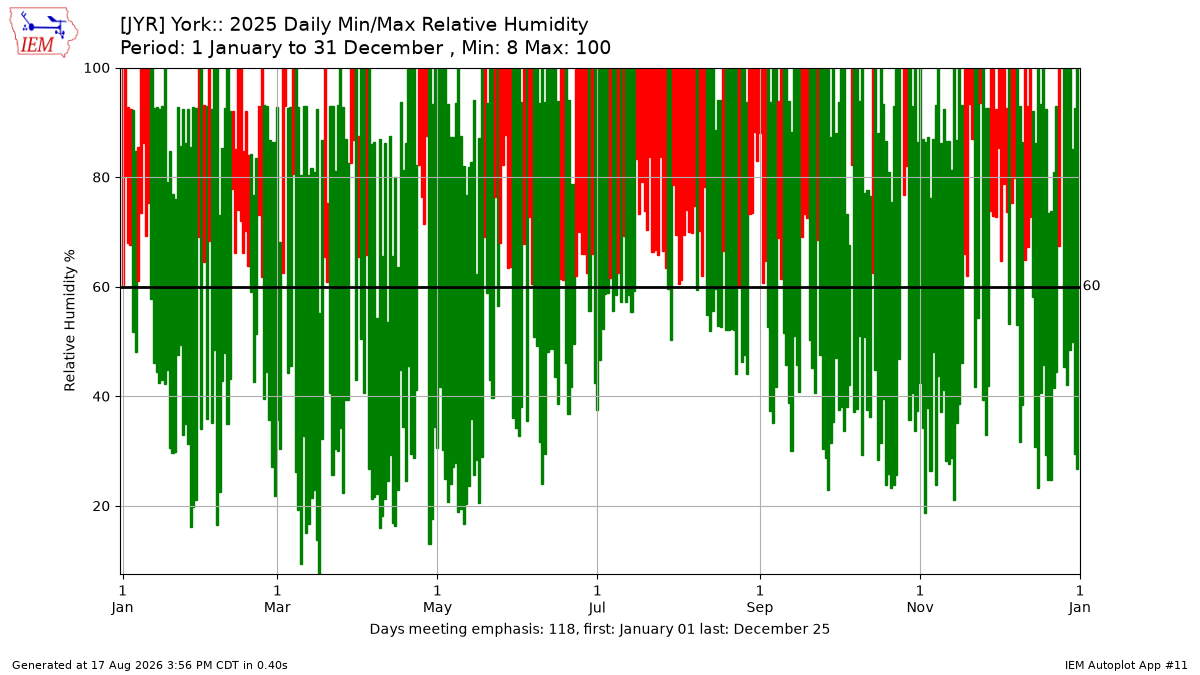
I asked Eric Hunt, UNL Extension Climatologist for some help assimilating the weather data for June, July, and August. The data is telling. In an email Eric shared, “York has had the highest average dew point in the state since June 21st, even more so than Falls City which would naturally be the most humid place in Nebraska. I also have attached the daily max/min humidity charts for the last two years. Those red lines are days where the relative humidity did not drop below 60 percent. That has happened frequently in your area this summer, on par with last year.” Charts at: https://jenreesources.com.

Last year, I shared we need a drop in humidity for the soybean white mold spores to be released. If the air relative humidity is 50% and above, the canopy relative humidity is at least that or higher. UNL emeritus plant pathology professor, the late Dr. Michael Boosalis, proved that the mushrooms produced by Sclerotinia sclerotiorum fungus needed a drop in humidity to build the pressure to release the spores. He had time-lapse imagery of this and was one of the few people in the world at that time who could produce the inoculum for plant breeders.
This is similar in concept to corn pollen. In many years, we receive a change in humidity as temperatures rise around mid-morning, allowing for anthers (which hold the pollen), to dry and release the pollen between mid-morning and mid-afternoon. However, high humidity can prevent this from happening.
Years ago, Dr. Tom Hoegemeyer wrote a CropWatch article on how high heat and high temperatures impact corn pollination. He shared, “Corn pollen is produced within anther sacs in the anther. The plant releases new, fresh anthers each morning, starting from near the top of the tassel, on the first day of shed, and proceeding downward over several days. The process of releasing the pollen from the anthers is called “dehiscence.” Dehiscence is triggered by the drop in humidity, as the temperature rises. However, when it is extremely humid and the humidity falls very little, dehiscence may not occur at all, or it may be delayed until late in the day. If one has breezes, while the humidity is still very high, the anthers may fall to the ground before pollen is released. If the temperature rises too high before pollen dehiscence occurs, the pollen may have reduced viability when it is shed.”
There may have been specific windows this pollination season where little to no pollen was released from anthers which could have impacted silk fertilization, especially when humidity never dropped below 70%. Just a day or two difference in flowering, or planting, or other factors can make a substantial difference in set, both in irrigated and non-irrigated fields. Silk receptivity to pollen also changes as silks elongate, become older, and dry out.
What I’m sharing about here is different than the tassel wrap situation impacting pollination in some fields due to reduced tassel and anther production; however, high humidity during pollination may have impacted the minimal pollen being shed from some of those tassels as well.
Regarding the corn maturing quickly, the end of July and a good portion of August saw night-time temperatures above 70F. Corn plants being C4 plants max out on photosynthesis when temperatures are above 86F and burn sugars at night to cool the plant when night-time temperatures are above 70F (corn prefers around 50F minimum temp). Using the sugars for cooling takes them away from growth and development, so the plant pushes forward in maturity. For those asking, the rains haven’t been able to offset this effect because night-time respiration is ultimately a factor of the night-time temperature.
The weather is outside of our control, but hopefully this helps explain some of the questions being asked. We will all hope for cooler nights going forward and a strong finish to the growing season. A reminder this week of the crop and soil health clinic at ENREEC near Mead on Aug. 27 and the wheat and alfalfa expo in Beatrice on Aug. 28.

Nitrogen observations
I’ve enjoyed hearing from farmers the past month about a few observations they’ve seen in their fields. The observations involve the difference between higher and lower nitrogen rates applied. The first observation was like I’ve shared in the past: less disease when less nitrogen was applied to fields. The comments have come from producers who were comparing either whole fields of theirs or strips within fields where nitrogen rates varied from 60-100+ lbs less nitrogen per acre. I was really pleased to hear farmers are noticing this observation for themselves in fields!
The second observation is fields looking good in spite of reduced nitrogen applied to some fields. All the producers who have provided this comment are using Sentinel Ag to aid in their nitrogen management. There’s a handful of producers who have been using Sentinel Ag for years with only 60-100 lb N/ac on their irrigated fields. In the past month, producers have also wondered about applying extra N due to recommendations of others or when one Sentinel indicator block would trigger but the others wouldn’t. In those cases, I’ve always recommended to only put on strips or a pie with the pivot that covered one indicator block but not the other. Prove it to themselves whether they needed the additional nitrogen or not.
We’ve had some consistent rains this growing season of 0.1-0.2” in the area and have been blessed with the larger rains the end of July and more recently. There’s quite a bit of research showing mineralization flushes when rains/irrigation of 0.5-1” are received (as long as the soil was at 50-80% field capacity). The small rains of 0.1-0.2” and the heavy morning dews I think are also contributing to mineralization bursts on the soil surface as a key to mineralization is wetting/drying cycles. Wetting and drying cycles on the soil surface lead to nitrogen and carbon cycling by the microbes.
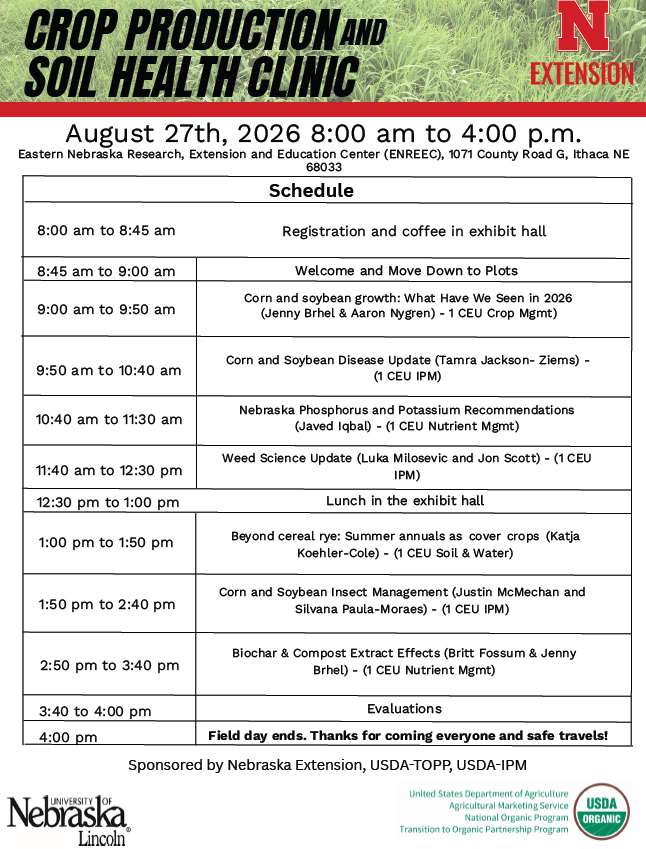
Crop Production and Soil Health Clinic will be Aug. 27th at ENREEC near Mead from 8 a.m.-4 p.m. This is a hands-on, research-based event focused on improving corn and soybean profitability through regenerative farming practices and better soil management. Topics include update on what we’ve seen with corn/soy this season, weed/disease/insect management, nutrient efficiency, cover crops, and biochar/compost extract effects. Designed for producers, crop advisors, agronomists and ag professionals, the program offers real-world tools to address pest resistance, reduce input costs and build more resilient cropping systems. To view the schedule and register, please click on the link: https://enreec.unl.edu/2026CropAndSoilHealthClinic/. The registration fee is $35 for those not needing CCA credits and $75 for those needing CCA credits. Fees include training, lunch, and reference materials. The training will be held rain or shine (bring rain gear).
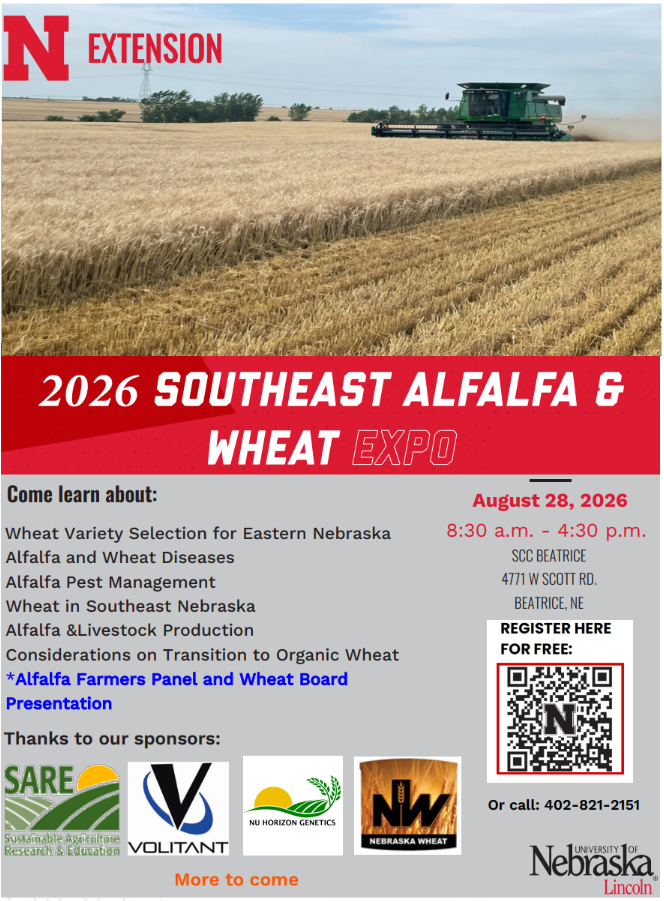
Wheat and Alfalfa Expo will be held on Aug. 28th from 8:30 a.m.-4:30 p.m. at Southeast Community College in Beatrice. The morning sessions will focus on wheat production and disease management. The afternoon sessions will focus on alfalfa management. The program will also feature an alfalfa producer panel, providing attendees with an opportunity to hear directly from farmers about their experiences and management practices. Attendees can choose to stay for the entire program or come and go at their convenience. There is no charge, but please RSVP for meal count at: go.unl.edu/2026alfalfawheatexpo or contact Matheus Ribeiro at mribeiro2@unl.edu or 402-441-7180.