Blog Archives
A Soil Health Journey
Monday morning my body woke up at 4 a.m. That’s normal for some people, but not for me. However, it was normal for me to wake up between 2-4 a.m. every Monday morning when I hadn’t finished my column on a Sunday night to get it completed in time for newspapers 😊
The past week was a whirlwind. I had wanted to finish well at UNL and last week included completing previously made commitments; will still finish harvest and reports with all my on-farm research cooperators. I’ve enjoyed being on the farm with Brian! And, I’m working some part-time hours as a Producer Research Lead for the Nebraska Soil Health Coalition, which closely aligns with both Brian and my goals in walking alongside others in their soil health journeys.
Since that is one goal Brian and I have, let’s talk about soil health. Defining soil health is difficult as there’s not an agreed upon definition. Soil is comprised of chemical, physical, and biological properties. The health part is the ability (continued capacity) to function as a vital living ecosystem sustaining plants, animals, and humans over time (via NRCS and numerous universities).
Six general soil health principles were adopted over time and are in continual revision by various entities:
- Minimizing Disturbance (reducing tillage, reducing chemical inputs)
- Keep the Soil Covered (protecting the soil with crop residue and/or cover crops)
- Maximize Biodiversity (diverse crop rotations, multi-species cover crops, diverse biology)
- Keep a Living Root Year-Round (active plant roots in the soil as long as possible)
- Integrate Livestock (add grazing animals where appropriate to the land to cycle nutrients and manage residues)
- Know Your Context (management is tailored to one’s specific climate, soil type, goals)
I think this is where soil health gets overwhelming to some as the principles can seem like a checklist and one’s Context trumps everything. That’s why I’ve referred to soil health as a journey.
We are all on journeys in life…physical, emotional/mental, spiritual, learning, etc. The start/beginning and destination are both important parts of a journey. However, it’s the time between the two where things happen. We change. We learn, grow, fail, succeed.
I think of life as interconnected with plants, humans, and animals. The soil sustains life for all of us. At a fundamental level, I think many seeking soil health journeys believe that healthy soil can lead to healthier plants, animals, and people.
I’ve watched how ag can quickly divide instead of unite. As I think of soil health, there can be a stigma that a person has to farm a certain way to be included. To me, there’s room at the table for all, and I don’t see soil health tied to a specific farming label.
There’s room to start with one thing. What is your concern? What is your goal?
- Those concerned about groundwater nitrate for future generations can start by reducing the amount of nitrogen applied. Using a tool like Sentinel Ag can help.
- Those concerned about soil erosion may consider reducing tillage or adding a cover crop in the off season.
- Those concerned about excess residue can work with a neighbor to graze livestock.
What one thing could be the next step to address a concern or goal in your soil health journey?
Beginning a Soil Health Journey
This was the topic of last week’s Friday February conversation. $700 million has been designated by USDA for regenerative ag and soil health. USDA’s defintion: “Regenerative Agriculture is a conservation management approach that emphasizes natural resources through improved soil health, water management, and natural vitality for the productivity and prosperity of American agriculture and communities.” From the website at: https://www.nrcs.usda.gov/programs-initiatives/regenerative-pilot-program, participants work with their local NRCS office to determine a whole farm plan addressing soil, water, and nutrient concerns. A soil sample is required in the first year and last year of the program. I’m grateful there’s finally a program that helps farmers who are either beginning or more advanced. For those beginning, practices such as reduced tillage, cover crops, etc. can be implemented. Those more advanced have additional options such as soil amendments. The original application was due Jan. 15 to qualify for 2026; however, several NRCS staff have told me to contact your local NRCS to fill out an application if you’re interested.
Why does this matter? The soil is a big deal! The majority of food and feed is raised in the soil. Healthier soil can lead to healthier people and animals. There’s an increasing number of labs that are documenting the nutrition density of foods grown in conventional vs. regen/organic systems. As I continue to learn results from these labs, it’s sad to hear how much we’ve lost in food nutrition. It’s also important for us to steward the resources we’ve been given well.
The following are a few thoughts shared by the farmers from the conversation. The greatest obstacle to overcome is one’s mindset…all the reasons we tell ourselves that we can’t change in addition to the social implications (family and friends) of doing something differently. We are only given so much time and so many seasons to farm. If you’re thinking about any change, try it now!
Advice to begin: Focus on one or two fields and continue the practices (reduced tillage or cover crops) on them for several years. It takes at least three years to see changes based on their experiences and our on-farm research studies. Planting cover crops on this or that field without consistency each year leads to frustration as one may not see improvements over time.
- Cereal rye before soybeans is the easiest way to start. Before corn, we’d recommend planting winter wheat or winter barley in the fall or spring oats.
- Either plant your crop into dead brown covers or green growing ones; don’t plant into the in-between stage. If terminating pre-plant, use clethodim to allow more structure to the covers and follow label restrictions before planting corn.
- Money savings can occur through reduced herbicide, fungicide, and seed treatment costs. Also through reduced irrigation if reducing tillage, which improves soil structure.
- Challenges are markets for alternative crops or to be paid for raising crops with less inputs.
- Challenges are also economics. Choosing to continue using the same amount of inputs with reduced tillage and covers makes the economics challenging. Personally, I see how growers on this journey could reduce inputs more; however fear is a factor in addition to advisors uncomfortable with recommending less.
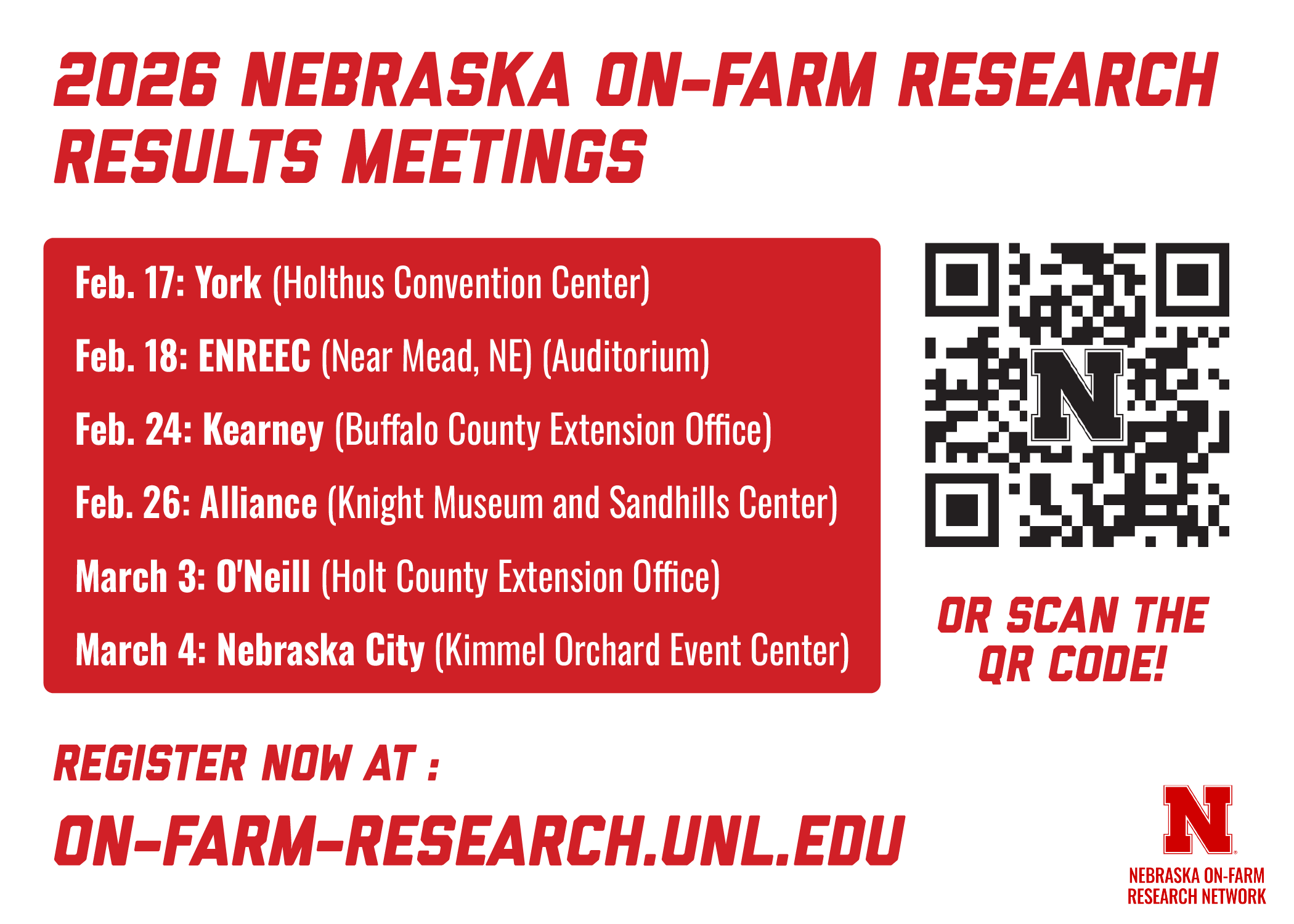
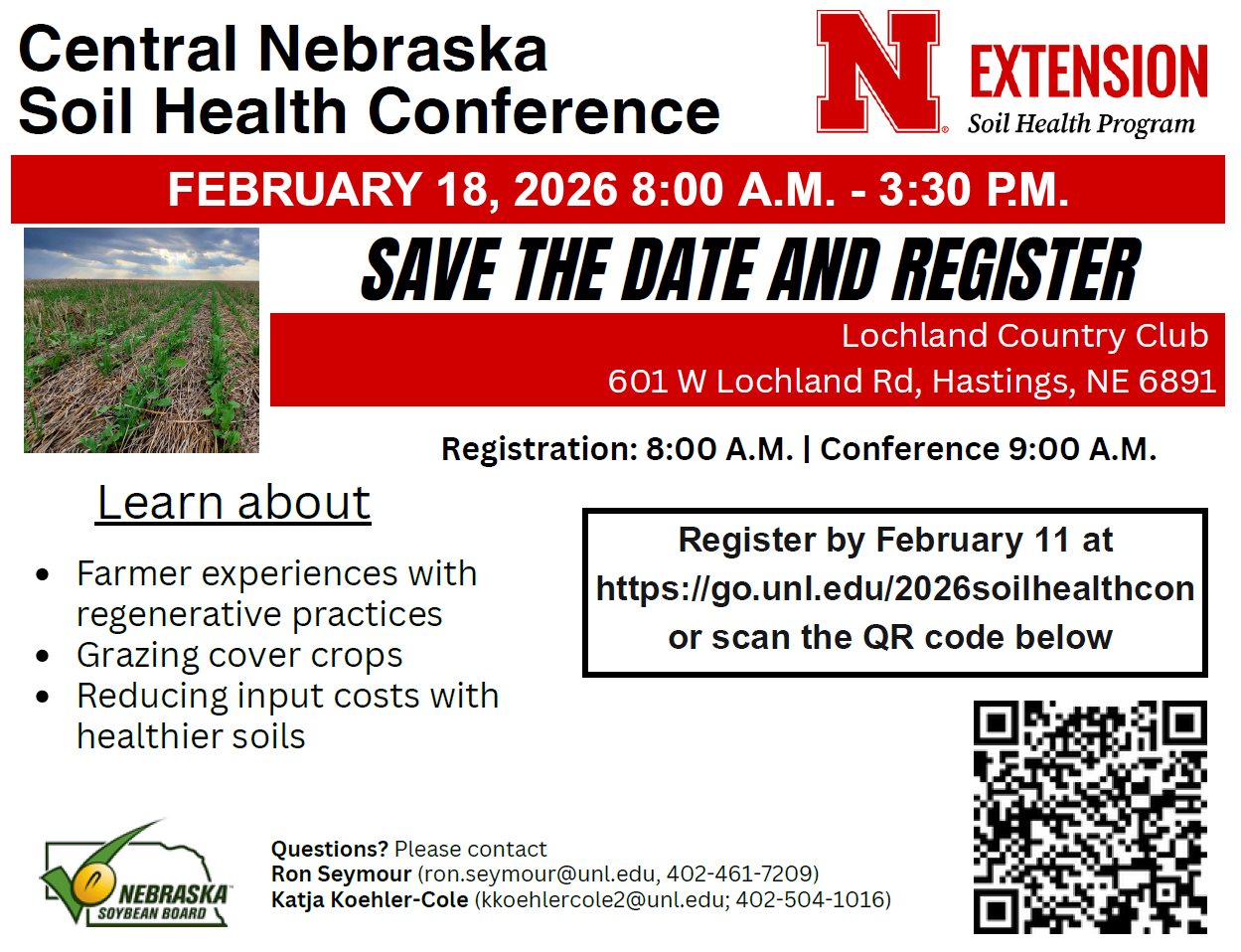
- Peer support is key. You don’t have to do this alone! If you’re interested in being connected to others, please reach out to me (jrees2@unl.edu). Another resource working to establish producer groups is the Nebraska Soil Health Coalition: https://www.nesoilhealth.org/. This Friday’s conversation (Feb. 13) is on nutrient balance from 10-Noon at the 4-H Bldg in York. The Central Nebraska Soil Health Conference is Feb. 18th at the Lochland Country Club in Hastings beginning at 9 a.m. (Reg. at 8 a.m.), RSVP: https://go.unl.edu/2026soilhealthcon.

Nebraska Soil Health Coalition
Soil Health Success Stories: This week I’m sharing on the Nebraska Soil Health Coalition. I’ve watched this effort since 2019 and am grateful for the leadership, vision, dedication, and endurance of the Board individuals who have successfully completed the beginning efforts of this Coalition! Some background from their website at: https://www.nesoilhealth.org/, “In recognition of the need to achieve more rapid and widespread adoption of soil health practices with multiple benefits, the Nebraska Legislature passed LB 243 in 2019. The legislation created a 17-member Healthy Soils Task Force (HSTF) task with developing a Nebraska Healthy Soils Initiative. The Healthy Soils Task Force concluded that healthier soils produced through best soil management practices improve yield stability, produce greater financial returns over time, reduce the need for chemical inputs, increase water infiltration rates and water storage capacity making soil more resilient to drought, flooding, and erosion, and protect and improve water quality.”
“In May of 2023 a group of committed individuals decided to establish an independent, non-profit Soil Health Coalition in Nebraska. The purpose of the Coalition is to advance producer-centered education, outreach, and adoption of soil health principles to build resilient farms, ranches, and communities across Nebraska.”
What I appreciate is the three-pronged, four metric approach that is different than what has been built in other states. The three prongs include: producer learning communities, demonstration/education sites, stakeholder visioning groups. The fourth metric includes Outcomes (soil health benchmarks, improved economics, community growth, success stories).
The other difference is the building of “Hubs” that include producers and stakeholders (medical, financial, consulting, community, etc.) in the surrounding communities of around a 9-county area. Hub 1 began in the Hastings and surrounding area with Hub 2 rolling out now in Southwest NE.
The producers participated in economic interviews with the Soil Health Institute (SHI) and socio-behavior interviews with Dr. Julie Snorek. Why is this important? SHI seeks to quantify economics of conventional vs. regenerative ag practices. By interviewing producers in a similar region, the economics and practices of that region can better be quantified and relevant to those producers.
What was learned? 20 farmers who had adopted soil health management strategies for at least 5 years (cover crops, reduced tillage, Sentinel Ag, etc.) were interviewed. For irrigated corn/soybean, it was found that overall, producers were able to reduce expenses by adopting soil health practices by a total of $147.19/ac for corn and $88.27 for soybeans. Added value from revenue such as grazing provided a total value of soil health practices of $152.94/ac for corn and $89.73/ac for soybean. Non-irrigated corn soybean saw a total value of $197.80 for corn and $102.12 for soybean for adopting soil health management practices. The full fact-sheet can be found here and is worth a read!
On the socio-behavioral side, the producers shared about isolation in adopting practices different than their neighbors, the importance of producer learning communities/peer networks to be vulnerable in sharing successes and failures, independence they felt in reducing the need to pay entities for inputs, farming being more fun/interesting in trying different practices, and also the need for alternative markets. The joy for me in attending the Celebration Event last week was seeing a glimmer of the hard work and dedication of the Board realized with producers and stakeholders presenting outcomes and the ability to have economics around these topics that are meaningful to Nebraska producers. Our hope is that more producers who are watching on the fringes will join us in adopting soil health practices in the future! More info. at: https://www.nesoilhealth.org/.
Water use till maturity for Corn: Beginning Dent 5”, ¼ milk 3.75”; ½ milk 2.25”; ¾ milk 1”.
Water use till maturity for Beans: Beg. Seed 6.5”; Full Seed 3.5”; Leaves beg yellow 1.9”.


Register now to reserve your seat: https://cvent.me/WMzLdk.


