Monthly Archives: October 2026
A Soil Health Journey
Monday morning my body woke up at 4 a.m. That’s normal for some people, but not for me. However, it was normal for me to wake up between 2-4 a.m. every Monday morning when I hadn’t finished my column on a Sunday night to get it completed in time for newspapers 😊
The past week was a whirlwind. I had wanted to finish well at UNL and last week included completing previously made commitments; will still finish harvest and reports with all my on-farm research cooperators. I’ve enjoyed being on the farm with Brian! And, I’m working some part-time hours as a Producer Research Lead for the Nebraska Soil Health Coalition, which closely aligns with both Brian and my goals in walking alongside others in their soil health journeys.
Since that is one goal Brian and I have, let’s talk about soil health. Defining soil health is difficult as there’s not an agreed upon definition. Soil is comprised of chemical, physical, and biological properties. The health part is the ability (continued capacity) to function as a vital living ecosystem sustaining plants, animals, and humans over time (via NRCS and numerous universities).
Six general soil health principles were adopted over time and are in continual revision by various entities:
- Minimizing Disturbance (reducing tillage, reducing chemical inputs)
- Keep the Soil Covered (protecting the soil with crop residue and/or cover crops)
- Maximize Biodiversity (diverse crop rotations, multi-species cover crops, diverse biology)
- Keep a Living Root Year-Round (active plant roots in the soil as long as possible)
- Integrate Livestock (add grazing animals where appropriate to the land to cycle nutrients and manage residues)
- Know Your Context (management is tailored to one’s specific climate, soil type, goals)
I think this is where soil health gets overwhelming to some as the principles can seem like a checklist and one’s Context trumps everything. That’s why I’ve referred to soil health as a journey.
We are all on journeys in life…physical, emotional/mental, spiritual, learning, etc. The start/beginning and destination are both important parts of a journey. However, it’s the time between the two where things happen. We change. We learn, grow, fail, succeed.
I think of life as interconnected with plants, humans, and animals. The soil sustains life for all of us. At a fundamental level, I think many seeking soil health journeys believe that healthy soil can lead to healthier plants, animals, and people.
I’ve watched how ag can quickly divide instead of unite. As I think of soil health, there can be a stigma that a person has to farm a certain way to be included. To me, there’s room at the table for all, and I don’t see soil health tied to a specific farming label.
There’s room to start with one thing. What is your concern? What is your goal?
- Those concerned about groundwater nitrate for future generations can start by reducing the amount of nitrogen applied. Using a tool like Sentinel Ag can help.
- Those concerned about soil erosion may consider reducing tillage or adding a cover crop in the off season.
- Those concerned about excess residue can work with a neighbor to graze livestock.
What one thing could be the next step to address a concern or goal in your soil health journey?
My Last Extension Column
I didn’t manage to get this written before leaving Extension; this is my last column for Extension. Thank you to all who have read what I’ve written through the years! It truly is humbling to know people read this column when there’s so many sources from which people can choose information.
I’ve reflected a lot. I’ve been sad at times to leave Extension and the people I’ve served, and, I’m excited for this next adventure to spend more time with Brian on the farm.
In reflecting, I keep coming back to gratitude. Through the years, some of the most impactful columns I’ve written (according to reader comments) talked about gratitude…how gratitude helps reduce anxiety and stress, how gratitude helps with one’s mood and outlook, how gratitude is the most endearing quality a person can have (and all of those statements are backed by research!). Please keep this in mind this harvest season! In spite of the challenges ahead, we truly are so blessed!
I’m grateful for a career in serving people and I’m looking forward to serving in my next one as well. I’m grateful for all the relationships and the people who have cared deeply for me. This has been exhibited throughout my career, but especially this past month through all the thoughtful notes, emails, cards, calls, texts, and the large turnout for the celebration. I’ve been somewhat overwhelmed and apologize if I haven’t gotten back to you. Thank you all for caring so well for me!
There’s a quote that stuck with me early in my career. It says, “People don’t care how much you know until they know how much you care”. How true! I wasn’t initially planning to leave my Extension career quite yet, and it was the clear next path. My husband and office team shared with me that it should be hard … that when a person cares deeply for others and in serving others, tears will and should flow at times. Change can be hard yet change can also bring blessing!
I’m grateful that relationships continue regardless of how careers change. Many showed me the truth of that when I moved from the Clay County area to the York/Seward area. I’m grateful to still be in an ag career and have the opportunity to still serve farmers, just in a different way.
I’m grateful for how Jesus changed my life! I was a sinner in need of a Savior. Jesus lived the perfect life, paid the penalty I deserved on the cross, conquered death and rose again! I recognized I couldn’t earn my way to heaven – that Jesus is the only way – and placed my faith, trust, and repentance in Him alone for my eternal salvation (Ephesians 2:8-9). He loved each of us that much to go to the cross for us! My hope is that if you don’t know for sure where you will spend eternity that you’d reach out for a conversation as I’d love to share more with you. My cell phone will remain the same (402) 440-4739.
While this is my last column for Extension, I’m not going to stop writing. Perhaps not every week, but I plan to write about soil health and things Brian and I are learning. I’m excited to take a deep dive into plant/human/animal nutrition, learn how to verify our compost and compost extracts via microscopy, and better understand root causes of plant problems instead of treating symptoms. If you’re interested in learning with me, you can enter your email into the “follow my blog by email” at https://jenreesources.com/. With this, thank you for the encouragement, relationships, and support of me these past 22.5 years! It’s been a blessing and I’m grateful – Jenny
Harvest Grain Quality Concerns 2026
I’ve been thinking of the grain quality concerns and safety with the upcoming harvest. We all know how crazy it’s soon to get with harvest. Unfortunately, most of the corn and soybean are ready now at the same time. It’s hard to know how to prioritize harvest. Normally, we’d go by percent stalk rot in a field of corn and percent moisture in both corn and soybean. Perhaps there’s still ways to prioritize based on those factors, but now we have the additional concern of looking at grain quality as well in both crops. The following article has tips as one faces harvest these coming weeks: https://cropwatch.unl.edu/harvest-2025-prep-guide-minimize-losses-disease-stressed-corn/.
For stalk rot assessments: Push at least 100 corn plants to arm’s length about 30 degrees from vertical. If plants bend below the ear and don’t snap back upright, they have a greater chance of lodging at or prior to harvest if there’s high wind events or heavy rain. I prefer the pinch test in which one squeezes the lower internodes to assess stalk strength and check for stalks that are easily crushed by hand.
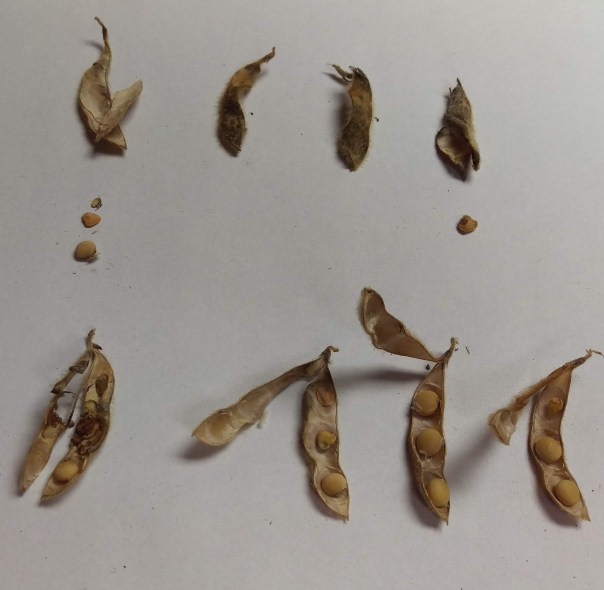
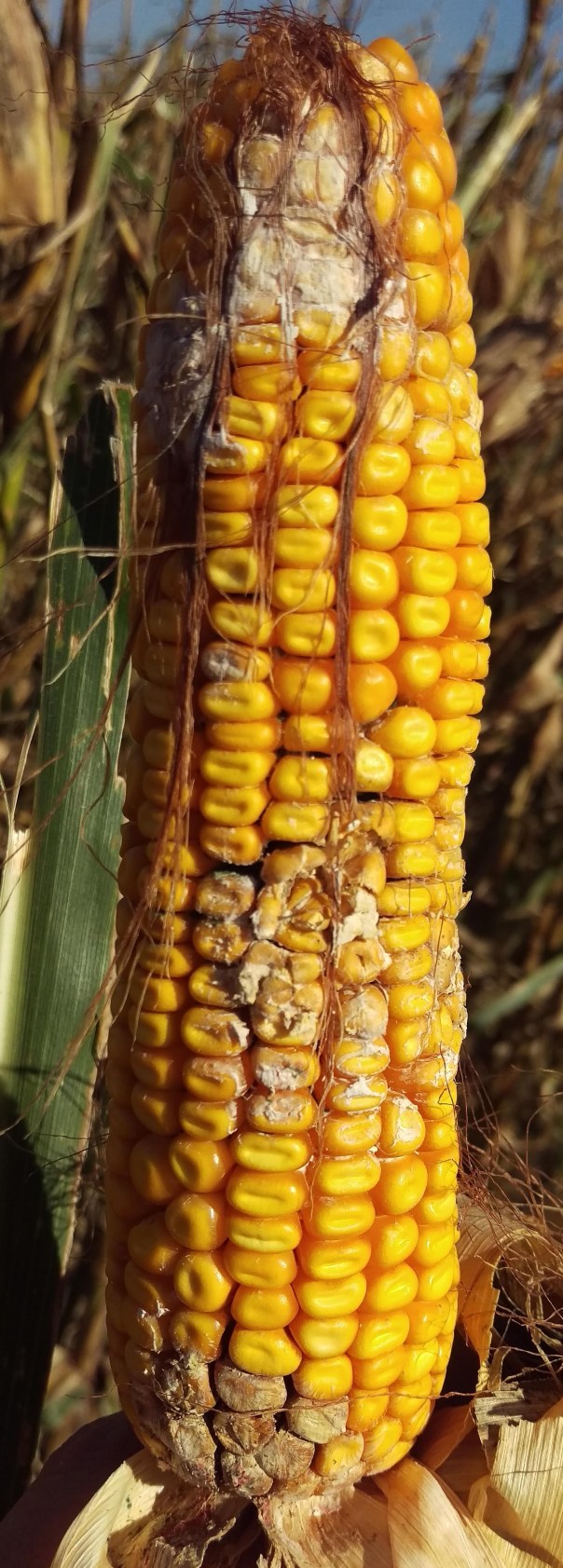
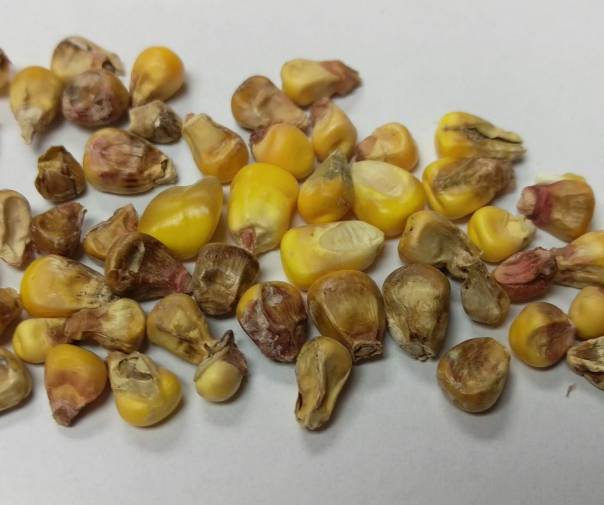
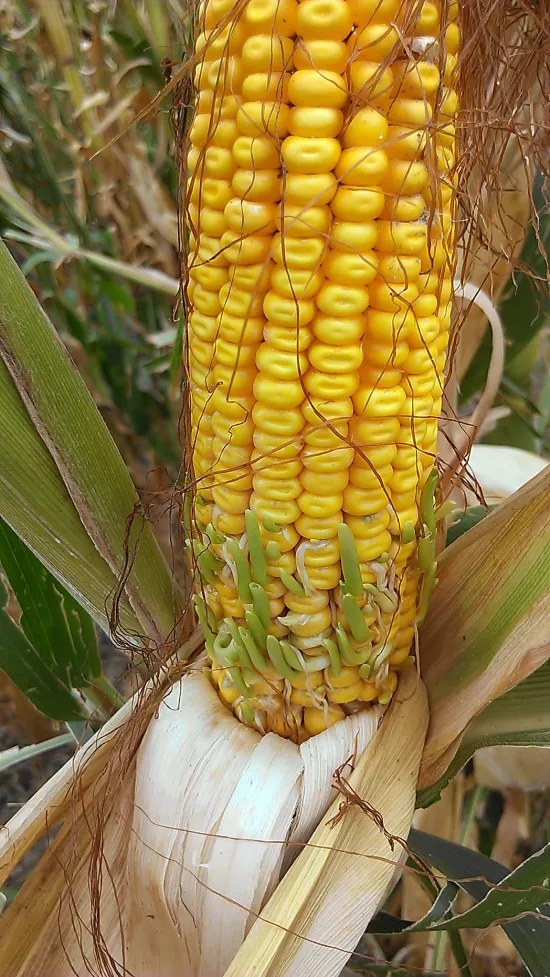
Both corn and soybean have sprouting occurring in the field. In corn, this is particularly occurring where ears are upright with tight husks. With soybean, it’s occurring where the beans in the pods dried down to 13% or less and rewetted to at least 50% of their seed weight with the rains. There’s also a number of fungal kernel rots occurring in corn. Fusarium and giberella have a white/pink/red fungal growth. The presence of the fungus doesn’t guarantee mycotoxins are present, but potential mycotoxins that can be associated with these fungi are vomitoxin and fumonisin. White fungal growth that overtakes an ear and makes it feel very light is diplodia. There are no mycotoxins associated with it. There’s also a number of “lesser fungi” that cause cob rots that we’re also seeing this season.
It’s important to know what’s impacting the corn ears prior to harvest, binning corn, or taking it to the elevator. If a particular hybrid is more impacted by kernel rot than another, make sure not to put that corn in the same bin as corn with better quality. Grain affected by ear rot diseases and mold are less suitable for storage. Use or sell affected grain first and store the highest quality corn possible. Grain needs to be cooled to 55F and at 13-14% moisture in order to stop Fusarium and other fungi from continuing to grow in the bin. More info. at this resource: https://cropprotectionnetwork.org/publications/storing-mycotoxin-affected-grain
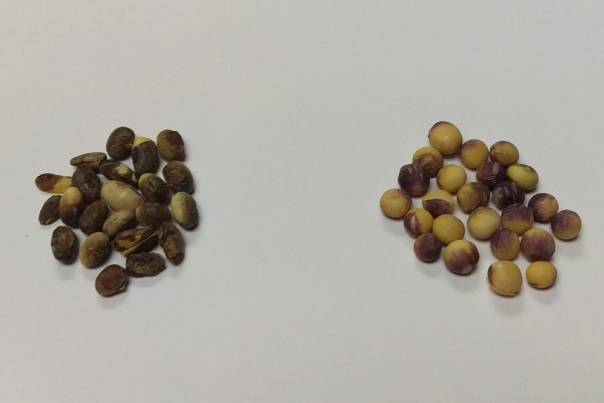
For soybeans, it’s also important to know if the variety in the field is impacted by things like purple seed stain or Phomopsis seed decay, which can cause elevators to reject soybeans. If you’re noticing discolored soybeans, talk to the elevator beforehand. Both of these conditions are variety related so keep track of which varieties you observe these conditions in.
Set combine fans to blow out as many broken/damaged kernels from insects, fungi, or sprouting as possible. Adjust combine settings to reduce harvest losses due to brittle kernels. Aim to start harvesting fields at a higher moisture (above 17%).
It will be a dirty harvest as secondary fungi can turn the leaves and stalks a blackish color. Fungal spores may behave like dust and aggravate respiratory illness or symptoms in sensitive individuals. Consider wearing dust masks or respirators when working in affected fields or around grain, such as in grain bins. Check air filters on equipment operating in conditions with a lot of dust and spores. Keep fire extinguishers close at hand. Take breaks as needed — and care for your mental, emotional and physical well-being. Be careful on roads: use headlights especially on gravel roads and check intersections before proceeding through them in the country. The Nebraska Rural Response Hotline is 800-464-0258 and is available for emotional support, legal and financial assistance, and disaster relief. Wishing everyone a safe harvest and hoping yields aren’t impacted too much from the challenges.

Corn Observations



Grain Storage
There’s over 25 species of fungi that can produce ear molds with the majority of them ceasing growth at 14% moisture within the kernel. For short term storage of moldy grain, drying to 15% moisture as quickly as possible can greatly slow additional fungal growth within the grain bin. The table below shares the days required to dry corn to 15% moisture with 1.0 cfm/bu and various temperature and humidity conditions. More info. at this resource: https://cropprotectionnetwork.org/publications/storing-mycotoxin-affected-grain

“Since drying time is directly proportional to the airflow, the producer can calculate the estimated drying times when using airflows other than 1.0 cubic foot of air per minute per bushel (cfm/bu). For example: Table II shows when drying corn from 18 percent to 15 percent moisture with 50F and 50% relative humidity air, the estimated drying time is 12.5 days using a 1.0 cfm/bu airflow. If the airflow is 1.25 cfm/bu, the estimated drying time would be 12.5 days / 1.25 = 10 days. For 1.5 cfm/bu, the drying time would be 12.5 days / 1.5 = 8.3 days. For 0.8 cfm/bu, the drying time would be 12.5 days / 0.8 = 15.6 days.” Source: Management of in-bin natural air grain drying systems to minimize energy cost.
- Management of in-bin natural air grain drying systems to minimize energy cost
- UNL CropWatch Grain Storage Resources
- Managing large grain bins for potential mycotoxin contamination
Mycotoxin Information
In 2026, we’re primarily seeing Fusarium and Gibberella species which have the potential to produce mycotoxins. Thus, the information below is directed at those fungal species and mycotoxin levels that can be associated with them. Again, the presence of fungi does not automatically mean a mycotoxin is present.

The following toxins can be produced from species of Fusarium and Gibberella. Source: Corn Ear Rots, Storage Molds, Mycotoxins, and Animal Health, Iowa State publication, 1997.
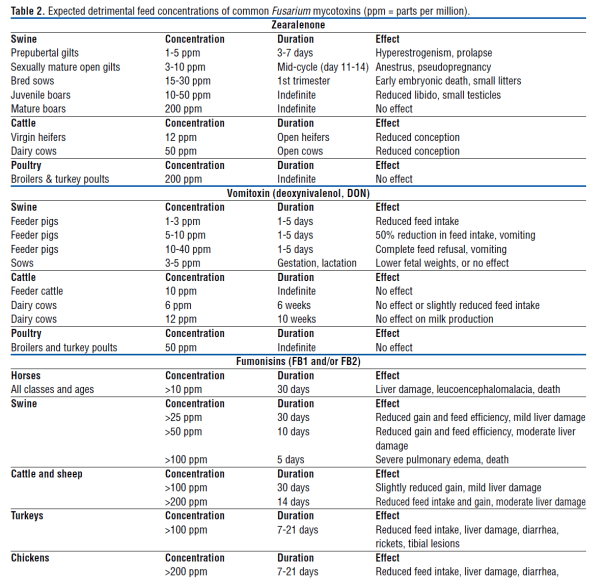
Source: Corn Ear Rots, Storage Molds, Mycotoxins, and Animal Health, Iowa State publication, 1997.


