Monthly Archives: May 2026
June 2026 Events
Wheat Variety Tours: Due to drought and frost impacts to wheat throughout the State this spring, the tours have been modified this year. Full details in this article: https://go.unl.edu/bm7f. Tours still occurring for those of you who receive this column include: June 10 for Jefferson County, Knobel Seeds (5 p.m. CT); June 15 for Hitchcock/Red Willow County, Peters Seed Farms (5 p.m. CT); and June 16 for Perkins County, Stumpf International Wheat Research Center (9 a.m. MT). Also a note, because certified wheat seed will be in short supply, it’s recommended that you reserve wheat seed as soon as planting intentions are determined for next year’s cropping season.
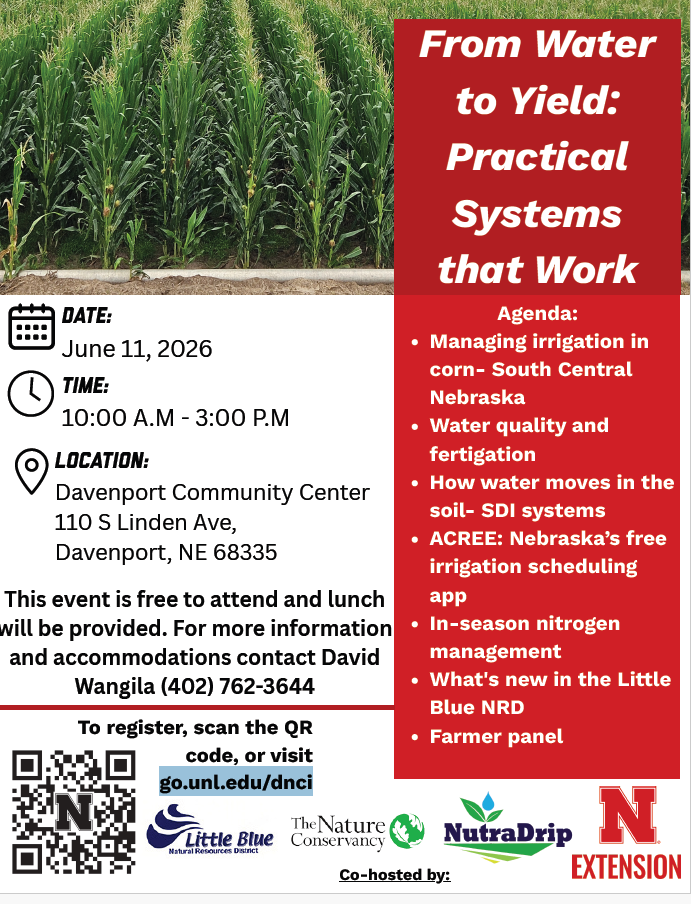
Water to Yield Workshop June 11: Farmers and agribusiness professionals are invited to attend a Water to Yield Workshop to be held at the Davenport Community Center in Davenport from 10 a.m.-3 p.m. (registration begins at 9:30 a.m.). The goal is to help producers better manage water and nitrogen resources for enhanced water quality and quantity. Topics include research from UNL’s South Central Ag Lab on irrigation scheduling with limited water, a free app for irrigation scheduling, subsurface drip irrigation, fertigation, in-season nitrogen management, and updates from the Little Blue NRD. Farmers will also share their insights on managing irrigation and in-season nitrogen on a farmer panel. There is no charge to attend, but registration is requested for a meal count. Please RSVP to the Clay County Extension Office at 402-762-3644 or at https://go.unl.edu/dnci.
Summer Stocker/Yearling Tour will be held on June 23 near Broken Bow, offering cattle producers an opportunity to learn from Nebraska operations managing through ongoing drought conditions and explore current research and management strategies for stocker and yearling systems. Registration will be held from 9 to 9:30 a.m. CST at the Custer County Fairgrounds 4-H Building, 44100 Memorial Drive in Broken Bow. Tour participants will visit operations managed by Rodney Lamb at Lamb Farm and Feedyard and Mike Tierney, where discussions will focus on drought management, grazing strategies, forage conditions and decision-making during challenging environmental conditions.
Lunch will be served at noon at the 4-H Building and will include a presentation from UNL beef systems specialists on a new vitamin and mineral balancing tool designed to support producer decision-making and herd performance. The cost to attend is $20, which includes lunch. Registration is due June 19. Participants can register online at go.unl.edu/summerstockertour or by calling 308-268-3105. The tour is sponsored by Merck Animal Health.
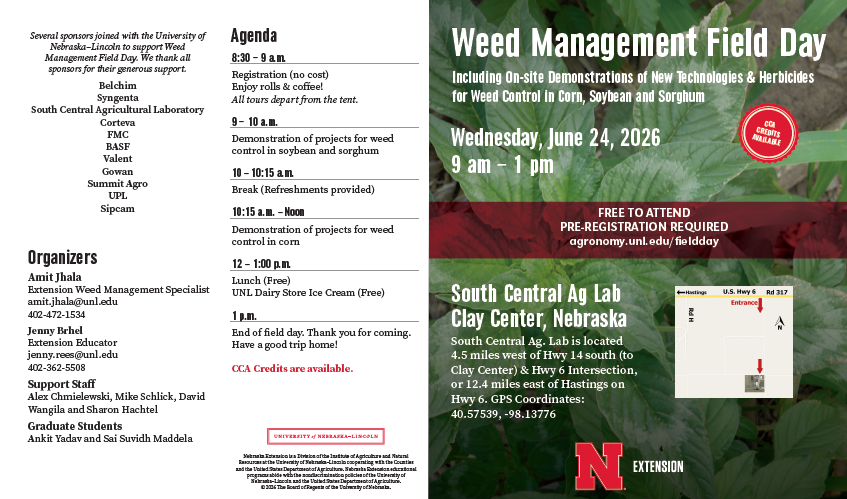
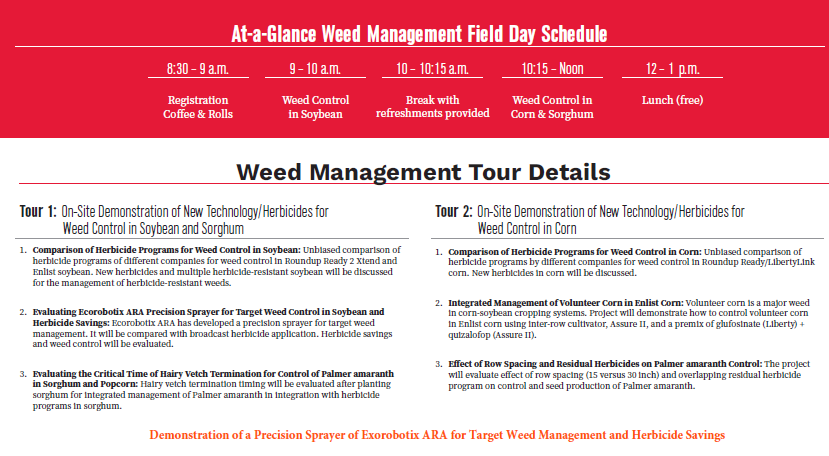
Weed Science Field Day will be held on June 24 at UNL’s South Central Ag Lab near Clay Center. The program runs from 9 a.m. to 1 p.m. (Registration at 8:30 a.m.). The field day showcases chemical comparisons for weed control in corn, sorghum, and soybean. I also appreciate how Dr. Amit Jhala is always looking at alternative options for weed control or system’s approaches that include chemicals and cover crops. New this year is an evaluation of the Ecorobotix ARA Precision Sprayer for targeted weed management. Row spacing of 15” vs. 30” with overlapping residual on palmer control and seed production will be shared. Also, hairy vetch termination timing for control of palmer amaranth in sorghum and popcorn will be shared. There is no charge to attend, but registration is requested to: https://agronomy.unl.edu/fieldday/.
Sprinkler Packages and Wind
Grateful for those who paid the ultimate sacrifice for our freedom and to their families left behind. May we never forget that freedom isn’t free! This week sharing excerpts of an article that my colleagues wrote on sprinkler packages in windy conditions. The full article is here: https://go.unl.edu/f90p. “Efficient irrigation relies on minimizing water losses and maximizing the portion of applied water that reaches the crop root zone. …Past UNL research has shown that evaporation losses are often less than 4% of the applied water, though potentially approaching 10% with sprinklers on top of the pipe under high pressures, creating small droplets. In contrast, wind drift can lead to larger losses than evaporation by physically moving water droplets away from the intended target area. This not only reduces irrigation efficiency but can also create uneven water distribution across the field.
…a field evaluation was conducted recently at the UNL’s South Central Agricultural Laboratory (SCAL) near Clay Center, Nebraska. The evaluation was conducted with sustained winds of 10-15 mph and gusts reaching 20-25 mph, conditions that are not uncommon during the irrigation season in Nebraska. The sprinkler industry offers a wide range of sprinkler packages designed to meet different irrigation goals. In this test, three sprinkler configurations from Nelson Irrigation Corporation were tested: 1) Orbitor with blue plate (large droplet design). 2) Sprayhead with tan bubble-wide plate (bubbler-style). 3) Sprayhead with purple plate (fine droplet design).
All these sprinklers were mounted on drops at 9 feet aboveground. Each configuration was assessed based on observed wetted diameter, droplet size and behavior, and overall performance under windy conditions. In addition, a catch-can test was conducted to evaluate how closely the applied water matched the target depth programmed into the system.
The Orbitor sprinkler performed consistently under windy conditions and maintained a stable water distribution pattern. It also produced a relatively large wetted diameter: approximately 40 feet in the direction of the wind. This broader coverage can help reduce application intensity and thus, the risk of generating surface runoff.
Sprayhead with Tan Bubble-Wide Plate: The bubbler configuration produced larger droplets and demonstrated strong resistance to wind drift. The wetted diameter was less than half of Orbitor’s at approximately 18 feet in the direction of the wind. These characteristics make this type of sprinkler particularly effective at delivering water to the intended area when wind is a concern. However, some localized ponding was observed during the test, even at a relatively low application depth of 0.25-inch. This suggests that the higher application intensity associated with a smaller wetted diameter may increase the risk of runoff, particularly in soils with lower infiltration rates or in fields with slope.
Sprayhead with Purple Plate: This configuration produced the smallest droplet size and, under calm conditions, would be expected to create a relatively narrow wetted pattern. However, under the windy conditions during the test, performance was significantly compromised. The fine droplets were highly susceptible to wind drift, to the extent that the boundaries of the wetted area could not be clearly identified in the field. …this type of sprinkler configuration may result in reduced irrigation efficiency and non-uniform water distribution when used in windy environments.
The results of this field test reinforce a key point: sprinkler selection plays a critical role in determining how effectively irrigation water is delivered under windy conditions. In windy conditions, droplet size matters. Sprinklers that produce larger droplets are less likely to be carried away by wind, improving the likelihood that water reaches the soil surface where it is needed. There is a tradeoff between drift and application intensity. While larger droplets reduce drift, they are often associated with smaller wetted diameters and higher application rates, which may increase the risk of ponding or runoff. …Producers are encouraged to evaluate their current systems, consider how they perform under windy conditions, and work with irrigation professionals to select and maintain sprinkler packages that align with your field conditions and water management goals.”
Forage Resources in Drought
Grateful to see some widespread rain this weekend! For fun, there’s a number of tales for predicting rain, including seeing snakes on/crossing the road. Some growers have shared specific numbers with me such as needing to see seven or five snakes on the road. I saw a post on X from the Western Colorado/Wyoming/Panhandle of Nebraska that had a number of replies regarding seeing snakes on the road and many chiming in regarding how many they’d seen last week. There were some who commented about turtles too (of which I also saw one crossing the road last week). And while farmers haven’t mentioned this one to me, it appears that there’s science behind these low-flying, at times kamikaze birds flying so low recently. Air pressure changes before a rain push the insects lower to the ground making the birds to fly lower to eat them. Regardless of what all is truth, it is interesting to me to hear what people observe and to consider how God’s creation knows weather events before we do.
Most of my questions this past week were on the lack of forage with cool-season pastures being so short, mostly in this area of the state. I continue to receive calls from the wildfire and severe drought impacted areas of western Nebraska too. We’re trying to help people with forage resources for grazing and also for drylot space get matched with those who need it at either: https://www.pasturematch.com/ or https://nebraskagrazingexchange.com/.
For people looking for hay and forage in the form of round or square bales, or for those who have bales to sell, a resource is the Nebraska hay and forage hotline at: https://nda.nebraska.gov/promotion/hay.
Received a number of calls about pastures, wheat, and alfalfa going backwards due to drought. We’ll need to watch how the rain changes things, but last week, I was recommending growers have crop insurance look at wheat and then consider getting it grazed or hayed for forage. It still may be a good option considering the need for forage many have.
Much of the alfalfa I’ve been looking at is in the bud stage nearing bloom but is often only 6-8” tall in non-irrigated fields and quit growing. My colleague Ben Beckman and I wrote an article for this week’s CropWatch (https://go.unl.edu/kmcg) where we figured that first cutting alfalfa would need to yield 0.5 ton to pay for the cost of fuel and cutting, raking, and baling. Other universities suggested no cutting of alfalfa if it was less than 10” tall. Quality is maintained in drought-stressed alfalfa, so if you do harvest, waiting for full bloom (vs. 1/10 bloom like we normally recommend) will help drought-stressed crowns recover better. With the recent rains, we’ll have to watch how the alfalfa regrows as it comes out of dormancy.
Grazing alfalfa is an option I’ve recommended to several in this situation instead, if there’s opportunity for fence and water. Waiting till the alfalfa blooms reduces any chance of bloat and waiting till full bloom helps the alfalfa recover better after grazing. Other things to consider when grazing alfalfa are: don’t turn animals out hungry, provide some free choice hay, and avoid turning animals out when there’s dew or recent rain on the leaves (allow the leaves to dry first).
If you can’t graze and can’t justify cutting hay, it’s probably best to just leave it alone. Shredding or haying will give you a cleaner, higher quality hay once your alfalfa does receive enough rain for regrowth. While removing dormant growth may slightly speed regrowth, plants will recover following sufficient rainfall even without cutting. In most cases, it’s not worth the cost and time involved to shred, clip or harvest low-yielding hay.
JenResources 5-10-26
Planting has greatly progressed and/or finished for most in the area. I enjoy seeing the fuzzy green appearance of fields with something growing in them again! The main issues I’m hearing about are drought, crusting, and ground squirrels. We will keep praying for rain! For ground squirrels, I’ve heard the following options for management: plant deeper (2 ¾” vs. they will dig to 2.5”), get a badger!, bait holes and replant. Zinc phosphide is labeled for use for ground squirrels. Nathan Mueller, a former colleague, had shared a pre-plant option (ZP® Rodent Bait AG) for consideration for next year. That product can be applied pre-plant or at planting according to labeled instructions. If you find something that works, please let me know so I can pass it along!
NUE Program: A reminder that the Nitrogen Use Efficiency program deadline to apply is May 15, 2026. The application and instructions can be found at: https://dwee.nebraska.gov/nebraska-nitrogen-use-efficiency-nue-program.
Lawn clippings around plants: Many homeowners apply herbicides (or pay a company to apply them) to their lawns. Herbicides include products that control dandelions, clover, and other weeds in lawns. They are also contained in “weed and feed” products. Most of these herbicides have restrictions that require at least 3-4 mowings of the lawn (so essentially think 3-4 weeks) before lawn clippings can be placed around garden plants. Dying and/or curling leaves around vegetables and flowers may be attributed to people placing lawn mulch around plants too soon.
Mulch and termites: Does using wood mulch around the home attract termites? No as the chipping process kills termites. The most noted study was conducted by Long, et al. in 2001 which compared different types of mulches. They found termites prefer higher nutrient woody materials like cardboard placed under inorganic mulches like pea gravel compared to wood or needle mulch. However, mulches can create a hospitable environment for subterranean termites already established in the soil near the home or building. Termites prefer a moist environment, so soil desiccation (letting the soil dry) near the house foundation is an important barrier. Some keys with applying mulch include: don’t apply more than 2” thick layer of mulch in landscape beds, ensure a 6” gap between the top of the mulch layer and the house siding, and avoid watering mulch or soil close the house foundation walls. Mulch can be applied up to the house foundation to within 12” of the foundation. One may also consult a professional to set up monitoring or barrier control methods for termites around the home or building. The following guide has additional helpful thoughts on termite prevention and control: https://edis.ifas.ufl.edu/publication/IN1277.
Roller Crimping Workshop: Discover how roller crimpers can help manage cover crops without turning the soil — see the equipment in action and learn how to make this low-disturbance method work for your operation at Nebraska Extension’s hands-on workshop on Wednesday, May 20. Free on-site registration begins at 9 a.m.; no pre-registration is required. The program will begin at 9:30 a.m. and conclude at 11:30 a.m. For more information, contact Katja Koehler-Cole at 402-504-1016 or Aaron Nygren at 402-624-8030. ENREEC is located at 1071 County Road G, Ithaca, Nebraska.
Roller crimpers mechanically terminate cover crops while leaving the soil undisturbed, ideally creating a thick mulch that suppresses weeds. They are commonly used by organic and regenerative farmers, as well as others looking to reduce herbicide inputs or improve weed control with cover crops. Growers and ag professionals interested in learning more about this termination strategy are invited to attend this workshop.
Frost Damage to Emerged Corn & Soybean
What to expect from frost on emerged corn and soybean: The cold temps on Friday night resulted in questions on what to expect regarding any potential frost damage to emerged corn and soybeans. For crop damage situations, waiting five to 10 days helps when assessing regrowth potential. The warm conditions of the past weekend following this freeze event can result in a quicker assessment of 3-5 days.
Plant tissues typically do not freeze when the air temperature around them is 32°F. The reason is because solutes are present in the membrane-bound cytoplasm (and also just outside of cell membranes) and they act like a very modest anti-freeze. Thus, plant tissue usually does not freeze until the tissue temperature reaches 30°F to 28°F. Source: Pearce, R.S. 2001. Plant Freezing and Damage. Annals of Botany 87:417-424.
Early season hail and/or freeze damage on corn can cause exposed leaves to be damaged. Fortunately, until V5-V6, the growing point is below the soil and the corn should recover. The damaged leaves will dry and, as regrowth pushes through, the damaged leaves should blow away in the wind. However, wrapping can occur, so fields should be monitored.
In assessing corn plants, dig up and then slice open plants to evaluate the growing point. If the growing point is white or cream in color and firm, the plant should survive. In contrast, if the growing point is brownish-colored and mushy, the plant will not likely survive.
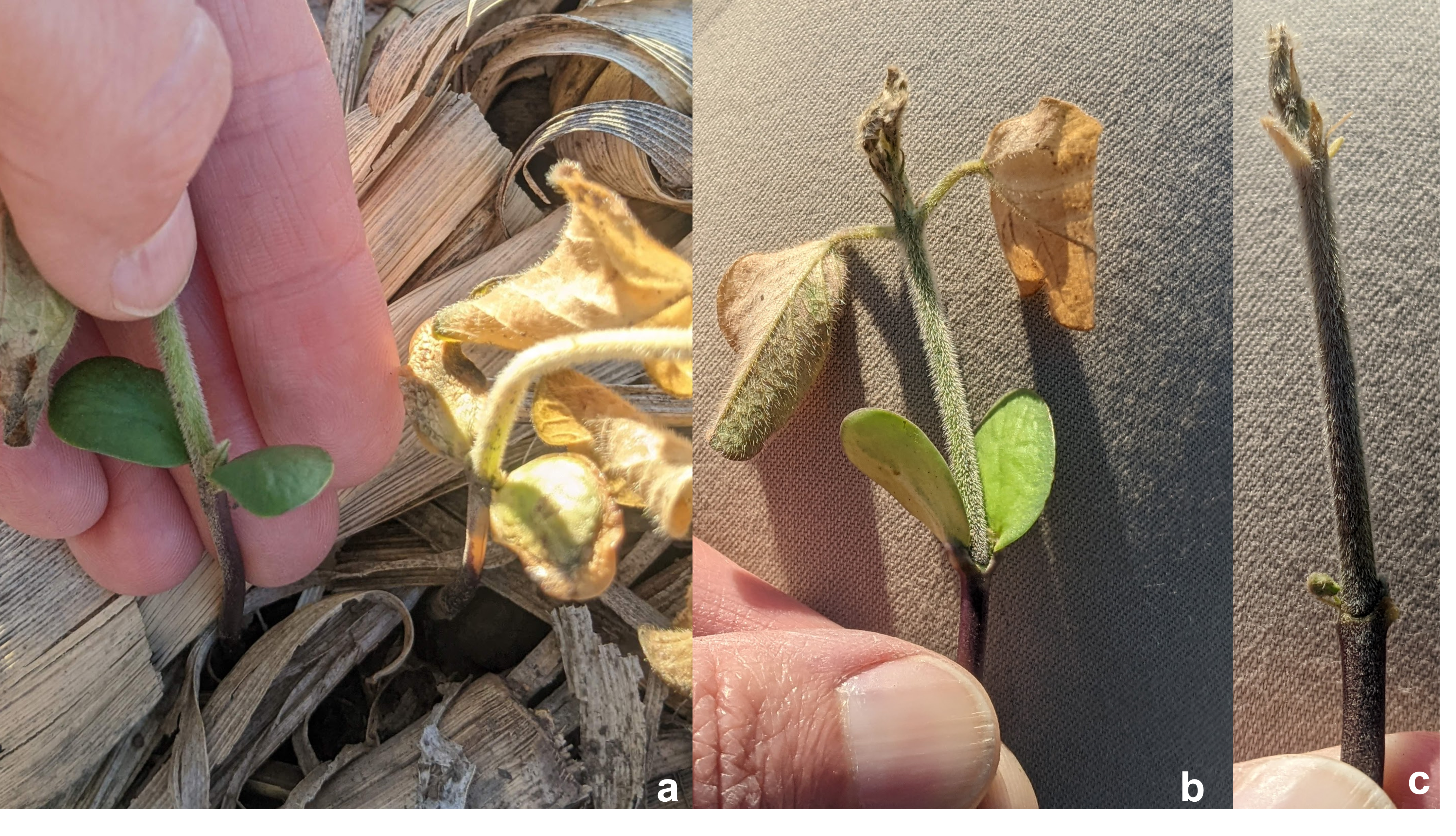
For soybeans, cotyledons are actually somewhat frost tolerant since they are 95% water and fairly thick, so low temperatures are needed for more time to cause damage. However, soybeans that are just emerging with the hypocotyl hook exposed at or just above ground level, are the most at risk for damage. The hypocotyl hook is the area of the stem below the soybean cotyledon. Anything that impacts it will result in seedling death. Watch for plants that have soft, mushy, or pinched hypocotyls. Soybeans can survive the cotyledons being stripped and/or burnt off. Soybean has additional growing points at the axillary buds. If damage occurred below the cotyledons, the plant will die. If above the cotyledons, check for new growth at axillary buds.
What about soybeans where the unifoliate leaves are exposed? Unlike corn, once the cotyledons emerge, all of the potential growing points are above ground so damage could occur. However, the key word in this last statement is growing points, as in more than one. So, even if low temperatures damage the stem tip, there are still two more growing points where the cotyledons attach that the soybean could regrow from. This can set back the plant and cause two stems to form but the plant is still viable if the growing points are still viable.
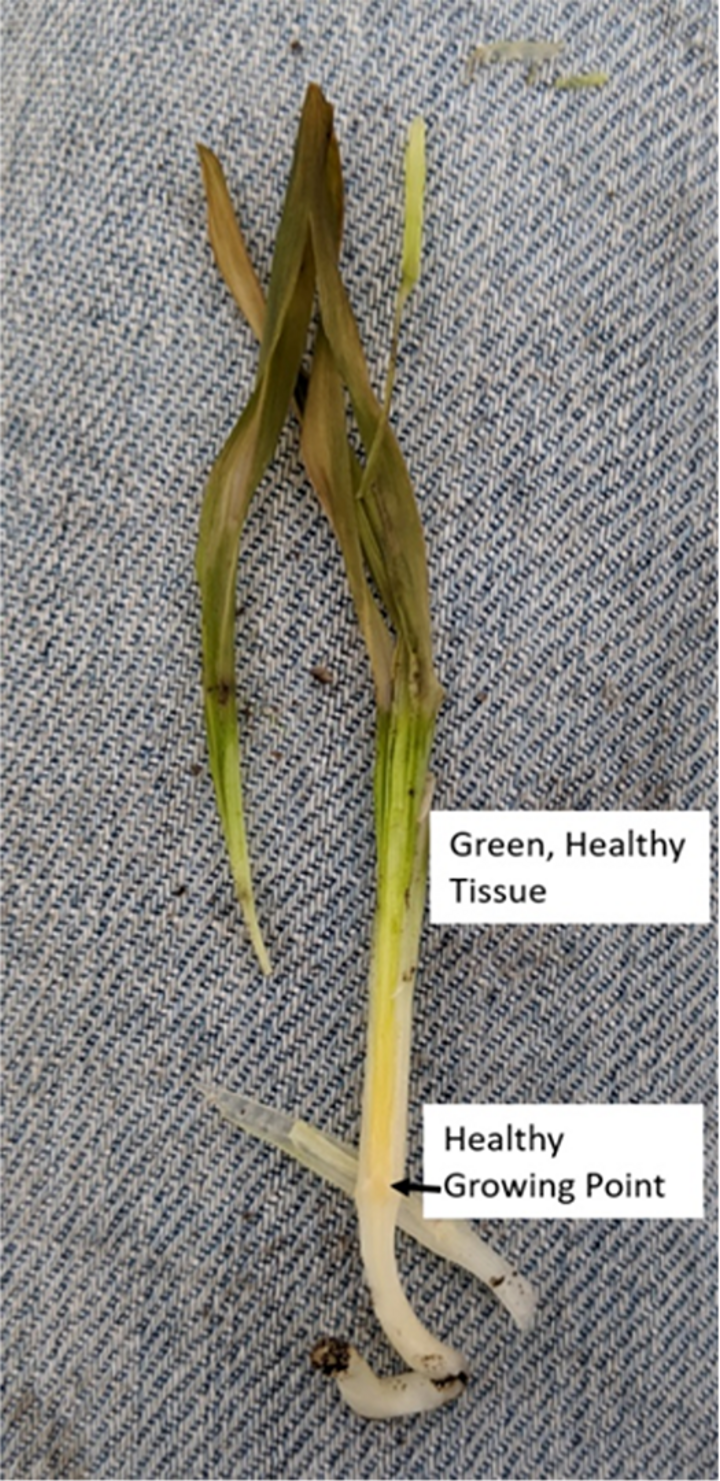
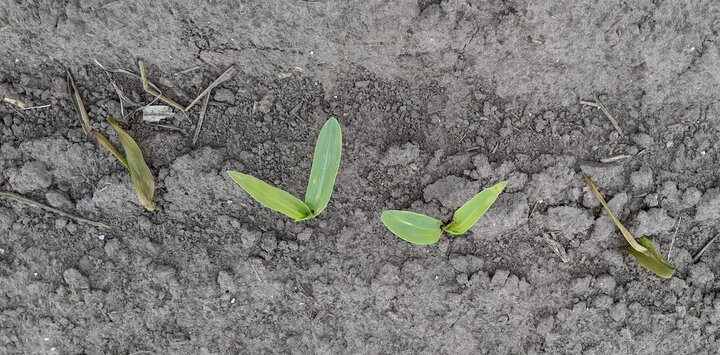
Picture showing the environmental variability associated with frost damage (Photo by Jenny Brhel).
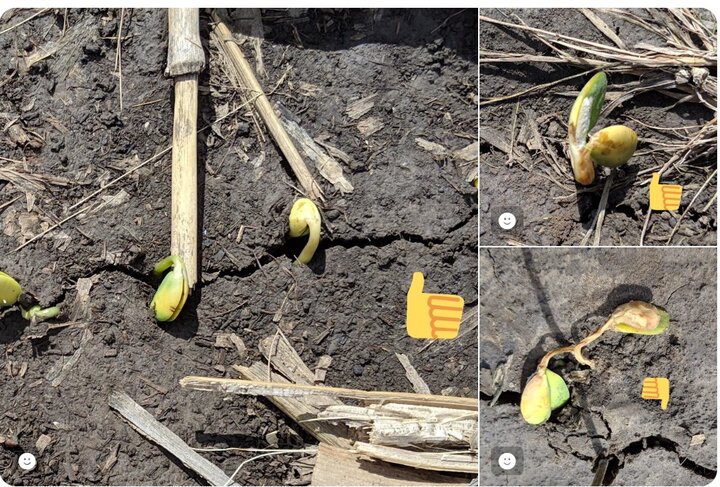
Pictures taken in 2019 by Jenny Brhel. The soybeans in the left photo had cotyledons just at the soil surface at time of frost. They survived (indicated by thumbs up emoji). The upper right-hand photo shows a seedling with light scarring on the hypocotyl and cotyledons. However, the hypocotyl wasn’t pinched and you can see the plumule between the cotyledons is alive and healthy. The lower right-hand photo shows the hypocotyl was damaged on these seedlings causing pinching. Thus these seedlings didn’t survive (indicated by thumbs down emoji). Soybeans with the hypocotyl hook just at the crack of the soybean surface will have to be watched for how deeply impacted that hypocotyl hook is (if it pinches clear through like in the thumbs down photo).


