Blog Archives
Frost Damage to Emerged Corn & Soybean
What to expect from frost on emerged corn and soybean: The cold temps on Friday night resulted in questions on what to expect regarding any potential frost damage to emerged corn and soybeans. For crop damage situations, waiting five to 10 days helps when assessing regrowth potential. The warm conditions of the past weekend following this freeze event can result in a quicker assessment of 3-5 days.
Plant tissues typically do not freeze when the air temperature around them is 32°F. The reason is because solutes are present in the membrane-bound cytoplasm (and also just outside of cell membranes) and they act like a very modest anti-freeze. Thus, plant tissue usually does not freeze until the tissue temperature reaches 30°F to 28°F. Source: Pearce, R.S. 2001. Plant Freezing and Damage. Annals of Botany 87:417-424.
Early season hail and/or freeze damage on corn can cause exposed leaves to be damaged. Fortunately, until V5-V6, the growing point is below the soil and the corn should recover. The damaged leaves will dry and, as regrowth pushes through, the damaged leaves should blow away in the wind. However, wrapping can occur, so fields should be monitored.
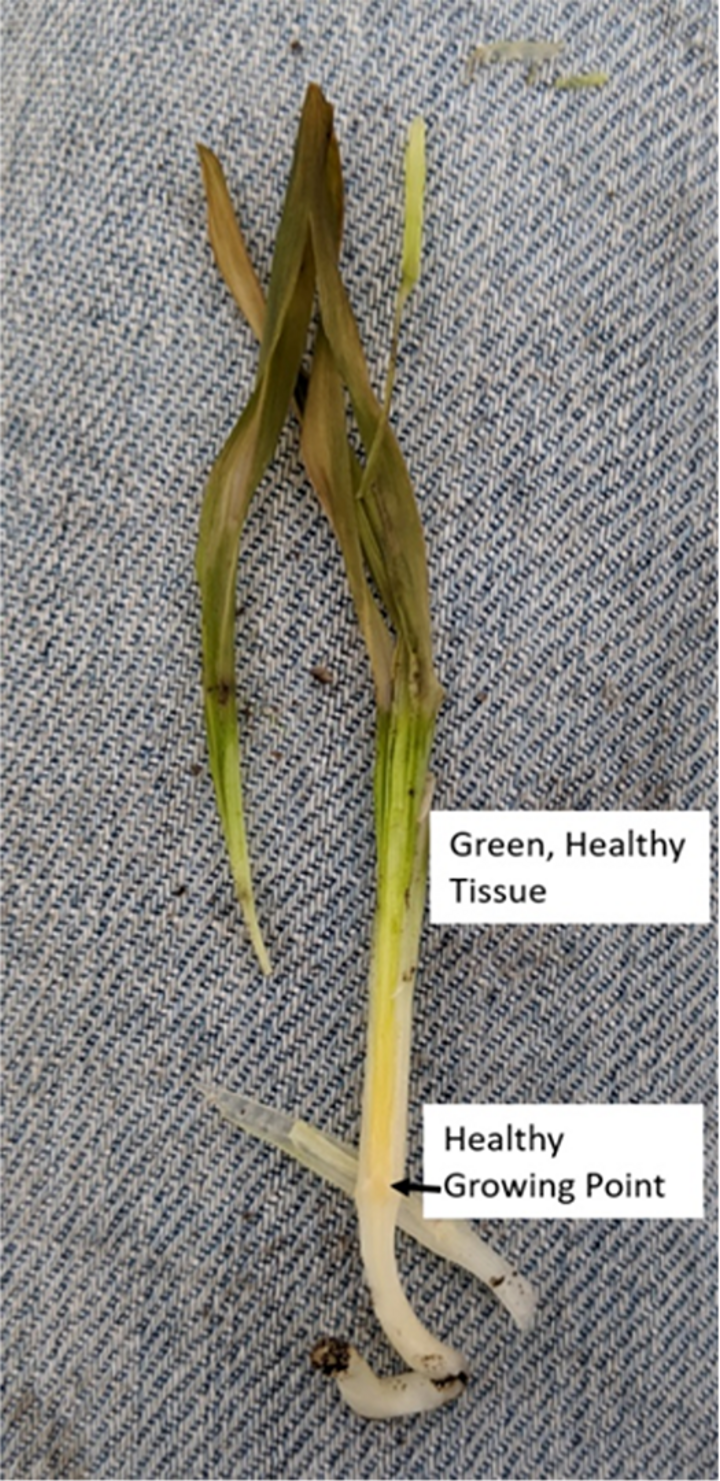
In assessing corn plants, dig up and then slice open plants to evaluate the growing point. If the growing point is white or cream in color and firm, the plant should survive. In contrast, if the growing point is brownish-colored and mushy, the plant will not likely survive.
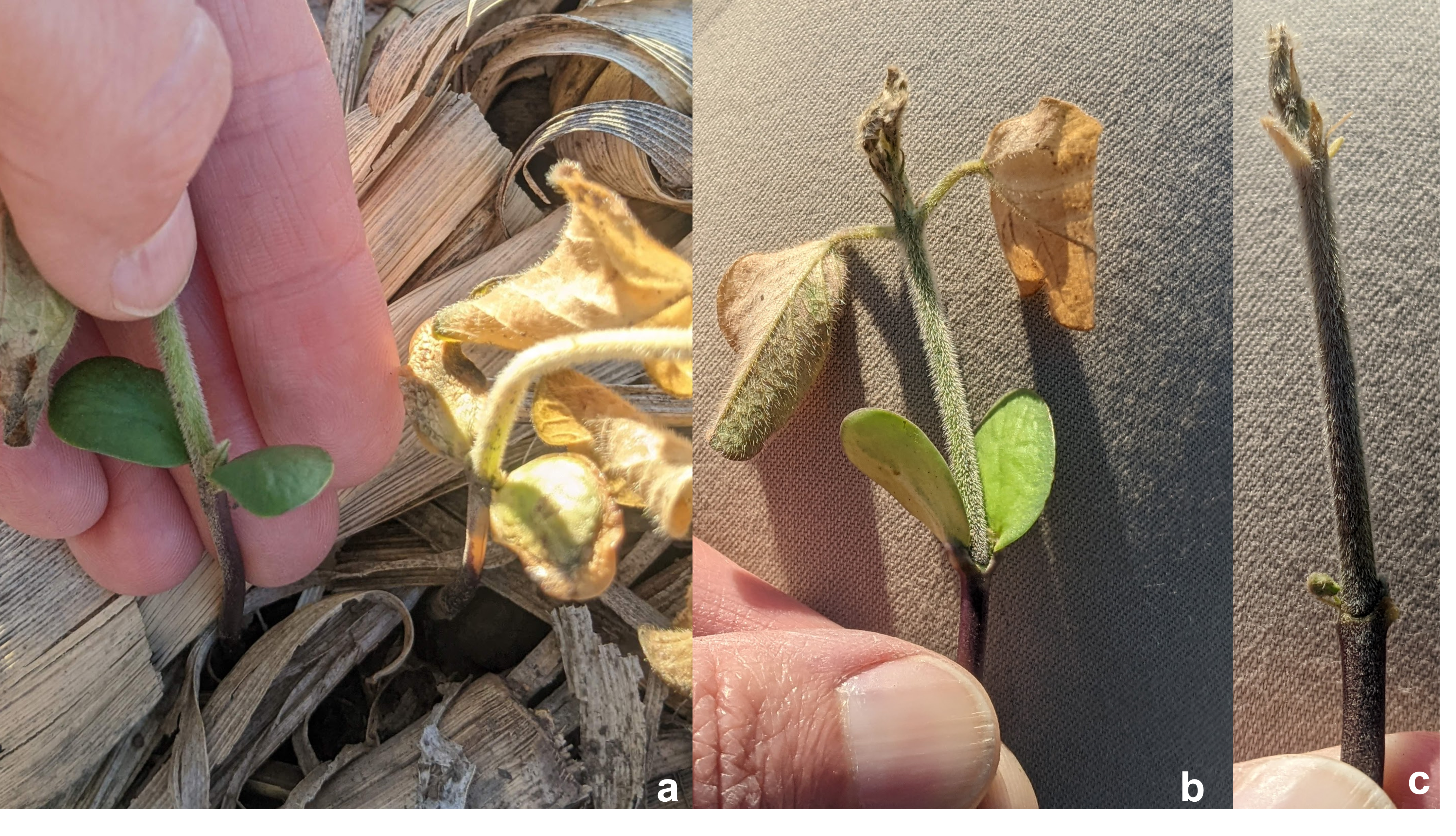
For soybeans, cotyledons are actually somewhat frost tolerant since they are 95% water and fairly thick, so low temperatures are needed for more time to cause damage. However, soybeans that are just emerging with the hypocotyl hook exposed at or just above ground level, are the most at risk for damage. The hypocotyl hook is the area of the stem below the soybean cotyledon. Anything that impacts it will result in seedling death. Watch for plants that have soft, mushy, or pinched hypocotyls. Soybeans can survive the cotyledons being stripped and/or burnt off. Soybean has additional growing points at the axillary buds. If damage occurred below the cotyledons, the plant will die. If above the cotyledons, check for new growth at axillary buds.
What about soybeans where the unifoliate leaves are exposed? Unlike corn, once the cotyledons emerge, all of the potential growing points are above ground so damage could occur. However, the key word in this last statement is growing points, as in more than one. So, even if low temperatures damage the stem tip, there are still two more growing points where the cotyledons attach that the soybean could regrow from. This can set back the plant and cause two stems to form but the plant is still viable if the growing points are still viable.
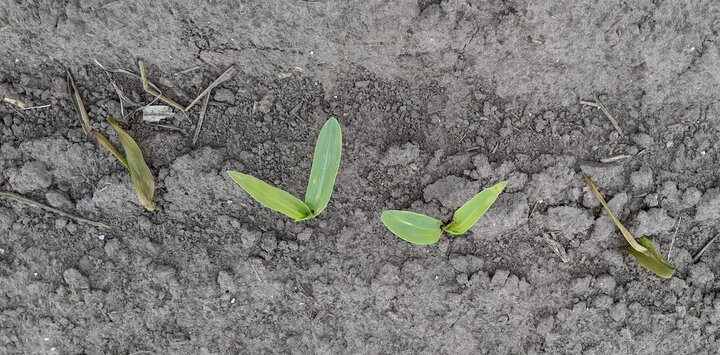
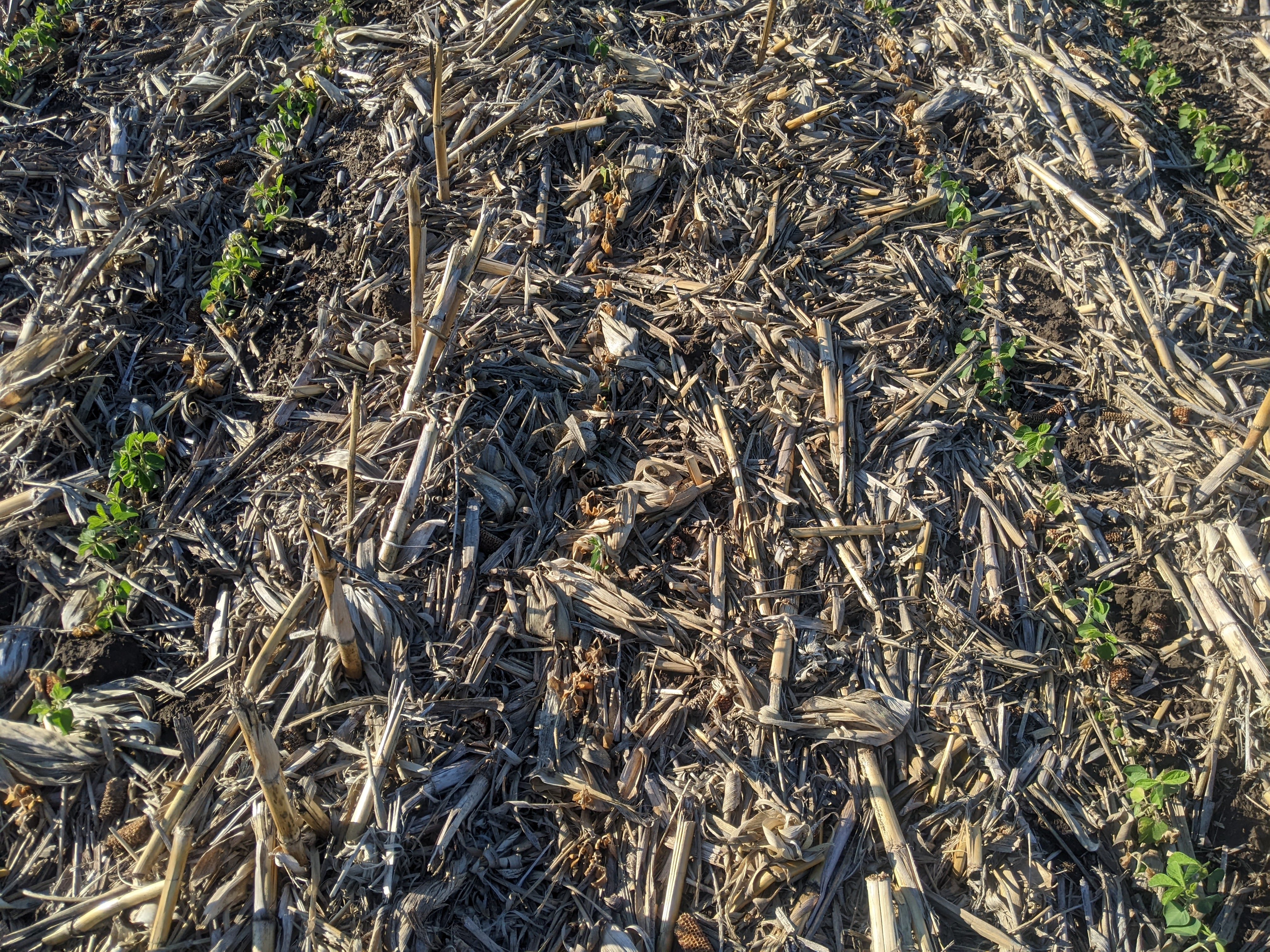
Picture showing the environmental variability associated with frost damage (Photo by Jenny Brhel).
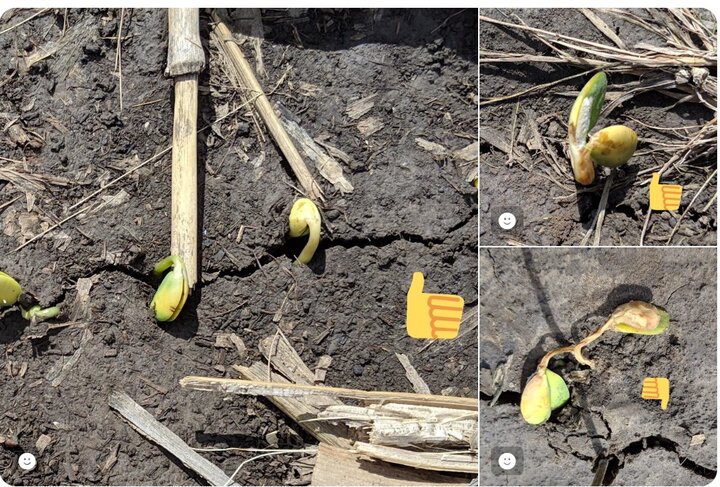
Pictures taken in 2019 by Jenny Brhel. The soybeans in the left photo had cotyledons just at the soil surface at time of frost. They survived (indicated by thumbs up emoji). The upper right-hand photo shows a seedling with light scarring on the hypocotyl and cotyledons. However, the hypocotyl wasn’t pinched and you can see the plumule between the cotyledons is alive and healthy. The lower right-hand photo shows the hypocotyl was damaged on these seedlings causing pinching. Thus these seedlings didn’t survive (indicated by thumbs down emoji). Soybeans with the hypocotyl hook just at the crack of the soybean surface will have to be watched for how deeply impacted that hypocotyl hook is (if it pinches clear through like in the thumbs down photo).
JenREES 5/30/22
Thankful today for all those who paid the ultimate sacrifice for our freedom, that our flag is still flying and for the freedoms we still have. May we never forget freedom isn’t free.
Frost Damage: Looked at a lot of fields this past week for frost damage, particularly bean fields. A key for evaluation is making sure the hypocotyl (the portion below the stem) is still firm and not pinched in any way or soft. Then exam the cotyledon area as there is an axillary bud next to each cotyledon which can shoot new branches. The rest of the upper-most plant may die, but as long as the cotyledon area is healthy, the plant should live. I have pictures to show this at jenreesources.com and we go into more detail in a CropWatch article at: https://go.unl.edu/e3si.
There’s a lot of situations with one or two rows damaged, but the damage alternates between the two. There’s many situations where there’s several rows of beans missing in patchy areas of drilled or planted fields (however, it’s not the entire row in any field I’ve looked at). Some of the patchy areas of fields are between 30-65K while other portions of fields are 100K or over. Beans are incredible at compensating and they will branch to compensate for no plants in an adjacent row. I just keep wondering about damaging the yield potential already there from these early planted beans to slot more in. I realize I would leave things at a lot less population than many are comfortable with and our recommendation is to leave fields with at least 50K. One needs to consider history of weed control in these fields as well. Each decision to leave a stand or replant is an individual and field-by-field one. I still am encouraging anyone who wishes to slot some in to consider planting a strip, leaving a strip, and alternating that at least 3 times. (Or if you’re drilling beans, you may need to make a round instead of a pass). The goal is to get two combine-widths from each planted/drilled area. This at least would be a way to see for yourself if slotting the beans in made any difference for you and please let me know if you are interested in doing this! If you do slot beans in, we’d recommend going with as similar of maturity as what the original maturity was until June 15. Ultimately, I just wish you the best in the decisions you’re making.
York County Progressive Ag Safety Day will be Tuesday, June 14th, 2022 8:30 am – 1:00 pm York County Fair Grounds York, Nebraska. This is a fun-filled day of learning for school-aged children. Topics for demonstrations and discussions include: Electrical Safety, Pipeline-Gas Safety, Grain Safety, ATV/UTV Safety, Look-a-Likes, Power Tool Safety, Equipment Safety, and Internet Safety. The registration fee is $5.00. This safety day includes lunch, snacks, a T-shirt, and a take-home “goody” bag. Registration is due by June 7th to ensure a t-shirt and take-home bag. Please register with the York County Extension office at (402) 362-5508. Sponsors include York County Farm Bureau, York Co. Extension, Wilbur-Ellis, and Black Hills Energy.
Weed Management Field Day will be held June 29 at South Central Ag Lab near Clay Center. Growers, crop consultants and educators are encouraged to attend. The field day will include on-site demonstrations of new technology and new herbicides for corn, soybean, and sorghum. An early morning tour will focus on weed management in soybean and sorghum followed by a tour of weed management in field corn. Field experiments will provide information for weed control options with various herbicide programs.
Three Certified Crop Advisor (CCA) Continuing Education Units are available in the integrated pest management category. There is no cost to attend the field day, but participants are asked to preregister at http://agronomy.unl.edu/fieldday. A brochure with more info. is located at the website. The South Central Agricultural Laboratory is five miles west of the intersection of Highways 14 and 6, or 13 miles east of Hastings on Highway 6. GPS coordinates for the field day site are 40.57539, -98.13776.


JenREES 5-10-20
The anticipated cool temps and potential for frost damage were on the minds of several towards the end of last week. The warm spring planting conditions allowed for more soybean emerged in Nebraska and the mid-west than I’ve ever seen before at this time-frame. From UNL small plot and on-farm research, it’s warm springs such as this that have provided the larger yield increases when soybean was planted early. As I’m writing this, low temperatures varied throughout the State Saturday night with more anticipated lows tonight. What should one look for in regards to frost/freeze recovery? First, we’d say to wait 3-5 days post frost to look for signs of regrowth. It may take up to 7 days depending on weather conditions following a frost event. I’ve provided photos in my blog at jenreesources.com to aid in what to watch for and will continue to add photos. Have learned a lot by flagging plants at different growth stages and taking pictures of their recovery. Would encourage you to do the same. One thing we’re always provided is the opportunity to learn!
Survival partly depends on how low temperatures got. Air temperatures of 28°F or less for at least two hours may result in damaged tissue and even death if the growing point is affected in corn and soybean. Air temperatures around 32°F typically don’t result in freeze of plant tissues. Why is this? Plant cells have solutes in the cytoplasm and just outside the cell membrane that act like a modest anti-freeze. Thus, the actual tissue temperature has to reach 28-30°F for frost damage to occur.
It also depends on stage of growth. For emerged corn, the growing point is still in the ground. Frost damage can appear as leaves discoloring and wilting due to plant cells rupturing. Eventually they will turn brown and slough off if new growth pushes through. It will be important to look at the growing point and make sure it’s white/yellow and firm and not discolored and soft. Warmer temps after frost event will help in reducing disease impacts from bacterial pathogens.
Soybeans that are just emerging with the hypocotyl hook exposed at or just above ground level, can be the most at risk for damage. The hypotcotyl hook is the area of the stem below the soybean cotyledon. Anything that impacts it will result in seedling death. Watch for plants that have soft, mushy, or pinched hypocotyls. These are situations where soybean seedlings tend to die. I’ve seen survival in seedlings with light scarring on the hypocotyl and cotyledons where there’s no pinching of the hypocotyl. Cotyledons just at the soil surface or above often will survive due to their high water content. They may have some light scarring yet they tend to survive. Look for the plumule (first true leaves from the shoot) within 7 days post-frost to ensure the growing point wasn’t injured. If unifoliolates were exposed, I’ve seen mixed results (depending on air temperatures and location in the field). Sometimes the unifoliolates will wilt and die but if the axiliary buds by cotyledons survive, new growth will occur.
For wheat, look for any splitting of the stems near the base of plants. Make sure the growing point looks healthy. Damage to wheat in jointing stage occur at 24°F for 2 hours and 28°F for 2 hours at boot. Impacts to wheat later on can also be seen at heading in white awns and spikelets and heads sometimes having difficulty to emerge from the boot (or being twisted). This CropWatch article shares more.
Low areas of fields, fields with coarser soil texture, and lower soil moisture contents can result in more frost damage. Fields receiving rains and wind prior to these cold temperatures may have aided in some protection. There’s often things I can’t explain when assessing frost damage. Sometimes a couple plants in a row will succumb while others around them at the same growth stage are fine. There’s just microclimate things that can’t always be explained. Here’s hoping most fields in the area are ok!
It’s also time to scout for alfalfa weevils and you can see more information and table of thresholds depending on growth stage in this CropWatch article: https://go.unl.edu/a7jw.
Rhubarb and Frost: If rhubarb leaves are not damaged too much and the stalks remain firm, it is still safe to eat. If the leaves are severely damaged or the stalks become soft or mushy, do not eat these stalks. Remove and discard them. New stalks can be harvested and eaten.

These are pics I took in 2019. The soybeans in the left photo had cotyledons just at the soil surface at time of frost. They survived. The upper right-hand photo shows a seedling with light scarring on the hypocotyl and cotyledons. However, the hypocotyl wasn’t pinched and you can see the plumule between the cotyledons is alive and healthy. The lower right-hand photo shows the hypocotyl was damaged on these seedlings causing pinching. Thus these seedlings didn’t survive.
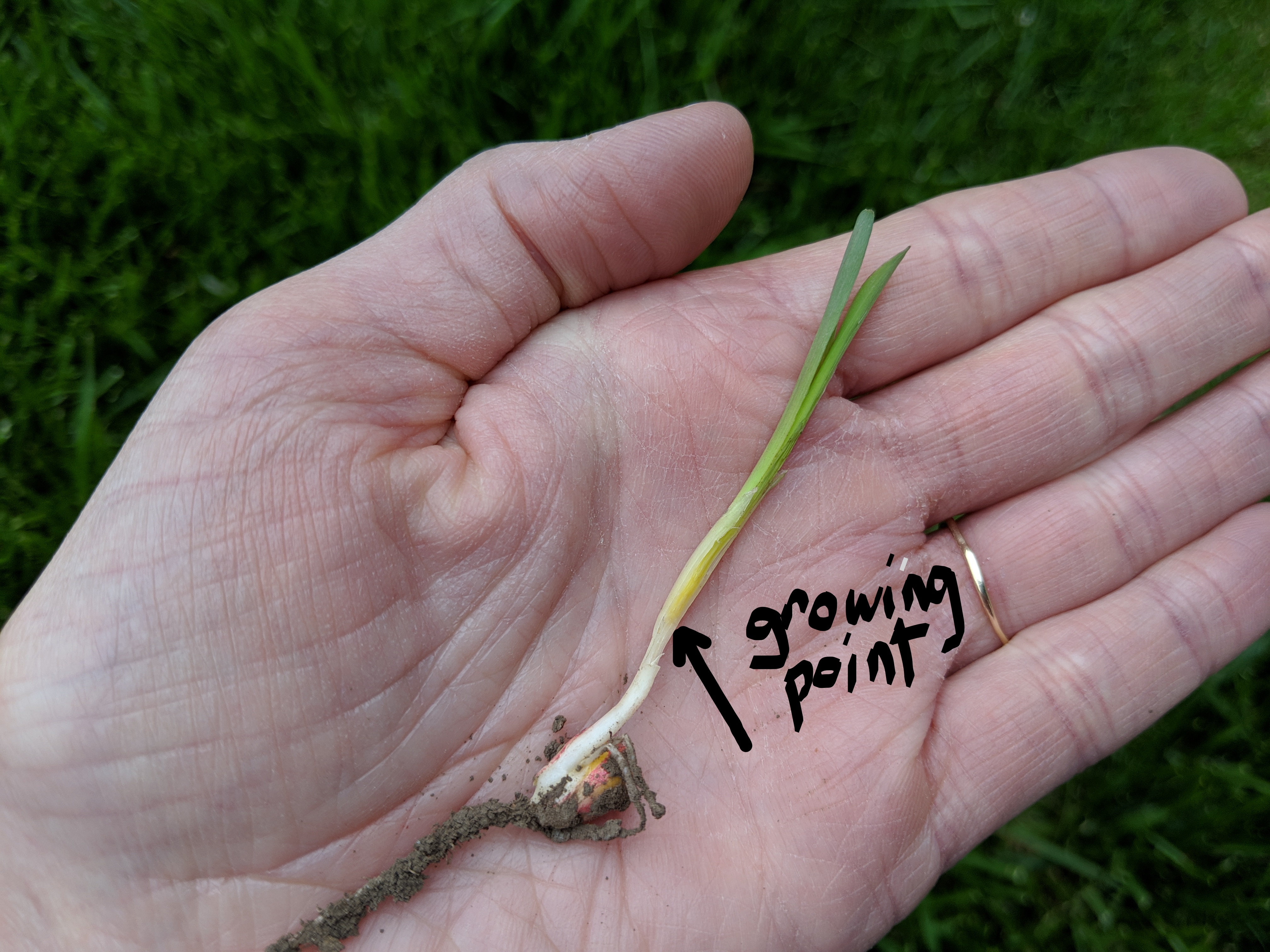
This is what a healthy growing point looks like on a healthy plant not impacted by frost.
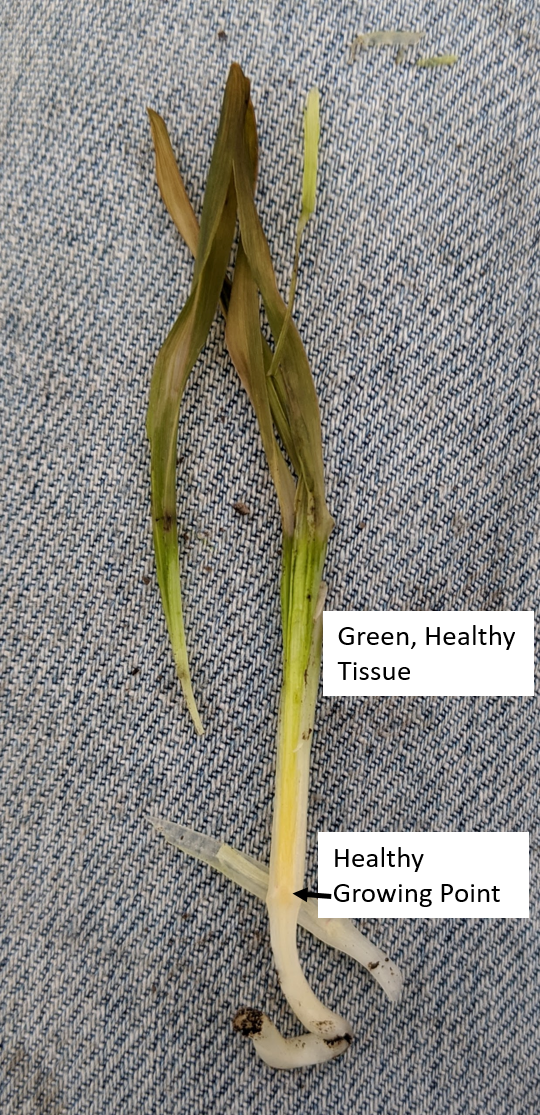
Corn impacted by frost on 3/9/20. Leaves watersoaked and wilted two days later. Splitting open stem reveals a healthy growing point (not brown or mushy) and green, healthy tissue below the wilted tissue. Thus, plants like these will likely recover, but it’s best to continue watching them for regrowth.

Plants impacted by frost (first and last) while middle two at same growth stage are not impacted. I see this often and have no explanation!

The beans next to this corn field look really good with light scarring of the cotyledons and healthy plumules.


