Harvest Grain Quality Concerns 2026
I’ve been thinking of the grain quality concerns and safety with the upcoming harvest. We all know how crazy it’s soon to get with harvest. Unfortunately, most of the corn and soybean are ready now at the same time. It’s hard to know how to prioritize harvest. Normally, we’d go by percent stalk rot in a field of corn and percent moisture in both corn and soybean. Perhaps there’s still ways to prioritize based on those factors, but now we have the additional concern of looking at grain quality as well in both crops. The following article has tips as one faces harvest these coming weeks: https://cropwatch.unl.edu/harvest-2025-prep-guide-minimize-losses-disease-stressed-corn/.
For stalk rot assessments: Push at least 100 corn plants to arm’s length about 30 degrees from vertical. If plants bend below the ear and don’t snap back upright, they have a greater chance of lodging at or prior to harvest if there’s high wind events or heavy rain. I prefer the pinch test in which one squeezes the lower internodes to assess stalk strength and check for stalks that are easily crushed by hand.
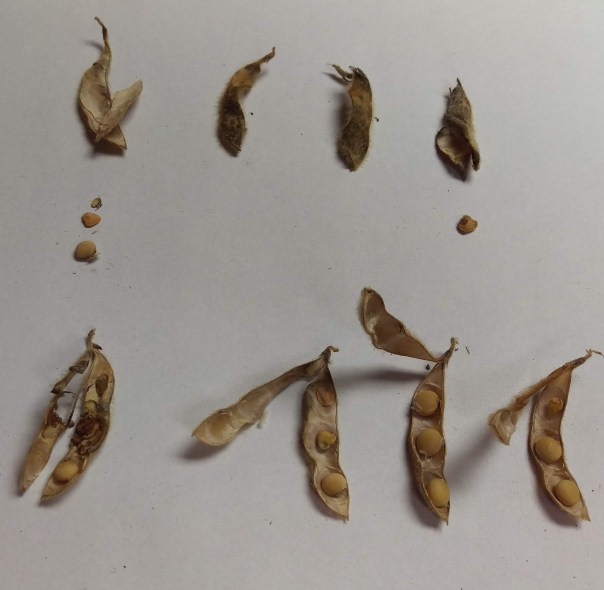
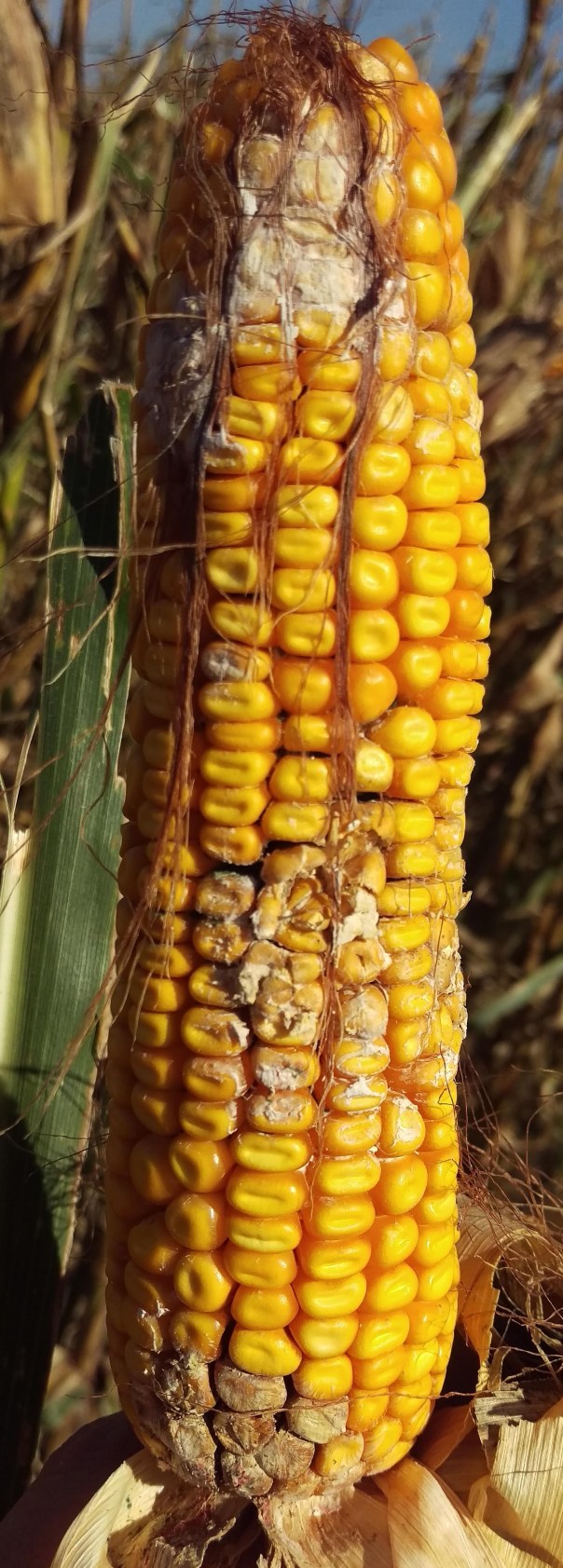
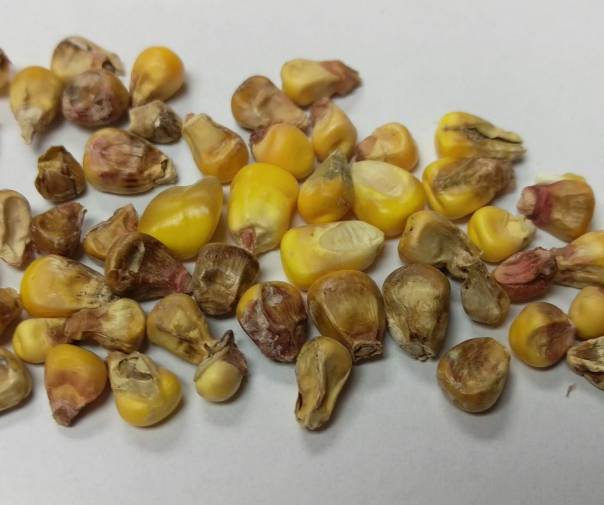
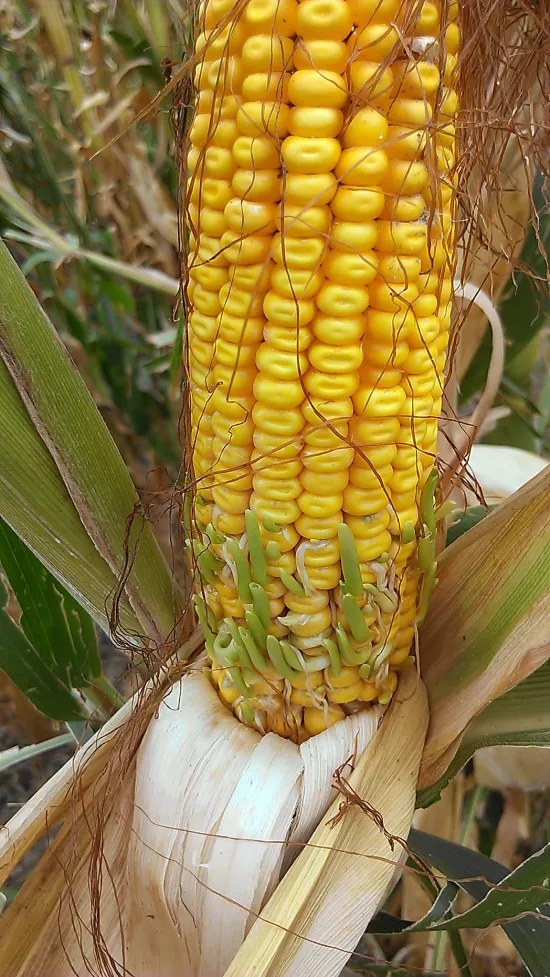
Both corn and soybean have sprouting occurring in the field. In corn, this is particularly occurring where ears are upright with tight husks. With soybean, it’s occurring where the beans in the pods dried down to 13% or less and rewetted to at least 50% of their seed weight with the rains. There’s also a number of fungal kernel rots occurring in corn. Fusarium and giberella have a white/pink/red fungal growth. The presence of the fungus doesn’t guarantee mycotoxins are present, but potential mycotoxins that can be associated with these fungi are vomitoxin and fumonisin. White fungal growth that overtakes an ear and makes it feel very light is diplodia. There are no mycotoxins associated with it. There’s also a number of “lesser fungi” that cause cob rots that we’re also seeing this season.
It’s important to know what’s impacting the corn ears prior to harvest, binning corn, or taking it to the elevator. If a particular hybrid is more impacted by kernel rot than another, make sure not to put that corn in the same bin as corn with better quality. Grain affected by ear rot diseases and mold are less suitable for storage. Use or sell affected grain first and store the highest quality corn possible. Grain needs to be cooled to 55F and at 13-14% moisture in order to stop Fusarium and other fungi from continuing to grow in the bin. More info. at this resource: https://cropprotectionnetwork.org/publications/storing-mycotoxin-affected-grain
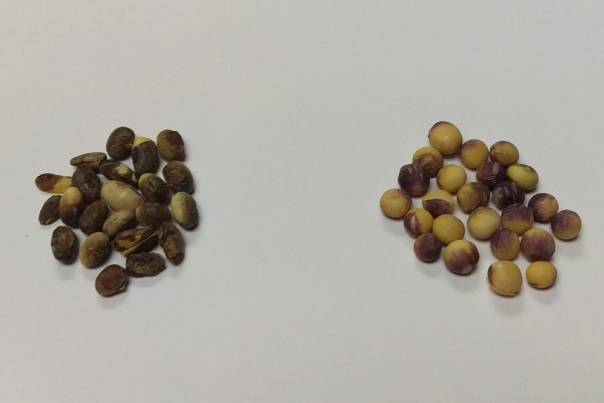
For soybeans, it’s also important to know if the variety in the field is impacted by things like purple seed stain or Phomopsis seed decay, which can cause elevators to reject soybeans. If you’re noticing discolored soybeans, talk to the elevator beforehand. Both of these conditions are variety related so keep track of which varieties you observe these conditions in.
Set combine fans to blow out as many broken/damaged kernels from insects, fungi, or sprouting as possible. Adjust combine settings to reduce harvest losses due to brittle kernels. Aim to start harvesting fields at a higher moisture (above 17%).
It will be a dirty harvest as secondary fungi can turn the leaves and stalks a blackish color. Fungal spores may behave like dust and aggravate respiratory illness or symptoms in sensitive individuals. Consider wearing dust masks or respirators when working in affected fields or around grain, such as in grain bins. Check air filters on equipment operating in conditions with a lot of dust and spores. Keep fire extinguishers close at hand. Take breaks as needed — and care for your mental, emotional and physical well-being. Be careful on roads: use headlights especially on gravel roads and check intersections before proceeding through them in the country. The Nebraska Rural Response Hotline is 800-464-0258 and is available for emotional support, legal and financial assistance, and disaster relief. Wishing everyone a safe harvest and hoping yields aren’t impacted too much from the challenges.

Corn Observations



Grain Storage
There’s over 25 species of fungi that can produce ear molds with the majority of them ceasing growth at 14% moisture within the kernel. For short term storage of moldy grain, drying to 15% moisture as quickly as possible can greatly slow additional fungal growth within the grain bin. The table below shares the days required to dry corn to 15% moisture with 1.0 cfm/bu and various temperature and humidity conditions. More info. at this resource: https://cropprotectionnetwork.org/publications/storing-mycotoxin-affected-grain

“Since drying time is directly proportional to the airflow, the producer can calculate the estimated drying times when using airflows other than 1.0 cubic foot of air per minute per bushel (cfm/bu). For example: Table II shows when drying corn from 18 percent to 15 percent moisture with 50F and 50% relative humidity air, the estimated drying time is 12.5 days using a 1.0 cfm/bu airflow. If the airflow is 1.25 cfm/bu, the estimated drying time would be 12.5 days / 1.25 = 10 days. For 1.5 cfm/bu, the drying time would be 12.5 days / 1.5 = 8.3 days. For 0.8 cfm/bu, the drying time would be 12.5 days / 0.8 = 15.6 days.” Source: Management of in-bin natural air grain drying systems to minimize energy cost.
- Management of in-bin natural air grain drying systems to minimize energy cost
- UNL CropWatch Grain Storage Resources
- Managing large grain bins for potential mycotoxin contamination
Mycotoxin Information
In 2026, we’re primarily seeing Fusarium and Gibberella species which have the potential to produce mycotoxins. Thus, the information below is directed at those fungal species and mycotoxin levels that can be associated with them. Again, the presence of fungi does not automatically mean a mycotoxin is present.

The following toxins can be produced from species of Fusarium and Gibberella. Source: Corn Ear Rots, Storage Molds, Mycotoxins, and Animal Health, Iowa State publication, 1997.
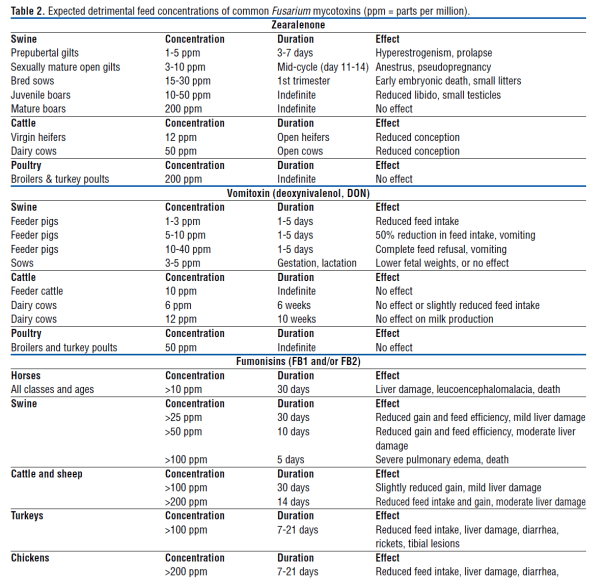
Source: Corn Ear Rots, Storage Molds, Mycotoxins, and Animal Health, Iowa State publication, 1997.

Posted on October 4, 2026, in Grain Storage, JenREES Columns and tagged grain quality, harvest, harvest safety, moldy corn, mycotoxins, sprouted corn, sprouted soybean. Bookmark the permalink. Leave a comment.


Leave a comment
Comments 0