Blog Archives
Harvest Grain Quality Concerns 2026
I’ve been thinking of the grain quality concerns and safety with the upcoming harvest. We all know how crazy it’s soon to get with harvest. Unfortunately, most of the corn and soybean are ready now at the same time. It’s hard to know how to prioritize harvest. Normally, we’d go by percent stalk rot in a field of corn and percent moisture in both corn and soybean. Perhaps there’s still ways to prioritize based on those factors, but now we have the additional concern of looking at grain quality as well in both crops. The following article has tips as one faces harvest these coming weeks: https://cropwatch.unl.edu/harvest-2025-prep-guide-minimize-losses-disease-stressed-corn/.
For stalk rot assessments: Push at least 100 corn plants to arm’s length about 30 degrees from vertical. If plants bend below the ear and don’t snap back upright, they have a greater chance of lodging at or prior to harvest if there’s high wind events or heavy rain. I prefer the pinch test in which one squeezes the lower internodes to assess stalk strength and check for stalks that are easily crushed by hand.
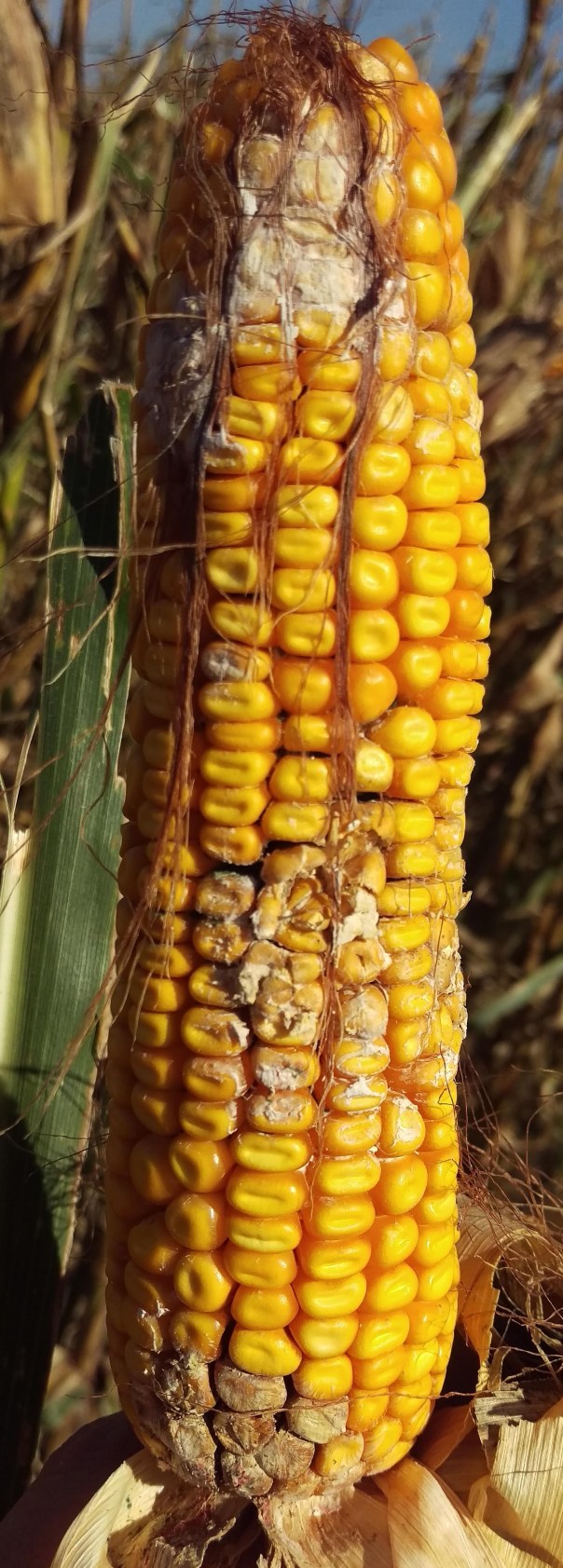
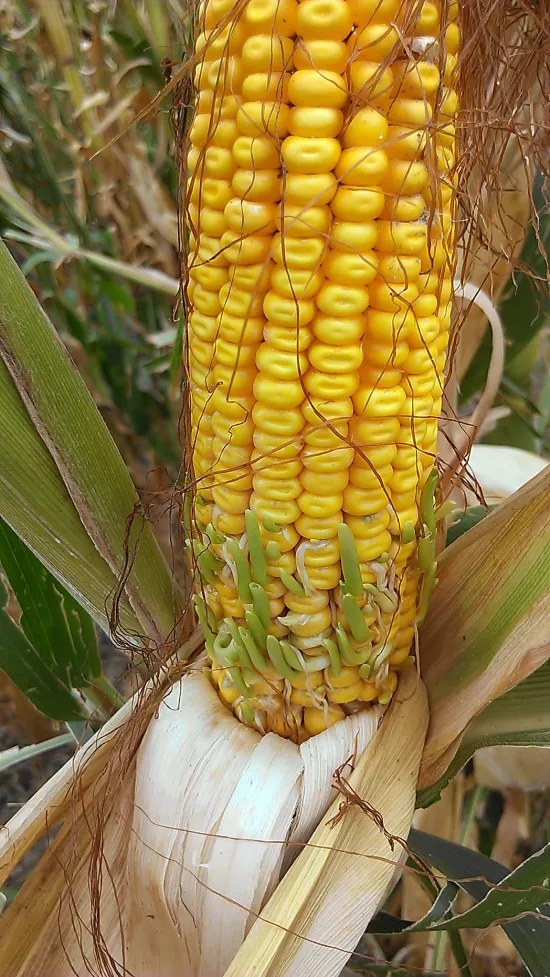
Both corn and soybean have sprouting occurring in the field. In corn, this is particularly occurring where ears are upright with tight husks. With soybean, it’s occurring where the beans in the pods dried down to 13% or less and rewetted to at least 50% of their seed weight with the rains. There’s also a number of fungal kernel rots occurring in corn. Fusarium and giberella have a white/pink/red fungal growth. The presence of the fungus doesn’t guarantee mycotoxins are present, but potential mycotoxins that can be associated with these fungi are vomitoxin and fumonisin. White fungal growth that overtakes an ear and makes it feel very light is diplodia. There are no mycotoxins associated with it. There’s also a number of “lesser fungi” that cause cob rots that we’re also seeing this season.
It’s important to know what’s impacting the corn ears prior to harvest, binning corn, or taking it to the elevator. If a particular hybrid is more impacted by kernel rot than another, make sure not to put that corn in the same bin as corn with better quality. Grain affected by ear rot diseases and mold are less suitable for storage. Use or sell affected grain first and store the highest quality corn possible. Grain needs to be cooled to 55F and at 13-14% moisture in order to stop Fusarium and other fungi from continuing to grow in the bin. More info. at this resource: https://cropprotectionnetwork.org/publications/storing-mycotoxin-affected-grain
For soybeans, it’s also important to know if the variety in the field is impacted by things like purple seed stain or Phomopsis seed decay, which can cause elevators to reject soybeans. If you’re noticing discolored soybeans, talk to the elevator beforehand. Both of these conditions are variety related so keep track of which varieties you observe these conditions in.
Set combine fans to blow out as many broken/damaged kernels from insects, fungi, or sprouting as possible. Adjust combine settings to reduce harvest losses due to brittle kernels. Aim to start harvesting fields at a higher moisture (above 17%).
It will be a dirty harvest as secondary fungi can turn the leaves and stalks a blackish color. Fungal spores may behave like dust and aggravate respiratory illness or symptoms in sensitive individuals. Consider wearing dust masks or respirators when working in affected fields or around grain, such as in grain bins. Check air filters on equipment operating in conditions with a lot of dust and spores. Keep fire extinguishers close at hand. Take breaks as needed — and care for your mental, emotional and physical well-being. Be careful on roads: use headlights especially on gravel roads and check intersections before proceeding through them in the country. The Nebraska Rural Response Hotline is 800-464-0258 and is available for emotional support, legal and financial assistance, and disaster relief. Wishing everyone a safe harvest and hoping yields aren’t impacted too much from the challenges.

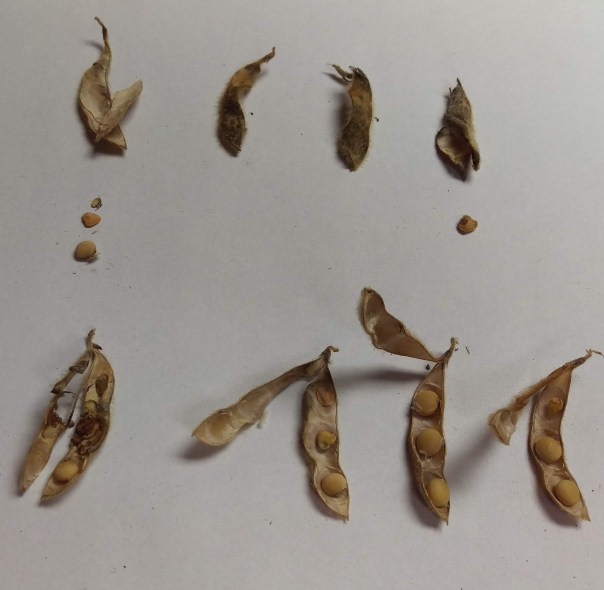
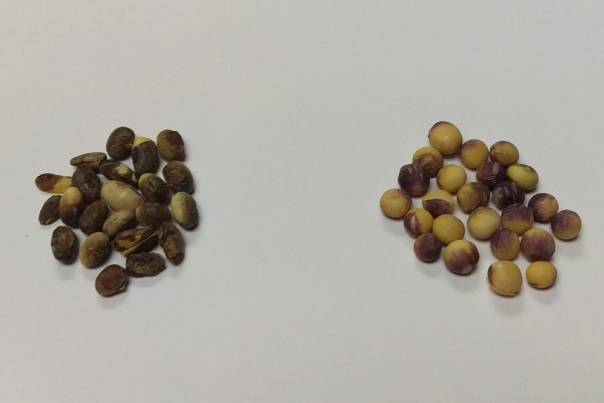
Corn Observations


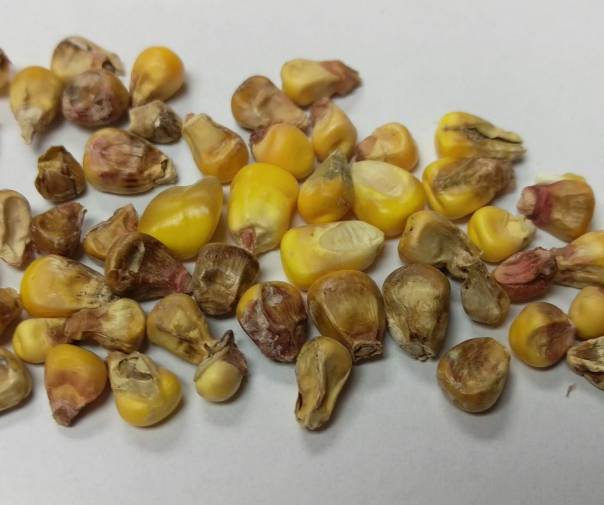

Grain Storage
There’s over 25 species of fungi that can produce ear molds with the majority of them ceasing growth at 14% moisture within the kernel. For short term storage of moldy grain, drying to 15% moisture as quickly as possible can greatly slow additional fungal growth within the grain bin. The table below shares the days required to dry corn to 15% moisture with 1.0 cfm/bu and various temperature and humidity conditions. More info. at this resource: https://cropprotectionnetwork.org/publications/storing-mycotoxin-affected-grain

“Since drying time is directly proportional to the airflow, the producer can calculate the estimated drying times when using airflows other than 1.0 cubic foot of air per minute per bushel (cfm/bu). For example: Table II shows when drying corn from 18 percent to 15 percent moisture with 50F and 50% relative humidity air, the estimated drying time is 12.5 days using a 1.0 cfm/bu airflow. If the airflow is 1.25 cfm/bu, the estimated drying time would be 12.5 days / 1.25 = 10 days. For 1.5 cfm/bu, the drying time would be 12.5 days / 1.5 = 8.3 days. For 0.8 cfm/bu, the drying time would be 12.5 days / 0.8 = 15.6 days.” Source: Management of in-bin natural air grain drying systems to minimize energy cost.
- Management of in-bin natural air grain drying systems to minimize energy cost
- UNL CropWatch Grain Storage Resources
- Managing large grain bins for potential mycotoxin contamination
Mycotoxin Information
In 2026, we’re primarily seeing Fusarium and Gibberella species which have the potential to produce mycotoxins. Thus, the information below is directed at those fungal species and mycotoxin levels that can be associated with them. Again, the presence of fungi does not automatically mean a mycotoxin is present.

The following toxins can be produced from species of Fusarium and Gibberella. Source: Corn Ear Rots, Storage Molds, Mycotoxins, and Animal Health, Iowa State publication, 1997.
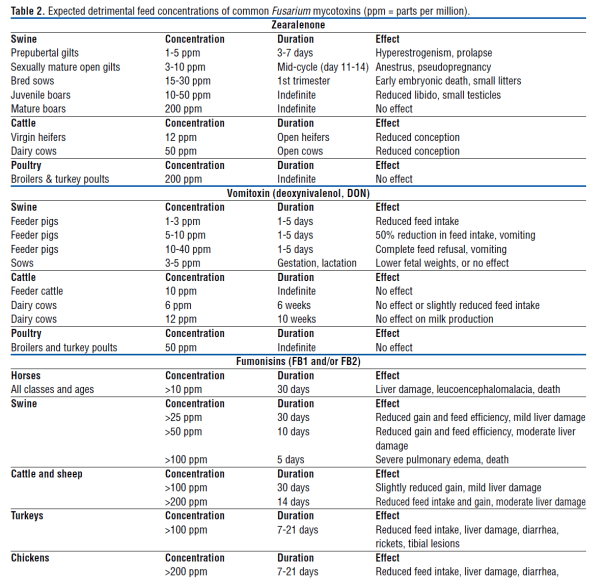
Source: Corn Ear Rots, Storage Molds, Mycotoxins, and Animal Health, Iowa State publication, 1997.
JenREES 1-26-20
Corn Quality Concerns: The two main questions I’ve received: “Are you hearing others mentioning low/variable test weights on corn?” and “Are you hearing of loads being rejected (to ethanol plants) due to mycotoxins?” While I’m unsure how widespread this is, I have been receiving these questions. A reminder to check your grain quality if you haven’t already been hauling or checking it.
Test Weight is a volumetric measurement (weight of corn grain per unit of volume), and as such, doesn’t directly correlate with yield. Standard corn test weight is 56 lbs/bu (1 bushel is 1.24 cubic feet). The size, shape, slipperiness of surface, and density of the kernel impacts test weight. Hybrids can show differences in test weight. Test weight is different than kernel weight, and thus not directly correlated with yield. Test weight gets at how tightly packed the starch is within the kernel. Reducing kernel moisture can allow for increased test weight if the starch loses water allowing for it to be packed more tightly within that kernel. Dry kernels that slide past each other may pack better allowing for increased test weight.
Lower test weights can result with disease, insect, and environmental stresses that impact photosynthesis and the movement of nutrients to the kernel during grain fill. These can include foliar and stalk diseases, drought stress, lack of nutrients, freeze prior to physiological maturity, late planting, and below normal temps during grain fill. Rewetting of kernels in the ear can impact test weight as kernels can swell and not shrink back to the same shape as previously. We know that moisture events happened after physiological maturity causing some sprouting of kernels in some ears prior to harvest. We did have high foliar disease pressure this year and reduced stalk quality. Compromised integrity of the kernel due to insect, disease, and mechanical damage can also impact test weight. I didn’t see the amount of kernel damage as I did in 2018. But there are certain hybrids that are high yielding and widely planted that I tend to see starburst patterns on kernels (due to Fusarium) and shortened husks exposing ear tips to more insect damage/ear molds. There are also hybrids that had a large amount of top dieback, husk tissue that turned brown early, or refuge in a bag plants that died early in fields. All of these may be factors potentially impacting test weight as well. Thinking about photosynthesis, we had reduced solar radiation during grain fill. I can’t help but think that could also impact it but didn’t easily find research that correlates solar radiation to test weight. There’s research correlating solar radiation to yield and kernel weight, though.
Regarding vomitoxin levels, the starburst patterns on kernels, insect damage leading to


ear molds, wet corn not properly dried or cooled in bins can all impact greater Fusarium growth and the potential for vomitoxin to be produced. If vomitoxin (also called DON) is an issue, concentrations can triple in the ethanol process of producing the distiller’s grains. Hogs and poultry are more sensitive than cattle, so the end user may be a factor in addition to the vomitoxin levels. I don’t know the levels being rejected so I can’t speak more to this.
York County Corn Grower Tour: Corn growers and spouses are welcome to join us February 3 for a tour of ag industries in the Lincoln area. We will meet at the York Co. Extension Office at 7 a.m. and will carpool leaving at 7:15. Our first stop will be RealmFive which focuses on wireless connectivity for ag operations. We will then tour Smart Chicken in Waverly which offers retail- and foodservice-packaged organic chickens and antibiotic-free chickens from Kansas, Iowa and Nebraska. Lunch at Lazlos is next followed by learning about the UNL hops program and research using corn gluten meal and soybean meal. Possibly another stop on way home. Please RSVP to me at jrees2@unl.edu if you’re interested in attending by Feb. 2nd. Hope to have a good group who can join us! Flyer at jenreesources.com.
JenREES 10-7-18
Grateful for the crops that have been harvested thus far! Also grateful for so many paying attention to grain quality coming out of the fields! That’s been a large part of the past 10 days for me…obtaining grain samples and pictures to answer grain quality questions from quite an area. So I did a quick literature review to better understand the conditions when various ear rot fungi grow and also put together a blog post to hopefully help all of us better diagnose what we’re seeing in grain samples-whether corn or soybean. You can find it at: https://jenreesources.com/2018/10/08/grain-observations/.
Fungal growth in storage is based on moisture, humidity, and temperature. I’ve heard various numbers being used for grain storage and I’m not a grain storage expert. I can also appreciate it costs you more and takes time with the current weather conditions to dry corn. In general, most Extension publications throughout the U.S. recommend getting grain dried to 15% as quickly as possible and maintaining grain in long-term storage at 13%. Briefly, in looking through the literature, the reason for this advice is because various ear rot fungi can continue to grow on and inside those kernels. There’s over 25 species of ear rot fungi with most of them ceasing growth at 15%. The main exception is Aspergillus which has species that can continue from just below 13 to above 14%. Thankfully we don’t have a problem with Aspergillus this year. We are seeing a lot of Fusarium and some Gibberella (which may increase with this rain). But we’re also seeing some Diplodia and other lesser ear rot fungi such as Penicillium, Cladosporium, and Nigrospora. The thing is that each fungal species has a temperature and moisture range in which they continue to grow. So if one is growing in a kernel, it gives off heat and moisture allowing for changes in temperature, humidity, and moisture within that area which can allow for other fungal species to grow. Fungi grow from one infected kernel to adjacent kernels. Having more ‘fines’, cob pieces, etc. can increase potential for fungal growth in the bin. Insects also give off heat which changes localized dynamics. Because of these reasons, our recommendation is to get grain dried to 15% as quickly as possible to help stop fungal growth we’re experiencing this year, particularly from Fusarium species. We’re not saying you need to get the grain dried to 13% immediately. It’s only a consideration down the road if you’re storing the grain till next summer. The following NebGuide is a great resource: Management of In-Bin Natural Air Grain Drying Systems to Minimize Energy Costs: http://extensionpublications.unl.edu/assets/pdf/ec710.pdf. Our grain storage resource page can be found at: https://cropwatch.unl.edu/grain-storage-management.
Also, there’s a new app called “Mycotoxins” and it’s another resource with ear rot pictures and mycotoxin information put out by several Universities produced for both Apple and Android devices.
Farm/Ranch Transition When You Aren’t in Control Nov. 14 York: Passing the farm/ranch on to the next generation is a tough job, especially if the next generation is unsure of what will happen when their parents pass. It is especially for those people, who are wondering what is going on, that a series of farm and ranch transition workshops are planned at Valentine, Ainsworth, O’Neill, Norfolk and York from Oct. 23 to Nov. 14.
The workshops will focus on the needs of the “sandwich generation” between parents who still own land and children who might want to join the operation, on whom farm/ranch transition and transfer often falls. Lack of communication often hinders transitions. The Gen2, or Sandwich Generation, will learn how to communicate with family to understand the transition and practice asking difficult questions.
Legal topics presented at the workshops will center around Gen2 needs, including elements of a good business entity, levels of layers for on-farm heirs control and access, and turning agreements into effective written leases. Joe Hawbaker, estate planning attorney, and Allan Vyhnalek, Nebraska Extension transition specialist, will share stories and experiences to successfully plan on the legal side. Dave Goeller, financial and transition specialist, will cover financial considerations, retirement, and compensation versus contribution.
Many families struggle to split assets fairly between on-ranch and off-ranch heirs, while continuing the ranch as a business. Goeller will discuss the family side and what to consider when dividing assets. Vyhnalek will also cover less-than-ideal situations, negotiating, and looking for other business options. The times are 9 a.m.-4:30 p.m. at each location. The closest location to this area is November 14 in York at the 4-H Building. Cost is $20 per person. If more than two people are attending per operation, the cost is $15/person. Pre-register at (402) 362-5508 or jrees2@unl.edu for meal count.
Funding for this project was provided by the North Central Extension Risk Management Education Center, the USDA National Institute of Food and Agriculture Award Number 2015-49200-24226.


