Blog Archives
Harvest Grain Quality Concerns 2026
I’ve been thinking of the grain quality concerns and safety with the upcoming harvest. We all know how crazy it’s soon to get with harvest. Unfortunately, most of the corn and soybean are ready now at the same time. It’s hard to know how to prioritize harvest. Normally, we’d go by percent stalk rot in a field of corn and percent moisture in both corn and soybean. Perhaps there’s still ways to prioritize based on those factors, but now we have the additional concern of looking at grain quality as well in both crops. The following article has tips as one faces harvest these coming weeks: https://cropwatch.unl.edu/harvest-2025-prep-guide-minimize-losses-disease-stressed-corn/.
For stalk rot assessments: Push at least 100 corn plants to arm’s length about 30 degrees from vertical. If plants bend below the ear and don’t snap back upright, they have a greater chance of lodging at or prior to harvest if there’s high wind events or heavy rain. I prefer the pinch test in which one squeezes the lower internodes to assess stalk strength and check for stalks that are easily crushed by hand.
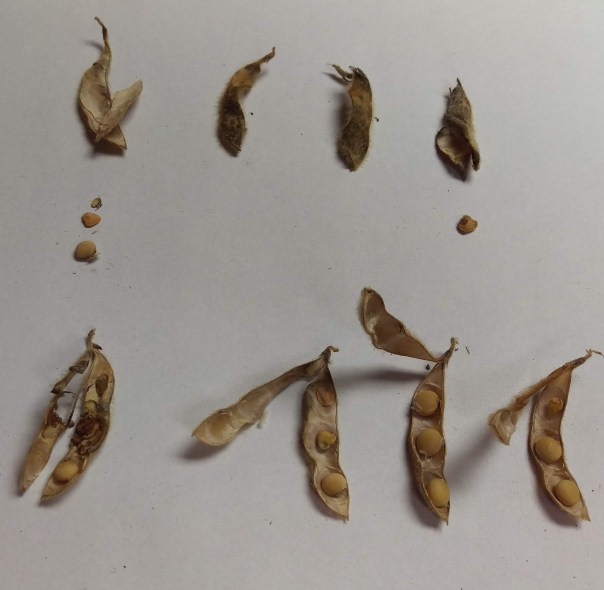
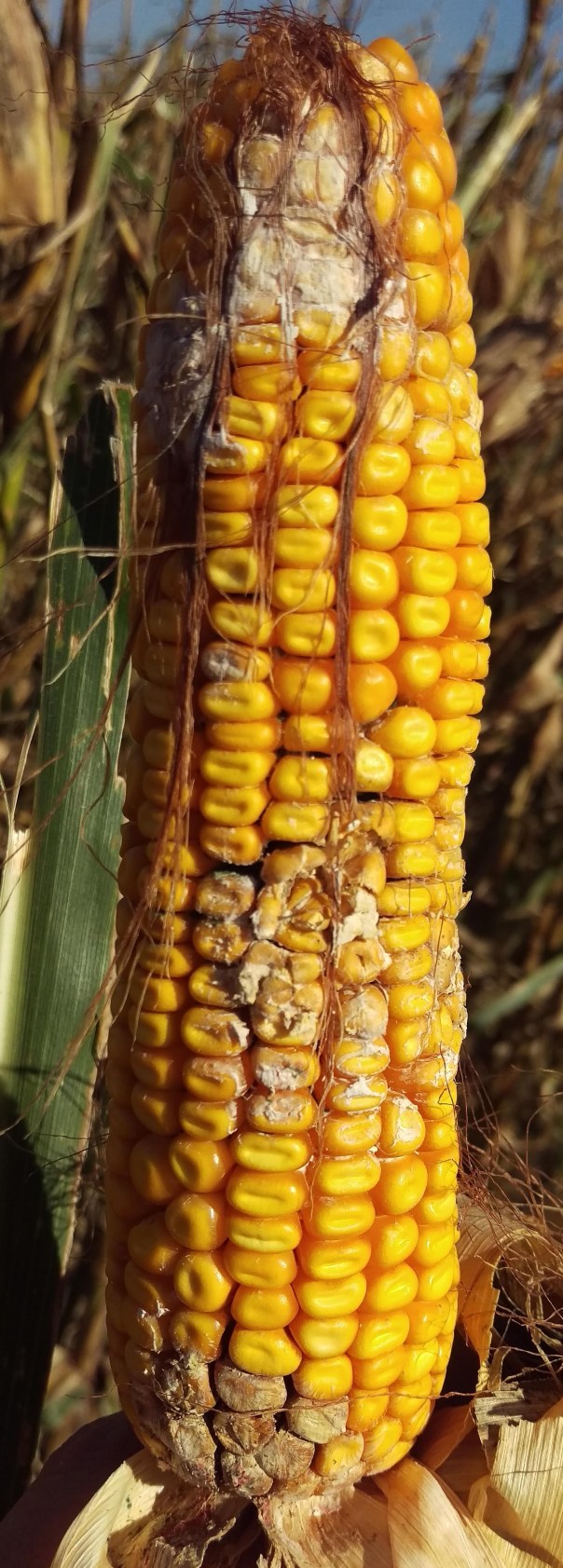
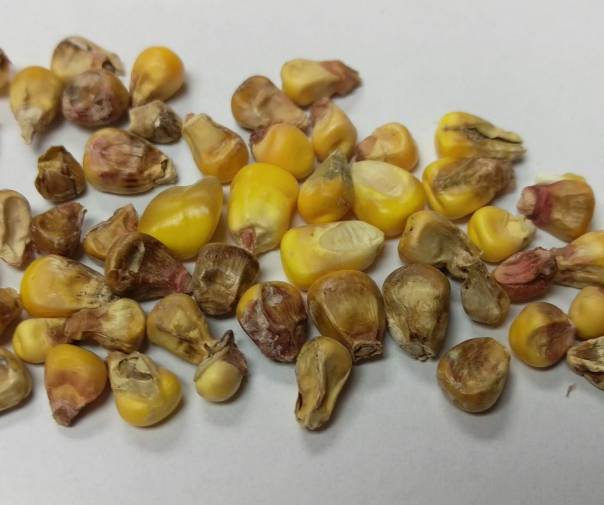
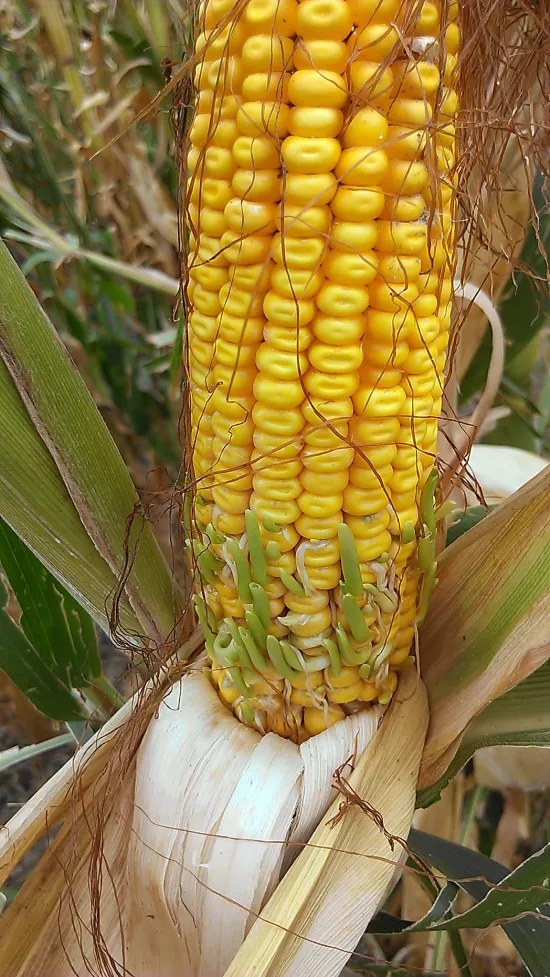
Both corn and soybean have sprouting occurring in the field. In corn, this is particularly occurring where ears are upright with tight husks. With soybean, it’s occurring where the beans in the pods dried down to 13% or less and rewetted to at least 50% of their seed weight with the rains. There’s also a number of fungal kernel rots occurring in corn. Fusarium and giberella have a white/pink/red fungal growth. The presence of the fungus doesn’t guarantee mycotoxins are present, but potential mycotoxins that can be associated with these fungi are vomitoxin and fumonisin. White fungal growth that overtakes an ear and makes it feel very light is diplodia. There are no mycotoxins associated with it. There’s also a number of “lesser fungi” that cause cob rots that we’re also seeing this season.
It’s important to know what’s impacting the corn ears prior to harvest, binning corn, or taking it to the elevator. If a particular hybrid is more impacted by kernel rot than another, make sure not to put that corn in the same bin as corn with better quality. Grain affected by ear rot diseases and mold are less suitable for storage. Use or sell affected grain first and store the highest quality corn possible. Grain needs to be cooled to 55F and at 13-14% moisture in order to stop Fusarium and other fungi from continuing to grow in the bin. More info. at this resource: https://cropprotectionnetwork.org/publications/storing-mycotoxin-affected-grain
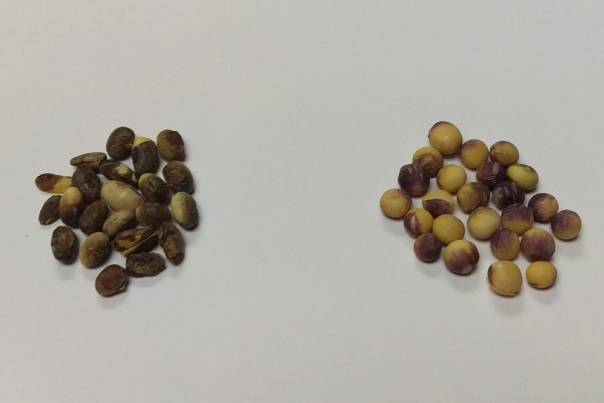
For soybeans, it’s also important to know if the variety in the field is impacted by things like purple seed stain or Phomopsis seed decay, which can cause elevators to reject soybeans. If you’re noticing discolored soybeans, talk to the elevator beforehand. Both of these conditions are variety related so keep track of which varieties you observe these conditions in.
Set combine fans to blow out as many broken/damaged kernels from insects, fungi, or sprouting as possible. Adjust combine settings to reduce harvest losses due to brittle kernels. Aim to start harvesting fields at a higher moisture (above 17%).
It will be a dirty harvest as secondary fungi can turn the leaves and stalks a blackish color. Fungal spores may behave like dust and aggravate respiratory illness or symptoms in sensitive individuals. Consider wearing dust masks or respirators when working in affected fields or around grain, such as in grain bins. Check air filters on equipment operating in conditions with a lot of dust and spores. Keep fire extinguishers close at hand. Take breaks as needed — and care for your mental, emotional and physical well-being. Be careful on roads: use headlights especially on gravel roads and check intersections before proceeding through them in the country. The Nebraska Rural Response Hotline is 800-464-0258 and is available for emotional support, legal and financial assistance, and disaster relief. Wishing everyone a safe harvest and hoping yields aren’t impacted too much from the challenges.

Corn Observations



Grain Storage
There’s over 25 species of fungi that can produce ear molds with the majority of them ceasing growth at 14% moisture within the kernel. For short term storage of moldy grain, drying to 15% moisture as quickly as possible can greatly slow additional fungal growth within the grain bin. The table below shares the days required to dry corn to 15% moisture with 1.0 cfm/bu and various temperature and humidity conditions. More info. at this resource: https://cropprotectionnetwork.org/publications/storing-mycotoxin-affected-grain

“Since drying time is directly proportional to the airflow, the producer can calculate the estimated drying times when using airflows other than 1.0 cubic foot of air per minute per bushel (cfm/bu). For example: Table II shows when drying corn from 18 percent to 15 percent moisture with 50F and 50% relative humidity air, the estimated drying time is 12.5 days using a 1.0 cfm/bu airflow. If the airflow is 1.25 cfm/bu, the estimated drying time would be 12.5 days / 1.25 = 10 days. For 1.5 cfm/bu, the drying time would be 12.5 days / 1.5 = 8.3 days. For 0.8 cfm/bu, the drying time would be 12.5 days / 0.8 = 15.6 days.” Source: Management of in-bin natural air grain drying systems to minimize energy cost.
- Management of in-bin natural air grain drying systems to minimize energy cost
- UNL CropWatch Grain Storage Resources
- Managing large grain bins for potential mycotoxin contamination
Mycotoxin Information
In 2026, we’re primarily seeing Fusarium and Gibberella species which have the potential to produce mycotoxins. Thus, the information below is directed at those fungal species and mycotoxin levels that can be associated with them. Again, the presence of fungi does not automatically mean a mycotoxin is present.

The following toxins can be produced from species of Fusarium and Gibberella. Source: Corn Ear Rots, Storage Molds, Mycotoxins, and Animal Health, Iowa State publication, 1997.
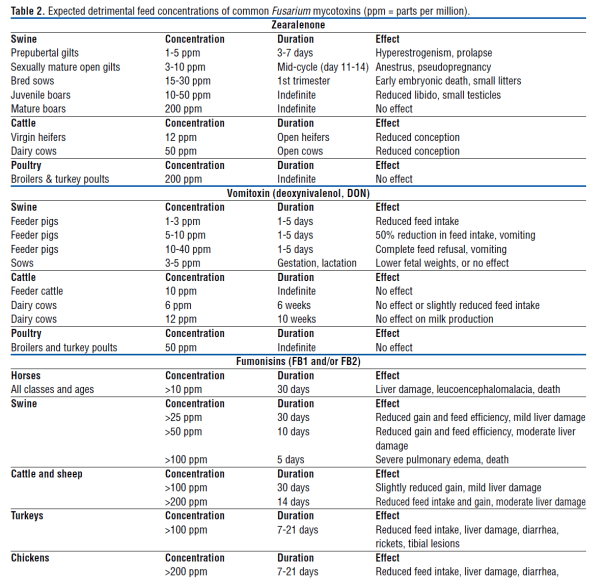
Source: Corn Ear Rots, Storage Molds, Mycotoxins, and Animal Health, Iowa State publication, 1997.
JenREES 9-16-18
Great to see many farm families at Husker Harvest Days last week and also great to see harvest getting started! Just a reminder for all of us to watch for equipment on the roads and allow for extra time to slow down, particularly with the speed limit changes. Dawn, dusk, and the evening can be the hardest times to see equipment and it can be difficult to see how wide or long the equipment extends. Harvest is hard work and a lot of hours yet is also a blessing to finish the growing season. Here’s wishing everyone a safe harvest season!
Harvest: As storm and drought-damaged corn is being harvested, just a reminder that grain should be tested for presence of ear molds and any potential mycotoxins now in addition to moisture/test weight. I’m hearing some differences in what’s all being tested when the harvest sample is taken, so be sure to talk to your insurance agent about this. It’s important to also test for mold and potential mycotoxins as that gives you an indication of what’s in the grain, particularly if any grain is going into the bin. We’d recommend not binning the worst damaged fields/areas of fields, particularly if you have a lot of diplodia in the field. Drying grain to 14% moisture as quickly as possible will stop most fungal growth and we recommend drying to 13% if diplodia is an issue in your corn ears. I’m also consistently hearing about light test weights in the storm damaged grain.
Rapid crop dry down has been a topic of conversation; I’ll share more next week. Briefly, grain moisture loss occurs when husks lose their color, when portions of the ear are exposed above the husk, with looser husks around the ears, when ears turn down, and when there’s fewer and thinner husk leaves. For those asking about dying patches in soybean fields (in which pods are not filling seeds), I’m consistently finding anthracnose in samples but am unsure it’s always been the cause. The concern with rapid dry down in corn is just how quickly these plants are cannibalizing stalks to keep filling ears, the amount of stalk rot in fields, and large ears (watch for potential weakened ear shanks due to various stresses). I test for stalk rot using a pinch test where I pinch the internode between the lower plant nodes for 20 plants and determine a percentage throughout portions of fields. Consider harvesting fields with higher amounts of stalk rot/weakened ear shanks first and also consider harvesting at higher moisture. I’m finding stalk quality quickly deteriorating, even in non-storm damaged fields.
For those with palmer amaranth on field edges, just a reminder that 99% of the seed is still viable going through that combine. Thus, the combine is one of the best ways of spreading palmer throughout your field and from field to field. My recommendation from observing palmer spread the past five years is to avoid combining field edges, strips, or patches where palmer is an issue. Instead, disk down the field edges to bury the seed and then plant an inexpensive small grain like bin-run wheat to reduce early germination next spring. Some have also planted rye. I don’t know if shredding vs. one-time disking is as effective this time of year (since palmer shoots seed heads at the soil line too but unsure if if produces viable seed past mid-September here). As I’ve spoken during pesticide trainings and other meetings, farmers have also shared their experiences. Some farmers shared they took this advice and reduced the problem the successive year and didn’t spread it through their fields (even if they were no-till farmers and had to till the field edges one time). I’ve had other farmers share they combined that field edge or patch and could tell the following year exactly where the combine went for the first few passes within the field as the palmer was a problem there. So, just another consideration as it takes a system’s approach for everything we do including weed management; palmer management begins right now with harvest.
Another management consideration is to harvest soybeans as close to 13% (the elevator standard) as possible. And, I realize this is easier for me to write about than to actually do depending on many factors! Soybeans delivered below or above 13% moisture lose potential profit. At greater than 13% moisture, there is a moisture dock on the scale ticket for delivering wet beans, resulting in a lower price per bushel. And with less than 13% moisture, profit is lost because there are fewer “bushels” to sell rather than a dockage on the ticket. There are fewer bushels because the load weight is divided by 60 pounds per bushel (assuming 13% moisture) rather than by the actual pounds per bushel for the moisture content of the beans at the time of delivery. If you sell soybeans at 8% moisture, you’re losing about 5.43% of your yield; at 9% moisture, it’s 4.4%; at 10% moisture, 3.3%; at 11% moisture, 2.25%; and at 12% moisture, it’s 1.14% yield loss. That doesn’t take into account additional risk for shatter losses during harvest. For a field that’s yielding 75 bu/ac, harvesting it at 9% results in selling 3.3 fewer bushels per acre based on weight because you’re not selling the water that you’re entitled to sell if the beans were at 13% moisture. With soybeans priced at $7/bushel, that’s a loss of about $23 per acre (with greater loss when soybean price increases).

Fusarium (white/pink/gray) is the primary ear mold on this hail-damaged ear with Pennicillium (blue-green) as secondary.

Gibberella stalk rot (related to Fusarium and looks similar). Gibberella is characterized by breakage at the node with pink discoloration within the pith tissue and black fungal structures (not clear in this photo) on the outside of the stalk node.

Seeing soybeans dying in patches like this in a number of fields where early death led to reduced pod fill. Finding anthracnose on stems but unsure it’s always the cause. Not always finding phytophthora or sudden death syndrome either in these patches.
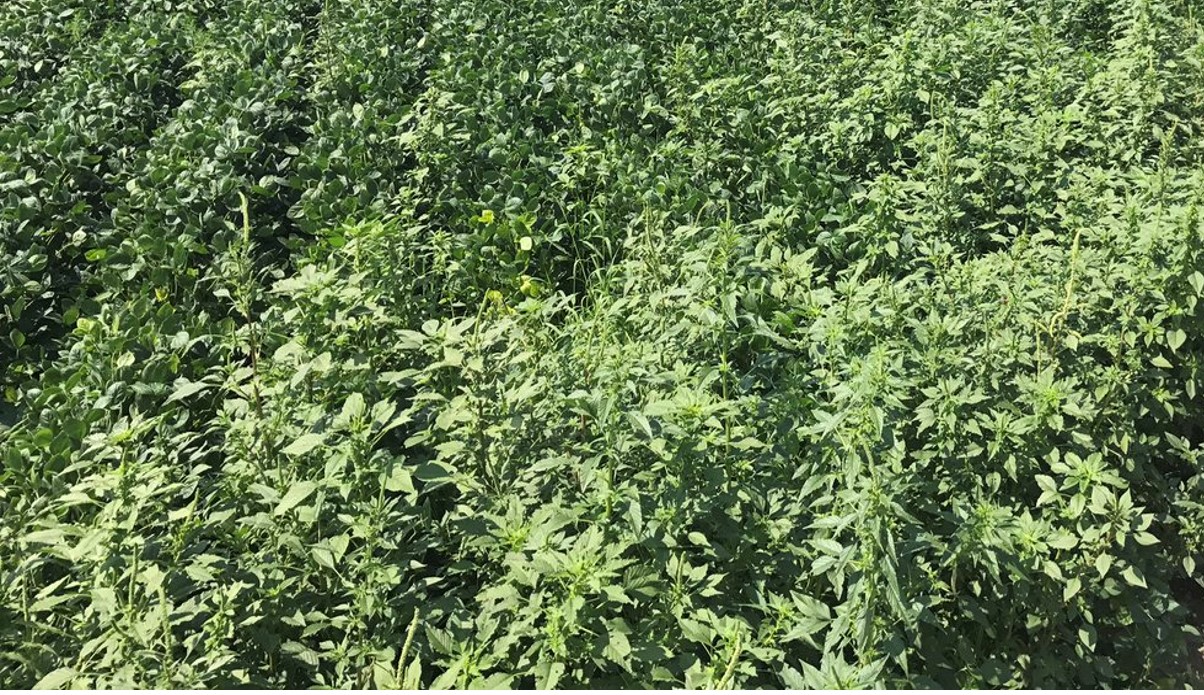
Palmer amaranth is often observed along field edges. Consider not running the combine through edges or patches with palmer to help avoid spreading it throughout your field.
Wind-Hail Crop Damage Meeting

Recent wind and hail storms have created damage across our area counties in Nebraska and Kansas. This brief meeting to be held on Monday near Gladstone, NE is designed to answer farmers’ questions regarding harvest, crop insurance expectations, and what to expect regarding crop maturity and future damage. Please click on the image to enlarge.
What do Mycotoxin Levels Mean?
Last week I was receiving text messages from a few of our farmers about corn harvest results from damaged corn. Low levels of mycotoxins are being detected in samples thus far, thankfully.

A reminder, the presence of mold does not automatically mean a mycotoxin is present. The fungi producing mold have the potential to produce mycotoxins.
Here’s What the Numbers Mean…
For aflatoxin, the U.S. Food and Drug Administration has set a recommended limit of 20ppb (parts per billion) for dairy animals, 100 ppb for breeding animals, and 300 ppb for finishing animals. To put this is simpler terms, a sample would need 20 affected kernels out of a billion kernels to be at the legal limit for dairy animals. So far, most samples are coming up at 5-6ppb which is very low.
For fumonisin, 20ppm (parts per million) is the recommended limit set by FDA for swine, 30ppm for breeding animals, 60ppm for livestock for slaughter, and 100ppm for poultry for slaughter. So, this would mean 20 affected kernels in a million kernels could cause a problem for swine. Again, our levels are averaging closer to 5ppm right now which are low.
Deoxynivalenol (DON) also known as vomitoxin is another mycotoxin being tested from grain samples. This mycotoxin causes reduced weight gain and suppresses animal feeding, especially in swine. Concentrations greater than 10ppm can result in livestock vomiting and totally refusing feed. FDA has recommended that total feed levels of DON not exceed 5 ppm for cattle and chicken, and 1 ppm for swine.
It is very important to sample from several places in the grain to get an accurate sample for damage and mycotoxins. It is also very important that black light tests are not used to determine the presence or absence of mycotoxins. Some of these mold fungi produce a compound that fluoresces under black light, but research has shown that this quality does not consistently predict the presence of mycotoxins (often provides false positives). Finally, before any of your storm-damaged corn is put in a bin, call your insurance agent out to get a sample!
Protecting Your Health with a Mask
There is some great information from the University of Nebraska Med Center on what types of masks to use to protect your health from molds and potential mycotoxins. Some people tend to have more sensitive immune and respiratory systems than others, so I’d highly recommend checking out these short videos.
Apps and Mobile Sites for Mobile Devices on the Farm
It didn’t take long for the phrase “there’s an app for that” to be seen and heard regularly in the phone and mobile device world. Today, there are many apps and mobile websites that can be fantastic tools for producers to use in decision-making. University of Nebraska Extension has developed several mobile apps to take a look at and be sure to visit our site often to learn of additional new apps.
In addition to our Extension Apps, Dennis Kahl, UNL Extension Educator, and I have also compiled a list of a few mobile apps that we think could be useful to farmers yet this year as they get closer to harvest, but also for next year to test out and see if they will indeed help them do work quicker and make decisions more accurately.
Today we are going to highlight a few mobile applications and mobile websites that producers may be using now as they make preparations for fall harvest.
- UNL CropWater – provides an easy way to estimate soil water status based on Watermark sensors installed at depths of 1, 2, and 3 feet. With these sensor readings, the Crop Water app will estimate the water used as well as what is still available for Nebraska soils.
- Market Journal – Television for Ag Business Decisions. Weekly crop reports, markets, weather and current insect,
 disease and harvest issues. It was also listed at Agriculture.com’s #1 ag app for 2013.
 - RealAgriculture – focuses on the issues that are impacting agriculture. The site is focused on getting farmers the opinions on issues so that you not only get the news but the insight into what the news means in the production business.
- DTN/PF – The Progressive Farmer – provides market data, link charts to market data for single, seamless view of how the latest prices correlate with current market trends.
- Farm Progress – Keep up on local ag news, grain and livestock markets, enhanced weather and blogs as well as Nebraska Farmer magazine.
- Husker Harvest Days Show – Maximize your time at Husker Harvest Days with this application that includes exhibitor and category lists, show maps and other tools to help you maximize your time at the show.
- Ag PhD Harvest Loss Calculator – Allows farmers to estimate yield loss before and during harvest by recording the number of individual corn, soybean, wheat, sorghum, barley or oat seeds found on the ground in a square foot.
- Combine Performance Optimizer by John Deere – Help operators adjust and set the critical settings for next year’s harvest of small and large grain crops to improve machine performance.
- Calibrate My Sprayer – Aid in the proper calibration of spraying equipment.
- In addition to the apps listed above, Crop Life featured a story of the Top 13 Mobile Ag Apps for 2013 and Agriculture.com has a list of mobile apps. Take a look at these as well.

With wireless technology available in most areas of the state, we utilize Verizon Wireless with our mobile devices in the field and in our communities to update various social media outlets such as Twitter, Facebook and blogs. Mobile access has allowed University of Nebraska Lincoln Extension to provide current information and situations in the field at all times. We encourage producers to subscribe to various resources including:
- Twitter
- @UNL_Cropwatch
- @UNLBeef
- @MarketJournal
- @IANRNewsService
- @UNLExtension
- For information on some of the newest technology, visit Innovative Tips for Rural Communities blog.
- If you are interested in staying up-to-date with crop information be sure to subscribe to and bookmark cropwatch.unl.edu and subscribe to Jenreesources Extension Blog.
Special thanks to Dennis Kahl as a Guest blog contributor to this post!
Harvest #Soybeans at 13%
In spite of green stems and even leaves on some plants, soybeans are surprisingly drier than what you may think. I’ve been hearing reports of 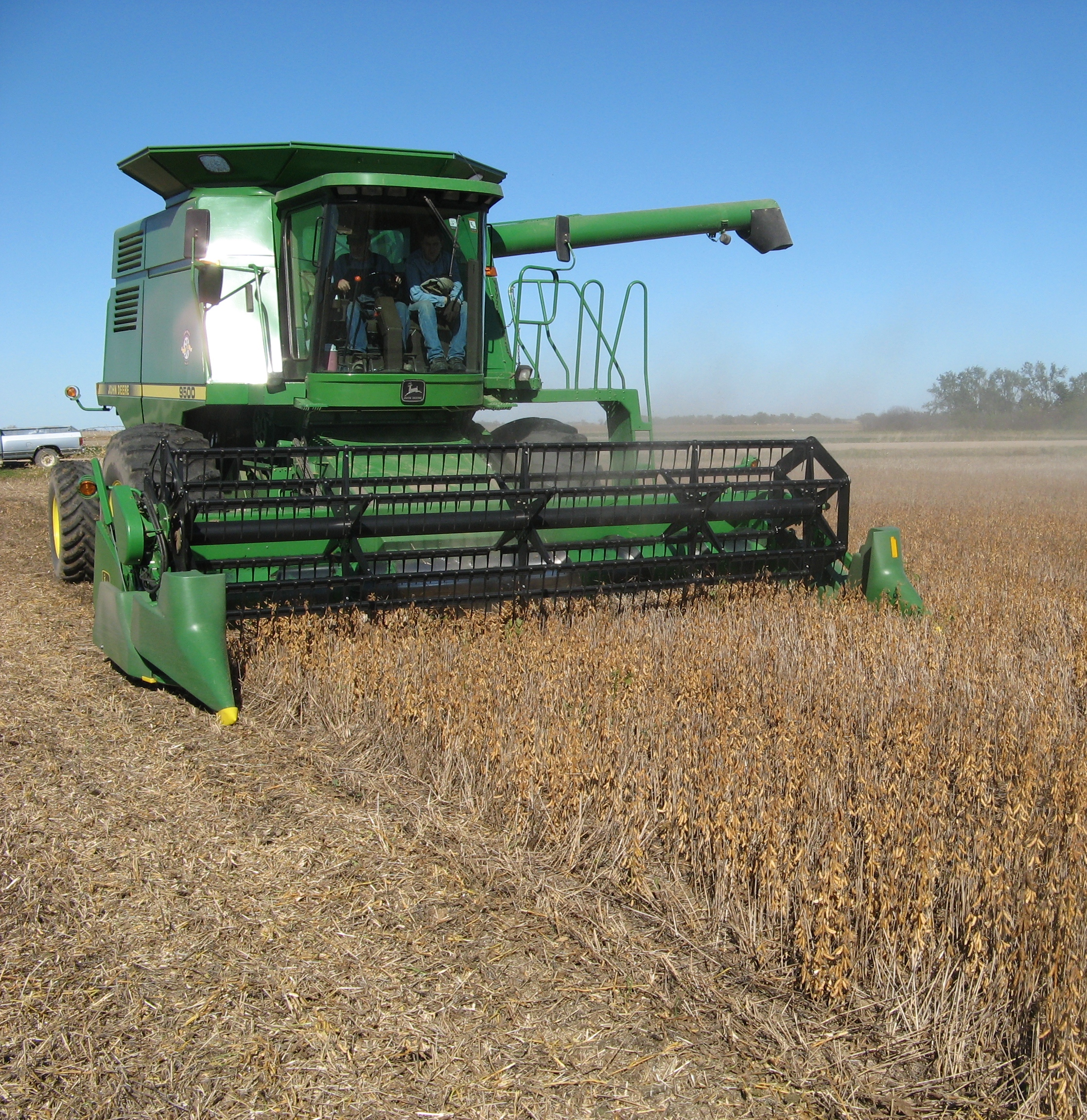 soybeans in the 7-10% moisture range already in spite of there also being some “lima beans” along with the low moisture beans at harvest.
Harvesting soybeans at 13% moisture is a combination of skill and maybe some luck. Why is 13% so critical? A standard bushel of soybeans weighs 60 lbs. and is 13% moisture. Often beans are delivered to the buyer at lower moisture than 13%. The difference between actual and desired moisture content will result in lost revenue to the grain producer. Here’s how the loss works based on UNL Extension’s “10 Easy Ways to boost profits up to $20/acre”:
- Since 13 percent of the weight is water, only 87 percent is dry matter. The dry matter in a standard bushel is 52.2 pounds and the remaining 7.8 pounds is water.
- If this bushel of soybeans is kept in an open basket and some moisture is allowed to evaporate, the net weight of beans would decrease. If the dry matter weight remains unchanged at the standard 52.2 pounds, the wet basis weight for any moisture content can be calculated.
- For example, a standard bushel at 13 percent moisture weighs 60 pounds. If the moisture content were reduced to 11 percent (89 percent dry matter), the wet basis weight per bushel of the soybeans would be 52.2 pounds of dry matter divided by .89=58.65 pounds. (1.35 pounds less than the standard 60 lb. weight of beans initially placed in the basket). For each 52.2 pounds of dry matter delivered at 11 percent moisture, you miss an opportunity to sell 1.35 pounds of water.
- It is standard practice for buyers to assume 60 pounds of soybeans constitutes a bushel when soybeans are at or below 13 percent moisture. When the beans are below 13 percent, the difference in water content is made up for by an equal number of pounds (wet basis) of soybeans.
- Assuming a 60 bushel per acre yield and selling price of $8.50 per bushel, the potential extra profit the producer could realize if the beans are harvested at 13 percent moisture instead of 11 percent is $11.48 per acre.
Rapid dry-down and difficulty harvesting green stems and pods are the most common reasons for harvesting at lower than standard moisture. The following practices can help producers maintain quality and expected moisture content.
- Adjust harvest practices. When harvesting tough or green stems, make combine adjustments and operate at slower speeds.
- Begin harvesting at 14 percent moisture. Try harvesting when some of the leaves are still dry on the plant; the beans may be drier than you think. Soybeans are fully mature and have stopped accumulating dry matter when 95 percent of the pods are at their mature tan color.
- Plan planting dates and variety selection to spread out plant maturity and harvest.
- Avoid harvest losses from shattering. Four to five beans on the ground per square foot can add up to one bushel per acre loss. Harvest at a slow pace and make adjustments to the combine to match conditions several times a day as conditions change.
Visit from Chinese Agronomists
Last week I had a neat experience in speaking to a group of agronomists from China about Extension. They are in the U.S. for 10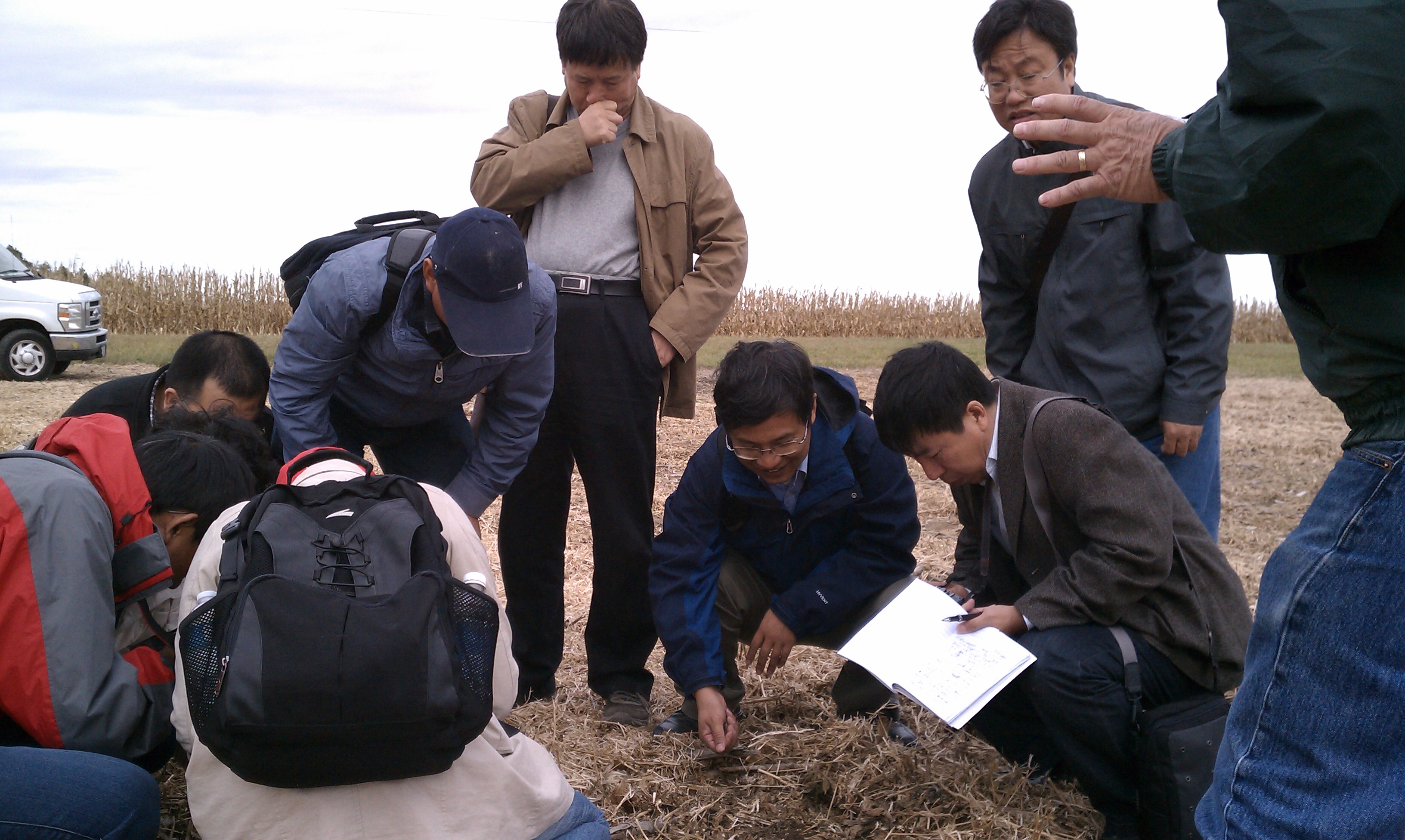 days and are interested in high yield corn production. I scrapped the presentation I had been asked to present as they had so many questions about our Extension system. So we started in a discussion…how do we set up a field day/meeting in Extension? How do we let farmers know about them? How do we decide what to talk about? Thus ensued a discussion of farming in China vs. farming in Nebraska. In China, many of the fields are hand-planted and less than 10% of their farmers have internet connectivity. In Nebraska, we’re seeing the trend of larger equipment and the majority of our farmers are connected to the internet. I suggested that they start with field days and meetings which shared the research-based information they are generating at their research sites. Advertise to farmers via word of mouth, radio, newspapers, direct mailings, or brochures/flyers left at common gathering spots. Once they have the people at the meetings, they can follow up with a survey to determine needs assessment for what the farmers would like to know more about in the future to determine future meeting topics.
Extension in Nebraska has greatly changed in my 7 years regarding how we share information. We are challenged today to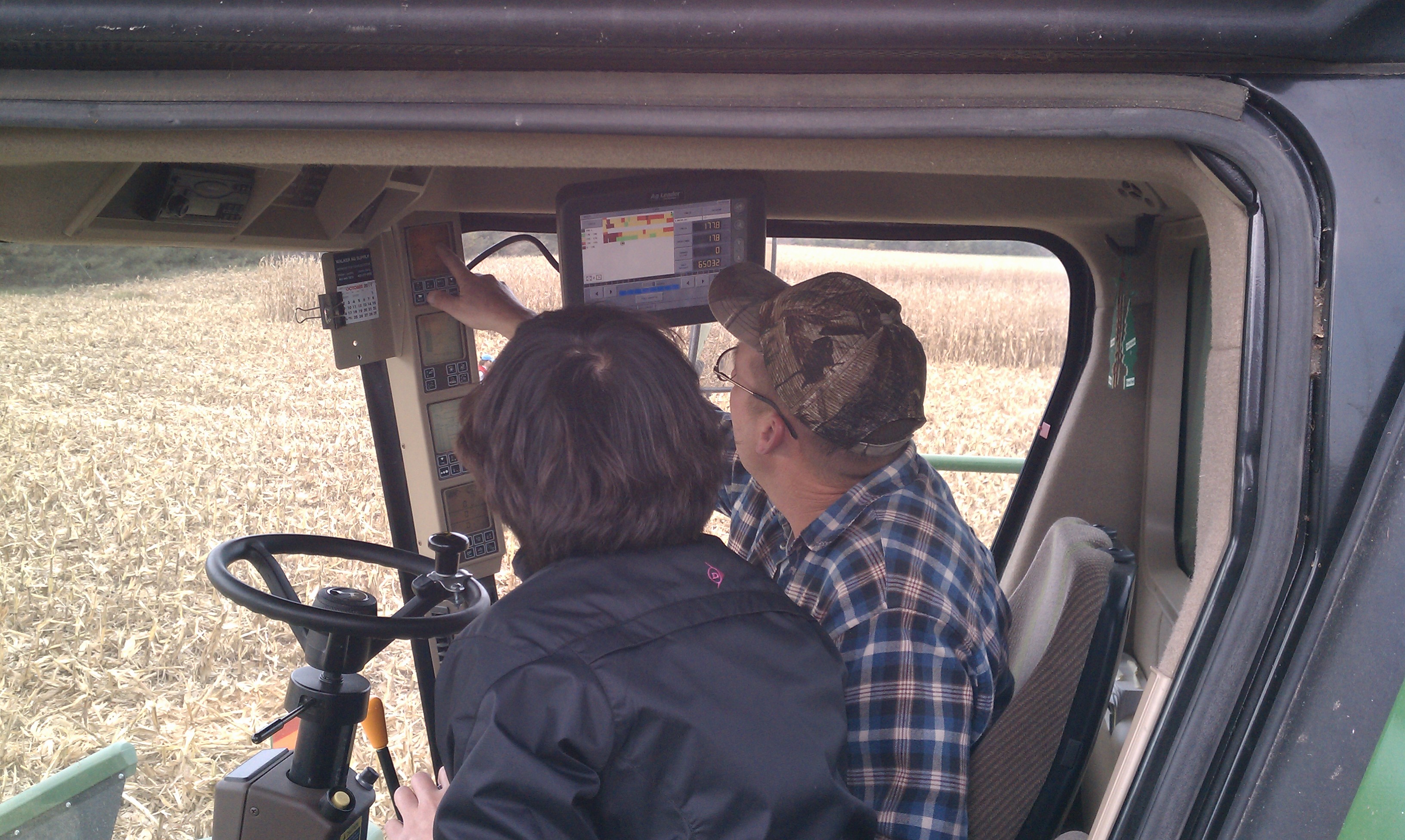 reach a broad audience who on one hand primarily finds information from newspapers to the other hand, primarily from the Web-and everywhere in between! This year, I’ve worked at trying to share the same information 7 different ways to reach a broader audience. I showed the agronomists from China the impact of the Web and social media in sharing information in Nebraska. They were amazed!
We then went on a tour where they were able to view harvest. It was fascinating watching them excitedly discuss and question no-till farming as they were digging through residue and in the soil. They also predicted corn yields by measuring and counting and comparing that to the combine yield monitor. Some enjoyed getting into the combines and learning about the precision ag tools available to farmers. It was a neat experience and I learned much from our visitors as well!

Farm Safety During Harvest
Combines have been rolling in the area soybeans and dryland corn. This is a busy time for farm families, but don’t let the rush to get the crop in compromise safety. Farming is one of the most hazardous occupations in the U.S. Here is a quick list of reminders for a safe harvest season.
It’s important to teach children these safety tips so they learn safety by habit as they live and work on the farm. Keep children and grandchildren away from equipment and machinery. Children who are involved in operating machinery and equipment should be properly trained by an adult on each piece they operate. It is always fun for kids to ride in the combines, or on the tractor fenders, but if there is not an extra seat and a seatbelt, it’s not a good idea. Tractor operators can be distracted by these extra riders and not keep their full attention on operating the equipment. All it takes is a sudden stop or swerve for the extra passengers to be thrown off or more serious injuries to occur. Keep kids out of grain wagons and bins and always be watchful for children and adults when moving machinery.
Double check to make sure all machinery is working properly and that safety shields are in place. When moving equipment, especially grain augers, watch for power lines, keeping equipment at least ten feet from them. Don’t get into grain wagons or bins while the grain is moving. Many people have seen the demonstrations of how quickly a person can be sucked under the grain and suffocated. Probably the hardest one to follow, yet easiest safety tip to do is to shut down moving equipment when it gets plugged. It only takes a few extra seconds and is well worth it to save a limb. People who think “nothing will happen to me” are those at the greatest risk for something to happen because they do not practice safety as they should. Farm accidents happen so quickly; don’t let them happen to you or your family!
Try to move equipment during the daylight hours. If you must move equipment at night, make sure tractor lights are working properly and slow moving vehicle signs are visible. It may even be helpful to put lights on grain wagons or on equipment you are pulling for other drivers to see them in time. You may have someone follow you in a vehicle with flashers to warn others of a slow moving vehicle ahead. Be cautious of other drivers as they get anxious to pass, especially if they try to pass while you intend on turning. For all of us on the road, it’s important to slow down and stay alert when we encounter harvest equipment on the road. During this Farm Safety Week, I’m wishing everyone a safe and bountiful harvest!


