Monthly Archives: August 2026
Humidity and Temperature Impacts
It’s been another interesting year weather-wise. There’s been a number of concerns about tip-back, lack of pollination, and how quickly corn is maturing. Some were also asking why we hadn’t seen white mold this year when it was cloudy during the early soybean flowering stages.
I asked Eric Hunt, UNL Extension Climatologist for some help assimilating the weather data for June, July, and August. The data is telling. In an email Eric shared, “York has had the highest average dew point in the state since June 21st, even more so than Falls City which would naturally be the most humid place in Nebraska. I also have attached the daily max/min humidity charts for the last two years. Those red lines are days where the relative humidity did not drop below 60 percent. That has happened frequently in your area this summer, on par with last year.” Charts at: https://jenreesources.com.

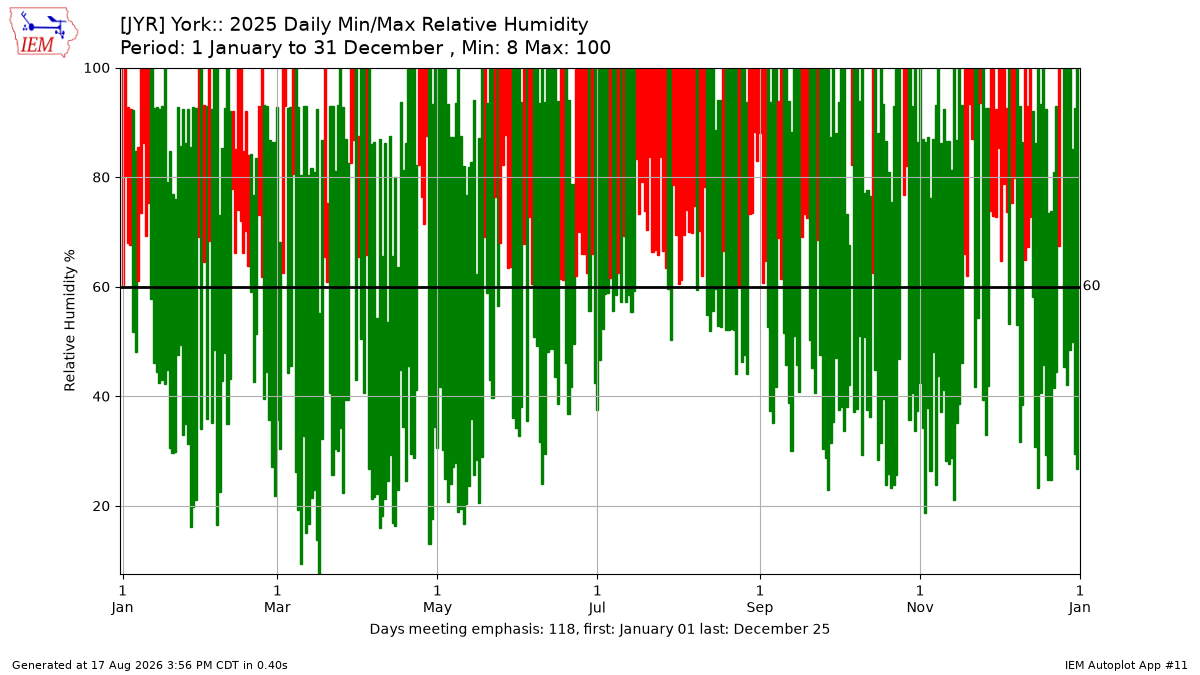
Last year, I shared we need a drop in humidity for the soybean white mold spores to be released. If the air relative humidity is 50% and above, the canopy relative humidity is at least that or higher. UNL emeritus plant pathology professor, the late Dr. Michael Boosalis, proved that the mushrooms produced by Sclerotinia sclerotiorum fungus needed a drop in humidity to build the pressure to release the spores. He had time-lapse imagery of this and was one of the few people in the world at that time who could produce the inoculum for plant breeders.
This is similar in concept to corn pollen. In many years, we receive a change in humidity as temperatures rise around mid-morning, allowing for anthers (which hold the pollen), to dry and release the pollen between mid-morning and mid-afternoon. However, high humidity can prevent this from happening.
Years ago, Dr. Tom Hoegemeyer wrote a CropWatch article on how high heat and high temperatures impact corn pollination. He shared, “Corn pollen is produced within anther sacs in the anther. The plant releases new, fresh anthers each morning, starting from near the top of the tassel, on the first day of shed, and proceeding downward over several days. The process of releasing the pollen from the anthers is called “dehiscence.” Dehiscence is triggered by the drop in humidity, as the temperature rises. However, when it is extremely humid and the humidity falls very little, dehiscence may not occur at all, or it may be delayed until late in the day. If one has breezes, while the humidity is still very high, the anthers may fall to the ground before pollen is released. If the temperature rises too high before pollen dehiscence occurs, the pollen may have reduced viability when it is shed.”
There may have been specific windows this pollination season where little to no pollen was released from anthers which could have impacted silk fertilization, especially when humidity never dropped below 70%. Just a day or two difference in flowering, or planting, or other factors can make a substantial difference in set, both in irrigated and non-irrigated fields. Silk receptivity to pollen also changes as silks elongate, become older, and dry out.
What I’m sharing about here is different than the tassel wrap situation impacting pollination in some fields due to reduced tassel and anther production; however, high humidity during pollination may have impacted the minimal pollen being shed from some of those tassels as well.
Regarding the corn maturing quickly, the end of July and a good portion of August saw night-time temperatures above 70F. Corn plants being C4 plants max out on photosynthesis when temperatures are above 86F and burn sugars at night to cool the plant when night-time temperatures are above 70F (corn prefers around 50F minimum temp). Using the sugars for cooling takes them away from growth and development, so the plant pushes forward in maturity. For those asking, the rains haven’t been able to offset this effect because night-time respiration is ultimately a factor of the night-time temperature.
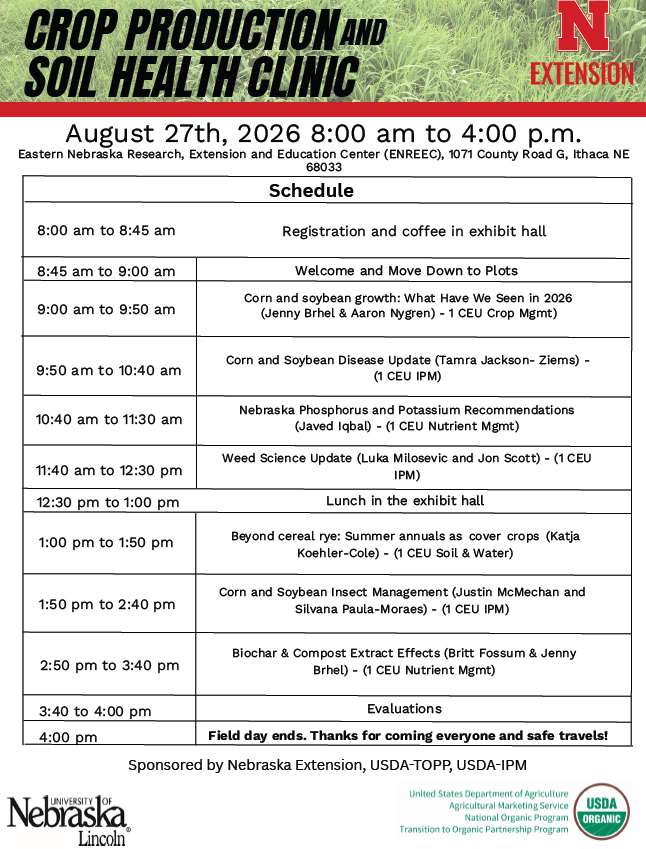
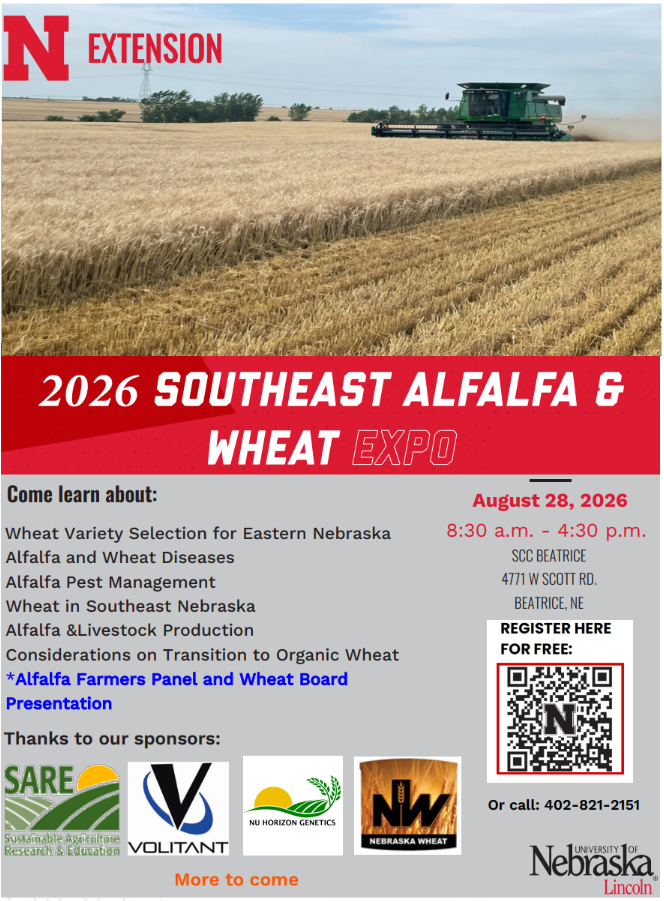
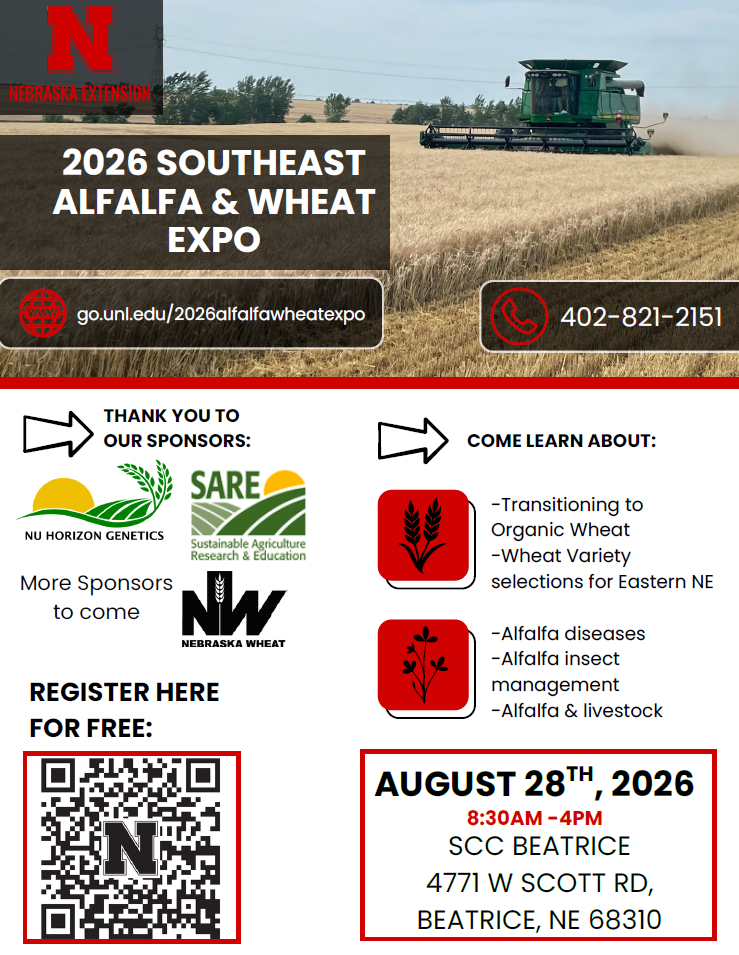
The weather is outside of our control, but hopefully this helps explain some of the questions being asked. We will all hope for cooler nights going forward and a strong finish to the growing season. A reminder this week of the crop and soil health clinic at ENREEC near Mead on Aug. 27 and the wheat and alfalfa expo in Beatrice on Aug. 28.

Nitrogen observations
I’ve enjoyed hearing from farmers the past month about a few observations they’ve seen in their fields. The observations involve the difference between higher and lower nitrogen rates applied. The first observation was like I’ve shared in the past: less disease when less nitrogen was applied to fields. The comments have come from producers who were comparing either whole fields of theirs or strips within fields where nitrogen rates varied from 60-100+ lbs less nitrogen per acre. I was really pleased to hear farmers are noticing this observation for themselves in fields!
The second observation is fields looking good in spite of reduced nitrogen applied to some fields. All the producers who have provided this comment are using Sentinel Ag to aid in their nitrogen management. There’s a handful of producers who have been using Sentinel Ag for years with only 60-100 lb N/ac on their irrigated fields. In the past month, producers have also wondered about applying extra N due to recommendations of others or when one Sentinel indicator block would trigger but the others wouldn’t. In those cases, I’ve always recommended to only put on strips or a pie with the pivot that covered one indicator block but not the other. Prove it to themselves whether they needed the additional nitrogen or not.
We’ve had some consistent rains this growing season of 0.1-0.2” in the area and have been blessed with the larger rains the end of July and more recently. There’s quite a bit of research showing mineralization flushes when rains/irrigation of 0.5-1” are received (as long as the soil was at 50-80% field capacity). The small rains of 0.1-0.2” and the heavy morning dews I think are also contributing to mineralization bursts on the soil surface as a key to mineralization is wetting/drying cycles. Wetting and drying cycles on the soil surface lead to nitrogen and carbon cycling by the microbes.
Crop Production and Soil Health Clinic will be Aug. 27th at ENREEC near Mead from 8 a.m.-4 p.m. This is a hands-on, research-based event focused on improving corn and soybean profitability through regenerative farming practices and better soil management. Topics include update on what we’ve seen with corn/soy this season, weed/disease/insect management, nutrient efficiency, cover crops, and biochar/compost extract effects. Designed for producers, crop advisors, agronomists and ag professionals, the program offers real-world tools to address pest resistance, reduce input costs and build more resilient cropping systems. To view the schedule and register, please click on the link: https://enreec.unl.edu/2026CropAndSoilHealthClinic/. The registration fee is $35 for those not needing CCA credits and $75 for those needing CCA credits. Fees include training, lunch, and reference materials. The training will be held rain or shine (bring rain gear).
Wheat and Alfalfa Expo will be held on Aug. 28th from 8:30 a.m.-4:30 p.m. at Southeast Community College in Beatrice. The morning sessions will focus on wheat production and disease management. The afternoon sessions will focus on alfalfa management. The program will also feature an alfalfa producer panel, providing attendees with an opportunity to hear directly from farmers about their experiences and management practices. Attendees can choose to stay for the entire program or come and go at their convenience. There is no charge, but please RSVP for meal count at: go.unl.edu/2026alfalfawheatexpo or contact Matheus Ribeiro at mribeiro2@unl.edu or 402-441-7180.
Fair 2026
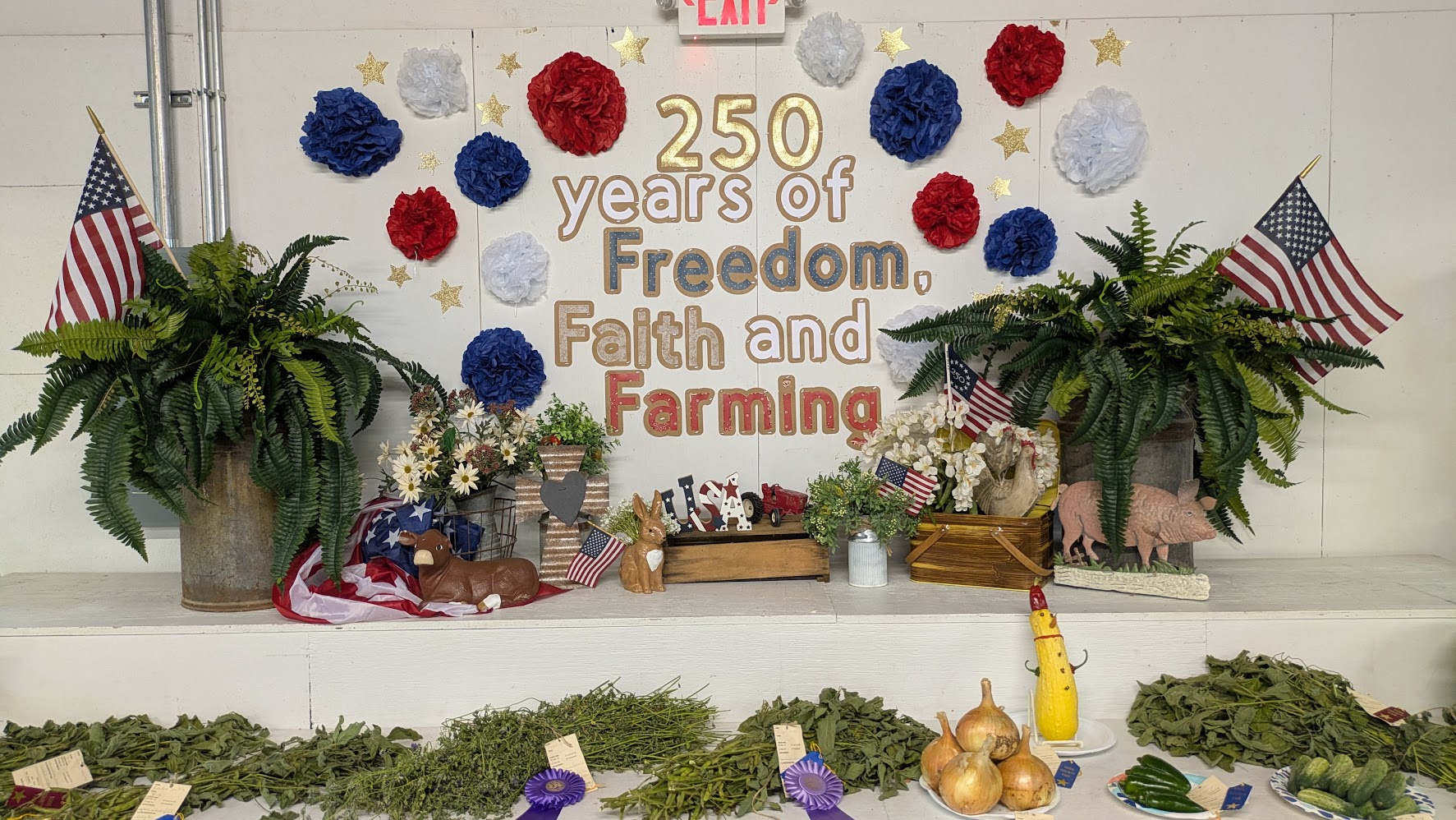
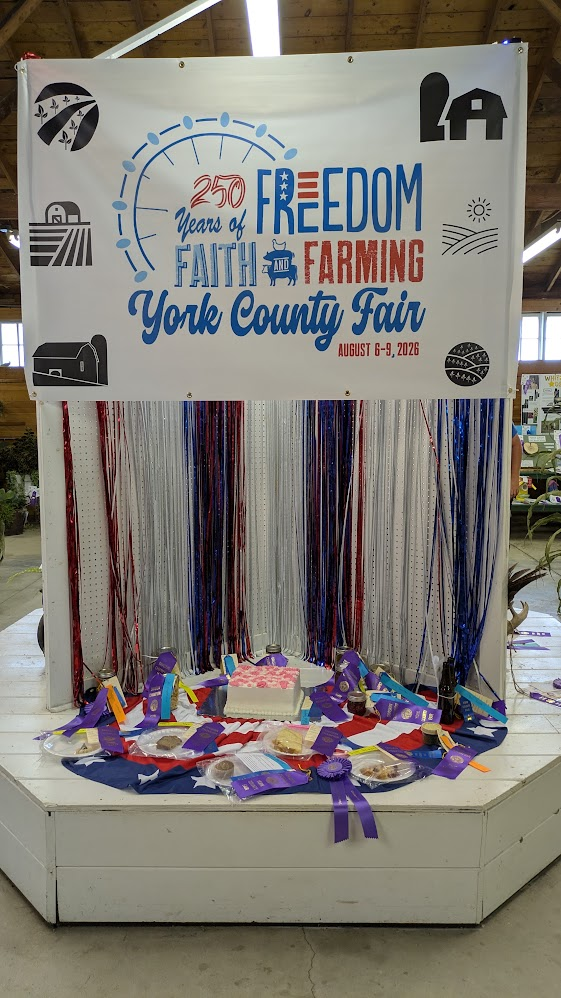
Youth walking around with medals around their necks, friends from across the county catching up at events, buildings full of exhibits, parking lots full and grounds full of people, hard work and dedication recognized, the large numbers of clover kid and junior exhibitors in the beef and sheep shows, wonderful people working together to make the fair a success – these are all some of the memories etched in my mind from county fair this past week. In many ways, it may have been one of the best fairs I’ve experienced. I’ve never seen Ag Hall so packed full of exhibits nor the parking lots so full in the time I’ve been in York County! I think the theme of patriotism with “250 years of freedom, faith, and farming” contributed a lot to the excitement around fair this year.
This year was my 24th county fair “on the other side” as an Extension Educator. There’s many fond memories from each county I’ve served in with fairs. The consistent things with each of the fairs has been the wonderful people to work with and the life skills being built by youth.
There’s so many people behind the scenes who make the fair happen. Special thanks to all the Ag Society members and their families, Extension staff and families, 4-H Council and families, and the large numbers of volunteers who make fairs a success! In Ag Hall alone, we have around 45 volunteers and I’m so grateful to each of them! Gary Zoubek asked 40 of them how many years they have been volunteering and they have a combined 669 years of volunteerism! We couldn’t run a fair without volunteers helping with judging exhibits, livestock shows, taking tickets at events, and in the food stand. We’re always seeking volunteers, so please contact the Extension Office if you’re interested.
A fun fact, one of the most favorite 4-H food stand items are the rice Krispie treats. What most don’t realize is there’s often someone in the Extension office making them or baking pies behind the scenes throughout the day each day. I wish I had a photo of our office after all the rice Krispie boxes and marshmallows were bought from two local grocery stores in town! One member of our office made 8 large batches of rice Krispie treats during the swine show alone and I have no idea how many total were made during fair! Thank you again to all who helped make the county fair a success!
Yield Forecasts: I wasn’t able to get in the fields this week, but a new CropWatch article was released on yield forecasts at: https://cropwatch.unl.edu/2026-corn-yield-forecasts-aug-4/. The Hybrid Maize model is used which considers 30 years of historical weather data for an area and estimates the potential corn yield based on the current year’s weather data compared to previous years’ data. While these are only forecasts, they can provide a prediction on what to expect, barring any significant weather or pest damage to fields. For the Clay Center/York area this year, it’s predicting:
- near- or below-average irrigated yields because of high nighttime temperatures during flowering and early grain filling.
- Rainfed yields are expected to be near average for the eastern and central Corn Belt, but below average for most of the western region.
- Temperature and rainfall during the rest of the grain filling will define the trend for the rainfed sites across the region.
JenResources 8-2-26
Hope to see you at the York County Fair this week from Aug. 6-9! All the activities can be viewed at: http://www.yorkcountyfair.com.
Renovating Lawns: August 15-September 15 are the best times to seed cool season grasses. Improving Turf in the Fall at https://go.unl.edu/2bn5 is a great resource to walk you through renovation depending on your situation. Some lawns can be easily improved by adding fall fertilizer. Sarah Browning, former Extension Horticultural Educator shares, “Lawns that are 10-15 or more years old typically need only two fertilizer applications a year. Make the fall application in late August or early September. On younger lawns, two fertilizer applications during fall are recommended. Make the first one in late August/early September, and the second in mid-late October.”
If overseeding is needed to fill in thinned areas but more than 50% of good turf remains, mow the existing grass 2.5” tall to make the soil prep easier. For lawns needing total renovation, start with a glyphosate (Roundup application) followed by waiting at least 7-10 days to kill the lawn. Mow dead vegetation as short as mower goes to then aerate the lawn three times. Full seeding rate for tall fescue is 6-8 lbs./1,000 sq.ft., and 2-3 lbs. for Kentucky bluegrass. When overseeding into an existing lawn, the seeding rate can be cut in half. Drilling the seed is perhaps best, otherwise, use a drop seeder. Seed half the seed north/south and the other half east/west for even distribution. Then lightly rake to ensure seed to soil contact.
Organic Field Days: The following are a few upcoming field days that may be of interest.
Schuchardt family farm
On August 7 from 10:30 am to 1:30 pm, the Schuchardt family is inviting us to visit their organic farm in Elgin (84151 523rd Ave, Elgin, NE). This year, they experimented with roller crimping soybean compared to cultivating. The field day will be a great way to connect with other farmers and Extension and includes a delicious lunch. There is no cost to attend. Please register here Schuchardt Farm Field Day Registration
Hintz Produce evening farm tour
On August 12 from 5:30 pm to 7 pm, the Hintz family will welcome visitors for an evening farm tour in Hebron (Hwy 136 & Road 6200, Hebron, NE). See their diversified farm which includes a high tunnel, greenhouse and alfalfa fields and hear about their experiences transitioning to organic production. No registration is required. For questions, please reach out to Katja kkoehlercole2@unl.edu


