Humidity and Temperature Impacts
It’s been another interesting year weather-wise. There’s been a number of concerns about tip-back, lack of pollination, and how quickly corn is maturing. Some were also asking why we hadn’t seen white mold this year when it was cloudy during the early soybean flowering stages.
I asked Eric Hunt, UNL Extension Climatologist for some help assimilating the weather data for June, July, and August. The data is telling. In an email Eric shared, “York has had the highest average dew point in the state since June 21st, even more so than Falls City which would naturally be the most humid place in Nebraska. I also have attached the daily max/min humidity charts for the last two years. Those red lines are days where the relative humidity did not drop below 60 percent. That has happened frequently in your area this summer, on par with last year.” Charts at: https://jenreesources.com.

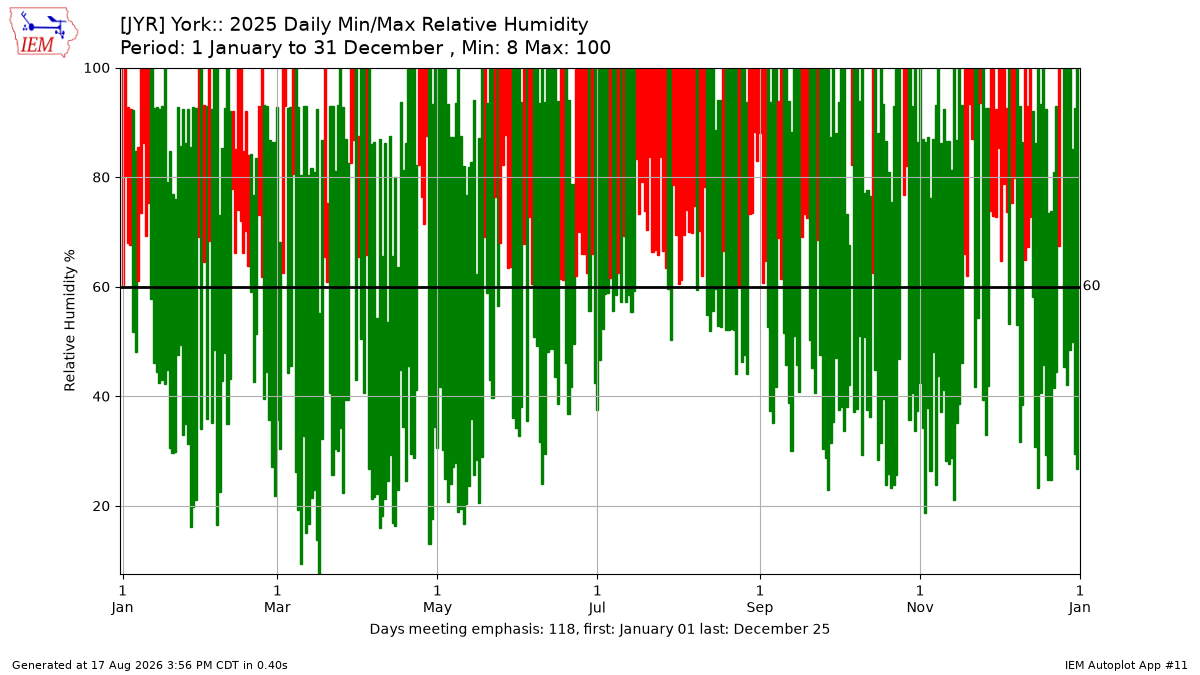
Last year, I shared we need a drop in humidity for the soybean white mold spores to be released. If the air relative humidity is 50% and above, the canopy relative humidity is at least that or higher. UNL emeritus plant pathology professor, the late Dr. Michael Boosalis, proved that the mushrooms produced by Sclerotinia sclerotiorum fungus needed a drop in humidity to build the pressure to release the spores. He had time-lapse imagery of this and was one of the few people in the world at that time who could produce the inoculum for plant breeders.
This is similar in concept to corn pollen. In many years, we receive a change in humidity as temperatures rise around mid-morning, allowing for anthers (which hold the pollen), to dry and release the pollen between mid-morning and mid-afternoon. However, high humidity can prevent this from happening.
Years ago, Dr. Tom Hoegemeyer wrote a CropWatch article on how high heat and high temperatures impact corn pollination. He shared, “Corn pollen is produced within anther sacs in the anther. The plant releases new, fresh anthers each morning, starting from near the top of the tassel, on the first day of shed, and proceeding downward over several days. The process of releasing the pollen from the anthers is called “dehiscence.” Dehiscence is triggered by the drop in humidity, as the temperature rises. However, when it is extremely humid and the humidity falls very little, dehiscence may not occur at all, or it may be delayed until late in the day. If one has breezes, while the humidity is still very high, the anthers may fall to the ground before pollen is released. If the temperature rises too high before pollen dehiscence occurs, the pollen may have reduced viability when it is shed.”
There may have been specific windows this pollination season where little to no pollen was released from anthers which could have impacted silk fertilization, especially when humidity never dropped below 70%. Just a day or two difference in flowering, or planting, or other factors can make a substantial difference in set, both in irrigated and non-irrigated fields. Silk receptivity to pollen also changes as silks elongate, become older, and dry out.
What I’m sharing about here is different than the tassel wrap situation impacting pollination in some fields due to reduced tassel and anther production; however, high humidity during pollination may have impacted the minimal pollen being shed from some of those tassels as well.
Regarding the corn maturing quickly, the end of July and a good portion of August saw night-time temperatures above 70F. Corn plants being C4 plants max out on photosynthesis when temperatures are above 86F and burn sugars at night to cool the plant when night-time temperatures are above 70F (corn prefers around 50F minimum temp). Using the sugars for cooling takes them away from growth and development, so the plant pushes forward in maturity. For those asking, the rains haven’t been able to offset this effect because night-time respiration is ultimately a factor of the night-time temperature.
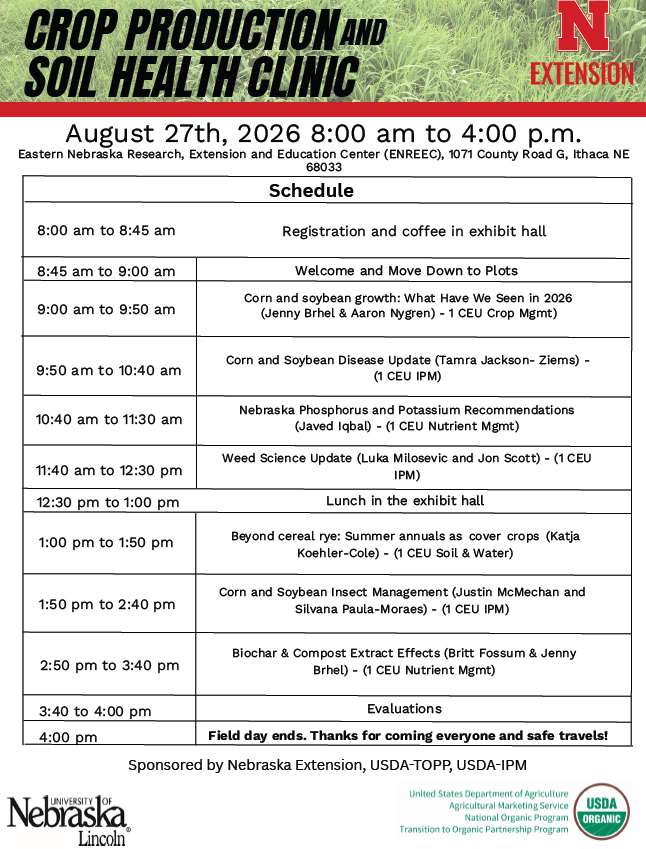
The weather is outside of our control, but hopefully this helps explain some of the questions being asked. We will all hope for cooler nights going forward and a strong finish to the growing season. A reminder this week of the crop and soil health clinic at ENREEC near Mead on Aug. 27 and the wheat and alfalfa expo in Beatrice on Aug. 28.



Posted on August 23, 2026, in JenREES Columns and tagged humidity 2026, humidity and temperature impacts on corn pollination, temperature 2026, white mold in soybean humidity impacts. Bookmark the permalink. Leave a comment.


Leave a comment
Comments 0