Blog Archives
Nitrogen observations
I’ve enjoyed hearing from farmers the past month about a few observations they’ve seen in their fields. The observations involve the difference between higher and lower nitrogen rates applied. The first observation was like I’ve shared in the past: less disease when less nitrogen was applied to fields. The comments have come from producers who were comparing either whole fields of theirs or strips within fields where nitrogen rates varied from 60-100+ lbs less nitrogen per acre. I was really pleased to hear farmers are noticing this observation for themselves in fields!
The second observation is fields looking good in spite of reduced nitrogen applied to some fields. All the producers who have provided this comment are using Sentinel Ag to aid in their nitrogen management. There’s a handful of producers who have been using Sentinel Ag for years with only 60-100 lb N/ac on their irrigated fields. In the past month, producers have also wondered about applying extra N due to recommendations of others or when one Sentinel indicator block would trigger but the others wouldn’t. In those cases, I’ve always recommended to only put on strips or a pie with the pivot that covered one indicator block but not the other. Prove it to themselves whether they needed the additional nitrogen or not.
We’ve had some consistent rains this growing season of 0.1-0.2” in the area and have been blessed with the larger rains the end of July and more recently. There’s quite a bit of research showing mineralization flushes when rains/irrigation of 0.5-1” are received (as long as the soil was at 50-80% field capacity). The small rains of 0.1-0.2” and the heavy morning dews I think are also contributing to mineralization bursts on the soil surface as a key to mineralization is wetting/drying cycles. Wetting and drying cycles on the soil surface lead to nitrogen and carbon cycling by the microbes.
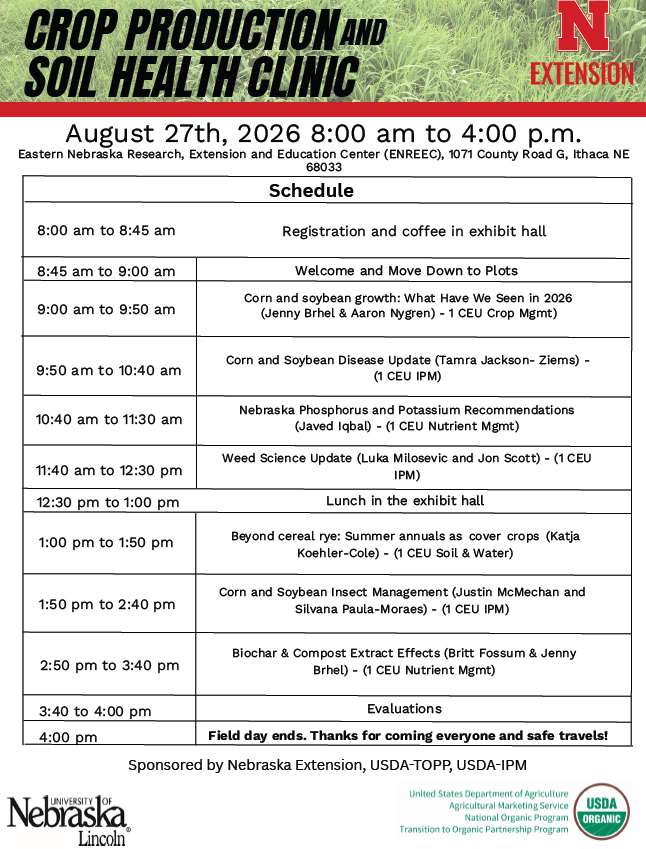
Crop Production and Soil Health Clinic will be Aug. 27th at ENREEC near Mead from 8 a.m.-4 p.m. This is a hands-on, research-based event focused on improving corn and soybean profitability through regenerative farming practices and better soil management. Topics include update on what we’ve seen with corn/soy this season, weed/disease/insect management, nutrient efficiency, cover crops, and biochar/compost extract effects. Designed for producers, crop advisors, agronomists and ag professionals, the program offers real-world tools to address pest resistance, reduce input costs and build more resilient cropping systems. To view the schedule and register, please click on the link: https://enreec.unl.edu/2026CropAndSoilHealthClinic/. The registration fee is $35 for those not needing CCA credits and $75 for those needing CCA credits. Fees include training, lunch, and reference materials. The training will be held rain or shine (bring rain gear).
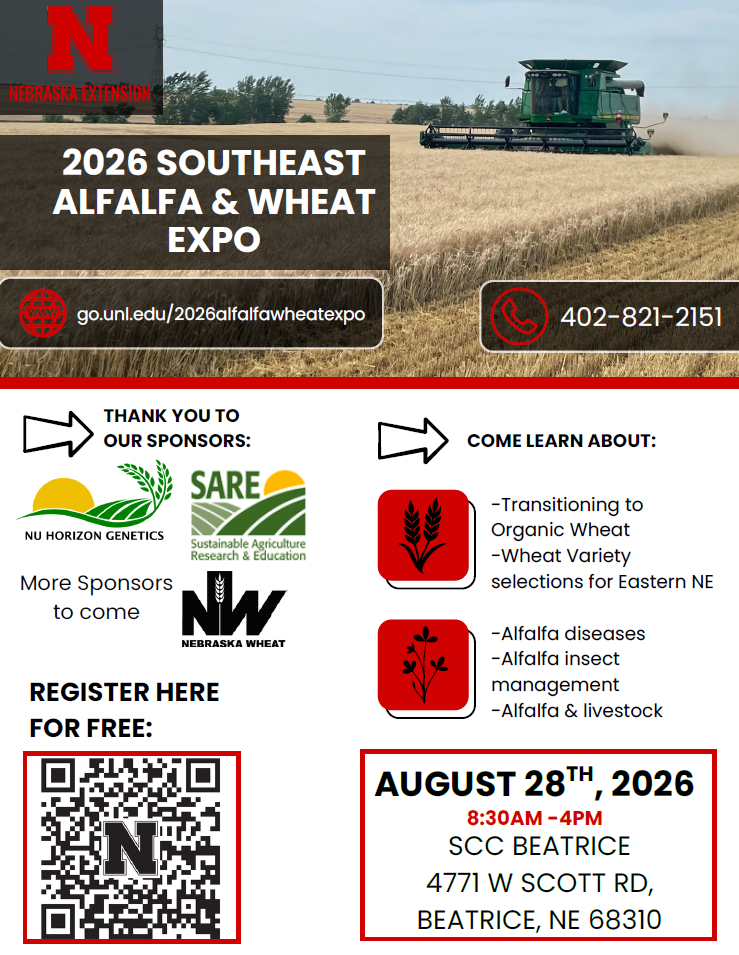
Wheat and Alfalfa Expo will be held on Aug. 28th from 8:30 a.m.-4:30 p.m. at Southeast Community College in Beatrice. The morning sessions will focus on wheat production and disease management. The afternoon sessions will focus on alfalfa management. The program will also feature an alfalfa producer panel, providing attendees with an opportunity to hear directly from farmers about their experiences and management practices. Attendees can choose to stay for the entire program or come and go at their convenience. There is no charge, but please RSVP for meal count at: go.unl.edu/2026alfalfawheatexpo or contact Matheus Ribeiro at mribeiro2@unl.edu or 402-441-7180.