Blog Archives
Early Season Tar Spot 2026
Tar spot of corn was found in several Nebraska counties this past week. You can see the full map at: https://cropprotectionnetwork.org/maps/tar-spot-of-corn. Samples can be sent in to the UNL Plant and Pest Diagnostic Lab if you’re unsure and want to confirm. So far we’re only seeing it at low incidence of a few lesions on plants.
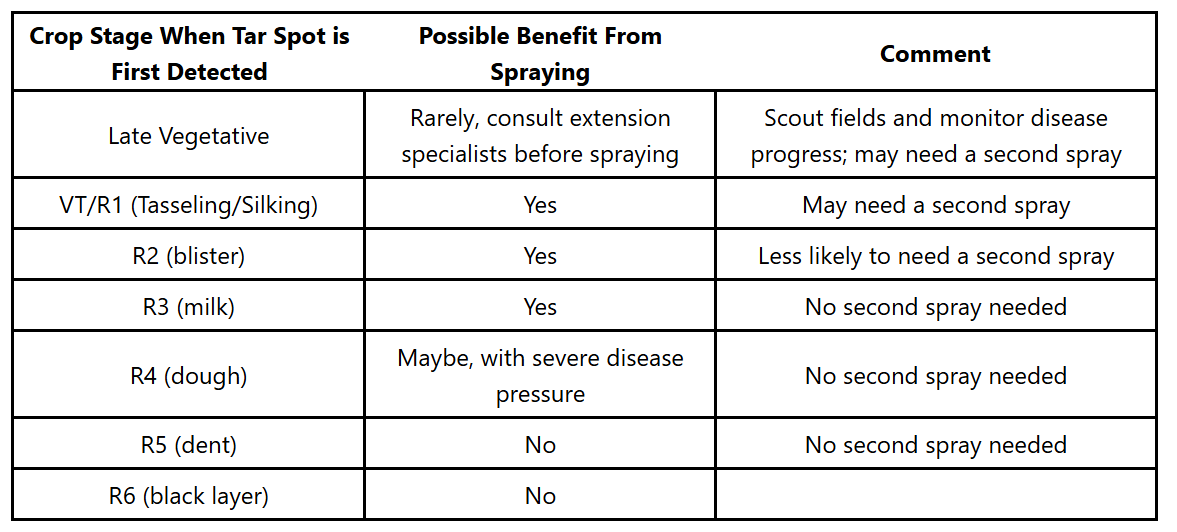
In this week’s UNL CropWatch, our Extension Plant Pathologists shared, “We do not recommend fungicide treatment at these early stages. Results from multi-state fungicide trials summarized on the Crop Protection Network show that treatment during the vegetative stages — V6 through V11 — was not economical even though disease had already begun.
Fungicide applications made between VT–R1 through R3 (milk) or occasionally early R4 (dough) stages were the most effective at controlling tar spot and had the best chance of generating a favorable net return. In those experiments, fungicide applications made to corn before tar spot severity exceeded 5% on the ear leaf by early R4 were still economical. Applications made after disease on the ear leaf exceeded 6% at application were not economical. Additionally, products with a mixture of active ingredients from two or more fungicide classes were most effective.”
You can see a photo of what 5-7% disease severity looks like at https://jenreesources.com/wp-content/uploads/2025/06/when-to-spray.png. There’s also a yield/price/fungicide risk assessment tool that allows you to compare the ROI of a fungicide application: https://connect.doit.wisc.edu/cpn-roi-tools/.
Considerations for now:
1-Scout fields and wait till a 5% threshold on leaves before applying fungicide
2-Observe fields as to which hybrids have more tolerance to tar spot
3-When irrigating, consider less frequent and deeper irrigations, https://go.unl.edu/vipj
4-Consider plant nutrition instead. I will focus on a series of plant nutrition articles in the coming weeks. Please contact me in the meantime if you’re interested in knowing more about this option.
The fungus that causes tar spot prefers temperatures in the 60-70F range, leaf wetness of at least 7 hours, and relative humidity above 75%. That’s why we can see it early in the growing season and then again later in the growing season. We will continue to see this favorable environment for the coming week. Once the environment (especially higher temperatures) is no longer favorable, the fungus isn’t able to grow and reproduce and that’s why we didn’t see lesion development throughout the summer in 2025. Susceptible host, pathogen able to infect, and the correct environment all have to come together at the same time for disease development.
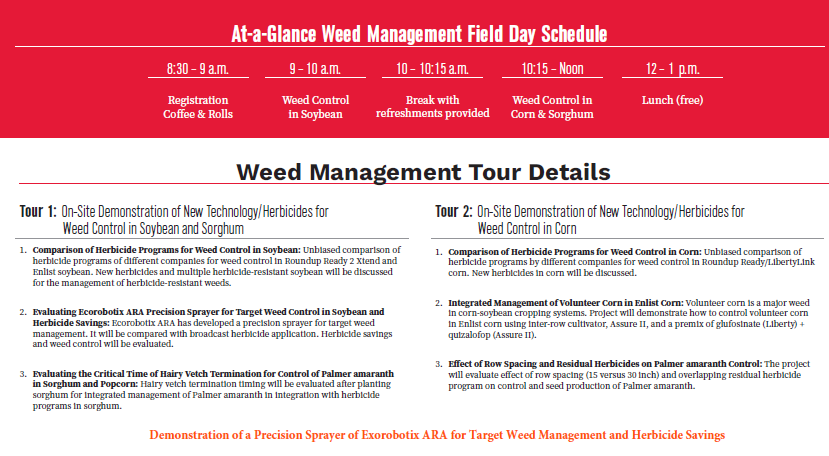
SCAL Weed Science Field Day: Just a reminder of the Weed Science Field Day at SCAL near Clay Center on June 24. Attendees will see weed control options for corn, soybean, and sorghum with chemical and cover crop tools. The Ecorobotix machine will be showcased as another precision spraying tool. No charge, walk-ins are welcome, but RSVP is preferred for meal count to: https://agronomy.unl.edu/fieldday.


Tar Spot of Early Corn Update
Received several calls about tar spot yesterday and today. As of right now, it’s been confirmed by UNL at LOW incidence (1-2 lesions per leaf) in Saunders, Pierce, and Clay (on 6/16/25), Polk, and Seward Counties (on 6/17/25). I really appreciate Craig Anderson and Mike Byers bringing me leaf samples to confirm. I also appreciate those who were calling to hear of any confirmations from leaf samples.


There’s a lot of fear surrounding this disease, and still some unknowns. We haven’t seen tar spot in Nebraska this early. It would be helpful if consultants/agronomists would confirm samples to Dr. Tamra Jackson-Ziems, the UNL Plant and Pest Diagnostic Lab (tar spot testing is free), or a local Extension Educator so that we have the most accurate information to provide. Tamra will update the tar spot map at: https://cropprotectionnetwork.org/maps/tar-spot-of-corn.
We are NOT recommending fungicide application in fields where tar spot is confirmed in these early vegetative stages.
Reasons for not applying fungicide now:
1-Economics: Corn economics are already a struggle. When tar spot appeared in the early vegetative stages, research from Dr. Darcy Telenko’s lab at Purdue University showed it wasn’t economical to apply at V6-V7 as it didn’t suppress disease enough. It was economical when the corn reached tassel stage or beyond. I show the research data below and you will also see the chart on the website link I shared above. In this post, Dr. Telenko shares 7 years of experience dealing with tar spot when it occurs early in the season and how to make fungicide decisions.
*Some Quick Tips & Tools for Preparing for Tar Spot in Corn-Dr. Darcy Telenko
*Tar Spot: What to look for in corn and making an informed fungicide application-Dr. Darcy Telenko
*Crop Disease Forecasting Tool for Tar Spot
2-Applications: Dr. Tamra Jackson-Ziems shared that some products say “no more than 2 applications per year”. Using those active ingredients now would mean you could use them again around tassel but no later when you may need the fungicide to finish the season. (See Dr. Telenko’s posts above).
3-Resistance management and integrated pest management. The photo below shows the economic threshold is 5-7% leaf severity for tar spot before it’s economical to spray. We’re a long way from that threshold on leaves confirmed for tar spot thus far. Avoiding unnecessary fungicide applications and using two modes of action when fungicides are applied may help in delaying resistance.
What to do now:
1-Continue to scout fields and wait till a 5-7% threshold on leaves before applying fungicide (see photo below)
2-Observe fields as to which hybrids have more tolerance to tar spot
3-When irrigating, consider less frequent and deeper irrigations
4-Consider plant nutrition? Manganese, Zinc, Copper, Boron, Sulfur all have a role in defending plants against pathogens. Will share more thoughts in another blog post.
Slide courtesy of Dr. Tamra Jackson-Ziems, UNL and Dr. Telenko, Purdue University. Fungicide application at V6-V7 resulted in negative economic return and similar disease pressure as the non-treated areas. Best fungicide timing for disease suppression occurred from tassel to milk and for economic return from tassel to dough.


