Blog Archives
Considerations at Tasseling
Happy 250th Birthday America!!! Grateful for the wisdom and vision of our forefathers. We are truly blessed! May we reflect on our blessings and remember that freedom isn’t free!
With tasseling beginning or nearing for most fields in the area, sharing a few reminders of questions I typically receive. Some of you saw uneven corn emergence, thus plant stages vary in some fields. Pay attention to fungicides/insecticide pesticide labels regarding adjuvants/surfactants that can be used and their timing to avoid any potential crop injury. Not all plants in a field may be at tassel, thus waiting till brown silk/milk if no disease/insects are present can help the later plants be at tassel while also potentially reducing the chances of needing another fungicide app.
Fertigating during pollination: I’m sharing this based on what we knew from previous corn genetics, but I’m unsure if pollen shed from weaker tassels in some of today’s hybrids may be impacted by any products applied during pollination. With that note, we have said fertigation during pollination is ok and generally should be still. Dr. Tom Hoegemeyer had shared that pollination mostly occurs between 8:30 a.m. and noon. Heat kills pollen when the temperature is 90°F to 95°F and is seldom viable past 2 p.m. That leaves lots of time to run pivots, apply N, etc. when it won’t harm pollination. The UNL recommendation for fertigation is to use 30 lb of N with 0.25″ of water or 50-60 lb of N with 0.50″ of water. With a high capacity pump, you can apply up to 60 lb of N in 0.25” of water.
Western Bean Cutworm: It’s been time to be scouting corn for western bean cutworms. When scouting, we typically find western bean cutworm egg masses on upper leaf surfaces of corn leaves with masses containing 50-85 eggs. Normally we’re taught to look at the upper portion of the plants closer to the tassels, but with silks emerging prior to tassels most of the time, I tend to also find masses on leaves around the ear leaf and sometimes directly on the husks (especially during periods of high heat). Egg masses are white and raised when newly hatched; they turn a purplish color when they’re getting closer to hatching. Links to light trap data are below:
- West Central Research and Extension Center, North Platte
- South Central Agricultural Lab, Clay Center
- Eastern Nebraska Research and Extension Center, Mead
Japanese Beetles in crop fields: Adults emerge from grassy areas (lawns, pastures, road-side ditches for at least 4-6 weeks (up to 10). Even if you treat, they can come back. Threshold is 30% defoliation on vegetative corn. Upon silking, the threshold is 3 or more beetles/ear with silks clipped to less than ½ inch and pollination is less than 50% complete. Soybean threshold is 20% defoliation at reproductive stages; sometimes defoliation looks bad but regrows quickly even when not using an insecticide. Usually the beetles congregate in borders first or areas in the field and not whole fields. Some consider a border app. Spidermites can also be flared upon insecticide applications.
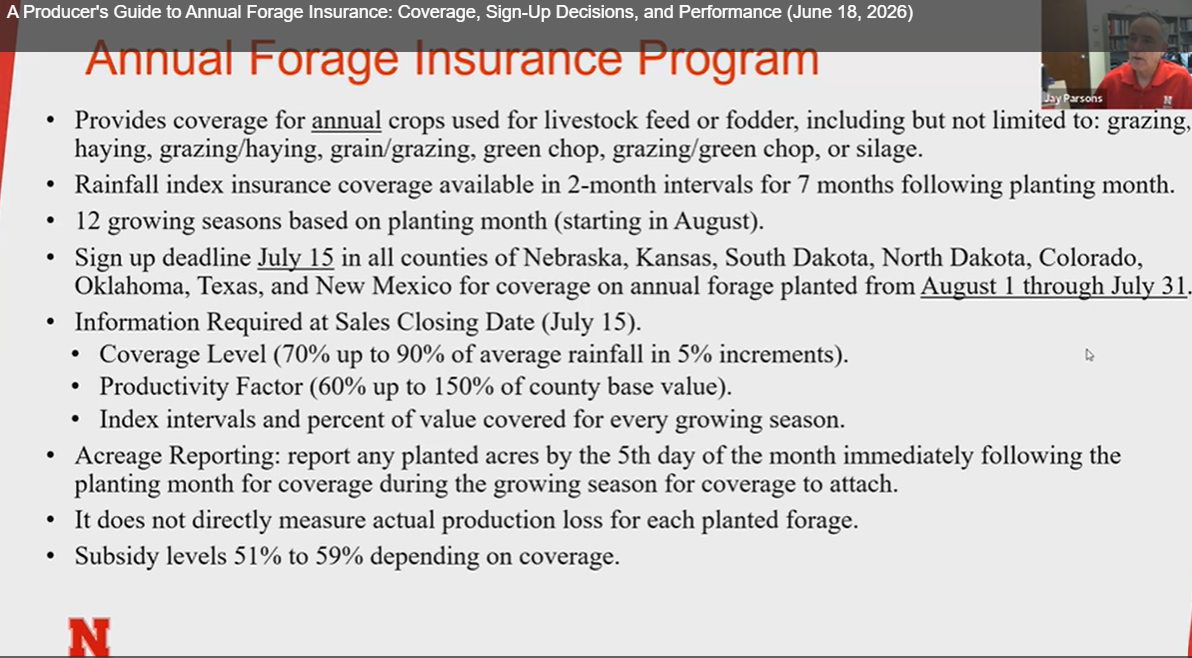
Annual Forage Insurance is a precipitation risk management tool available for annual forages planted on cropland with intended use as livestock feed or fodder. With so many impacted by drought, wildfires, and now hail, wanted to share on this opportunity. The insurance is available in all counties of Nebraska. It is a rainfall index product much like the popular Pasture, Rangeland, Forage (PRF) insurance. The sign-up period for annual forages planted from August 1, 2026 through July 31, 2027 is currently open until July 15, 2026. A recent webinar discussing this opportunity can be found here: https://cap.unl.edu/annual-forage-insurance-webinar-2026/.
| Extension Job Opportunities Do you enjoy helping people, learning, teaching, being objective, and enjoy each day not being the same? If so, Extension may be a great career opportunity for you! We’re seeking team members for Platte County and Adams County. Applications can still be submitted after the deadline (case of Adams Co.) as the search committees can continue to review applications until the position is filled. Platte Co: https://employment.unl.edu/postings/100978 Adams Co: https://employment.unl.edu/postings/100656 Minimum Requirements: Master’s degree in agronomy, crop science, plant sciences, or a closely related field (extension educator) OR bachelor’s degree in agronomy, crop science, plant sciences, or a closely related field (extension instructor). If hired as an instructor, the incumbent will be expected to make satisfactory progress toward and complete a master’s degree within the initial five-year appointment period. Demonstrated knowledge of production agriculture, cropping systems, water management and irrigation, agronomics, precision/digital agriculture, and/or agricultural sustainability. Strong teaching, communication, and relationship-building skills, with the ability to translate research-based information into practical educational programming for diverse audiences in formal and/or non-formal educational settings. Demonstrated ability to develop and deliver educational programs, outreach activities, applied training programs, and educational content through presentations, publications, digital resources, web-based platforms, and/or social media. Ability to work collaboratively with producers, Extension specialists, industry partners, community stakeholders, and multidisciplinary teams. |
High Heat & #Corn Pollination
With the high heat, lack of rainfall, and pollination occurring in many fields or just around the corner, questions have been 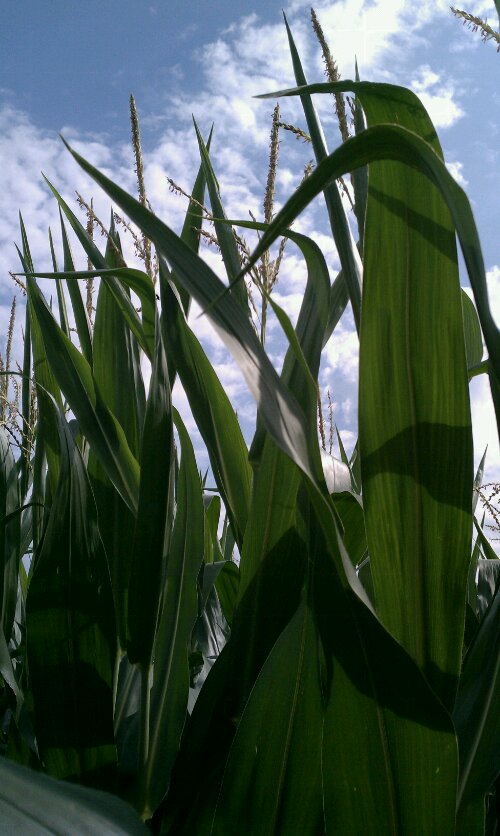 rolling in regarding how high heat affects corn pollination. Dr. Tom Hoegemeyer, UNL Agronomy Professor of Practice wrote the following article and I’m sharing it for the excellent info. Hybrid Maize simulations will be shared in this week’s CropWatch and in next week’s news article.
“Corn was originally a tropical grass from the high elevation areas of central Mexico about 7,400 feet above sea level, 2,000 feet higher than Denver. Today, corn still prefers conditions typical of that area — warm daytime temperatures and cool nights. Areas that consistently produce high corn yields share some significant characteristics. These areas — central Chile, the west slope of Colorado, etc. — are usually very bright, clear, high light intensity areas with cool nights.
This year, in the prairie states and in the Cornbelt, conditions have been dramatically less than optimal. Corn maximizes its growth rate at 86°F. Days with temperatures hotter than that cause stress. In the high yield areas, cool night temperatures — at or below 50°F — reduce respiration rates and preserve plant sugars, which can be used for growth or reproduction, or stored for yield. These are optimum conditions for corn, and interestingly, are fairly typical for areas around central Mexico where corn is native.
In years when we get high day and nighttime temperatures coinciding with the peak pollination period, we can expect problems. Continual heat exposure before and during pollination worsens the response. Daytime temperatures have consistently stayed in the upper 90s to low 100s.The high humidity, which helps reduce crop water demand, also increases the thermal mass of the air—and provides extra stored heat and insulation at night.
Corn pollen is produced within anther sacs in the anther. The plant releases new, fresh anthers each morning, starting from near the top of the tassel, on the first day of shed, and proceeding downward over several days. The process of releasing the pollen from the anthers is called “dehiscence.” Dehiscence is triggered by the drop in humidity, as the temperature rises. However, when it is extremely humid and the humidity falls very little, dehiscence may not occur at all, or it may be delayed until late in the day. If one has breezes, while the humidity is still very high, the anthers may fall to the ground before pollen is released. If the temperature rises too high before pollen dehiscence occurs, the pollen may have reduced viability when it is shed. A person experienced at hand pollination in corn will often see this happen. There will be anthers in a “tassel bag,” but little pollen. The usual solution to this is to wait a couple hours until the temperature rise reduces the humidity. However, last year we had some conditions where pollen was never released from the anthers. This can impact silk fertilization, particularly in open-pollinated situations.
Corn is a “C4 Photosynthesis” plant, making it extremely efficient at capturing light and fixing CO2 into sugars. One drawback of this system is that with high daytime temperatures, the efficiency of photosynthesis decreases, so the plant makes less sugar to use or store. High nighttime temperatures increase the respiration rate of the plant, causing it to use up or waste sugars for growth and development. This results in the plant making less sugar but using up more than it would during cooler temperatures. Heat, especially combined with lack of water, has devastating effects on silking. If plants are slow to silk, the bulk of the pollen may already be shed and gone. Modern hybrids have vastly improved “ASI” or anthesis-silk interval (the time between mid-pollen shed and mid silk). Regardless, in some dryland fields we see seed set problems because of “nick” problems between pollen and silking.
Even in some stressed areas within irrigated fields (extreme sandy spots, hard pans or compaction areas where water isn’t absorbed and held, and some “wet spots”) we can see stress-induced slow silking and resulting seed set issues. Historically, this has been the most important problem leading to yield reduction, particularly in stressful years. Once silks begin to desiccate, they lose their capacity for pollen tube growth and fertilization.
Even with adequate moisture and timely silking, heat alone can desiccate silks so that they become non-receptive to pollen. This is a bigger problem when humidity is low and on hybrids that silk quite early relative to pollen shed. Even with dew points in the 70s, when temperatures reach the high 90s to the100s, the heat can still desiccate silks and reduce silk fertility.
Heat also affects pollen production and viability. First, heat over 95°F depresses pollen production. Continuous heat, over several days before and during pollen-shed, results in only a fraction of normal pollen being formed, probably because of the reduced sugar available. In addition, heat reduces the period of pollen viability to a couple hours (or even less). While there is normally a surplus of pollen, heat can reduce the fertility and amount available for fertilization of silks. Research has shown that prolonged exposure to temperatures reduced the volume of pollen shed and dramatically reduced its viability. For each kernel of grain to be produced, one silk needs to be fertilized by one pollen grain.”


