Monthly Archives: June 2023
JenREES 6/25/23
Crop Updates: Irrigated crops are moving along with corn approaching the late vegetative stages and many beans in beginning to full flowering. Spidermites in stressed fields; no point doing anything. Small grasshoppers and Japanese beetle adults starting to emerge…sorry everyone, I groaned too!
Soy Problems: Past 10 days received calls and texts from a large area regarding soybean often having yellowing to some extent, growing slowly, some with stacked internodes and some dying. Chem may not have broken down with the dry conditions from last year’s corn herbicides. Most situations had some type of Group 27 chemistry and yellowing of newer trifoliates and buds could be seen. In irrigated fields, the soybeans are growing out of it with water and time. In non-irrigated fields, the drought isn’t helping with plant metabolism and breakdown of herbicide.
Also, a number of reports of soybean plants dying. Work through each situation to determine if herbicide carryover, drought, seedling disease, other issues, or a combination of factors are the issue. Many times I’m seeing a combination of factors. Seeing some plants in non-irrigated situations have a red lesion on the stem with rotted roots, which can be an indication of Rhizoctonia root rot (disease that occurs with stress, particularly herbicide injury and drought). Some soybeans dying in irrigated situations were replanted beans that didn’t have a seed treatment fungicide on them and they have characteristic phytophthora root rot (dark lesion from soil line up and rotted roots), sometimes also in combination with herbicide carryover symptoms. Many have mentioned beans are short and not growing quickly. Dry conditions and often also Group 15 products can result in slowed growth as the beans are trying to metabolize those products. Most are aware of the heart-shape/club shape as normal to leaves of beans from metabolizing Group 15 products.
Crop Insurance Question: Several asked about gravity irrigated soybeans that are too small to ridge in gravity irrigated fields and pivot corners if they could just change the designation to non-irrigated beans. Another consideration, some wells are sucking air and they’re concerned about keeping pivots going. In talking with someone from crop insurance, he said that designations are based on whatever the intent at planting was and that can’t be changed. However, they are receiving the same questions and being unable to ridge beans can be an insurable cause of loss, so please talk with your crop insurance agent about your specific situation.
Irrigating Beans: Glad to see moisture has been pushed into the third foot in more corn fields. Typically we’d avoid irrigating soybean at flowering to avoid disease onset such as sudden death syndrome and white mold, but this year depends on your current soil moisture status, if it’s canopied or not (less favorable for disease if it isn’t yet), and the disease history of the particular field. If there’s no subsoil in bean fields with minimal canopy cover, I’ve been saying to irrigate deeply and less frequently during soybean flowering.
ET (Evaporation from the soil surface and Transpiration of water through the leaves) has been higher in our area this year. Factors that contribute to ET include humidity, temperature, wind, cloud cover. We’ve had low humidity (unusual for us-thus lack of rainfall), intense sun with minimal cloud cover, and a few days with some wind. Knowing ET helps one understand how the crop uses water to better schedule irrigations. UBBNRD sends out ET info. from the York 2W mesonet station; please let Terry Julesgard know if you’d like to receive it. Otherwise ET info. at: https://cropwatch.unl.edu/gdd-etdata.
Forage insurance webinar on June 29th at Noon. Info. at: https://go.unl.edu/k6s7.
Weed Science Field Day June 28th at South Central Ag Lab near Clay Center where a number of corn and soybean herbicide programs are showcased. Herbicide programs with planting green, interseeding cover crops also shown. 9 a.m.-1 p.m. (Reg. at 8:30 a.m.). RSVP: https://agronomy.unl.edu/fieldday
Graze Master Event June 28-29th in Seward County featuring tours of area producers’ operations and many speakers. Info. and RSVP: https://www.grazemastergroup.com/events.
Tomato leaves curling: Lots of reasons. Lower leaves curling often due to heat/water stress. Upper leaves curling could be virus, insects, or herbicide damage. Look at all plants in the garden. If only tomato plants impacted, and only certain ones with upper leaves, most likely a virus-remove those plants. If upper leaves curling due to growth regulator (2,4-D/dicamba) injury, I say remove any current fruit on the plants and just keep watering to dilute it in the plant. If new growth in several weeks looks normal, you can eat new fruit. More info. from Backyard Farmer video: https://youtu.be/gsaWvzghaYQ.
Please take care of yourselves! Recent webinar recording about stress: https://go.unl.edu/5oje Nebraska Rural Response Hotline: 1-800-464-0258.


JenRees 6/18/23

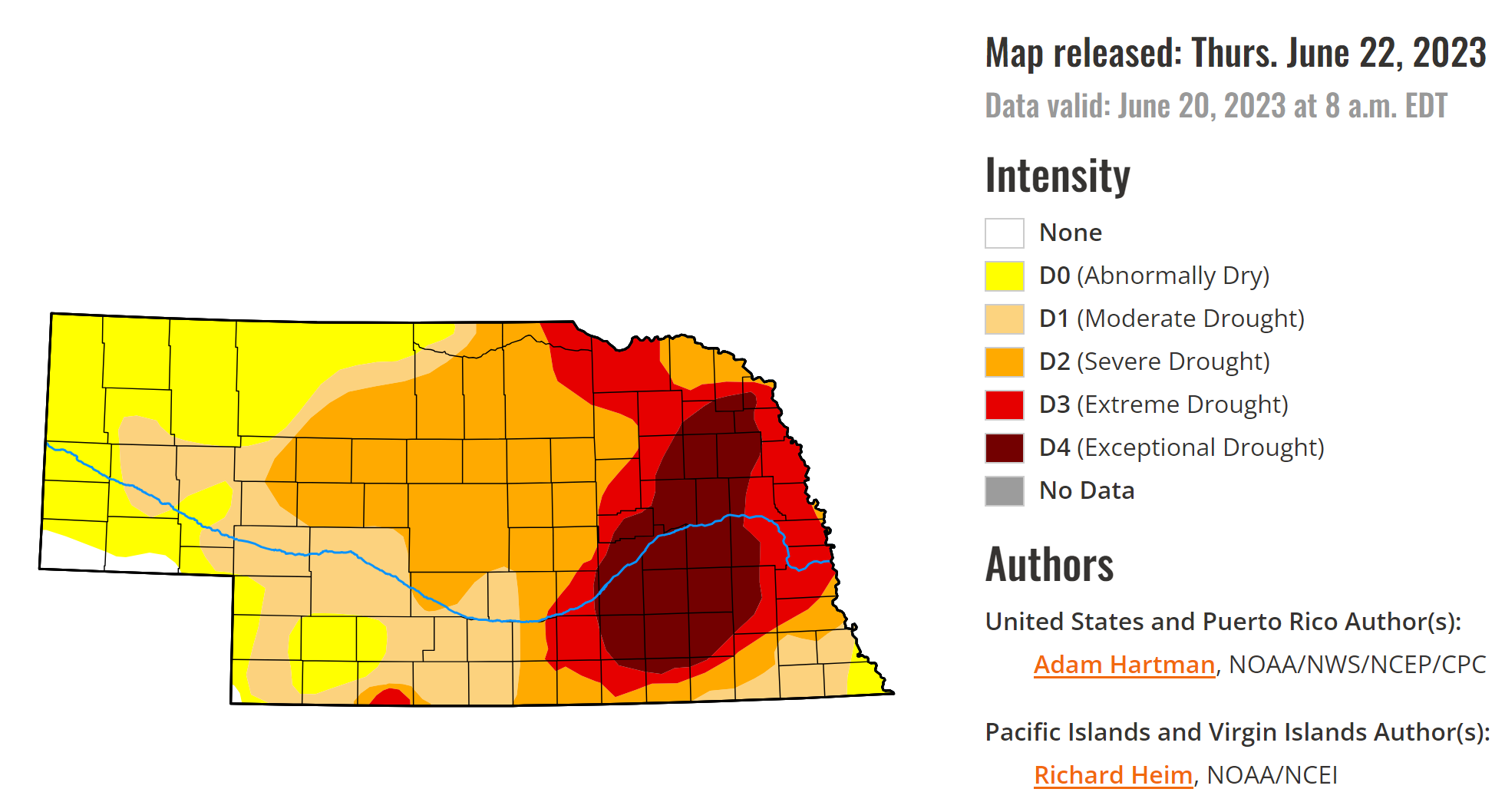
Drought: Several have asked about the yield potential of non-irrigated pivot corners if they were irrigated at this point. I don’t know if anyone really knows. This column reaches such a wide area. There’s part of the area I serve that I don’t think there’s any yield potential. For other places, my guess is ears wouldn’t be more than 4-8 rows around. I asked a plant breeder for his perspective. He shared it could be possible for 100-120 bu/ac with rain, depending on how long it had been rolled, and for corn further along (late vegetative stages). I’m seeing non-irrigated corn in most area drought-stressed fields are 4-7 leaf vs. 8-12 leaf in the pivot irrigated portion. The research I found says, from Emergence to 12 leaf corn, an estimated 1-3% yield loss occurs for each day after 4 consecutive days of stress. Some corn in the area has been rolled for nearly 18 days. Here’s some math for consideration if it can help (I’m going to use 20 days of stress). Let’s say you typically receive 180 bu/ac non-irrigated yield. 1% yield loss/day for 20 days would result in a loss of 36 bu/ac. A 2% yield loss/day for 20 days would result in a loss of 72 bu/ac and a 3% yield loss/day for 20 days would result in a loss of 108 bu/ac.


I’m honestly surprised that the drought-stressed corn is still gray-blue/green in color overall with only a few scattered plants firing now. I know it’s hard to see the corn dying. Each situation varies regarding well capacity and if there’s other wells to water corners, how long the corn has been stressed, etc. Overall, my suggestion has been to not divert water from pivots to save corners. For beans, they’re putting energy into deeper roots with less above-ground growth. These small beans will most likely flower shortly and yield loss will be from aborted flowers, pods, or death of plants if we don’t get rain.
Several have also commented on weed control difficulties with drought-stressed weeds. There’s two well-written articles in this week’s CropWatch https://cropwatch.unl.edu about drought-stressed weeds.
ET/GDD info: The CropWatch ET (evapotranspiration) info. is now available at: https://cropwatch.unl.edu/gdd-etdata.
2nd Cutting Alfalfa: Non-irrigated alfalfa fields are short (6-12”) with some blooming. Received a question regarding to cut or not. Dr. Bruce Anderson had shared in previous years that one needs to obtain at least 0.5 ton/acre in order to pay for harvesting costs. With higher hay prices and short forage, you can determine what’s best for your situation. Alfalfa that goes dormant will regrow when rains occur. By leaving it alone, the alfalfa will go dormant and eventually lose the leaves from the stems. If you hay or shred it, it may try to regrow, but with no moisture, it will also go dormant. There’s also potential to damage crowns from driving on extremely stressed alfalfa. If you can fence it and have water access, grazing full-bloomed alfalfa is also an option and is low-risk for bloat at that stage.
Lawn Watering: Lawns are really showing drought stress. Kentucky bluegrass is shallower-rooted and doesn’t take heat as well as fescue. However, bluegrass will go dormant without dying, whereas fescue, even though it’s deeper rooted and more drought-tolerant, doesn’t go dormant from drought-stress, so it can die. After bluegrass has reached three weeks of dormancy and fescue has changed color, it’s recommended to water 0.5”/week to keep both grass species from dying.
Oak Leaf Tatters: Received calls in the Henderson/Bradshaw area about oak trees with leaves that looked like they’d been eaten; no insects were present. Several calls earlier in the year were regarding malformed oak leaves, primarily on young oak trees (1-5 years old). Oak leaf tatters is a condition characterized by Iowa State, where cold stress when tree leaves are emerging coupled with herbicide injury causes oak leaves to look deformed, tattered, or look like they’ve been eaten. I see problems every year with oak trees, primarily in lawns when ‘weed and feed’ products are applied when oak tree leaves are emerging. So, in the future, avoid those products in lawns during leaf emergence. There were also some late cold snaps that likely impacted oak trees when leaves were ready to emerge. There’s nothing to do other than to water to avoid drought stress. All the trees I looked at are developing new growth; they’ll look more ‘normal’ in 10-14 days. The cold snaps may have also impacted apple and other fruit tree varieties that were in the pink/white bud stage or already starting to bloom, thus why some trees don’t have fruit.


Please take care of yourselves! Rural Wellness website: https://ruralwellness.unl.edu/ and Nebraska Rural Response Hotline: 1-800-464-0258.
JenREES 6/11/23

Last week I heard the following repeated themes:
- What are we going to do with dryland crops/pivot corners/endrows?
- I just keep lying awake at nights trying to figure out how to feed livestock. I need to sell cows.
- I’m exhausted and it’s only early June.
- I have no idea how I should be irrigating right now.
- This may sound crazy, but I’m thinking…
For the majority of us, this is unchartered territory for making decisions and seeking to advise. Yes, we’ve had drought before. The extra significance with this year is the fact that, for the majority of us in our lifetimes, we haven’t experienced this lack of subsoil moisture. As I continue to probe fields, non-irrigated subsoil moisture doesn’t often go below 8-10” into the ground and irrigated subsoil moisture doesn’t often go below 20-24”. We all know this; we desperately needed this past weekend’s rains which too many in the area didn’t receive.

With every challenge is opportunity, and for me, the opportunity here is learning. I keep listening to stories from older generations or those out west. Even those out west who experience drought shared that they usually have some subsoil moisture and corn often gets to at least waist tall before dying. Corn dying at ankle to knee high for us is very hard to see.
Consider talking with others. There may not be ‘right’ answers, but instead, making the best decisions we can with the information we have right now. We’re learning together.
Several mentioned trying to keep some armor (residue/plants with roots) on the soil to protect pastures which means getting cattle off earlier in spite of forage being tight. The hardest conversations have been around selling cows because that’s a livelihood and people have built up genetics.
For irrigation, the comment many of us shared was trying to get moisture down into the profile for later in the season as water levels continue to decline and with low capacity wells. Steve Melvin and team wrote a CropWatch article that shares additional thoughts: https://go.unl.edu/80w2.
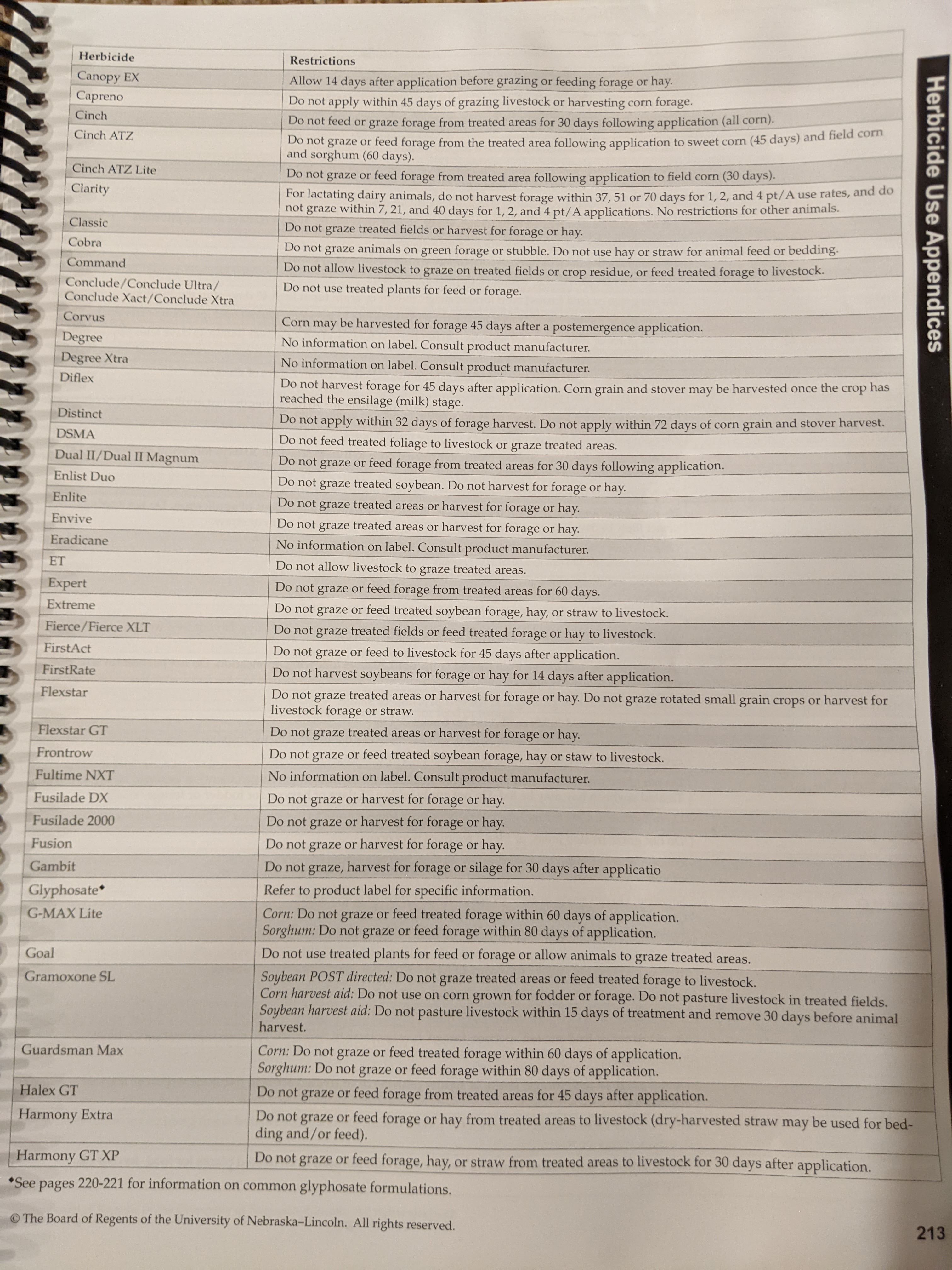
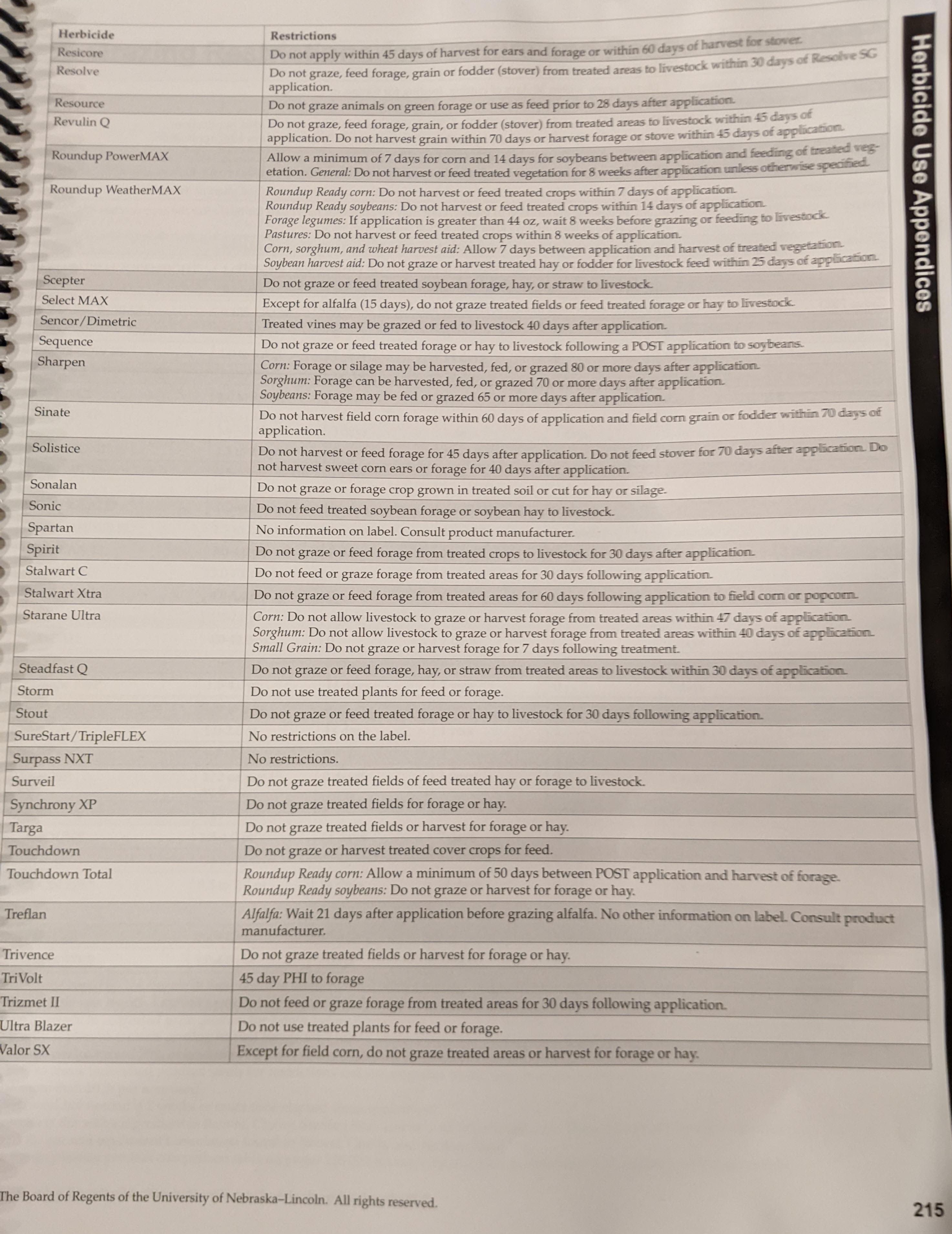
For non-irrigated crops, forage has been on my mind all year. Thus, why I wasn’t recommending full chem loads and side-dress nitrogen applications depending on the individual field situations. My thought has been these non-irrigated crops become opportunities for grazing where that’s applicable. There’s considerations first such as being released by crop insurance, waiting till the crops have died as today’s hybrids and varieties are more resilient than the past, and checking herbicide grazing restrictions (I have pics of those from the UNL Weed Guide on my blog). I’ve been talking to a lot of people about how to graze corn and soybeans or other options and will share in future weeks if we need to go there.
For those considering planting an annual forage species (sorghum or millet species) after non-irrigated corn and soybean (that died from drought), we need 4-6” of rain to germinate seeds and for some subsoil moisture as that profile would’ve been completely depleted from the previous crop. We may not have enough moisture till closer to August. In the meantime, would recommend checking herbicide plant-back restrictions and that you consider the opportunity for annual forage insurance. There’s upcoming workshops (Beatrice & Hastings on June 20) where you can learn more: https://go.unl.edu/ubyt.
By the end of last week, I realized I was doing a poor job of encouraging people and finding positives in situations. I needed a change in perspective. For me, I have nothing without my faith and renewing my hope in a much larger eternal perspective was necessary. It helped me to get away to a Christian concert festival with friends and family and to hear an encouraging sermon at church. What may help you may differ, but I’d encourage you to take some time to de-stress and seek encouragement through positive activities. Whether through your faith, spending time in nature, music, exercise, journaling, reading, woodworking, seeing friends, etc., be intentional to take time away with positive activities. Also rest. Brandy VanDeWalle also shared thoughts on drought’s impacts on people in her blog: https://vandewalleviews.com/2023/06/09/drought-impacts-on-people/.



JenREES 6/4/23

Drought discussions: Grateful for any rain that anyone received! It’s amazing how even a small amount of rain can lift moods. Drought isn’t a fun topic but sharing questions I’ve received the past few weeks.
I think part of the reason why irrigated ground in general also greatly lacks subsoil moisture is because we irrigated far later into the season than typical with the replant crops in addition to not getting precipitation for recharge. Our silt-loam soils can hold at least 2.2”/foot of moisture with around half of that (1.1”) readily available to the plants. Soil moisture sensors or probing fields can give you an idea what’s even available in the soil profile and provide the reality of how much we really need to recharge the profile at this point. Also, various colorations of yellow/purple/blue/gray corn are all indications of drought stress based on how long they continue to roll leaves or are struggling to transport water and nutrients. Some hybrids have more of a purpling tendency upon stress due to their genetics.
Drought stress during V5-V8 corn can impact rows around on the developing ear. Hard, dry surface ground can also impact brace root development. In soybeans, stress right now makes the plants shorter and roots deeper. Iowa State showed a chart that when corn is drought stressed for four consecutive days from V1-V12, an estimated yield reduction of 1-3% per day is possible.
I think the discussion more than yield right now is how long/if these non-irrigated crops will survive. Some are hoping they can survive long enough to obtain any type of forage. If we don’t get rain, things are looking pretty bleak past potentially next week.
So what to do? For those with poor stands I’ve been advising to wait and see if we get rains by the federal crop deadlines. I’ve been asked by some if crop insurance will require replanting poor stands. In talking this through with someone in crop insurance, it sounds like they’re also recommending people to wait for now and replant won’t be required if we don’t get rains, because we have no surface moisture to germinate anything. He said they have allowed for replant in parts of the state that had some good recent rains but it’s really a case by case basis with as spotty as the rains have been. Many are concerned about weed control going forward, especially after our palmer problem last year. Without rain, we can’t activate chemical on these non-irrigated fields, so I don’t have good answers right now. We’ll have to see what happens.
Thinking about POST- herbicides and weed control, I’m late in sharing this but had several conversations the past 10 days. Most with non-irrigated fields weren’t throwing the whole load out there but instead some type of contact herbicide to burn down weeds present and wait and see what happened with rain. This was due to concerns over not having rain to activate residual, keeping options open if the current crop is destroyed and a forage crop could be planted later in the year, and concern over small, stressed corn/soy having to deal with a large chem load. We recommend residual products receive at least 0.5-0.75” within 5-7 days of application to activate them. Sometimes we can still get some activation with certain products up to 14 days after application, but from what I’ve heard from chem reps and weed scientists, that’s the max we can hope for.
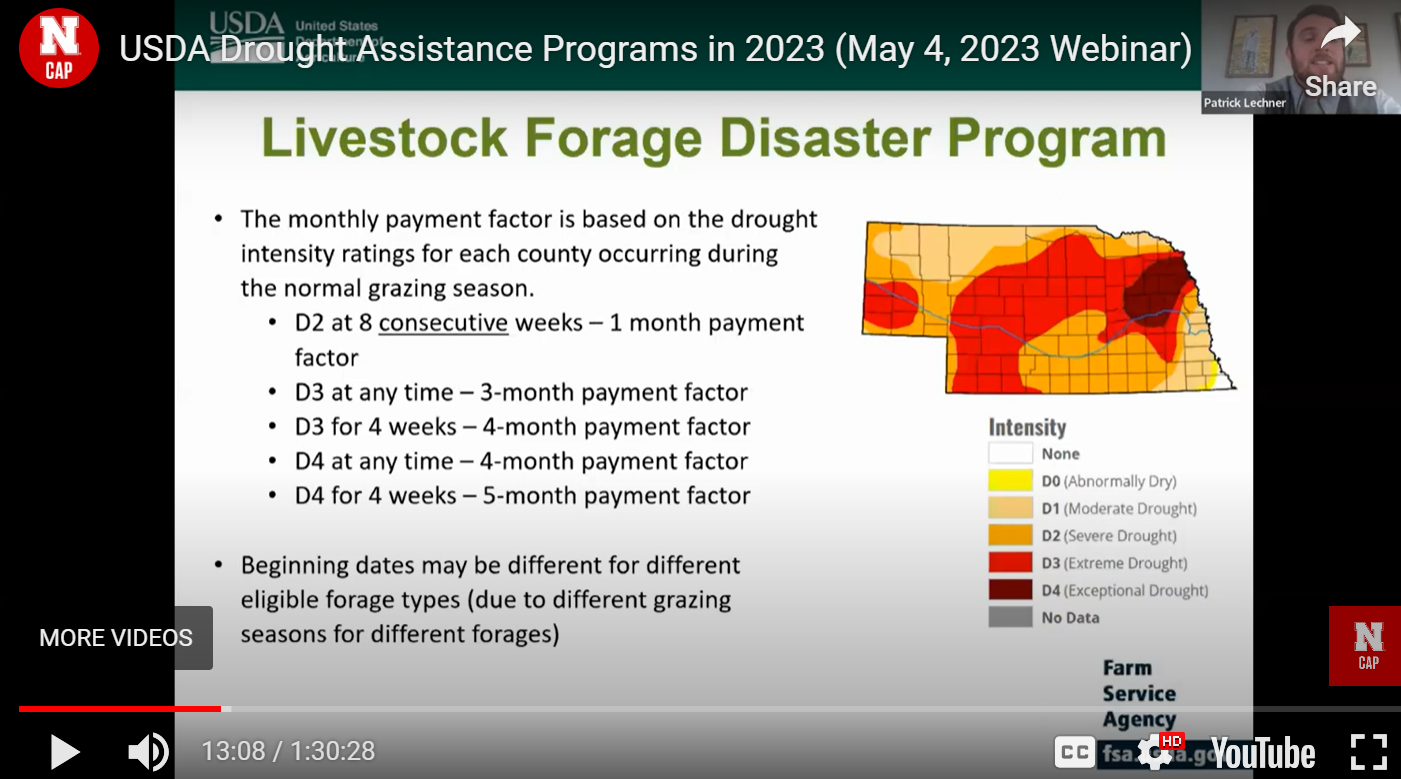
Re-sharing this webinar on drought assistance: https://go.unl.edu/r24y. I also added a key graphic to my blog that shows when the livestock forage disaster program kicks in. It’s based on the drought monitor and it’s all triggered by county, not where the “line” is drawn in counties between drought designations. Most of the counties in this area of the State have now triggered D4 so the program kicks in for a 4 month payment factor. When a county is in D4 for 4 weeks, the payment factor increases to 5 months. There are several programs within USDA drought assistance including helping with feed and water transportation costs and for those who’ve had to sell off livestock. The webinar does a good job going through the programs and answering questions. You can also contact your local Farm Service Agency office with questions.
Final thoughts, in spite of how weary people are of irrigating and the craziness of having to lay pipe just to get plants going, I think most still feel blessed if they have irrigation. The corn in irrigated fields changed from the ‘ugly duckling’ stage to the pretty green stage this week and corn likes the day/night temps we’ve had. We will keep praying for rain and it will come in time!


 JenResources