JenREES 6/4/23

Drought discussions: Grateful for any rain that anyone received! It’s amazing how even a small amount of rain can lift moods. Drought isn’t a fun topic but sharing questions I’ve received the past few weeks.
I think part of the reason why irrigated ground in general also greatly lacks subsoil moisture is because we irrigated far later into the season than typical with the replant crops in addition to not getting precipitation for recharge. Our silt-loam soils can hold at least 2.2”/foot of moisture with around half of that (1.1”) readily available to the plants. Soil moisture sensors or probing fields can give you an idea what’s even available in the soil profile and provide the reality of how much we really need to recharge the profile at this point. Also, various colorations of yellow/purple/blue/gray corn are all indications of drought stress based on how long they continue to roll leaves or are struggling to transport water and nutrients. Some hybrids have more of a purpling tendency upon stress due to their genetics.
Drought stress during V5-V8 corn can impact rows around on the developing ear. Hard, dry surface ground can also impact brace root development. In soybeans, stress right now makes the plants shorter and roots deeper. Iowa State showed a chart that when corn is drought stressed for four consecutive days from V1-V12, an estimated yield reduction of 1-3% per day is possible.
I think the discussion more than yield right now is how long/if these non-irrigated crops will survive. Some are hoping they can survive long enough to obtain any type of forage. If we don’t get rain, things are looking pretty bleak past potentially next week.
So what to do? For those with poor stands I’ve been advising to wait and see if we get rains by the federal crop deadlines. I’ve been asked by some if crop insurance will require replanting poor stands. In talking this through with someone in crop insurance, it sounds like they’re also recommending people to wait for now and replant won’t be required if we don’t get rains, because we have no surface moisture to germinate anything. He said they have allowed for replant in parts of the state that had some good recent rains but it’s really a case by case basis with as spotty as the rains have been. Many are concerned about weed control going forward, especially after our palmer problem last year. Without rain, we can’t activate chemical on these non-irrigated fields, so I don’t have good answers right now. We’ll have to see what happens.
Thinking about POST- herbicides and weed control, I’m late in sharing this but had several conversations the past 10 days. Most with non-irrigated fields weren’t throwing the whole load out there but instead some type of contact herbicide to burn down weeds present and wait and see what happened with rain. This was due to concerns over not having rain to activate residual, keeping options open if the current crop is destroyed and a forage crop could be planted later in the year, and concern over small, stressed corn/soy having to deal with a large chem load. We recommend residual products receive at least 0.5-0.75” within 5-7 days of application to activate them. Sometimes we can still get some activation with certain products up to 14 days after application, but from what I’ve heard from chem reps and weed scientists, that’s the max we can hope for.
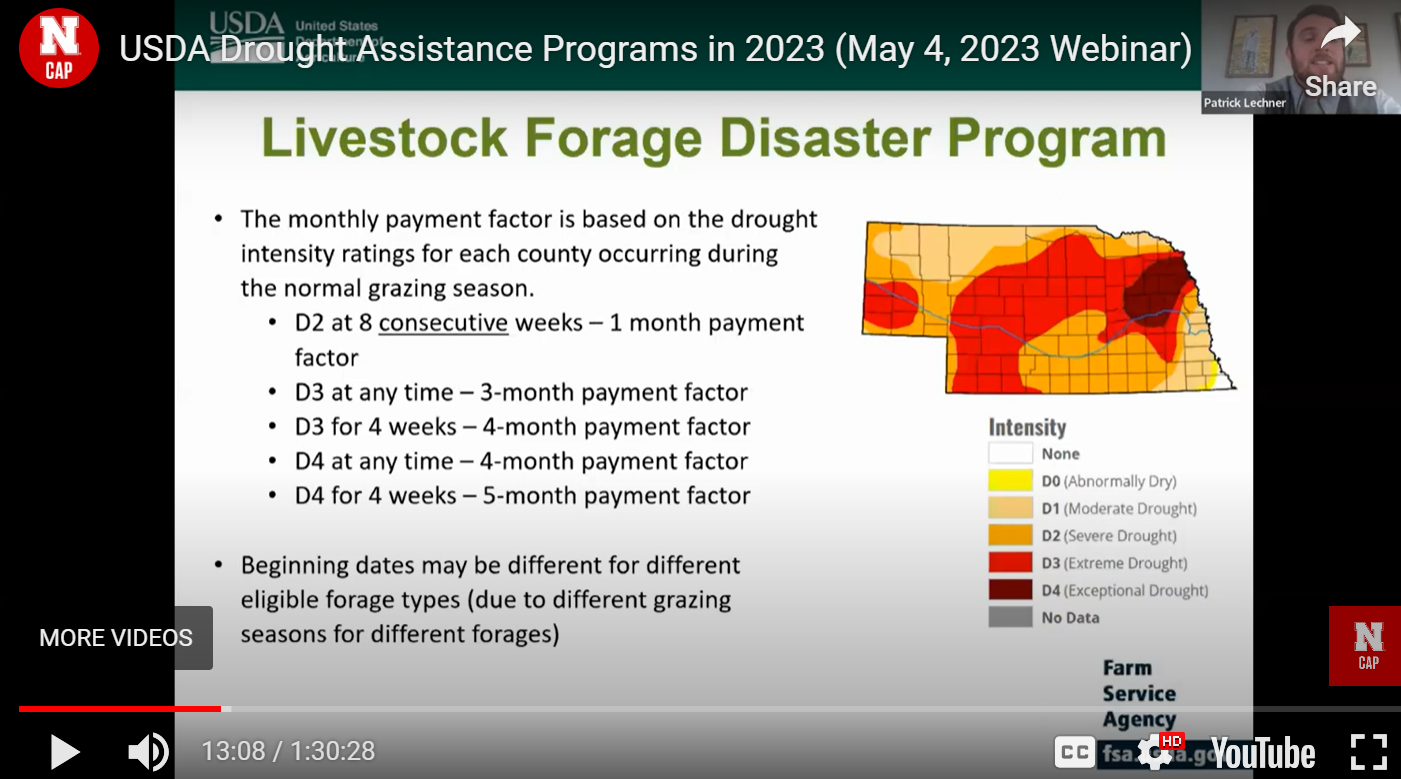
Re-sharing this webinar on drought assistance: https://go.unl.edu/r24y. I also added a key graphic to my blog that shows when the livestock forage disaster program kicks in. It’s based on the drought monitor and it’s all triggered by county, not where the “line” is drawn in counties between drought designations. Most of the counties in this area of the State have now triggered D4 so the program kicks in for a 4 month payment factor. When a county is in D4 for 4 weeks, the payment factor increases to 5 months. There are several programs within USDA drought assistance including helping with feed and water transportation costs and for those who’ve had to sell off livestock. The webinar does a good job going through the programs and answering questions. You can also contact your local Farm Service Agency office with questions.
Final thoughts, in spite of how weary people are of irrigating and the craziness of having to lay pipe just to get plants going, I think most still feel blessed if they have irrigation. The corn in irrigated fields changed from the ‘ugly duckling’ stage to the pretty green stage this week and corn likes the day/night temps we’ve had. We will keep praying for rain and it will come in time!

Posted on June 4, 2023, in Drought, JenREES Columns and tagged drought, early-season drought. Bookmark the permalink. Leave a comment.


 JenResources
Leave a comment
Comments 0