Monthly Archives: July 2023
JenREES 7/30/23
150th York County Fair: Hoping you can attend the 150th York County Fair this week! Full Schedule of
events at: http://www.yorkcountyfair.com. Raffle tickets are being sold for the York County Fair Foundation with proceeds used for projects at the fairgrounds. Only 400 tickets will be sold at $50.00 each. A total of 56 drawing winners will receive $150.00 each and the winning tickets get put back in the drawing for additional chances to win. Drawings will occur weekly from the first week of October 2023 through the last week of September 2024 (and daily winners during the 2024 York County Fair). Tickets can be purchased from Ag Society or Fair Foundation members, at a Fair booth in the Mercantile building during the County Fair, or at the York Co. Extension Office till Sept. 30 (or until all tickets are sold).
Weather Impacts: I keep saying we’re a long way from harvest and it seems like we continue to face difficulties. For me, it keeps reminding me that I’m not in control but I can look to and trust the One who is. Many worked so hard to keep livestock safe. Feel for those who unfortunately lost livestock to the heat and humidity. Farm Service Agency (FSA) asked that we remind producers of the Livestock Indemnity Program and to report livestock losses within 30 days of the losses occurring. Please call your local FSA office to provide an official notice of loss. The local office will share with you what is needed for appropriate documentation of losses.
It was a blessing to receive a widespread 2” of rain on Saturday morning! Also good to see something planted into some hail damaged fields. As storms continue to occur in different areas, what I’ve shared earlier in regards to forages still applies. Summer annuals can still be planted through Aug. 15 (unsure on haying depending on weather, but definitely can graze).
Flying/spreading oats, rye or other small grains with or without brassicas continues to be an option as well. Palmer is emerging. 2,4-D amine and 2,4-D ester are both labeled as “anytime” for applying before seeding any small grain. Read the specific label for any restrictions. Oats give the most fall forage. Earliest greenup in the spring is rye followed by wheat followed by triticale. Triticale will provide the most spring biomass but it comes on late (think June time-frame for haying).
Drought: By Friday afternoon, non-irrigated fields rapidly turned, were firing, and using fields for forage was the question, particularly from Nuckolls Co. I think most were just thinking ahead to having plans in place should they be needed. Reminder again, the field needs to be released by crop insurance. I called Dr. Mary Drewnoski to talk through grazing corn in brown silk to milk stages. We’re treating this as immature corn. So the considerations we gave before were the fact that nitrates would exist but that cattle would self-adapt as they graze the tops first. Any ears present will be mostly water. Mary’s main concern at this point was how much could be knocked down and under-utilized by allowing the full field vs. larger strip grazed areas. One can supplement with a few pounds of grain or with hay. She mentioned to not feed a non-protein nitrogen source (ex. lick tubs) when feeding high nitrate forages. Don’t turn out empty and allow access to plenty of fresh water. If plants end up completely brown before they’re released by crop insurance, it won’t change the nitrate concentration of those plants. Options at that point are still grazing or ensiling. For those who’ve shared they really want to hay the corn, know that your nitrate concentration will be highest with that option. Cut at least 8-12” above the ground. I would recommend sampling for nitrates after baling and also only consider this option if you have the ability to grind those bales and mix in a ration. Do NOT harvest or graze for at least three days following rain that “breaks” drought conditions. The rain causes an uptake of nitrogen from the soil, which is translocated into the plant. After three days, the nitrogen will have been converted to plant protein and is no longer in dangerous form.
Whether for drought or hail damage, for those trying silage, reposting Dr. Bruce Anderson’s silage info. “Fermentation usually (but not always) reduces nitrate levels and risk. Yield is about one ton per acre of silage for each harvested foot of earless corn plant (not counting the tassel). Feeding value is about 70% to 80% of well-eared corn silage. Corn with some grain (less than 50 bushels) tends to produce about one ton of silage for every five bushels of grain with a feed value about 80 to 90% of regular corn silage. Harvest timing is critical with silage to ensure the correct moisture for proper fermentation. Desired moisture level for silage is about 65%. Plants with any green leaves usually are too wet to chop for silage. For proper moisture, most leaves may need to be dead before chopping. The stalk and ear hold amazingly high water concentrations. For corn with no grain, even if all leaves are dead, the whole plant (and silage) moisture can be 70% if the stalk is still green and alive.
Once plants actually die they can rapidly dry down. There are several ways to reduce moisture content. If corn has pollinated, delay silage harvest until all chances of increased biomass tonnage have passed or plants naturally dry down to appropriate moisture levels. Corn can be windrowed and allowed to partially dry before chopping. Excessively wet material can be blended with drier feeds such as ground hay, cracked grain, or dried distillers grains. However, this can take a lot of material — about 500 lb of grain or hay to reduce each ton of chopped corn with 85% moisture down to 70% moisture. Silage inoculants may improve fermentation and preservation of drought-damaged silage.”




JenREES 7/23/23
Grateful for the rains we had earlier in July for green-up of plants and allowing some to take a little break from irrigating and for beautiful cooler weather during pollination!
Crop Update: There’s no southern rust yet. Minimal common rust, minimal GLS lowest leaves, minor northern corn leaf blight in some canopies. Mostly bacterial leaf streak from wind/hail and also physoderma brown spot which is common once pollination occurs.
Hail Damage Follow-Up: I would describe this week as a roller coaster for all dealing with hail damage again. Each passing day makes decisions more difficult because we’re running out of growing season. First, the fact that you’re going back and forth on decisions is normal-none of us knows the best decisions right now or how this season will end. I’m also grateful to hear how many are seeking input from others! The fact that all our farmers are weary from the stress of drought, irrigating since planting, and now some having to replant is real. The fact that some of you are at the point of being ‘done with trying to do something with damaged fields’ is also a common theme. Conversations I’ve had if it helps:
Beans: I can’t guarantee the beans you planted or are planting this week will make it, but a Group 2.0 or less will be close at this point. They are an easier option for some to get something covering the ground. You may feel better seeing something growing in a week.
Annual Forages: Lot’s of back/forth here. You should get enough growth for haying something like pearl millet or sorghum-sudangrass yet, but in the event you don’t, there’s always the option of grazing. I’ve mostly recommended this option for people who have livestock, have someone who wants to graze, or are more familiar with annual forage from an equipment, etc. perspective. I don’t foresee a problem with ‘getting rid’ of forage. If this seems too risky as we approach August or you’re too exhausted to consider this, go with the next options instead.
Ready to be Done but Want Ground Cover: I’m more concerned about palmer control than yields on these fields. We know how sickening harvest was last year. The ‘easier button’ at this point is to have someone fly or spread on something for you. There may be opportunities to use ground rigs from seed corn fields. You wouldn’t have to do anything with stalks right now.
- No livestock: If you want something to winterkill, options are a small grain like oats, brassicas like turnips/radishes, or if you don’t want the ‘divots’ from the bulbs, consider forage collards (more expensive). Rape is also an option. If you want something to survive winter, use rye or wheat.
- Livestock: The above are also options for those with livestock or those who may have someone to graze stalks. The stalks, regardless of height, can still be grazed at some point.
Hail Damage Recovery: Seeing new leaves on soybean plants. The problem is how many of these plants were close to R5 (beginning seed) at the time of hail. Fields that were R3 have more flowers coming, but fields that were in R4 or later are mostly just showing leaves with very few flowers. So, the pods that are currently out there are mostly it for what can be produced. For corn, in these fields with 25% or less tassels, pollination is spotty and poor. Some fields, there’s quite a bit of hailstone damage with mold already developing…I’m not trying to be a downer, just honest on what can be observed. Please take care of yourselves! Rural Response Hotline: 1-800-464-0258.
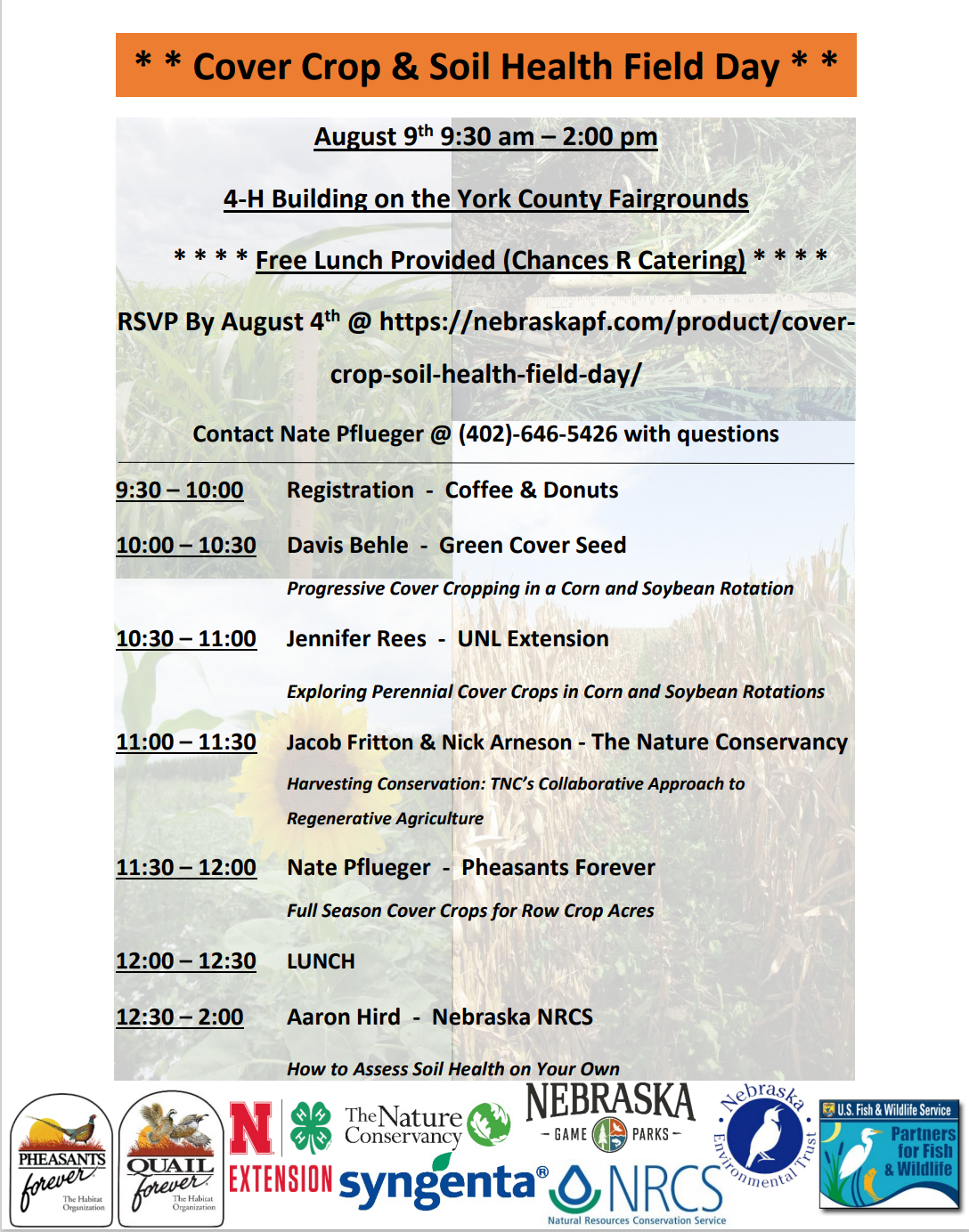
Field Days: July 31st at 7 p.m. is the Precision Fertigation Sunset Seminar at Jason Richter’s field on Road 8 between the York/Seward County line road and Road W in York County. This is an on-farm research study using the Sentinel Fertigation technology I’ve shared about…to apply fertilizer based on when the plant says it needs it using satellite imagery. Thank you to Jason for hosting! More info. and RSVP here: https://www.sentinelfertigation.com/sunset-seminars.
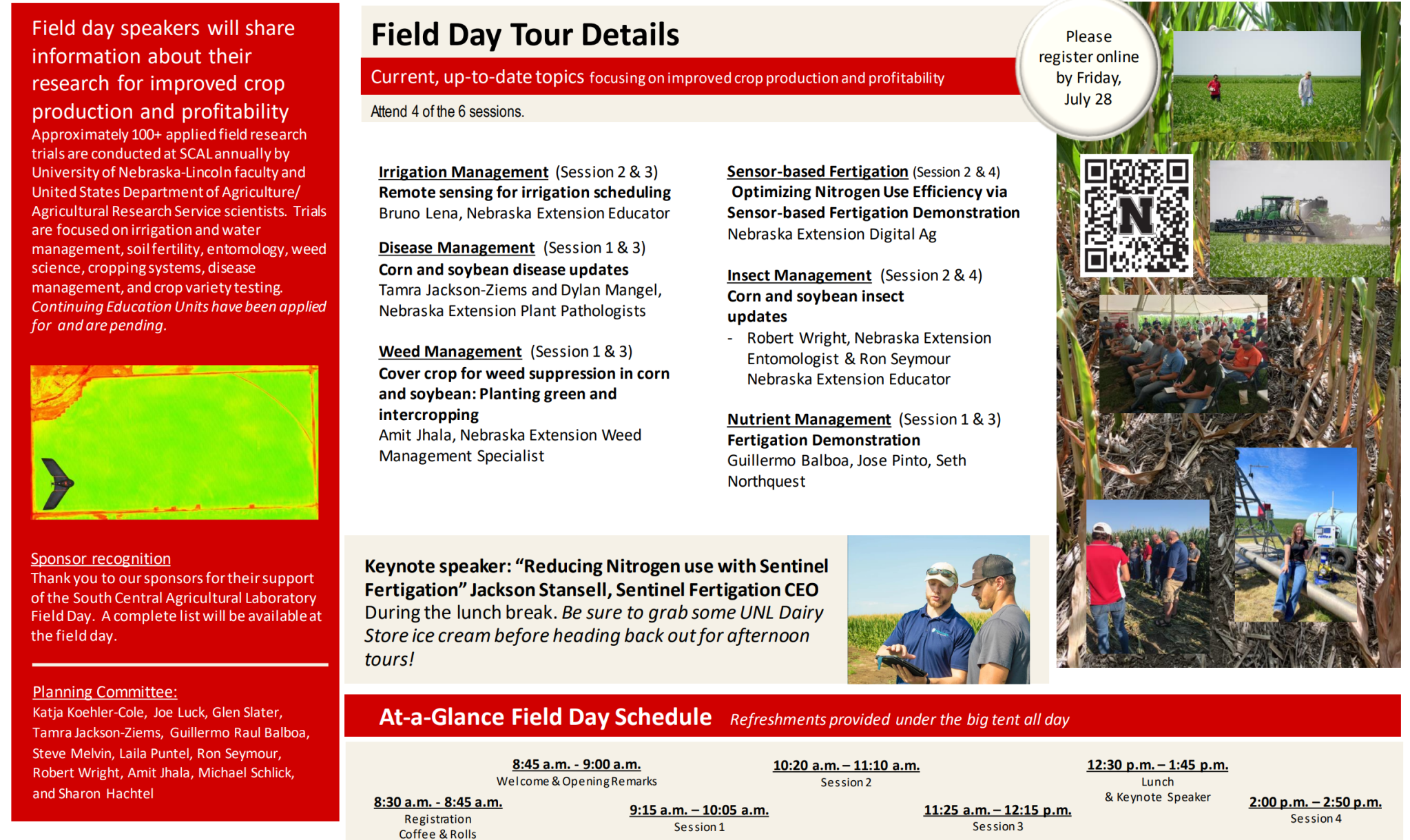
August 1 is the South Central Ag Lab Field Day near Clay Center from 8:45 a.m.-3:05 p.m. (Reg. at 8:30 a.m.). You choose the tours you attend from topics such as nutrient, disease, weed, irrigation, insect management. Noon speaker is Jackson Stansell with Sentinel Fertigation on “Reducing Nitrogen Use With Sentinel Fertigation.” RSVP at: go.unl.edu/scalfieldday.
August 3 is the Drones in Ag field day at the ENREC near Mead from 8 a.m.-2:30 p.m. (Reg. at 7 a.m.). This conference serves as a platform to exchange knowledge and experiences among participants. Topics include how to fly drones legally in the national airspace, including requirements to fly sprayer drones, practical uses of drones in agriculture, and tips and tricks to successfully use drones in a business. CCA credits pending. Details and RSVP at https://neata.org/.


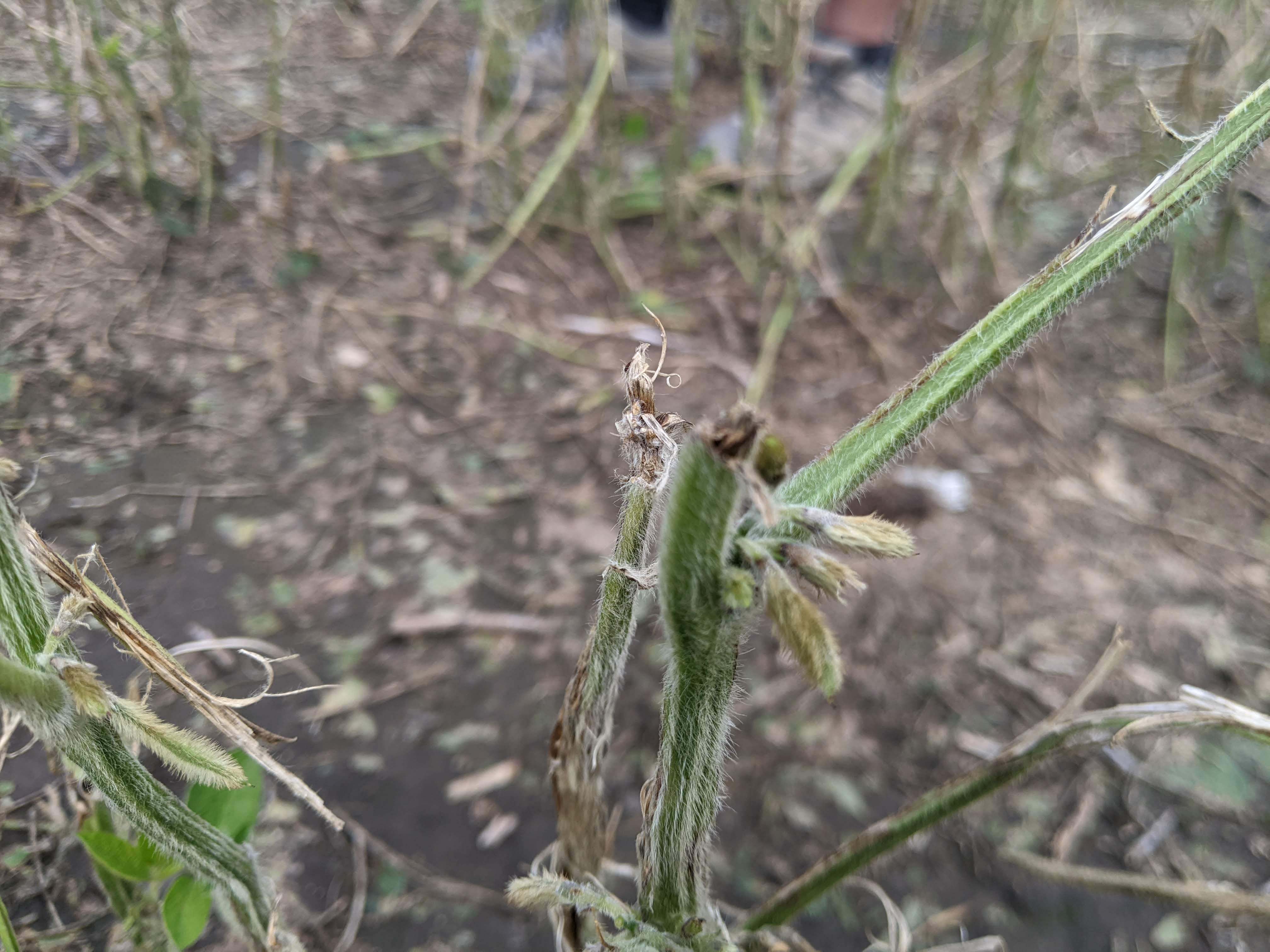
Anyone else seeing this? Hard to tell in the pic but tried to draw lines. I’m seeing the old check strips left from last year showing up as greener than the rest of the fields in these fields hailed again this year. Unsure why…more N perhaps there? Also showing soybeans with pods that survived the hail in different fields where I’m not seeing new flowers.
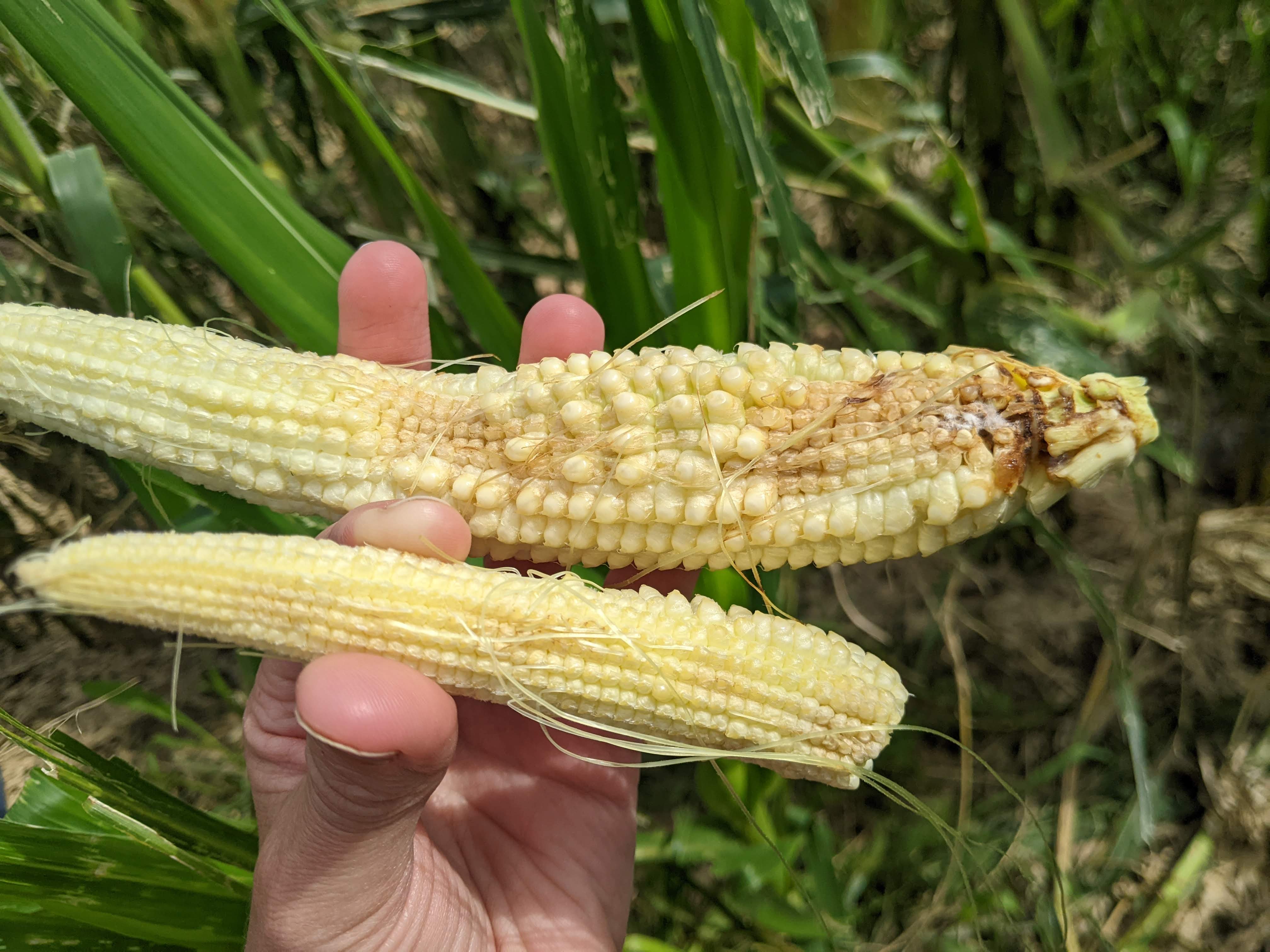
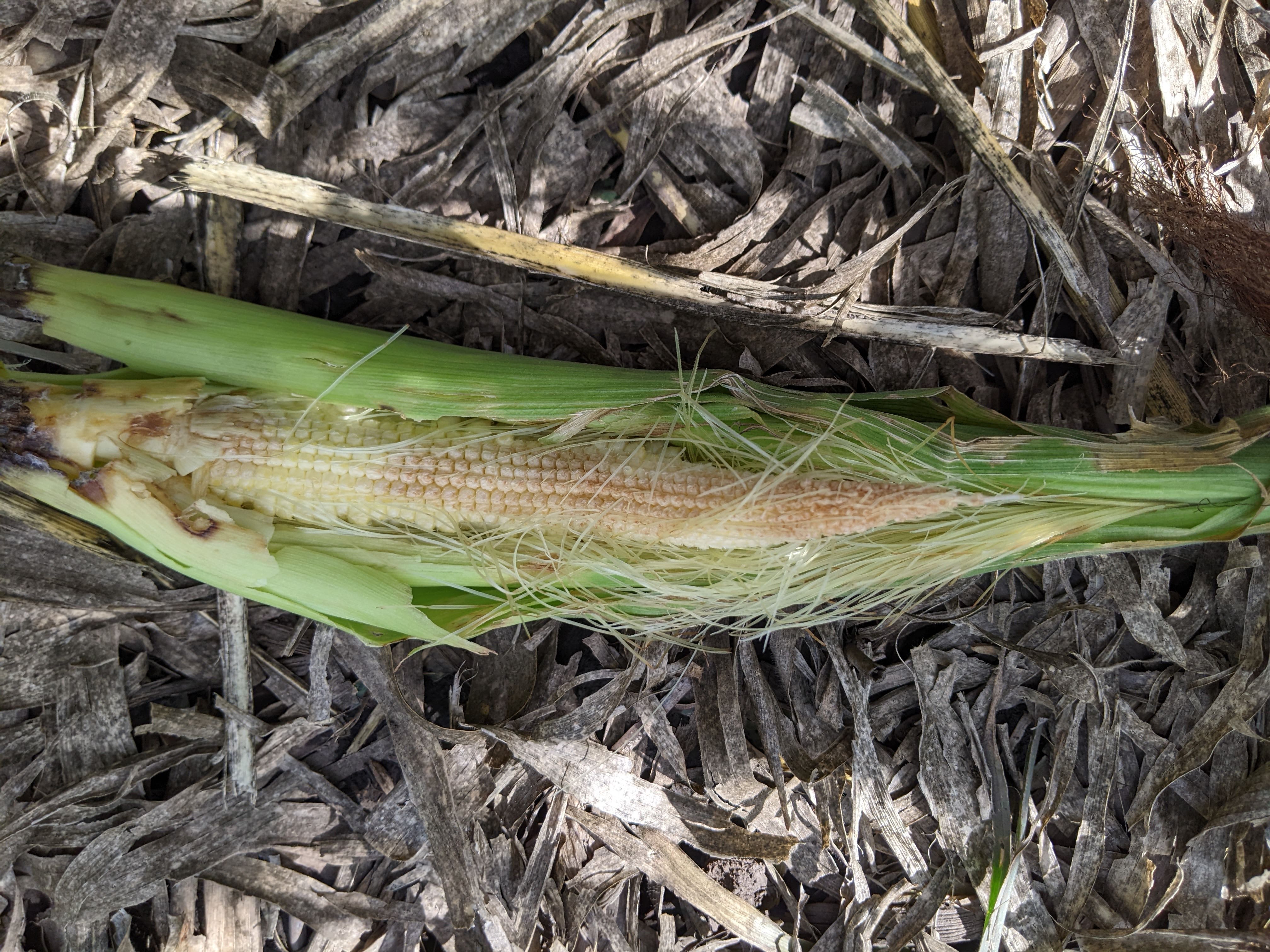
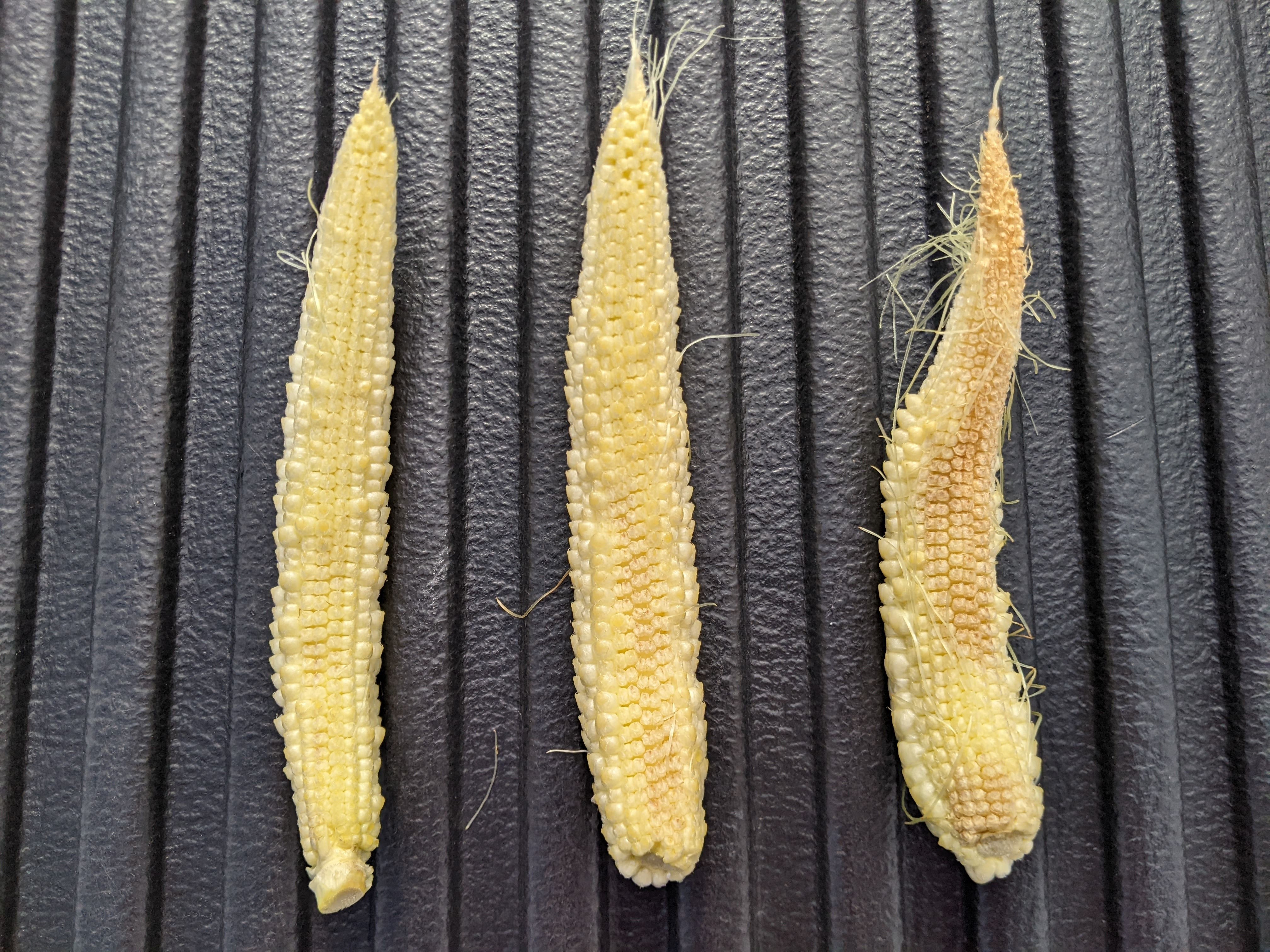
Can see pollination had occurred on some kernels showing blister development and a lot of ugly looking ears between lack of pollination and from hailstone bruising. The top ear already shows mold growth from Fusarium towards the ear base.

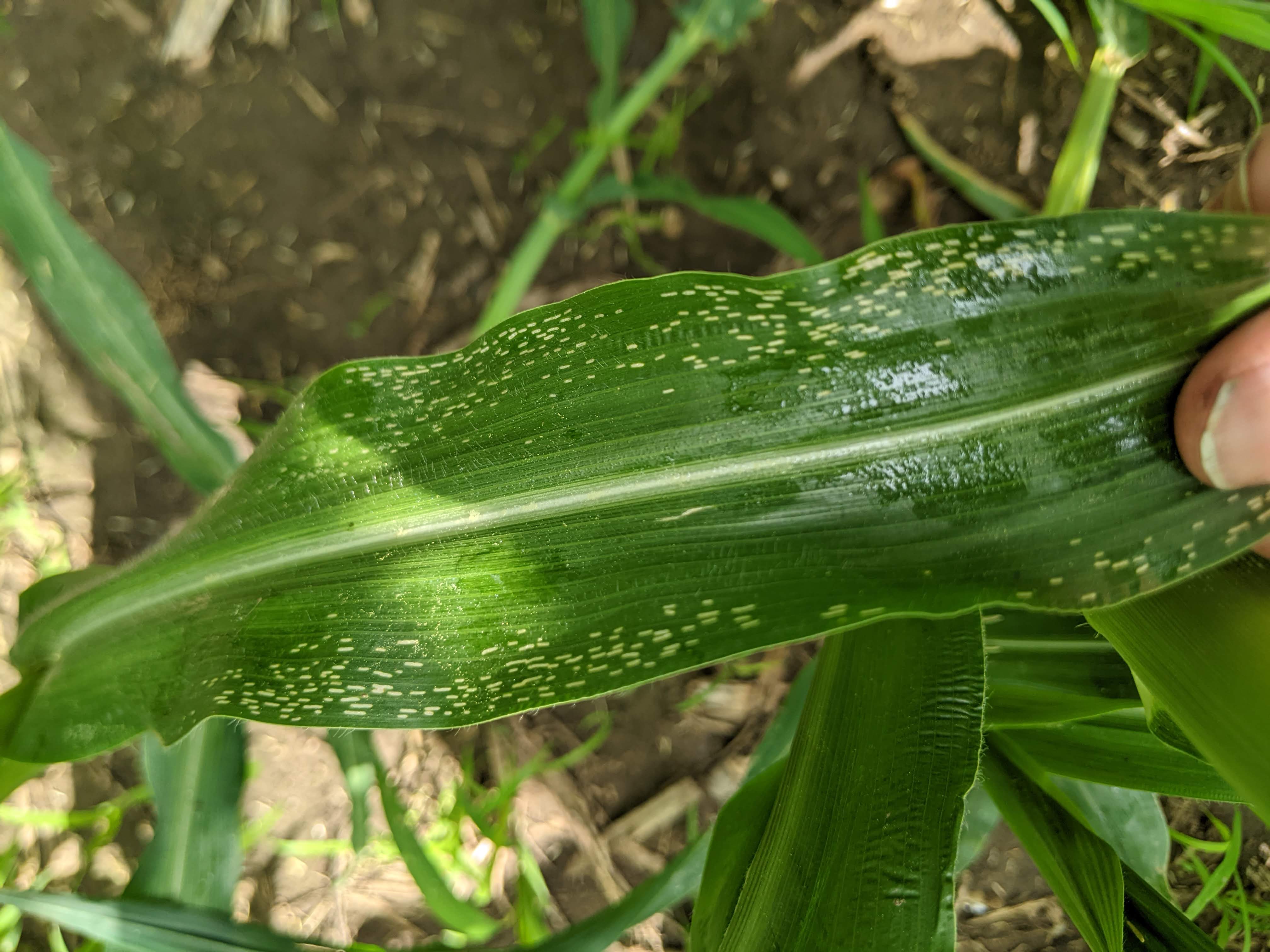
So far nothing to be concerned about regarding corn diseases in fields I’ve looked at. Bacterial leaf streak (above) fairly common in fields right now from wind/hail damage. When backlit, you will see yellow halos around lesions and it looks worse from the back-side of leaves-nothing to do or worry about. Below: Upper left is northern corn leaf blight (cigar-shaped lesions in mid-canopy of some fields); Gray leaf spot (typical rectangular lesion that I found 3 leaves above the soil and not above that); Below that is damage from corn blotch leaf miner adults when the female is making ovipositioning sites; larger lower picture is physoderma brown spot lesions (dark purple/brown spots along midribs, leaf axils and leaf sheaths and also orangish colored ‘bands’ of circular lesions on leaves since this pathogen moves with water. Notice on the top part of this leaf is a white streak that appears transparent; that is from corn blotch leaf miner larvae feeding.




JenRees 7-17-23
(July 4th Left photo and July 10th Right photo of hail damage in Nebraska via Interactive Hail maps).
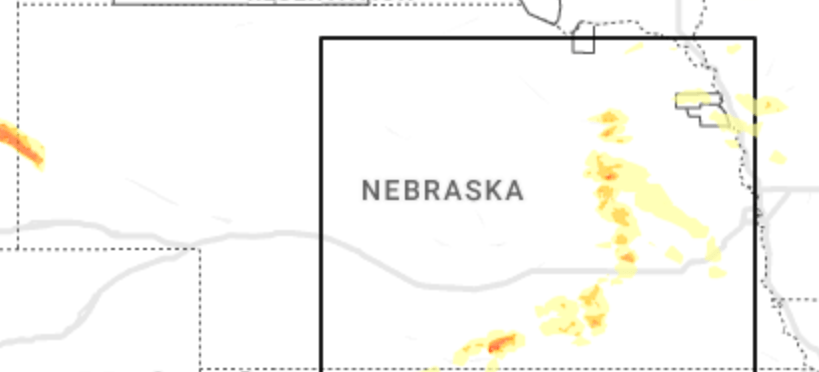

This week sharing on hail damage discussions I had with people depending on their individual field situations, previous herbicide, need for forage, all dependent upon crop insurance decisions. The July 4 and 10th hailstorms impacted an area from north of Thayer into Polk county down through Waco to east of McCool Junction and east through pockets of Utica area and Beaver Crossing/Goehner areas. As I’ve talked with people, there’s another level of mental difficulty in having to see it each day at one’s place vs. driving to fields to see it. Feel for everyone impacted, particularly those of you who were hit the past two years. Perhaps one opportunity now is growing much-needed forage as pastures are gone and many need feed for livestock.
Soybean assessments for yield are difficult when they were at R3-R4 (podding stages) prior to hail. There were new leaves/flowers the day after the storms which will continue to R5 (beginning seed). Tops were very broken on these stems so pods will most likely be low towards the ground from branching.
Soybean replant for federal crop was July 5th. Leaving fields alone is one option. For soybeans that lost most of leaves and upper stems, depending on crop insurance decisions and producer goals, have talked about splitting the rows to plant or else drilling beans (due to concerns of open canopy for weeds). Considerations include costs such as seed and seeding, fungicide seed treatment, herbicides. Increase seeding rate to at least 150,000 seeds/ac, use a fungicide seed treatment, and aim for a Group 2.0 maturity or less to reduce frost risk. A table at jenreesources.com shows yield ranges and when physiological maturity could occur via running historical York weather station data in a model with a July 20th planting date. The clock is ticking for replant soybeans to make seed prior to frost. Beans that freeze prior to maturity are often ‘lima-shaped’ beans at harvest or have an off-green color. That color will lesson some over time.
Others felt bean fields provided an opportunity for seeding forage. In that case, the field needs to be released by crop insurance. Check soybean herbicides used for any replant restrictions; you assume the risk of the cover crop seed germinating if you seed before a restriction ends.
Corn decisions are fairly clear to me. Hail also finished off some of the drought-damaged corn. Seed corn is each company’s decision by field-greensnap and bacterial top rot in fields I’ve seen. For corn that’s mostly stripped but was nearing tasseling or had ear development, watch for bruising. Past observations showed bruising from hailstones to ears during silking stage results in ear mold development. There’s nothing you can do about it but be aware of it for harvest and storage. Bruising to stalks allows for stalk rot to set in. Fungicides at some point can help with stalk strength. For fields with some tassels amidst mostly mowed off plants above the ears, watch pollination if they’re not released. Fields with tall stalks mowed just above or below the ears can be forage opportunities. Some considered grazing first and then planting a forage crop. Have also talked about flying brassicas like turnips/radishes into these taller stalk fields to allow for grazing of the stalks with the brassicas at some point. Check for any corn herbicide grazing restrictions. Also know it’s your risk to seed cover crops prior to any replant restrictions from corn herbicides used. Don’t turn cattle in empty, provide fresh water, no strip grazing, avoid grazing lowest 8″ of stalk, and consider supplementing hay/energy for any nitrate concerns.
Some planned to shred the stalks and replant with beans instead. Some planned to shred the stalks and drill in something like sorghum sudan, pearl millet, or sudangrass now. Some planned to plant a small grain like rye/oats/wheat or a combination of them in August/September time-frame depending on if they wanted the cover to winterkill (oats), wanted less growth next spring (wheat), or more growth next spring (rye). I know rye especially got a bad rap this year in the midst of drought, but again, we’re in a drought. For any of these options, you’ll need to check replant restrictions and know the risk is on you if you plant prior to it.
The following contains more info. for planting annual forages in July or August: https://go.unl.edu/ypgc. Additional considerations are cost/availability of seed, seeding, equipment, will forage be hayed/grazed/both, will you use it or do you have someone to use it, or can you grow something to sell. Some with hay have considered using these forages for their livestock and selling their hay at some point for the higher price. Haven’t heard anyone from the July 10 hailstorm talking about short season corn for silage but did talk to others from earlier hailstorms in the State regarding that. There was also greensnap to varying degrees and bent but not broken plants (where ear abnormalities can occur). Willing to listen if you want to bounce off ideas. Ultimately, please take care of yourselves! Rural Response Hotline: 1-800-464-0258.
Silage: This really depends on plant height and ability to harvest for silage. Dr. Bruce Anderson shared in a 2012 CropWatch article Using Weather Damaged Corn as Forage that, “Fermentation usually (but not always) reduces nitrate levels and risk. Yield is about one ton per acre of silage for each harvested foot of earless corn plant (not counting the tassel). Feeding value is about 70% to 80% of well-eared corn silage. Corn with some grain (less than 50 bushels) tends to produce about one ton of silage for every five bushels of grain with a feed value about 80 to 90% of regular corn silage. Harvest timing is critical with silage to ensure the correct moisture for proper fermentation. Desired moisture level for silage is about 65%. Plants with any green leaves usually are too wet to chop for silage. For proper moisture, most leaves may need to be dead before chopping. The stalk and ear hold amazingly high water concentrations. For corn with no grain, even if all leaves are dead, the whole plant (and silage) moisture can be 70% if the stalk is still green and alive.
Once plants actually die they can rapidly dry down. There are several ways to reduce moisture content. If corn has pollinated, delay silage harvest until all chances of increased biomass tonnage have passed or plants naturally dry down to appropriate moisture levels. Corn can be windrowed and allowed to partially dry before chopping. Excessively wet material can be blended with drier feeds such as ground hay, cracked grain, or dried distillers grains. However, this can take a lot of material — about 500 lb of grain or hay to reduce each ton of chopped corn with 85% moisture down to 70% moisture. Silage inoculants may improve fermentation and preservation of drought-damaged silage.”
150th York County Fair: We’re asking for copies (no originals) of fair photos through the years for a display in Ag Hall. Feel free to share a brief memory/who is in the photo on the back. Please bring your copies to the York Extension Office by July 21st if possible. Thanks!
Table 1. Yield Potential of Maturity Groups Planted on July 15 or 20, 2023 in the York, NE area via the SoySim model (thanks to Dr. Jim Specht for running this for me). One week makes a big difference between July 15 and July 20th for yields and reaching physiological maturity. Note average 30 year frost date for York at 31F is October 14th and at 28F is October 21st. I bolded the July 20th planting dates as that’s what’s realistic now.
| Maturity Group | Planting Date | Low Yield (bu/ac) | High Yield (bu/ac) | Average Yield (bu/ac) | Physiological Maturity Date |
| 1.0 | July 15 | 21 | 33 | 26 | September 24 |
| 1.5 | July 15 | 27 | 39 | 34 | October 4 |
| 2.0 | July 15 | 33 | 44 | 39 | October 13 |
| 2.5 | July 15 | 35 | 46 | 43 | October 20 |
| 3.0 | July 15 | 28 | 47 | 43 | October 27 |
| 3.5 | July 15 | 23 | 38 | 35 | October 28 |
| 1.0 | July 20 | 18 | 29 | 24 | October 2 |
| 1.5 | July 20 | 25 | 34 | 30 | October 13 |
| 2.0 | July 20 | 25 | 37 | 32 | October 21 |
| 2.5 | July 20 | 20 | 40 | 32 | October 28 |
| 3.0 | July 20 | 15 | 42 | 31 | October 29 |
| 3.5 | July 20 | 10 | 36 | 24 | November 2 |
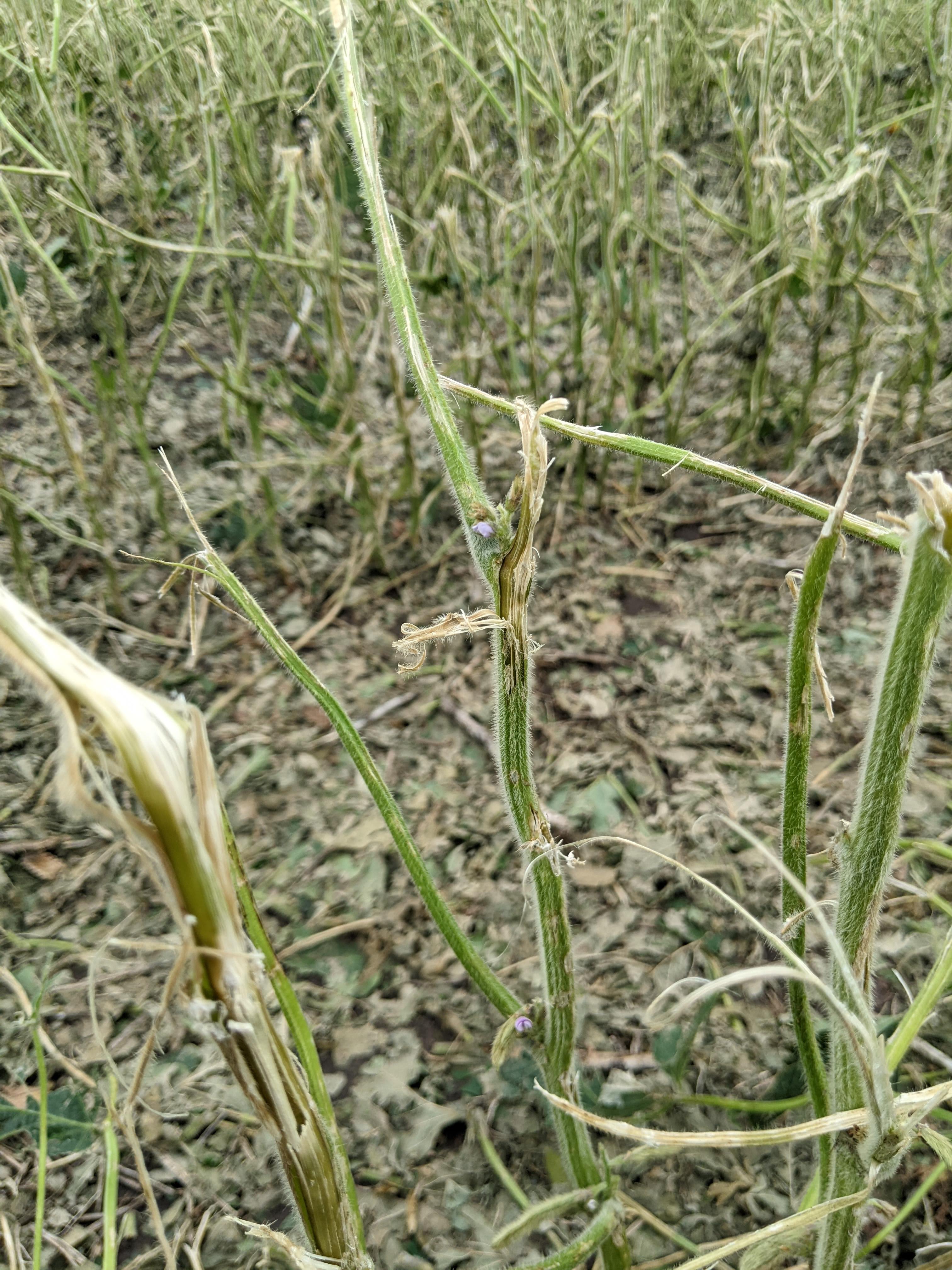
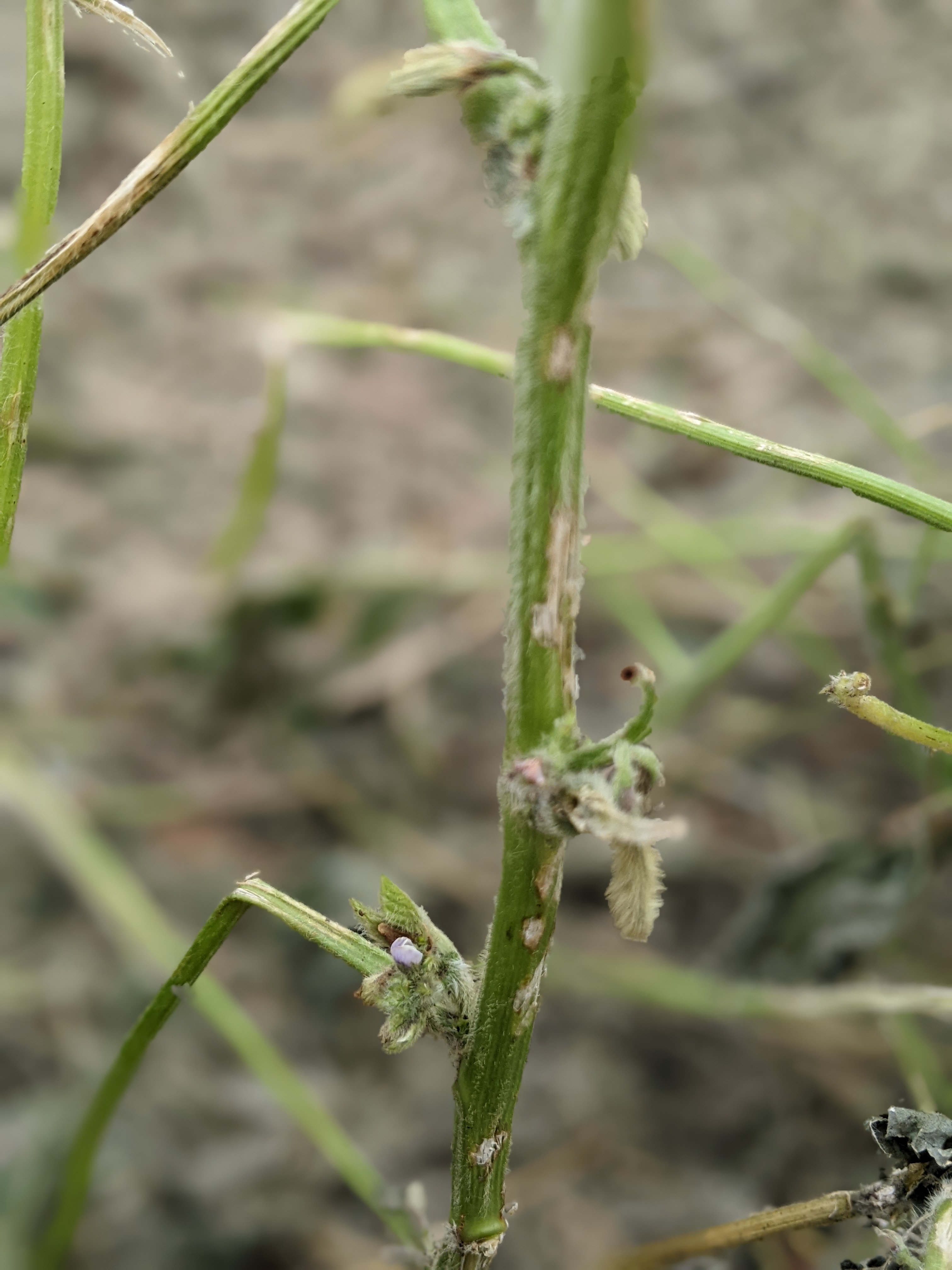
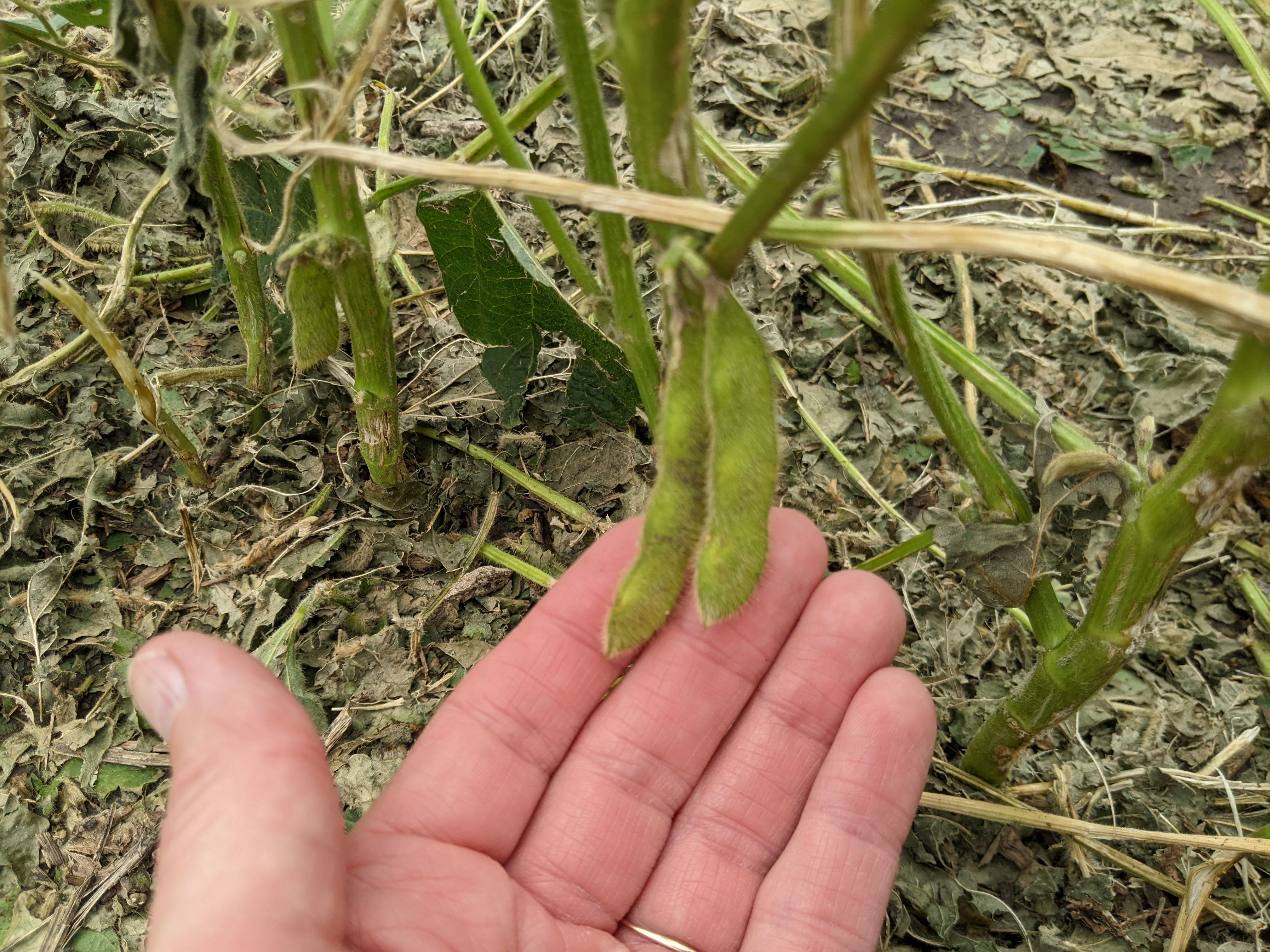
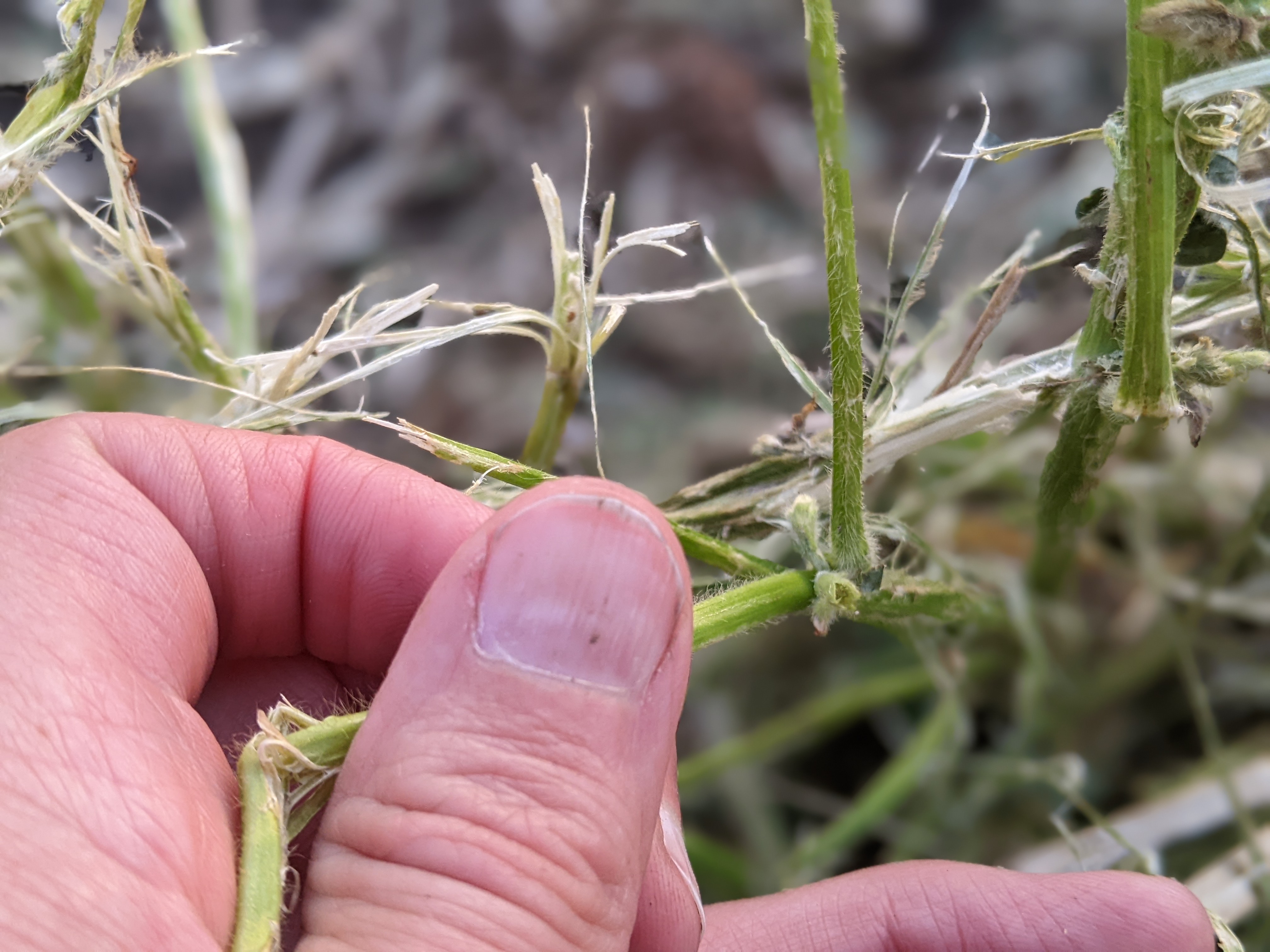
Pictures from various soybean fields showing soybean damage to tops of plants, tiny pods that survived in some axillary buds, and new regrowth. Lowest pods were at beginning seed (R5) in lowest nodes of some fields I checked which means upper parts of the plant were most likely between R3-R4 (podding stages). New growth (new leaves and flowers) was seen in axillary buds the day after hail damage. Will be tough to get much top growth with shredded stems and as many nodes have been cut off. Most new growth will most likely branch and be lower on plants that were more severely affected.

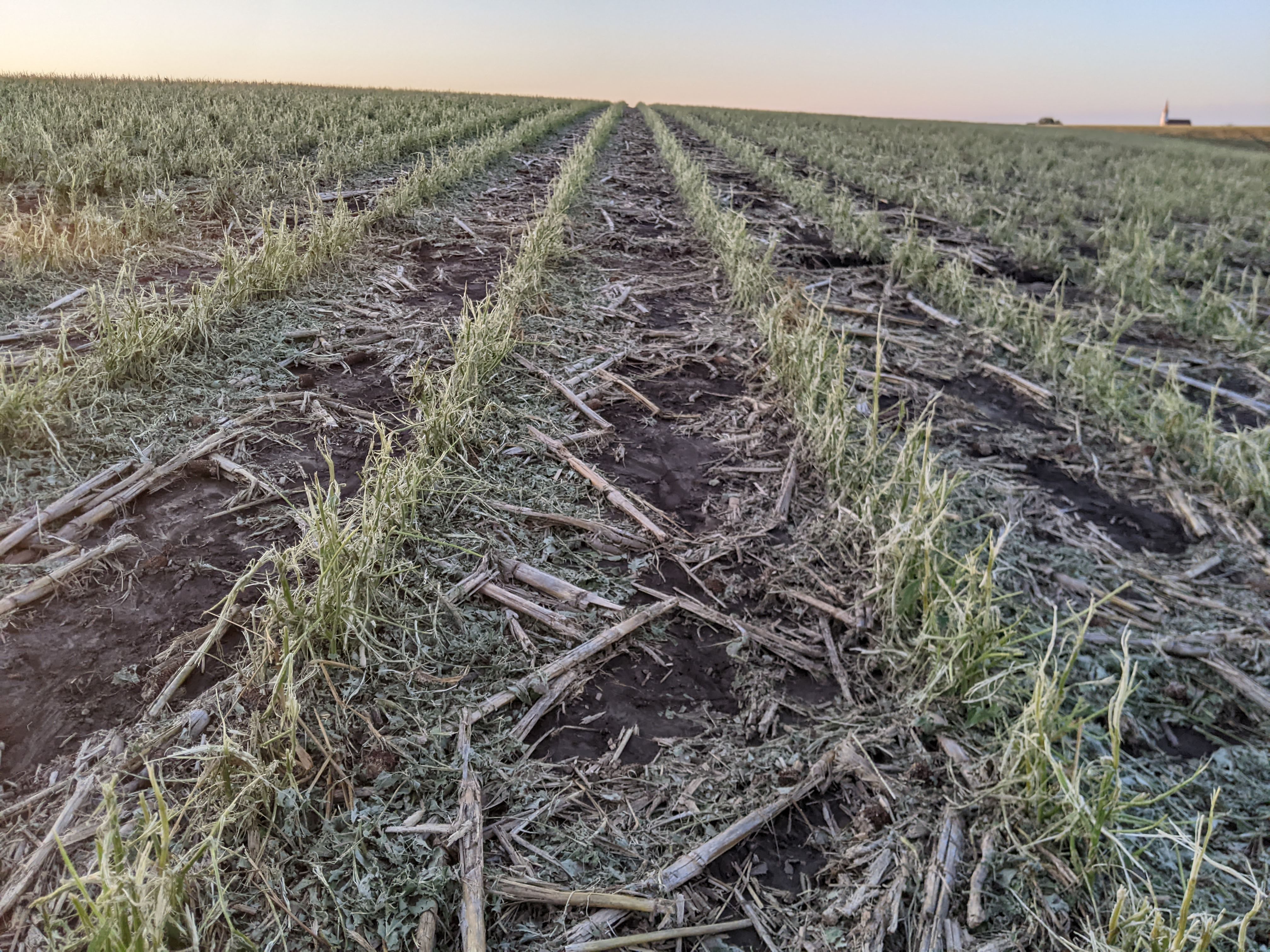


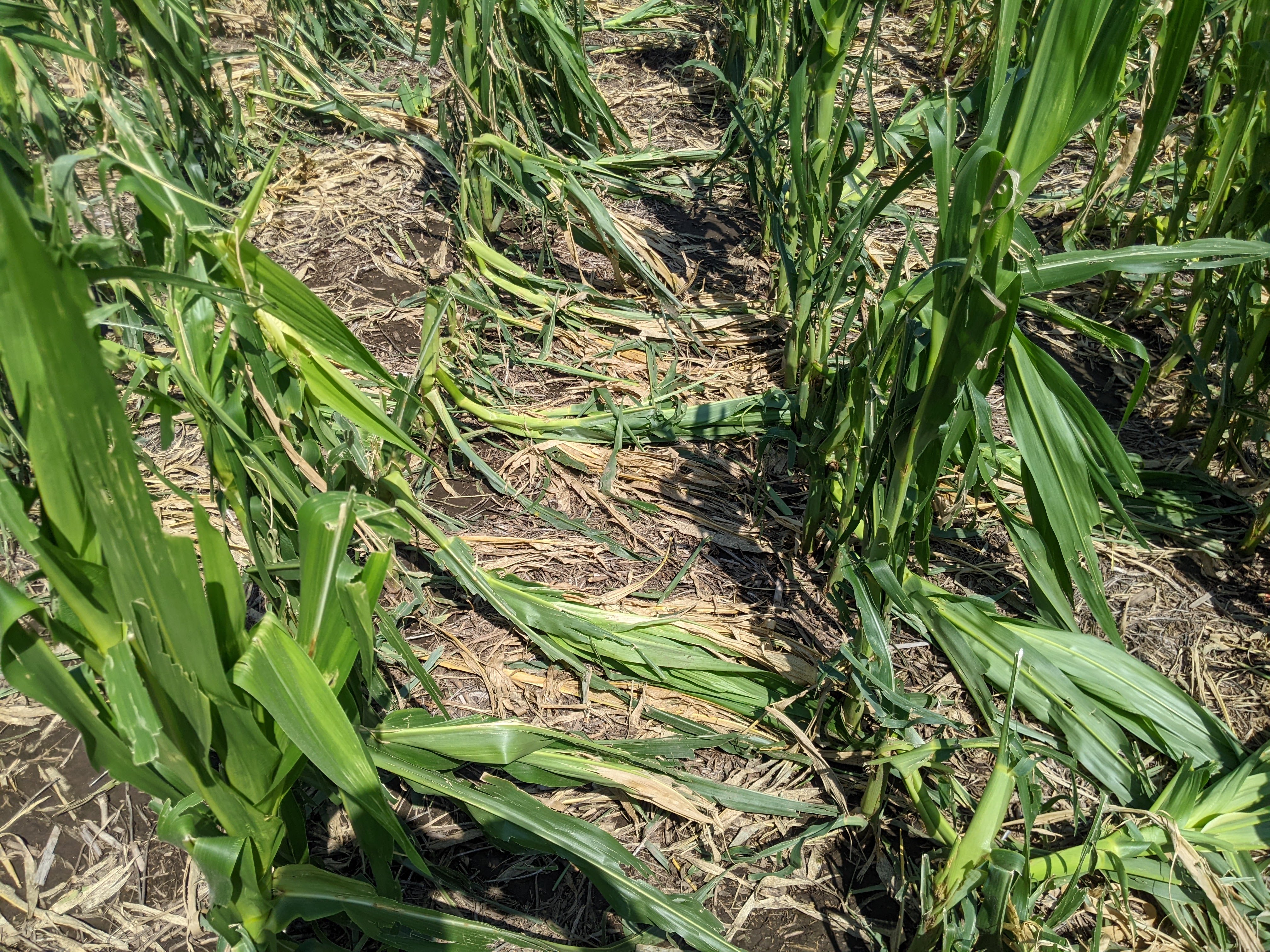
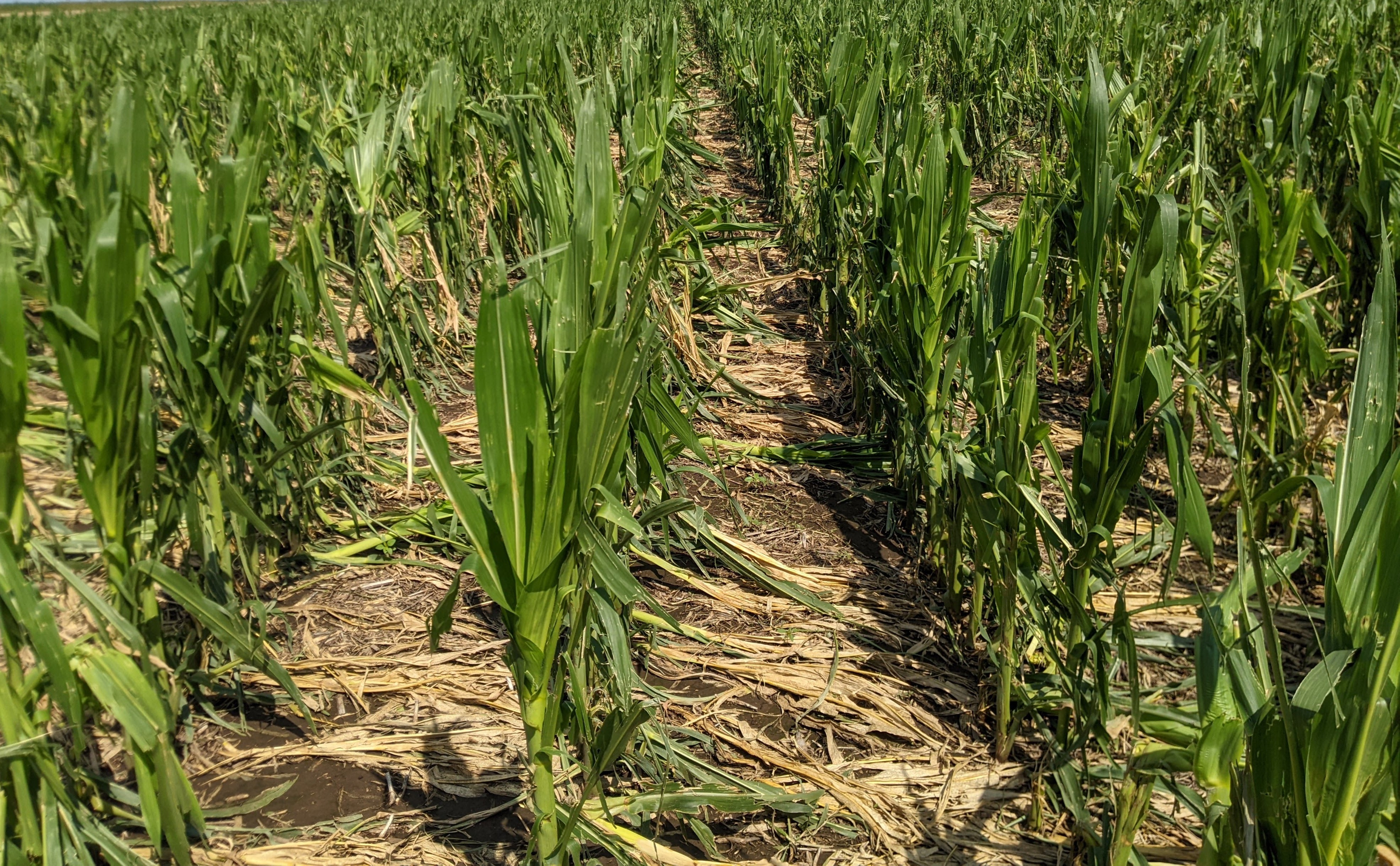
Corn plants mowed off around the ear or below in various fields. These provide opportunities for forage should one be interested in that. There are some who have talked about shredding stalks and planting beans as well as an option.


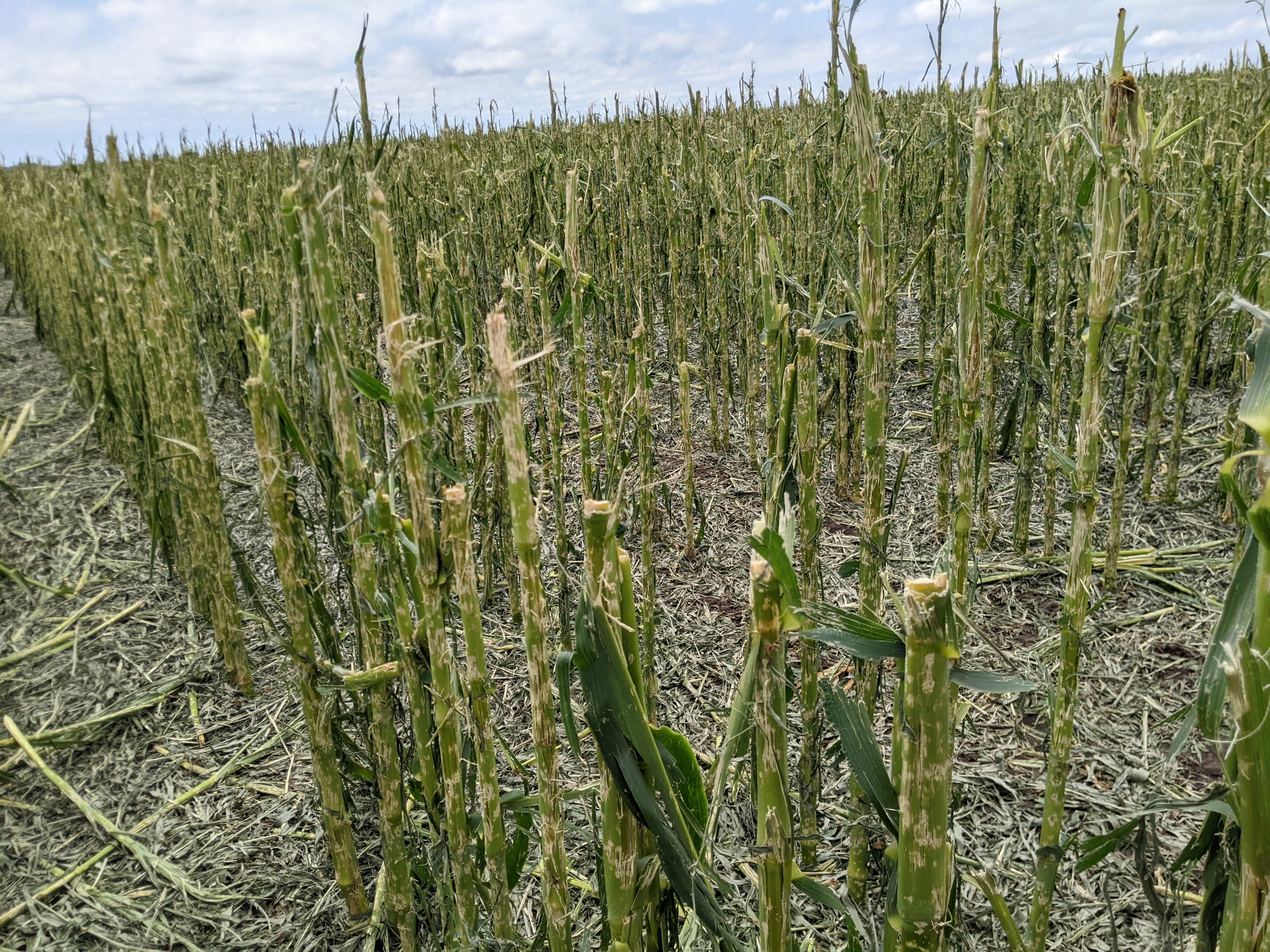
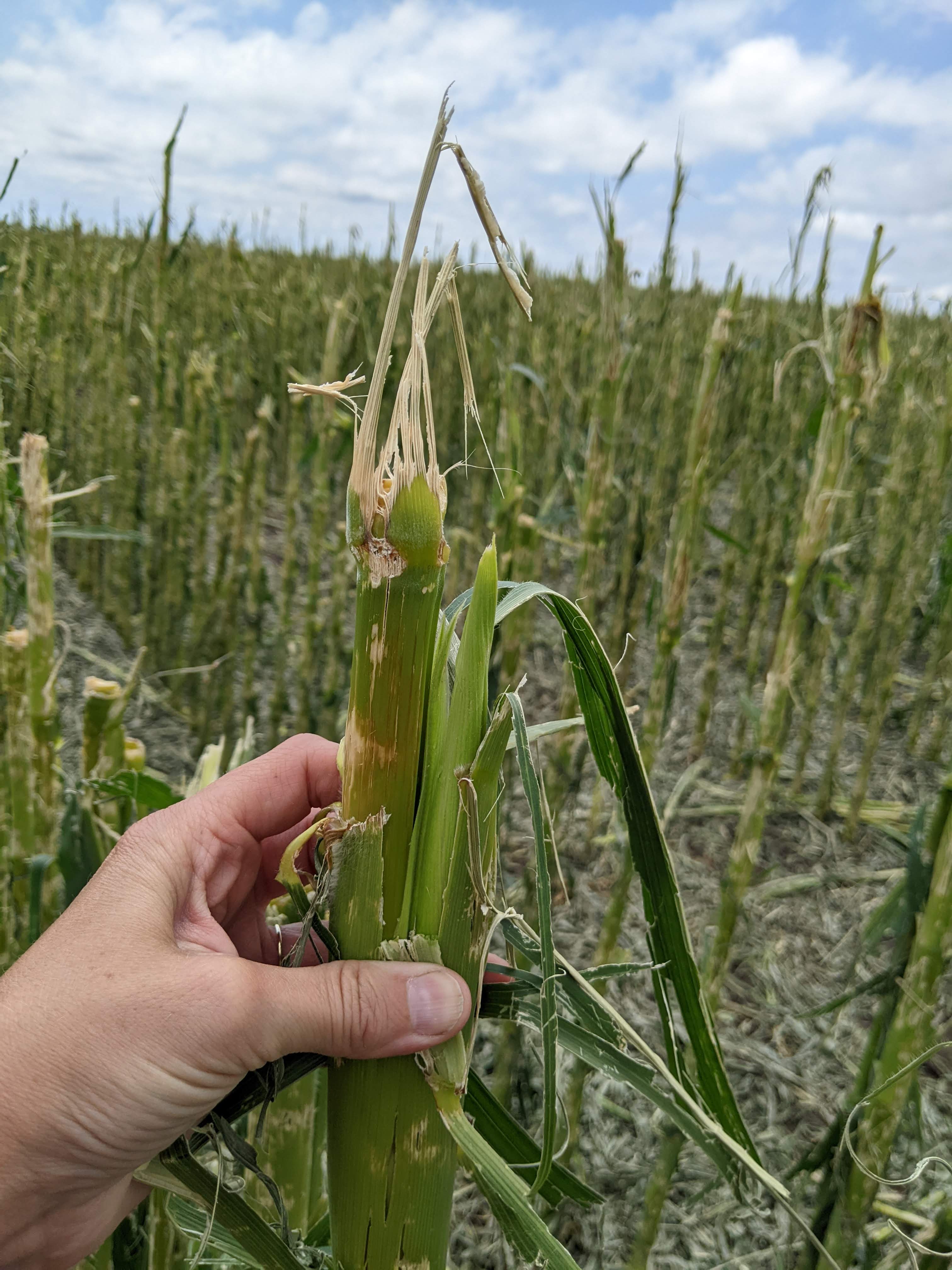
Photos from later-planted seed corn with greensnap and bacterial top rot setting in. Fields like this are hard to tell the extent of damage from the road.

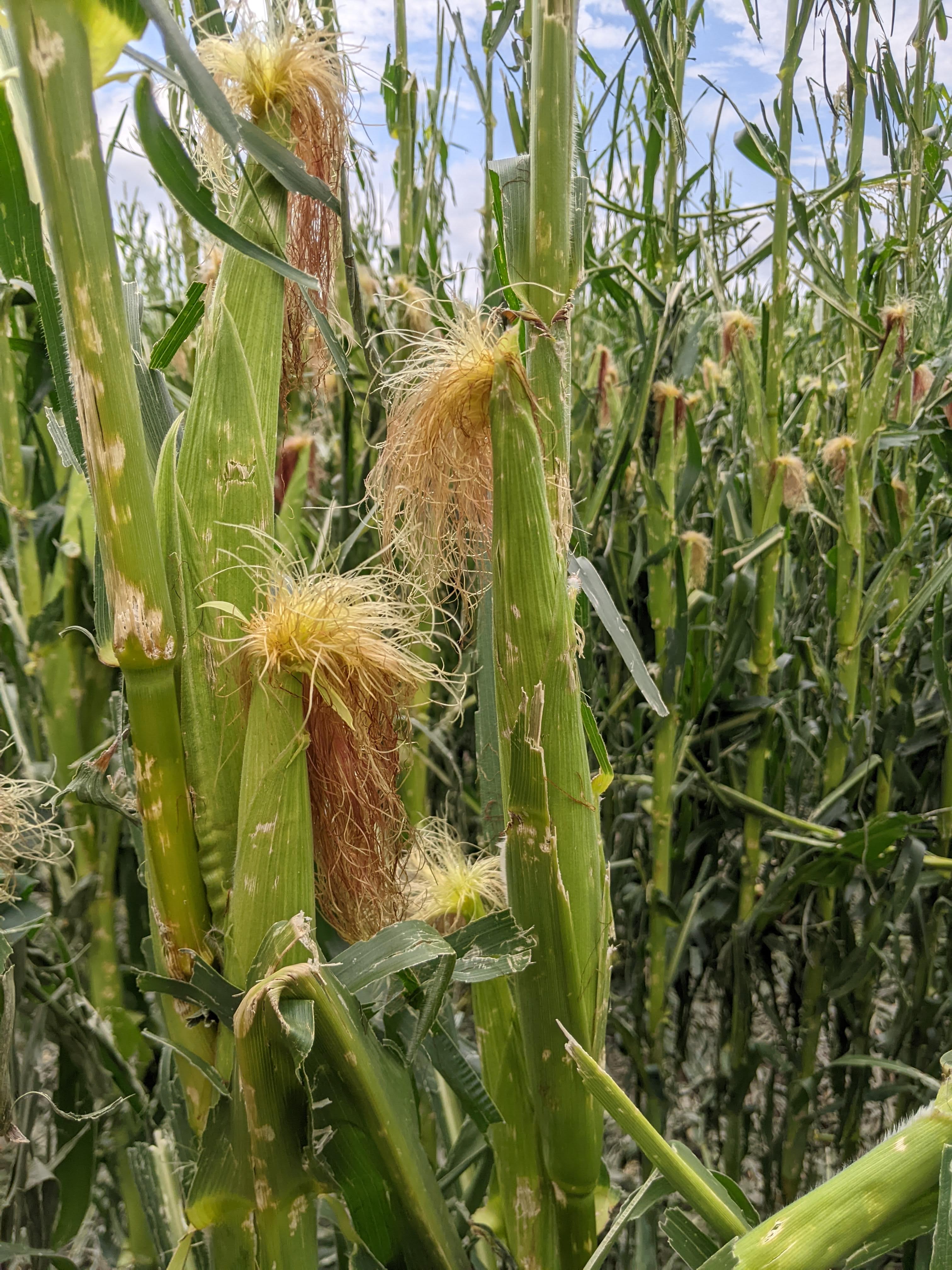
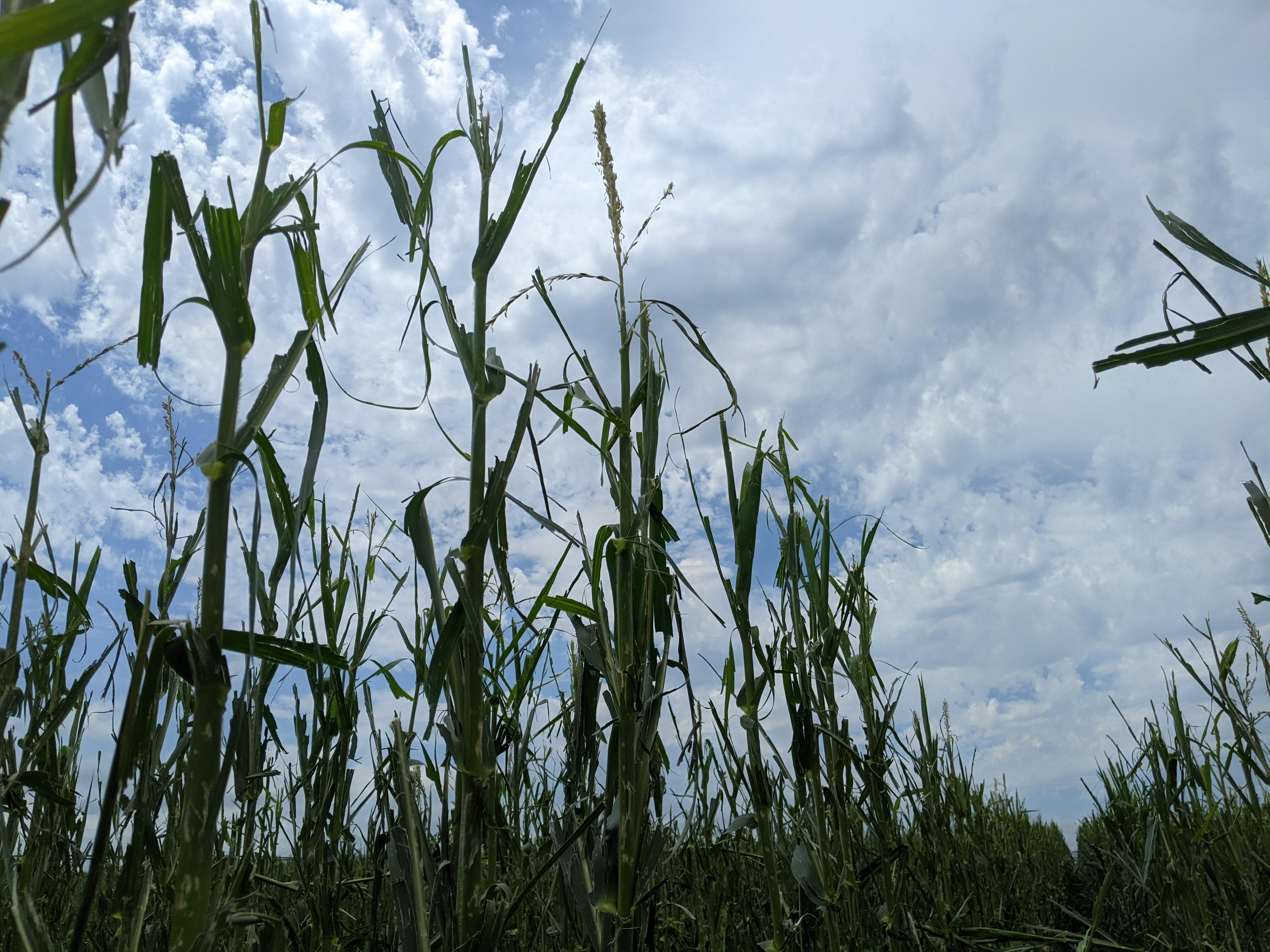
These are all fields with some amount of tassels remaining. The first picture represents all those fields with less than 25% tassels and the rest of the stalks cut off around ear height. Will need to watch pollination in those fields. Fields with damage to ears that were silking may have hailstone bruising. Ear mold is something to watch in those situations but nothing one can do about it.


JenREES 7/9/23
It was sad to see several get hit with devastating hail for a second year in a row from the July 4th storm. It was also such a blessing to get the unexpected gift of a fairly widespread 1”+ rain last Friday morning!
For those dealing with hail, I don’t have any great new ideas for planting into totaled crops beyond soybeans or some type of forage crop at this point. For replanting with soybeans, we suggest 0.5-1.0 maturity less than you normally plant, make sure you have a fungicide seed treatment (wouldn’t have to have anything for SDS, just for seedling diseases), increase your seeding rate, and consider narrower rows to close canopy quicker. Phytophthora root rot is something I tend to see fairly often with replant soybeans, thus the rec for the fungicide seed treatment. For acres damaged on fringes, I recommend leaving existing soybean stands of 50K, which is trickier now that we’re at R2-R3 in many fields. In corn fields with less damage, we will have to watch what happens on timing of silks/tassels.
For those interested in planting annual forages in July or August after hail/drought/wheat harvest, the following contains more info. on seeding rates, tonnage, species, etc.: https://go.unl.edu/ypgc.
Annual Forage Insurance is an opportunity for obtaining crop insurance (in Nebraska, Kansas, South Dakota) to protect against the primary production risk of low precipitation. This is for annual forage crops used for grazing, haying, grazing/haying, green chop, grain/grazing, grazing/green chop, or silage. The current sign up period ends July 15 for coverage on annual forage planted from July 16, 2023-July 15, 2024. This insurance uses the two-month rainfall index intervals with coverage up to 90% of normal precipitation (similar to perennial forage insurance). Recorded webinar with info: https://go.unl.edu/3d57.

Japanese beetles: Adults emerge from grassy areas (lawns, pastures, road-side ditches for at least 4-6 weeks (last year was around 10). So, even if you treat, they can come back. Threshold is 30% defoliation on vegetative corn. Upon silking, the threshold is 3 or more beetles/ear with silks clipped to less than ½ inch and pollination is less than 50% complete. For soybeans the threshold upon reaching flowering is 20% defoliation (watch for pod clipping too). More info. on chemical options for crops at: https://go.unl.edu/osyi. The following are chemical options for landscapes/fruits/gardens: https://go.unl.edu/bke4. The hardest thing has been to tell people they can’t eat produce or fruit from using products that weren’t labeled for the plants they applied to. Crazy how many livestock and crop products were used in landscapes last year….please follow pesticide labels.
We know how uneven these corn fields are-even irrigated ones. Many labels specify no NIS between V8/V10 till Tassel. Even if applying ‘at tassel’, realize that not all plants in the field will be at tassel, so you run the risk of abnormal ear development with the wrong adjuvants/surfactants present. If disease/insect pressure doesn’t warrant an app, I prefer delaying till at least brown silk to apply products to help alleviate any potential risk. I tend to be called out to many field problems. Since I started talking about this, the number of calls with messed up ears due to wrong timing of application the past three years has dwindled significantly. So, just a consideration as we begin to see more tassels shooting.
Western Bean Cutworm: It’s recommended to start scouting when 25% of moth flight occurs based on a GDD model. Lincoln hit 25% on July 2nd, Grand Island July 6, Columbus July 7, York July 8th, Clay Center July 10th. Threshold is 5-8% egg masses/live larvae. You can learn more about the GDD prediction tool and predictions for your area at: https://go.unl.edu/438o.
JenREES 7/2/23
This week thinking about gratitude. In spite of difficulties, we’re truly so blessed! Grateful for freedom as we celebrate this 4th! Grateful for all the smiles I saw towards the end of last week from farmers/families who had received some rain…whether it was 0.20” or over 1” over the few days. I think many of us just needed to feel/see/smell how fresh everything is after it again! Grateful for whatever corn unrolled! It’s so hard for those who still keep missing rain with how spotty it is. The mental toll is real with the stress and exhaustion so many producers are experiencing. I also feel for those who live in parts of the State/other states who got such bad hail and wind…I know many of you can empathize with them too.
Last week there were those desperate for forage for livestock who decided to graze non-irrigated acres. I sent out an email mid-week about crop insurance and grazing info. Won’t share all that here; it’s in this article: https://go.unl.edu/dhi9. First talk with crop insurance before making any decisions on drought or other disaster-impacted acres. If those acres are used before talking with insurance, a ‘0’ could be assessed for your 2023 APH which stays with you for 10 years. Loss will be assessed via stand reductions (minimal loss) or the permanent wilt method. The permanent wilt method assesses plants firing, lower leaves crumble easily in one’s hands, leaves don’t unroll at night, and plants don’t respond to moisture. Farmers also may have the option to leave strips that will be assessed at harvest (like you did with last year’s hail) if you prefer that.
Grazing makes the most sense to me on these acres desired for forage. Check for any herbicide restrictions then check with crop insurance. If the corn is released for grazing, there will be nitrates. We aren’t as concerned about grazing corn higher in nitrates prior to ear development compared to if the grazing would occur after an ear was put on. Protein is higher when grazing corn in these vegetative stages. Don’t turn livestock out empty. Providing plenty of fresh water will help reduce nitrate risk. Cattle should self-adapt by eating the tops of plants first and then will be more adapted to eating the higher nitrate areas lower in the plant. Don’t strip graze; allow open access to the field to allow more time for cattle to self-adapt to the nitrates. You can consider supplementing hay, grain, or both. There’s thoughts a little grain may be beneficial to provide energy to offset nitrates. We’re all learning so please share your observations. Additional forage info. here: https://go.unl.edu/dhi9.
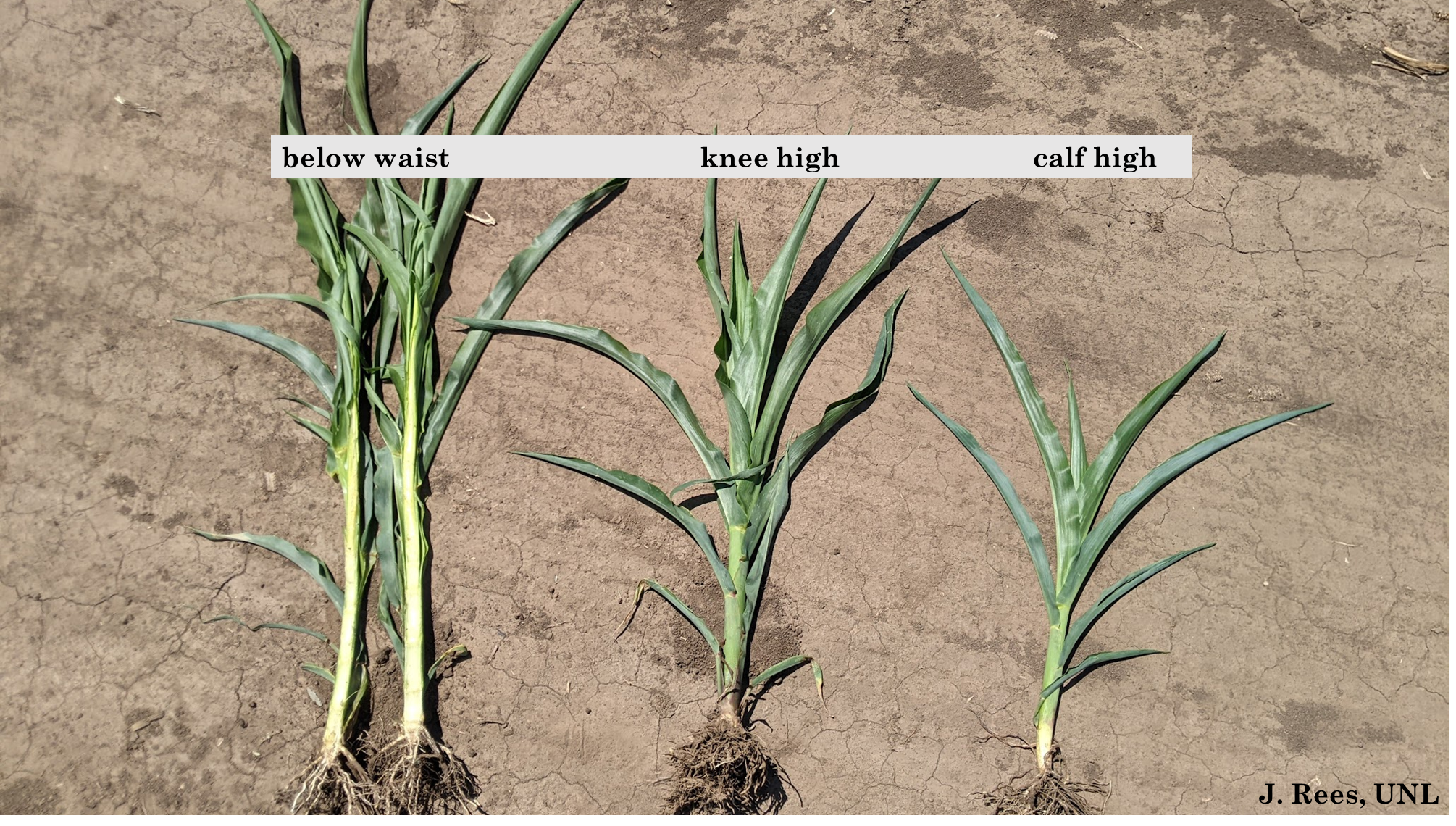
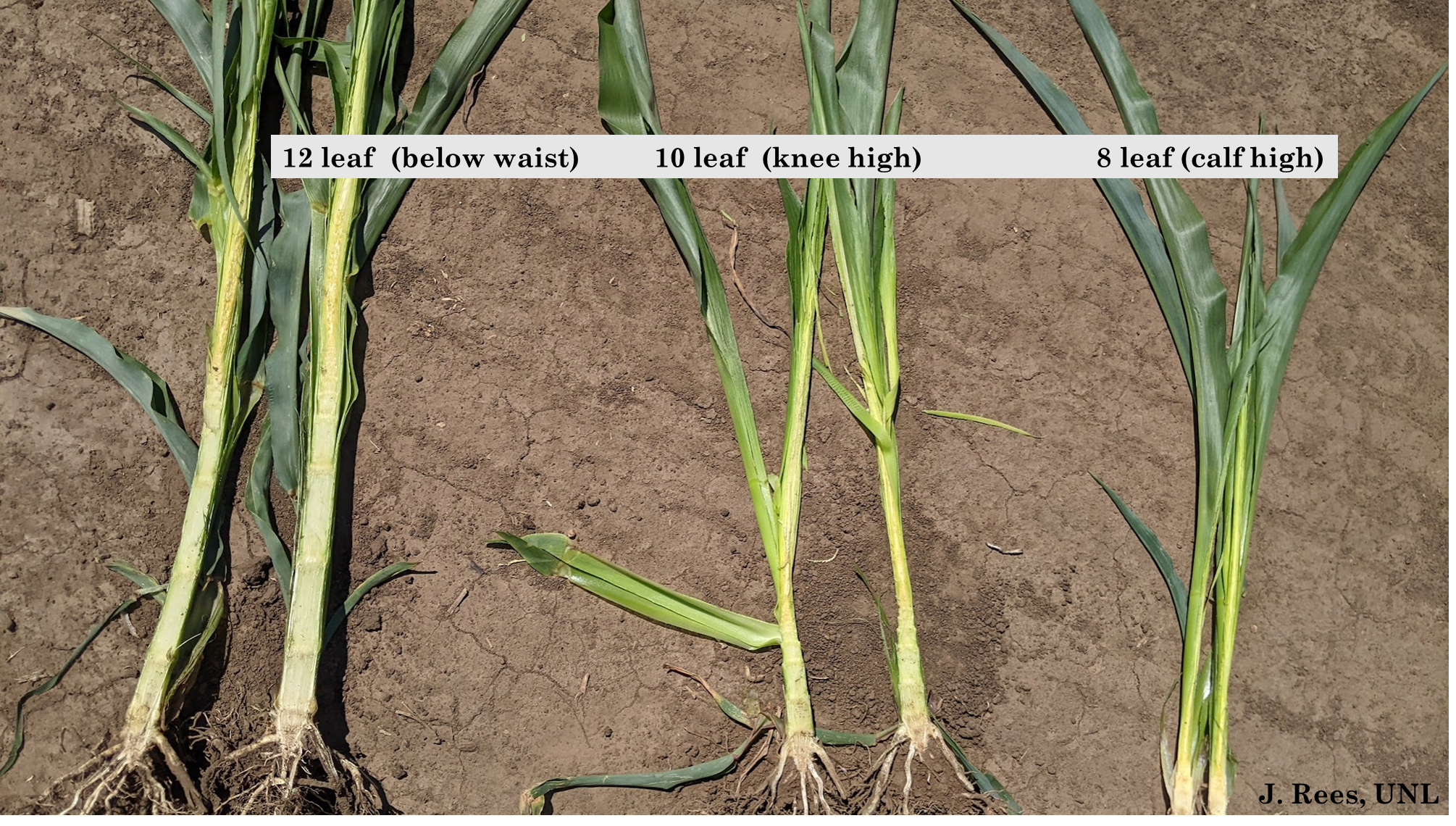
Last week I investigated any potential in non-irrigated corn to better determine when it was done. Photos at jenreesources.com. Corn that is silver/gray and never unrolled with the rain is obviously done. But I was also grateful to see how much corn did unroll when it looked so toasted last Wed.! While very short, some put on several stacked leaves. There’s also a lot of corn rolled again after minimal rain. As I dissected plants in fields throughout the York/Seward county area that were at least 10 leaf (whether these plants were around knee high or above waist high), I found the primary ears and saved them. Carefully dissecting them, I then put them under the microscope. In all fields I was finding 10-16 rows around! So, I was wrong! A few weeks ago I shared I didn’t think we’d have more than 4-8 rows around on these very stressed plants during that 5-8 leaf development time-frame. I’ve wrestled this week in sharing this as I didn’t know if it would provide encouragement or discouragement. We’ve got a long way to go with receiving adequate moisture to get to pollination, timing of pollen-shed/silking coinciding, etc. Yet, I also felt sharing could provide some hope and much-needed encouragement of some potential for those who got some rain and saw leaves unroll. Hopefully this info. does a little of the latter for you. For me, no matter what happens, with my faith, it gave me such an awe of the Creator in seeing these tiny kernels.
As tasseling approaches in irrigated fields, think through your decisions regarding costs. You’ve put a lot of money already into irrigation with a long season ahead. I’m always the outlier on this, but consider if/when you really need fungicide/insecticide apps instead of automatically applying. Delaying till needed buys you time with the residual. Also, please take at least 10 minutes a day to stop and take a break with positive activity to refresh one’s mind. Maybe even jot a few things down you’re grateful for each day? Sometimes stress can lead to unwise decisions-please take care of yourselves!
In case Japanese beetles explode this week, here’s a printable resource for homeowners in advance: https://go.unl.edu/bke4.
A tale of three corn plants from the same non-irrigated drought-stressed field that were rolled for well over 20 days. These are heights on me so much shorter for all you taller individuals!


 JenResources