Monthly Archives: January 2024
JenREES 1/28/24
It’s incredible how quickly January flew by! The following are programs occurring next week. Reminder of the Friday February Conversations (10-Noon 4-H Bldg. York). The February 2nd conversation is around crop rotations, specifically diving into pest management issues with soybeans and seed corn and discussing ideas to help. It’s going to take farmers and ag industry working together on these discussions, so please invite/encourage those who have input/ideas to attend!
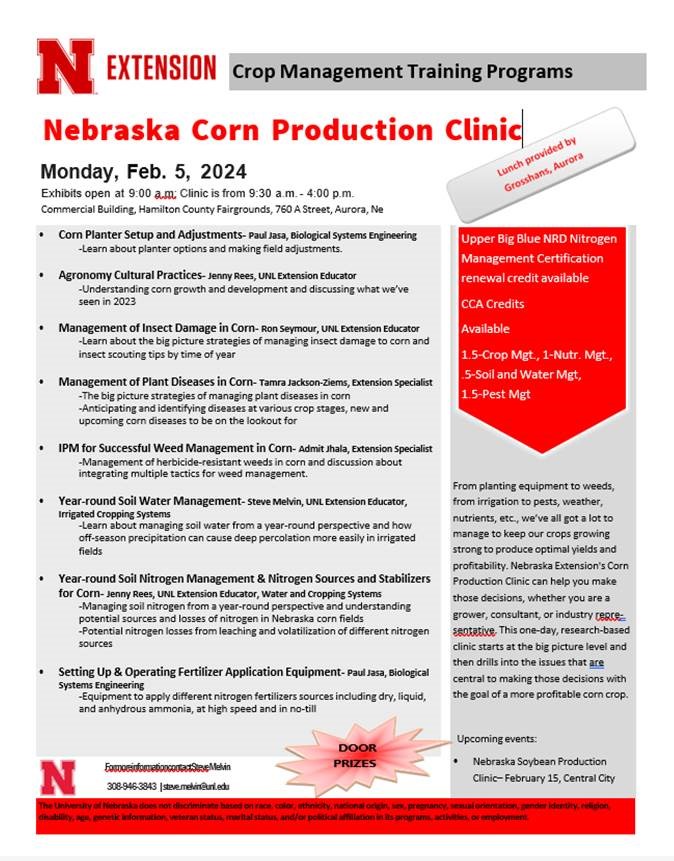
Nebraska Corn Production Clinic Feb. 5 at the Commercial Building, Fairgrounds in Aurora, starting at 9 a.m. with breakfast and time to visit with the vendors at the display booths. Presentations will start at 9:30 a.m. with Corn Growers and USDA updates, and conclude about 3:45 p.m. with door prizes. The event has a great lineup of excellent speakers focusing on all things corn, plus several ag display booths.
Topics include: Corn Planter Setup and Adjustments; Advanced Agronomy Cultural Practices; Management of Insect Damage in Corn; Management of Plant Diseases in Corn Including Tar Spot; IPM for Successful Weed Management in Corn; Year-round Soil Water Management; Year-round Soil Nitrogen Management and Nitrogen Sources and Stabilizers for Corn; and Setting Up and Operating Fertilizer Application Equipment. CCA credits are available.
The ag day event is consistently ranked by the farmers who attend as one of the best educational ag events. The day is free of charge to the participants thanks to sponsors and exhibitors. The noon meal sponsor is Grosshans in Aurora. More information is available https://merrick.unl.edu or by calling Steve Melvin at (308) 946-3843.
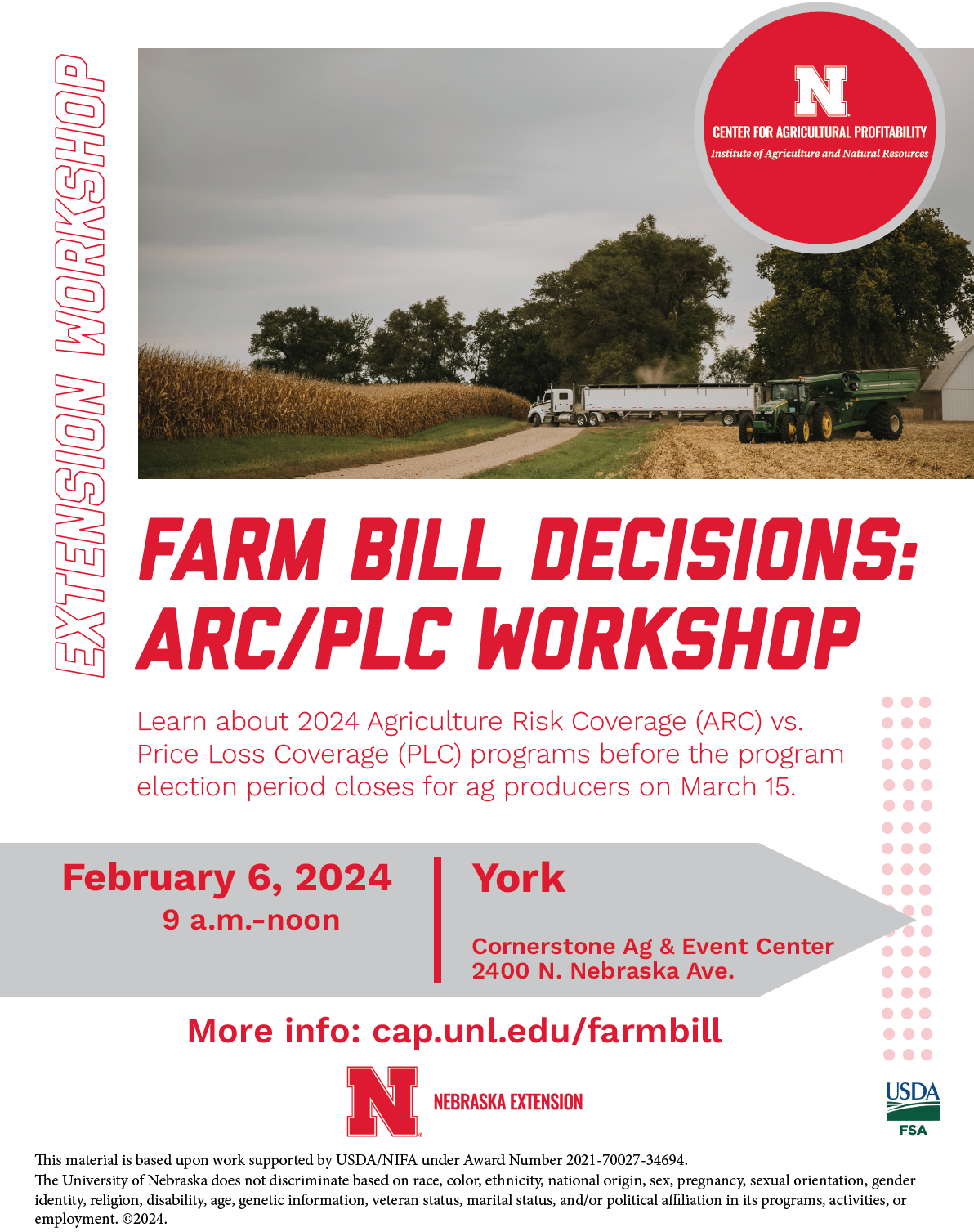
Farm Bill (ARC/PLC) program workshop for ag producers will be in York on Feb. 6 from 9 a.m.-Noon at the Cornerstone Ag & Event Center at the Fairgrounds in York. Nebraska USDA Farm Service Agency (FSA) is reminding producers now is the time to make elections and enroll in the Agriculture Risk Coverage (ARC) and Price Loss Coverage (PLC) programs for the 2024 crop year. The signup period is open through March 15, 2024, and producers are encouraged to begin working with their USDA county Farm Service Agency (FSA) office to complete the process. Although election changes for 2024 are optional, enrollment (signed contract) is required for each year of the program. If a producer has a multi-year contract on the farm, it will be necessary to sign a new contract for the farm by the March 15th deadline if a 2024 election change is desired. If an election is not submitted by the deadline of March 15, 2024, the election defaults to the current election for crops on the farm from the prior crop year.
Producers can learn about the ARC and PLC options for 2024 during a series of workshops hosted by the University of Nebraska-Lincoln’s Center for Agricultural Profitability (CAP) and Nebraska FSA that will be held across the state in February. Area workshops include:
- Feb. 6, 9 a.m.-Noon, Fairgrounds in York
- Feb. 7, 1-4 p.m., Community Building in Columbus
- Feb. 9, 9 a.m.-Noon, ENREEC near Mead
- Feb. 9, 1-4 p.m., Extension Office in Beatrice
- Feb. 14, 1-4 p.m., Extension Office in Hastings
The meetings have no charge and are open to the public. More information and a full schedule are available on the Center for Agricultural Profitability’s website, https://cap.unl.edu/farmbill.
Feb. 6-7 Nebraska Soils School: There’s also an incredible opportunity for learning and CCA credits through this soils school in partnership with the Nebraska AgriBusiness Association. More details here: https://cropwatch.unl.edu/2023-CW-News/2024-Soils-School-Agenda.pdf.
Feb. 7 Part 107 course training to help you pass the test for flying drones will be held at ENREEC near Mead. More info: 402-460-0742.

Fridays in February 2024
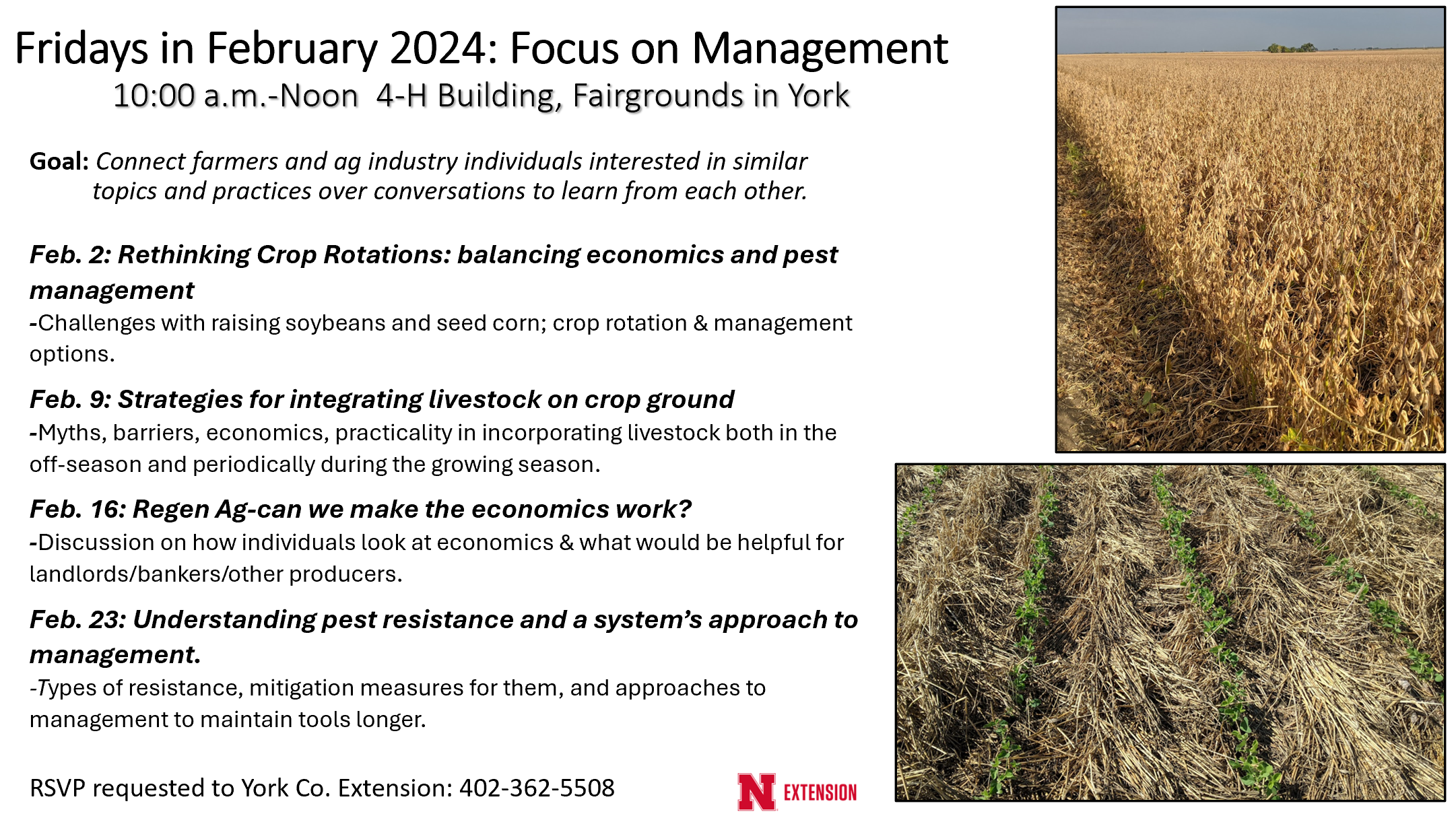
Fridays in February Conversations-Focus on Management: As an Extension educator, I prefer discussion, interaction, and co-learning vs. lecturing. This program started a couple years ago as an opportunity for producers and ag industry to gather and have informal, practical conversations, and share experiences/solutions around topics ag is facing. As I thought about last year and conversations people shared, the following topics surfaced. Each conversation is on Fridays in February from 10 a.m.-Noon at the 4-H Building in York. Please join us for coffee, cookies, and conversation around any/all these topics if you’re interested! Please RSVP to me or 402-362-5508.
Feb. 2: Rethinking Crop Rotations: balancing economics and pest management. A number of producers are frustrated with soybean yields, the problems with raising soybeans, and a handful have given up seed corn with others considering this. Both are important crops to this area so we’ll discuss crop rotation/management options to do things differently.
Feb. 9: Strategies for integrating livestock on crop ground. There’s many benefits of having livestock on crop ground. We’ll discuss some myths, barriers, economics, and what could be practical in incorporating livestock both in the off-season and periodically during the growing season.
Feb. 16: Regen Ag-can we make the economics work? There’s quite a bit of interest in Regen Ag and trying things differently. This is good yet the economics still need to work. As I’ve worked with producers in this space, I feel we need to have a discussion on how individuals look at economics and what we need better numbers around for landlords, bankers, and other producers.
Feb. 23: Understanding pest resistance and a system’s approach to management. Pest resistance is a topic we are currently and will continue to face in the future. We’ll discuss types of resistance, mitigation measures for them, and approaches to management to maintain tools longer.
Eastern NE Corn and Soybean Expo will be held on Jan. 25th at the Eastern NE R&E Center near Mead with viewing of vendor booths at 8:30 a.m. and program beginning at 9:10 a.m. This event combined the former Fremont Corn Expo and the Soybean Days in Wahoo. Mike Zuzolo, president of Global Commodity Analytics and Consulting LLC, is the keynote speaker. He will speak on “Navigating 2024 Commodity Markets — Funds vs. Fundamentals”. His presentation will include: Assessing 2024 Prices For Grains and Cattle — Look at Top 3-5 Drivers; Factors To Focus Upon — U.S. and Global S/D Fundamentals (Micro-Conditions) vs. Funds and Investment Flow Drivers (Macro-Conditions); Project 2024 “Overvalue” and “Undervalue” Levels For Corn/Soybeans/Cattle Through March 31. Many additional topics are included. More info. at: https://go.unl.edu/jmh7.
Chemigation Training In York Jan. 26: For anyone interested in applying chemicals (fertilizer or pesticides via irrigation systems, a chemigation certification is required. Steve Melvin is doing this training Jan. 26th at 1 p.m. at the 4-H Building in York if you need initial or recertification training. RSVP to 402-362-5508.
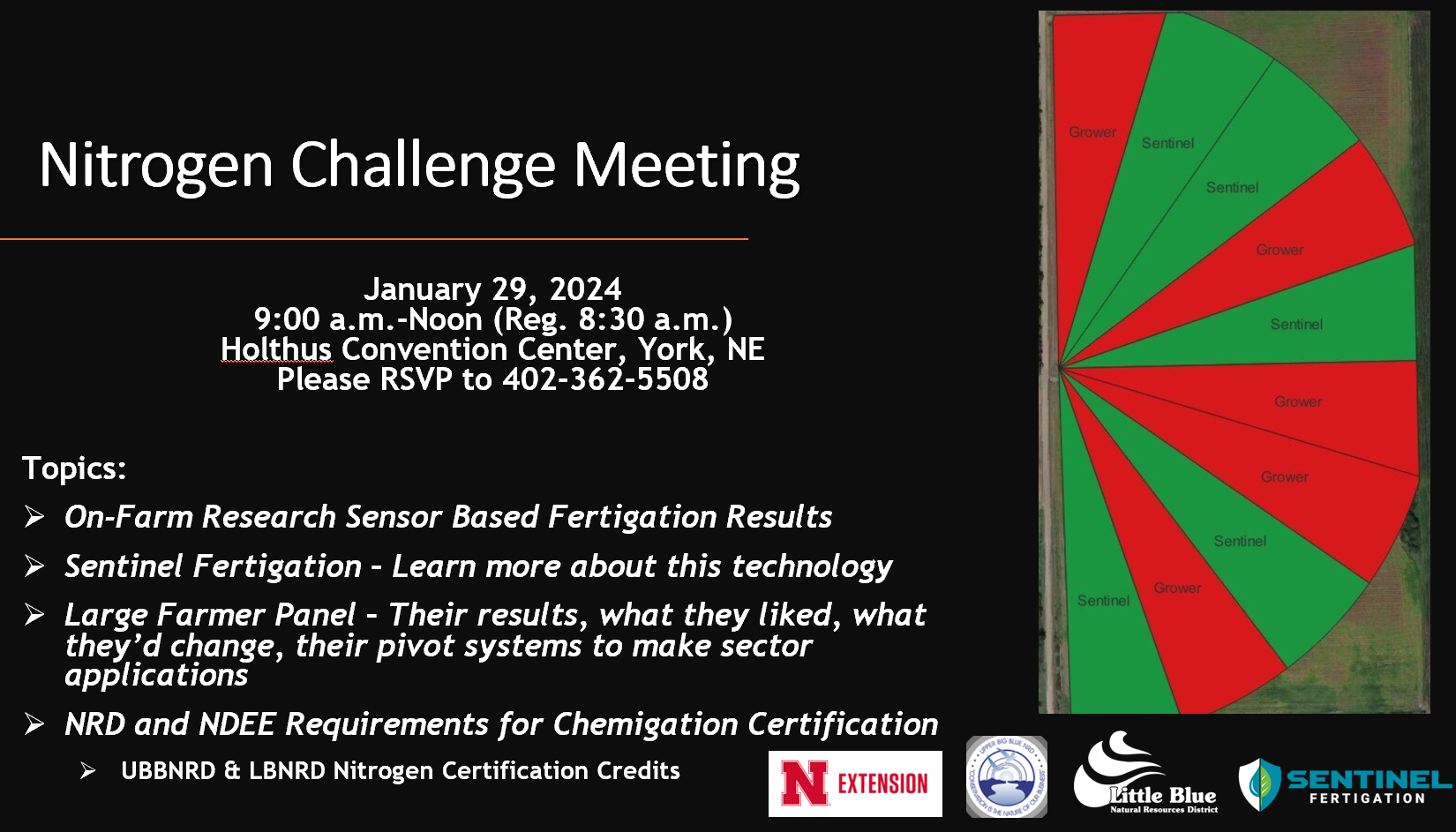
Nitrogen Challenge Meeting Jan. 29th: Reminder of my nitrogen challenge meeting at the Holthus Convention Center in York from 9 a.m.-Noon on January 29th. This training does qualify for nitrogen certification training requirements from the NRD. You can walk in that day but RSVP is helpful for planning purposes to me or 402-362-5508.

Cattle and Cold Resources
Well that was quite a week to remember! Grateful for and maintained thoughts and prayers for all those clearing roads, in law enforcement, firefighters, emergency management, first responders, and livestock producers. Thank you for all you do!
Crop Production Clinics: Quick reminder of Crop Production Clinics this week in Hastings (Jan. 17) and York (Jan. 19). RSVP at https://agronomy.unl.edu/cpc is very helpful as we’re trying to make food and room arrangement decisions. Also, RSVP has been extremely helpful to me this winter already as it’s allowed me to contact attendees and let them know of program info. with all the weather we’ve had this winter. So, please do RSVP to the local Extension Office for the programs you wish to attend. Thanks!
Farm Bill Meeting will be held February 6th at the Cornerstone Event Center at the Fairgrounds in York from 9 a.m.-Noon. Dr. Brad Lubben with UNL and representatives from the Farm Service Agency will be presenting. RSVP to 402-362-5508 if interested in attending.
Livestock and Cold Resources can be found here: https://beef.unl.edu/cow-management-and-cold-weather. The following is a Q/A from the resources written by Dr. Rick Rasby, UNL Beef Extension Specialist.
“Q. How do a cow’s energy requirements change with cold weather? How much more feed does she need?
A. Moisture, high winds, and cold temperatures all increase the cow’s energy requirements. Cows in an optimal body condition score (BCS 5 to 6) are better able to withstand adverse environmental conditions than thin cows. The lower critical temperature of a beef cow is the lowest temperature a cow can be exposed to before she needs to have changes metabolically to help her cope with cold stress.
Lower critical temperature for beef cows is influenced by hair coat condition (dry or wet/muddy), body condition (thin, moderate, fleshy) and hair coat description heavy/winter, winter, fall, or summer. As hair coat changes from summer to winter, BCS changes from thin to fleshy, and hair coat changes from dry to wet, lower critical temperature decreases which means cows can withstand harsher conditions without an increase in energy needs. Magnitude of coldness is equal to Lower Critical Temperature – Wind Chill Index. Energy requirement increase about 1% for each degree of cold stress. As an example, cows that have a heavy winter hair coat that is dry and are in condition score of 5 have a lower critical temperature of 19°F.
Be very careful if you plan to use grains (corn) to increase the energy density of the diet during severe condition as you may do more harm than good. Feeding more than 2-3 lb/hd/day of corn to cows on a forage based diet will decrease fiber digestion. When cows are on a forage-based diet and supplemental energy is needed, consider the use of high energy, non-starch feed stuffs such as distillers grains and soy hulls to meet cow energy requirements. It would not be advisable to change rations daily, but if is predicted that weather conditions will be severe over a period of time then ration changes may be warranted.
A webinar titled Caring for Cattle in Cold Weather highlights the effects of cold weather on cattle and management practices to help mitigate these effects.”
Jan. 15th Pesticide Trainings are on!
-9:00 a.m. Extension Office in Seward.
-2:00 p.m. *NEW LOCATION* Extension Office in Geneva. Please let others know as fairgrounds are not cleared out.
Jan. 16th Pesticide Trainings:
-9:00 a.m. in Clay Center *NEW LOCATION* Community Bldg. (219 W. Fairfield Ave.)
-2:00 p.m. in Nelson at Auditorium
Be safe and many other options for training available in the area! https://jenreesources.com/upcoming-events/
Nitrogen Challenge Meeting
Nitrogen Challenge Meeting Jan. 29: In November I issued a nitrogen challenge. The full article can be found here: https://jenreesources.com/2023/11/12/my-nitrogen-challenge/. My goal is to have an increasing number of producers use sensing technologies such as this that have been research-proven to help with nitrogen management.
Ultimately my challenge was to everyone with irrigated ground who applies fall anhydrous or spring pre-plant fertilizer:
- Leave 1 piece of ground with a base rate of 70-100 lb N/ac
- Goal is to apply the rest of N in season using a tool like Sentinel Fertigation that senses what the plant needs. I will share 2023 research results from area producers this winter. If you decide you don’t wish to try a tool like Sentinel Fertigation, you can apply the rest of N the way you’d like.
- Only asking to consider for 1 field. Are you willing to join me in this?
On January 29th, I’ll be having a Nitrogen Challenge Meeting. It will be from 9 a.m.-Noon at the Holthus Convention Center in York. As promised, on-farm research results from sensor-based fertigation will be shared in addition to learning more about Sentinel Fertigation as a tool for nitrogen management. I also wanted you to hear directly from the area farmers who have used this tool the past few years. Some of the farmers have used this technology in on-farm research fields and some just tried it on fields. In fact, a few of the top 6 National Corn Yield Contest winners who applied 180 lb N/ac or less used Sentinel Fertigation in 2023. A larger farmer panel will share what they liked, what they’d change, and their pivot setup for managing sectors (as there’s different ways of managing this for individual pivots). Information will also be shared about chemigation requirements.
There is no charge for this meeting and the UBBNRD and LBNRD are providing nitrogen certification credits for those who attend this meeting. Please RSVP to 402-362-5508 so we know how to plan if you’re interested in attending. I’m truly hoping to see many producers interested in learning more and joining me in this challenge!
Three State Beef Conference: Re-evaluating today’s management practices for future success: On Jan. 18th in Syracuse, NE from 6-9 p.m. (Registration at 5:30 p.m.), learn more about re-evaluating management of corn residue grazing, development of heifers and management of young cows to help ensure success. Location: Fair Center building, Otoe County fairgrounds, 135 Plum St, Syracuse, Nebraska
Topics include: Corn residue grazing: current recommendations and adjustments based on new data, Dr. Mary Drewnoski, beef systems specialist, University of Nebraska; Developing heifers for the future, Dr. Kiernan Brandt, professional services technician, Trans Ova Genetics; and Managing young cows for longevity and profitability, Dr. Thiago Martins, asst. professor, beef reproduction extension & research, University of Missouri.
Pre-registrations are appreciated for planning purposes. The registration fee is $30 per person which includes a meal and a copy of the conference proceedings. RSVP to: Connor Biehler, Extension Educator, 402-624-8007, cbiehler2@unl.edu.
Also: Reminders of meetings that begin this week including Cow-Calf College, some Crop Production Clinics, and pesticide trainings.


 JenResources