Monthly Archives: April 2024
Smaller Trees for Landscapes
What a blessing to receive rain!!! Also a blessing for all the acres planted the past week in good conditions!
Crabgrass Preventer timing: Crabgrass germinates when soil temperatures are maintained at 55F for 5-7 consecutive days. As I write this, soil temps for the York area have averaged 55F for the past week. So, it would be a good idea apply crabgrass preventer soon. You can consider splitting your crabgrass herbicide application by applying half of the highest labeled rate now and the other half 6-8 weeks later. Often there’s a flush of crabgrass later in the season and splitting the application can help with that.
Paraquat Training Webinars for anyone who needs certification or re-certification for Paraquat Handling. Paraquat Training Webinar Registration 2024 (https://syngenta.zoom.us/webinar/register/WN_D4RPlS2_RAyWTDJ_tBtv3A#/registration). The registration link will require: first and last name, email address, and certification license #. There is a mandatory quiz at the end of the webinar that will be conducted thru zoom, so attendees have to attend the entire webinar and take the quiz. Webinar dates: April 30th from 1-2 p.m. and May 1 from 2-3 p.m.
Smaller Trees for Landscapes: Last Friday was Arbor Day and Kelly Feehan, Extension horticulture educator, shared information on smaller trees to consider for landscapes. “Following are suggestions for smaller trees for Nebraska. These are hardy trees under 30 feet tall that are aesthetically pleasing for more than one season. Be careful of selecting trees with one good characteristic, like leaf color, but have nuisance characteristic like root suckering such as Canada red or Schubert chokecherry and Quaking aspen.
A small ornamental tree we need more of is Serviceberry (Amelanchier sp). Trees range from 15 to 25 feet tall and are native or regionally native depending on the species. They have white April blooms, making them a replacement for overplanted ornamental pear. Edible fruit produced in June attracts songbirds who devour all the fruit. Most have orangish fall color like the cultivar “Autumn Brilliance”.
Hardy northern sources of Eastern redbud (Cercis canadensis) are good to plant. With purplish pink blooms in April, they stand out each spring. They are native and prefer part shade, especially afternoon shade in hot Nebraska. ‘Alba’ and ‘Royal White’ are white booming cultivars.
Ironwood or American Hophornbeam (Ostrya virginiana) is a tough, durable tree. It tolerates alkaline soil and dry sites. Another native, it typically grows 25 to 30 feet tall and has interesting fruit and bark. The bark is flaky and the fruit, resembling clusters of hops, appear in July or August.
Hawthorns are also tough trees but many have thorns. Thornless cockspur Hawthorn (Crataegus cusgalli var. inermis) is a good choice. These 15 to 25 foot tall tree has glossy green leaves, white spring flowers, and persisting red fruit. When fruit persists into winter, they add winter interest and provide food for wildlife. Hawthorns tolerates alkaline soils and dry or wet sites.
Japanese tree lilac (Syringa reticulata) is a tree form of lilac growing up to 20 to 30 feet. They bloom in June with white, fragrant flowers and are proving to be tolerant of clay soils and urban conditions. Peking tree lilac is a subspecies. The cultivar ‘Copper Curls’ has exfoliating coppery bark and trees are growing in the Blair NE arboretum and at the North Platte research station.
Corneliancherry dogwood (Cornus mas) is hardier than flowering dogwood (Cornus florida) and has yellow flowers in April. It grows to 15 to 25 feet and has sour but edible fruit for use in jams and jellies. Kousa dogwood (Cornus kousa) has interesting white flowers in May and red fall color. It needs uniform moisture or leaves can scorch causing the edges to turn brown.
Fringetree (Chionanthus virginicus) ranges in height from 12 to 20 feet. It has very interesting white flowers that resemble fringes and bloom in May. They are fragrant and followed by bluish fruit to attract songbirds. With yellow fall color and good adaptability to urban sites, it’s worth trying.
A smaller maple to use is Shantung maple (Acer truncatum). The leaves resemble Japanese maple leaves, but this maple is hardier. It has orangish yellow fall color and reaches 20 to 25 feet tall. It is listed as having good drought and heat tolerance once established.”

I took a picture of this so here is a clickable link to register for the webinars: https://go.unl.edu/annualforagewebinar.
JenREES 4/19/24
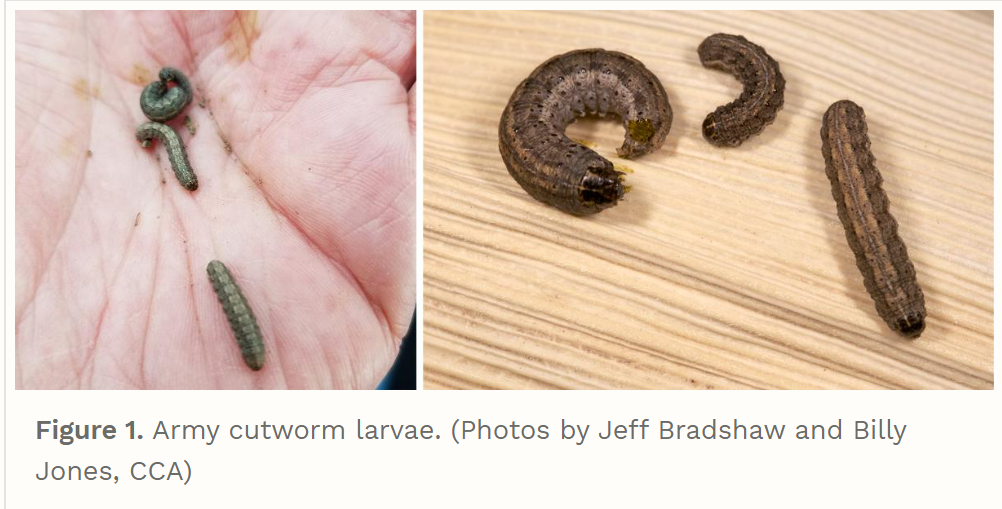
Army cutworms have been found in some wheat and alfalfa fields. I honestly haven’t looked at pastures but have gotten several calls about pastures this week, so perhaps be looking at them as well. The threshold is four or more cutworm larvae per square foot of winter wheat or alfalfa. A lower threshold is necessary for stands that are new or had some winterkill/drought-stressed. Damage looks like chewing on the leaves stems to complete stand reduction. Army cutworm larvae are greenish-brown to greenish-grey caterpillars, approximately ½ to two inches in length. They feed at night so you may have to look under residue or dirt clods to see them in the day.
Nitrogen Fertilizer Trends in Nebraska from 1955-2023: Dr.’s Richard Ferguson, Bijesh Maharjan, and Javed Iqbal wrote a nice updated article on nitrogen fertilizer trends for CropWatch this week. I pulled out a few excepts here, but please also check out the full article with the graphs and figures here: https://go.unl.edu/ki69.
“As farmers embark on another growing season in Nebraska, most will be applying some form of nitrogen fertilizer to optimize crop production. … Initially, ammonium nitrate, mostly sold in bags, and anhydrous ammonia were the dominant fertilizer sources. Nitrogen fertilizer use grew steadily from 1955 into the 1970s as fertilizers became more available and farmers saw the benefit for crop production. During this period, urea and urea ammonium nitrate solutions became more available and their use grew. Anhydrous ammonia dominated fertilizer sales during this period, peaking in 1968 with over 75% of total N sold as anhydrous ammonia.
Use of urea ammonium nitrate (UAN) solution (both 28% and 32% N) began to take off in the 1980s, and today is the most dominant form of nitrogen fertilizer used in Nebraska. In 2022, 57% of all N consumed in Nebraska came from UAN solutions, while 23% came from anhydrous ammonia, and about 14% from urea.
Total nitrogen used in Nebraska began to plateau around 1980 until about 2010. Since then, trends for increasing total N use have been observed. This trend generally coincides with an increase in land area from which corn is harvested. Approximately 8.85 million acres of corn were harvested in Nebraska in 2010, while 9.5 million acres of corn were harvested in 2023.

Figure 4 shows a very positive overall trend, with fertilizer N use of around 1.6 to 1.7 pounds fertilizer N per bushel of corn in 1965, to around 0.8- to 0.9-pound fertilizer N per bushel of corn in 2022. This positive trend illustrates that Nebraska farmers have become much more efficient through the years in managing nitrogen fertilizer.
There are many factors influencing this trend, including genetics advances and overall improvement in production practices. However, it’s likely that a major factor in this trend has been growing awareness of the risk of environmental degradation from excessive nitrogen application, influenced by many educational programs conducted by the University of Nebraska-Lincoln and natural resources districts. This trend is also influenced by requirements in some groundwater management areas for producers to follow nitrogen and irrigation best management practices.
While the general trend for the past 60 years is positive, Figure 4 also shows very little change recently in fertilizer nitrogen use efficiency: it has remained around 0.8- to 0.9-pound fertilizer N/bu since 2000 (circled data points). This data also does not illustrate variations in efficiency that occur in regions across the state. This lack of recent improvement suggests that current widely used practices may have reached their limit in terms of nitrogen use efficiency, and adoption of other tools, such as in-season application and sensor-based fertigation, may be required to further increase nitrogen use efficiency.”
I took a picture of this so here is a clickable link to register for the webinars: https://go.unl.edu/annualforagewebinar
Planting Considerations
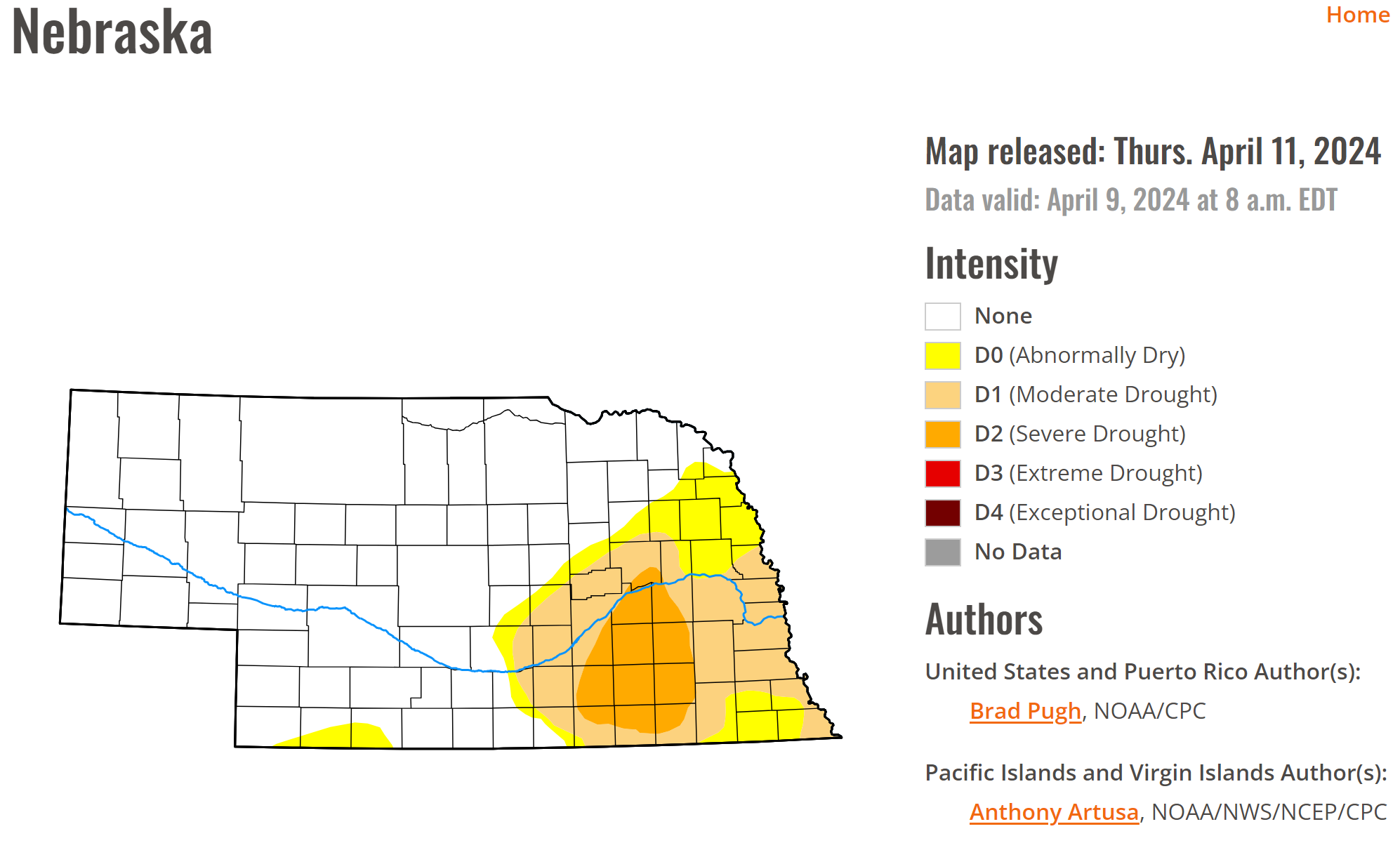
Planting Considerations: The warmer air and warming trend of soil temperatures have allowed for planting to begin last week for some. This week hopefully brings some moisture. It also looks like a cooling trend will occur the mid-half of the week with frost potential by the weekend.
Agronomically we’ve come a long way with genetics and seed treatments. Because of this, some don’t worry about soil temps. Yet every year I think most agronomists would say we can trace various problems back to a specific planting date(s) or planting window. So, I still feel they’re an important consideration.
We often hear a preference of planting corn and soybeans in as close to 50F or greater soil temperatures as possible. Below 50F, I prefer to see corn planted on a warming trend of 5-7 days like what we saw last week. The consideration is for soil temps in the mid-40’s on a warming trend with no chance of a cold snap (cold rain/snow) within 8-24 hours for soybean and 48 hours for corn. The time-frame is due to the imbibition (critical water uptake) time-frame for corn and soybean. Soybean seed uptakes water more rapidly than corn and once the imbibition phase is complete, the soybean going through the osmotic phase can tolerate 35-40F soil temps as long as soil is not saturated. Soil temps for your field can be monitored by using a thermometer or checking out CropWatch soil temps at: https://cropwatch.unl.edu/soiltemperature.
Besides soil temperatures, another part of the soil being fit for planting include the soil not being too wet to create sidewall compaction and getting the seed vee closed. I think the greater thing some will deal with is making sure there’s moisture where the seed is placed. I recommend putting corn and soybeans in the ground at 2”. That may seem deep for beans but our UNL research found 1.75” seeding depth provided the highest yield for soybean. It also provides buffered soil moisture and temperature conditions when planting soybeans early. Bob Nielsen, emeritus professor at Purdue said corn can be seeded 2.5-3” deep if that’s where uniform soil moisture is located in order to achieve uniform germination and emergence. We don’t recommend planting soybean deeper than 2.5”.
For corn seeding rates, it’s best to check with your local seed dealer as all our research shows that optimal corn population varies by hybrid. However for soybean, our recommendation after 17 years of on-farm research studies (2006-2023) in heavier textured soils and 30″ rows continues to be: plant 120,000 seeds/acre, aim for a final plant stand of 100,000 plants/acre and you’ll save money without reducing yields. If that seems too risky, try reducing your rate to 140,000 seeds/acre or try testing it for yourself via on-farm research!
One final thought, make sure you’re keeping yourself and those in your operation safe by wearing proper PPE when handling treated seed, including filling boxes, when seed gets plugged, or when digging up seed. Seed tag labels will list PPE required for the seed treatments in case you weren’t aware of this. Here’s wishing you all the best whenever the planting season begins for your farm!
Alfalfa Weevils and Army Cutworms have been showing up in some alfalfa fields and it would be good to check wheat and other small grain fields for army cutworms. The last time we saw alfalfa weevils this early was back in 2012. Larvae are green with a dark head and white stripe down the back. They can often be found near the soil during the day. Use a sweep net if possible to detect their presence, and if they are present, randomly select at least five sampling sites from across the entire field. At each site, gently pick or cut at least 10 alfalfa stems at ground level. Shake the larvae off the stems by beating the stems into a deep-sided bucket, also looking for any larvae in folded leaflet tips. Count the larvae and determine the average number of larvae per stem. Economic threshold for the mid-vegetative stages of 10-15” tall are 1.5-2 alfalfa weevils/stem (chart can be found at: https://go.unl.edu/pxhk). Highly effective insecticides for alfalfa weevil control include those that are pyrethroids (active ingredient ends in “thrin”, such as Permethrin) and products containing indoxacarb (e.g., Steward). If you spray prior to harvest, check pre-harvest interval (often 7-14 days).


 JenResources