Monthly Archives: July 2024
August 2024 Events
It’s fair time!!! Hope to see you at the York County Fair this week from Aug. 1-4 and the Seward County Fair next week Aug. 8-11.
For field updates, southern rust was found in a number of counties last week at low incidence. I’m able to find it a low levels in every field I walk into right now but incidence is so low that I still haven’t been recommending to spray. We’ve been seeing southern in lower portions of canopies in fields that have already been sprayed because the product didn’t penetrate that deep into the canopy. The updated map is at: https://corn.ipmpipe.org/southerncornrust/. Depending on when you read this, Seward does need to be filled in because we have confirmed it in Seward Co. too.
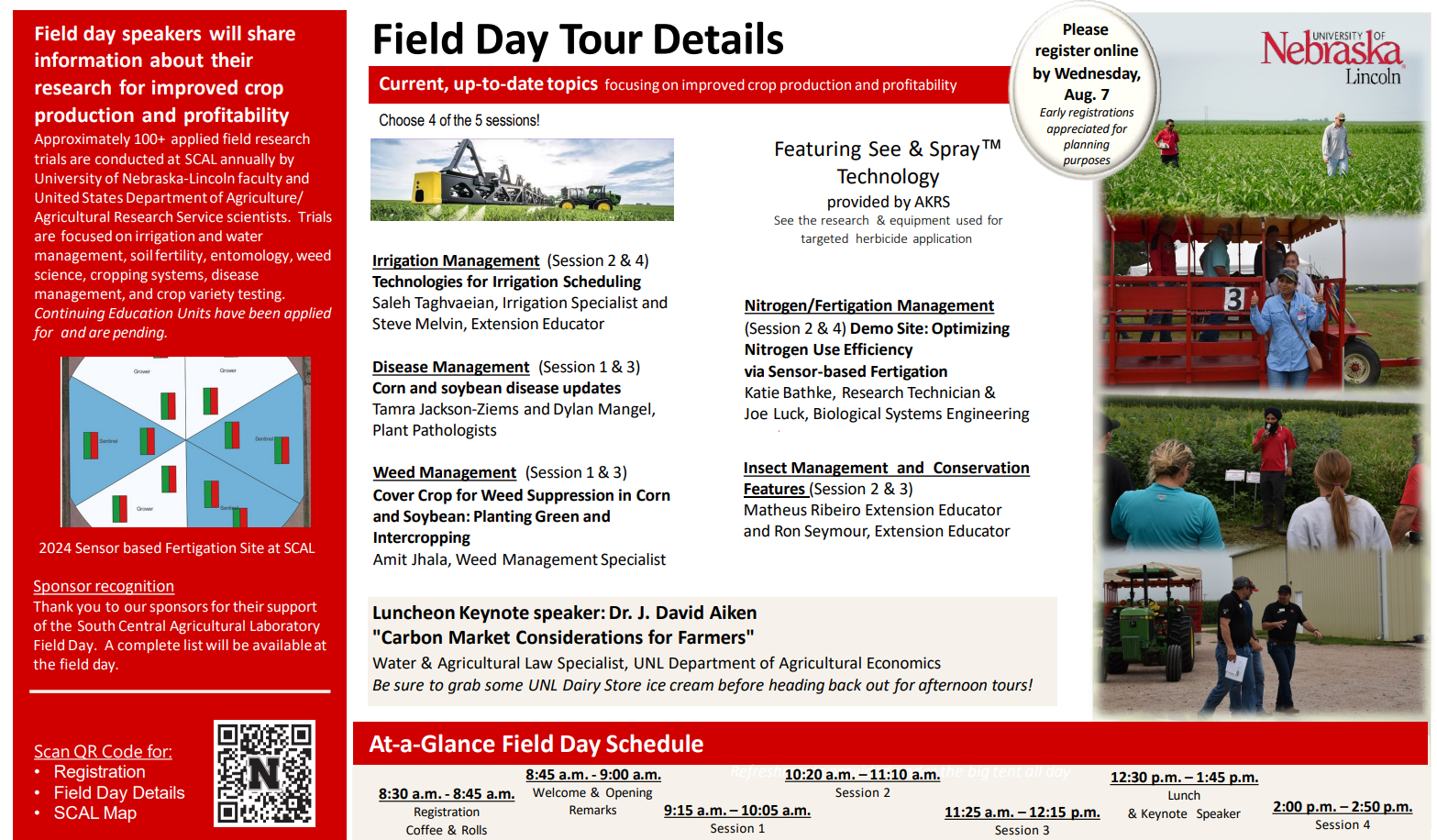
South Central Ag Lab (SCAL) Field Days on Aug. 8th near Harvard will begin with registration at 8:30 a.m. and the program at 8:45 a.m. Tours can be selected depending on what the attendees are most interested in. A special demonstration will provide the opportunity to see real-time, camera-based weed detection technology with the John Deere See and Spray. Topics and presenters include: Irrigation Management Technologies with Saleh Taghvaeian and Steve Melvin; Corn and Soy Disease Management with Tamra Jackson-Ziems and Dylan Mangel; Weed Management focused on Planting Green and Intercropping by Amit Jhala; Nitrogen/Fertigation Management with Katie Bathke and Joe Luck; and Insect Management and conservation features with Matheus Ribeiro and Ron Seymour. The lunch keynote speaker will be Dr. J. David Aiken, water and agricultural law specialist, sharing on “Carbon Market Considerations for Farmers”. SCAL is located at 851 Hwy. 6, near Harvard. There is no cost and RSVP is requested for planning purposes to (402) 762-3536 or https://go.unl.edu/scalfieldday. CCA credits are pending.
Soil Health Field Day will be held Aug. 8th at the 4-H Building in York from 10 a.m.-2 p.m. (Reg. at 9:30 a.m.). Topics include: Making winter wheat a success by Nathan Mueller; Soil health and summer annual cover crops by Katja Koehler-Cole; Protecting your bottom line with resilient cropping systems by Nick Arneson; Cover crop options that help game birds by Nate Pflueger; What we’ve learned so far about compost extracts by Jenny Rees; followed by a cover crop field site visit. 2.5 soil/water CEUs are available. No charge but please RSVP to 402-646-5426 for meal count.
Soybean Management Field Days are following a different format this year. The local field site for our area will be at Scott Richert’s field in the Ulysses/Gresham area on Aug. 15th from 6-8 p.m. (reg. at 5:30 p.m.). Scott planted soybeans green into rye and then roller crimped the rye after soybean emergence. This practice has aided in reducing palmer and white mold in his fields. This location will feature his on-farm research seed treatment study where he’s comparing the seed company’s full seed treatment vs. his biological seed treatment vs. an inoculated treatment vs. untreated check. I’m really looking forward to this format of showcasing the farmers and their research and topics of relevance to our local area. Other evening locations include Holdrege on Aug. 13 and Neligh on Aug. 14. Another option will be Aug. 16 at ENREEC near Mead with program from 10:30 a.m.-2 p.m. (Reg. 10 a.m.). That location will focus more on the TAPS soybean plots, Ag Olympics, and soybean gall midge research plot tours. There’s no charge thanks to sponsorship by the Nebraska Soybean Board, but please RSVP for planning purposes to 402-624-8030 or https://enreec.unl.edu/soydays.



Peer Groups
This past week I attended the National Association of County Agricultural Agents meeting in Dallas, TX. It’s a joy to see my ag educator/agent friends serving people through the U.S. and its territories, to talk through local issues, learn from and encourage each other. Extension is truly like a big family, both within Nebraska, and outside of it, and I’m grateful for that and for peer groups in my life over time. Even though I took care of clientele during my time away, it’s also nice to physically get away at times to reset.
A highlight of these meetings is a tour of local ag for that State. My tour was on cotton production including touring a cotton gin. Others of you probably know this, but I didn’t realize the cotton flowers were so beautiful! They begin white when they bloom. Once they pollinate, they turn pink, then turn into the boll which eventually form burs around it. Cotton is either stripped with a stripper header like some harvest wheat (which essentially leaves the stalk standing), or it is harvested by picking where only the bolls are removed. Most of the farmers in this area of Texas use stripper headers. Some fun facts: a cotton boll has 4 compartments, each with 7 seeds in it. Each bale of cotton removed from a field goes through the gin individually. It comes in at about 10-12% moisture and is dried to 6-7% to allow for easier cleaning. The cottonseed, burrs, sticks, etc. are removed from it and the cleaned cotton is baled and bagged with a sticker tracing that bale back to the original field. The grower is paid for the cleaned cotton and the cottonseed (and often more money is made from the cottonseed than the cotton). The rotation in the area I toured was corn/cotton.
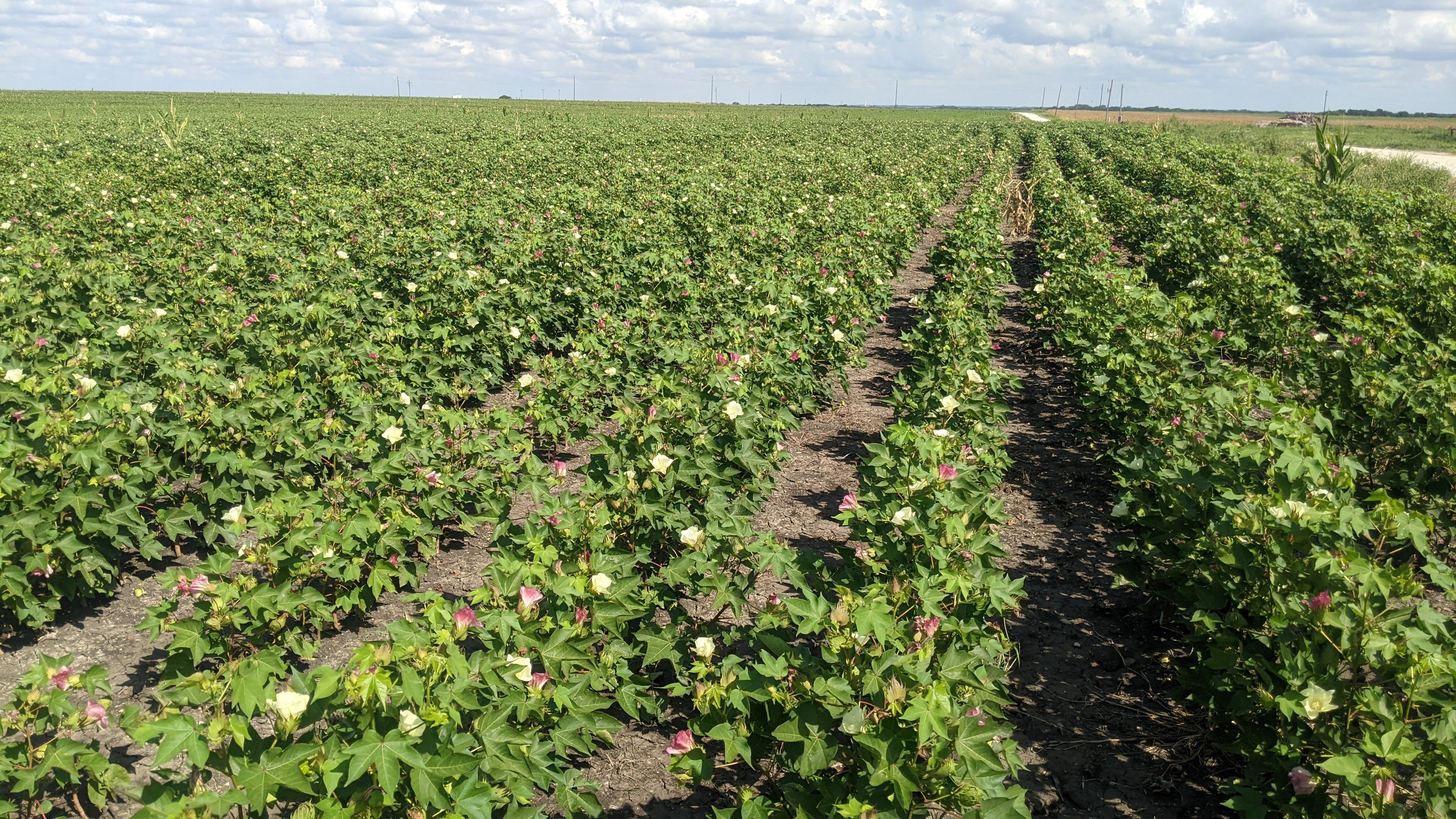


(Captions for photos above: Cotton field (top left); Several flower and boll stages in this pic (top right); First flowers are this beautiful white color but don’t smell (bottom left); How cotton comes into the gin compared to cleaned cotton (bottom middle); cottonseed compared to the remaining material removed from the cleaned cotton (bottom right).)

I also presented on the importance of peer groups. Participating in peer groups with like-minded individuals (regardless of one’s career or the topic) is a rewarding way to learn, encourage, and be more innovative. In 2020, in the midst of covid while serving a large area, one grower encouraged me to connect him to the growers I was telling him about who were like-minded in their thinking regarding regenerative agriculture. So, we started a small soil health support group with growers from three counties and myself, met via zoom at first, then did a late summer driving tour of farms. I’ve watched deep friendships develop, sharing of equipment across county lines, and supporting each other’s businesses including cover crop seed sales, biological product sales, seed treatment, and seed cleaning. These specific peer groups have grown to around 30 farmers in a few groups from 6 counties. The goals were connection of like-minded farmers who were humble and vulnerable in sharing successes and failures, openminded in trying new things, and ultimately that collectively we could “fail forward faster” in finding meaningful solutions to reducing chemical and nutrient inputs.
Because the growers wanted to obtain data around some of their efforts, since 2020, they’ve completed 19 Nebraska On-Farm Research Studies in the regenerative ag space. And because farmers like to hear from other farmers, they have shared on these studies at 13 Ag Industry and Extension meetings thus far. In ag, it’s so easy to isolate and feel alone. Perhaps many careers are this way? Would encourage anyone to consider joining or creating a peer group with like-minded individuals if you’re not already in one.
On-Farm Research: I’m so grateful for all the farmers who have/continue to work with me/my peers via on-farm research to collect meaningful data that benefits all of us! The Nebraska Soybean Board followed a few of our farmers with on-farm research efforts last harvest season and had the following short video created that highlights the importance of on-farm research if you’d like to know more: https://youtu.be/XUyouEjYgIU?si=KIVfrXrDR9pSuN_D.

July 2024 Crop Update
The past 10 days, my top questions have been around fungicide recommendations, control of Japanese beetles, and hail damage. I feel there’s an increasing segment of agronomy that is focused on preventing pests based on fear. I’m grateful for those agronomists who only recommend products when warranted by scouting.
Some thoughts, although not popular, for consideration. Fungicide for white mold in soybean is pricey. If the field didn’t have a history of white mold, I wouldn’t recommend applying a fungicide for white mold. For seed corn fields without a history of white mold, I’d wait to see if white mold develops. If too fearful, would only apply one application at R2. Only fields with a history of white mold would I be considering preventive fungicide applications. And in those fields, if the beans had been planted green into a small grain and/or if a biological product with activity against white mold was used, would suggest scouting and applying only if white mold was present. Fungicide efficacy ratings: https://cropprotectionnetwork.s3.amazonaws.com/soybean-foliar-efficacy-2024.pdf.
Hail: Looked at quite a bit of hail damage in Clay/Fillmore counties last week. Always so hard to see beautiful crops impacted or destroyed. Some hail resources for you: late vegetative/tasseling in corn: https://go.unl.edu/y3of, Soybean decisions: https://go.unl.edu/z7ad; and hail damage info. on my blog at https://jenreesources.com.
Corn Diseases: There’s very little I’ve seen in fields. Bacterial leaf spot (BLS) is common on hybrids and can be confused with gray leaf spot. BLS has longer, thinner lesions with wavy lines when looking at the lesions closely. I’ve seen quite a bit of Goss’ wilt, as early as V8. There’s nothing we can do for either BLS or Goss’s as bacterial diseases, but it’s good to be aware they’re occurring.
Tar spot has been found in Richardson, Nemaha, Saunders, Dodge, Colfax counties but not in our area. Southern rust has been found in northeast Kansas. I still recommend waiting on fungicide applications until we need them. Research found that products applied between tasseling and milk when tar spot was present in low amounts (5%) was effective in controlling tar spot most years. So, waiting could be wise with tight economics, particularly if tar spot, gray leaf spot, and southern rust come in later.
Japanese Beetles in crop fields: Usually the beetles congregate in areas in the field and not whole fields. So even at a 20% defoliation in soybeans during reproductive stages, it’s been hard to pull triggers for spraying because it’s not field-wide defoliation (and we’ve seen soybeans recover in the past). For corn, the threshold is 3 beetles per ear with silks clipped less than ½” and 50% or less of the field is pollinated. A challenge with Japanese beetles is that we have another potentially 4-6 weeks of emergence from grassy areas. So, one can spray an insecticide, but it’s not uncommon to see the beetles damaging fields again once the residual wears off. Spidermites can also be flared upon insecticide applications. Some consider a border app since they begin feeding in the borders. So, those are all things to consider.
Sevin and Japanese Beetles: For homeowners, PLEASE read the pesticide labels before applying products (even if you’ve used that same product in the past). I do mention Sevin as a product that can be applied in different situations in this guide: https://go.unl.edu/xgd6, but not all Sevin formulations are the same; thus, not all the same plants are labeled! We’ve unfortunately seen some plants injured to the point of death in the past. So please, double check that the plant is labeled before applying an insecticide product to control the beetles.

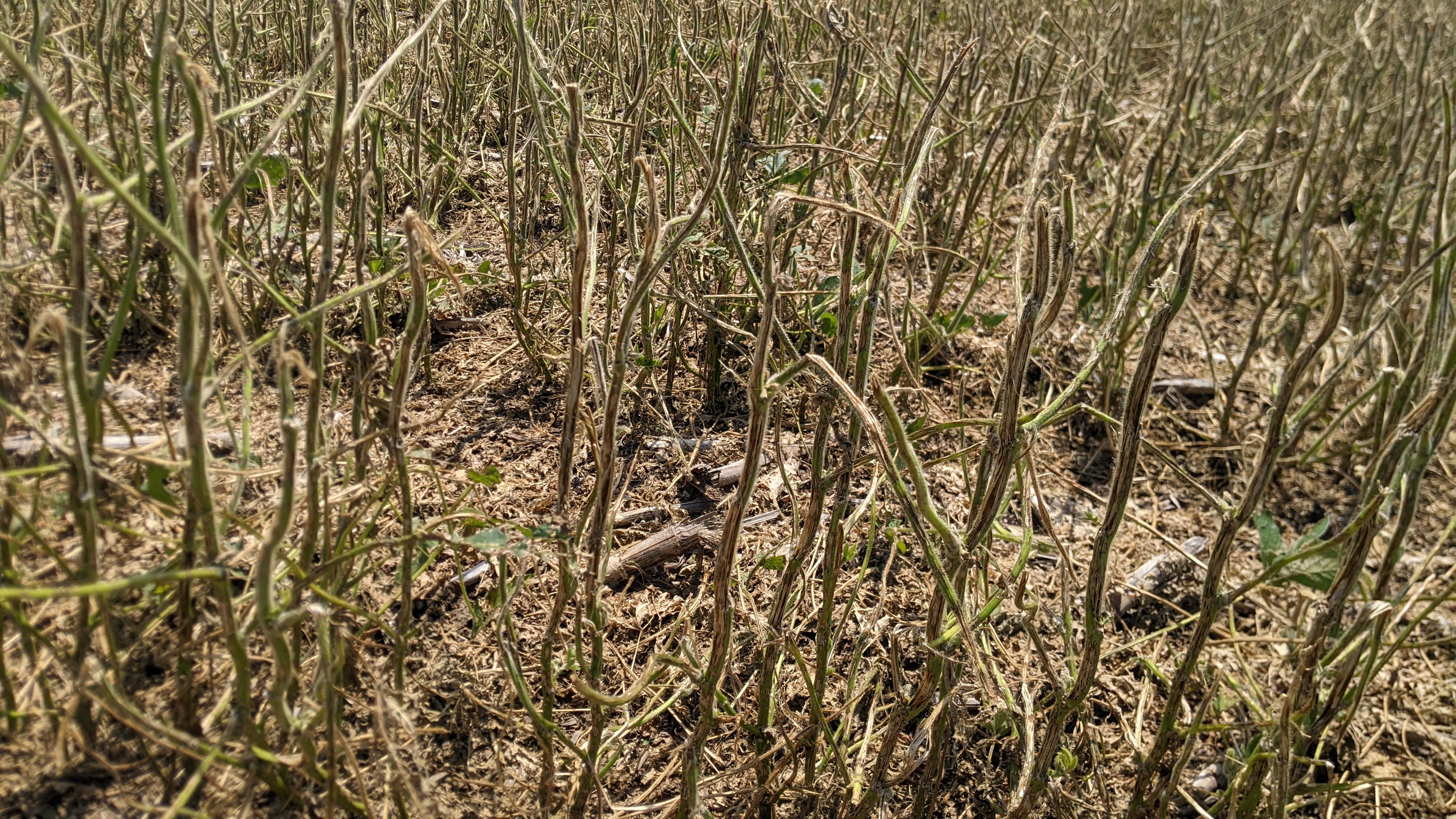


For soybean damage, the situations with pictures shown here (other than the top right) will recover. These fields are already showing new growth in axillary buds including new leaves and flowers. While some canopy was lost, they will look a lot better in 7-10 days. Look for areas of the field (lower right picture) that were protected such as by trees and/or pivot tires, to determine the original development stage when the soybeans were damaged. In the case of the upper right photo, those beans were planted the week of April 10th and were already at a strong R4 to beginning R5. By R5, soybeans will not recover because all new node, leaf, and pod development ceases. If considering to replant any beans, there’s risk of using later than a 2.5 maturity variety with a July 15th planting date in reaching maturity before a frost. By July 20th, aiming for closer to a 2.0 maturity is wise. Also, if you’re replanting into soybeans, we’ve found a fungicide seed treatment is wise as phytophthora root rot tends to be a problem in replant.
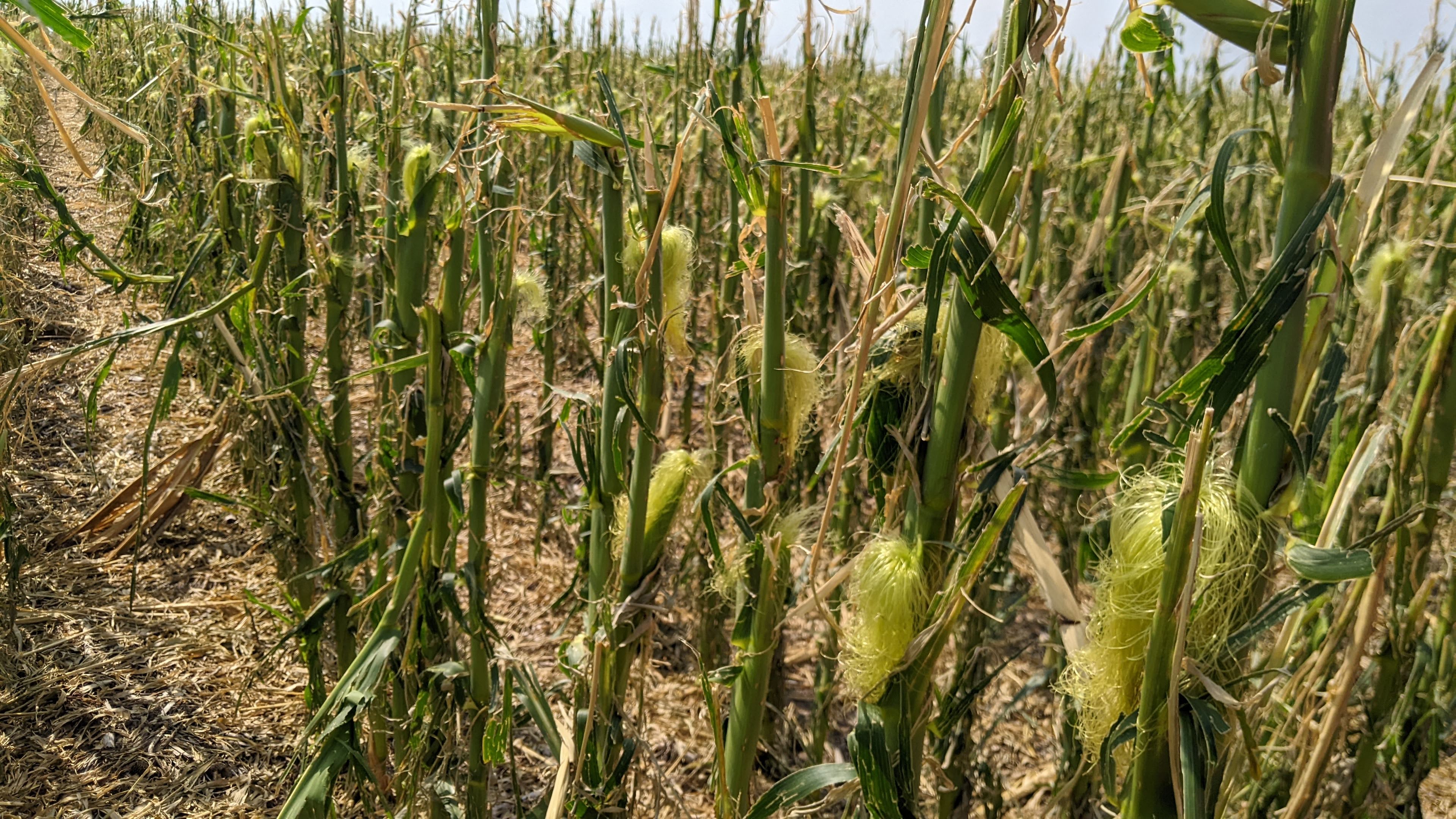




For corn, much of the corn I looked at has mostly leaf stripping and will be ok. There’s also bent/broken plants. Fields vary in the amount of stem bruising. When taking stand counts, I push a little hard on plants to see if they break off when I’m taking counts. A rule of thumb we’ve used in the past: every plant in 1/1000th of an acre we give 10 bu/ac to. So, a count of 12 plants has a potential of 120 bu/ac. That may seem crazy; it depends on how things pollinate, how damaged the ears are, final stand, etc. but it has been in the ballpark in enough cases for me to still use it as a guideline for making hail damage decisions.
In these photos, the fields were far more severely damaged. There’s fields like we saw in 2023 where 1/3 of the field or less still has tassels (top left and middle photos). We saw crop insurance delay that decision in the past to see how the ears would pollinate. I’m not sure what they will decide this year. I was seeing a few brown silks in some of these field situations, but it’s super early too. There’s also a large number of dead tassels in these fields (bottom right photo) that won’t provide any pollen. Tassels remaining tend to be wrapped in the newer leaves but as you see in bottom, middle photo, the tassel is trying to shed pollen inside the trapped leaves. Ears may be misshapen and damaged due to hailstones and/or being damaged and unable to emerge from sheaths (bottom left photo).
What we learned in the past is that palmer comes in quickly once the canopy opens. One can consider warrant with drops as a layby depending on how much Group 15 had been used in the field. Most chose not to go that option. Some seeded covers like brassicas/small grain into fields not totaled (flew on or haggie). Most let the palmer grow.
In the top right photo when fields were totaled, some allowed the weeds to grow and grazed with cattle or sheep. Some seeded a summer annual cover like sorghum sudan/sudangrass/pearl millet. In 2023, several crop producers chose pearl millet so they didn’t have to worry about prussic acid poisoning for those bringing in livestock or wanting to hay. Others just waited till later in the year, shredded down the stalks and planted in a small grain like oats or rye. The “blessing” with a decision in July is it can allow for more time to make a decision compared to if we were in June and the primary option was to replant. That perhaps was the biggest lesson I learned last year in working with producers. If you have specific questions or want to talk through decisions, please give me a call.
Also, it’s important to recognize that these disaster events create loss…in this case, loss of crops, pivots, bins, not only in irrigated acres but in a lot of non-irrigated acres that had more potential than most have seen in years, much less their lifetime. It’s ok to have a range of emotions surrounding this. And, it’s common to feel stressed, numb, and not want to make a quick decision. If I’ve learned one thing in my career, it’s the fact that as people, we all just need to talk about the stress and emotions we all face at times with someone we trust. My biggest piece of advice is to talk to someone just to get outside of one’s own head. There’s so much stress in life, not to mention in ag. The most common comment I’ve heard from people the past several years was they just appreciated being able to share with someone about the stress and what they were feeling. There’s also a number of mental wellness resources on the front page of CropWatch at https://cropwatch.unl.edu.
Resources:
- Summer annual forage grasses: https://extensionpubs.unl.edu/publication/g2183/2013/pdf/view/g2183-2013.pdf
- Making soybean replant decisions-what we learned: https://go.unl.edu/z7ad
- Corn damage to late vegetative/tasseling corn: https://go.unl.edu/y3of
More information and registration at: https://www.grazemastergroup.com/events.
JenREES 7/7/24
I’m grateful for the nice rains that we received and it’s also hard when crops get damaged by wind/hail/flooding. For those who received damage in surrounding counties, I’m willing to look at fields and help with decisions. We did share some additional information in this week’s CropWatch on hail during late vegetative/tasseling in corn: https://go.unl.edu/y3of and mid-season flooding: https://go.unl.edu/ua96 damage.
Tuesdays at 9 is Extension’s monthly climate outlook webinar. The next one is this Tuesday, July 9th at 9 a.m. Join Eric Hunt, agricultural meteorology and climate resilience extension educator on the second Tuesday of each month to hear insights on weather conditions across the state of Nebraska and Midwestern region, and updates on the long-range outlook. Participants will also have the opportunity to ask questions during the webinar, using the Q&A function in Zoom. Questions will be answered near the end of the webinar, as time permits. To register and view recorded webinars, please visit: https://cropwatch.unl.edu/second-tuesday-9.
4R’s Field Day will be held July 11th at the Eastern NE Research Education and Extension Center near Mead with program from 9 a.m.-3 p.m. (Registration at 8:30 a.m.). This event on 4Rs of Nutrient Stewardship features knowledge and tools to improve nutrient management, soil health, crop yields and water quality. Specific topics include discussions on the future of nitrogen management in Nebraska, Enhanced efficiency fertilizers, Updated UNL nitrogen recommendation tool, Can biological products serve as alternatives to chemical nitrogen fertilizers, farmer panel, and a drone fertilizer application demo. 4.5 CEUs on Nutrient Management are available. There is no charge for this event but RSVP is requested for meal count to: https://go.unl.edu/7gjw.
GrazeMaster Field Day will be held Wednesday, July 24th near Denton, NE. The day will begin at Brian Brhel’s farm (481 140th Denton, NE) with registration from 8-9 a.m. and the field day beginning at 9 a.m. Brhel is a farmer and cattle producer implementing cover crops, unique crop rotations, and regenerative grazing. Also presenting will be Zack Smith with his invention – the Stock Cropper, “Stock cropping is a regenerative agricultural system that raises row crops in conjunction with multiple species of livestock simultaneously in the field.” From there the day will continue at the Denton Community Center in Denton with lunch. Afternoon speakers/topics include Rosalie Hillmer of Hillmer Feed & Supply; Vance McCoy of Triple Creek Cover Crops sharing on the importance of a mindset shift being one of the most important aspects of changing one’s farm/ranch in addition to the positives and challenges when improving soil health; Nick Ward of Ward Labs; Farm Legacy Planning; a Profitability panel; and the Lutheran Institute of Regen Ag. There is no charge but RSVP is requested for lunch. More information and registration at: https://www.grazemastergroup.com/events.
ProHort Lawn & Landscape Lunch & Learn will be July 16, August 20, and September 17 from 12-1 p.m. These noon webinars are an informal opportunity for those who serve people in the lawn and landscaping profession to share what’s happening in landscapes, management recommendations and helpful resources. Be ready to share questions or problems you are currently finding in client landscapes. No charge and open to all green industry professionals. Register at: https://unl.zoom.us/meeting/register/tJAscO-ppjgoHNVgh4_StJFZfeM8_d2Lq5aY#/registration
Japanese Beetle Management Resource: https://go.unl.edu/xgd6.


 JenResources