July 2024 Crop Update
The past 10 days, my top questions have been around fungicide recommendations, control of Japanese beetles, and hail damage. I feel there’s an increasing segment of agronomy that is focused on preventing pests based on fear. I’m grateful for those agronomists who only recommend products when warranted by scouting.
Some thoughts, although not popular, for consideration. Fungicide for white mold in soybean is pricey. If the field didn’t have a history of white mold, I wouldn’t recommend applying a fungicide for white mold. For seed corn fields without a history of white mold, I’d wait to see if white mold develops. If too fearful, would only apply one application at R2. Only fields with a history of white mold would I be considering preventive fungicide applications. And in those fields, if the beans had been planted green into a small grain and/or if a biological product with activity against white mold was used, would suggest scouting and applying only if white mold was present. Fungicide efficacy ratings: https://cropprotectionnetwork.s3.amazonaws.com/soybean-foliar-efficacy-2024.pdf.
Hail: Looked at quite a bit of hail damage in Clay/Fillmore counties last week. Always so hard to see beautiful crops impacted or destroyed. Some hail resources for you: late vegetative/tasseling in corn: https://go.unl.edu/y3of, Soybean decisions: https://go.unl.edu/z7ad; and hail damage info. on my blog at https://jenreesources.com.
Corn Diseases: There’s very little I’ve seen in fields. Bacterial leaf spot (BLS) is common on hybrids and can be confused with gray leaf spot. BLS has longer, thinner lesions with wavy lines when looking at the lesions closely. I’ve seen quite a bit of Goss’ wilt, as early as V8. There’s nothing we can do for either BLS or Goss’s as bacterial diseases, but it’s good to be aware they’re occurring.
Tar spot has been found in Richardson, Nemaha, Saunders, Dodge, Colfax counties but not in our area. Southern rust has been found in northeast Kansas. I still recommend waiting on fungicide applications until we need them. Research found that products applied between tasseling and milk when tar spot was present in low amounts (5%) was effective in controlling tar spot most years. So, waiting could be wise with tight economics, particularly if tar spot, gray leaf spot, and southern rust come in later.
Japanese Beetles in crop fields: Usually the beetles congregate in areas in the field and not whole fields. So even at a 20% defoliation in soybeans during reproductive stages, it’s been hard to pull triggers for spraying because it’s not field-wide defoliation (and we’ve seen soybeans recover in the past). For corn, the threshold is 3 beetles per ear with silks clipped less than ½” and 50% or less of the field is pollinated. A challenge with Japanese beetles is that we have another potentially 4-6 weeks of emergence from grassy areas. So, one can spray an insecticide, but it’s not uncommon to see the beetles damaging fields again once the residual wears off. Spidermites can also be flared upon insecticide applications. Some consider a border app since they begin feeding in the borders. So, those are all things to consider.
Sevin and Japanese Beetles: For homeowners, PLEASE read the pesticide labels before applying products (even if you’ve used that same product in the past). I do mention Sevin as a product that can be applied in different situations in this guide: https://go.unl.edu/xgd6, but not all Sevin formulations are the same; thus, not all the same plants are labeled! We’ve unfortunately seen some plants injured to the point of death in the past. So please, double check that the plant is labeled before applying an insecticide product to control the beetles.

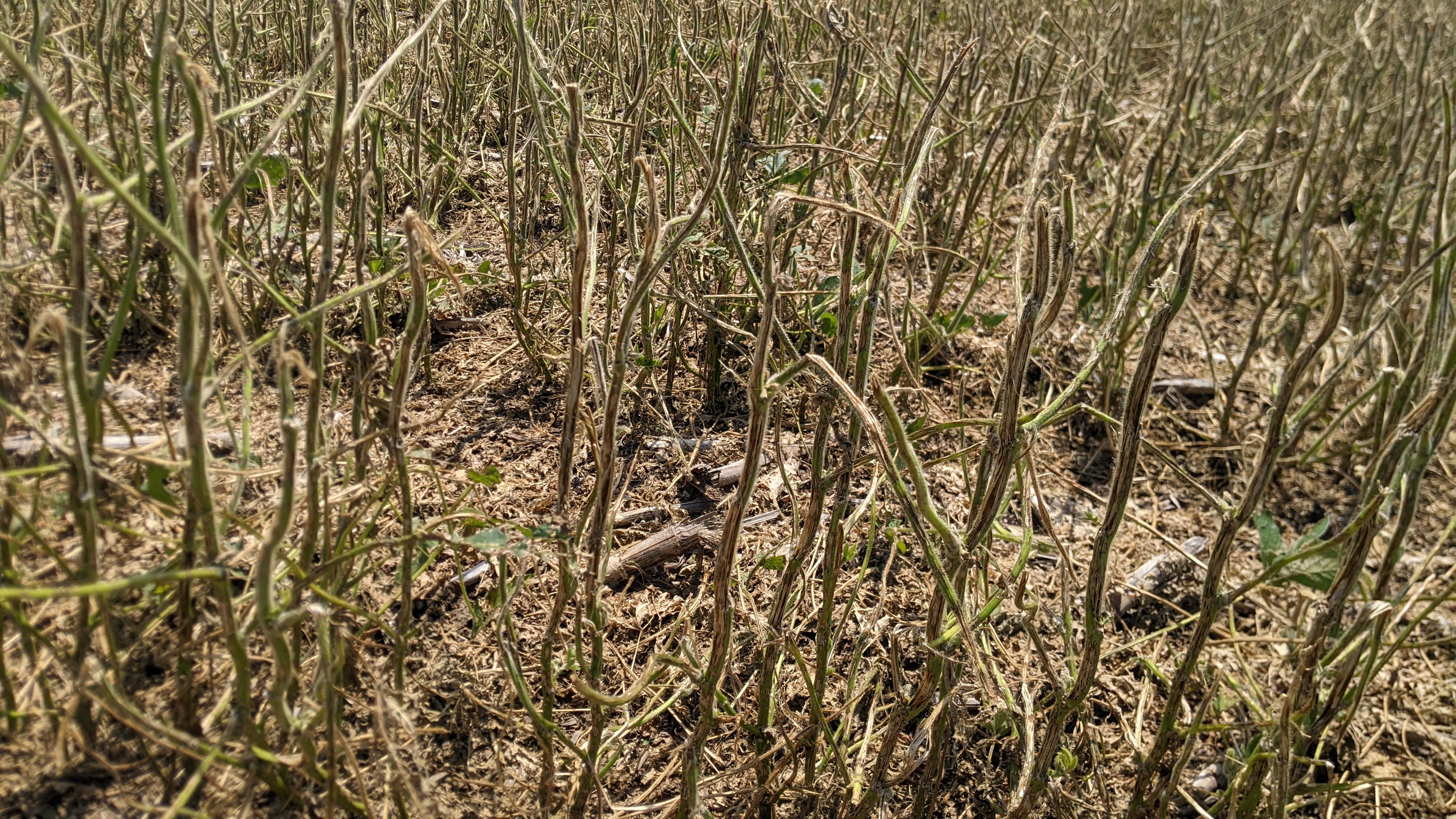


For soybean damage, the situations with pictures shown here (other than the top right) will recover. These fields are already showing new growth in axillary buds including new leaves and flowers. While some canopy was lost, they will look a lot better in 7-10 days. Look for areas of the field (lower right picture) that were protected such as by trees and/or pivot tires, to determine the original development stage when the soybeans were damaged. In the case of the upper right photo, those beans were planted the week of April 10th and were already at a strong R4 to beginning R5. By R5, soybeans will not recover because all new node, leaf, and pod development ceases. If considering to replant any beans, there’s risk of using later than a 2.5 maturity variety with a July 15th planting date in reaching maturity before a frost. By July 20th, aiming for closer to a 2.0 maturity is wise. Also, if you’re replanting into soybeans, we’ve found a fungicide seed treatment is wise as phytophthora root rot tends to be a problem in replant.
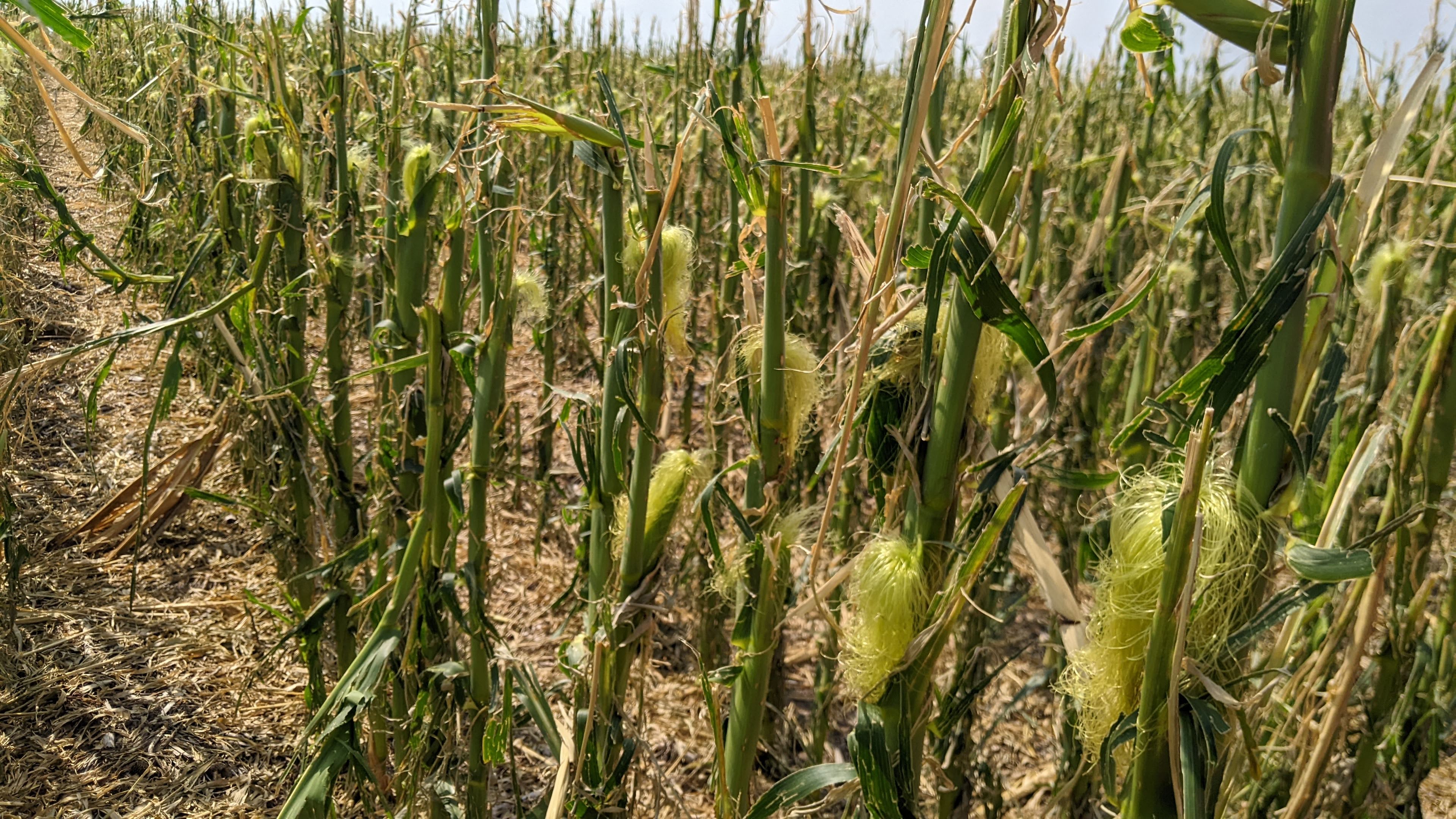


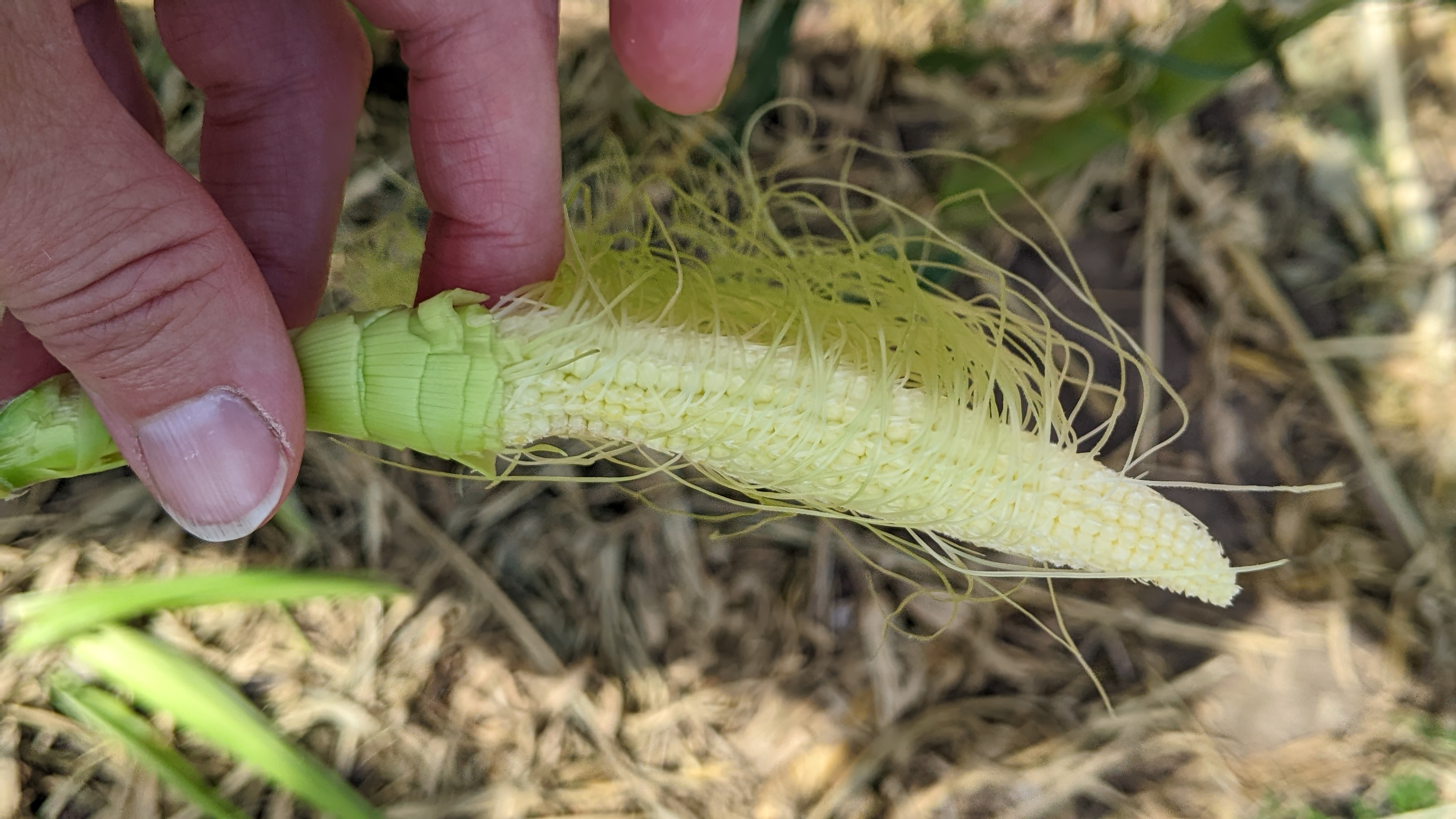


For corn, much of the corn I looked at has mostly leaf stripping and will be ok. There’s also bent/broken plants. Fields vary in the amount of stem bruising. When taking stand counts, I push a little hard on plants to see if they break off when I’m taking counts. A rule of thumb we’ve used in the past: every plant in 1/1000th of an acre we give 10 bu/ac to. So, a count of 12 plants has a potential of 120 bu/ac. That may seem crazy; it depends on how things pollinate, how damaged the ears are, final stand, etc. but it has been in the ballpark in enough cases for me to still use it as a guideline for making hail damage decisions.
In these photos, the fields were far more severely damaged. There’s fields like we saw in 2023 where 1/3 of the field or less still has tassels (top left and middle photos). We saw crop insurance delay that decision in the past to see how the ears would pollinate. I’m not sure what they will decide this year. I was seeing a few brown silks in some of these field situations, but it’s super early too. There’s also a large number of dead tassels in these fields (bottom right photo) that won’t provide any pollen. Tassels remaining tend to be wrapped in the newer leaves but as you see in bottom, middle photo, the tassel is trying to shed pollen inside the trapped leaves. Ears may be misshapen and damaged due to hailstones and/or being damaged and unable to emerge from sheaths (bottom left photo).
What we learned in the past is that palmer comes in quickly once the canopy opens. One can consider warrant with drops as a layby depending on how much Group 15 had been used in the field. Most chose not to go that option. Some seeded covers like brassicas/small grain into fields not totaled (flew on or haggie). Most let the palmer grow.
In the top right photo when fields were totaled, some allowed the weeds to grow and grazed with cattle or sheep. Some seeded a summer annual cover like sorghum sudan/sudangrass/pearl millet. In 2023, several crop producers chose pearl millet so they didn’t have to worry about prussic acid poisoning for those bringing in livestock or wanting to hay. Others just waited till later in the year, shredded down the stalks and planted in a small grain like oats or rye. The “blessing” with a decision in July is it can allow for more time to make a decision compared to if we were in June and the primary option was to replant. That perhaps was the biggest lesson I learned last year in working with producers. If you have specific questions or want to talk through decisions, please give me a call.
Also, it’s important to recognize that these disaster events create loss…in this case, loss of crops, pivots, bins, not only in irrigated acres but in a lot of non-irrigated acres that had more potential than most have seen in years, much less their lifetime. It’s ok to have a range of emotions surrounding this. And, it’s common to feel stressed, numb, and not want to make a quick decision. If I’ve learned one thing in my career, it’s the fact that as people, we all just need to talk about the stress and emotions we all face at times with someone we trust. My biggest piece of advice is to talk to someone just to get outside of one’s own head. There’s so much stress in life, not to mention in ag. The most common comment I’ve heard from people the past several years was they just appreciated being able to share with someone about the stress and what they were feeling. There’s also a number of mental wellness resources on the front page of CropWatch at https://cropwatch.unl.edu.
Resources:
- Summer annual forage grasses: https://extensionpubs.unl.edu/publication/g2183/2013/pdf/view/g2183-2013.pdf
- Making soybean replant decisions-what we learned: https://go.unl.edu/z7ad
- Corn damage to late vegetative/tasseling corn: https://go.unl.edu/y3of

More information and registration at: https://www.grazemastergroup.com/events.


Posted on July 14, 2024, in Crop Updates, Diseases, hail, JenREES Columns, Storm Damage and tagged fungicide decisions, hail, japanese beetles, storm damage. Bookmark the permalink. Leave a comment.


 JenResources
Leave a comment
Comments 0