Disease and Fungicides
Disease and Fungicides: Tar spot has been found in Polk and York counties at moderate incidence on leaves below the ears in the Shelby/Gresham/Benedict areas thus far. So far, all the samples and photos received have been in fields that were already sprayed. I’ve received a number of questions the past few weeks on why disease is present on fields that were sprayed with a fungicide. In the samples and questions received, I ask where the disease (mostly southern rust or tar spot) is located on the plant. If located below the ear, most likely, the product didn’t penetrate the canopy below the ear leaf. Some producers have asked for increased gallonage (3 gal/acre+) in order to better penetrate the plant canopy. In nearly every case of the questions/samples received, the diseases are below the ear leaf and not above.
If the disease is above the ear leaf in fields sprayed with a fungicide, it’s possible the spores had infected the leaves but hadn’t produced visible signs of lesions until after the fungicide was applied. Products containing triazoles (Group 3) can have some curative (killing) activity to what is already present on the leaf, but they will only work if the fungus was present a few hours to a few days before a leaf was sprayed with a fungicide. It’s also possible with very tall hybrids and lower ear placement that the coverage didn’t reach the ear leaf in some of those situations. Group 7 and 11 fungicides should provide 21-28 days of control. For fields where fungicide was automatically applied at tassel, that residual has most likely worn off or will soon. I’m not aware of any fungicide resistance issues yet in corn in Nebraska.
In corn fields that haven’t been sprayed, I’ve seen low incidence of southern rust at the ear leaf and below. At some point, it may worsen, but as many fields approach dough to dent, it’s helpful that disease didn’t explode yet. Info. about fungicide app if needed at these later development stages is below. Another observation is I tend to see more disease in fields that have been sprayed that had higher rates of nitrogen applied at one time vs. spoon-feeding over time. It’s just an observation and may not hold true, but it’s something observed thus far.
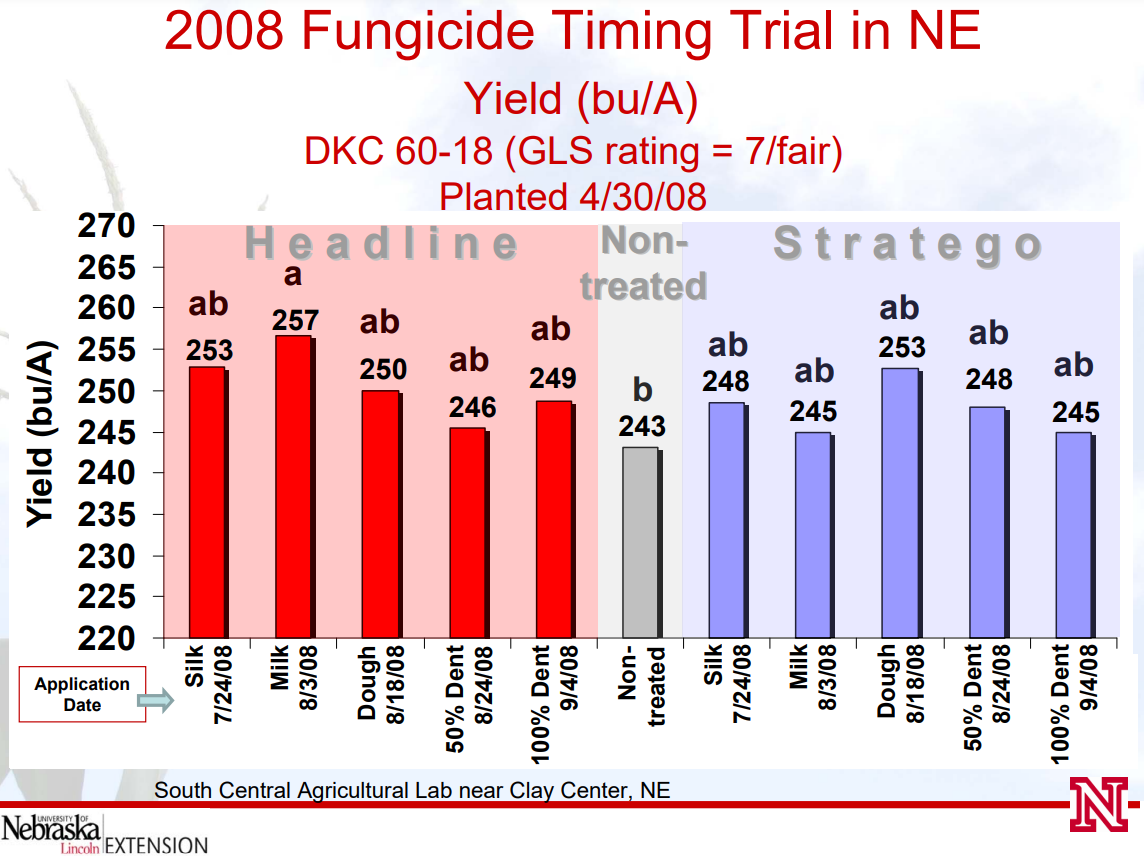
Dr. Tamra Jackson-Ziems had a fungicide timing study for two years (2008 and 2009) at South Central Ag Lab which showed fungicides could be applied through 100% dent (watch pre-harvest intervals) and had no yield difference compared to tassel in a year without southern rust pressure but heavy gray leaf spot pressure. I think we’d be more comfortable with applying no later than dough/early dent instead of 100% dent. The data is why I recommend delaying fungicide apps till needed. Several asked about the need for second fungicide apps if fields have higher disease pressure at ear leaf and below. That’s going to be a farmer/agronomist and field by field decision. The economics are tough this year with one app much less two.

Soybean Management Field Days: Would like to encourage and remind you of the upcoming Soybean Management Field Day at Scott Richert’s farm near Ulysses on Thursday, Aug. 15 from 6-8 p.m. (Reg. at 5:30 p.m.). Google map pin of the location at https://go.unl.edu/smfd3. It’s on the Butler/Seward Co. line on Rd. 21 (Ashland Rd) between Roads D and E in Butler Co. and Roads 434 and 420 in Seward Co. I’m grateful we were able to change this program to be more relevant to the area and showcase what the farmers are doing. If you’re interested in hearing more about how small grains like rye can help with palmer and white mold control, hear about learning experiences with roller crimping, and learn about various soybean seed treatments, we hope you’ll join us! Please RSVP for meal count but walk-ins are welcome (402-624-8030 or https://enreec.unl.edu/soydays).


Posted on August 12, 2024, in Diseases, JenREES Columns and tagged fungicide applications, southern rust of corn, soybean management field day. Bookmark the permalink. Leave a comment.


 JenResources
Leave a comment
Comments 0