Soybean Seed Size-Yield Impacts
Soybean Seed Size and Yield: It’s been awhile since we’ve seen full pods throughout plants (instead of flat pods with shrunken seed) and I’ve also noticed more 4-bean pods on upper nodes of plants this year. It has been deceiving in that soybeans with greener stems and some leaves were right at that point of being ready to harvest in the 13-14.5% range. Now I’m hearing a lot of dry beans are coming out again.
For the most part, soybeans have been of good seed size and quality. There are areas where “bb’s” are being observed again. I’ve heard reports of this from producers in the non-irrigated portions of southern Seward county and Saline counties. In those situations, plants often held onto leaves and just died due to lack of moisture; however, the seed number is still allowing for decent yields. This made me think of information I shared last year from Dr. Jim Specht, Emeritus UNL Soybean Physiologist, so resharing.
During soybean reproductive development, three stages — R1-R2 (flowering), R3-R4 (podding), and R5-R6 (seed-filling) — occur successively during July and August in the growing season. Soybean yield is ultimately a function of two components: the harvested seed number (in terms of unit land area), and the seed mass (weight of the average harvested seed). Seed number is set during the R1 to R4 stages of flowering and podding, though abortion of pods or seeds in those pods can occur in the later R stages. Seed mass (i.e., size) is set during the R5 to R6 stages of seed-filling, as the seeds undergo enlargement until the R6 stage ends at the onset of the R7 (physiological maturity) stage.
Jim and colleagues conducted a 3-year study in the 1980’s looking at the drought-stress sensitivity of seed number and seed size during different R stages. It involved 14 Group 0-Group 4 soybean varieties using seven treatments — each consisting of a single irrigation application, but each treatment differed with respect to the R stage coinciding with the single irrigation event.
When the single irrigation was applied during flowering, they saw a substantial increase in seed number, yet also a lower seed mass compared to the control rainfed treatment. This indicated that when water stress is mitigated during flowering (but not thereafter), soybean plants will set more seeds, but also end up making those seeds smaller when water is not adequate thereafter. We normally don’t recommend irrigation during flowering to avoid disease onset. This year we had some rains with cloudy conditions during a portion of the flowering period. However, rains shut off for the most part after that. I think that’s why we’re seeing the smaller seed size with lots of beans in some of the extremely dry areas.
In contrast, when a single irrigation is applied during seed-fill (R5-R6), fewer seeds are set (and/or retained) due to prior water stress, but the mass of those fewer seeds is optimized due to the late-applied single irrigations that mitigate any coincident water stress.
They also found a response pattern coinciding with an irrigation event occurring at R3.5 and R4.5 (podding) that showed plants in that stage are conditioned to enhance seed mass while still increasing seed number to some degree. Irrigating at this stage resulted in the highest yields among treatments. Thus, why we typically encourage first irrigation of soybeans at R3 in our silt-loam soils. Additional research in the early 2000’s verified this.
The research also showed a full-season multiple irrigation treatment that resulted in maximized seed number, but seed mass was not increased beyond the increase achieved with single irrigation at R3.5. Thus, by irrigating all season (or in a season where rainfall provides no water stress), seed number (which is set before seed mass) is prioritized by stress-free plants relative to optimization. While the weather is outside our control, I hope this is helpful in thinking through this past year. For risk mitigation going forward, I think it shows the importance of planting varying maturity groups to help spread risk with variations in weather conditions each year.
The full articles can be found at UNL CropWatch: One contains a quick method to determine yields using seed size just prior to harvest. The other is about water stress timing.
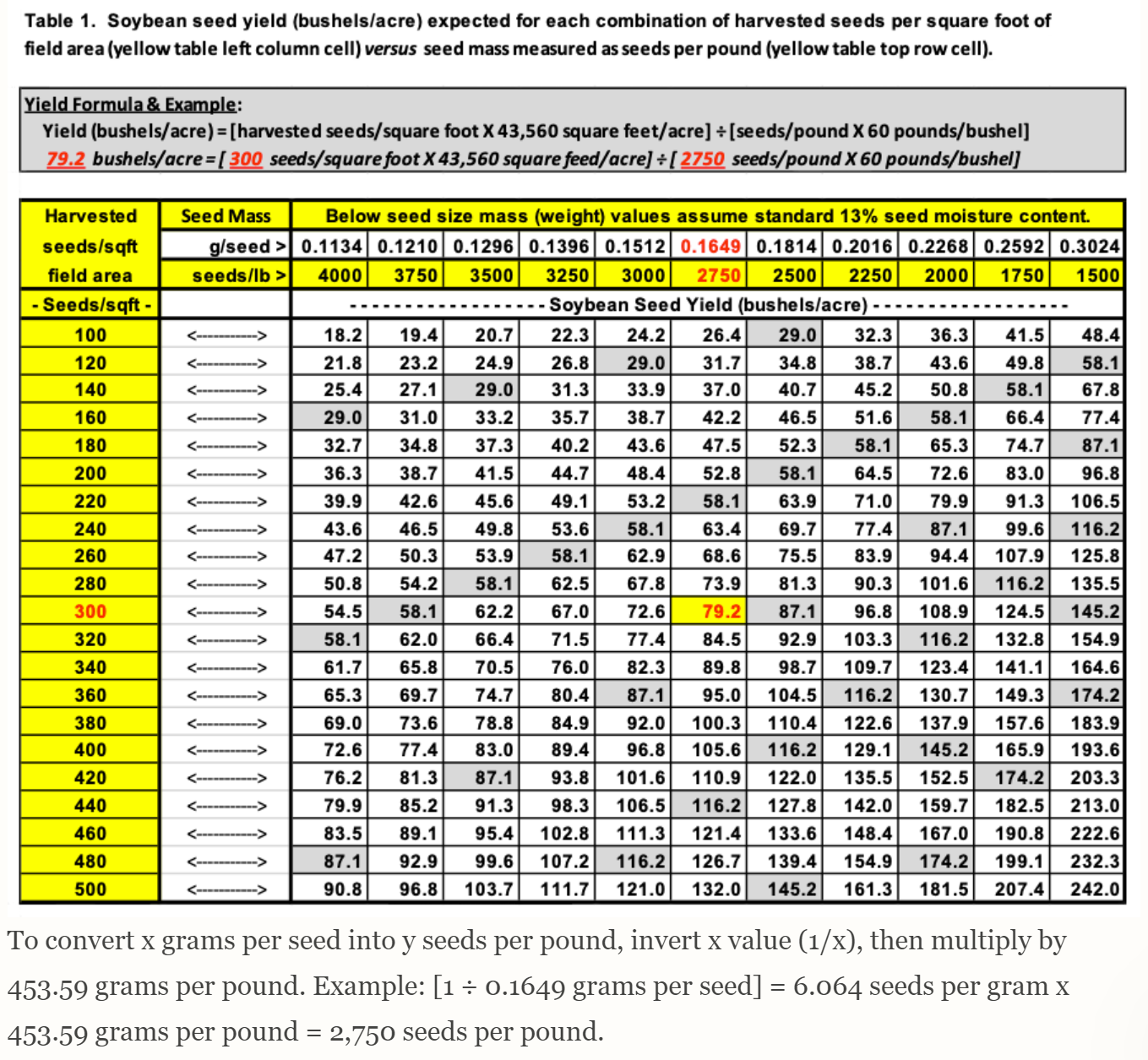
For Alex Harrell from Georgia with the record breaking yield of 218 bu/ac in 2024, he mentioned aiming for large seed size. Based on this chart, assuming around 450 seeds per square foot, he’d be achieving around a 1500 seeds/pound seed size.
In 2023, Alex Harrell reported a record soybean yield of 206.8 bushels/acre in 2023, and he suggested that the harvested seed in field likely had a seed mass of around 1,675 seeds/pound. Thus, a large seed size with (doing the math) around 477 seeds per square foot on a plant population of 77,000 plants/ac.

Posted on September 30, 2024, in JenREES Columns and tagged soybean seed size, soybean yields. Bookmark the permalink. Leave a comment.


 JenResources
Leave a comment
Comments 0