Monthly Archives: October 2024
Fire Damage to Fields
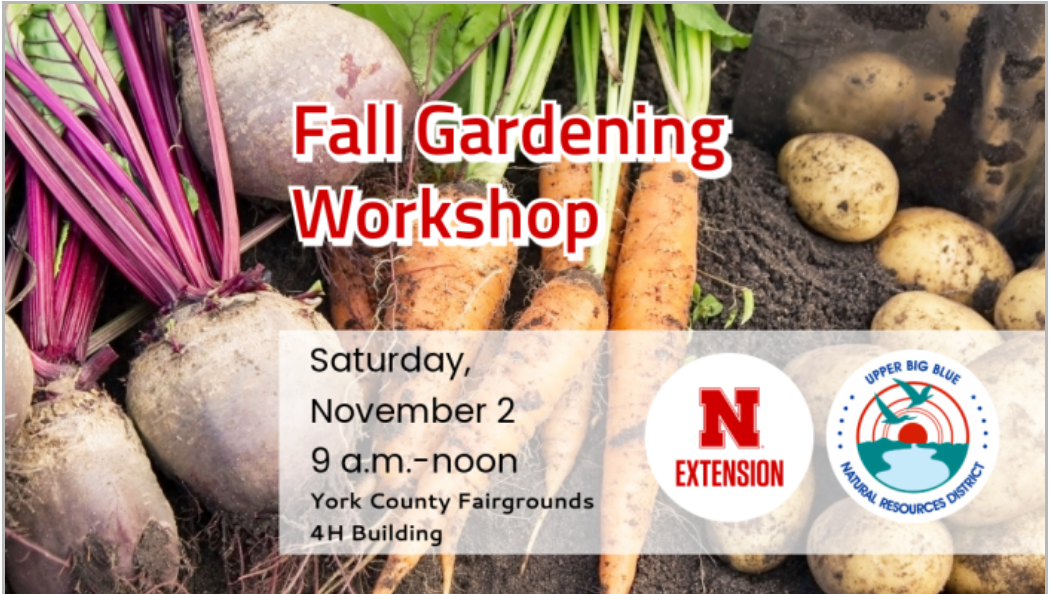
Reminder of the Fall Gardening Program this Saturday, Nov. 2, from 9 a.m.-Noon at the York County Fairgrounds (4-H Building). No charge. Registration is requested but not required to 402-362-6601.
Fire Damage to Crops and Residue: With the dry conditions and the fires that have occurred, I’ve received questions regarding the nutrient value in the residue and/or soil impacts in addition to what to do with unharvested crops that were impacted. Make sure crop insurance is contacted.
For corn that wasn’t harvested, if the ears are still attached to stalks, take ears from a couple worst parts of fields and also least impacted areas of fields (if that’s possible). It usually takes me about 4 ears to get a quart-sized ziplock bag full of shelled grain. Send the grain in to a lab (ex. Ward Lab, etc.) that will perform energy and protein analysis of the grain. I’ve found the grain analysis helps in situations where, at first, the elevators/ethanol plants say they won’t take the grain. We’ve often found the fires move so quickly in the field that the starch and overall grain quality is not impacted, in spite of the grain having some charred spots. If elevators or ethanol plants won’t take it, it has also been mixed in feed rations for livestock, which the grain analysis helps there too.
For unharvested fields with downed corn, depending on how charred the corn is and how much corn is down, many have chosen to disk up the field and then plant a rye cover crop. Grazing these fields has been done very carefully by strip grazing and if you plan on doing that, I will put you in touch with Dr. Mary Drewnoski. We also share more in this article: https://go.unl.edu/8hi2.
Plan on soil testing, which is wiser to do so next spring, to determine nutrient levels prior to planting. The combination of drought + fire may result in greater nitrogen availability than what one may think.
Fire can often aid grasslands, so would say to let pastures work to recover on their own for now.
For crop residue that’s burned, most nitrogen and sulfur in the residue are lost; however, the phosphorus and potassium are retained in the ash (as long as they don’t blow away).
Short-term nutrient loss from the residue is none to minimal. Research from the University of Wisconsin looked at the need to replace nitrogen to the succeeding corn crop when soybean residue was either removed or not removed. They found no difference in nitrogen impacts to the corn crop regardless if the residue was removed, thus there’s no need to replace the nitrogen in burnt soybean residue. Research from USDA-ARS in Nebraska, when looking at corn residue removal prior to corn planting, also suggested no need to replace the nitrogen lost from the residue. They found increased mineralization due to the change in C:N ratio when residue was removed. Previous research compiled in this resource from South Dakota State shared the same sentiments: https://openprairie.sdstate.edu/cgi/viewcontent.cgi?article=1365&context=extension_extra. The SDSU resource is also helpful when walking through a dollar value of other loss considerations.
Perhaps the greatest losses to consider are organic matter, soil loss, and soil moisture. Regarding organic matter, the soil holds the greatest portion of this. One year of residue is minimal, attributed with the potential of increasing organic matter 0.03-0.06%, depending on tillage type, crop, etc. Soil erosion due to wind/water can result in organic matter loss and loss of more productive soil. This is hard to quantify. Perhaps the more important factor is the soil moisture losses in no-till, non-irrigated fields, particularly in a dry year such as this. Paul Hay, Extension Educator emeritus, years ago shared with me several documented situations where yield losses due to moisture loss were estimated. Corn planted into burned no-till, non-irrigated soybean stubble ranged from 15-28 bu/ac yield loss in two situations. There was 0-3 bu/ac yield loss associated with soybean planted into burned, no-till, non-irrigated corn residue in two situations. Use of soil moisture probes can give an indication of soil moisture differences between burned and non-burned areas of fields or between fields. Direct yield comparisons between fields are difficult to make due to planting dates, hybrids/varieties, agronomic practices, etc., but important to still collect and assess.
We’ve observed in the past is that the ash on the soil is fairly hydrophobic after a fire event. Thus, even when rain occurred, it took several rains before the ash on the soil was disturbed enough for any rain to soak in. Because of this and to reduce soil loss overall, we recommend to get a rye cover crop drilled into the field. We found that the farmers who drilled in the cover and had enough moisture to eventually get it germinated and established in the spring were able to better grow crops in those areas the following year (these were non-irrigated fields). The fields and areas of fields where rye didn’t get established had poor crops the successive year, which was also a drought year.
Resources:
Fire Damage FAQ: https://go.unl.edu/8hi2
Fire Damage and Crop Residue Impacts: https://go.unl.edu/0wgq

Upcoming November 2024 Events
Sharing this week on upcoming November events. Please be safe with the remainder of harvest and we’ll keep praying for rain!
Fall Gardening Program: The Upper Big Blue Natural Resources District, USDA-NRCS, and Nebraska Extension are joining forces to present a fall garden workshop on Saturday, November 2, from 9 a.m.-12 p.m. at the York County Fairgrounds (4-H Building). This event is free to attend. Registration is requested but not required to 402-362-6601.
The workshop will include time to visit booths, speak with presenters, and enjoy refreshments from 9 to 9:30 a.m. Presentations will be from 9:30 to 11:30 a.m. From 11:30-noon, there will be time for Q&A with both presenters, gathering materials, and viewing demonstrations at presenter booths. A representative from the Nebraska Forest Service will also be on hand to answer your tree care questions. Ordering for the NRD’s Conservation Tree Program will kick off in November.
This event will feature Extension Educator Sarah Browning, who has presented at our gardening workshops recently, including one on vegetable gardening and another on fruit tree care. Browning will present a Solution Gardening session that focuses on “right plant, right place.” Which plants are best for shade/sun? How about sandy or wet soil? What if you have a wildlife problem? If something didn’t work as planned this past growing season, Browning may be able to shed light on why and help you create a new game plan for next year.
Learn about opportunities for small-scale and urban agriculture producers with Brach Johnson, USDA Nebraska State Urban and Small-Scale Agriculture Conservationist. The Natural Resources Conservation Service (NRCS) has technical and financial resources for urban dwellers to enhance their production system and protect our natural resources. Urban agriculture includes the cultivation, processing, and distribution of agricultural products in urban and suburban areas. Community gardens, rooftop farms, hydroponic, aeroponic and aquaponic facilities, and vertical production, are all examples of urban agriculture. Tribal communities and small towns may also be included.
Cover Crop Grazing Conference is being held Nov. 6th with registration and trade show from 8:30-9:30 a.m. and program from 9:30 a.m.-3 p.m. at the West Central Research and Extension Center in North Platte. This year’s theme is “Getting the Most Out of Every Acre”. This conference is designed for producers looking to enhance profitability and sustainability through innovative grazing systems. Topics and speakers include: Winter Grazing Opportunities with Annual Forages and Latest Findings on Using Cover Crops for Forage, by Dr. Bart Lardner, University of Saskatchewan; My Journey to Integrate Cattle on Crop Ground by Logan Pribbeno, Wind Glass Ranch; and Filling the Forage Gaps Using Cover Crops by Dr. Mary Drewnoski. Breakout session topics include: Tips for Selecting and Using Temporary Fencing and What You Need to Know About Planting Dates and Forage Production. There is a charge of $40 to attend. Registration is at: https://go.unl.edu/ccgc24.
Central NE Regenerative Ag Conference will be held Nov. 19th in Holdrege at the Phelps Ag Center. Program is from 8:45-4:30 p.m. (Reg. 8 a.m.). Featured speaker will be Rodney Saunders with NRCS in addition to farmer panels. More info. and registration at: https://www.cccneb.edu/agconference
Yield & Soil Impacts from Grazing Corn Residue
With pastures short on grass due to drought, it’s a blessing for producers to get cattle out on cornstalks. Sharing an update on long-term research showing no negative impacts to the subsequent yield or soil from cattle grazing corn residue.
Mary Drewnoski, et. al share on yield impacts, “Two studies were conducted to evaluate the effects of corn residue harvest on subsequent crop yields. In a long-term study (16 years), cattle grazing corn residue in the spring (February to the middle of April) or the fall (November through January) slightly improved subsequent soybean yields and had no effect on corn yields in an irrigated field maintained in an annual corn-soybean rotation at Mead, Neb. In a five-year study, fall grazing (December through January) or baling of corn residue had no effect on subsequent corn grain yields in a field maintained in continuous corn production at Brule, Neb. These data suggest that the grazing of corn residue in the fall or spring at or below UNL recommended stocking rates will have slightly positive or no impacts on subsequent soybean or corn yields.
The stocking rates utilized were consistent with UNL grazing recommendations, which result in removal of half the husks and leaves produced (8 lb of leaf and husk per bushel of corn grain produced). The corn yields ranged from a low of 186 bu/ac in 2004 to a high of 253 bu/ac in 2009, with a median over the 16 years of 203 bu/ac. Recommended stocking rates would have ranged from 2.1 to 2.9 AUM/ac with a median of 2.3 AUM/ ac.”
Dr. Mary Drewnoski wrote an updated Beefwatch article about soil compaction and grazing. “One of the most common concerns about grazing corn residue is that cattle will cause soil compaction. A long term grazing data (16 years) conducted at the UNL has shown no compaction when grazing in the fall or the early spring. In this long-term study, grazing did not impact soil nutrient content. This fits well with expected impacts given that cows in mid-pregnancy retain very little nitrogen, phosphorus or potassium. Thus, they excrete in manure and urine most of what they consume resulting in very little nutrients being removed from the land. With long term grazing there was an improvement in subsequent soybean and corn yields. This could have been due to the nutrient cycling being sped up as there is an increase in microbial biomass in the soil in the grazed areas.
More recently, a study was designed to test an extreme scenario for spring grazing. The thought was that if grazing was to cause compaction, it was most likely to happen when the soil is wet and thawed and when a high stocking density was used. The field was grazed at the recommended rate by starting in mid-February with 3 hd/ac for 45 days (normal stocking) or starting in early March with 9 hd/ac for 15 days (high stocking). Turn out of the higher stocking density groups was delayed until it rained to have the worst-case scenario. All groups were removed mid-March. There were some minor increases in bulk density (measure of compaction). The penetration resistance was also higher, and thus more down pressure had to be applied to get the soybeans planted. Down pressure applied at planting was 265 lbs in the non-grazed and 290 lbs in the grazed treatments. Much of the increase in penetration resistance is due to the soil having less cover and thus less surface soil moisture. The planting speed was also reduced due to the surface roughness. However, the subsequent soybean yields were still improved by grazing. While it is not recommended to graze late into the spring as this does have some downsides when it comes to planting, if cattle happen to be left out when a warm-wet spell occurs, there is no long-term damage to the land.
Overall, when managed correctly, grazing corn residue can be a win-win for both the crop and cattle producer. Want to see the data for yourself? Check out these Nebraska Beef Reports:”
Effect of Corn Residue Removal on Subsequent Crop Yields
Effect of long-Term Corn Residue Grazing on Soil Properties
Effect of Corn residue grazing or Baling on Subsequent Crop Yield and Nutrient Removal
Impact of Spring Corn Residue Grazing on Soil Physical Properties and Crop Yield
Dry September 2024
Dry Conditions: With the dry conditions, harvest has been rapidly progressing. Two weeks ago, soybeans had green stems with seeds that were drier than people thought. Last week, many were harvesting soybeans in the 7-8% range. For corn I’ve been hearing a lot of 13-15% moisture and a couple reports down to 11%, but still with good kernel depth and quality. There’s unfortunately nothing we can do about this other than prioritize which fields to harvest. We’re in a race against time and the low moisture is due to weather conditions and hybrid specificity.
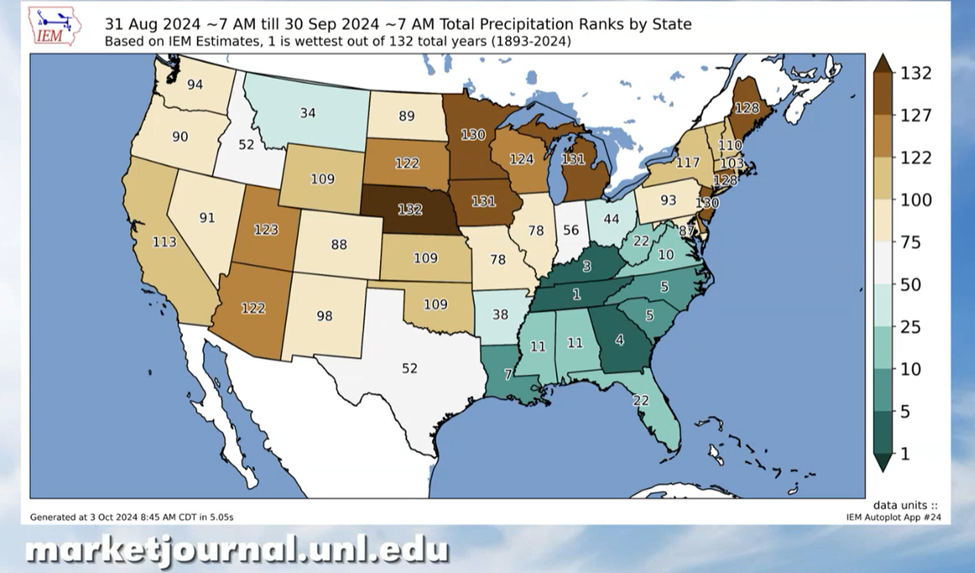
I’ve never seen it so dry in September. Eric Hunt, Extension Meteorologist, showed that September 2024 was the driest September in Nebraska on record (132 years). He also shared there’s no relief in site moisture-wise with above-average temps till at least the latter half of the month.
The lack of relative humidity and precipitation, intense sunshine, higher temperatures, and wind have all led to the grain moisture loss we’re seeing (which can be as much as 0.8-1.0 percentage points/day). Dr. Bob Nielsen, Extension Emeritus Corn Specialist from Perdue shared, “It is not uncommon for grain moisture to decline more than one percentage point per day over a period of days when conditions are warm, sunny, windy and dry.” Research that he and others conducted back in the 90’s showed that when corn matures also impacts drydown rate. Corn that matured in late August had a daily average drydown rate of 0.8 percentage points per day while corn that matured in late September averaged 0.4 percentage points per day. The corn borer pressure on non-gmo hybrids and late season disease pressure on all hybrids also led to plants dying/maturing early.
Corn hybrid characteristics can also impact kernel moisture. Hybrids that have thinner or permeable pericarp layers (outermost layer of the corn kernel), are more subject to moisture loss and faster drying rates in the field. I’m unsure how one knows this characteristic though.
You can look for these other characteristics resulting in quicker drydown: lower husk leaf number and thinner husk leaf, how soon the husk leaf tissue turns brown, how well the husk covers the ear (less coverage allows for faster drying), how tight the husk is (as looser husks will increase moisture loss), and how fast the ear turns down vs. remaining upright.

Fire Conditions: With the dry conditions and low humidity, we have a high risk of fire potential. I’m grateful to Nebraska DOT for posting the fire danger on signs throughout the state as a reminder to those traveling. Hopefully that will help reduce cigarette fires. Please keep thinking safety including fire safety with harvest. Days like Saturday are days to take a break from the field. Have fire extinguishers with you and charged, disks at fields, blow out combines regularly. Roads are so dangerous with the dust; turn lights on when traveling in the daylight. Please be safe! Safety resources: Educational Resources | College of Public Health | University of Nebraska Medical Center (unmc.edu)
Cover Crops and Small Grains: With the dry conditions, I’ve heard of several semi loads of wheat returned and not planted in the southern counties I serve. It’s hard to know what to do, but if a small grain is part of one’s rotation (which I feel there’s many benefits of), I’d recommend to stay the course with planting the current rotation and evaluate the situation next spring. It’s something to also discuss with crop insurance. Regarding irrigated ground, I have been recommending to put on 0.5”, potentially with two shots if needed, for cover crops. This may seem like a waste of water, so my explanation. The covers are an investment for soil erosion loss, uptaking excess nitrogen, aiding with weed control next year, and/or for grazing. With no soil moisture, the low amounts of irrigation are to get seeds growing or keep seedlings alive for the time being.
Trees and Lawns: We also need to be deeply watering trees in landscapes. Push a screwdriver in the ground to determine wetting depth. Kentucky bluegrass is shallower-rooted and doesn’t take heat as well as fescue. However, bluegrass will go dormant without dying, whereas fescue, even though it’s deeper rooted and more drought-tolerant, doesn’t go dormant from drought-stress, so it can die. After bluegrass has reached three weeks of dormancy and fescue has changed color, it’s recommended to water 0.5”/week to keep both grass species from dying.


 JenResources