Fire Damage to Fields
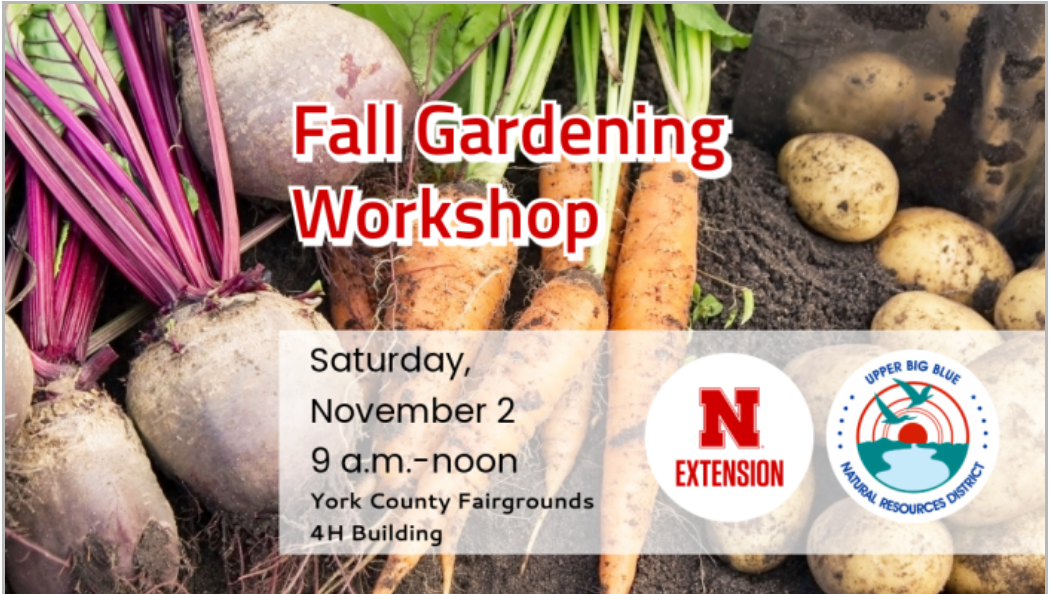
Reminder of the Fall Gardening Program this Saturday, Nov. 2, from 9 a.m.-Noon at the York County Fairgrounds (4-H Building). No charge. Registration is requested but not required to 402-362-6601.
Fire Damage to Crops and Residue: With the dry conditions and the fires that have occurred, I’ve received questions regarding the nutrient value in the residue and/or soil impacts in addition to what to do with unharvested crops that were impacted. Make sure crop insurance is contacted.
For corn that wasn’t harvested, if the ears are still attached to stalks, take ears from a couple worst parts of fields and also least impacted areas of fields (if that’s possible). It usually takes me about 4 ears to get a quart-sized ziplock bag full of shelled grain. Send the grain in to a lab (ex. Ward Lab, etc.) that will perform energy and protein analysis of the grain. I’ve found the grain analysis helps in situations where, at first, the elevators/ethanol plants say they won’t take the grain. We’ve often found the fires move so quickly in the field that the starch and overall grain quality is not impacted, in spite of the grain having some charred spots. If elevators or ethanol plants won’t take it, it has also been mixed in feed rations for livestock, which the grain analysis helps there too.
For unharvested fields with downed corn, depending on how charred the corn is and how much corn is down, many have chosen to disk up the field and then plant a rye cover crop. Grazing these fields has been done very carefully by strip grazing and if you plan on doing that, I will put you in touch with Dr. Mary Drewnoski. We also share more in this article: https://go.unl.edu/8hi2.
Plan on soil testing, which is wiser to do so next spring, to determine nutrient levels prior to planting. The combination of drought + fire may result in greater nitrogen availability than what one may think.
Fire can often aid grasslands, so would say to let pastures work to recover on their own for now.
For crop residue that’s burned, most nitrogen and sulfur in the residue are lost; however, the phosphorus and potassium are retained in the ash (as long as they don’t blow away).
Short-term nutrient loss from the residue is none to minimal. Research from the University of Wisconsin looked at the need to replace nitrogen to the succeeding corn crop when soybean residue was either removed or not removed. They found no difference in nitrogen impacts to the corn crop regardless if the residue was removed, thus there’s no need to replace the nitrogen in burnt soybean residue. Research from USDA-ARS in Nebraska, when looking at corn residue removal prior to corn planting, also suggested no need to replace the nitrogen lost from the residue. They found increased mineralization due to the change in C:N ratio when residue was removed. Previous research compiled in this resource from South Dakota State shared the same sentiments: https://openprairie.sdstate.edu/cgi/viewcontent.cgi?article=1365&context=extension_extra. The SDSU resource is also helpful when walking through a dollar value of other loss considerations.
Perhaps the greatest losses to consider are organic matter, soil loss, and soil moisture. Regarding organic matter, the soil holds the greatest portion of this. One year of residue is minimal, attributed with the potential of increasing organic matter 0.03-0.06%, depending on tillage type, crop, etc. Soil erosion due to wind/water can result in organic matter loss and loss of more productive soil. This is hard to quantify. Perhaps the more important factor is the soil moisture losses in no-till, non-irrigated fields, particularly in a dry year such as this. Paul Hay, Extension Educator emeritus, years ago shared with me several documented situations where yield losses due to moisture loss were estimated. Corn planted into burned no-till, non-irrigated soybean stubble ranged from 15-28 bu/ac yield loss in two situations. There was 0-3 bu/ac yield loss associated with soybean planted into burned, no-till, non-irrigated corn residue in two situations. Use of soil moisture probes can give an indication of soil moisture differences between burned and non-burned areas of fields or between fields. Direct yield comparisons between fields are difficult to make due to planting dates, hybrids/varieties, agronomic practices, etc., but important to still collect and assess.
We’ve observed in the past is that the ash on the soil is fairly hydrophobic after a fire event. Thus, even when rain occurred, it took several rains before the ash on the soil was disturbed enough for any rain to soak in. Because of this and to reduce soil loss overall, we recommend to get a rye cover crop drilled into the field. We found that the farmers who drilled in the cover and had enough moisture to eventually get it germinated and established in the spring were able to better grow crops in those areas the following year (these were non-irrigated fields). The fields and areas of fields where rye didn’t get established had poor crops the successive year, which was also a drought year.
Resources:
Fire Damage FAQ: https://go.unl.edu/8hi2
Fire Damage and Crop Residue Impacts: https://go.unl.edu/0wgq


Posted on October 28, 2024, in JenREES Columns and tagged fire damage to crop residue, fire damage to fields, fire damage to harvested fields, fire damage to unharvested fields. Bookmark the permalink. Leave a comment.


 JenResources
Leave a comment
Comments 0