Fall Nitrogen Challenge
It’s such a blessing to receive some moisture! With November here, sharing this week on nitrogen applications.
While the November 1 date that allows for fall fertilizer application to fields has arrived, we also recommend waiting to apply fall nitrogen till soil temperatures are below 50F. At that temperature, soil microbes are less active and less likely to convert ammonium to nitrate. Soil temperatures can be viewed at: https://cropwatch.unl.edu/soiltemperature. As I write this, the daily average 4” soil temperature is currently 55F with the weekly average at 53F.
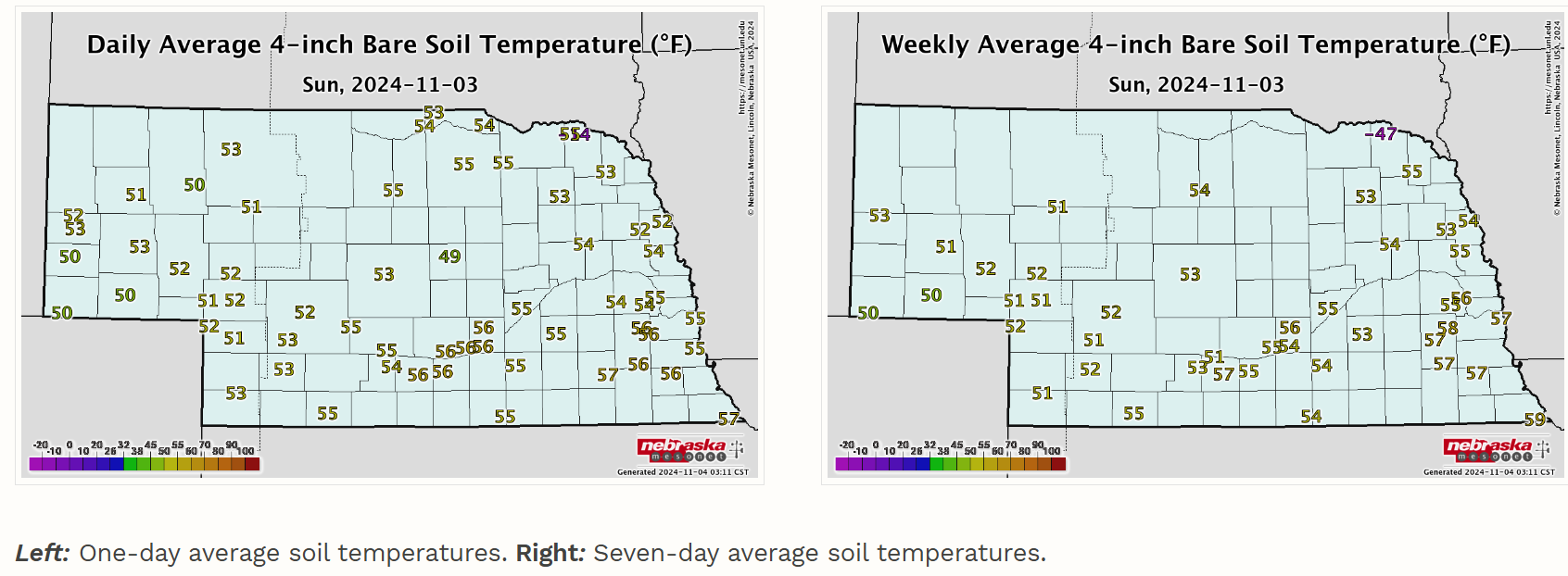
Nearly a year ago, I shared my Nitrogen Challenge with you. I’m grateful for all the producers who gave that a try! Some who wanted to try it had applied too large a base rate before I had released the article, so sharing a reminder now.
My Challenge: The challenge is to everyone with irrigated ground who applies fall anhydrous or spring pre-plant fertilizer:
- Leave 1 piece of ground with a base rate of 70-100 lb N/ac.
- Apply the rest of the N in season as needed using a tool like Sentinel Fertigation that senses plant needs.
- Asking each grower to consider this for 1 field. Are you willing to join me in this?
I genuinely believe this is the primary way to change the nitrogen story both now and for future generations. Why? We can’t impact the legacy nitrate from previous generations that is impacting groundwater nitrate levels now, but we can impact the nitrate that remains in the soil after current nitrogen practices now.
Nitrogen rate is the most consistent thing I keep seeing in nutrient recommendations and on-farm research studies that we can adjust. I’ve shared On-Farm Research results from farmers’ fields in this part of the State on heavier textured soils showing there’s no one solution with nitrification inhibitors, nitrogen application timing, biological products. The most consistent thing I see is an opportunity around reducing nitrogen rates. I’m not saying there’s one solution. My challenge is around what I feel holds the most promise right now for irrigated ag in this area.
We can’t precisely know an amount of nitrogen to recommend for application to land using pre-plant soil tests and/or any nitrogen equation. They’re good tools. But, we don’t know how much irrigation will be applied in season nor how much mineralization will occur due to weather conditions. 2022-2023 were high mineralization years and 2024 was a low one. Soil agronomy needs biology in addition to chemistry and physics. That’s why I’ve been so supportive of the in-season sensing technologies where the plant tells us what it needs based on what is occurring in the soil. Project Sense was a UNL/NRD/Corn Board/USDA research effort using ground rig applications. I think it never took off because I’m unsure any Co-op or company took the idea on as a business. Would still be applicable.
The UNL pivot-based sensing research resulted in the graduate student forming the company Sentinel Fertigation. If there’s other companies doing this, please consider them too. There’s so much in ag we have to react to. Applying N in-season is also reactive. However, we can also be proactive in showing that farmers and agronomists locally want to keep looking for solutions to the nitrate problem by trying newer tools/technologies to see any impacts. Please contact me if you are willing to join me in this challenge.




Posted on November 4, 2024, in JenREES Columns and tagged fall anhydrous application, fall nitrogen application, nitrogen challenge, sentinel fertigation. Bookmark the permalink. Leave a comment.


 JenResources
Leave a comment
Comments 0