Monthly Archives: January 2025
Life is Not Guaranteed
Last Tuesday night was our first Farm Succession Program “Leaving a Lasting Legacy”. That night was an incredibly impactful night for me. We heard from two women who became widows in their 30’s with young children. They were incredibly courageous in sharing their stories of loss, grief, difficulty navigating bills and decisions, etc. I left that night with so much on my mind. My husband and I have talked much since then. I’ve also shared with my siblings as we talked through how would our next of kin be able to navigate our accounts, passwords, etc. if something would happen to us.
The ladies shared several things that I felt would be beneficial to all for me to share here.
- At minimum, have a will in place that shares your desires for who receives your belongings, guardians for your children, etc.
- All vehicles and property should be listed as “joint tenancy with right of survivorship”.
- Both widows nearly dealt with probate. One widow lost both her father and husband in a plane crash and both were part of the family dairy business. The trust had been started but never completed by the father. They were able to avoid probate on the things the father had in the part of the estate plan written down but are still paying hefty fees on the parts that weren’t written in order to keep the family business. She emphasized the importance of finishing estate plans!!! Then review them every 2-3 years.
- In the case of the other widow, the husband had an off-farm job as a life insurance agent in addition to the farm. She shared the blessing of how well he provided for her by having such a large life insurance policy that helped her pay off debt and keep/manage the farm while raising her children at home.
- All accounts need to have both people listed. For example, the family phone plan was listed under the husband. She wasn’t able to access it with the phone company since she wasn’t listed and had to start over with new phones and accounts.
- The husband’s work email was used for several accounts at home (electric, heat, etc.). When he passed, his email was discontinued and the wife had no access to the accounts, nor was she listed on them. They both shared the difficulty paying bills and keeping their homes because they weren’t listed on accounts, on top of the immense grief they experienced.
- Ensure all account usernames and passwords are in a place where your next of kin can access them. There are tools for this including Nokboxes from Dave Ramsey.
- Medical: Many lawyers have templates for this, but if not, one document tool (paper or digital) you can use is from 5 Wishes. One wife whose husband was non-responsive had no idea if he would want experimental drugs used, if he wanted to be on dialysis for the rest of his life, and then if he wanted to remain on life support. She shared how having to make those decisions for him still haunts her, especially discontinuing life support.
There’s so much more I could share. Life is so short. Tomorrow, our next moments, nothing is guaranteed. My hope is that this column creates conversations amongst loved ones. Do you and your spouse/next of kin have a will in place? Do you have access to each others’ bank accounts, have a place where usernames/passwords are stored, have the names necessary on all accounts?
If you’re interested in attending, we will still take people each Tuesday night for the next three weeks. Please contact the Extension Office closest to you if you’re interested. More info: https://wia.unl.edu/succession25/.

Pesticide Safety
Pesticide Safety: I remember first getting my pesticide license in college. Since then I’ve taught safety training each year for the past 21 years as an Extension Educator. It’s not my favorite thing to teach, but it is important. After teaching 8 trainings this past week, I got to thinking that beyond those trainings, I never have shared that information broadly. So, sharing, what I feel is, impactful safety information.
During training, I share that we’re there as private pesticide applicators receiving safety training so that we can keep ourselves, our families, and everyone in our operations safe.
An Agricultural Health Study was conducted where carpet dust from various places in the home was collected. The researchers were looking for pesticide residues in the dust. They collected residues from non-farm homes, farm homes without recent pesticide use, and farm homes with recent pesticide use. In all cases, they found: metolachlor and chlorpyrifos at very low levels and 2,4-D and glyphosate (Roundup) at medium to high levels. I then ask each group of applicators where they think the most residue would be found in the home. Logically, most of us would say the laundry room or the entryway of our homes. The answer? The Father’s Changing Area…the bedroom. I think that’s a sobering thought for a lot of us. Even more sobering is an update to this information. Pesticide residues, specifically atrazine, was also found in the child’s bedroom, only in farm homes.
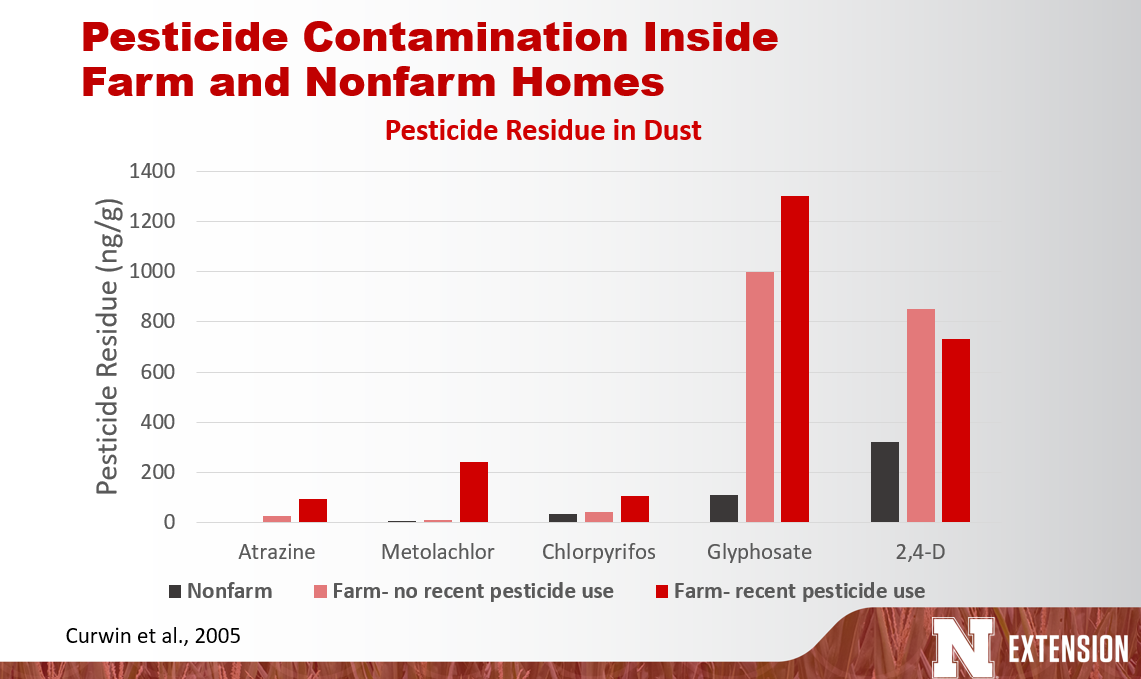

This information is important as we think about how any of us can be tracking pesticides through our homes. Pesticides are applied to fields but also to our lawns and sometimes even to driveways. Think about our shoes walking through all these areas.
- Do we always remove our shoes at the entranceway before walking through homes?
- Do we always remove pesticide contaminated clothing in an area where we’re not walking through the home first?
- Are we then leaving that clothing separated from the family laundry in a plastic trash bag?
Laundering pesticide contaminated clothing correctly is also super important. We talk about this during pesticide training. But I wonder how many homeowners using general use pesticides are aware of how to properly launder clothes after they’ve applied products like roundup, 2-4D, or things like weed and feed to lawns?
The following are basic steps for laundering pesticide contaminated clothing. I also have magnets that you can put by the washer machine and you can contact me if you’re interested in having one.
- Separate clothing with heavy plastic bag (trash bag)
- If the clothing is heavily contaminated, hose it off or pre-soak outdoors…or consider tossing heavily soiled clothing and shoes.
- Wash contaminated clothing daily.
- Use Hot water, liquid detergent, and the biggest wash load size possible.
- NEW: Add 1 cup of salt to the washer if washing clothing where paraquat was used.
- If possible, line dry clothing. Otherwise, use the regular drying setting.
- Run an empty cycle through the washing machine before washing family/regular laundry.
Nitrogen Challenge Meeting 2025
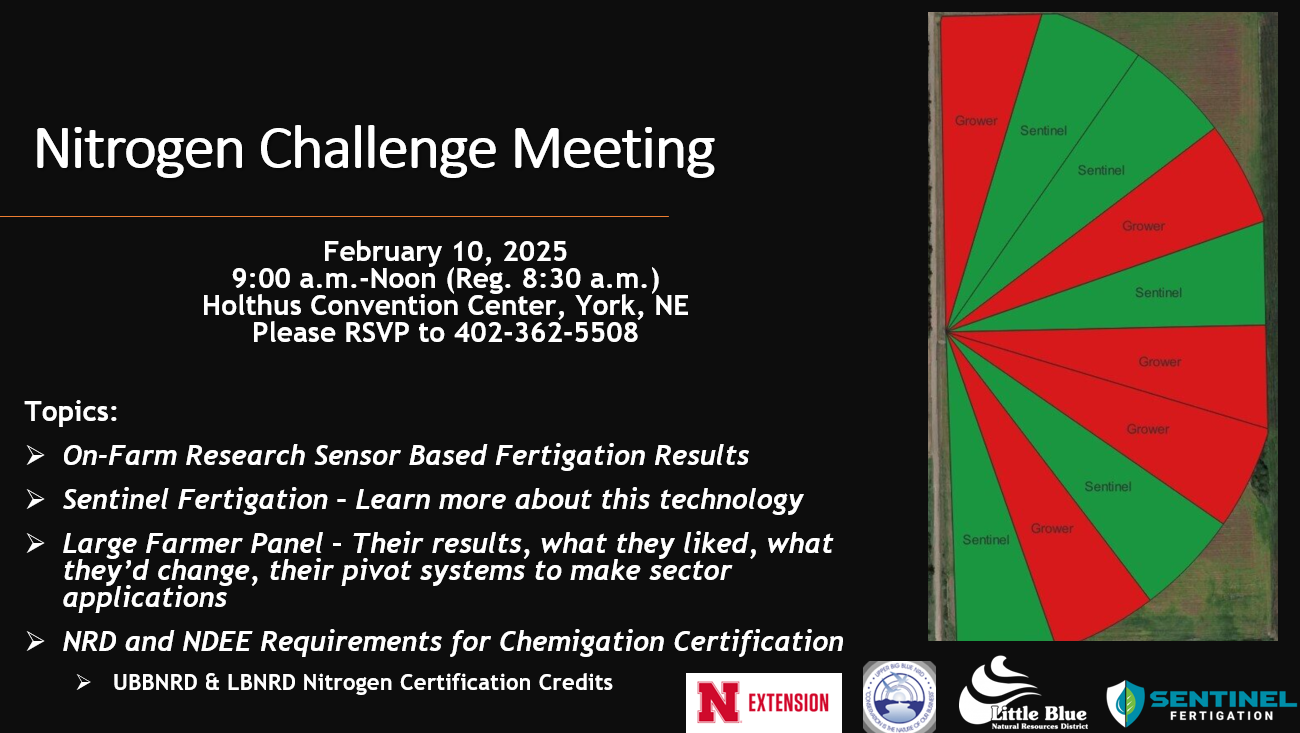
Nitrogen Challenge Meeting Feb. 10: In November of 2023, I issued a nitrogen challenge. As a reminder, my challenge was to everyone with irrigated ground who applies fall anhydrous or spring pre-plant fertilizer:
- Leave 1 piece of ground with a base rate of 70-100 lb N/ac
- Goal is to apply the rest of N in season using a tool like Sentinel Fertigation that senses what the plant needs.
- Only asking to consider for 1 field. Are you willing to join me in this?
Sixteen area producers took the challenge on 4718 acres in 2024. I haven’t heard the combined nitrogen savings yet, but if each reduced nitrogen by 40 lb/ac, that’s a savings of 188,720 pounds of nitrogen. And the greatest impact is that nitrogen use efficiency continues to be improved to on average around 0.6 lb N/bu produced with minimal residual soil nitrate remaining post-season in soil samples. The comments I’ve heard from the growers so far are that they’re so surprised how the technology can see when the crop needs nitrogen before they can and how much nitrogen they saved using the technology while obtaining similar yields.
I don’t have the 2024 on-farm research results yet. The 2023 on-farm research data showed that on average, 57 lb/ac less nitrogen was applied in the Sentinel Fertigation sectors than the grower sectors with similar average yields of 253 bu/ac for the Sentinel sectors and 255 bu/ac for the grower sectors. Average nitrogen use efficiency was 0.57 for Sentinel and 0.77 for the growers (which was actually really good for these growers to begin with!)
My goal for nitrogen management is to see an increasing number of producers use sensing technologies such as this that have been research-proven to help with nitrogen management. The updated Extension Circular published by UNL Nutrient Management Specialists also recommends using sensing technologies and in-season nitrogen applications vs. recommending a rate or even recommending using nitrogen equations. There’s just too much uncertainty with weather conditions to know what a crop will need in any given year.
So, I’m hosting another Nitrogen Challenge Meeting this year. It will be February 10, 2025 from 9 a.m.-Noon at the Holthus Convention Center in York. It will be a similar format to last year where on-farm research results will be presented in addition to an explanation of how the sensing technology works from Sentinel Fertigation. We will hear from NRD staff regarding chemigation requirements and this training qualifies for nitrogen recertification credits for both the UBBNRD and LBNRD. I think the most impactful part of last year’s program was the larger farmer panel, which I will have again. There’s so much we can learn from the growers using the technology and from the differences each of them have in their pivot and chemigation systems. You’ll hear from them about the successes and challenges they had.
For non-irrigated acres, there’s increasing interest to use the satellite imagery to also make applications in season. You’ll learn more about this as well. There is no charge for this meeting but please RSVP to me or to 402-362-5508 so we can plan for refreshments and materials. I hope to see more growers trying the Nitrogen Challenge in 2025!
Farm Succession Meetings: As a reminder, our farm succession meetings begin on Tuesday nights for four weeks beginning Jan. 21. It’s a great opportunity and men are welcome in addition to women. More info: https://wia.unl.edu/succession25/

Fridays in February 2025
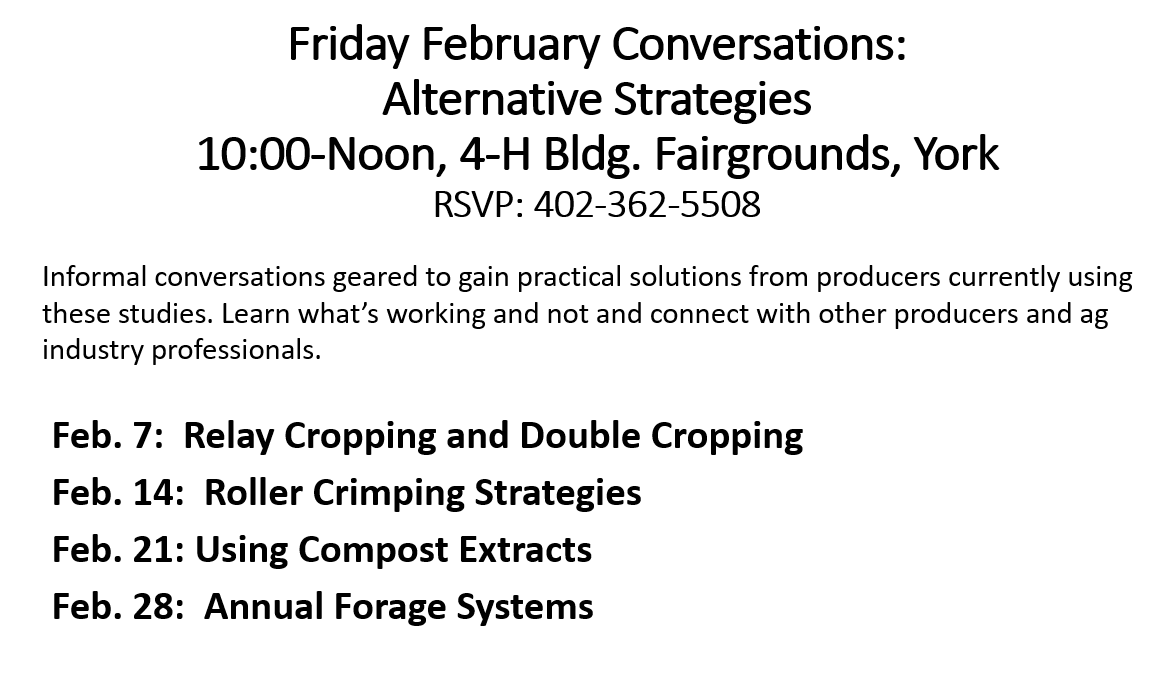
2025 Fridays in February Conversations: For the past few years I’ve hosted “Fridays in February” conversations with the goals for producers and ag industry to gather and have informal, practical conversations, and share experiences/solutions around topics ag is facing. With the downturn in commodity prices and tight economics, I’ve been thinking about alternative strategies. I’ve also received increased questions and interest around some common topics. So, they will be the topics of conversation this year. With every conversation, I will invite a few producers and/or ag industry to share their experiences. Then all engage in informal conversation. Please consider joining us for coffee, cookies, and conversation around any/all these topics if you’re interested! Conversations are held each Friday from 10 a.m.-Noon at the 4-H Building in York. Please RSVP to me or to 402-362-5508 so I can have enough materials prepared for each conversation.
February 7 – Relay Cropping and Double Cropping: There’s been increasing interest of how to improve the economics of small grains with either relay cropping or double cropping soybeans with either rye or wheat. Hear from growers who are trying this in a variety of ways and what they have learned.
February 14 – Roller Crimping Strategies: Small grains have huge benefits in our crops regarding reducing soil erosion, weed control, and breaking pest cycles. There’s also been an increase of growers planting corn or soybeans green into small grains. Hear from growers on the equipment they’re using, different strategies on roller crimping small grains and what they’ve learned.
February 21 – Using Compost Extracts: There’s an increased interest in using biology to help release soil nutrients to the plants while reducing the amount of synthetic nutrients applied. Instead of purchasing biological products, the growers using compost extracts are “growing their own biology” from composts using various methods, then adding water to the compost to extract the microbes and applying them to fields. Hear about the different methods growers are using for creating compost, extracting microbes, and what they’ve learned. On-Farm Research results will also be presented.
February 28 – Annual Forage Systems: With low commodity prices and high cattle markets, there could be opportunity for more producers to consider annual forage systems instead of traditional commodity crops. There’s also increasing interest in trying “regen” years on a piece of ground that includes cover crops and grazing to build diversity. Hear from growers who are incorporating annual forage systems into their crop rotations and what they’ve learned.
Reporting Survey: It’s reporting season for Extension. If you’d kindly like to share how my Extension work impacted you in 2024, please go to slido.com and use the code 4EXT. It’s anonymous and only 5 questions. Thanks!


 JenResources