Monthly Archives: July 2025
JenResources 7/27/25
White Mold in Soybeans Questions: There’s no need to worry about spraying if you don’t have a history of this disease in your fields. If you did have white mold in 2023, there’s potential for it in 2025. There’s also a lot of confusion about what white mold looks like. If one is in a corn/soy rotation, corn residue in a soybean field often has a “white fungal” growth on it this time of year. That’s due to saprophytic fungi doing their job in decaying that organic material; nothing to worry about! There’s also many types of mushrooms that are involved with decaying organic material that one might find in a field. Seeing mushrooms does not mean they’re going to create white mold. The fungus that causes white mold of soybeans creates mushrooms from black sclerotia that look like mouse droppings. When you scout within a soybean canopy, the mushrooms will be attached to the sclerotia on the soil surface. They also have a specific look to them. You can learn more from Dr. Dylan Mangel, Extension Soybean Pathologist, in this CropWatch article: https://go.unl.edu/opv3.

County Fairs: Thanks to all who made the Seward and Fillmore County Fairs a success! This week is the York County Fair; the website that contains the schedule of events and ability to purchase tickets is at: http://www.yorkcountyfair.com/. For those interested in exhibiting items in Open Class, you can find the Fair Book in the Extension Office or online at: https://go.unl.edu/c2qn. Entry times are Tuesday, July 29 from 6-8 p.m. and Wednesday, July 30 from 8-11 a.m.
Testing Moisture in Forages: Dr. Mary Drewnoski sent out the following info. after a summer grazing field day, “accurate moisture testing is key to preventing spoilage and heating in hay and to ensuring proper fermentation in silage. Below are a few options, along with pros and cons:
Koster Moisture Tester
How it works: Uses a small scale and heating unit to determine moisture by weight loss.
Pros: High accuracy (considered the “gold standard”). Works for hay, silage, and other forages.
Cons: Slower process (20–60 minutes per sample). Requires a power source.
More info & instructions: UTIA Publication (PDF)
Where to buy: Koster Tester Website or search online for deals. Price is now around $500 (double a few years ago when I bought mine).
Hay Windrow Moisture Testers
How it works: Dish-style handheld electronic probes for quick readings in windrows or chopped samples.
Pros: Fast and easy to use in the field. Measures a wider range of moisture (13–70%) compared to standard bale probes, making them suitable for silage.
Cons: Less precise than Koster. Can require good sample prep for consistency.
Where to buy: There are mean options on Amazon or a simple google search with this term will give you option. Price range: $200–$400
DIY Option: If you already have a hand held bale probe, here’s a way to adapt it: Progressive Forage Article
Microwave Oven Method
How it works: Drying a forage sample in the microwave to measure weight loss.
Pros: Very low cost (just need a microwave and scale). Works for both hay and silage.
Cons: Time-consuming and requires caution (fire hazard if overheated and results in potential for increased error). Not as convenient for field testing.
Directions: UNL CropWatch Article


Crop Update 7/21/25
Crop Update: Pollination is occurring and with the news on social media, received a number of calls regarding corn tassels this week. Last year, I had seen some “tassel wrapping” in a few hybrids but hadn’t said anything as I didn’t receive calls on it. This year it’s far more widespread throughout the country. What is meant by tassel wrapping is the last few leaves are tightly wrapped around the emerging tassel so that only a small portion of the top is pollinating and showing. As I’ve watched these tassels the past two years, they try hard to emerge from the leaves. Some hybrids are able to push out of the leaves better. Some will push out through the side of the leaves. The tassels then look strange with what parts are able to shed pollen once they emerge from the wrapped leaves.
In some of the hybrids, there’s enough pollen being shed from refuge plants and the tassel tops, that they should still pollinate ok. There’s a few with less pollen shed, yet there’s also corn pollinating in nearby fields. Hopefully there won’t be pollination issues. It will be important to watch your specific fields for pollination.
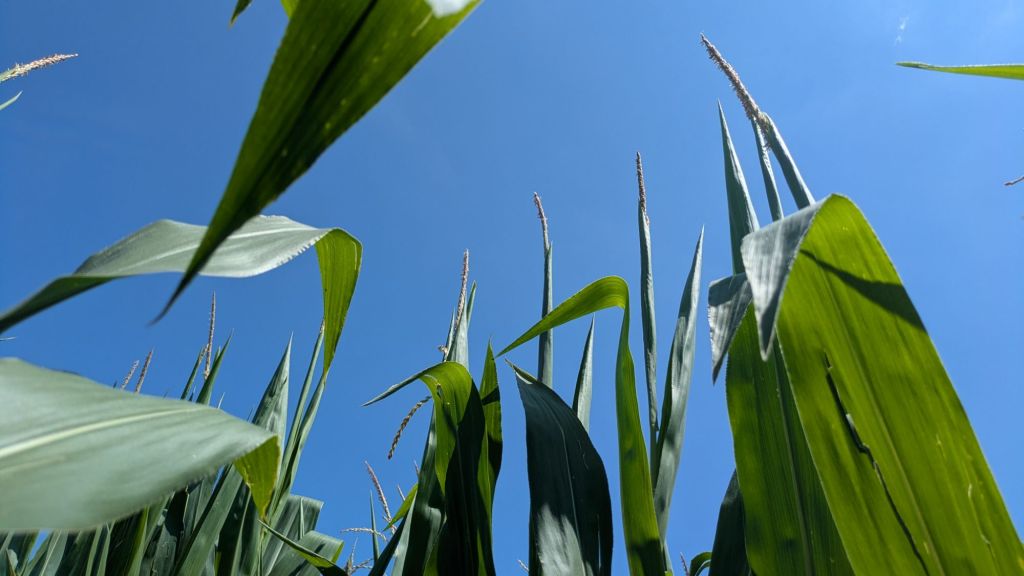


No one likes to see these things happen. There’s been a number of things shared as to what’s going on. Some are calling this environmental. I’ve heard a number of people talking about either generic dicamba or status applications to corn. I’ve been in the fields looking at this for 10 days and would encourage you to walk into the signed plots of the different companies and local County Corn Grower plots. If this was an environment or dicamba issue alone, entire counties of acres would be impacted because of being in a similar environment and because of how much dicamba is used in post-herbicide applications. This unfortunately appears to be genetic as I’m only seeing it in specific genetics. When across companies, they’re genetically related.
Southern rust was also found in Nebraska last week and in our area, it was found in Butler and Polk counties even though Butler isn’t lit up on the map. It’s at low incidence and not a level to spray yet. I’m still saying to wait till at least milk if you’re still planning on a fungicide app to reduce potential pathogen resistance and for best economic thresholds: https://corn.ipmpipe.org/southerncornrust/.
Summer Grazing Field Day: Alex Daake in the Utica area is hosting a field day on Tuesday, August 5th from 4-6 p.m. at 4136 Superior Rd, Utica. He took a pivot and divided it into quarters. One quarter is soybean, corn, grazed mix for 1 year, grazed mix for 2 years. Cereal rye is also taken for seed after the grazing. He rotates the quarters each year. The field day will primarily focus on how Alex is grazing covers, the cover crop mixes used, and how he feels it’s improving the soil. Come learn about what he’s doing, why, and the economics. On the quarter with corn was 2 years of previous grazing. He has an on-farm research nitrogen study on that ranging from 0-150 lb N/ac. He is also using satellite imagery from Sentinel Nutrient Mangement to determine which plots, if any need additional nitrogen. It will be a great afternoon of learning and sharing! Please RSVP to me at jrees2@unl.edu or 402-440-4739 if you’re interested in attending. Cookies and drinks will be provided.
South Central Ag Lab Field Day will be held Thursday, August 7th near Clay Center from 8:45 a.m.-3:10 p.m. (Reg. 8:30 a.m.). The day is designed so you can pick and choose which topics you’d like to attend. More info. at: https://enreec.unl.edu/south-central-agricultural-laboratory-field-day/.
JenResources 7/14/25
It was a blessing to get away for the national ag agents conference and then on vacation! The keynote speaker was Dwayne Fisher who is the VP Marketing and partner at Champion Produce Sales in Idaho. His speech was about relationships. My takeaway from him was, “The more, more, more is creating less, less, less when it matters most, most, most. When we don’t feel we have time for one more thing, pause and take time to do something for someone else. (Regarding people)-Notice them, Value them, Serve them, Encourage them. We can’t replace Relationships.” This was a helpful reminder and “shot in the arm” for me; hopefully, helpful in some way for you too.
For the ag tour, I learned about wool production and marketing and toured a sheep ranch that was 45 miles from Yellowstone National Park in the mountains. The rancher shared the challenges of grazing thousands of sheep in the mountains with wolves and bears migrating from the park and killing sheep. The specific wolves and bears have to be tracked and ID verified before they can be eliminated. They work with experts to use drone technology and game cameras to help identify the specific animal. At the wool-buying stop, we learned that China dictates the market based on weekly wool sales in Australia. Australia sells more wool in one week than what the U.S. sells in 1 year. The take-home from the wool-buying stop was to buy more natural fibers like wool and cotton.
Fungicides: Received many questions last week on fungicide applications to corn and soybeans. First, tar spot is still at low levels where it’s been found in fields and hasn’t hit the 5-7% thresholds. It prefers temps in the 60’s-70’s, which to me explains why we’ve mostly seen it get worse in fields at the end of the growing season. I realize a lot of fungicide is going on corn. Economically and threshold-wise, I’d wait as long as possible before applying a fungicide. The research from Indiana showed that it was still economical to apply through milk-early dough stage. Waiting will allow for residual for when you may need it later in the season if tar spot or southern rust take off. There won’t be residual left for those making apps now. Just for consideration as the economics don’t justify multiple applications.


For soybeans, if the field had never had white mold in the past, I would not worry about a fungicide for white mold. If it’s a seed corn/soybean or corn/soy rotation field and had white mold in the past, one could aim for one fungicide application at full flower (R2). If you’ve had 2 years of corn followed by beans this year, you probably don’t need a fungicide. And, if you planted soybeans green into a small grain, again, you shouldn’t need a fungicide as we’ve seen small grains keep white mold at bay. I realize I’m more conservative with recs compared to most, but this is based on economic thresholds and understanding the pathogen and crop rotation history. Also, a reminder if you’re interested in using plant nutrition in either corn or soy for on-farm research, please let me know.
Summer Grazing Field Day July 24 will be held at Eastern NE Research & Extension Center near Mead from 9 a.m.-2 p.m. (Registration at 8:30 a.m.). The cost is $20 and they are requesting RSVP for lunch count. More info here: https://beef.unl.edu/news/summer-grazing-field-day-strategies-beat-slump/. The day will be casual and discussion-based. Take a look at the summer phase of a double-crop annual forage system—where warm-season forages like sudangrass (with or without sunnhemp) are being grazed by both cow/calf pairs and stockers. Additional topics include:
- How to manage warm-season annuals to get the most out of them
- What the performance data says (ADG, stocking rate, carrying capacity)
- How the economics compare between cow/calf and stocker systems
- New prussic-acid free sorghum-sudangrass variety
- Virtual fencing in action


 JenResources