Monthly Archives: December 2025
January 2026 Events
Hoping you and your family had a blessed Christmas and wishing you a wonderful 2026! Winter program brochures are being mailed and can be viewed at: https://jenreesources.com/upcoming-events/. Please contact the Extension Office hosting the event you’re attending.
It’s also Extension reporting time and I appreciate those who share thoughts about my work via this survey. If you’re willing, please go to https://www.slido.com/ then enter 4EXT in the code area. Thanks!
Custom Rates Survey: Many people utilize UNL’s custom rates publication to get an estimate for charging or compensating for various farm-related operations. The survey is available from now until mid-January. If you provide custom services and agricultural operations and are willing to provide input, please sign up to receive the survey at go.unl.edu/tbky. Data will be gathered and summarized in the 2026 report. Thank you for your help!
Crop Production Clinics offer recertification for pesticide applicators (commercial, non-commercial applicators) in addition to updated crop and pest management information. The closest to this area include: Jan. 14 near Mead, Jan. 16 in Beatrice, Hastings on Jan. 21, York on Jan. 22, and Kearney on Jan. 27. This year, only the locations in York, Kearney, and Norfolk will be hosting the second room that features information on cropping systems, digital ag, agribusiness, and water and nutrient management. More info. and RSVP at: https://agronomy.unl.edu/cpc.
Pesticide Training: A common question is, “Do I need to renew my license if the coop is applying the chemicals and I’m not?” The answer to this is, no as long as you are not applying any restricted use pesticides at all. A certified pesticide applicator needs a license if you are using restricted use pesticides. I’m teaching the trainings at York, Seward, and Fillmore counties and helping David Wangila with some of the trainings in Clay, Nuckolls, and Thayer counties. It is helpful for RSVP to the county you wish to attend the training even though you can also walk in.
Nitrogen Challenge Meeting will be held on Friday, Jan. 16th at the Holthus Convention Center in York beginning at 9 a.m. The goals of this meeting are to share the research-based results from using in-season nitrogen management via Sentinel Ag, understand how to use this technology, and share farmer testimonies from growers utilizing this technology. There will be a peer networking lunch sponsored by Sentinel Ag to develop a peer network of growers using this technology. There is no charge but we need an RSVP for the meal count. Please RSVP to jrees2@unl.edu for the time being.
Jan. 22 Corn and Soybean Expo will take place on Thursday, January 22, 2026 at ENREEC near Mead (1071 County Road G, Ithaca, NE 68033). The program will kick off at 8:30 a.m. and will finish up at 3:00 p.m. The goal is to help producers plan for next year’s growing season. There is no registration fee.
Jan. 28 Corn Production Clinic will be held at the Fairgrounds in Aurora. More details will be shared in the future.
Joy and Praise
Today I was thinking of the gifts of joy and praise. Watching the children sing and share in our church’s children’s Christmas program filled my heart with joy! People in our church then shared testimonies of praise for what God has done in our lives through the recent sermon series in Jonah. All the testimonies contained joy and praise in spite of a few of them bringing many of us to tears. We have a number of friends who have unexpectedly lost family members the past two weeks. Other friends and family are facing illness and hoping to spend this Christmas together. It’s hard to lose family members any time of the year, especially around holidays. A few friends were grieving family members who passed earlier this year not being with them this Christmas and a few others were grieving family members who passed several years ago. Perhaps some of you can relate to these situations too?
The National Institute of Health published a study in May of 2025 about the complexities of joy. The authors shared, “Joy was perceived as a distinct, profound emotion, often intertwined with gratitude and love. Barriers to joy included negative relationships, societal pressures, and emotional burdens, whereas fostering positive relationships, engaging with nature, and cultivating self-awareness were identified as key strategies for sustaining joy.” The study also shared the resiliency of joy…that participants experienced joy in spite of good or difficult times…that choosing joy produces resilience.
In this study, “Participants consistently shared that connection was fundamental to their experiences of joy, emerging from connection with others and sharing values, meaning, and purpose. Being connected to oneself, especially the authentic self, and being open to a range of emotions, were deemed crucial for experiencing joy. Connection to nature and the environment was significant, particularly for those who felt disconnected from people. Feeling connected to something larger than oneself and engaging in loved activities such as hobbies and spiritual practices were important for experiencing joy. Periods of diminished joy coincided with a loss of connection in various ways.”
It’s good to see research continue to show the benefits of connection producing joy. Life is hard and grief is a funny thing in how it shows up so randomly. It made me think about what I shared at Thanksgiving about intentionality in time with others as life isn’t guaranteed. A couple girlfriends and I talked about this again today…that we want to be intentional with the most important things and in living with joy and gratitude. We wanted to be more intentional with family, friends, and those hurting around us.
Wishing you and your family/friends Christmas blessings with joy and praise in the midst of whatever you may be facing. I’m also grateful for the Savior of the World who was born to die that we might live!
Winter Program Brochures have been mailed by several area counties or will be mailed after Christmas. Please RSVP to the county office where you’d like to attend the meeting being hosted. You can also find the list of winter events at: https://jenreesources.com/upcoming-events/.


Ranching for Profit School
This past week my husband and I had an incredible experience attending the Ranching for Profit School. It’s a fairly intense business training but really more than that. He had attended the school a few years ago and we chose to go together this year so I could better understand the economic concepts we were using on the farm. It’s exciting to see how the concepts, in addition to the peer group of other businesses, is helping transform our farm!
Ranching for Profit School began in 1983 and its mission is to help create Healthier Land, Happy Families, More Profitable Businesses. I think many of us can resonate with this. Specifically, the mission is about our purpose, our “why”. I’ve had a personal mission statement for decades, but it’s important for our businesses to have a statement as well. Why? It helps us with decision making and keeps us grounded in the good and difficult times. The mission should encompass the customer value, the owner value, and core principles (values). Our vision is what we want. I appreciated how the teachers kept asking us, “What do you want?” We can’t make wise decisions if we don’t know what we want to aim for. They shared, “If you can see it in your head and feel it in your heart, you can hold it in your hand.” Every business on my team left with an action item to work on our Mission/Vision. I think that’s an important item for all of us to consider for ourselves personally as well as professionally.
For the economic concepts, we were taught a way to determine gross margin per unit. This allows us to evaluate enterprises (each crop and/or class of livestock) side by side to understand where we were obtaining the most value. If we’re going to be profitable, we need to think about the value we’re creating. It’s a way to help us consider the things we should be doing more or stop doing altogether. We also learned strategies to determine how to increase the value of each enterprise.
We were challenged to think about any paradigms keeping us from moving forward. Paradigms are a lens from which we view the world. They’re subconscious beliefs we’re often unaware of. An example many can relate to is, “Hard work leads to success”. However, how many of us work incredibly hard yet aren’t profitable? Often working even harder isn’t possible or practical. We all have paradigms that impact our daily decisions and relationships. Some paradigms can be positive, but others can paralyze our decision-making. Paradigms lead to action which leads to results. Thus, they suggested if we wanted to change our result, we needed to look at our paradigms. Sometimes we can’t see the things right in front of us that need attention because of our paradigms. This is also where it’s important to have trusted peers and advisors who we allow to speak into our lives to help us see what we can’t. One unfortunate story shared how an owner’s deeply rooted paradigm resulted in an operation going bankrupt, in spite of others speaking into the situation using the economics. It made me wonder how quickly that could happen, particularly during really tough economic times such as now in farming. It was helpful for me to become more aware of paradigms I have and hopefully this thought is helpful to you too.
If any of this sounds of interest to you, I’d encourage you to check out the Ranching for Profit website at: https://ranchingforprofit.com/. While the school was designed for ranchers with livestock and grazing/haying enterprises, there are a number of farm and other businesses who attend because of the solid business principles that can be applied anywhere.
Dr. Kohl’s Ag Update
This week, I’m sharing an article that my colleague, Brandy VanDeWalle wrote on December 5, 2025 about “Ag Update and the Road Ahead” by Dr. David Kohl’s presentation at the recent Farmers and Rancher’s College Program. Brandy writes,
“Recently at a Farmers & Ranchers College program, Dr. David Kohl shared his global perspective on current events and how they influence U.S. agriculture—insights that are always incredibly valuable. One of the highlights of his presentation was a “SWOT analysis” of the United States. While many businesses routinely use SWOT analyses to evaluate strengths, weaknesses, opportunities, and threats, it was fascinating to consider how this framework applies to an entire country.
Kohl noted that one of the United States’ greatest strengths is its abundant natural resources. Together, the U.S. and Canada hold 20% of the world’s water supply. The nation’s extensive river system also provides an efficient means of transporting goods. Additional strengths include a solid capital structure, legal system, and property rights; the global role of the U.S. dollar in trade; a strong educational system; an entrepreneurial economy; and the country’s historic position as a global influencer since World War II.
Weaknesses cited include political polarization, inconsistent policies, and declining trust in institutions. The U.S. also faces an aging population combined with a reactive healthcare system, a growing federal deficit, substantial budget obligations, a service-dependent economy, a widening concentration of wealth and income, and aging infrastructure paired with supply chain challenges.
Kohl highlighted that North America has tremendous potential when the U.S., Canada, and Mexico work together—representing 5% of the world’s population but 29% of the global economy. Additional opportunities include improving proactive healthcare to enhance quality of life, cultivating next-generation leadership at all levels, advancing as a global leader in applied technologies, and strengthening natural resource and environmental management.
Among the threats, Kohl warned of the likelihood of a catastrophic technology event that could disrupt major industries or even the country itself. He also identified the risk of a “brain drain,” as scientists and researchers leave the U.S. due to issues such as funding uncertainty, instability, perceived anti-science sentiment, and heavy recruitment from other global powers including the EU and China.
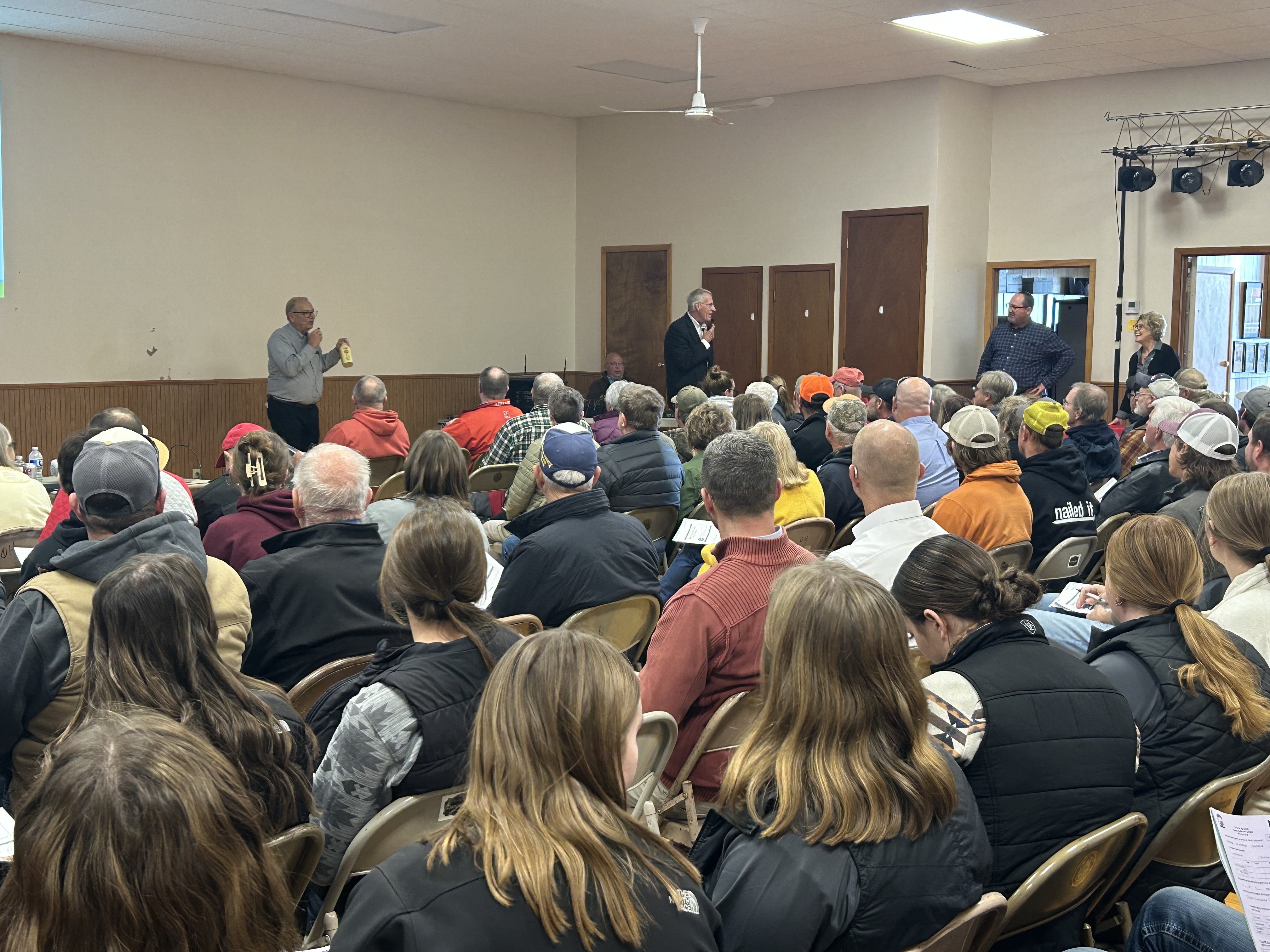
Dr. Kohl emphasized the critical importance of human interaction and communication. While artificial intelligence and other technological tools can help reduce workloads, they can never replace genuine human relationships. He reminded attendees that people need connection and purpose. Quoting a favorite saying, he noted, “It is better to have a good neighbor than their farm,” reinforcing the idea that being kind and building strong relationships matter far more than acquiring more land or expanding a business.
In conclusion, he provided leadership principles that stand the test of time:
- Change occurs bottom up, not top down.
- Manage the controllables, manage around the uncontrollable.
- Quick money builds ego – disciplined principle-based strategy/activity results in resiliency, nimbleness, agility and character.
- If you are going to lead, you must read!
- Success is often measured in dollar signs. Significance is giving back and making a difference in people’s lives.
- A successful culture and society must have success in agriculture.
It was great to see over 30 FFA members and community college students in attendance which Dr. Kohl praised and asked them each to share what they learned. He praised the 4-H and FFA programs for providing youth a purpose and developing life skills.”


 JenResources