Crop Ground to Annual Forage Grazing
Converting Crop Ground to Annual Forage Grazing: A handful of producers have been doing this in the area with more considering it for 2026. Why? With the high input costs and low commodity prices, producers are searching for alternatives. The economics of grazing covers is good compared to planting corn and soybeans. Pencil it out for your operation. Input costs for grazing annual forages include cover crop seed and seeding, land costs, potentially one herbicide application between rye and planting a summer cover crop, water and fence infrastructure, and irrigation for establishing covers on irrigated ground. Here’s a potential rotation to make this work: rye planted in the fall or oats planted in March. Strip graze the rye or oats in April-May. Plant a summer annual cover crop mix in June/early July. Strip-graze the summer mix in late July-October. Some people will move livestock off the crop ground between light frosts until a hard freeze if sorghum species are in the summer mix (to avoid any prussic acid poisoning). Then livestock can continue grazing any remaining forage after frost with minimal loss in quality. If cool season cereals like rye/wheat/oats were added to the summer mix, they will come on in the fall and add additional quality to the forage into the winter. Or, a cool season cereal can be planted in the fall after the summer annual forages are grazed off. There’s multiple options for doing this!
Those cash renting ground were often able to pay for the cash rent of irrigated or non-irrigated crop ground in 1 to 2 grazings. How to figure costs? UNL farm real estate reports share an average cost of $68/cow-calf pair/month to graze on pasture in Eastern and Central NE. Annual forages would have a higher quality, so that should be taken into consideration for the value received. If you would graze cattle for someone else, such as grazing custom cattle, you can expect to receive anywhere between $1.50-$2.50/1000 lbs of cow (standard animal unit)/day depending on one’s location. This is also the value you’re creating if you’re using your own cattle to graze the covers. If you own cattle and want to retain your calves and add weight after weaning, consider putting the calves on the forages for the highest value return and gains. Pencil it out for your operation. We converted half our crop acres this year to forages for custom grazing cows. And, the benefits are beyond a single year of economics. I’ve seen how strip-grazing plants with animals can improve ground through improving pH, improving water infiltration through better soil aggregation, increased soil microbial communities, and nutrient release. A risk for consideration is lack of rainfall on non-irrigated ground to establish covers and maintain growth. Producers will also share specific examples with their economics on this Friday’s Feb. 27th conversation from 10-noon at the 4-H Building in York.
Farmers Bridge Assistance (FBA) Program: This program provides $11 billion in one-time bridge payments to row crop producers in response to temporary trade market disruptions and increased production costs. The FBA enrollment period opens Feb. 23 and closes April 17, 2026. There will not be mailed prefilled applications anymore. Producers are encouraged to use/create a login.gov on farmers.gov to apply or they can still apply in person in the office. More info: https://www.fsa.usda.gov/news-events/news/02-20-2026/usda-announces-enrollment-period-farmer-bridge-payments?utm_campaign=022026fbaenrollment&utm_medium=email&utm_source=govdelivery.
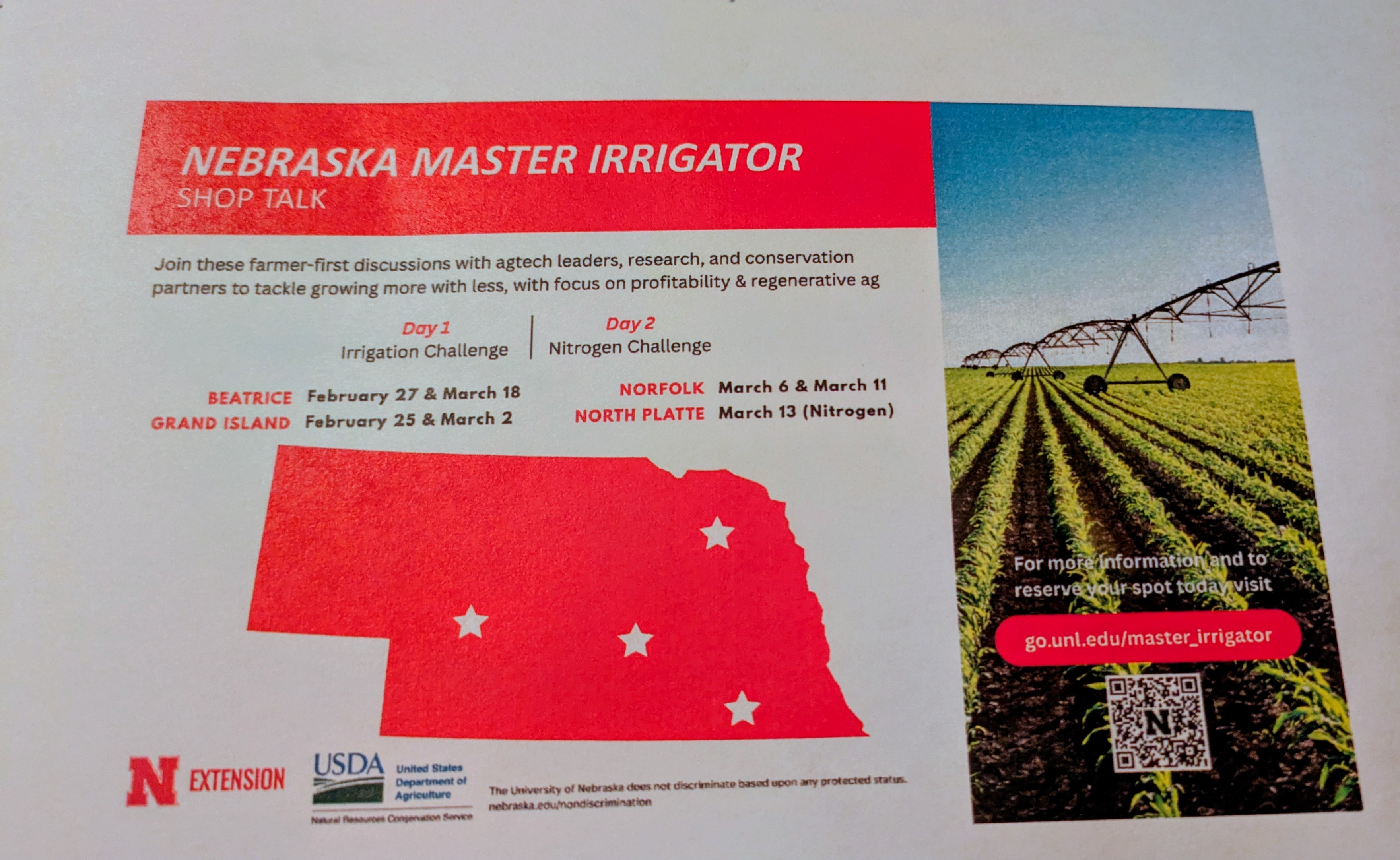
Master Irrigator Program: Nebraska Extension invites farmers, agricultural professionals and conservation partners to participate in a local 2026 Nebraska Master Irrigator “Shop Talk” discussion. These will be two‑day, discussion‑based programs focused on tackling today’s most pressing irrigation and nitrogen management challenges. The first day of each location will focus on irrigation and the second day will focus on nitrogen. Registration and info at: https://go.unl.edu/master_irrigator. Walk-ins are welcome. Closest sessions include: Grand Island Extension Office on Feb. 25 & Mar. 2; Extension Office in Beatrice on Feb. 27 & Mar. 18.


Posted on February 22, 2026, in Forages, Grazing, JenREES Columns and tagged converting crop ground to annual forages for grazing, grazing annual forages, grazing cover crops. Bookmark the permalink. Leave a comment.


 JenResources
Leave a comment
Comments 0