Drought and Nitrogen Use Efficiency
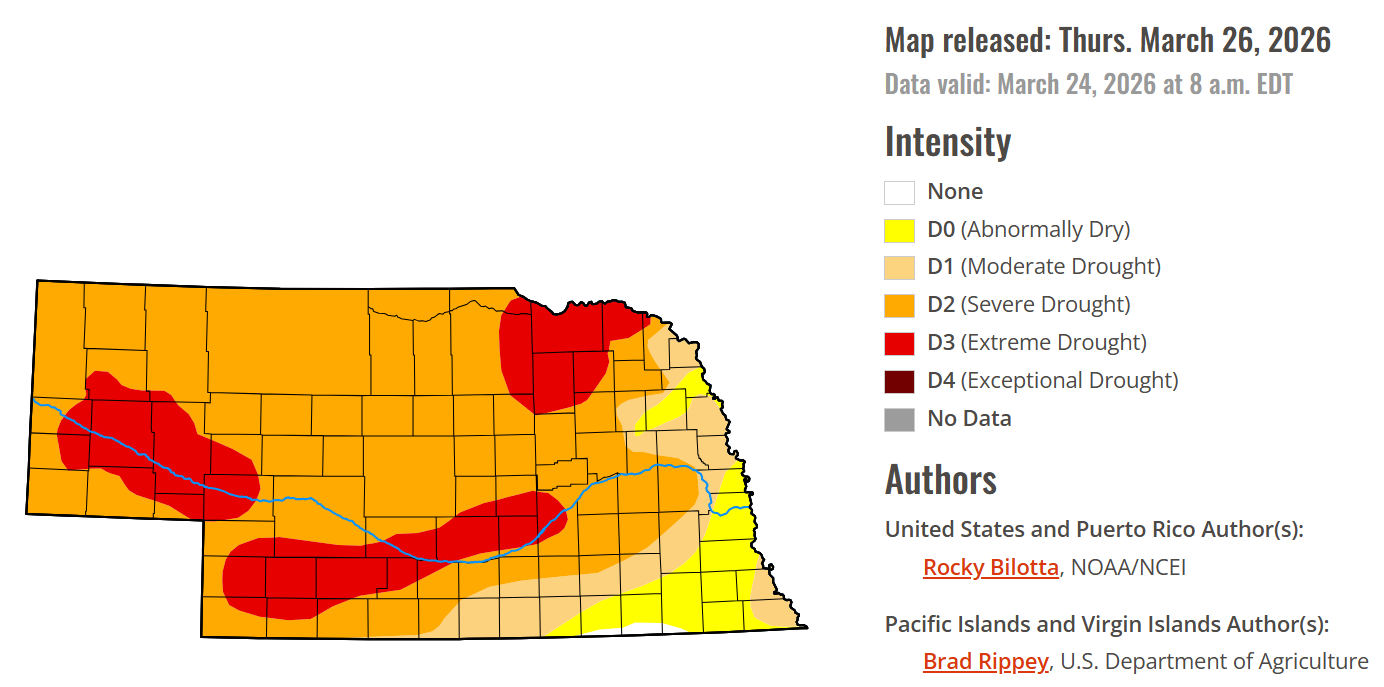
Drought: As of Thursday’s drought monitor release, 99.6% of Nebraska is abnormally dry/in drought. This same week in 2023 was also at 99.6% and similar to 2025 at 98.2%.
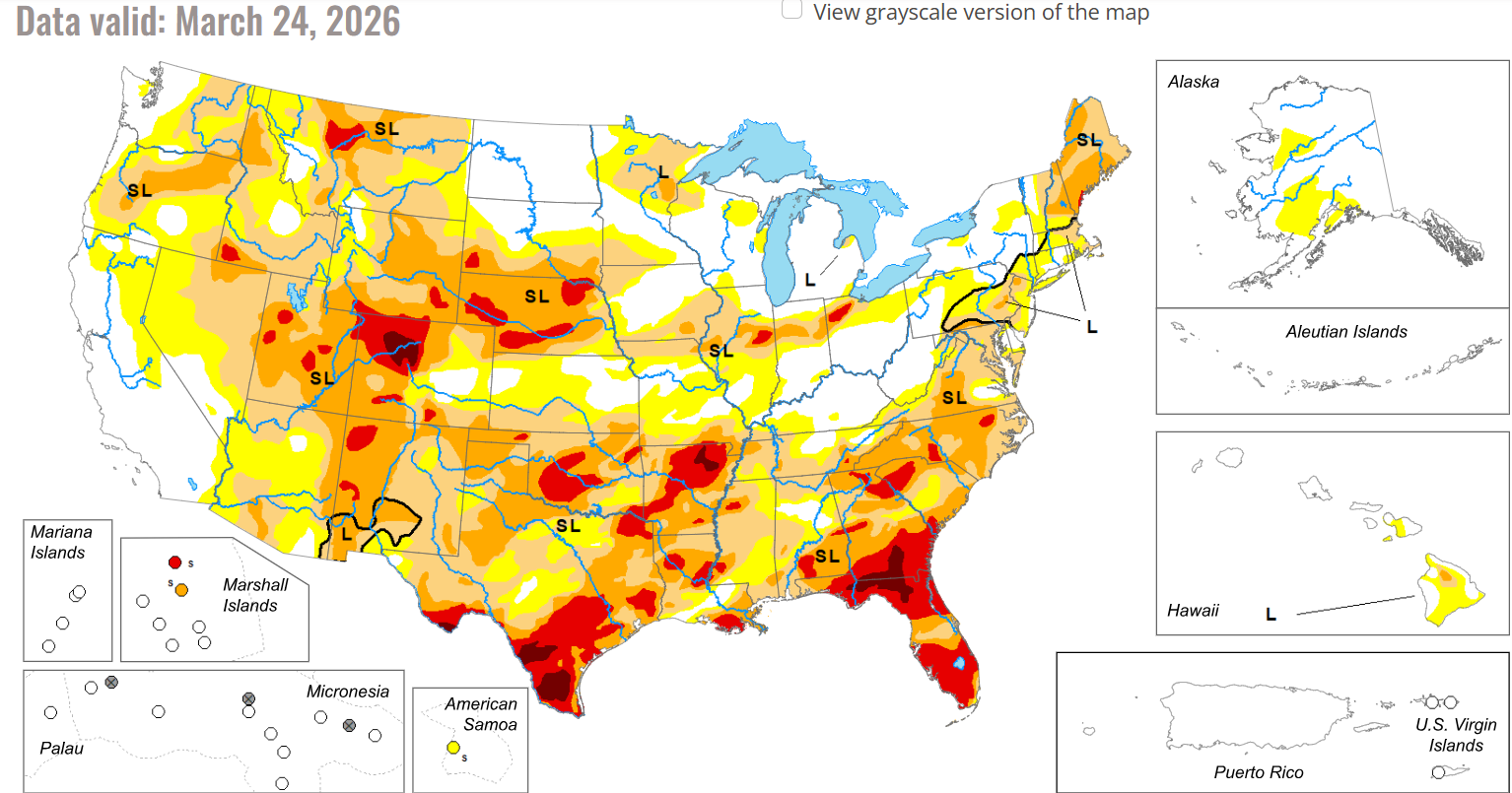
What’s also interesting is that currently 77.1% of the entire U.S. is abnormally dry/in drought. That’s actually the highest for last week on record for the U.S. I could find. The other closest years for entire U.S. drought were 72% in 2022; 67% in 2025; and 65% in 2002, 2013, and 2021. We all know it’s dry and we’ll keep praying for much-needed rain.
Cover Crop Termination Timing: I’ve received a number of questions about cover crop termination timing. Several have also contacted me asking about the potential of utilizing these covers for custom grazing cattle impacted by wildfire areas instead of terminating the covers. There’s a number of questions around this and ideas on how to compensate for the grazing/cattle care. To be clear, my goal in sharing this is to help with the questions I’m receiving and to help with a real situation Nebraskans are facing right now. I think the unknowns are how many producers are willing to offer this type of service and how many cattle impacted by wildfires need custom acres to graze. Because producers have asked me who to talk with to obtain answers, I’d suggest contacting the NDA director’s office and possibly commodity groups such as Nebraska Cattlemen’s or Nebraska Farm Bureau to share your thoughts and see if there’s possibility for a decision around this soon.
For farmers with non-irrigated ground, if you’re not planning on using the cover crops for forage, watch soil moisture for your specific fields. While I promote planting crops green into cover crops, the soil moisture situation is dire in the seed zone and terminating pre-plant may be the wisest option. For growers with irrigated ground, again, watch your soil moisture for your specific fields. If choosing to terminate pre-plant, one option is to use clethodim (follow label regarding the wait period of 7-10 days prior to planting corn). Clethodim provides a slower kill and doesn’t cause the covers to “melt down” as rapidly as roundup does. If you choose to plant green, have pivots ready to go in the event you need to provide water into the seed zone after planting into the growing cover.
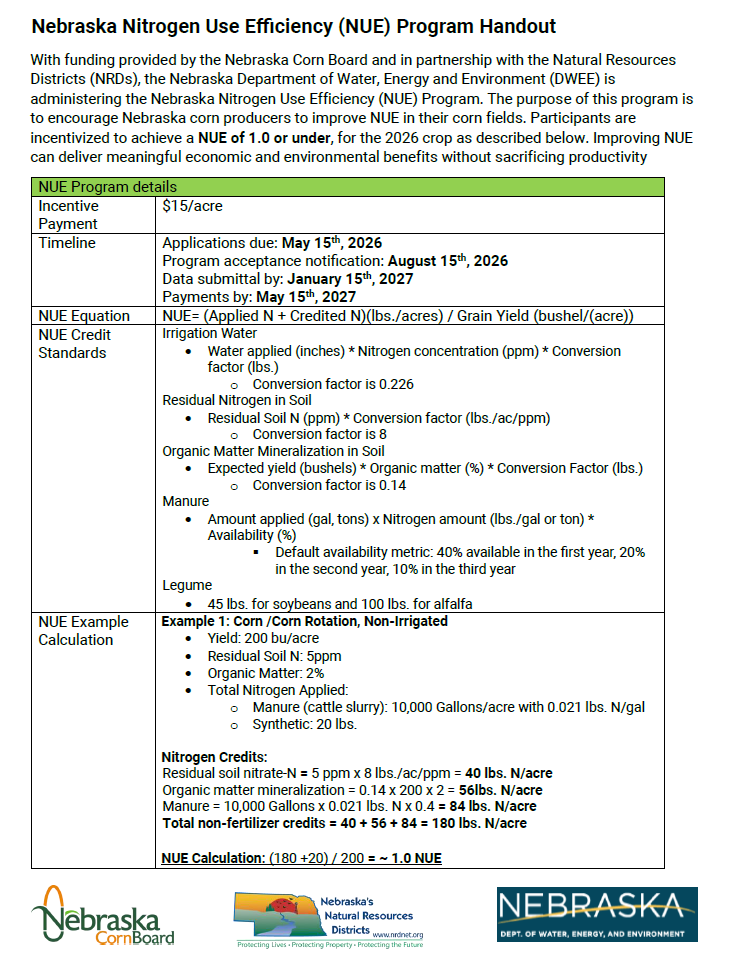
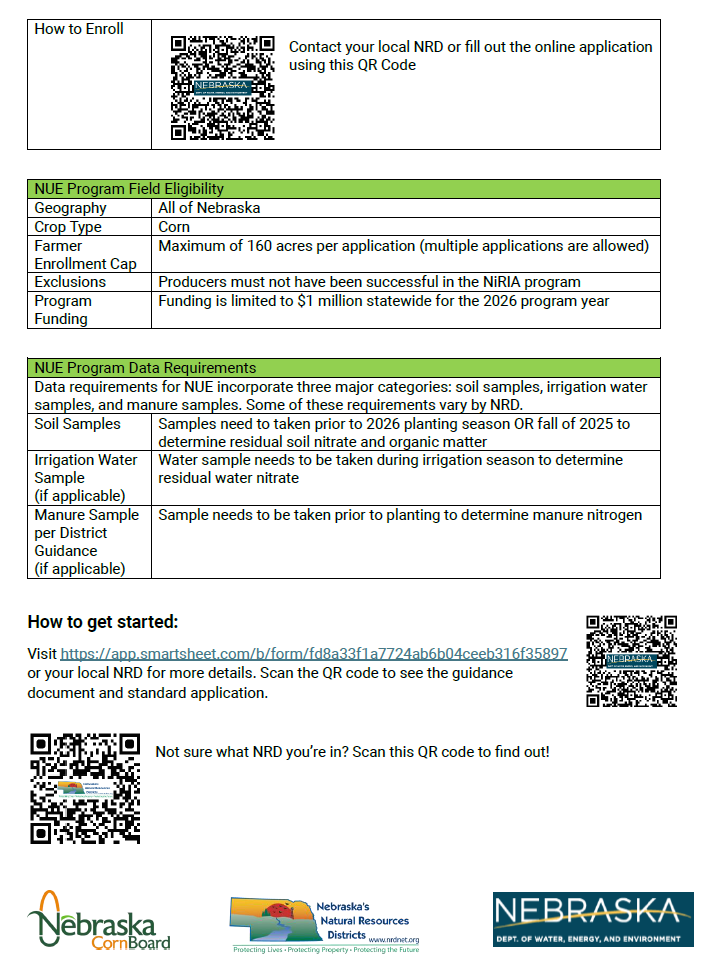
2026 Nebraska Nitrogen Use Efficiency (NUE) Program: With funding provided by the Nebraska Corn Board and in partnership with the Natural Resources Districts (NRDs), the Nebraska Department of Water, Energy and Environment (DWEE) is administering the Nebraska Nitrogen Use Efficiency (NUE) Program. The purpose of this program is to encourage Nebraska corn producers to improve NUE in their corn fields. Participants are incentivized to achieve a NUE of 1.0 or under, for the 2026 crop as described below. Improving NUE can deliver meaningful economic and environmental benefits without sacrificing productivity.
Nitrogen Use Efficiency (NUE) measures how effectively a crop converts available nitrogen (N) into harvested grain yield, quantifying the relationship between N inputs and crop output. NUE accounts for total available N by including credits such as soil, water, legumes, and manure (lbs./acre) divided by grain yield (bu/acre).
For the 2026 cropping season, applications are due May 15th, 2026, pending funding status, and will be subject to NRD approval. NRD will review and prioritize the applications based on available funding. Methods for application prioritization will be established by each NRD with applicants notified no later than August 15th, 2026, whether their application has been approved or denied. Full details at: https://dnr.nebraska.gov/nebraska-nitrogen-use-efficiency-nue-program.


Posted on March 29, 2026, in Drought, JenREES Columns and tagged cover crop termination, drought, nitrogen use efficiency program. Bookmark the permalink. Leave a comment.


 JenResources
Leave a comment
Comments 0