Author Archives: JenBrhel
JenREES 12-22-19
Thanks to Randy Pryor, Extension Educator Emeritus, for reviewing this article. Also, appreciate the growers who shared data and Farm Service Agency (FSA) personnel from several counties who answered my questions. Here’s more farm bill information.
PLC Yield: A few weeks ago, I mentioned you can obtain a sheet from your local FSA Office which shows PLC yields and necessary yield in order to increase PLC yield. If you don’t have that sheet, you can use your 156EZ form. Take your PLC yield and divide by 0.81 to get the yield necessary to increase your PLC yield. For example, a PLC corn yield of 190/0.81= 234.57 bu/ac. Your 2013-2017 RMA actual yields would need to show you’ve achieved at least 234.57 bu/ac in order to increase your PLC yield.
Seed Corn Yields: For seed corn yields, if the farm has commercial corn in addition to seed corn in rotation, the commercial corn yield will be applied to the seed corn. If no commercial corn is grown in rotation on the farm, use the Plant Base Yield (PBY) not to exceed 120% of the county irrigated corn yield. For example, in 2013, York County Irrigated Corn Yield was 235.92 bu/ac. Multiply this by 120% = 283.10 bu/ac. Compare this to the PBY for the same year and use the lower of the two numbers.
Historical Irrigated Percentage (HIP) is taken into account for ARC-CO payments. For those of you who are using the Texas A&M decision tool, you will see a box to input HIP. As you look at your 156EZ form, you will see an area for HIP. Counties that had to split out irrigated vs. non-irrigated acres for certain crops in the 2014 Farm Bill will have a HIP listed. Counties that didn’t have to do this will not have one listed. For those with HIP listed, it may or may not be accurate depending on if you incorporated/lost irrigated ground in the past 5 years. For purposes of the Texas A&M tool, you can use your best estimate of irrigated vs. non-irrigated percentage.
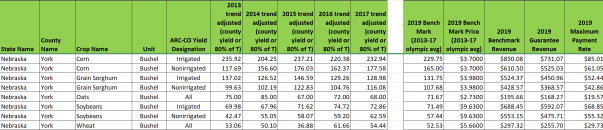
ARC-CO Calculation: Regardless if you’d like to try the Texas A&M tool or not, you can also get an idea of the price in which ARC-CO would trigger a 2019 payment by doing a simple calculation. Take your county guaranteed revenue and divide that by the county benchmark yield. For example, for irrigated corn in York County, the 2019 Guaranteed Revenue is $731.07. The 2019 Benchmark Yield (which is an Olympic average yield from 2013-2017) for irrigated corn in York County is 229.75 bu/ac. Taking $731.07/229.75= $3.18. What this means is that based on these numbers, if the York County RMA Yield comes in at 229.75 bu/ac, which is a trend adjusted yield, a payment would not be triggered for ARC-CO for irrigated corn in York County until a $3.18 corn price is achieved. This is in comparison to PLC in which the trigger is $3.70 for the corn price. Many of the counties in which I’ve done this calculation for irrigated corn have around a $3.18 trigger price for ARC-CO currently. That alone tells you a lot regarding decision making. If the trendline yield remains close to current one, it leans towards enrolling in PLC for irrigated corn, but it is a two year decision. You can also try other figures (ex. trying 235 and 220 bu/ac) if you think the trendline yields may be higher or lower than the current estimate to see other potential ARC Co price triggers.
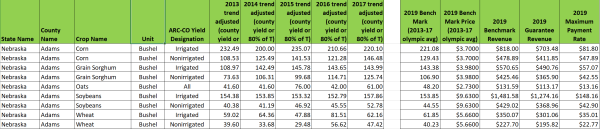
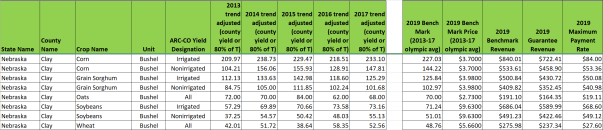
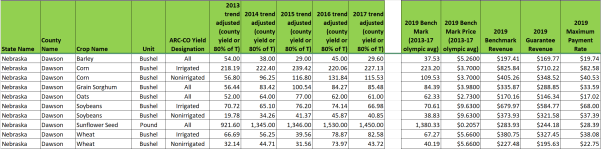
Randy Pryor shared a spreadsheet with me from USDA that had all the yearly yields, trend yields, and revenue guarantees for each county and each crop in Nebraska to date. I’ve placed tables with these numbers on my blog at jenreesources.com for the counties in which I helped growers for the 2014 Farm Bill. You can also ask your FSA Office if they can provide this information for you.
FSA Meetings: If you missed the Farm Bill meetings and would like to better understand the differences between the 2014 and 2018 Farm Bills, please contact your local FSA Office. Many of them are having small meetings certain days of the week but can’t share which way you should enroll.
Texas A&M Decision Aid: Randy Pryor and I are recommending that if you use a decision aid, that you use the Texas A&M one. For those of you I worked with during the 2014 farm bill, I have your username and password if you no longer do. You can also reset it by calling their help line. I’ve assembled screen shots at https://go.unl.edu/texasam that walk you step by step through inputting data into the tool. If you have questions, please let me know. Hoping this is helpful!
*End News Column. County tables below.



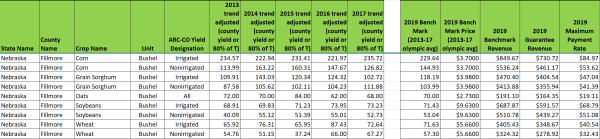
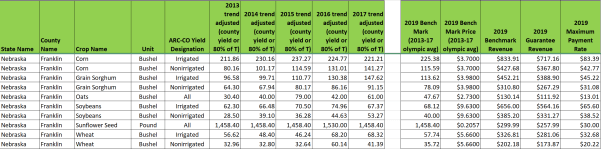
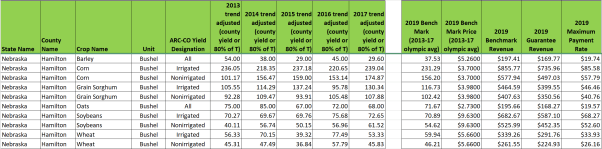

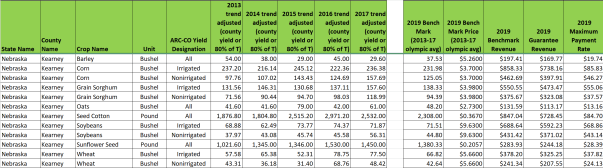
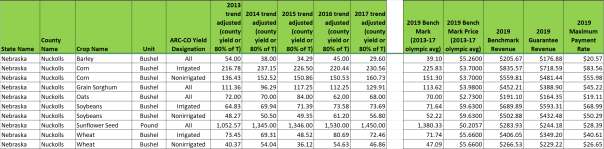

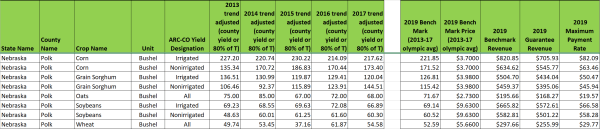


Additional Farm Bill Info:
Entering data into Texas A&M Farm Bill Decision Aid Tool
*Special thanks to Randy Pryor, Extension Educator Emeritus for reviewing this information.

You will need your FSA156EZ form which can be obtained from your local FSA Office. It will show you farm numbers, base acres, PLC yields for each of your farms. For counties that had split irrigated and non-irrigated yields in the 2014 Farm Bill, there will be a Historical Irrigated Percentage (HIP) listed on your 156EZ as well. For counties that had combined irrigated and non-irrigated yields, there will be no HIP (as shown on this form). A HIP would not take into account 2013-2017 production, thus, if you added irrigated acres during that time, you would need to consider that in your HIP percentage. You will need to add a HIP for the Texas A&M Farm Bill Decision Aid. If one isn’t listed on your FSA156EZ or if your HIP has changed the past 5 years, use your best estimate.
The Texas A&M Farm Bill Decision Aid can be found at: www.afpc.tamu.edu/tools/farm/farmbill/2018. You will need to first login using your email and password (If you used the tool for the 2014 Farm Bill decision, it will take the same email and password. I have them for growers I helped with the 2014 Farm Bill). Otherwise, if you can’t remember it, you can request help from the developers (Phone: 979-845-5913 or Email: info@afpc.tamu.edu. Some have said it takes a long time to receive a response). If you’ve never used it, register with an email and password. If you forgot your password and didn’t receive a response, perhaps consider signing up with a new email address. Just be sure to keep the email and password with your farm bill info. for future decision aid tools!
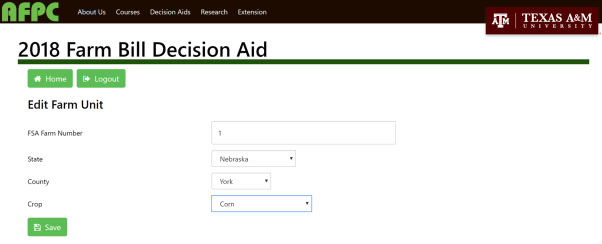
I haven’t found any data that was entered in 2014 to be in this 2018 decision aid thus far. Thus, you will need to click on “new farm” and you will see the above screen appear. Enter your FSA Farm Number, State, County, and one crop for that farm number. Then click ‘save’.

You will then see this screen appear. If you have another crop with base acres on the same farm number, click on “add another crop” and repeat as many times as necessary until all crops with base acres are added for that farm number.
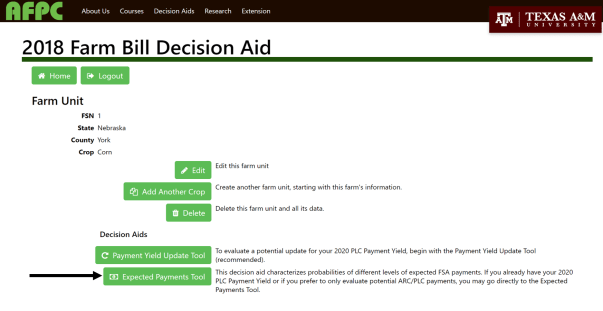
Once all your crops are entered for the farm number, click on “expected payments tool”.

You can now use your 156EZ to enter base acres, PLC Yield, HIP, and expected prices. For simplicity, you can anticipate PLC yield to be same in 2020 as 2019. USDA projects prices in the right-hand column. I would recommend to run the simulation using their prices first (click on “use these”). You can always go back and play with prices. Then click on “recalculate” button. Note: The “advanced settings” can be used to hone in on county yields as we get closer to February and more accurately predict 2019 payments.

The program will show possible payments based on 500 simulations of anticipated outcomes from the data you entered. Be patient and wait for the numbers to appear. It will give you mean potential payments on this view.
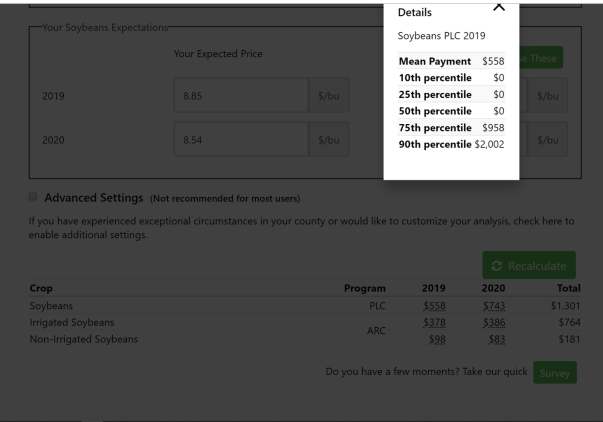
In order to better understand payment potential, click on the dollar amounts. For example, I clicked on 2019 PLC $558 and you can see additional information appears. There’s no really good explanation of this information in the tool, so here’s how to better understand it. The mean is the true average of 500 runs. Each percentile shows the maximum potential payment. In this example, there’s a 75% chance of a payment $958 or less and 90% chance of a payment of $2002 or less.

You can then go back to ‘home’ and repeat the steps clicking on “expected payment tool” in order to enter data for other crops under the same farm number. (Note: always be sure to check the crop on the upper part of the screen as for some reason, it seems to default to soybean).

This is showing the output for corn in this simulation with a mean PLC payment of $1744. With current prices, we’re just in a different situation compared to where we were making decisions for the previous farm bill.
You can then repeat these steps for each farm number to get an idea of potential payments for all crops under each farm number. This is a tool to help with your decisions with the best information possible at this time. Hopefully this is helpful for you and please share any comments/questions below.
Additional Farm Bill Info:
JenREES 12-15-19
The past few weeks I’ve had several questions regarding cash rents/leases. My colleague Allan Vyhnalek wrote an article addressing several of these questions, so sharing some of his thoughts. You can read his full article here: https://go.unl.edu/qxt7.
“What should I rent my ground for? (How do I calculate a fair rental rate?): Land rent can be based on several things. Rental rates of the local area, percentage return on investment, survey data showing rental rates, percent of gross income, and many others. The recommendation is to calculate the estimated rental rate based on three or four of these calculations and then decide.
- The local rental rate might be obtained from an ag loan officer at your local bank, by ag real estate professionals, or from professional farm managers.
- To calculate a percent return on investment, multiply the value of the land by the percent return that you’d like to receive. Be sure to factor in expenses such as land taxes when making this calculation.
- Land Value Surveys:
UNL land value survey: https://agecon.unl.edu/realestate/2019-farm-real-estate-report
Nebraska Ag Statistics Service (NASS) survey: https://www.nass.usda.gov/Statistics_by_State/Nebraska/Publications/County_Estimates/19NEcashrents.pdf - The percent of gross income is calculated by taking the average yield of the commodity grown multiplied by the expected price for that commodity which equals the gross income per acre. The landlord would typically receive about 30% of the gross income calculation; however, the number will change based on yield and price. The percentage should represent an average across 5 or more years.
The bottom line on rental rate is that it will be what the renter agrees to pay and the landlord agrees to accept. Pricing will also be based on supply and demand of farmland rental ground in the area. There is no right or wrong definitive rental price. The final rent is simply an agreement between parties involved. Typically this constitutes a fair and equitable trade price for the use of the ground.
Is a Crop Share Lease still a valid lease? Yes, it is still a fair lease. It is probably the fairest lease that you can have. In periods of commodity price stability, the cash lease gained popularity because the landlords didn’t like to pay for their part of the expenses and most didn’t care to have to market their share of the crop. A crop share lease indicates your willingness to share the risk of farming. Crop Share leases share the risk between landlord and tenant. Cash leases put all risk of production on the tenant solely.
What is the Most Common Share Lease Used? There is no share lease that is more or less correct or appropriate for one situation or another. The distribution of the share (50/50, 60/40. Etc.) depends largely on the agreement between the land owner and the tenant. In some cases, the agreed to distribution in the lease, is 60% tenant and 40% landowner; in other cases the distribution depends on the final inputs, for example, the tenant would pay all seed and chemical, and landowner paying all land and drying. Your final distribution will depend on your expectations and the agreement with the tenant.”
Farm Real Estate Resources: https://cropwatch.unl.edu/economics/realestate
Fillable Lease Templates: https://aglease101.org/DocLib/default.aspx
Flexible Cash Lease Calculator: https://farm.unl.edu/cash-rent-flex-calc
Landlord/Tenant Cash Rent Workshops: These three-hour workshops will cover: agricultural finance and the real estate market; current trends in ag finance across Nebraska; negotiation skills for effectively managing land leases; current considerations on lease provisions; and strategic farmland succession and communications. There is no charge and please RSVP to the Extension Office in the county you wish to participate. Closest locations to this area will be: Jan. 7, 1:30 p.m., Extension Office in Seward; Jan. 8, 9 a.m., 4-H Building in York; and Jan. 15, 1 p.m., Fairgrounds in Clay Center.
JenREES 12-8-19
Farm Bill: A special thank you to Leann Nelson and her staff from the York/Hamilton
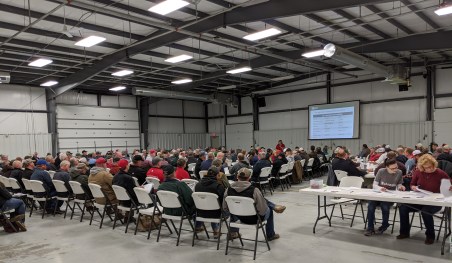
County Farm Service Agency (FSA) for their help in Friday’s Farm Bill meeting in York! We had 130 pre-registered with at least double that actually attending. Greatly appreciate their help keeping coffee going and the help with set up and tear down! Farm bill decisions are complicated. For this column, I will provide a little perspective and also some first steps for consideration. In future columns, I will walk through options for decision making using the Texas A&M tool and other calculations.
Perspective: We need to keep in mind the current decision is for the 2019-2020 signup only…not the life of the farm bill. The decisions for the 2014 farm bill were extra daunting when we had to speculate what would happen with prices for the duration of the farm bill in addition to considering base acre reallocations. So, this two-year decision followed by the opportunity to change annually from 2021-2023 may be a blessing and take a little pressure off as you’re not ‘stuck’ with your decision for five years.
First Steps: Currently you need to: make an election for 2019/2020 and enroll for 2019, enroll for 2020, and determine whether or not you will update your yields. Your program election and enrollment for 2019 need to be complete by March 15, 2020; enrollment for 2020 by June 30, 2020; and your PLC yield update deadline is September 30, 2020. With making crop insurance decisions these winter months and having RMA data fresh on your mind, consider looking at yield updates now instead of waiting. My recommendations for first steps:
1-Contact your local FSA Office asking for their yield spreadsheet that shows your yields and base acres for each farm number. The spreadsheet will also show what actual yield is necessary in order to update your PLC yields. Even if you choose ARC-CO for your program election, it’s important to at least look at PLC yields as this gives you the opportunity to increase them in the event you ever choose PLC in the future. Because of the adjustment factors, a substantial yield improvement may be necessary to update PLC yield. So, knowing what yield you actually need in order to update can save you time before going through all your RMA data. Any yield updates will apply only to the 2020 year and beyond (not to 2019).
If you choose to update yields, you will need to use actual yields (designated with ‘A’) on your crop insurance forms (not APH). Sometimes crop insurance units are on the same sheet encompassing several farm numbers-so be aware of that as you will need to separate them out (irrigation practice doesn’t matter). If a crop insurance unit includes multiple FSA numbers, you can pro-rate those bushels to split the unit using acres. You also could go back to yield map data or scale tickets if you prefer. Ultimately, keep records of how you determine your yield updates as you will need them if you are spot-checked anytime before the end of this farm-bill period. The landowner also needs to sign off on the yield update and Power of Attorney (POA) is acceptable. The 2014 and 2018 farm bills specified that PLC yield could be certified from a minimum of 0.01 acres planted 1 year of the farm bill period. Randy Pryor shared that with me and he would recommend planting at least 1 acre. He had a grower with milo base acres who planted a 25 acre milo plot one time during the last farm bill period; it yielded well allowing him to update his milo yield. We don’t know what future farm bill rules will entail yet something to consider for the next 5 years if rules for PLC yield updates end up the same as the previous farm bills.
2-If you have any idea on farm program elections for 2019-2020, make an appointment now with your FSA Office and go ahead and enroll for 2019. They will also work through the enrollment paperwork for 2020 if possible. You can always change your election prior to March 15, 2020! All Farm Bill information can be found at farmbill.unl.edu.
Keeping Stress Levels in Check Webinar: A free webinar will be offered December 17 geared for farm and ranch families. The webinar will take place over the noon hour (12:30 p.m. CST) and can be accessed at go.unl.edu/stresswebinar. This webinar will provide strategies for dealing with the stress of farming or ranching in today’s difficult economic environment.
Additional Farm Bill Info:
JenREES 12-1-19
This time of year transitions to winter programming for me. The past few weeks I’ve mostly talked about cover crop results we’ve received from our on-farm research studies. I’m pretty passionate about on-farm research! On-farm research allows us to study topics we often wouldn’t receive funding for, with minimal monetary investment while conducting them on growers’ farms. It wouldn’t be possible without our grower cooperators and I’m so grateful for them!
We have an on-farm research database at: http://resultsfinder.unl.edu/ where you can click on a county or enter a keyword to search for various studies. It’s kind of picky on the wording, but it’s still a nice tool. I used this to compare cash crops planted into either cereal rye or cover crop mix for 1 year or for 3 years. Results can also be viewed via tables on my blog at: jenreesources.com.
One Year Studies: From 2008-2018, there were 7 studies in which corn or soybean was planted into cereal rye. They all showed either no yield difference or yield loss when the cash crop was planted into the cereal rye regardless of terminating pre- or post-planting. In 3 studies conducted in Clay, Franklin, and Phelps counties in 2014, either non-irrigated corn or wheat was planted into a cover crop mix. They all showed yield loss and moisture was anticipated to be a limiting factor, but no moisture sensors were used in the studies.
Three Year Studies: In three Saunders county locations where they planted cereal rye after harvest on the same strips for three successive years, there was either no yield difference or a yield increase in year three when the cash crop was planted into the cereal rye. We also have a long term study in Nuckolls county and will share more on that in an upcoming column.
We encourage growers to conduct studies more than one year where feasible. It’s especially important when looking at studies that have longer term implications to soil to maintain studies in the same location over time. Maybe some of you have tried a cover crop once but didn’t see positive yield results after year one; perhaps yield results would be different over time? The on-farm research studies summarized here don’t go into enough detail to specify why yields were the same or improved in the three studies in year three. During different meetings, some also asked about nitrogen tie-up in the cover contributing to yield loss. There are other studies showing addition of nitrogen at planting can reduce yield loss impacts due to nitrogen tie-up. Where we had information about nitrogen applied at planting, I added this to the tables on my blog. Ultimately, there wasn’t consistency in rates applied nor improved yield in all cases with these studies.
Farm Bill Meeting York Dec. 6: A reminder of the Farm Bill Meeting to be held at the Cornerstone Event Center at the Fairgrounds in York from 9 a.m.-Noon on Dec. 6. Please RSVP at: go.unl.edu/farmbill to select this or any other location. This helps us prepare and helps save time at the door during registration. If you prefer not to RSVP via computer, you can call your local Extension or FSA office and we will get you registered.
Nebraska Soybean Day and Machinery Expo Dec. 19 will assist soybean producers in planning for next year’s growing season. The expo will be in the pavilion at the Saunders County Fairgrounds in Wahoo. The Saunders County Soybean Growers Organization will be collecting non-perishable food and monetary donations for the Saunders County Food Bank backpack program. Complimentary noon lunch will be served. Registration is available the day of the expo at the door and there is no registration fee.
The event opens with coffee, doughnuts and the opportunity to view equipment and exhibitor booths at 8:30 a.m. Program begins at 9:10 a.m. Topics include: A New Marketing Tool for Soybean Growers-The Role of Harvest Moisture (Cory Walters, UNL); Decision Making in Uncertain Times (Richard Preston, Preston Farms Kentucky); Managing Soybean Diseases with Fungicides (Daren Mueller, ISU); Managing Waterhemp (Chris Proctor, UNL); Soybean Gall Midge (Justin McMechan, UNL); and Nebraska Soybean Checkoff Update and Association Information.
*End of Column. Cover Crop Tables Below.
Table 1: Corn or Soybean Planted into Cereal Rye Cover. One year studies. Yield values with the same letter are not significantly different at a 90% confidence level (for each individual study).

Table 2: Corn or Wheat Planted into Cover Crop Mix. One year studies. Yield values with the same letter are not significantly different at a 90% confidence level (for each individual study).
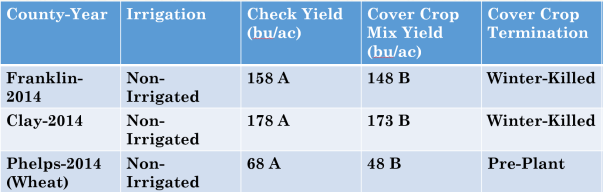
Table 3: Three year studies utilizing cereal rye as cover crop in same strips over time. Yield values with the same letter are not significantly different at a 90% confidence level (for each individual study).

JenREES 11-24-19
I’ve often thought about two words the past few months: Grief and Gratitude. It’s been a hard year for many with grief coming in the form of various losses. The stories I’ve been blessed to be entrusted with this year included losses in the form of livestock, land, fences, feed, finances, crops, homes, health, relationships, family members, pets, farms, jobs…
It’s important to take the time to grieve and acknowledge the losses while not getting stuck there. I think sometimes we want to push forward and avoid the mess of grief, but there’s healing in acknowledging it. At our Extension Fall Conference, we spent time talking through 2019 and the experiences we had as Extension faculty with boots on the ground serving people. While it was uncomfortable for many, there was healing in the discussion and sharing, in the tears and triumphs of helping others during a really difficult year. I would encourage us all to acknowledge losses we’ve experienced and ultimately keep talking with others instead of isolating.
Our keynote speaker at our conference was David Horsager who wrote the book The Trust Edge. One thing he asks his audiences, “What is the most endearing quality a person can have?” What do you think? Often people say kindness, compassion, generosity, being positive, humor, etc. His company does a great deal of research and they’ve found the most endearing quality is…Gratitude…sincere gratitude. According to Oxford’s Dictionary, gratitude means “the quality of being thankful; readiness to show appreciation for and to return kindness”.
There’s been a lot of research on gratitude! Harvard University shared, “In positive  psychology research, gratitude is strongly and consistently associated with greater happiness.” Summarizing several studies I read, most would say finding a way to count one’s blessings or focusing on gratitude greatly improved a person’s sleep, health, attitude, focus, and relationships. Many of those studies didn’t involve individuals who struggled with mental wellness. However, one study in Indiana focused on 300 adults who suffered from anxiety and depression. The researchers wanted to see if focusing on gratitude could help with mental health concerns. Adults were split into three groups and each group also received counseling. One group wrote a letter of gratitude to someone each week (but wasn’t required to share it). Another group wrote down negative thoughts and experiences while the third group didn’t do any activity involving writing. Individuals who wrote the gratitude letters were found to have significantly improved mental health 4 and 12 weeks after starting the activity (in spite of only 23% actually sending the letters). The gratitude activity on top of receiving counseling resulted in better mental wellness for the individuals than counseling alone. Regardless of if one is in the midst of a difficult time or not, research ultimately shows the benefits of seeking gratitude!
Grief and Gratitude. With Thanksgiving this week, for what are you and I grateful? Perhaps there’s someone who came alongside you this year during a difficult time or someone who showed you an unexpected kindness that you wish to thank in some way? Perhaps you choose to make a list of things for which you’re thankful or jot a few things down each day? Perhaps you choose to write one letter or note to someone each week expressing thanks? Or perhaps your family starts a tradition of expressing gratitude in some way during Thanksgiving dinner? Additional ideas for expressing gratitude, particularly for those with children, can be found at: https://go.unl.edu/q04v. Here’s wishing everyone a blessed Thanksgiving!
UNL Thanksgiving Food Safety Resources: https://go.unl.edu/ji8p
UNL Thanksgiving Food Preparation Tips: https://go.unl.edu/7rwi
JenREES 11-17-19
Trees Hanging onto Leaves: Driving in the country or in towns I tend to observe what’s going on in the fields, but also observe what’s occurring with the trees. Right now I’m noticing many maples trees looking like mine: hanging onto a portion of greenish/gray/brown leaves. Typically my silver maples are the first to lose their leaves each fall along with a neighboring ash. But the season didn’t start off typical for them either! Some of you, like me, have dealt all year with the huge seed load produced by these and other trees this spring. So why are some trees hanging onto leaves this fall? Most likely a cold snap in early fall interrupted the normal process deciduous trees follow to prepare for winter survival. As days shorten, a layer of cells (abscission zone) form between the tree branch and the individual petioles (stems of leaves), allowing the leaves to fall from the tree. This helps protect the tree from water loss in the winter. Some tree species, such as oaks, have an adaptation to maintain their leaves during the winter called leaf marcescence. It’s unknown exactly why. The hypotheses for why oaks maintain their leaves include: better protection of winter buds, allow for trapping of snow around the tree base, and allow for a flush of nutrients when leaves drop and are decomposed in the spring. So while it’s not normal for maples, lindens, ash, and other species to maintain leaves over the winter, there’s nothing we can do about the delay in leaf drop. If the leaves don’t drop this fall/winter, they will be pushed off by new growth from buds next spring. Leaves may continue to drop this fall/winter with wind and snow events. One thing to be aware of is the potential for increased limb breakage from wind/snow events in trees maintaining heavy leaf loads.
Are you interested in helping understand the noise of farming? Researchers at the University of Iowa developed (and are currently testing) a ‘HearSafe’ system to measure noise exposure of farmers. The goal is to provide information about exposure to loud sounds on the farm and how to protect one’s hearing. This system will consist of a small noise monitor, smart phone, and a laptop. They are looking for farm workers to try these new devices. The research activities are short term (between 1 day and 2 weeks), equipment and training are provided, and there’s compensation for participation. Those ages 18-65, active in farm production (20+ hours per week on average), who have access to a device with high-speed internet are eligible to participate. For more information please contact Jackie Curnick at jacqueline-curnick@uiowa.edu or (319) 335-4425.
Nov. 25 Heuermann Lecture Focuses on Protecting Ecosystems while Advancing Agriculture: Strategies for achieving agricultural advances while preserving Nebraska’s healthy agricultural ecosystems will be discussed at the Heuermann Lecture Nov. 25. It will be held at 3:30 p.m. at the Nebraska Innovation Campus Conference Center in Lincoln and via livestream at: https://heuermannlectures.unl.edu. Following the discussion will be a showing of the documentary film “Follow the Water.” Dinner is included to those staying for the showing. The event is free and open to the public.
Panelists will include Craig Allen, professor in the School of Natural Resources and director of the Center for Resilience in Working Agricultural Landscapes; Andrea Basche, assistant professor in the Department of Agronomy and Horticulture; and Michael Forsberg, co-founder of the Platte Basin Timelapse Project and assistant professor of practice in the Department of Agricultural Leadership, Education and Communication. The film tells the story of connections between the environment and people, and a river that shaped the land. Forsberg, a conservation photographer, and Pete Stegen, a filmmaker, journeyed for 55 days through the watershed by bike, foot and canoe, gathering footage with their smartphones. A panel discussion will follow the viewing so the audience can explore the themes of the film with Forsberg and his team.
Heuermann Lectures are funded by a gift from B. Keith and Norma Heuermann of Phillips. The Heuermanns are longtime university supporters with a strong commitment to Nebraska’s production agriculture, natural resources, rural areas and people.
JenREES 11-10-19
With harvest wrapping up, many of the questions/conversations this week involved economics in some way. So this week’s column will focus on upcoming learning opportunities. But before I get to that, thank you to all our veterans for your service and sacrifices! Thank you also to your families!
Ag Land Management Webinar: On Monday, November 18th at 6:30 p.m., Jim Jansen, an agricultural economist, and Allan Vyhnalek, a farm and ranch succession specialist, will lead their final ‘Agricultural Land Management Quarterly’ webinar of the year. They will provide an overview of the 2019 Cash Rental Rate Survey, conducted by the USDA National Agricultural Statistics Service, and discuss prevented planting considerations for Farm Service Agency programs and crop insurance. The importance of landlord/tenant communication during the winter months and tips for leasing also will be discussed. The free session is open to everyone at https://agecon.unl.edu/landmanagement. The recorded webinar will be archived there, along with past sessions. There will be time for participants to ask questions at the end of the session. Questions also may be submitted in advance at https://agecon.unl.edu/landmanagement.
Dr. Kohl to present at Farmers and Rancher’s College: On December 9th Dr. David Kohl, Professor Emeritus at Virginia Tech and popular for his insights, will be presenting at the Bruning Opera House in Bruning from 1-4 p.m. about “Agriculture Today: It is What it is…What Should We Do About It”. There is no charge for the program due to the Farmers and Rancher’s College sponsors, but please RSVP for meal at: (402) 759-3712 or online at: https://extension.unl.edu/statewide/fillmore/agriculture-0/.
Women Managing Ag Land Conference: Female agriculture landowners, farmers, and ranchers looking to increase their business management skills are encouraged to register for the 2019 Women Managing Agricultural Land conference. The conference will be held Dec. 11 at Nebraska Innovation Campus, 2021 Transformation Drive in Lincoln. Participants will have the opportunity to hear from leading experts in land values, Nebraska property taxes, cash rental rates and cultivating landlord-tenant relationships. Jim Jansen, co-author of the Nebraska Farm Real Estate survey, will discuss trends in Nebraska land values. Mykel Taylor, of Kansas State University, will share resources related to negotiations and communication between landowners and tenants. Cathy Anderson, from the Nebraska USDA Farm Service Agency, will discuss the 2018 Farm Bill and its implications for Nebraska agriculture. The full conference schedule and registration form are available at https://wia.unl.edu/wmal. A registration fee of $45 per person covers materials, meals, and breaks. The conference is hosted by Nebraska Extension and is inspired by Annie’s Project. In Nebraska, Annie’s Project is supported by Farm Credit Services of America. Also, a reminder that all Farm Bill information and upcoming meetings can be found at: http://farmbill.unl.edu.
Cover Crop Day: On November 20, a workshop focusing on cover crops will be held from 9 a.m.-1 p.m. (Reg. 8:30) at the 4-H Building in York. Presentations from NRCS, UNL, and Pheasants Forever will cover using cover crops to address soil compaction and improve soil health; precision conservation opportunities to increase farm profitability while conserving soil, water, and wildlife; and opportunities for cover crop on-farm research and cost share options. A free meal and optional field tour is provided but please RSVP to: http://nebraskapf.com/product/cover-crop-field-day-habitat-tour/
or call the Extension Office at (402) 362-5508.
On-Farm Research Searchable Database: A helpful resource to view studies growers’ peers have conducted with the economics provided can be found at https://resultsfinder.unl.edu. It’s a little picky based on the words one chooses, but has a lot of great info. Also, for anyone interested in conducting studies involving anhydrous with and without inhibitors this fall or spring, I have on-farm research protocols developed, so please let me know.
Women Managing Ag Land Conference
This would be a very helpful conference for any woman currently managing land or interested in learning more about managing land in the future. Great networking opportunity as well!

There are many women whether by choice or chance who manage agricultural land. For some, it is their livelihood and business. Other women might have inherited land from a family member and there are also women who just want to learn more about the agricultural business in partnership with a spouse or family member. No matter what the circumstance, Nebraska Extension will be providing a program to equip women with necessary management skills.
 Photo by Kaboompics .com on Pexels.com
A recent news release came out which shared that any female agriculture landowners, farmers, and ranchers looking to increase their business management skills are encouraged to register for the 2019 Women Managing Agricultural Land conference. The conference will be held Dec. 11 at Nebraska Innovation Campus, 2021 Transformation Drive in Lincoln.
The first-ever Women Managing Agricultural Land Conference will allow women to build relationships with each other, attend workshops and gain…
View original post 164 more words
JenREES 11-3-19
York County Corn Grower Plot Results and Banquet: The results of the York County Corn Growers plot can be found at: https://jenreesources.com/2019/11/03/2019-york-county-corn-grower-plot-results/. Special thanks to Ron and Brad Makovicka for their  dedication and work in hosting! Also appreciate all the seed companies who participate! The York County Corn Grower’s Banquet will be held Tuesday, November 26 at Chances ‘R in York with social at 6:30 p.m. and dinner at 7:00 p.m. Tickets are $10 and may be purchased from any York Co. Corn Grower director or at the York Co. Extension Office.
Fall Nitrogen Application: With November here, a reminder to check soil temperatures before applying anhydrous ammonia to crop fields. Soil microbial activity and the rate of conversion of ammonium to nitrate is very low when the soil temperature is less than 50oF. Thus, apply fertilizer-N (and manure) when the soil temperature at the 4” soil depth is below 50°F and trending cooler. Daily and weekly soil temperatures (taken 4” below the surface of bare soil) can be found at: https://cropwatch.unl.edu/soiltemperature.
Extension Soil Fertility and Nutrient Management Specialists Javed Iqbal, Charlie Wortmann, Bijesh Maharjan, and Laila Puntel shared additional considerations for fall Nitrogen application in this week’s CropWatch: Apply anhydrous ammonia rather than other N fertilizers; Limit fall application of N to silt loam, silty clay loam, and finer textured soils; Use nitrification inhibitors to slow the conversion of ammonium to nitrate, especially on sand-dominant soils; Avoid fall application on wet soils; and Consider applying a lower base rate of nitrogen in the fall and plan on applying the rest at planting, or as a side-dress application.
On-Farm Research Protocols are available for anyone interested in fall vs. spring nitrogen management studies, inhibitor studies, or other potential on-farm research studies by contacting your local Extension educator. For growers within the UBBNRD interested in on-farm research studies that have a water quality focus, you may be eligible for additional support through the UBBNRD. In some instances it may cover district staff and equipment use; in others, it may cover a portion of the costs of lab analysis of soil, plant tissue, or water samples. If you’re a grower interested in this type of study, please contact the UBBNRD or your local Extension Educator to talk through your study idea and for additional information.
Farm Bill Meetings: Joint Nebraska Extension and Nebraska Farm Service Agency (FSA) producer education meetings are scheduled at 28 locations across the state from late November to mid-December in advance of the coming ARC/PLC enrollment deadlines in early 2020. The meetings are free and open to the public. Advance registration is encouraged for planning purposes for materials and facilities. Attendees can register for any of the meetings conveniently on the web at farmbill.unl.edu or by calling or visiting their county FSA or Extension office. The educational programs will feature information and insights from FSA specialists and Extension experts, as well as other relevant information from local agencies.
Nearest locations for this area of the State include: Nov. 25. Community Center, Red Cloud (1-4 p.m.); Dec. 3 ENREC near Mead (9-Noon); Dec. 4 Ag Park in Columbus (9-Noon); Dec. 5 College Park in Grand Island (1-4 p.m.); Dec. 5. Opera House, Bruning (1:30-4:30 p.m.); Dec. 6 Fairgrounds Cornerstone Building York (9-Noon); Dec. 16. Extension Office Lincoln (9-Noon); Dec. 17 Fairgrounds 4-H Bldg. Beatrice (9-Noon); Dec. 17 Fairgrounds in Kearney (1-4 p.m.).


 JenResources