Author Archives: JenBrhel
JenREES 2-10-19
On the first day I started Extension nearly 15 years ago, I met two other Extension Educators and a farmer in a Clay County farmer’s field. The farmer was cooperating with us in an on-farm research project. It was great for me to see farmers answering their own questions by partnering with Extension to conduct field-scale, replicated research on their own farms. It also became a key tool for me to learn via field observations and build relationships with growers.
Any of you who know me know on-farm research is something in which I’m pretty passionate! The reason? You’re all going to meetings and reading information regarding various practices/products and you may wonder if any of those things will work on your farm. You may try various tests on your own, which can provide some information. But because fields are so variable, scientific tests can’t be conducted by just splitting fields in half or without true randomization and replication. Another reason I believe in on-farm research is because we answer much with minimal money invested! I think of numerous studies our farmers have partnered with us in which University faculty wouldn’t have been able to obtain grants because they were too applied. However, in farmers utilizing their equipment on their own ground partnering with Extension to collect and analyze data, we’ve been able to conduct these studies with minimal cost other than some additional time and travel to fields. We’ve tested numerous products including soybean inoculants, growth promoters, soil health, and nutrient management ones. We’ve tested various practices such as populations, planting dates, planting depths, nutrient timing, cover crops, and much more. A good portion of our results can be found at http://resultsfinder.unl.edu. That site is still missing the first 15-20 years of Greater Quad County on-farm research studies, but everything is there from 2010 on. (I hope to one day help get the rest added).
I’m so grateful for all of our on-farm research cooperators-especially to all of you who have worked with me-for your investment of time and trust in partnering! We can’t do this without you! And, I hope more growers consider partnering with us in on-farm research in the future!
On-Farm Research Updates: Next week will be our Nebraska On-Farm Research updates. It’s an opportunity to hear from the growers themselves who conducted studies in 2018 regarding why they chose their studies, how they conducted them, and what their plans are for the future. I really enjoy these meetings and learning from the discussions! While many of the studies may show there’s no differences, those are still answers to specific questions! Research projects include: cover crops, variable rate seeding, planting populations, starter fertilizer, fungicide applications, alternate crop rotations, seed treatments, and sidedress nitrogen management technologies including drone and sensor-based, variable-rate nitrogen management. Certified Crop Advisor Credits have been applied for and are pending approval. Call (402) 624-8030 or e-mail onfarm@unl.edu to register. Locations and times are listed below. There’s no charge with lunch included due to the partnership of the following: Nebraska Corn Growers Association, the Nebraska Corn Board, the Nebraska Soybean Checkoff, and the Nebraska Dry Bean Commission.
- Feb. 18: Grand Island, Hall Co. Extension Office, College Park, 9 a.m.-4:30 p.m. (Reg. 8:30)
- Feb. 19: Norfolk, Lifelong Learning Center, Northeast Com. College, 9 a.m.-4:30 p.m. (Reg. 8:30)
- Feb. 20: Beatrice, Valentino’s Restaurant, 701 E. Court St., 9 a.m. – 4 p.m. (Reg. 8:30)
- Feb. 26: North Platte, West Central Research & Extension Center, 9 a.m. – 2 p.m. CST (Reg. 8:30)
Soybean Yield Gap On-Farm Research Project: A number of you have helped through the years in providing field history information for Dr. Patricio Grassini for the Soybean Yield Gap project. That’s the difference between current farm yield and potential yield as determined by climate, soil, and genetics. An analysis of survey responses from over 2000 soybean producers indicated a 20%-30% yield gap for soybean. In Nebraska, three practices have been identified as being important for improving yield and producer profit: planting date, seeding rate, and the use of foliar fungicides and insecticides. An on-farm research study in eastern Nebraska is seeking 20 growers to test “improved” practices versus “baseline” practices in 2019 and 20 again for 2020. A PDF handout with the regions and more details can be found at: https://go.unl.edu/h8hc. Please let me or your local Extension Educator know if you’re interested in this!
JenREES 2-3-19
Ag Land Management Webinars: Extension Ag Economists will be presenting quarterly webinars The first episode on February 18th at 6 p.m. CST will examine recent trends in Nebraska cash rental rates and considerations for updating agricultural leases for 2019. Future episodes will address landlord-tenant communication, lease decision-making issues, and seasonal lease considerations. The webinars will conclude with an “Ask the Experts” session where participants can get answers to their land or lease questions. The webinars can be viewed online at agecon.unl.edu/landmanagement. Webinar dates are: Feb. 18, May 20, Aug. 19, and Nov. 18.
RUP Dicamba Information: Several have asked this question: if you plan on applying RUP dicamba products this year, you do need to take RUP dicamba training again. It’s an annual certification which can be obtained through online or face to face training. NDA also shared the 2019 record keeping form which can be found at: http://www.nda.nebraska.gov/pesticide/dicamba/RUP_DicambaApplicationRecord2019.pdf. A team of us also updated a Frequently Asked Questions document which can be found at: https://cropwatch.unl.edu/2019/2019-faq-rup-dicamba.
Shark Tank Coming to UNL: If you’ve got an innovative idea or product you want to develop commercially, start prepping your sales pitch. ABC’s “Shark Tank” television show is coming to Lincoln on April 5-6, courtesy of the Engler Agribusiness Entrepreneurship program at the University of Nebraska–Lincoln. Entrepreneurs from across Nebraska and the northern Great Plains are encouraged to come to Lincoln to present their ideas and products to “Shark Tank” casting producers. The one- to two-minute pitches are the first step in being considered for pitching on the show’s 11th season. On the show, “sharks” — successful business people and potential investors — hear pitches and question presenters, seeking out those most likely to be successful and warrant investment. For the first time, an open Shark Tank Casting Call is taking place in Nebraska. This is your opportunity to help us showcase the entrepreneurial spirit of the heartland. The Heartland Shark Tank, presented by the Engler Program and local partners, is more than a simple pitch. It’s a unique opportunity to network with other small business owners, hear from local small business leaders, celebrate midwest entrepreneurship, and take your shot at Shark Tank. You can learn more at: https://heartlandsharktank.com/.
UNL’s 150th Birthday Celebration: The University of Nebraska was chartered on February 15, 1869 and charged with its land-grant mission of public education and service to Nebraska. In 2019, we mark a 150-year legacy of improving the quality of life for Nebraska and beyond. From February 11-15, UNL is celebrating Charter Week and Charter Day on Feb. 15. You can learn more about all the activities at: https://n150.unl.edu/. Specifically on the 15th is an open house at the Wick Alumni Center from 10 a.m.-Noon where attendees can enjoy a cupcake and view the Nebraska charter along with other historic items on display. Tune in to a live stream of the event on the official University of Nebraska–Lincoln Facebook page. Dairy Store N150 ice cream called “Nifty 150” will be served from 1-2 p.m. at the East Campus Dairy Store. Then at 7:30 p.m. is the Charter Day grand finale at the Lied Center for Performing Arts with a multimedia concert showcasing the university’s incredible history with over 300 artists, two world premiere musical works, fireworks and a toast to the next 150 years.
There’s also a new book ““Dear Old Nebraska U: Celebrating 150 Years,” published by the University of Nebraska Press that is available for sale. The book traces the history of UNL from one building in a small prairie town to more than 43,020 acres of campuses statewide. The book is available for purchase in the University Bookstore, local booksellers and through the University of Nebraska Press website at https://www.nebraskapress.unl.edu/university-of-nebraska-press/9781496211811/. A book signing is planned as part of the N150 Charter Day Open House, 10 a.m. to noon Feb. 15 at the Wick Alumni Center, 1520 R St.
JenREES 1-27-19
Farm Bill: I need to clarify something I mentioned last week and I apologize for misunderstanding this. I heard the farm bill presentation for the third time this winter and after asking this question, realized I had misunderstood and incorrectly informed you all last week. This is in regards to base acres and which crops were planted the past 10 years. I incorrectly told you that (for example) if you had sorghum base acres and hadn’t planted sorghum the past 10 years, that your payments would be reduced. It is true that this idea was proposed in negotiations (so keep in mind for the future). However, that idea did not pass; the correct statement is if you planted a crop that is not approved for program payments, your base acre payments will be reduced. So, for example, if you planted industrial hemp instead, which currently is not an eligible crop for program payments, your base acre payments would be reduced. So just wanted to correct this on my end.
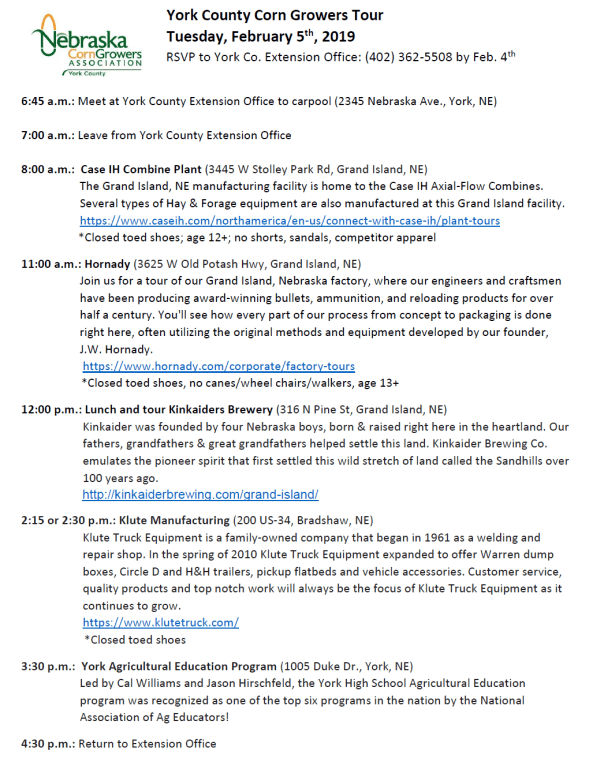
York County Corn Grower Tour Feb. 5: The York County Corn Grower’s Association is sponsoring a tour on February 5th. We will meet at the York County Extension Office at 6:45 a.m. and plan to leave for Grand Island by 7:00 a.m. Morning tour stops include the Case IH Axial-Flow Combine Plant followed by Hornady which produces bullets, ammunition, and reloading products. Lunch will be held at Kindaiders Brewery in which attendees will also receive a tour. The group will then tour Klute Manufacturing near Bradshaw which produces Warren dump boxes, Circle D and H&H trailers, pickup flatbeds, and vehicle accessories. The final stop will be the York Agricultural Education Program which was recognized as one of the top six programs in the nation by the National Association of Ag Educators. Attendees must wear closed toed shoes and be able to walk without a cane/walker based on the requirements of the places we’re touring. Please RSVP no later than Feb. 4th to the York County Extension Office at (402) 362-5508.
Nebraska Ag Technologies Association Conference: Learn about the latest developments in precision agriculture technologies January 31 at the Nebraska Agricultural Technology Association (NEATA) Conference. The group’s annual meeting and agriculture industry conference will be held at the Kearney Holiday Inn and Conference Center in Kearney. Conference topics will include precision economics, nutrient and water management, data collection, and precision equipment. Featured guest speakers include Brian Arnall, precision nutrient management extension specialist, Oklahoma State University; Jim Smith, executive director, Blueprint Nebraska; and Cathy Anderson, chief specialist, Nebraska State Farm Services Agency Office. Attendees will also be able to choose from 10 breakout offerings. The conference will be held from 8 a.m. to 5 p.m. To view the conference program and register, visit https://neata.org/. The fee is $175 when pre-registering and $195 the day of the conference. Students may register for $25.
Managing Ag Land for the 21st Century: This workshop for current and future landowners and tenants will cover current trends in cash rental rates, lease provisions, and crop and grazing land considerations. There will be two meetings in the area. One on Feb. 12 at the Fillmore County Fairgrounds in Geneva. The other will be held on Feb. 25 at the Butler County Event Center at the Fairgrounds in David City. Both meetings will begin with registration at 9:15 a.m., with the program starting at 9:30 a.m., and ending by 3:00 p.m. There is no charge for these programs. To attend in Geneva, please RSVP at (402) 759-3712. To attend in David City, please RSVP at (402) 367-7410.
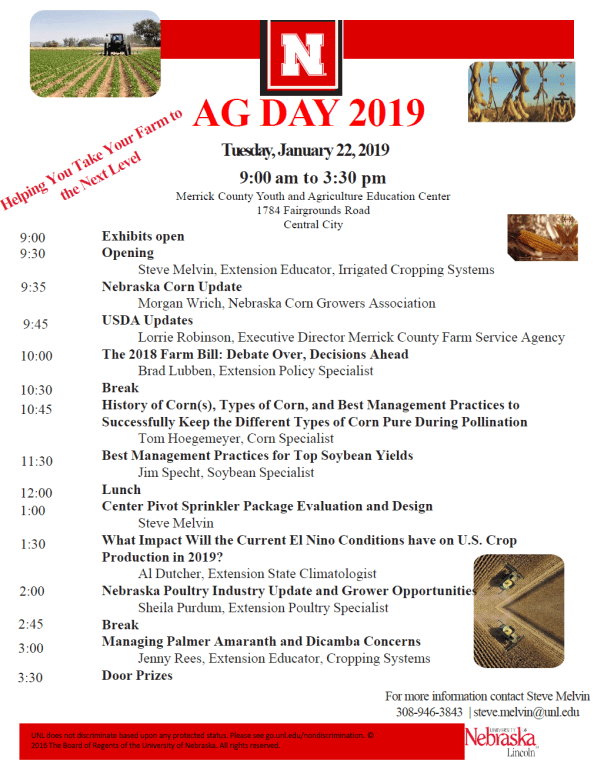
Hamilton County Ag Day will be held Feb. 13 with registration at 9 a.m. and program from 9:30 a.m.-3:30 p.m. The program will include updates from Nebraska Corn Growers, Farm Service Agency, and Natural Resources Conservation Service. Additional topics include Managing Soil Microbes 101, Stalk and Grain Quality Concerns with Corn, Land Rental Considerations for 2019, Pivot Wheel Track Management, Corn Stalk Grazing Economics, Benefits of Corn Stalk Grazing, and a weather update from Al Dutcher. There is no charge for the program but please RSVP to (402) 694-6174 for lunch count.
Nebraska Cover Crop and Soil Health Conference will be held Feb. 14 at the Eastern Nebraska Research and Extension Center (former ARDC) near Mead. The program runs from 9 a.m.-3:30 p.m. with registration at 8:30 a.m. Topics and presenters include: “Growing a Revolution: Bringing Our Soil Back to Life,” David R. Montgomery, professor of geomorphology, University of Washington; “Rebuilding and Maintaining Life in the Soil,” Jay Fuhrer, soil health specialist, Natural Resources Conservation Service, Bismarck, North Dakota; “How My Farm has Responded to Cover Crops and Crop Rotation,” Ray Ward, founder, Ward Laboratories; “Northeast Nebraska Farmer’s Perspective on Cover Crops,” Jeff Steffen, Crofton farmer; “How I Graze My Cropland Without Owning Livestock,” Scott Heinemann, Winside farmer; and a farmer panel. There is no fee to attend, but individuals must pre-register by 5 p.m. Feb. 8 to ensure meals and resource materials are available. Seating is limited. To register, call 402-624-8030, email cdunbar2@unl.edu or use the form at https://go.unl.edu/tmj5.
York County Corn Grower Tour Feb. 5
Please RSVP to the York County Extension Office if you’re interested in attending!
JenREES 1-20-19
Stress. We all have it in life. I didn’t really think about how stress can be good until my colleague Brandy VanDeWalle asked us some questions during her presentation at the Cow-Calf College. She asked us what we look like with good stress. Thinking about it, good stress allows me to be that much more productive in achieving tasks. I’m not a procrastinator, but long gone are the days where I used to color code my planner. My experiences with the military and being in Extension allowed me to give all that up for being spontaneous and flexible with the changes and deadlines placed upon me each day. So that’s me and good stress. We were also asked what we look like with bad stress. Many of us shared we tend to withdraw from others and be shorter/abrupt in responses than we intend. Weather perhaps plays a huge role in adding stress to lives for those of us in agriculture.
Research has shown each person has around 70,000 thoughts per day with 80% of the more repetitive thoughts being negative. Wow-80% negative! That blew me away. But they don’t have to be. Research also showed that taking a 10 minute walk reduced cortisol (stress hormone) in the brain by 50-70%. Even if a person doesn’t walk, taking a break can help. Last week we lost a couple of Nebraska farmers and my heart goes out to their families. The National Farm Medicine Center in Wisconsin tracked farm suicides during the 1980’s in the Upper Midwest and found that the suicide rates were 58 for every 100,000 farmers and ranchers. Suicide rates today are more than 50 percent higher than they were in the 1980’s at the peak of the farm crisis.
It’s so hard to know what others are going through; so often we wear masks. I’ve done this too. We’re all prone to much pride in life, especially in the midst of struggling. I challenge us all to do more in 2019. Let’s pay more attention to those around us, spend more time connecting, be more honest about our situations. There’s so many times a simple text, phone call, email, or visit changed the outlook on my day. Last week a farmer shared how the weather made for a challenging time with calving; a neighbor stopped by and brought him a slice of breakfast pizza. That simple act of noticing his struggle and taking time to talk changed his outlook. So let’s check in with each other more and have the courage to be honest about how things are truly going. There’s also a number of free resources for help including: Nebraska Farm Hotline – 1-800-464-0258; Farm Mediation Clinics 1-800-464-0258; Nebraska Legal Aid: http://www.legalaidofnebraska.com.
Economics: In thinking through options for lowering input costs, there’s several things that come to mind. Some may even be good on-farm research projects to test. One consideration with the new farm bill is the fact that there will be an increase in CRP acres. So, producers have a decision to make regarding potentially enrolling acres into CRP. And, if doing that, perhaps converting some land next to that area into an annual forage system is another option if you have cattle. I will go into the details of this in another column. We have had some guys doing this and it’s just another alternative to consider.
Reducing soybean populations without affecting yields has been proven via on-farm research for 12 years now. I’ve documented this regardless of what has happened in-season. We even had a York county producer who did this study in 2018 and raised 93 bu/ac with a final average stand of 67,000 plants/ac! And, for those with dectes stem borer, my observation has been that dectes doesn’t penetrate the stems as easily on these thicker stems in lower population fields. I don’t have any research, though, so if you’re interested in testing that, please let me know.
Common thinking is that max yield provides max returns. There’s some things like early soybean planting that I will always push for increasing yields. But otherwise, I tend to look at that statement differently and ask if we always have to look at max yields. What if we looked at maximizing economics instead? I realize a lot of seed purchases have been made. There’s some strong flex hybrids that yield really well in non-irrigated environments. A couple of farmers have also mentioned this to me. We’re curious what would happen if we put them under irrigation at lower populations. It could even be an on-farm study to compare a low pop (28K or less), lower input system to one’s current system with higher inputs. However, the question would be which is most economical in the end. Please let me know if you’d be interested in trying this.
I’ve also had a handful of guys mentioning they were interested in sorghum because of the reduced input costs. For those of you who I worked with during the last farm bill who kept sorghum base acres, I mentioned it may be wise to plant sorghum somewhere on those farms before the next farm bill because we never know what will happen regarding payments. We’ve learned in this new farm bill that there will be a payment reduction for any crop not grown in the last 10 years that you have base acres for. So that may be another reason to consider planting some sorghum for the future. If it’s been awhile since you’ve planted sorghum, there’s a free sorghum symposium on January 24 in Grand Island at the Extension Office. Registration begins at 9 a.m. and you can RSVP at: 402-471-4276.
JenREES 1-13-19
Thank you to all the committee members, sponsors, exhibitors, presenters, attendees, and media coverage of the York Ag Expo last week! Great to see so many turn out for the educational sessions as well!

Packed room for chemigation training at York Ag Expo.
Farm Bill: I was extra pleased with the excellent questions and discussion with the afternoon educational sessions at the York Ag Expo. The following are the major changes that Dr. Brad Lubben, Extension Farm Policy Specialist, shared during the Farm Bill 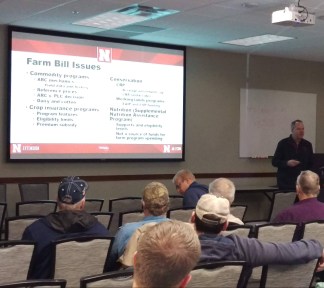
presentation. Farmers will have the opportunity to make a new election for either ARC-CO or PLC for the years 2019-2020 (a two year decision), after which the decision will be a yearly one (beginning in 2021) until the end of the farm bill period. There’s more changes to the ARC program than PLC. For ARC, the primary source of yield data will most likely be RMA crop insurance data instead of NASS survey data. The 25% factor used to establish ARC-CO coverage by irrigated or non-irrigated practice is no longer in effect. Instead, a farmer can make a request to the FSA committee if not less than 5% of the acreage was irrigated or not less than 5% was non-irrigated during the 2014-2018 crop years. Coverage is now tied to a physical county regardless of administrative county. The plug yield in ARC-CO increased from 70% to 80% of the transitional yield. There will also be a trend yield adjustment similar to the Federal crop insurance trend-adjusted yield endorsement. When Brad showed what this looked like if applied to the previous farm bill, it increased the bu/ac in all the examples he showed. Thus, he speculates it should improve the ARC-CO benchmark. Regarding PLC, producers will have the opportunity to consider updating yields on farms. There’s a specific equation that will be used and because it’s focused more on the 2008-2012 period to help those farms most effected by drought, it may not provide a benefit to all farms. It would still be worth working through the equation just to make sure for your individual farms. The other change to PLC is the equation for the effective reference price. In 2014, several of us in Extension worked individually with you to help you through these decisions using decision support tools. Money was not provided in this farm bill to support the computer tools so we’re still waiting to see if they will be developed. We’re assuming they will be. Yet the decisions this time may be more straightforward with making a decision for the first two years followed by annually vs. the life of the farm bill like what happened in 2014. All resources and information can be found at http://farmbill.unl.edu. Regarding ARC vs. PLC decisions, Brad shared the following points:
- Under stable, lower price levels, PLC support will kick in before ARC support for downward price movement.
- Under modestly increasing price levels, ARC and PLC support may quickly disappear.
- Under substantially higher prices, moving average price in ARC benchmark and moving average price in PLC effective reference price could rachet up support to near equivalent levels.
Survey: Every year in Extension we write annual reports to justify the work we accomplished during the year. Last week I shared a survey link to provide me feedback regarding 2018 efforts. Thank you for those who have responded; I appreciate it!!! The survey truly is anonymous. For those who haven’t responded, I would greatly appreciate your feedback on this short survey at: https://app2.sli.do/event/q2p1sedv/polls. A year ago I changed the way I did my email list and news columns. My hope is that the format is more beneficial for us all in spite of the extra time it takes me each week. I’m genuinely open to and desirous of your feedback. Also, if you’re reading this and would like to be added to my email list, please email me at jrees2@unl.edu and I will add you.
Crop Production Clinics and Nebraska Crop Management Conference: Thank you to all who requested via surveys, emails, or phone calls in 2018 that you wanted to see the Crop Production Clinic back in the area! You were heard and one will be held in York at the Holthus Convention Center on January 17th! You can see the full schedule at http://agronomy.unl.edu/cpc. The Nebraska Crop Management Conference in Kearney on Jan. 28-29 has the same topics as Crop Production Clinics with additional topics and out of state speakers. You can view the registration for that conference at: https://agronomy.unl.edu/NCMC. While I realize many of you attend CPC for specific reasons, there is an opportunity this year to participate in a university research study and be paid for your time. Simanti Banerjee, an assistant professor in the Department of Agricultural Economics, is studying producer behaviors in response to farm bill programs. The study will take up to two hours. Average earnings from participating in the study are expected to be up to $100, depending on your decisions and those of other participants. All information collected is confidential and your responses are anonymous and will not be connected to your name. You can read more and register to participate in this study at this site: https://agronomy.unl.edu/crop-production-clinic-study-consent. Looking forward to seeing those who attend the upcoming CPC and NCMC!

Cow/Calf College Moved
Cow Calf College moved to the Clay County Fairgrounds on January 14, 2019.

With the government shut-down, the Meat Animal Research Center is closed, thus we are forced to move the Cow/Calf College program to the Clay County Fairgrounds. The Fairgrounds are located on the west side of Clay Center, located off of West Johnson Street. Registration is filling quickly, so if you would like to attend, please register.
JenREES 1-6-19
It feels like a long time since I wrote! Being burned out, I wasn’t ready to reflect on 2018 in my previous column. Perhaps some of you felt that way too? There were plenty of challenges for agriculture in 2018. Grateful for breaks. Grateful for a new year! Grateful for good new hires in Extension to help with the work load throughout the State! As I reflect on the past several years, thank you for your support as I’ve done my best to cover a lot of counties to the best of my ability. Grateful for the opportunity to serve Nebraskans via Extension and to enjoy this work! And while it comes at the expense of our farmers, I’m grateful for the continual opportunity to learn with every new crop/pest problem. I know a few of you have wished these problems didn’t have to happen to you so I could learn! Yet I do appreciate the phone calls to work through situations with our farmers and ag industry professionals. While each year presents unique challenges, I’m always inspired by the resiliency of our farmers and those in the ag community. Looking forward to serving you in 2019!
Short Survey: In Extension, we always need to prove that what we do in our work brings value to those of you we serve. Would you please consider completing this short survey for me to provide feedback, specifically regarding my email newsletter, news column, any specific way I helped you last year, and ways I can improve in my Extension role in 2019? All feedback is anonymous. Please go to the following direct link: https://app2.sli.do/event/q2p1sedv/polls or you can also go to https://www.sli.do/ and enter the code 7708. Thank you for considering this!
York Ag Expo: Reminder of the York Ag Expo this week! Hoping to see many people come out to view the exhibits and also come to the educational sessions. I try to train people to RSVP for all my educational events, but walk-ins are always welcome. Chemigation is on January 9th from 9 a.m.-Noon with Steve Melvin. Then come out and hear the latest on the Farm Bill, Crop Insurance decisions, and Farm Taxes from 1-4 p.m. from Brad Lubben, Cory Walters, and Austin Duerfeldt. On January 10th, I will present private pesticide training from 9 a.m.-Noon. Then come out for residue and manure management from 1-4 p.m. with Mary Drewnoski, Michael Sindelar, Tim Mundorf, and myself. From 4-5 p.m. will be the keynote speaker Chad E. Colby. Agribusiness after-hours from 5-6 p.m. Ag appreciation lunch both days and all exhibitors and sponsors can be found at: https://yorkchamber.org/event/ag-expo/. Hope to see you there!
RUP Dicamba Training: On the Nebraska Department of Ag website, you will now see the list of UNL face-to-face trainings, the link to the UNL online dicamba training, and a list of certified applicators who have completed dicamba training. I took the online course on Friday so I could better answer questions. This year, it allows you to take one of two tracks: presentations by Dr. Bob Klein or Dr. Greg Kruger. You are also welcome to take both for more information. There are instructions with screenshots on the online dicamba training webpage: https://pested.unl.edu/dicamba-training-instructions. Some reminders regarding this, the applicator’s name and applicator ID number need to be listed when registering for the online course. Last year we had some wives complete the registration for husbands and then the wives were listed as certified and not the husbands. This year anyone applying RUP dicamba must complete approved RUP dicamba training and must also be a certified licensed pesticide applicator. Regarding face to face trainings, I am not having a dicamba training during the York AgExpo, but there are many options available that can be viewed on the NDA website. For that training, you will need to bring your certified applicator number. If you are a new pesticide applicator who hasn’t received a number yet, you will put ‘pending’.
York-Hamilton Cattlemen’s Banquet: The York-Hamilton County Cattlemen are planning their 71ST Annual Cattlemen’s Banquet for Tuesday January 29, 2019 at the Holthus Convention Center in York. Dave Thorell of Loomis, NE will be the featured entertainment. Dave Thorell is a regionally known speaker, avid agriculture advocate, humorist, story teller and was the voice of Agriculture News for over forty years on KRVN Radio. Thorell was elected into the Nebraska Broadcaster Hall of Fame. The Cattlemen will also recognize Rich Pearson of Hordville and Allen Roehrs of Bradshaw as Honored Guests for the evening for their contributions to the area livestock industry and the Cattlemen’s Association. The evening starts at 6:30 with social time, a Prime Rib meal at 7:00 with entertainment and recognition of honored guests to follow. Cattlemen’s Banquet tickets are $25 per person. Sponsorships are also available that include two banquet tickets and recognition at the banquet for $150. Cattlemen’s Banquet tickets can be purchased from any of the York-Hamilton County Cattlemen’s Directors including Brian Blase of Hordville; Brock Ekhoff and Terry Ross of Aurora; Jeff Underwood of Exeter; Allen Klute and Mark Klute of Hampton; David McDonald of Phillips, Jeff Meradith, Kim Regier and Josh Chrisman of York; Kim Siebert of Henderson, plus the Extension Offices in York County and Hamilton County.
JenREES 12-30-18
Happy New Year! The following are upcoming programs you may be interested in attending.
York Ag Expo: Hope to see you at this year’s York Ag Expo at the Holthus Convention Center in York January 9 and 10th! The list of sponsors and exhibitors can be viewed at: https://yorkchamber.org/event/ag-expo/. Educational sessions are being offered again at the Expo. On January 9th, Chemigation training (both initial and recertification) will begin at 9 a.m. There is no charge and please bring a calculator with you. If you are coming for initial training, I’d recommend you get the materials before-hand to look through and you can receive them from the Extension Office. At 1 p.m., Brad Lubben, Cory Walters, and Austin Duerfeldt with UNL will share the latest on the Farm Bill, Crop Insurance decisions, and Farm Tax information. Farm Credit Services of America will also share information. On January 10th, I will have a private pesticide training session at 9 a.m. Please bring your barcode letter from NDA if you have it and the cost is $40. Then at 1 p.m., Mary Drewnoski, Michael Sindelar, and I will discuss residue removal considerations via baling and grazing. Tim Mundorf with Central Valley Ag (CVA) will be sharing on the value of manure as well. At 4 p.m. on Thursday the 10th, Chad E. Colby, Ag Technologist and well known on Ag Twitter, will be the keynote speaker. He is being sponsored by CVA. This will be followed by the Celebrating Ag Social Hour sponsored by the Rural Radio Network from 5-7 p.m. Lunch will be served both days beginning at 11:30 a.m. and sponsored by Cornerstone Bank. Hope to see you there!
Pulse Crop Expo: There’s been quite an interest in pulse crops the past few years in Nebraska. Some growers are looking at pulse crops to change up labor requirements during the year, looking for a different market and price, or looking for another crop that allows cover crops to be planted and established after harvest. To learn about getting started with pulse crops or how to enhance your existing pulse production, don’t miss the 2019 Nebraska Pulse Crops Expo January 7 at the Holiday Inn in Kearney from 9 a.m. to 5 p.m. Lucas Haag, northwest area agronomist with Kansas State University, will be the keynote speaker, presenting on field pea growth and development and management of field peas at critical growth stages. Other presentations include research-based information on production practices, tillage, seeding rates, and irrigation. The 2019 NE Pulse Crops Expo is sponsored by the SARE (Sustainable Agriculture and Research Education), the Nebraska Environmental Trust, and pulse crops industry partners. There is no charge, but please register by going to: https://cropwatch.unl.edu/nebraska-pulse-crops-expo-registration or calling 402-318-1124.
Farmers and Ranchers Cow/Calf College: This annual program will be held at the U.S. Meat Animal Research Center and Great Plains Veterinary Education Center near Clay Center on January 14, 2019 with registration, coffee and donuts starting at 9:30 a.m. The program will run from 9:55 a.m. until 3:30 p.m. This program is sponsored by Nebraska Extension’s Farmers and Ranchers College and RSVP is needed for the noon meal. Speakers include: Welcome by Dr. Mark Boggess of USMARC and Dr. Dale Grotelueschen, Director of the Great Plains Veterinary Education Center; Mary Drewnoski with “To Graze or Not to Graze? Factors that Affect Risk Nitrate Toxicity in Annual Forages”; Rick Funston with “Increasing Production Efficiency”; Brandy VanDeWalle on “Family Farm Stress”; Amy Schmidt with “Top 3 Environmental Considerations During Short-Term Cow-Calf Confinement” and Dr. Kip Lukasiewicz on “Animal Husbandry Strategies to Improve One’s Efficiency”. Please pre-register by January 8th, to (402) 759-3712. Walk-ins are accepted, but may not get a lunch. You may also complete your registration online at http://go.unl.edu/farmersrancherscollege. Remember, your contact information is required to be on the U.S. MARC property, so pre-registration is helpful and will save you time at the door!
23rd Annual Great Plains Growers Conference: This conference will be held in St. Joseph, Missouri on January 10-12 for anyone interested in growing fruit, vegetable, hydroponics, cut flowers for production. Topics on Jan. 10 include: “Cover Crops and Soil Health”; “Food Safety Modernization Act (FSMA) Grower Training”; “Hops Potential”, “Selling Local Foods” and “Honey Bees & Beekeeping”. Concurrent sessions on Friday and Saturday Jan. 11 and 12 provide more than 50 presentations on a wealth of subjects. In addition to presentations on conventional and organic vegetable production, there will be tracks on tree and small fruit production; organic and conventional vegetable production; season extension; greenhouse and hydroponics; cut flowers and technology for growers. A full program, registration information and more information can be found at the website: www.greatplainsgrowersconference.org.


 JenResources