


Author Archives: JenBrhel
Memorial Day
Greater love has no one than this than to lay down his life for his friends- John 15:13

Grateful for those who paid the ultimate sacrifice for our freedom and for their families left behind.

May 19 Wheat Update


Damage to heads from frost/freeze is beginning to appear as white awns/florets in wheat heads. Thankfully this damage is very minor in area wheat fields right now.


Barley yellow dwarf is also appearing in fields and is noticeable by flag leaves with a yellow/purple color. This is a disease vectored by various aphid species. The aphid in this photo is a corn leaf aphid and I’m seeing these in wheat as well right now in addition to lady beetles which are feeding on them. We also observed aphids last fall and were concerned about them potentially vectoring this disease. I would say this is my least favorite wheat disease because you can do many things correct with wheat just to have this one show up and affect yield.


Stripe rust and leaf rust are also rapidly increasing in area fields with the humidity and moisture this past week. Fungicide options differ right now dependent upon wheat growth stage.

Wheat flowering (pollinating). Look for the small yellow anthers. The wheat head will begin pollination in the center first and then pollinate the top and bottom. I’m also concerned about the potential for Fusarium Head Blight (scab) in our wheat right now with all the rain we’re receiving during pollination. Only a few fungicides are labeled for wheat during flowering and the ones that are can only be applied up to 50% flowering. These include Caramba, Prosaro, Folicur, and Proline which are slated to help prevent scab and also kill fungal diseases like rust already present on the leaves. Read and follow all pesticide label directions.

Also seeing some loose smut in fields which again is fairly minor. Both loose smut and stinking smut (common bunt) can be prevented by using a seed treatment fungicide at planting. Often these diseases occur in fields where wheat has been planted and smut has occurred before and when using bin-run wheat that has not been treated with a seed treatment fungicide. Also notice all the yellow ‘flecks’ on these leaves which are indicative of fungal infection (most likely rust) on these leaves.
Crop Update May 5, 2017
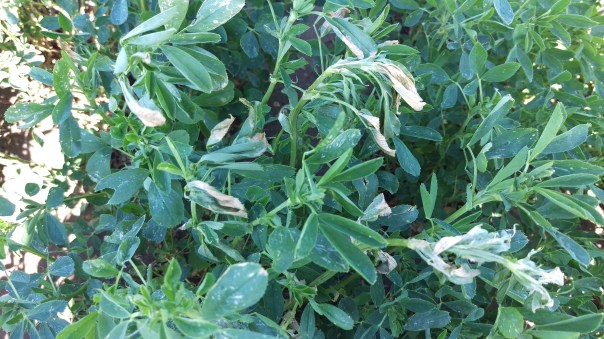
Received numerous alfalfa questions about browning and wilting of leaves/stems. This photo shows those symptoms of frost/freeze damage.

Check the upper-most cluster of buds on alfalfa to determine any affects on regrowth. This is where the growing point is located. Most of the alfalfa plants I’ve observed have healthy buds. With the cool temperatures, regrowth has been delayed. You may need to wait 7-14 days after the frost/freeze event to determine if regrowth is occurring from upper buds or from crown buds-and also to determine if an early harvest is warranted if there’s no regrowth from upper buds. More information on alfalfa frost damage and management considerations.
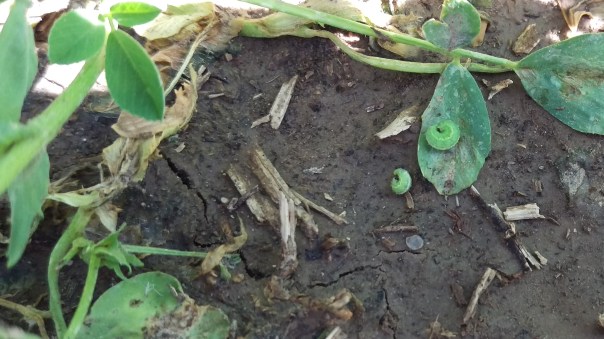
I’m also observing alfalfa weevils in low numbers in alfalfa fields. It will be important to scout your fields and monitor regrowth for second cutting. More information on alfalfa weevil thresholds.
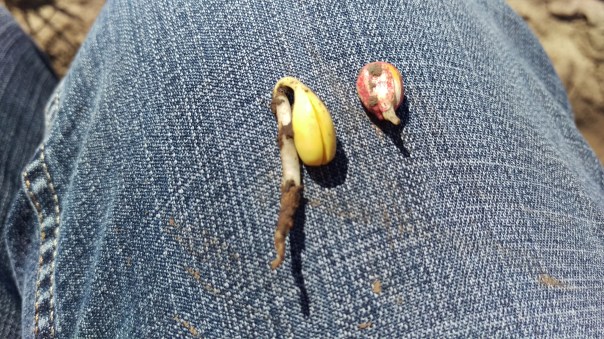
Soybean planted April 21 at 2″ depth with good growth (I should have removed the soil from the root for this picture-did so after taking it and the root is healthy). Corn planted April 24th, 48 hours prior to cold rains in Clay County, showing beginning germination and a healthy seed. More information on potential chilling injury to corn and soybean seeds.

Cooler temps last week slowed stripe rust of wheat which I found in low incidence April 26. Powdery mildew (gray/white spots in this photo) is still moderate-heavy in lower canopy. April 6th was a beautiful day when I was in the area looking at crops, but with so many wheat fields with herbicide apps in that time-frame, I didn’t walk into fields to know how close wheat was to jointing. Since then I’ve noticed a more sprawling growth to wheat instead of erect. This week I’m noticing thicker than normal nodes where wheat is trying to erect itself-and you can see that in this photo with the bent stems. I’m not observing noticeable damage from frost/freeze at this time thankfully. It will be important to watch as heads emerge for any difficulty emerging from the boot, damage to awns, or white colored florets/heads.

Germination of corn in York County Corn Grower plot planted April 22. Soil temperature in the field that morning was 46F with a weekend of warm air temperatures.
2017 Ag Day
Happy Ag Day (March 21) and National Ag Week! 
The Agricultural Council of America began celebrating Ag Day in 1973 with the desire to recognize and celebrate the contribution of agriculture in our everyday lives. This program encourages every American to understand how food and fiber products are produced; value the essential role of agriculture in maintaining a strong economy; and appreciate the role agriculture plays in providing safe, abundant, and affordable products.
Today, each American farmer feeds more than 168 people which is a large increase from 25 people in the 1960s.
Today’s farmers also produce 262 percent more food with 2 percent fewer inputs (labor, seeds, feed, fertilizer, etc.), compared with 1950. Farm and ranch families comprise just two percent of the U.S. population. According to the American Farm Bureau Federation, America’s rural landscape is comprised of around 2 million farms with 99 percent of U.S. farms being operated by families – individuals, family partnerships or family corporations. Farmers on average receive only $0.13 of every dollar spent on food at home and away from home.
Regarding Nebraska, the Nebraska Department of Ag reports in its “2016 Ag Facts” card that cash receipts contributed almost $23 billion to Nebraska’s economy in 2015 and 6.1 percent of the U.S. total.
- Nebraska’s ten leading commodities (in order of value) for 2015 cash receipts are cattle and calves, corn, soybeans, hogs, chicken eggs, dairy products, wheat, hay, dry beans and potatoes.
- Every dollar in agricultural exports generates $1.22 in economic activities such as transportation, financing, warehousing and production.
- Nebraska’s $6.4 billion in agricultural exports in 2015 translates into $7.8 billion in additional economic activity.
- Nebraska’s top five agricultural exports in 2015 were soybeans, feeds and fodders, beef and veal, corn and soybean meal.
- Nebraska had 48,700 farms and ranches during 2015; the average operation consisted of 928 acres.
- In 2015, Nebraska had 25 operating ethanol plants with a total production capacity of over 2 billion gallons. Nebraska ranked 2nd among states in ethanol production and utilized 31% of the state’s 2015 corn crop.
- Livestock or poultry operations were found on 49% of Nebraska farms.
- 1 in 4 jobs in Nebraska is related to agriculture.
- From east to west, Nebraska experiences a 4,584 foot elevation difference and the average annual precipitation decreases by one inch every 25 miles.
- Between 2007-2012, Nebraska experienced a 5% increase in the number of farms and 10% increase in the number of new farmers.
So agriculture is of huge importance to our economy! It was interesting to see the change in some of these numbers compared to last year, a sign of the economic times we currently face in the agricultural industry. Information is being shared each week at our CropWatch web site to help.
Please be sure to thank a farmer and those who work in the agricultural industry this week! Without them, we wouldn’t be able to enjoy the safe, affordable, healthy food supply and choice we have as consumers!


Ag and Flex Lease Workshop
Cash lease questions are continually one of the top questions I answer in the office. We’d encourage landlords, tenants, and spouses to attend this or a workshop near you to hear the most updated information for the coming year!



 JenResources