Author Archives: JenBrhel
Preparing Irrigation Scheduling Equipment
It’s wonderful receiving the rain we did, seeing how quickly planting progress came along, and how quickly corn is popping out of the 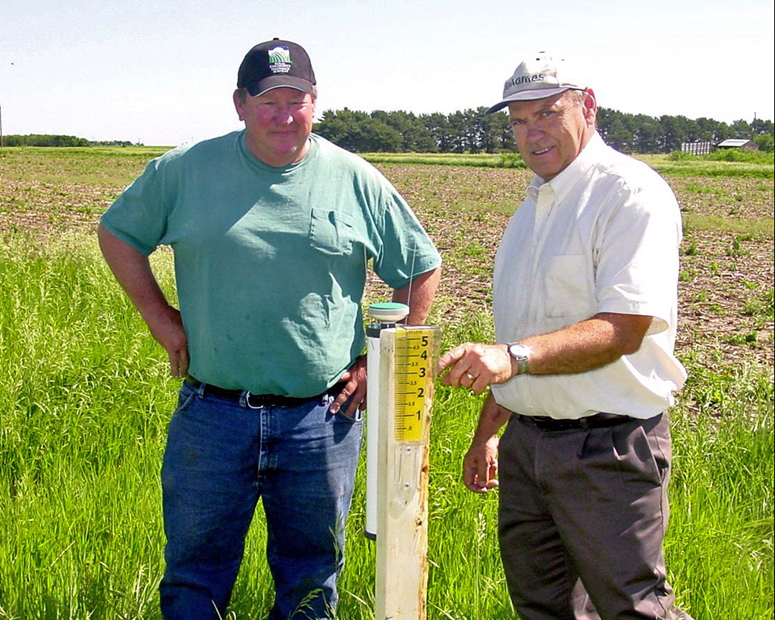 ground! Being mid-May, it’s time to get our Evapotranspiration (ET) gages out. A reminder to only use distilled water in the gages, make sure to fill up the ceramic top portion of the gage before inserting the stopper, and gently dust off the ceramic top and replace the white membrane and green canvas cover. We recommend replacing those membranes and covers each year so if you need a new one, please let the Natural Resources Districts (NRDs) or me know and we’ll get you a new one! For those of you recording ET information online, please be sure to do so consistently each week to help your neighbors and crop consultants.
Early after crop emergence is the best time to install watermark sensors. For those of you with watermark sensors, read them to ensure they read 199 kpa (dry). Then “prime” them first by soaking them for 24 hours in water to ensure all the air bubbles have been released. The sensors should have a reading of 10 kpa or below to be considered good. If they read higher than that, either continue soaking them another 24 hours and read them again, or plan that they no longer are reading correctly and replace them with others from the NRDs. Remember after soaking sensors that water moves up into the PVC pipe via capillary action, so be sure to dump the water out of the pipe  as well.
When installing the sensors, be sure to install them wet, drain excess water, and look for areas that are not compacted, avoid tractor wheel tracks, and look for even spacing of plants. Carefully install without breaking off any plants (thus easier when plants are small!). It’s also important not to install sensors into extremely wet fields. What we have found is that a thin soil layer can cover the sensor when pushing it into the soil of very wet fields. When that soil layer dries, it can provide a reading of 199 saying the sensor is dry when it truly isn’t. If this happens to you, simply remove the sensor, rewet for one minute and re-install. It should be acclimated to field conditions within 48 hours. If you have any questions regarding the installation process, please let the NRDs or your local Extension Educator know. You can also view videos of the installation process and receive additional information to answer your questions.
Drought Stressed Trees
Elizabeth Killinger, UNL Extension, shares some great information on drought stressed trees and what to do with them this spring.

The drought has wreaked havoc on the landscape. Some of the damage, like with turf, was seen fairly early into the drought. The extent of damage to trees and shrubs might not be fully realized until this spring.
Being observant of plant material can help determine if it was just dinged or the damage was more severe. Brown or discolored foliage doesn’t always mean the plants are on their way out or beyond the point of no return. In addition to drought, winter desiccation can also cause many evergreens to change colors. Evergreen trees and shrubs are constantly loosing moisture through their leaves during the winter. Winter desiccation happens when the root system isn’t able to absorb enough moisture to keep up with the amount lost by the leaves. It causes evergreens to have a brown or tan coloration at the ends of the needles. The damage usually occurs uniformly…
View original post 527 more words
Understanding Research Statistics
Dr. Charlie Wortmann, UNL Extension Soil Fertility Specialist, explains the power of statistics for understanding yield and other differences and non-differences for on-farm research.
Gardening in Drought
As I set here writing, we went from wearing t-shirts yesterday to receiving freezing rain and sleet today! The precipitation is much welcomed and it’s nice to see spring bulbs coming up and the grass turning green! But we’re unfortunately not out of the woods yet regarding this drought, and may not be for some time.
This Thursday, April 11, Elizabeth Killinger, UNL Extension Educator in Hall County, will be talking to us about gardening during drought. Come enjoy an evening of learning about drought-tolerant plants and ideas for your landscape! The evening begins with a light supper at 5:30 p.m. and we plan to be finished around 7:00 p.m. There will be no charge for this workshop, so please come and invite your friends and your youth who enjoy gardening as well!
Also, if you would like to bring some plants for exchange, you are welcome to do so and share with others! Please call the Clay County Extension Office at (402) 762-3644 or Jenny at jrees2@unl.edu to let us know you’re coming so we can plan for the meal. See you then!
Drought Stressed Turf
Great information regarding drought-stressed turf from Elizabeth Killinger, UNL Extension!
 The recent rains might have pushed the issue to the back of your mind, but it is still there staring us in the face; the drought. The drought has wreaked havoc on more than trees and shrubs in the landscape; turf also was affected. Don’t worry there is still time to get a lush, green lawn this growing season.
Due to last year’s drought, many lawns might not recover from damage they have received. Assessing the appearance and the amount of damage in your turf will pay off in the long run. If over 50 percent of your lawn is still in good condition and is of the grass species you desire, overseeding might be a good option to fill in those thin, damaged areas. If your lawn is less than 50 percent desirable living grass, renovation of the entire lawn might be in your future.
Seed selection can be…
View original post 432 more words
Sugar Applications to Crops
For the past ten years I’ve come across farmers who really believed in applications of sugar to reduce their pest populations. Being no research to my knowledge to prove it, I tucked the observation in the back of my head for future reference. With farmers looking to increase yields and looking to other farmers such as Kip Cullers for information, some of our on-farm research producers were curious about sugar applications in their operations with the hopes of increasing yield.
Nebraska On-Farm Research Corn Results
Using the application rates that Kip Cullers uses, one Clay County producer applied 3 lbs of sugar (purchased pallet of cane or beet sugar from the local grocery store) per 10 gallons of water at V7-V8 on corn in 2010-2011. Cullers also tanked mixed the sugar solution with a post-herbicide application like glyphosate but this producer didn’t do that. To simulate any affect of the water or driving through the field, he also drove through the untreated check spraying water only. Two years of research results showed no significant increase in yield. However, there was a noticeable difference in standability at harvest. This producer did not apply a foliar fungicide either year. When it came to harvest, this producer needed the reel in 2010 for the untreated check. Stalk rot ratings were taken using the pinch test two weeks prior to harvest. To him, the $1.25/acre of sugar was worth it to improve standability even if yield was not significantly improved. You can view the full research report here.

Several York County producers have also tried this with one producer finding a non-statistical 2 bu/ac yield difference with the check yielding better while the other producers found a statisically significant 2 bu/ac increase to the sugar treatment. Another producer in Hamilton County is testing this using the corn product he grows-using 1 qt of corn sugar (high fructose corn syrup) per 10 gal of water applied still at V7-v8.
In 2012, a small plot study was conducted at UNL’s South Central Ag Lab near Clay Center to determine any differences between sugar application, fungicide application, and untreated check in corn. All treatments were applied at R2. Because of the drought in 2012, there was minimal disease pressure, thus there were no significant differences between the three treatments regarding area under the disease progress curve. The untreated check did show the most stalk rot (via the push lodging test). The sugar application reduced the lodging rating by half and the fungicide application showed the lowest lodging rating. For yield, there were no significant yield differences with the untreated check yielding the highest followed by the fungicide and sugar applications. The entire study report can be found here.
In Soybeans we have had producers apply 3 lbs sugar in 10 gallons of water at R3 (beginning pod). In all years, there have been no significant differences in yield. Lodging ratings were not taken as that is more variety and water dependent.
Additional research…
has shown that application of sugar to crops increases the numbers of beneficial insects in those fields. South Dakota research entomologists showed that lady beetles benefited from a combination of prey and non-prey foods. In a follow-up study, these entomologists applied sugar sprays to soybeans and quantified the frequency of sugar feeding by analyzing the gut contents of common lady beetles in three states. They found all the tested lady beetles regularly consumed sugar-like nectar in soybean fields, even when it wasn’t applied as a supplement. They also found more lady beetles in the sugar treated plots compared to the untreated plots.
At this time we can’t explain the standability effect we’re seeing from our sugar applications to corn. Our hypothesis is that early application of sugar to corn is increasing beneficial microbes that may be keeping the exposed brace roots and stalks healthier. We hope to conduct more research in the future to answer this question.
In conclusion,
the application of sugar to corn and soybeans has not always shown increased yield. However, in nearly all of the corn studies, sugar treated plots have shown increased stalk strength at harvest. Research has also shown an increase in the number of beneficial insects in fields where sugar was applied. Further research is needed to understand the interactions aiding stalk strength in corn.
If you are interested in conducting on-farm research studies in your field, please contact any of our UNL Extension Educators or Specialists! You can also follow the conversations this year via our Facebook page and Twitter feed!
What do you think of sugar applications to crops? Have you tried this in the past and if so, what were your results?
Corn Planting Rate Research & Recs
Even with recent rain and snow events, the subsoil is still dry. You may be wondering,
“What should I do regarding corn planting rates in 2013?”
A few weeks ago, UNL Extension held our on-farm research meetings to share our 2012 Corn Planting Rate results for irrigated and dryland conditions. I always enjoy hearing our farmers share why they were interested in a certain trial and what they found out as a result.
Our farmers followed protocols of 28K, 32K, 36K, 40K (40,000 seeds/acre) or 30K, 34K, 38K, 42K/acre for irrigated production and 18K, 22K, 26K, and 30K for dryland production. 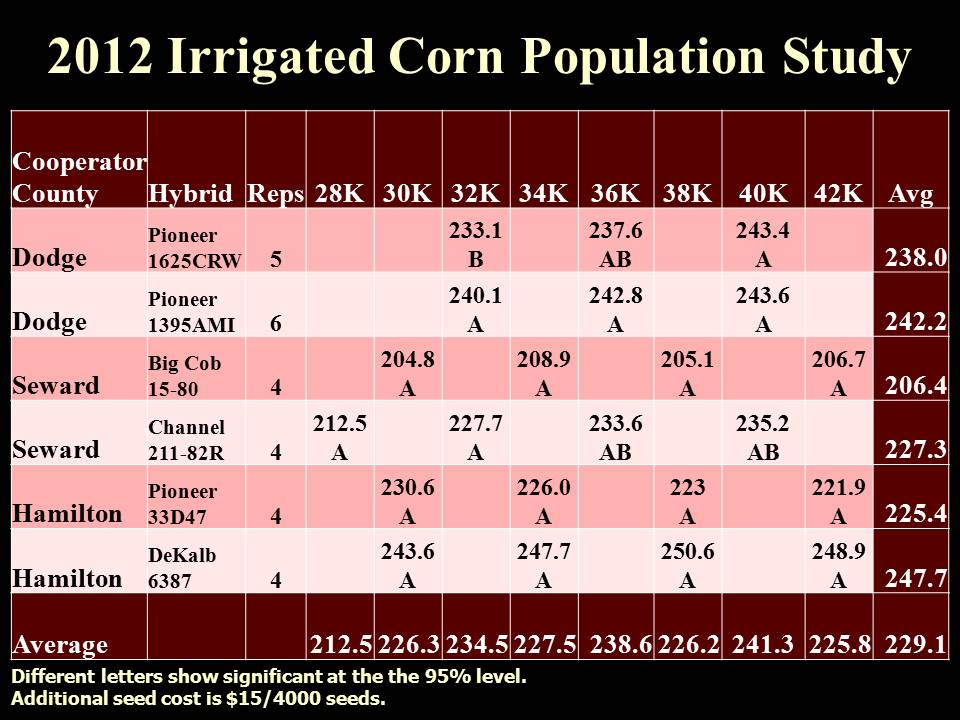
The results since 2010 continue to show us that each individual hybrid varies in its response to increasing populations; however, there is a general trend with newer hybrids that increasing population results in increased yields. Dr. Tom Hoegemeyer, UNL Agronomy Professor of Practice spoke about how our hybrids have genetically come so far in combating various stresses while maintaining yields. We know that many seed companies have conducted research to determine the population calibration curve for each hybrid to determine best recommendations for you. Thus, we’d recommend that you check with your seed dealer to determine which hybrid may fit best at which population for your operation.
Even with this data, you may question if that’s truly the best population for your field; that’s where on-farm research comes in! We recommend testing the recommended population against a higher and lower population with at least 4000 seeds/acre difference in planted population-whether irrigated or dryland. With today’s technologies, it’s not very difficult to test seeding rates for different hybrids for yourself!
So what rate should you plant this year? In the majority of our irrigated studies, economically, many hybrids maximized yields and economic returns between 32,000-36,0o0 seeds/acre. Again, this is very hybrid dependent so ask your seed dealer what he/she would recommend and test for yourself!
Regarding limited irrigation, UNL research has actually shown a negative effect of lost yield by backing off population too far in a dry year. 
Tom’s recommendation was for dryland in Eastern Nebraska, most hybrids even with the low soil moisture profile should be ok with planting 24,000-28,000 seeds/acre. I realize we have essentially no moisture in our profile. But taking probabilities of rainfall events, March-May is usually pretty good and we don’t want to short-change ourselves in yield by planting too low of populations. For Central into Western, NE, I feel 20,000-22,000 seeds/acre will work for many hybrids. Our genetics have come so far since we finished the last drought in 2007 and were planting 18,000 seeds/acre in dryland. We will just keep praying for rain and hope for the best next year! Ultimately, test this and your other on-farm questions for yourself to know what will work for your farm!
If you’re interested in conducting some seeding rate trials, please let anyone on our UNL On-Farm Research Team know! All our studies are posted on the CropWatch on-farm research page.
What planting rates are you considering for 2013?
Youth Discover Crop Science
An excellent opportunity for youth to become detectives and have fun while learning about crops and science! Consider having a youth you know attend this Big Red Camp and learn more about agriculture careers! There are also scholarships available to attend!

Are you interested in science, agriculture, plants, crops, insects, or diseases? If so, join our team of detectives to solve crop-related problems in the Crop Science Investigation (CSI) Big Red Camp! Become a detective while participating in hands-on sessions to learn about and increase your knowledge of crops, science, and agricultural careers. Youth detectives will interact with agronomic professionals across Nebraska to solve experiments in: nutrient management; managing disease, insect and weed problems; water management; crop production, and much more! Do you have what it takes to become a CSI detective?

There are a variety of careers related to plant sciences such as:Agricultural Communicator; Agronomist; Crop Consultant; Crop Insurance Adjuster; Educator; Co-op Manager; Farmer or Rancher; Farm Credit Banker; Field or Lab Researcher; Plant Breeder; Soil or Water Conservationist; Seed, Fertilizer, or Chemical Sales; or Technical Representative.
Scholarships are available in the amount of $300 to participants who…
View original post 243 more words
Mobile Ag Apps from UNL
This week I saw an article from agriculture.com that had ranked UNL’s Market Journal app as the Number 1 agriculture app! I’ve also felt it was the  best ag app from UNL providing markets, each week’s show segments via YouTube, weather, and all the CropWatch articles in a one-stop app.
So being snowed in right now, I thought it would be a good time to share some new apps developed by UNL. The newest ag apps are for livestock. Some of you are in calving season and UNL Extension just released the NUBeef-BCS (body condition scoring) and NUBeef-Anatomy apps that may be helpful. They are available on the Apple App Store and will be via Google Play shortly.
NUBeef-BCS allows producers to visually assess their cow herd using a number system that objectively describes the amount of condition or fat reserve of the animal. Body condition score describes the relative fatness of a cow based on a nine point scale. When using the NUBeef-BCS app, producers can simply take photos of their beef cows and then score cows at important times throughout the year, such as at weaning and before the start of calving and breeding season. Taking pictures of the same cow multiple times throughout the year allows producers to better manage the herd according to Rick Rasby, UNL Beef Specialist. He said one of the challenges during winter is producers want to score body conditions, but cows have their winter hair coats. The app includes drawings of cows in different body condition scores that also can help with that. An added component to the app is an education component and is designed for instructors to use at all levels-from high  school, junior college, and four-year colleges. The app has a group of cows that have already been body condition scored that can be pulled up and used to practice scoring.
The NUBeef-Anatomy app provides visual and text information about the muscles and bones of the beef carcass. The user can navigate through the carcass by displaying cross-sections and then touch any muscle or bone to display the respective physical and chemical properties. Check out the NUBeef YouTube channel for more info. or watch Feb. 1’s segment of “Market Journal”.


 JenResources