Category Archives: Ag Issues
RUP Dicamba Training for Soybeans
My top question the past two weeks has been about dicamba training. I just received the information regarding this training from our pesticide program coordinators.
First, to clarify some mis-understandings: Dicamba training is required for those applying the following dicamba products: XtendiMax®, FeXapan™, and Engenia®. These products are all Restricted Use Pesticides (RUP) this year; thus, you have to be a certified applicator to purchase and use these products. Dicamba training is not required if you’re applying dicamba corn products (unless it is the above-mentioned products).
Second, pesticide training of any kind is not the same as dicamba training. Dicamba training is completely separate. Having your pesticide applicator license does not qualify you to apply RUP dicamba in 2018.
Third, some have asked if everyone in the operation needs this training or not…specifically the person who is purchasing the RUP dicamba with his/her applicator license but is not the one intending on applying the chemical. NDA says that, “Dicamba-specific training is only required for application of the product, not for purchase of the product.”
- You need to be a certified pesticide applicator to purchase the RUP dicamba products.
- You need to be a certified pesticide applicator and complete dicamba training to apply the RUP dicamba product. So hopefully that helps clarify who in your operations need this training.
Your options for RUP dicamba training include the following:
- Nebraska Extension online training course hosted by eXtension. See the link at : https://campus.extension.org/login/index.php (1.25-1.5 hours).
- Crop Production Clinics or Nebraska Crop Management Conference. Details at https://agronomy.unl.edu/cpc and https://agronomy.unl.edu/ncmc
- County-hosted training sessions at the option of local educators presenting the video which is the same as the online training (1.25-1.5 hours).
- RUP dicamba product (XtendiMax®, FeXapan™, and Engenia®) manufacturer sponsored training. Each manufacturer will advertise individually.
I took the online training so I could better answer your questions. The link to the UNL online dicamba training can be found at the http://pested.unl.edu site or you can go directly to the training at: https://campus.extension.org/login/index.php. Once at this site, you will need to create an account. You will then be sent a confirmation email and upon opening that, you will be logged in. From the course list choose “pest management”.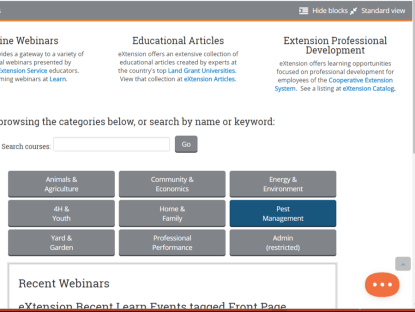
Then scroll and click on “Online Training for Dicamba Herbicide”. 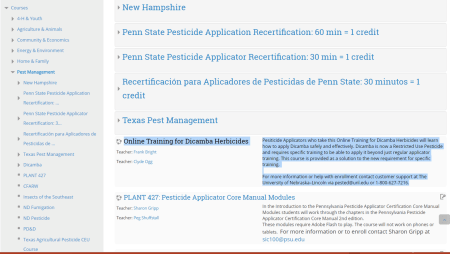
You will then need to register for the training. It will ask you to add your Nebraska pesticide applicator number in a specific field as well. Your name and applicator number are required before you begin the training. You can then click on the first video followed by the first quiz. It keeps track if you completed the entire video or not before you can advance.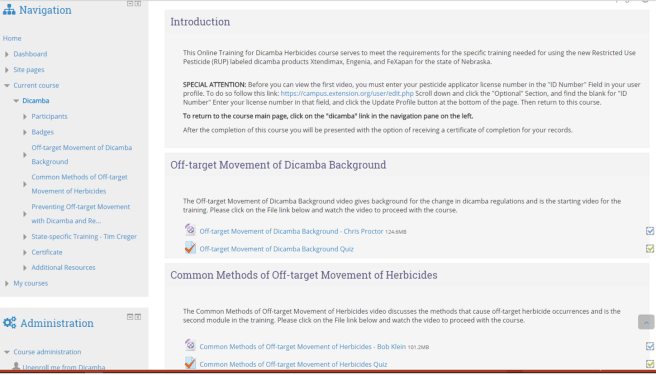
I felt the information was good overall and I appreciated the fact that they mentioned how corn dicamba applications also influenced the problems we saw in 2017. They also share quite a bit of research regarding volatility, conditions/timing of temperature inversions, dosage amounts and effects on yield. The quizzes are short and were fairly common sense. You can click to check each answer once you have selected your choice and will have to submit all your answers before moving on. When you have completed all the videos and quizzes, you can have a certificate emailed to you. You will also be officially entered into Nebraska Department of Ag’s database. NDA said they will only honor those names in their database as those who’ve completed dicamba training.
NDA is asking ag retailers selling these RUP dicamba products to check the NDA database to ensure the person applying the product has received dicamba training. NDA’s dicamba information including record keeping forms, etc. can be found at: http://www.nda.nebraska.gov/pesticide/dicamba.html.
The other thing you need to know: some have asked if a group of people can watch the online training at the same time at your farmstead. The answer is actually no from the standpoint you all would have to watch the training on separate computers/devices. The only way your name is recorded in the NDA database is through your registration name and pesticide applicator number on the training site. It only allows one person to enter his/her information to view the training and complete the quizzes. If you attend an NDA approved face-to-face training such as at Crop Production Clinics, you can train as a group but will still need to supply your individual names and pesticide applicator numbers at the training.
Hopefully this helps clarify some of the questions you have and during this cold weather, you have the opportunity to get this training completed if you need it for 2018.
Reminder: York Ag Expo at the Holthus Convention Center in York January 10-11. Schedule of Events and Exhibitors: http://yorkchamber.org/yorkagexpo/
Educational Sessions: https://jenreesources.com/2017/12/26/york-ag-expo-educational-sessions/

Is the beef industry sustainable: A look at grass-fed, hormones, growth promotants, and more
Lindsay does a great job of summarizing highlights from Dr. Jude Capper’s presentation at our Sensitive Issues Media and Communication training.

Recently, several of my colleagues and I hosted a Sensitive Issues: Media and Communication Training, we worked on developing and improving our communication skills around agriculture and agricultural topics. One of the topics we received more information on was sustainability.
Dr. Jude Capper, a livestock sustainability consultant, was our first speaker. I want to share with some of the messages about sustainability shared by Dr. Capper.
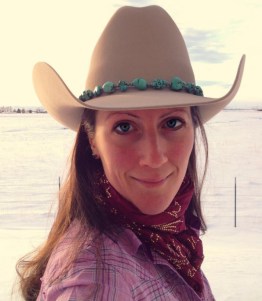 – Sustainability is defined as “able to last or continue for a long time.” Many livestock farmers and ranchers are sustainable – whether they raise 10 head or 1,000 head. If you have never heard of the Century Farms Program, you should check it out. The American Farm Bureau Foundation recognizes farms or ranches by state that have been in a family for 100+ years! That is sustainable.
– There are essentially three things that need to be considered to be…
View original post 657 more words
Sensitive Issues Training-Engage
Many of us have been there…we’ve been asked a question in which the answer can be deemed controversial because the topic is based on emotion and beliefs. How do we respond? Do we get caught up in the emotion and passion of the issue and try to force our beliefs on others? Do we shy away or try to avoid an answer altogether by remaining silent?
Last week’s Sensitive Issues Media and Communications Training was developed to help all of us through these situations. It was a remarkable experience working with an amazing group of ladies, all passionate about food, but looking at food from a variety of perspectives and taking an issues-based approach in developing our team. Our team was comprised of a livestock expert, a manure expert, two food and nutrition experts, a communication’s expert, and myself from a crop production perspective. Special thanks to Dr. Chuck Hibberd, Nebraska Extension Dean and Director, for providing us a New Audiences Innovation Grant to partially fund this training. You can catch the conversation on Twitter at #SIMCT15.
We invited the Center for Food Integrity to conduct their Engage training with us, which was sponsored by the United Soybean Board. This training uses “the power of shared values to highlight industry trends and teaches strategies for using values-based messaging in daily conversations, and public speaking and media opportunities.” There was discussion, role playing, and mock media interviews. The training challenged me to use something I also just learned from “7 Habits of Highly Effective People” training….Seek first to Understand, then to be Understood.
Essentially, ask questions. Understand why a consumer believes X, Y, or Z about food and agriculture. Universal values include:
- Compassion
- Responsibility
- Respect
- Fairness
- Truth
Seek to understand the other person’s values by listening and asking questions. Then share by communicating about common values telling your food and ag story. We can’t really script this. We can’t be so vague that we’re not credible. For example, the following is vague and perhaps over-used:
By doing X we help the environment.
Instead, we need to be willing to talk about the hard issues with authentic transparency…to share our own individual stories.
I also desire water that is safe for my family to drink and desire for there to be enough water for future generations. That’s why my colleagues and I work with farmers to use research-based irrigation scheduling tools. Doing so helps reduce over-irrigation which can reduce the nitrate levels reaching our groundwater and the amount of water being pumped from the aquifer.
There were a few surprises for me. The first being the progress in one year (based on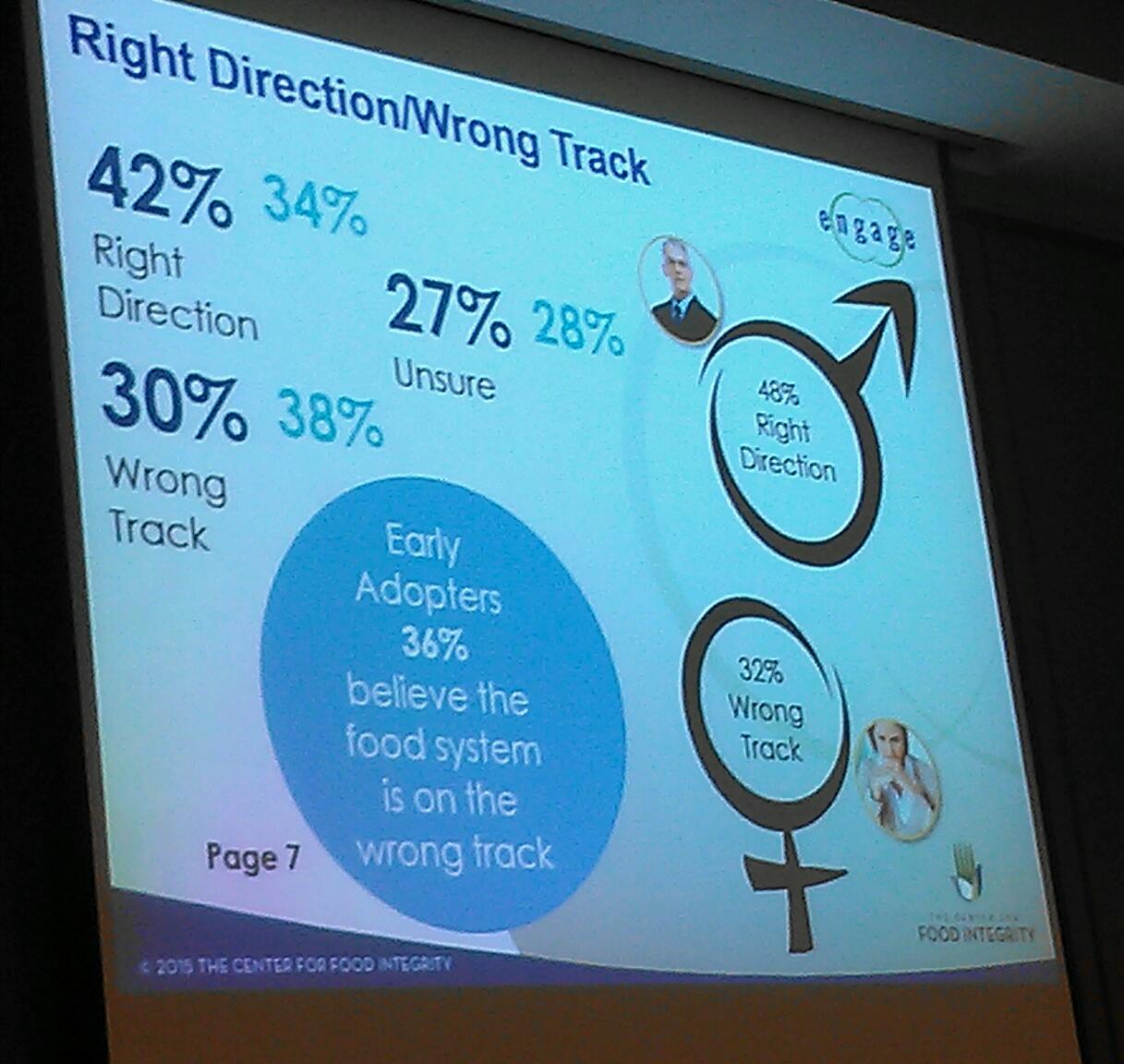 the Center for Food Integrity’s research) that we’ve made in consumer trust. This slide is essentially saying that 42% of consumers feel the food system is going the right direction (up from 34% last year). Men are more trusting of the food system at 48% believing the food system is on the right track. 32% of women feel the food system is on the wrong track.
Another surprising, yet encouraging piece of information for  me to see is which people are trusted the most on sensitive topics. On the topic of genetically modified foods, University Scientists topped the list, a Scientist that was a Mom was second, and Farmers were third. This is different than other research I’d seen, so I was excited about this. It was a survey of 2005 individuals conducted in 2014 and was encouraging from the standpoint that we do still have an opportunity to share our stories with those who truly desire to know more about where their food comes from. We will never change the activists, but we can reach the middle.
Finally, I loved the following quote which is so true:
A picture is worth 1000 words; a video is a library.
They showed the following video from Similac entitled, “The Mother ‘Hood“. Instantly, my mind went to how easy it would be for ag to do something similar. We tend to be so divided, but division is killing us. We are in the business of providing a safe, affordable, food supply to the world…but beyond that, our diversity provides consumer choice. If you watch the video, consider what is the common issue that could bring all of ag together. I have some ideas and my team members and I have discussed what a similar video with diverse agriculture groups would look like. What are your thoughts and ideas?


 JenResources