Category Archives: Crop Updates
Early Corn Growth Stages
Determining Corn Growth Stage: Grateful for the rain showers! With the cooler weather, corn plants appear shorter due to shortened internodes but are further along in development than one may think. Correct growth staging of corn using the collar method is important. Some herbicides have application restrictions of V8 (8 leaves), particularly when certain adjuvants are used. These restrictions are in place to protect developing corn ears.
Be sure to growth stage plants correctly counting collars (leaves pull away from the main stem like a collar around one’s neck). Start counting leaves at the base of the plant with the smallest rounded-tip leaf with a collar as #1. From there count every leaf with a true collar. Leaves that are still wrapped in the whorl around the main stem without exposed leaf collars are not counted. Plants around V6 (6 leaves) start losing the lowest leaf.

The growing point emerges above ground between V5-V6. After that point, splitting the stalk becomes the most accurate way to determine plant growth stage when lower leaves are absent. To stage using this technique, dig a plant inside the field (past the endrows) without breaking the stalk. Carefully split the stalk down the middle through the root ball. At the base of the stalk is an inverted triangle that contains Nodes 1-4 (but they can’t be differentiated). Next look for the white area above that (about ½-3/4”) followed by the next visible band. The white area is the internode with the band being the 5th node (V5). There’s about an inch of internode between V5 and V6. After that, internode length is more dependent upon air temperature instead of soil temperature. Every leaf is attached to a node. Pull off the fully collared leaves and follow them back to where they break off at a specific node. Count the nodes on the stalk to the highest collared leaf that breaks off at a node to determine the growth stage. Once you determine the correct growth stage, you can consider painting a known leaf stage on certain plants (ex. paint the 6th leaf) and then count successive leaves from there when the field is checked. This avoids you having to split more stalks in the future.

Crop Share Survey: The economics team is asking landowners and tenants for input into a Crop Share Survey to better understand lease structure, shared expenses, and educational needs for those utilizing crop share leases in Nebraska: https://go.unl.edu/2025cropshare.
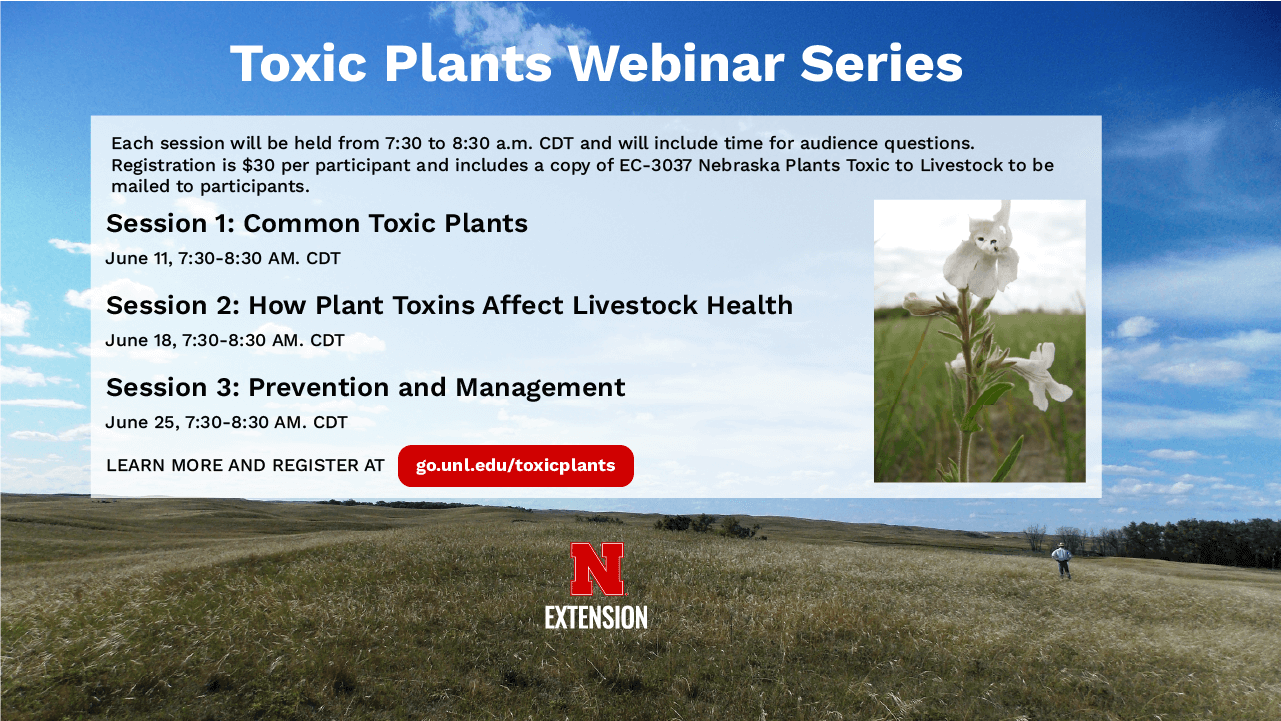
Toxic Plants Webinar Series regarding how the plants impact livestock health will be held June 11, 18, and 25 from 7:30-8:30 p.m. each evening. More info. and register at: go.unl.edu/toxicplants
June 17-18 Tractor Safety Training in York: This is an opportunity for youth to learn how to safely operate farm machinery and receive a farm husbandry certification if they’re 14-15 years old. For more information and to register, please visit: go.unmc.edu/tractor-safety-training
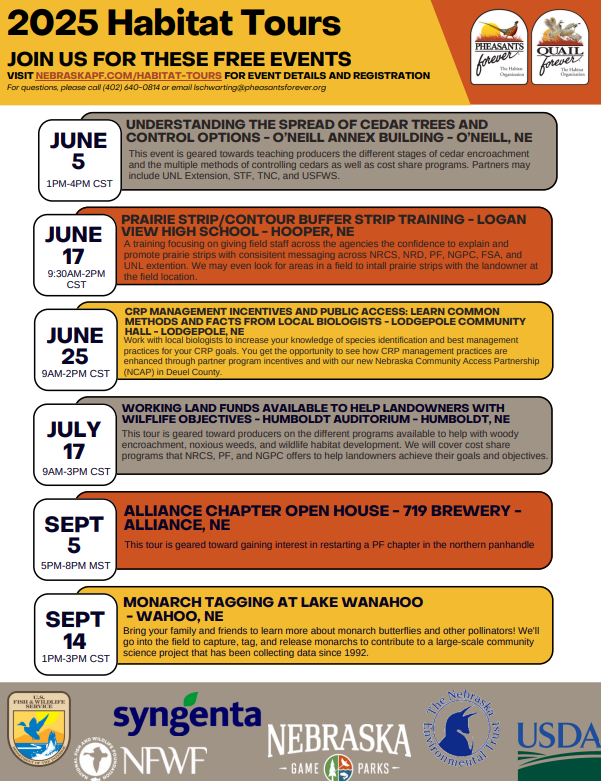
June 17th Prairie Strips Tour: Pheasants Forever is hosting a field day at Logan View School near Hooper in conjunction with UNL Extension from 9:30 AM to 2:30 PM, focused on prairie strips and their role in agricultural productivity and natural resource outcomes. RSVP at: nebraskapf.com/habitat-tours.
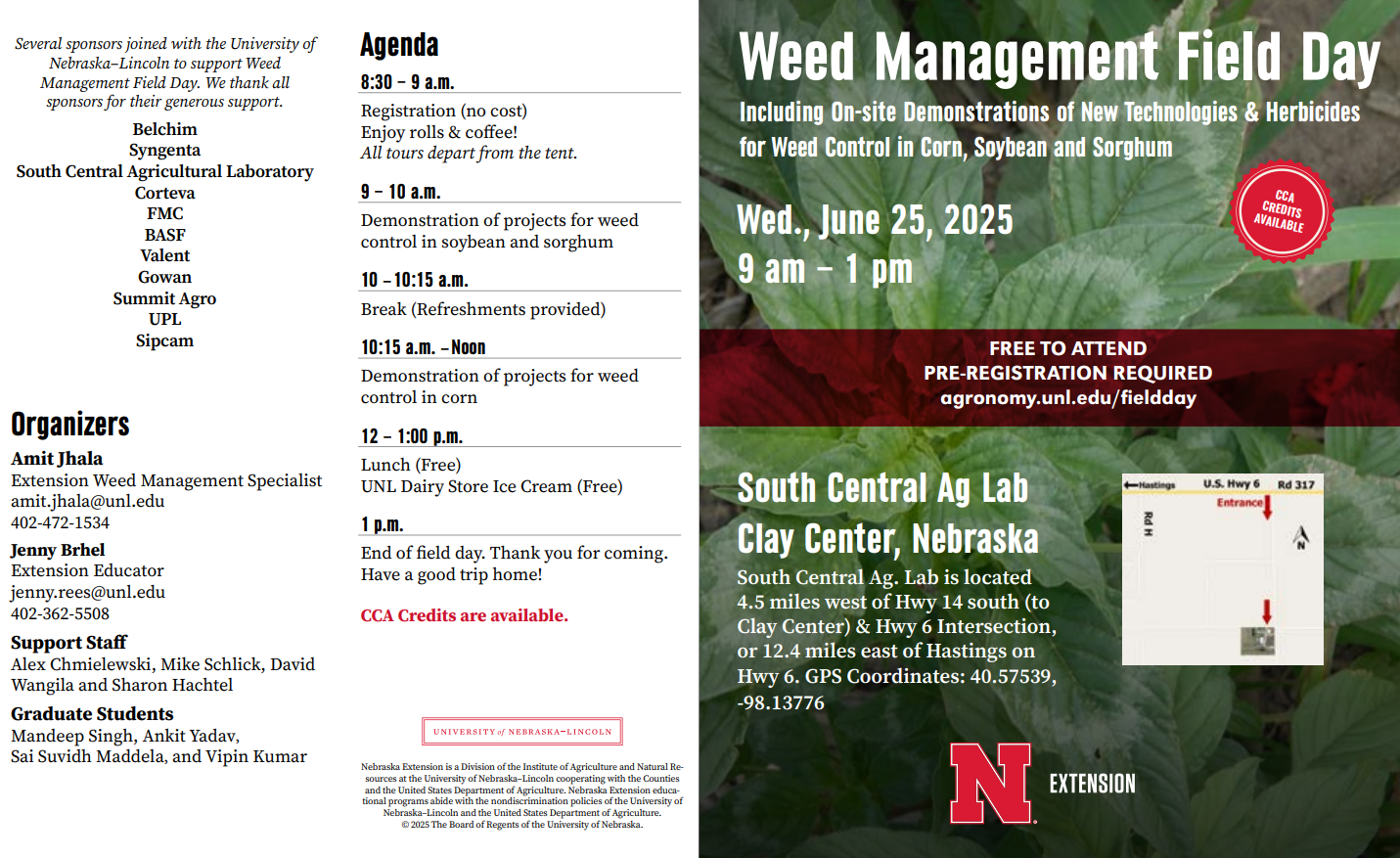
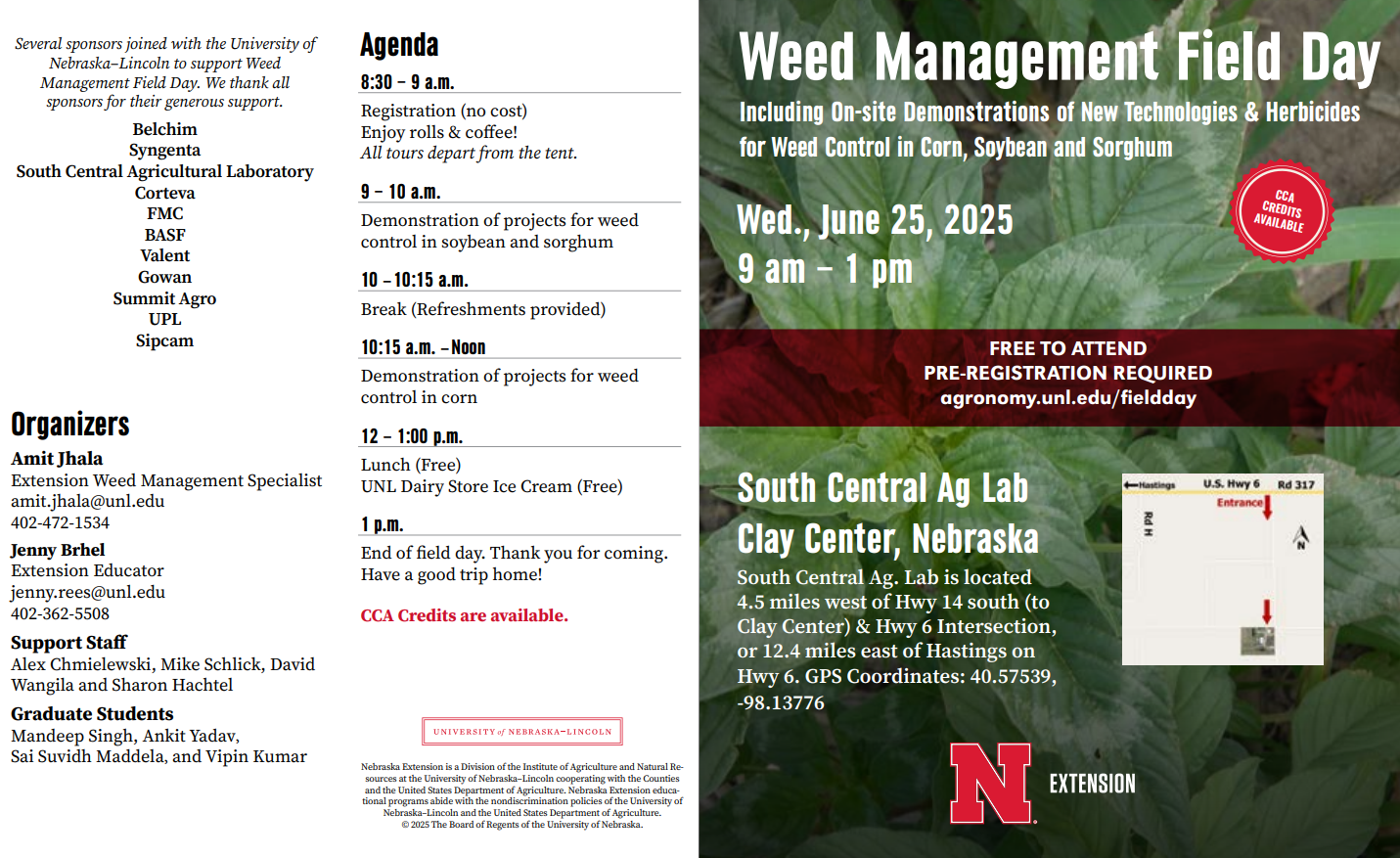
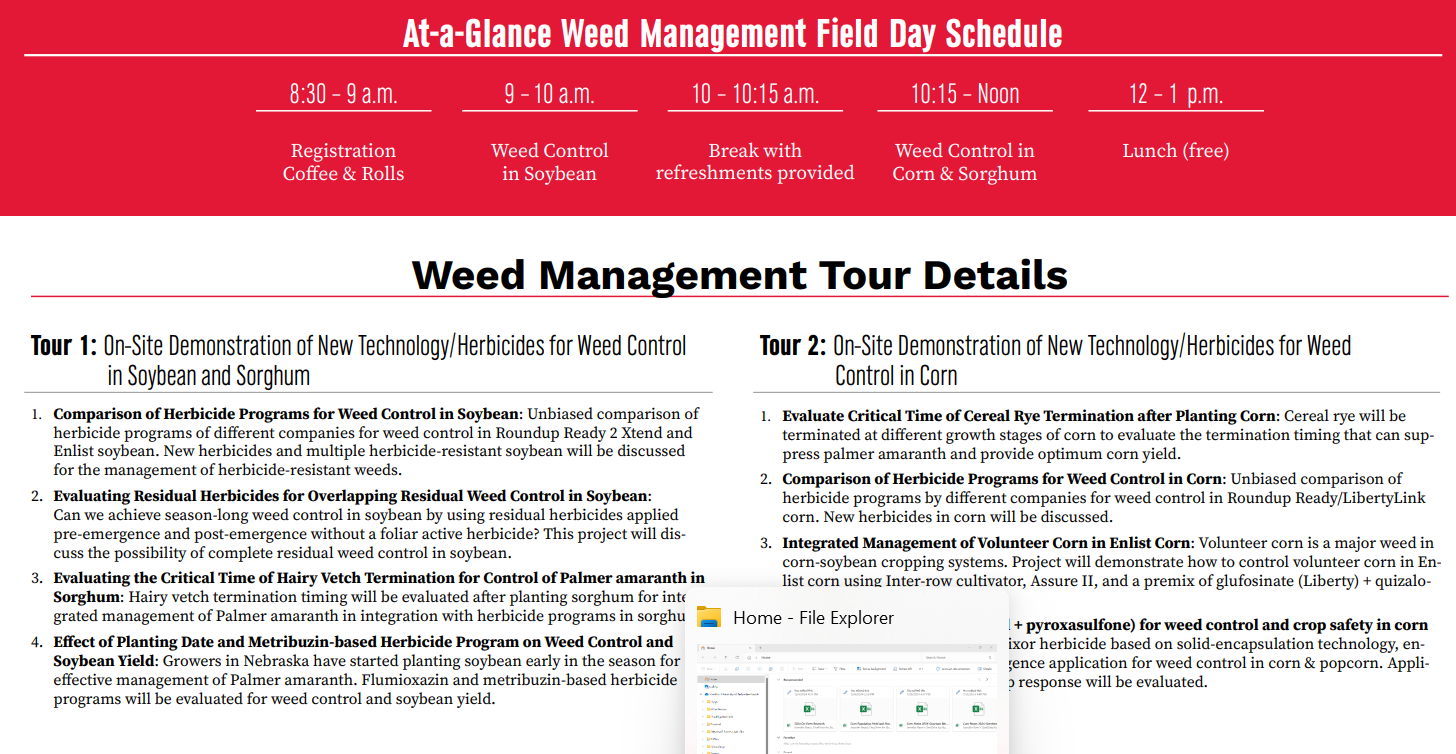
June 25 Weed Management Field Day will be held from 9 a.m.-1 p.m. (Reg. 8:30 a.m.) including lunch at UNL’s South Central Ag Lab near Clay Center. The event is free but pre-registration is needed for lunch count at: https://go.unl.edu/qemk. The event will demonstrate weed control options in soybean, corn, and sorghum. Management options that will be demonstrated include: various herbicide programs including ones with overlapping residual, timing of hairy vetch termination for weed control in sorghum, planting date and metribuzin based herbicide program in soybean, termination timing of cereal rye after corn planting, volunteer corn management in Enlist corn, and evaluating Surtain for weed control and crop safety in corn and popcorn.


JenResources 5/4/25
Crop Updates: I was reminding myself to count my blessings that we have received any rain falling from the sky! The rainfall has been spotty and I can appreciate it’s been frustrating and tiring with the winds and lack of rainfall. We’ve also been blessed with incredible planting conditions this season. It’s interesting to hear a number of farmers share they were completely done with planting in April this year. It’s also nice to see the green crops emerging in fields.
Have heard reports of alfalfa weevils being higher incidence in Kansas and the southern border counties of Nebraska. Please be scouting alfalfa. More info. here: https://crops.extension.iastate.edu/encyclopedia/alfalfa-weevil.
For wheat, there’s been very little rust (stripe or leaf rust) found in Kansas through Texas. With recent rains and dew, it’s good to be scouting for these diseases. While I’m not aware that we have any wheat flowering yet, wheat development does vary throughout the area receiving this information. To check on the Fusarium Head Blight (scab) risk, check out this tool: https://www.wheatscab.psu.edu/.
I’ve had some questions on what to expect for insects this year. No one can know for sure, but our Extension entomologists shared on this topic a few weeks ago in a CropWatch article found here: https://go.unl.edu/2zmn. The following are some excerpts from the article:
“Soil Temperatures: Despite frigid temperatures in February 2025, Nebraska soil temperatures at insect overwintering depths (around 4 inches) remained relatively stable due to insulating snow cover and crop residue. The cold event likely had minimal impact on most overwintering insect pests, as the soil didn’t freeze deep enough or stay cold long enough to kill them.
Unfortunately, temperatures at most locations where western corn rootworm, western bean cutworm, and wheat stem sawfly typically overwinter have not reached sustained periods of low enough temperatures to cause considerable mortality. The exception would be the chance for higher mortality of WCR and WBC in January in the Scottsbluff region.
We recommend that scouting and management practices are continued as planned in 2025, and as informed by pest pressures observed in 2024, rather than relying upon this winter’s weather to provide adequate control of pests. However, weather between now and summer could still impact insect survival; for example, very wet soil conditions in spring can reduce WCR survival as larvae hatch out and potentially drown.”
Crabgrass preventer in lawns: With the warm soil temperatures, it’s time to get crabgrass preventer on lawns if you’re interested in doing this and haven’t already done so.
Field bindweed has been another pest people have asked about. It produces deep roots and it spreads by seeds, rhizomes and stolons. For homeowners, Kelly Feehan shared that “If hand-pulling or hoeing is the chosen control, studies show if bindweed is pulled before it grows five leaves, you may have better success. It may take up to three or four growing seasons to kill a plant, but it’s possible if one stays on top of removing plants before they have five leaves. If herbicides are used, spot treat weeds before they bloom and avoid getting herbicide on desirable plants. Tryclopyr and glyphosate can be used carefully in landscapes on bindweed.” Another tip has been to apply glyphosate to a nitrile glove and run the gloved hand on the vine so the herbicide is applied to the vine and not the desirable plant. That also takes diligence but can help over time.
JenResources 4/27/25
The weather and soil temperatures have been incredible for planting progress in this part of the State! The main agronomic question I’ve received the past few weeks has been from those with small grain cover crops around termination timing. We share more details in this article, although decisions are based on individual producers’ goals and the situation in each individual field: https://cropwatch.unl.edu/2021/cover-crop-termination-tradeoffs/.
It’s been a very different spring with small grain and pasture growth. In some ways, it reminds me of 2023, but in others, it seems worse. There was a period of time I was watching small grains, especially in non-irrigated fields, just “set” and not grow. Pastures were doing the same thing. Now in non-irrigated fields, I’m seeing rye that’s fairly short and in boot to heading stage, far earlier than it should be. My biggest concern for non-irrigated fields is soil moisture. It’s a field by field assessment and I recommend that growers be digging in fields to have a better idea of soil moisture and depth of moisture. Even for some growers that typically plant green, we’ve made the call to terminate prior to planting or at planting to conserve what moisture we can.
For the irrigated fields, the rye is also maturing quicker than expected, and for some, has gotten taller than they had desired before planting. For those who were planning on planting soybeans green into the rye, I’m not concerned about the rye “getting too tall”. You will observe the soybeans “stretching” for sunlight once they emerge. They will be longer between the soil surface and the cotyledons and also first unifoliates compared to if they were planted without a small grain. My concerns would be:
- Ensuring the soybean is planted into even moisture or able to be irrigated after planting. If you’re concerned about soil moisture and won’t get beans planted this week, you can always terminate before planting.
- The seed vee is closed if a PRE herbicide is applied. Sometimes I’ve seen difficulty in getting the seed vee closed and if that’s the case, avoid a PRE herbicide to avoid injury to the seed/germinating seedlings. Often I don’t recommend a PRE herbicide when planting green due to the tradeoff in cost between the PRE and the cost of cover crop seed and seeding. But for those who still want to use one, it’s important to ensure that seed vee is closed.
- For both corn and soybean, be aware that the taller the rye gets, the greater the Carbon:Nitrogen ratio becomes. This ratio impacts nutrient tie-up and results in longer break-down time of the small grain. For corn, it’s important to add nitrogen some way during planting to help off-set the nutrient tie-up early on in that seedling’s life. For both corn and beans, sulfur is also tied up. Purdue University found adding 20 lbs of sulfur anytime from pre-plant to V3 resulted in a yield increase. Oh, and when planting green with taller rye, we’ve found it helpful to not use residue removers.
Alfalfa Weevils: I’ve also been noticing alfalfa weevils at low incidence in alfalfa fields thus far and recommend scouting your fields. Cut 10 stems at ground level at 5 different sites in the field. Then, beat the stems in a 5 gallon bucket and count the total number of larvae with a black head. Determine the average number of larvae per stem. There’s a couple of charts with economic thresholds at: https://crops.extension.iastate.edu/encyclopedia/alfalfa-weevil. There’s also a tradeoff of harvesting early vs. spraying depending upon when economic thresholds are reached.

July 2024 Crop Update
The past 10 days, my top questions have been around fungicide recommendations, control of Japanese beetles, and hail damage. I feel there’s an increasing segment of agronomy that is focused on preventing pests based on fear. I’m grateful for those agronomists who only recommend products when warranted by scouting.
Some thoughts, although not popular, for consideration. Fungicide for white mold in soybean is pricey. If the field didn’t have a history of white mold, I wouldn’t recommend applying a fungicide for white mold. For seed corn fields without a history of white mold, I’d wait to see if white mold develops. If too fearful, would only apply one application at R2. Only fields with a history of white mold would I be considering preventive fungicide applications. And in those fields, if the beans had been planted green into a small grain and/or if a biological product with activity against white mold was used, would suggest scouting and applying only if white mold was present. Fungicide efficacy ratings: https://cropprotectionnetwork.s3.amazonaws.com/soybean-foliar-efficacy-2024.pdf.
Hail: Looked at quite a bit of hail damage in Clay/Fillmore counties last week. Always so hard to see beautiful crops impacted or destroyed. Some hail resources for you: late vegetative/tasseling in corn: https://go.unl.edu/y3of, Soybean decisions: https://go.unl.edu/z7ad; and hail damage info. on my blog at https://jenreesources.com.
Corn Diseases: There’s very little I’ve seen in fields. Bacterial leaf spot (BLS) is common on hybrids and can be confused with gray leaf spot. BLS has longer, thinner lesions with wavy lines when looking at the lesions closely. I’ve seen quite a bit of Goss’ wilt, as early as V8. There’s nothing we can do for either BLS or Goss’s as bacterial diseases, but it’s good to be aware they’re occurring.
Tar spot has been found in Richardson, Nemaha, Saunders, Dodge, Colfax counties but not in our area. Southern rust has been found in northeast Kansas. I still recommend waiting on fungicide applications until we need them. Research found that products applied between tasseling and milk when tar spot was present in low amounts (5%) was effective in controlling tar spot most years. So, waiting could be wise with tight economics, particularly if tar spot, gray leaf spot, and southern rust come in later.
Japanese Beetles in crop fields: Usually the beetles congregate in areas in the field and not whole fields. So even at a 20% defoliation in soybeans during reproductive stages, it’s been hard to pull triggers for spraying because it’s not field-wide defoliation (and we’ve seen soybeans recover in the past). For corn, the threshold is 3 beetles per ear with silks clipped less than ½” and 50% or less of the field is pollinated. A challenge with Japanese beetles is that we have another potentially 4-6 weeks of emergence from grassy areas. So, one can spray an insecticide, but it’s not uncommon to see the beetles damaging fields again once the residual wears off. Spidermites can also be flared upon insecticide applications. Some consider a border app since they begin feeding in the borders. So, those are all things to consider.
Sevin and Japanese Beetles: For homeowners, PLEASE read the pesticide labels before applying products (even if you’ve used that same product in the past). I do mention Sevin as a product that can be applied in different situations in this guide: https://go.unl.edu/xgd6, but not all Sevin formulations are the same; thus, not all the same plants are labeled! We’ve unfortunately seen some plants injured to the point of death in the past. So please, double check that the plant is labeled before applying an insecticide product to control the beetles.

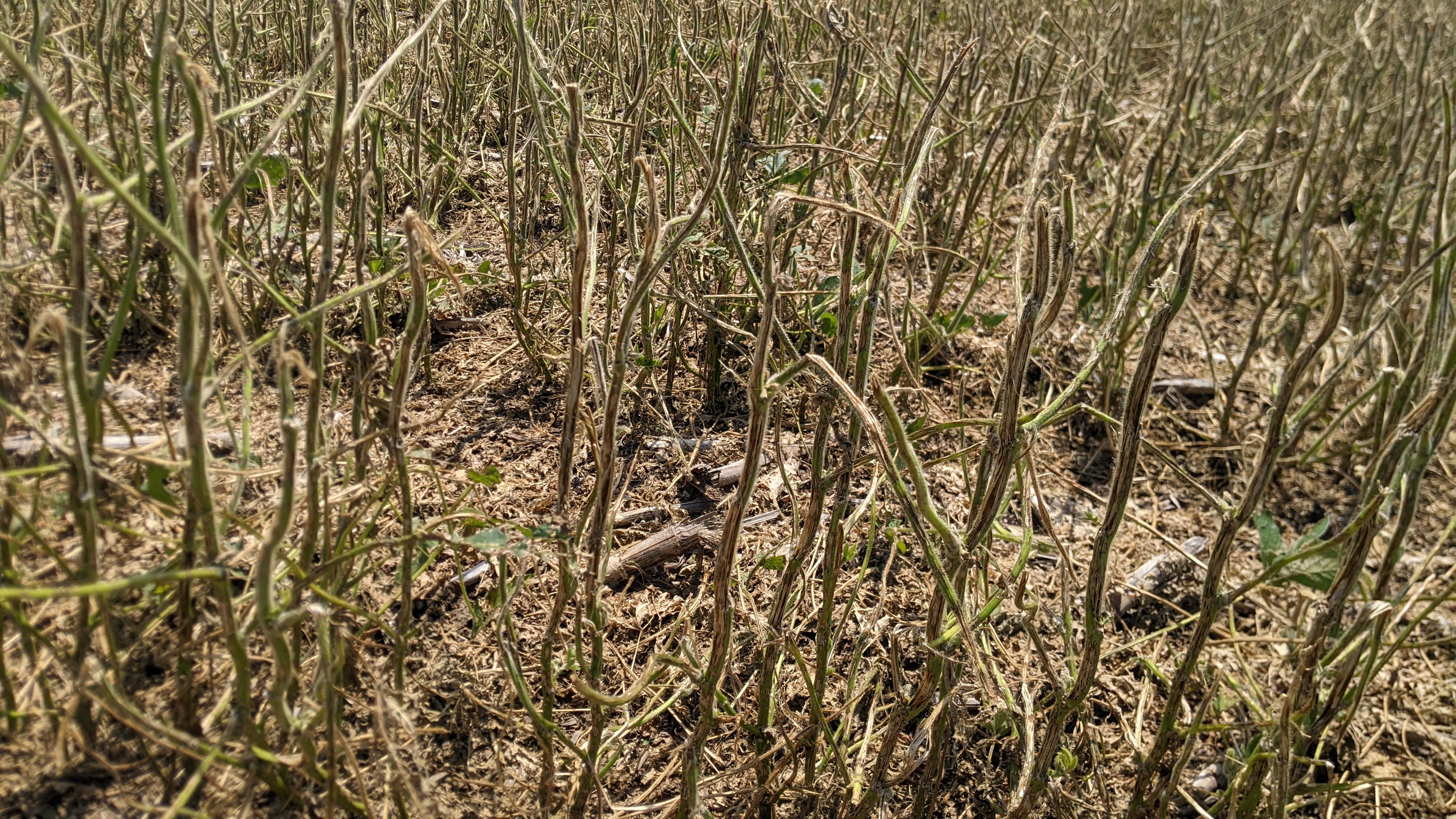


For soybean damage, the situations with pictures shown here (other than the top right) will recover. These fields are already showing new growth in axillary buds including new leaves and flowers. While some canopy was lost, they will look a lot better in 7-10 days. Look for areas of the field (lower right picture) that were protected such as by trees and/or pivot tires, to determine the original development stage when the soybeans were damaged. In the case of the upper right photo, those beans were planted the week of April 10th and were already at a strong R4 to beginning R5. By R5, soybeans will not recover because all new node, leaf, and pod development ceases. If considering to replant any beans, there’s risk of using later than a 2.5 maturity variety with a July 15th planting date in reaching maturity before a frost. By July 20th, aiming for closer to a 2.0 maturity is wise. Also, if you’re replanting into soybeans, we’ve found a fungicide seed treatment is wise as phytophthora root rot tends to be a problem in replant.
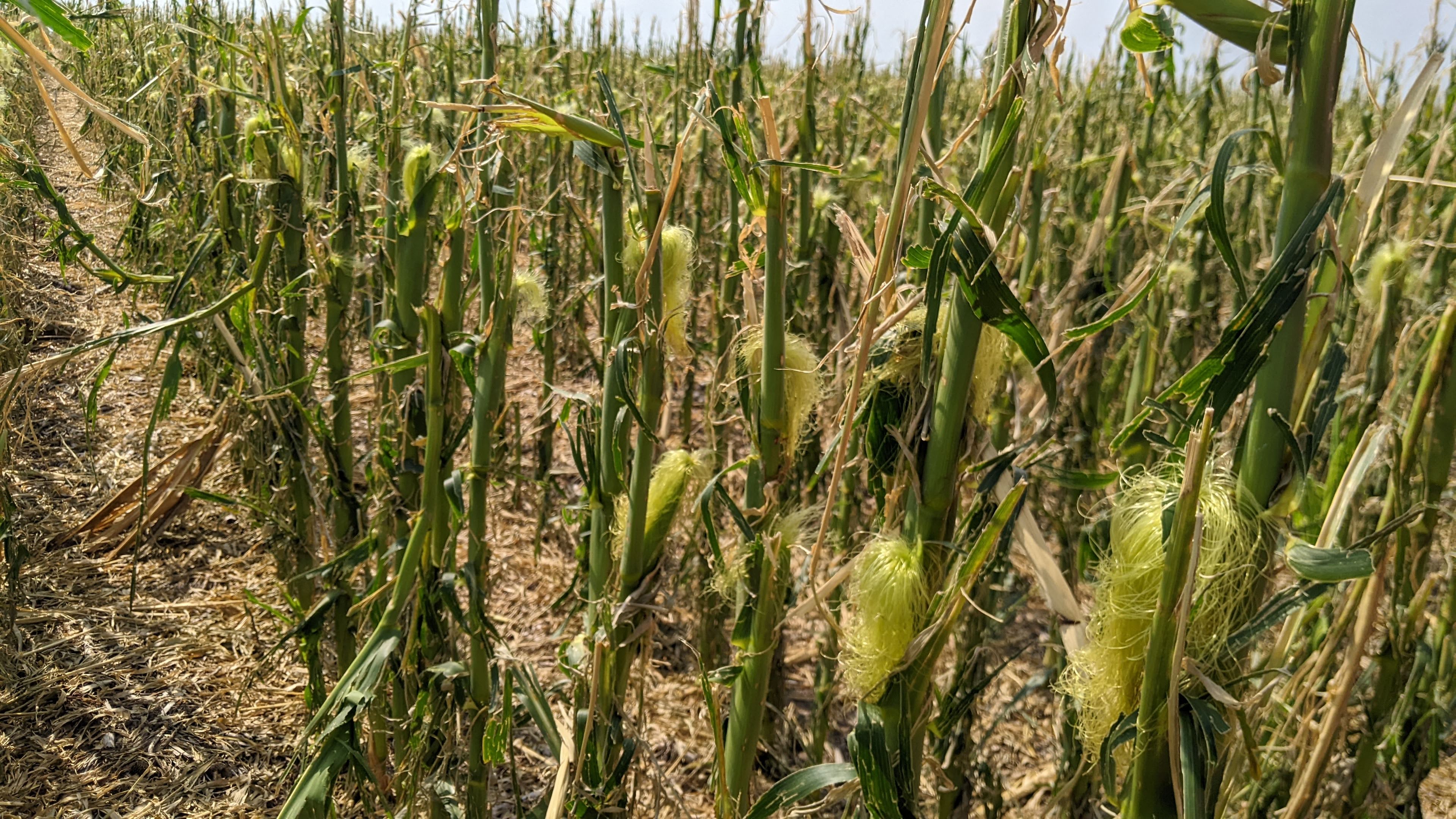


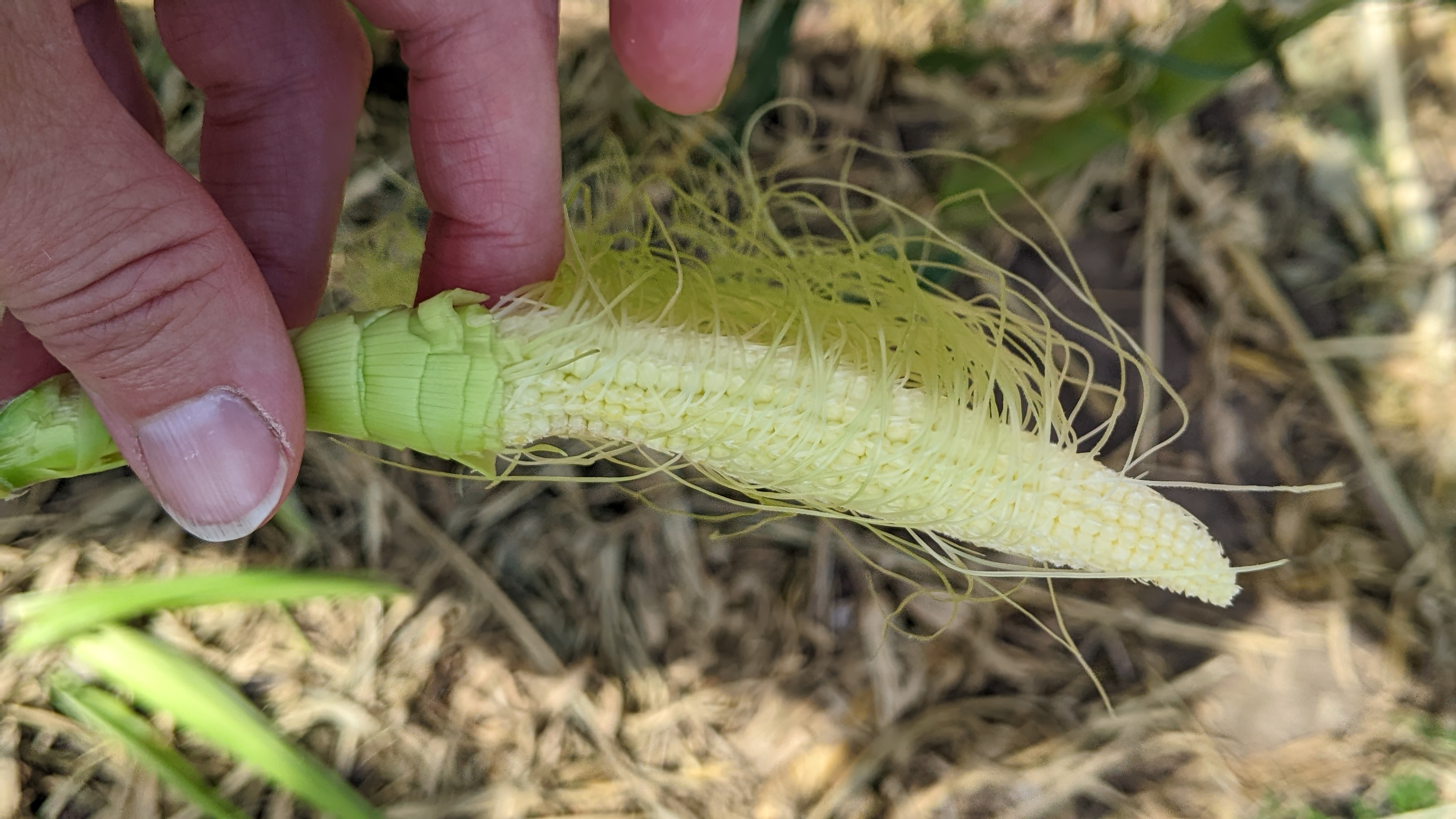


For corn, much of the corn I looked at has mostly leaf stripping and will be ok. There’s also bent/broken plants. Fields vary in the amount of stem bruising. When taking stand counts, I push a little hard on plants to see if they break off when I’m taking counts. A rule of thumb we’ve used in the past: every plant in 1/1000th of an acre we give 10 bu/ac to. So, a count of 12 plants has a potential of 120 bu/ac. That may seem crazy; it depends on how things pollinate, how damaged the ears are, final stand, etc. but it has been in the ballpark in enough cases for me to still use it as a guideline for making hail damage decisions.
In these photos, the fields were far more severely damaged. There’s fields like we saw in 2023 where 1/3 of the field or less still has tassels (top left and middle photos). We saw crop insurance delay that decision in the past to see how the ears would pollinate. I’m not sure what they will decide this year. I was seeing a few brown silks in some of these field situations, but it’s super early too. There’s also a large number of dead tassels in these fields (bottom right photo) that won’t provide any pollen. Tassels remaining tend to be wrapped in the newer leaves but as you see in bottom, middle photo, the tassel is trying to shed pollen inside the trapped leaves. Ears may be misshapen and damaged due to hailstones and/or being damaged and unable to emerge from sheaths (bottom left photo).
What we learned in the past is that palmer comes in quickly once the canopy opens. One can consider warrant with drops as a layby depending on how much Group 15 had been used in the field. Most chose not to go that option. Some seeded covers like brassicas/small grain into fields not totaled (flew on or haggie). Most let the palmer grow.
In the top right photo when fields were totaled, some allowed the weeds to grow and grazed with cattle or sheep. Some seeded a summer annual cover like sorghum sudan/sudangrass/pearl millet. In 2023, several crop producers chose pearl millet so they didn’t have to worry about prussic acid poisoning for those bringing in livestock or wanting to hay. Others just waited till later in the year, shredded down the stalks and planted in a small grain like oats or rye. The “blessing” with a decision in July is it can allow for more time to make a decision compared to if we were in June and the primary option was to replant. That perhaps was the biggest lesson I learned last year in working with producers. If you have specific questions or want to talk through decisions, please give me a call.
Also, it’s important to recognize that these disaster events create loss…in this case, loss of crops, pivots, bins, not only in irrigated acres but in a lot of non-irrigated acres that had more potential than most have seen in years, much less their lifetime. It’s ok to have a range of emotions surrounding this. And, it’s common to feel stressed, numb, and not want to make a quick decision. If I’ve learned one thing in my career, it’s the fact that as people, we all just need to talk about the stress and emotions we all face at times with someone we trust. My biggest piece of advice is to talk to someone just to get outside of one’s own head. There’s so much stress in life, not to mention in ag. The most common comment I’ve heard from people the past several years was they just appreciated being able to share with someone about the stress and what they were feeling. There’s also a number of mental wellness resources on the front page of CropWatch at https://cropwatch.unl.edu.
Resources:
- Summer annual forage grasses: https://extensionpubs.unl.edu/publication/g2183/2013/pdf/view/g2183-2013.pdf
- Making soybean replant decisions-what we learned: https://go.unl.edu/z7ad
- Corn damage to late vegetative/tasseling corn: https://go.unl.edu/y3of

More information and registration at: https://www.grazemastergroup.com/events.

Odd Crop Things
I’m grateful for the good start to the growing season that many in the area I serve have experienced thus far. Soybeans have started flowering or will soon. Earliest planted corn isn’t far from tassel! Some areas continue to miss rain and other areas get far too much. For those dealing with flooding, the following are some rules of thumb:
- Corn Prior to V6: Plants can survive under water for 2-4 days if temperatures do not exceed 77°F.
- V7—V10: Plants can survive 7-10 days if temperatures do not exceed 86°F.
- VT—R1: Reduced nutrient uptake and successful pollination if standing water is present longer than 2-4 days. Yield losses may occur.
- Soybeans: Yield losses minimal if flooding lasts less than 48 hours. Flooded for 4-5 days, fewer nodes develop and plants will be shorter; possible stand and yield loss beyond that.
- Soybeans at flowering: Potential yield loss, especially on poorly drained soils.
We’ve seen several oddities this year in crops, which I haven’t talked much about, but a crop consultant suggested I should write a column on them. The following have been found from Saunders County through the Gothenburg area this year.
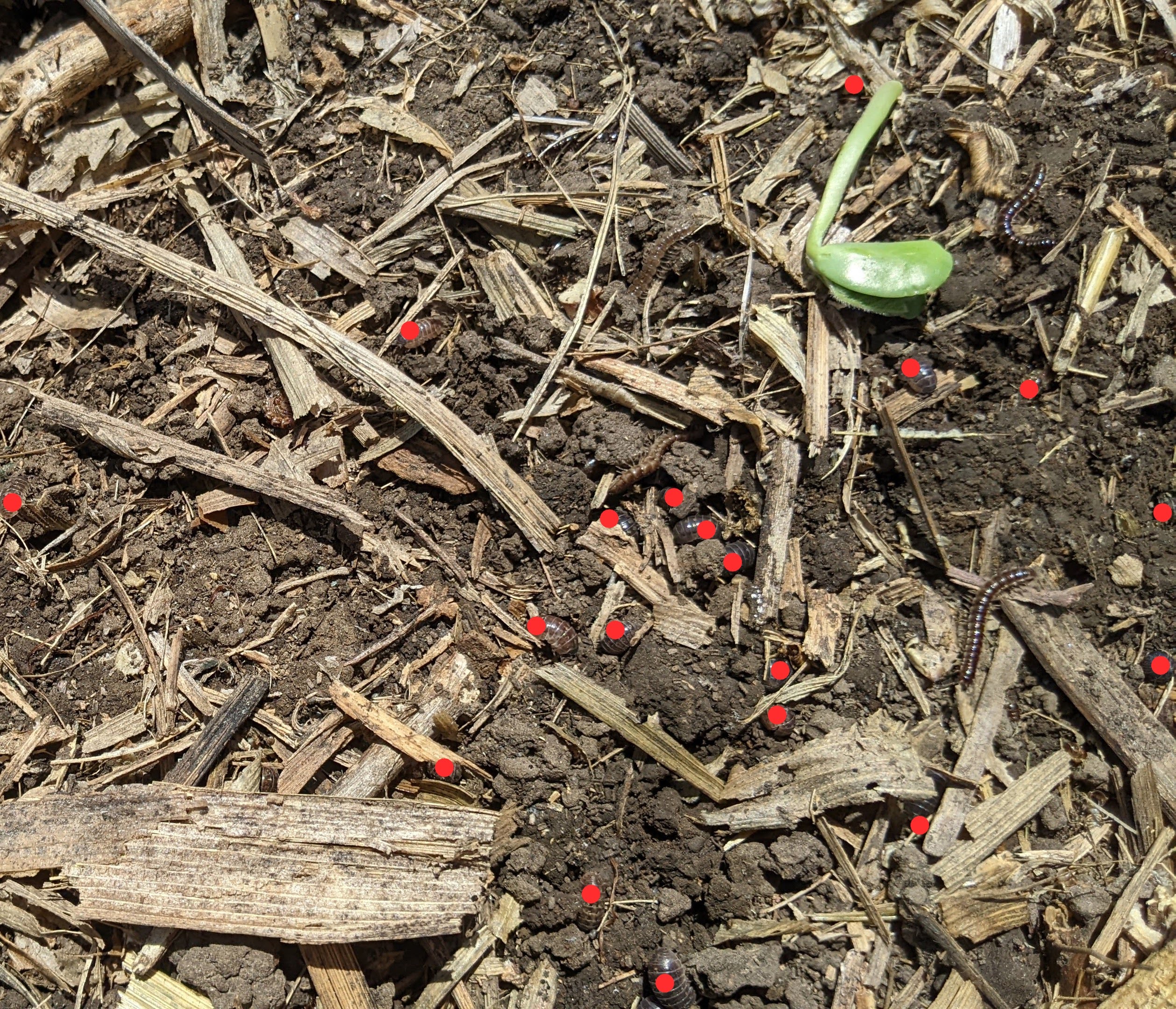
The warm February, reminiscent of 2017, provided the potential for greater insects. Thankfully haven’t seen more than 10% damage from wheat stem maggots to corn planted green into small grains (compared to 2017). Pill bugs (roly polys) and centipedes which typically feed on decaying material and other small insects/spiders, respectfully, have caused damage to soybeans in some fields. I’ve never seen these numbers nor damage before! However, this year, in heavy residue fields, we’ve observed them eating soybeans to the point of fields needing replanting. Slugs and snails have plagued some double crop small grain/soybean fields with one consultant sending me a picture of a planter bar loaded with snails.
Been some issues with seed germination in some hybrids/seed lots. Heard situations of non-liberty tolerant refuge in liberty link corn hybrids. There’s also the failing to remember which trait is in which field before spraying herbicides, so a reminder to double check that before herbicide applications occur. There’s been a lot of uneven corn within rows this year. Each field has various circumstances, but common culprits have been: solar storm throwing off GPS which got seeds too close to fertilizer bands; residue blowing back over portions of rows; planting depth and/or sidewall compaction issues; seed issues; and “weaker” corn plants having a hard time outgrowing HPPD (bleacher chemistry) herbicides in portions of fields. With corn rapidly growing and canopying, unevenness in fields doesn’t look as bad anymore. Overall, these oddities are few and I’m grateful for a good start to this growing season!
Japanese beetles are unfortunately starting to appear. Reminder: don’t use traps as they attract more beetles to your yard! Beetles can be knocked off plants into soapy water in the evening hours and disposed of. The following contains conventional and organic insecticide information: https://go.unl.edu/xgd6.
Reflection: Some know that I’ve been out off/on helping family and I’m grateful for that opportunity. We had celebrated making it through each surgery with Cheesecake Factory Cheesecake and are praising the Lord for healing😊As I drove home this weekend from celebrating family birthdays, I was reminded again how blessed we are to live this life and how short it truly is. How often we miss the little things or don’t take time to celebrate! Some recent conversations included how often the china stays in the cupboard, taking time to smell a blooming flower instead of just walking by or just stopping to admire a sunrise/sunset. Simple things. But I think the result is gratitude. This week, perhaps we can seek to live life more intentionally with the people around us.
Reminder of Weed Management Field Day at South Central Ag Lab near Clay Center June 26!


JenREES 9/10/23
Crop Update: This seems like another strange end to the season with irrigating, harvest, harvesting silage, and harvest finished occurring simultaneously in the area I serve. For those interested in planting wheat, check out Nathan Mueller’s information on winter wheat variety selection on his blog: https://croptechcafe.org/winter-wheat-variety-selection-fall-2023/. Nathan does a great job of comparing varieties over time and sharing details he hears and sees on varieties for eastern Nebraska.
A few have asked about adding moisture to silage that’s too dry. Dr. Bruce Anderson once shared “it takes about 7 gallons of water for each ton of silage to raise moisture content just one point. Even if you have enough water, the chopped corn can’t absorb it fast enough to do any good.” A better option is to add a wetter feed like irrigated corn to help with the moisture content. Bruce shares more considerations here: https://cropwatch.unl.edu/2017/making-silage-dry-corn.
Check moisture content on non-irrigated corn and soybeans and harvest accordingly. Have heard reports from some non-irrigated fields from Nuckolls Co. to Seward Co. going as low as 13.6% to 17% for corn last week. A lot of non-irrigated beans in the area I serve have no pod fill in the upper ½-3/4 of plants, which I realize makes it hard to want to harvest them. In irrigated corn fields, particularly those that had quite a bit of premature ear droop, watch stalk integrity and also integrity of the ear shank attachment where it connects to the ear; consider earlier harvest in those fields. Soybeans do need nearly two inches of moisture when leaves turn yellow. However, that moisture can come from a combination of soil moisture reserves and irrigation, so it doesn’t mean you need to irrigate two more inches.
Couple things about pastures: make note if you’re seeing cattle avoiding any grass in them. I’ll share more on that next week. Also, a quick note that with the shortage of grass, cattle may be getting higher quantities of nitrate-rich weeds. Had a couple people reporting losses to me, so please be aware of this.
Grazing Corn Residue: Received numerous questions on grazing non-irrigated corn residue with stalks most likely high in nitrates. Cattle will go for the ear, husk, leaf first. I realize some of these fields have essentially no ears (for either ear or husk); the cattle will still graze leaves before stalks. Rarely do leaves have high nitrates. You can always test to be sure. Then get them off before they graze the lowest 12” of stalk. There’s also field situations where these ‘nubbin’ ears are spongy, have tiny kernels and aren’t threshing, so there may be more grain on the ground than one realizes. Hopefully the following info. isn’t needed, but sharing in case. Anything above 8-10 bu/ac on the ground needs a well-planned grazing strategy. How do you know? An ‘average’ corn ear would be considered about one bushel an acre loss, so do your best to estimate how many of these tiny ears would equate that. There’s a couple of ways to measure the area to determine grain on the ground. One way is to take your combine width in rows (8 rows, etc.), then measure one one-hundredth of an acre and count the ears in the area on the ground. Another way is to take 3 100-foot counts in three different areas of the field. Take the total number of ears (again consider a ‘normal’ ear size), divide by two, and that would give you an approximate bushel per acre loss.
One can adapt cattle to grain by feeding two to three pounds per day and slowly move up to 10-15 pounds per day over approximately 10-14 days. Turn cattle out that are full and make sure plenty of fresh water is readily available. Also consider feeding high quality hay as a supplement. For those with plants that were two foot or less on field edges that you didn’t run a combine through, perhaps consider fencing out those field edges? Also, while a frost does release prussic acid from sorghum species, frost does not release nitrates from corn plants/stalks.
Last Alfalfa Cutting: I think most in the area have finished last cutting of alfalfa. If you’re still considering it, alfalfa needs at least 6 weeks before the first average killing frost which can range from 24-27F due to plant height, stress, portions of plant affected, topography, etc. Research has shown that cutting during that resting period can increase the chances of winterkill and also reduce the first cutting of alfalfa the subsequent year. To be safe, that last cutting should be taken for our area by mid-Sept. even though I realize some have made it to early Oct. in the past. If you have quite a bit of regrowth and are in need of forage, another option is to cut or graze the alfalfa anytime after waiting a week after a killing frost.
Husker Harvest Days is this week! A number of topics will be covered in the Big Red Building where Extension, Curtis, and LEAD are located. The pesticide safety educators will be in the Hospitality Tent near NDA and will be doing respirator fit tests. If that’s something someone in your operation needs, please bring the respirator for the fit test. The TAPS team will be doing the crop skills challenge again in Lot 942 and there’s a student and non-student competition each day. Events include pest ID, grain moisture/yield estimates, plot imagery ID, and water use efficiency. There’s prize money each day of $250 gift card for 1st place, $150 for second and $100 for third.
As I re-read what I wrote, I realize this column was heavy with sharing about problems for awareness. Grateful we’re nearing the end of this crop season! Wishing everyone safety and all the best in finishing out this year!
JenRees 9/3/23
Water use till maturity for Corn: Beginning Dent 5”, ¼ milk 3.75”; ½ milk 2.25”; ¾ milk 1”.
Water use till maturity for Beans: Beg. Seed 6.5”; Full Seed 3.5”; Leaves beg yellow 1.9”.
Crop Update: Harvest is coming early and will probably start rolling this week for some non-irrigated crops. Please be safe with the heat and dry conditions and keep fire safety in mind! Quality in non-irrigated corn ranges but some is very poor; please assess your fields before choosing to store it. Soybeans took a yield hit with the last few heat waves. If you have non-irrigated soybeans that are turning brown, it may be good to check pod fill. Regarding irrigation, corn should be wrapping up soon and it will be tempting to quit on beans too. However, beans still need nearly two inches of water when the leaves begin to turn yellow. Technically, when the white membrane has separated from the seed inside the top several pods, they are no longer using moisture. Evaluating the soil moisture status in each field will help you determine if/how much more irrigation you need. Here’s wishing a safe finish to the growing season and harvest to all!

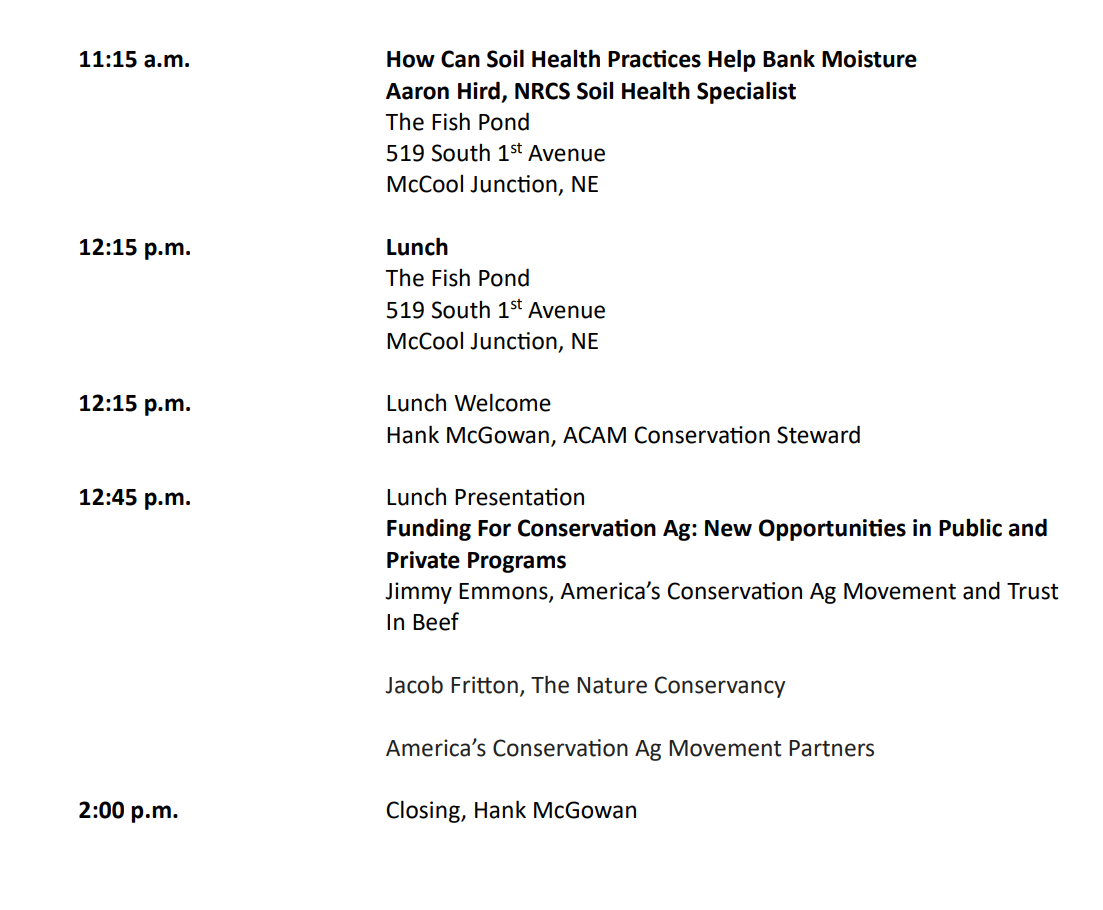
A Soil Health Field Day will be held Sept. 8 from 8 a.m.-2 p.m. (Reg. at 7:30 a.m.) at McGowan Farms, 1213 Rd. 4 McCool Junction. Several farmers will share their experiences with intercropping/relay cropping, integrating perennial cover crops and livestock with cash crops. Additional topics include: animal health strategies, soil health and moisture, and soil health funding opportunities. No charge, info and RSVP at: https://events.farmjournal.com/acam-sept8?i=NKF6zLCT4K-TcK44GTpfFL3hKF56pMmH.
Soybean Gall Midge: Most of the area I serve thankfully does not have this pest yet; however, it has increased in Seward county this year. Travis (TJ) Prochaska, recently joined us as an Extension Educator in Colfax county from serving as an Extension Crop Protection Specialist at NDSU. He has his doctorate in entomology and his family farms in Seward county. We’re glad to have him join Nebraska Extension!

Travis wrote the following along with Justin McMechan, “Soybean gall midge was first detected in Seward County during the 2019 growing season. However, the 2023 growing season has presented several growers in the area with their first experience with the emerging pest, especially in areas near the city of Seward and west. Other counties in eastern Nebraska have been dealing with the pest for several years. Typically, adults emerge in early- to mid-June. To receive alert notifications of soybean gall midge adult emergence, go to soybeangallmidge.org and register for the alert network. Overwintering adult soybean gall midge emerge from the previous year’s soybean fields and fly to an adjacent soybean field to lay eggs on young soybean plants. As the eggs hatch, the immature larvae feed on stem tissues underneath the epidermis, disrupting water and nutrient uptake within the plant. As the larvae grow, they will transition from a white to a bright orange color specimen.
Infested soybean plants can wilt or lodge at the feeding site and, in some cases, result in the death of the plant. Plants become susceptible to infestation around the vegetative V2 leaf stage as fissures (small cracks) develop near the base of the stem, providing an entry point for females to lay eggs. Management has been hit-and-miss. Research studies completed by Dr. Justin McMechan’s lab have shown some results, but foliar-based treatments have been inconsistent between locations and years. Chemical control should only be considered if the history of gall midge has been recorded or an adjacent field has shown a history of gall midge. Gall midge is a field edge pest, so any treatments be should be confined to the first 60-120 feet of the field. Research has shown that hilling, a process where soil is used to cover the base of the stem can be an effective strategy to control, however, it is difficult to implement at the V2 stage and not cover up the small soybean plants. Granular at-plant applications with Thimet 20G have shown consistent control, but its use is limited due to the need for additional specialized equipment. A multi-year field study funded by the Nebraska Soybean Board has shown that delaying soybean plantings until late-May can reduce infestation and injury. Studies led by Dr. Bob Koch, University of Minnesota, are showing some success with biological control and predators (i.e., ground beetles, parasitic wasps, etc.); however, further studies are needed to fully understand their impact.
As with any insect-related program, scouting will be key. Scout field edges of soybean that are adjacent to fields that were planted to soybean last year. To assess a soybean plant for larval infestation, look for any dark brown or black discoloration near the base of the stem below the cotyledonary nodes. If found, peel back the outside layer of the stem to reveal any possible white or orange larvae. As we approach September, there are no practical management tactics this late in the season. However, scouting to build a profile and a history will be helpful for possible treatments for the 2024 crop.”

Quick note for those who replanted soybeans and mentioned they’re flowering, Dr. Jim Specht ran the SoySim model for me and gives approximations of when to expect maturity is reached for the weather conditions thus far. First column is 1.5, middle is 2.0 and last column is 2.5. Based on this, should be seeing beginning pods this week. The harder part will be looking at the physiological maturity line, depending on when we receive a frost. I realize this isn’t encouraging to see either.

JenREES 8/27/23
Quite the Year: What a blessing to have a cooler weekend! Some in the area I serve also received decent rains to help pastures or to end irrigation. The labor, time, financial, and mental/physical/emotional aspects of irrigating have taken a toll. Likewise, not having access to irrigation has taken a toll on farmers with non-irrigated ground. I think the extra irrigating (having to start after planting) also unfortunately aided more soil-borne diseases in soybeans this year such as Fusarium and Phytopthora root rots, sudden death syndrome, and white mold. I’ve never seen soybeans baled for forage till this year. Each field varied in how far gone it was, but wondering (for beans not taken for forage) how recent rains in the southern counties will potentially cause beans to try to regreen?
Several shared they feel this year is even harder than last year. It feels harder to me too, but I almost wonder if it’s more compounded by several rough years in a row? We’re still blessed in numerous ways and it’s good to think of gratitude each day! Continue to hang in there! Even if you can get away from the area for a day or night-such as going to the state fair-it’s amazing how just a quick break from the norm can help with reset and perspective. At least it’s been helpful for me.
Corn Ears Drooping: The high heat coupled with moisture stress in various fields played a role in corn ears drooping down last week. Typically, ears remain upright till they reach black layer. A loss of turgidity in the ear shank which feeds the ear can create the ear shank to droop creating a pinchpoint restricting water and nutrients to the ear. If the flow is completely shut off, grain fill to the ear ceases and the kernels will prematurely reach black layer.
What can you do now? Note places in fields where this occurs, particularly in irrigated fields (look for soil compaction, root restrictions, crown rot, etc.). Also note hybrids as genetics can also play a role. Looking at hybrid plots may also be of interest. Scout fields with drooping ears to determine percent milk line. At the beginning of dent, kernel moisture is at 60% and kernel dry matter is only 45% of the final.
In estimating potential yield loss, if the ear droops during early dent when the milk line is hard to differentiate, yield loss could be up to 40% if the flow of carbohydrates is completely shut off. If the ear droops at the end of the dent stage, when the milk line is close to the tip of the kernel, then yield losses could be up to 12%. Identify the development stage in which the ear drooped then you can multiply the percentage of ears affected (in a known area like 1/100th or 1/1000th of an acre) by the estimated yield loss per ear (depending on the growth stage utilizing the 40% to 12% loss estimations). Also watch the integrity of the ear shank and plan harvest accordingly to reduce the potential of ears on the ground pre-harvest.
Lawn Renovation: John Fech, Extension Educator shares the following, “There are 3 categories of lawn reseeding: 1-Total renovation – if less than 50% of the lawn is comprised of desirable species, 2-Lawn Overseeding – if 60 to 70 % is desirable, and 3-Lawn Thickening – if the current lawn is mostly desirable, but just a little thin.
With total renovation, step 1 is to spray the entire lawn with a non-selective herbicide such as glyphosate. Once the herbicide has taken effect, you can move on to Step 2. Step 2 is powerraking to create a seedbed. It’s wise to think of this step as the platform on which the new grass will grow.
Step 3 is to rake off the debris. As hard as it may be, it’s well worth it in terms of creating a seedbed that facilitates seed to soil contact. Step 4 is to apply grass seed with a drop spreader; seed is light and can easily be carried off site with a light wind. Divide the amount of seed in half and apply it in a north/south direction and then an east/west path. For Kentucky bluegrass turfs, apply a total of 2 -3 lbs of seed per 1,000 sq. ft. and 9-10 lbs of seed for turf type tall fescues lawns.
To create a suitable environment for germination and initial growth, it’s best to irrigate several times per day and keep the upper inch moist, but not soggy or dry. For Kentucky bluegrass lawns, this will take about 3 weeks; for turf type tall fescue, about 2 weeks. It’s very important to keep watering lightly and frequently until all the seed has germinated, or else the resulting lawn will be thin and clumpy. After the new turfgrass plants are a half inch to an inch tall, apply a starter fertilizer at label rates to encourage thickening and provide for the next few weeks of establishment.
If lawn overseeding is called for, the procedure is much the same as it is for renovation, except that the spraying of the lawn is skipped. In the case of caring for a mostly desirable, but slightly thin lawn, apply 0.5 to 0.75 lbs of a slow release nitrogen fertilizer product and spot spray broadleaf weeds that may have invaded due to the voids in the lawn. Products such as Weed-Free-Zone, Weed B Gone Maxx or Trimec are suitable for this purpose. Please read and follow all label directions.”

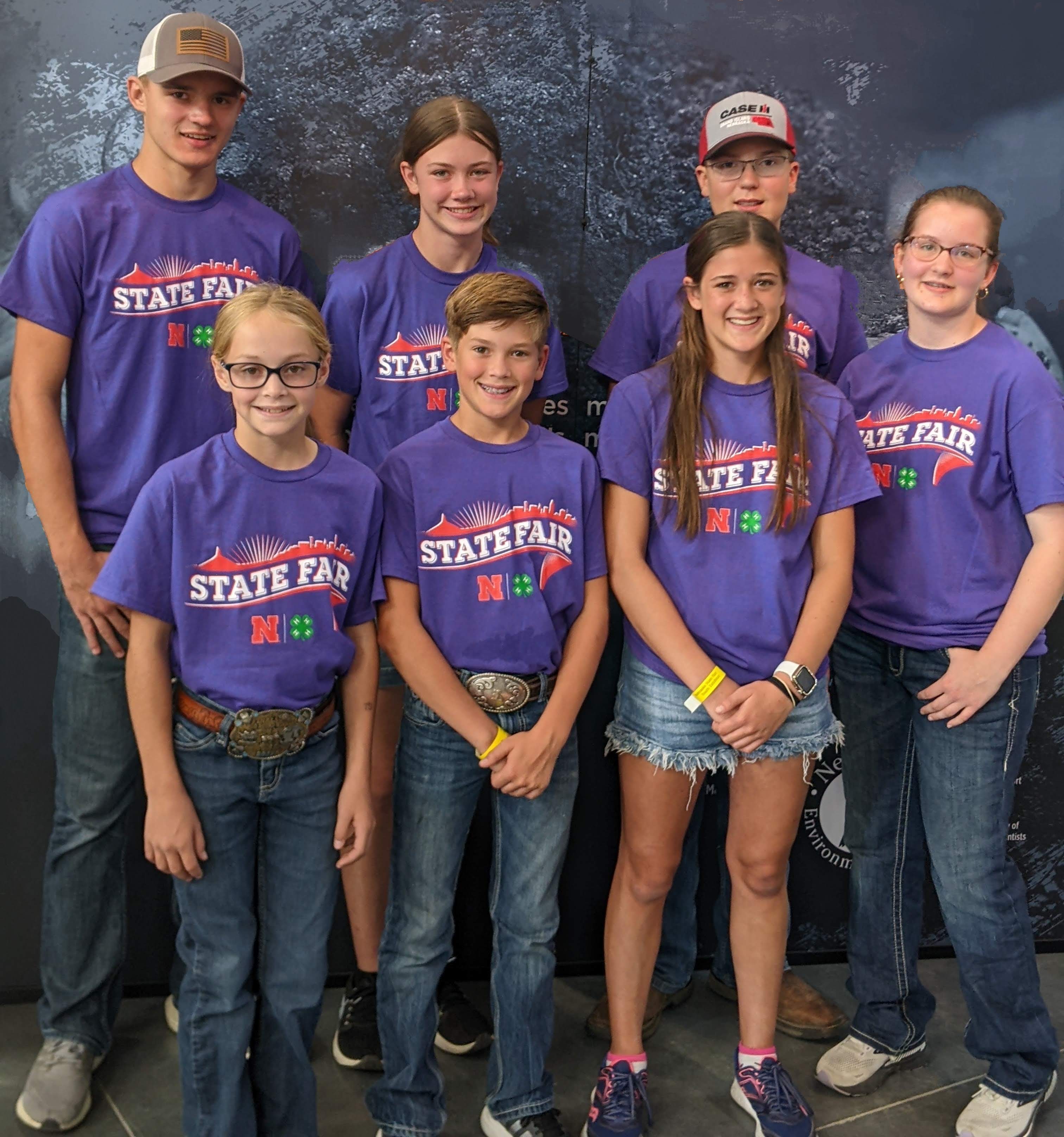
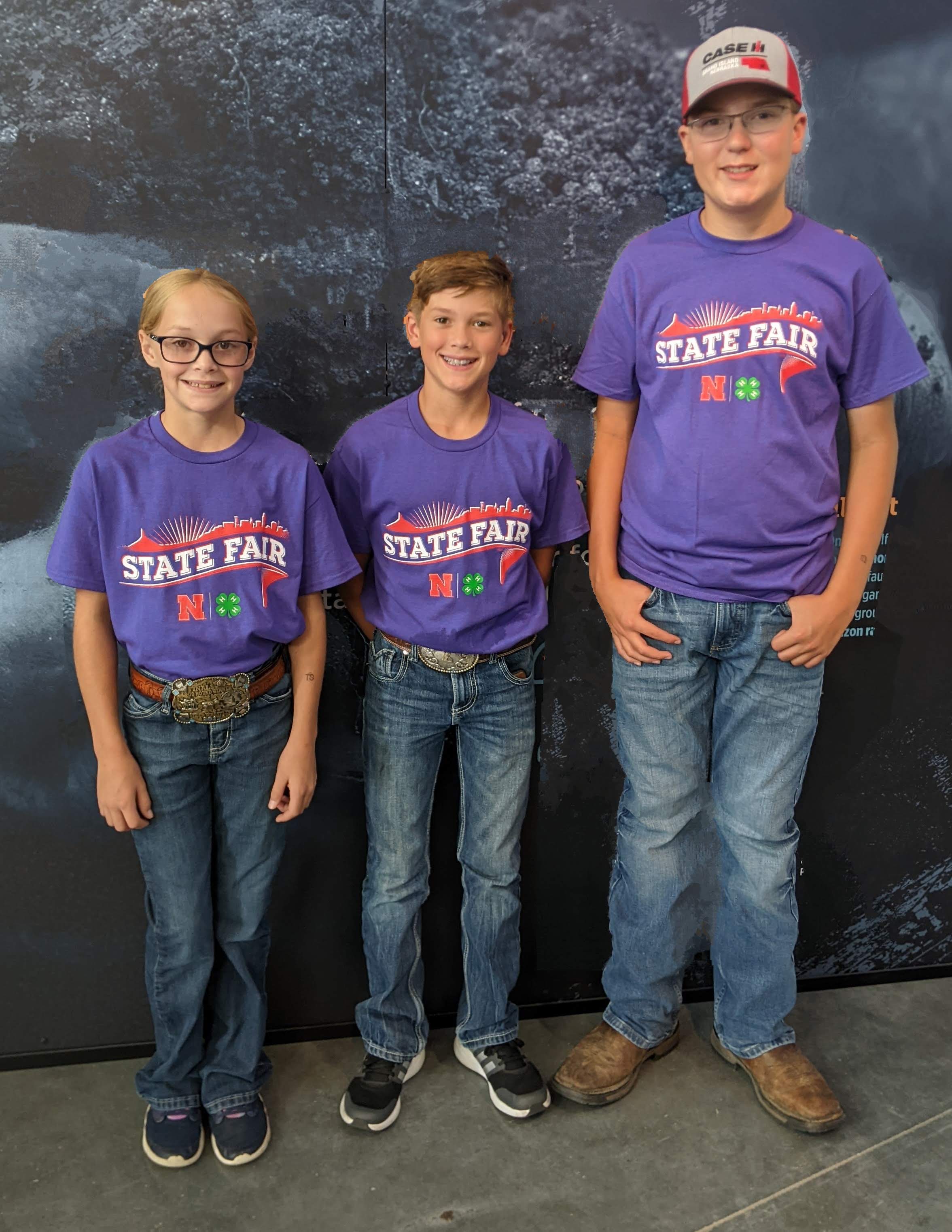
Something that brings me joy is to see youth continue to learn and develop life skills such as identifying plants! I’m blessed to work with an incredible group of youth in Crop Science Investigation (CSI) who enjoy learning. They also practice and compete in plant ID at county and state fairs. So proud of them!




JenREES 8/20/23
Two weeks’ worth of articles to share here. Lots happened with weather for fields, vegetables, trees.
Water use till maturity for Corn: Dough 7.5”; Beginning Dent 5”, ¼ milk 3.75”; ½ milk 2.25”; ¾ milk 1”.
Water use till maturity for Beans: Beg. Seed 6.5”; Full Seed 3.5”; Leaves beg yellow 1.9”.

Silage: With higher nitrates in drought-stressed corn, for those cutting the corn for silage, please be aware of silage gas (nitrogen dioxide) which is toxic. National Ag Safety Database shares, “Shortly after ensiling green plant material, oxygen is used in fermentation and the nitrates in the plant are released as nitric oxide (NO). This gas quickly escapes from the silage and combines with oxygen in the air to form toxic nitrogen dioxide. The lethal gas is yellowish-brown and smells like some laundry bleaches. After more oxidation, it forms N2O5, which then forms highly corrosive nitric acid when combined with water. Since oxidation may occur in the lungs, nitrogen dioxide can produce permanent lung damage.” Nitrogen dioxide is denser than air so it hangs out in low-lying areas around the bunker or pile (stay out of these low lying areas to reduce exposure). It’s worse the first 12-60 hours after ensiling. More info: https://nasdonline.org/901/d000741/watch-out-for-silage-gas.html.


Grazing: Grazing drought-stressed corn or harvesting the corn and grazing the residue can still be safely done in spite of higher nitrates. The key is to remember the nitrates are highest in the stalk, particularly the lower foot of the stalk. Thus, for those choosing to graze drought-stressed corn instead of harvesting, the cattle will pre-select for ears first followed by husk and leaf tissue which are low in nitrate concentrations. The same goes when grazing harvested fields high in nitrates. As long as the cattle aren’t forced to eat much more than any grain, leaf, husk, one can better manage for nitrates.
In both cases, since grain will be present at this point, there’s increased risk of acidosis due to potentially higher grain in the cow’s diet. Strip grazing can help limit the amount of grain cattle are allowed to consume at one time. Also, adapt cattle to grain by feeding two to three pounds per day and slowly move up to 10-15 pounds per day over approximately 10-14 days. Turn cattle out that are full and make sure plenty of fresh water is readily available. Also consider feeding high quality hay as a supplement and then moving to the corn field for a period of time during the day. Cross fencing and strip grazing areas will help limit intake and reduce trampling while turned out on drought-stressed corn. I realize many probably won’t strip graze or allocate acres. Stalk trampling can provide ground cover. The problem is when cattle are forced to eat the trampled stalks and end up with portions of stalks higher in nitrates. Those are the concerns to watch for.

Some asked about grazing drought-stressed soybeans where pods quit filling/didn’t develop. From what I understand (please check with your insurance), crop insurance rules don’t allow the soybeans to be released till they’re brown. However, ask them if you can leave strips and you should be able to utilize the rest for forage. Soybeans were originally developed as a forage crop and they have value when they’re green with low bloat risk. Once they turn brown, the quality becomes like sawdust in feed value. Don’t let young calves graze beans with seeds due to problems with high oil content. We wrote more about this topic in this article: https://cropwatch.unl.edu/2023/soybeans-forage. One final important thing is not to provide access to blocks, tubs or supplements that contain urea when allowing access to raw soybeans. Raw soybeans contain urease that can rapidly turn urea into ammonia and cause ammonia toxicity.
Final consideration: I realize this sounds crazy in the midst of drought, but I’m also thinking about soil erosion if we get wind again. Perhaps consider a cover that will winter kill like brassicas/spring cereals to get some roots in the ground where silage is being chopped or in the wildfire damaged areas. I know winter cereals like rye took a lot of moisture in a drought year and got a bad rap-they did hold the soil in place. Some are hoping to plant wheat after silage. Just a consideration; it will rain again one day.
Soybean Problems: White mold, sudden death syndrome, and gall midge have also been hot topics for several weeks. For white mold and SDS, aim to irrigate deeper and less frequently. Gall midge is popping up more in Seward Co. and there’s still too much unknown about it. Will share more next week.
Corn Grower Banquets: Aug. 28: Hamilton Co. Corn Growers 5 p.m. plot tour-field ¼ north of 6 road and J near Giltner; 6 p.m. meal and program Giltner Community Center with featured speaker KAAPA Ethanol. Aug. 29: York Co. Corn Growers 6 p.m. seed dealers share, 6:30 p.m. social, 7 p.m. meal and program with featured speaker Sentinel Fertigation (all at Stone Creek in McCool Junction). Cost $15 for beef and chicken meal and appetizers. RSVP to 402-362-5508 or any corn grower director.
Vegetables: Many questions on vegetables. Basically, the humidity allowed for a number of fungal diseases to get started. Most vegetables with blemishes can still be eaten or used (just wash and remove the blemishes). One can’t use green beans with rust and it’s not recommended to can tomatoes with certain diseases (tomato ringspot virus, lateblight fungus) as they can change the pH.

Brown leaf clusters: Every August, oak trees (but sometimes others such as hackberry, honeylocust, elm, linden) get a cluster of brown leaves towards the ends of branches. This damage is caused by twig girdlers or twig pruners, different types of beetles. Adult beetles chew a circle in the bark between where the old and new wood occurs on a twig. This girdles the twig, cutting off the water and nutrient supply causing its death. Eggs are then deposited and larvae hatch, tunnel, and survive in the dead twigs. Twigs girdled by any of these insects may stay attached to the main branch for several weeks or be broken out of the tree by wind. Tunneling in the twigs may not be evident in the fall if twigs fall out of the trees before the insect eggs have hatched. Mature trees with heavy infestations can look bad, but the damage isn’t a serious health problem to the tree and no chemical control is recommended. Burn or discard infected twigs in the fall and spring that contain developing larvae to minimize the impacts for the future.

JenREES 7/9/23
It was sad to see several get hit with devastating hail for a second year in a row from the July 4th storm. It was also such a blessing to get the unexpected gift of a fairly widespread 1”+ rain last Friday morning!
For those dealing with hail, I don’t have any great new ideas for planting into totaled crops beyond soybeans or some type of forage crop at this point. For replanting with soybeans, we suggest 0.5-1.0 maturity less than you normally plant, make sure you have a fungicide seed treatment (wouldn’t have to have anything for SDS, just for seedling diseases), increase your seeding rate, and consider narrower rows to close canopy quicker. Phytophthora root rot is something I tend to see fairly often with replant soybeans, thus the rec for the fungicide seed treatment. For acres damaged on fringes, I recommend leaving existing soybean stands of 50K, which is trickier now that we’re at R2-R3 in many fields. In corn fields with less damage, we will have to watch what happens on timing of silks/tassels.
For those interested in planting annual forages in July or August after hail/drought/wheat harvest, the following contains more info. on seeding rates, tonnage, species, etc.: https://go.unl.edu/ypgc.
Annual Forage Insurance is an opportunity for obtaining crop insurance (in Nebraska, Kansas, South Dakota) to protect against the primary production risk of low precipitation. This is for annual forage crops used for grazing, haying, grazing/haying, green chop, grain/grazing, grazing/green chop, or silage. The current sign up period ends July 15 for coverage on annual forage planted from July 16, 2023-July 15, 2024. This insurance uses the two-month rainfall index intervals with coverage up to 90% of normal precipitation (similar to perennial forage insurance). Recorded webinar with info: https://go.unl.edu/3d57.

Japanese beetles: Adults emerge from grassy areas (lawns, pastures, road-side ditches for at least 4-6 weeks (last year was around 10). So, even if you treat, they can come back. Threshold is 30% defoliation on vegetative corn. Upon silking, the threshold is 3 or more beetles/ear with silks clipped to less than ½ inch and pollination is less than 50% complete. For soybeans the threshold upon reaching flowering is 20% defoliation (watch for pod clipping too). More info. on chemical options for crops at: https://go.unl.edu/osyi. The following are chemical options for landscapes/fruits/gardens: https://go.unl.edu/bke4. The hardest thing has been to tell people they can’t eat produce or fruit from using products that weren’t labeled for the plants they applied to. Crazy how many livestock and crop products were used in landscapes last year….please follow pesticide labels.
We know how uneven these corn fields are-even irrigated ones. Many labels specify no NIS between V8/V10 till Tassel. Even if applying ‘at tassel’, realize that not all plants in the field will be at tassel, so you run the risk of abnormal ear development with the wrong adjuvants/surfactants present. If disease/insect pressure doesn’t warrant an app, I prefer delaying till at least brown silk to apply products to help alleviate any potential risk. I tend to be called out to many field problems. Since I started talking about this, the number of calls with messed up ears due to wrong timing of application the past three years has dwindled significantly. So, just a consideration as we begin to see more tassels shooting.
Western Bean Cutworm: It’s recommended to start scouting when 25% of moth flight occurs based on a GDD model. Lincoln hit 25% on July 2nd, Grand Island July 6, Columbus July 7, York July 8th, Clay Center July 10th. Threshold is 5-8% egg masses/live larvae. You can learn more about the GDD prediction tool and predictions for your area at: https://go.unl.edu/438o.


 JenResources