Category Archives: Crop Updates
Residue Concerns
The recent rains have left their impact on fields throughout the county and Nebraska in general. I’ve received several questions this week regarding flooded fields and how to help crops buried beneath piles of residue.
For flooded fields, Bob Nielsen with Purdue University wrote an excellent article to address these concerns. In short, our cooler temperatures will help plants survive better, but plants completely submerged under water in saturated soils for more than 48 hours don’t stand much of a chance for survival. You can read his entire article here.
If there’s one thing I would like to see farmers reconsider, it’s stalk chopping. It seems like every year we deal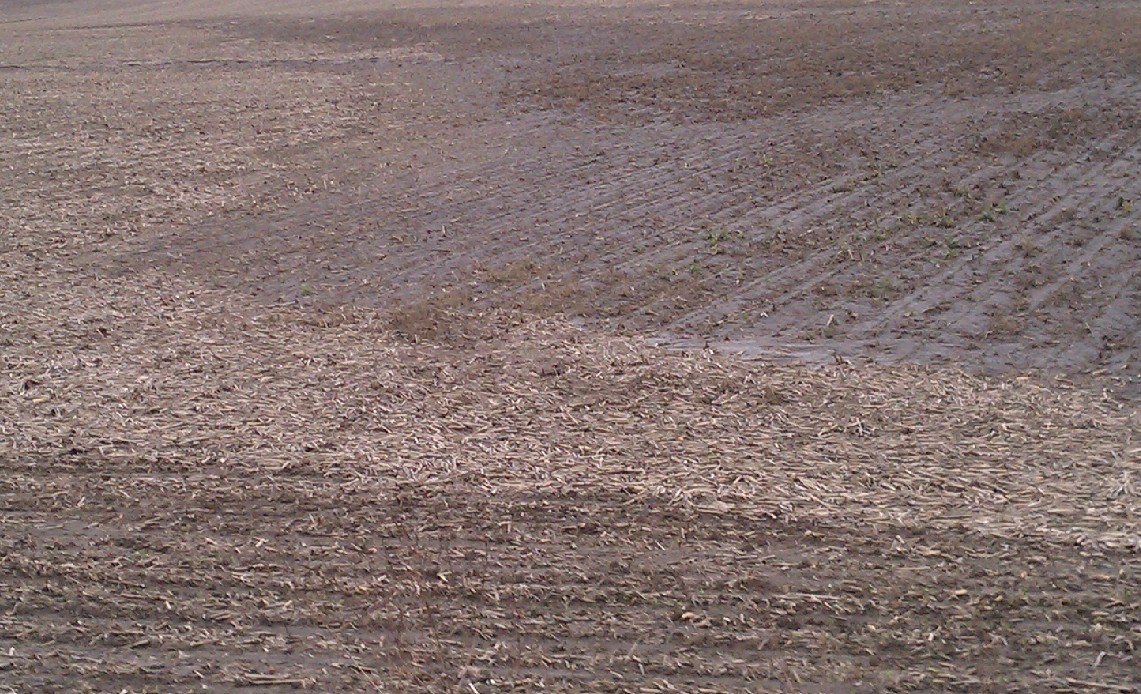 with heavy rains washing stalks from fields where they pile in certain areas of the fields burying plants, covering roadside ditches or jamming creeks. Talking to my colleagues and to several area farmers, we’ve all considered burning as an option. However, burning may only get the top-most dry material while the material underneath is still wet and won’t burn. Another farmer correctly pointed out that there’s usually so much silt intermingled with the residue that it’s hard to get a good burn anyway.
Keith Glewen, UNL Extension Educator in Saunders Co. suggests you consider harrowing or possibly rotary hoeing the stalks, knowing that the depth of stalks and the period of time which elapses following a heavy rain event are important factors in determining success or failure in managing the unwanted stalks. There’s a short amount of time to get that residue off those plants if there’s no light getting down to them. In some situations in the county, residue is up to 1 ft. deep over the top of plants. Harrowing can help even out the field and emerged seedlings may be damaged, but the growing point for corn is still below ground at this point. For emerged beans, the growing point would be above ground so harrowing wouldn’t be a good option. With the rains again today and forecast for more in the future, I’m not even sure that harrowing is much of an option right now for corn as it will take awhile to get back into the fields. In places where 1 ft. of residue is burying plants and the inability to get to those piles with the wet conditions, I don’t expect much plant survival there.
For now we’ll have to wait and see. In the mean time, evaluate your operation and the need for chopping stalks. If you don’t detach the stalk it won’t move. UNL on-farm research found no yield benefit to shredding vs. not shredding stalks in the research which can be found here.
Wheat Update
It’s been a quiet year so far regarding wheat, so it didn’t surprise me when the calls started rolling in this week regarding wheat looking yellow. Most wanted to know if we had disease issues out there. Looking at fields throughout Nuckolls and Clay counties, I saw very little disease overall. That’s most likely due to the dry conditions we’ve had and the fact that many fields I looked at were wheat on corn or soybean stubble. Wheat on wheat fields had disease such as tan spot or septoria leaf blotch on the leaves. I did not see any powdery mildew or rust in any of the fields I looked at.
So why are some fields yellow? Well, most likely it’s due to a combination of factors. We had a dry fall and winter. Some wheat had winter injury and some just never developed a good root structure due to lack of moisture. Dr. Drew Lyon, UNL Extension Dryland Cropping Systems Specialist, also shared with me that poor root structure could also be a result of not having a firm seed bed during planting. Without a firm seed bed, roots aren’t allowed to develop like they should, can’t explore the soil for nutrients, and are more exposed to the potential for crown and root rots. Fall-applied fields often had sprayer wheel
tracks showing green wheat in the wheel tracks and yellow wheat elsewhere-most likely the compaction from wheels allowed for better establishment, created a depression where moisture held, and allowed for less nitrogen loss.
Fall applied nitrogen may have been lost due to the dry fall and winter. It appears that fields with spring applied nitrogen look better due to moisture this spring after application. There’s also environmental reasons for yellow wheat. The cold soil temperatures may not have allowed for nitrogen release to the plants yet-we may see a change by next week. Many places in south central Nebraska have experienced dry conditions creating yellow-brown lower leaves and a blue cast to the wheat. I have pictures of wheat with ice crystals on it from some of the cold snaps we experienced. Cell rupture of that plant tissue could also have caused the yellowing of those lower leaves.
Bottom line, right now there’s nothing you can really do for the yellow wheat and warmer temperatures may allow for nitrogen uptake in the future if the nitrogen wasn’t already lost. Right now there’s nothing to be worried about regarding fungal disease concerns. I’d recommend you continue scouting your fields for powdery mildew and rust and consider a fungicide application if needed (need to protect the flag leaf). I’ll keep you updated on what I’m finding in the fields!
Discussion Topic-Your Planting Progress
Planters have been rolling and corn has gone in the ground quickly in the past week. Please provide an update on your planting progress-and a general location of where you farm! If you are on Twitter, or even if you’re not, if you go to http://www.twitter.com and search for #plant11, you will see a variety of perspectives of how the planting season is going for producers throughout the United States. Happy Planting!
Planting Progress
Well, it’s May Day as I write this and planters were rolling late last week. Dr. Roger Elmore provided an article regarding historical planting progress in Iowa. Finding it interesting, I chose to work the numbers for Nebraska. Many of us have been comparing this year to 2008. When we look at state-wide planting progress, we’re essentially tracking right with 2008: 9% planted the last week of April in 2008 vs. 5% in 2010. It will be interesting to read tomorrow’s report and see the change. In 2008, the average 4 days of good field conditions allowed for a jump in corn planted to 31%. With the size of today’s equipment, and the number of planters going since Thursday last week, I would expect a similar jump state-wide.
I haven’t heard the question yet, but remember receiving it at this time in 2008. The question of “should I switch to a shorter-season hybrid?” The answer is not yet. Unlike soybean varieties which are photoperiod sensitive resulting in reduced yield with later planting, research has proven that corn hybrids can adjust to delayed planting dates.
I found the following information from Dr. Roger Elmore and Lori Abendroth with ISU. Essentially, research from Purdue and The Ohio State University looked at early (April 25-May 10), mid (May 20-June 1), and late (June 10-15) planting dates to determine the time required (in days) from planting to silking, silking to physiological maturity, and planting to physiological maturity. What the research found was that as planting date was delayed, all hybrids in the study shortened the time between planting and silking. They also found that all hybrids, when planted late, increased the number of days between silking and physiological maturity (but the day increase varied with each hybrid). Finally, they found that hybrids change the length of time from planting to silking more than the time from silking to physiological maturity…so the corn hybrids put less emphasis on the vegetative stages than the reproductive ones. Essentially these findings show that hybrids can adapt to later planting date by changing the number of days to various physiological stages.
How does planting date affect yield and percent risk of frost? I ran some simulations using UNL’s Hybrid Maize model. This model can do many things, but I used long-term weather data from Clay Center, NE to predict potential yields and frost probability based on planting date. Looking at a 113 day hybrid planted April 15 vs. May 1 vs. May 10, the frost risk increased from 10%, 17%, and 21% respectively with average yields in a “perfect year-no limiting conditions” of 248, 254, and 244 bu/acre respectively. For a 110 day hybrid planted the same days, yields ranged from 233, 242, and 243 bu/acre respectively with frost risks of 3%, 10%, and 17% respectively. Granted this is just a model and can’t predict perfectly what will happen.
First post of new crop season
As I write this, the sun is deciding whether or not it wishes to shine. Corn that has been planted appears to have a very short radical (main root developing from the kernel) in many fields. For those of you with corn in the ground wondering if it will come up or not, only time will tell. The following article posted to CropWatch may ease some of your concerns for now.
For those of you who haven’t planted yet, you’re most likely getting anxious to get the seed in the ground. It’s important to start that seed off right. Mudding the seed in the ground can only cause headaches later on and shallow planting in wet conditions can lead to rootless corn syndrome. See the following article from Iowa State University regarding similar planting conditions in 2008 and resulting emergence.
I would encourage you to share what you’re seeing in your fields now and throughout the coming growing season!


 JenResources