Category Archives: Horticulture
JenResources 6/8/25
Wheat Stem Maggot in Corn: Been seeing and hearing of some wheat stem maggot in corn for some fields where corn was planted green into rye. While I see this to a small extent each year, the last time we heard widespread reports was in 2017 (photos and info. at: https://jenreesources.com/2017/06/05/corn-concern-in-wheatrye-cover/). Symptoms include the corn whorls of plants looking wilted. Pulling out the whorl and carefully unfurling it may reveal the light-green maggot. Some key points: the maggot will move from dying rye or wheat into healthy corn. It will not move from plant to plant in corn unless the entire corn plant dies. What we have normally seen is the maggot kills the main stem of the corn plant; however, the plant produces tillers which then produce ears (not typical tiller ears). Because of that, replanting is not recommended. Our Extension Entomologists also don’t recommend spraying an insecticide once the maggots are in the whorls because they won’t have activity against the maggots inside the corn. There are no published thresholds for the maggot once it gets into the corn plant. Here’s an article UNL researchers published on timing and use of insecticides in cover crop/corn systems: https://www.mdpi.com/2075-4450/13/4/348.
Regen Ag Field Tours: A series of Regen Ag tours are available June-August. For now, I’ll share on two of them. On June 11, Doug and Traci Steffen are hosting a compost and covers tour on their farm near Crofton, NE from 1-3 p.m. RSVP at https://practicalfarmers.org/field-days.
On July 8 from 10 a.m.-Noon, Junior Pfanstiel is hosting a covers and corn tour on his farm near McLean, NE. Lunch is also included. Junior alternated 4 rows of corn with 4 rows of multi-species cover crops throughout his field with the goal of obtaining the same yield on fewer acres while also having grazing acres. Please RSVP to: (402) 254-6758.
Roundup: Homeowners, Please read the active ingredients on jugs before purchasing and using Roundup products. I’ve had several situations where homeowners have bought “Roundup” thinking it was the traditional “glyphosate”, but instead the active ingredient was “triclopyr”. The problem? They work differently. Glyphosate is a non-selective herbicide that doesn’t move in the soil or from plant to plant. It only works on the plant it comes in contact with. Triclopyr is a growth regulator herbicide (same family as 2,4-D and dicamba) that mostly affects shrubs, stump treatment, and broadleaf weeds. It has minimal activity on grasses. It has soil residual activity, on average for 30 days, but can be as much as nearly a year depending on how the microbial life break it down. It can volatilize (move off-target to other broadleaf plants after application) and it can be excreted through the roots of plants that were sprayed to nearby, non-sprayed plants impacting them.
Because of this, some people who have used Roundup containing triclopyr have reported issues with growing vegetables, flowers, their grape vines, raspberries, and around fruit trees. Triclopyr symptoms on plants looks like a “strapping” of leaves where they become bubbly and elongated, but it’s a different look than 2,4-D damage. Plants grown in soil treated with triclopyr may have kinked stems and appear stunted. More info. on triclopyr: https://purduelandscapereport.org/article/the-summer-of-triclopyr-mounting-evidence-for-off-target-damage/. A great resource explaining all the different “Roundup” products on the market: https://www.purdue.edu/fnr/extension/when-roundup-isnt-roundup-purdue-landscape-report/.



JenResources 4/21/25
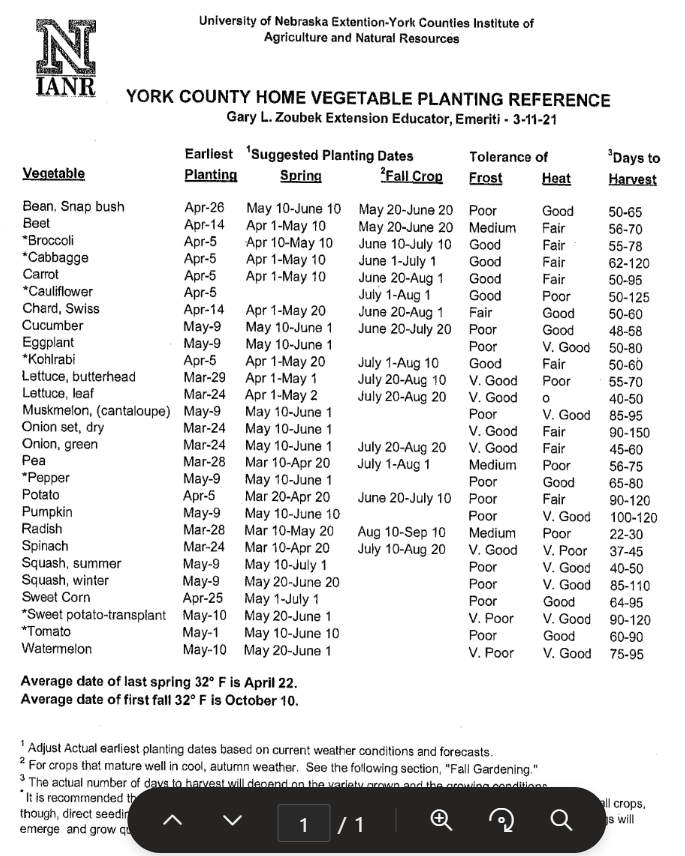
Hope you had a blessed Easter with your families/friends! It was wonderful for those who also received some rain! Quite a bit got planted last week with the warmer soil temperatures. Continue to monitor soil moisture for individual fields to have proper seeding depth into moisture. Eric Hunt, Extension Meteorologist, mentioned March 2025 had the highest wind gusts on record in Nebraska. That’s not a desirable stat, but it does help explain why so many asked if it’s normally this windy, why the surface soil moisture dried so quickly, and why small grains and pastures haven’t grown much in spite of warm soil temps. For vegetable gardens, I placed the planting guide at: https://jenreesources.com/2025/04/14/vegetable-planting-reference/.
Crabgrass Preventer for lawns is best applied when soil temps have been 55F at 4” depth for several days. Last week we were fairly close; watch soil temperatures this week at: https://cropwatch.unl.edu/soil-temperature/. For new lawn seedings, there’s options of a couple products to prevent crabgrass. Siduron (commonly sold as Tupersan) and mesotrione (found in Scotts Turf Builder Triple Action Built for Seeding) are available options.
Roundup Products for Homeowners: It’s important to read the active ingredients on the label when shopping for products. “Typical Roundup” contains the active ingredient glyphosate which is non-selective and will kill any green plants not resistant to it. Any product containing glyphosate that is sprayed on the lawn will kill the lawn.
The product labeled “Roundup for Lawns” does not contain glyphosate, which can be confusing. Active ingredients in this product include MCPA, quinclorac, dicamba and sulfentrazone. These herbicides are effective on a broad range of weeds that might infest the lawn such as dandelion, crabgrass and nutsedge, without harming the lawn when used properly.
“Roundup 365” is a product that contains glyphosate, imazapic, and diquat. This product can provide 12 month control of weeds and is labeled for use on driveways, patios, sidewalks, and gravel areas. Just know that nothing can be safely planted back into that area for at least 12 months.
To remove undesirable trees that grow within evergreen trees or hedges like lilacs, use glyphosate instead of Tordon on the cut stumps. This is because the glyphosate doesn’t have additional soil activity and stays within the root system of the plant it’s been applied to. Just be careful to only use a product with glyphosate with nothing else added to it. Ultimately, please read the labels to ensure you’re using a product that is labeled for the place you wish to use it, for any restrictions on the product, and what pests it lists to control.
Tree Planting: With Arbor Day this week, it’s important to not plant trees too deep. Kelly Feehan shares, “If a tree is planted at the same depth it was in its container, and the soil in the planting hole beneath the root ball is loosened, odds are very good the tree will be planted too deep. Since planting trees at the same depth they are in their containers and loosening soil in the bottom of planting holes is often done, too deep of planting occurs frequently. To plant a tree at the correct depth, wait to dig the hole until after a tree’s first lateral root at the base of the trunk is located. Soil may need to be scraped off the top of the root ball to do this. Only then dig the hole just deep enough so the root ball will sit on firm, undisturbed soil and the first root is just below ground level. Dig planting holes one to two times wider than the root balls diameter to loosen soil and encourage outward tree root growth.”
For those who have put their faith, trust, and repentance in Christ alone for salvation, Easter, and every single day, holds gratitude of the price that was paid in full for sin. We serve a Risen King! “All Praise to the Name Above All Names!”
JenResources 4/6/25
Storm Damaged Trees have been an increasing concern for homeowners. The cedar windbreaks seem to be the greatest affected and it’s hard to know how much damage has been done until you start the cleanup process. This is a resource from the Nebraska Forest Service on storm damaged trees: https://nfs.unl.edu/snow-and-ice-damage-trees/ and https://nfs.unl.edu/immediate-care-storm-damaged-trees/. Additional resources: https://nfs.unl.edu/pruning-large-trees/ and all Forest Service Resources at: https://nfs.unl.edu/nfs-publications/.
When I look at each tree situation, I look at the overall structure of the tree, if there’s any shelf fungi (look like dinner plates) on the trunk or main branches (indicator of heart rot), any other major signs of decay/disease, and seek to visualize how the tree will look upon being properly pruned. I’m not a forester, but these are quick things I’m looking for. Most of the trees I’ve recommended to keep unless they had obvious heart rot or other issues. Of key importance is to trim the trees back to the bark branch collar to allow for sealing over the pruning cut. There are places in trees with large gaping wounds from the sheer weight of branches tearing and falling. I don’t know how they will all heal and seal, but trees are pretty amazing at what they can withstand. Some of these trees have an odd-shape after pruning, but you can always make the decision to remove them later.

There have been some fungus gnat outbreaks after removing trees, especially entire windbreaks. The decaying organic matter in the soil in addition to exposed moist soil can allow for fungus gnats to thrive. They typically only live 7-10 days, but in that time-frame, the female can unfortunately lay hundreds of eggs multiple times. Thus, why a few are reporting “millions” of gnats in their farm yards. I don’t have a good answer for you on managing this. Numbers will be reduced once the soil dries out in the top two inches or so. Unfortunately, this situation will most likely take three to four weeks to potentially resolve until the gnats find a new home and/or die. If they get into your home, you can use yellow sticky traps to catch them and also shallow pans of dishwater.
Vegetable Planting Guide that was compiled by emeritus Extension Educator Gary Zoubek can be found at: https://go.unl.edu/vegetableguide.
Ground covers: The following is information from April’s ProHort Update at:https://hles.unl.edu/update042025/. Ground covers can be a great alternative to mulching the landscape bed while providing habitat for pollinators and season-long interest. They will spread and cover the ground via rhizomes or stolons while also reducing soil erosion. That makes them a great option instead of grass on a steep slope where it is hard to maintain turf. There are many native or well adapted groundcovers to choose from. Here are a few groundcover options for spring color:
- Prairie smoke (Geum triflorum), grows great in sunny, dry locations, blooms from May to July
- Sweet woodruff (Galium odoratum), grows great in dry shade, blooms April-May
- Carpet bugleweed (Ajuga reptans), grows in moist shade with blue blooms from May to June
- Creeping phlox (Phlox stolonifera), good bloomer in shade with purple blossoms in spring
- Pasque flower (Pulsatilla patens), very early spring bloomer with purple blossoms in full sun
- Candytuft (Iberis sempervirens), showy April-May bloomer in full sun
- Lungwort (Pulmonaria officinalis), small pink-blue blooms in April-May in part to full shade

Garden Tips
Garden Tips: This past week we got onions in the ground. Something new I tried, after hearing Kelly Feehan, Extension horticultural educator and Gary Zoubek, Extension educator emeritus recommend it, was to start onions from transplants instead of sets. It’s a tip for growing large onions that store well. Onions are biennials. In year one, they grow leaves and bulb and then set seed in year two. Sets grown for sale removes one season from the growth, so when we plant sets in our gardens, they want to go to seed, so you may see blooming in mid-summer, which limits the onion bulb size. If you do grow onions from sets, look for dime size or smaller sets as they would be less likely to bloom. This year, I’m looking forward to seeing what the transplants do.
Kelly Feehan shares, “Late March through April is typically the time to plant cool season vegetables. These vegetables germinate and grow in cooler soils and can tolerate light frosts. They include onions, potatoes, radish, lettuce, carrots, beets, peas, broccoli, and cabbage.
Potatoes are planted in April, sometimes late March or early May. A tip for increasing potato yields is hilling potatoes after they begin to grow. Once they are 12 to 20 inches tall, carefully scrape soil up around the plant to create a hill. Potato tubers grow on stolons, underground stems, above the roots. Hilling provides more space for tubers to grow and maintains cooler soil temperatures, especially if hills are mulched. As a cool season crop, cooler soil will increase tuber production.
If potato hills are spaced closer together, tubers grow smaller. If hills are spaced farther apart, tubers grow larger. The recommended spacing is 12 inches between hills and 3 feet between rows. The 12-inch spacing will result in smaller tubers. An 18 to 24 inch spacing will result in larger tubers.”
Soil Temperatures can be found at: https://cropwatch.unl.edu/soiltemperature. This is helpful for knowing when to plant vegetables, when to plant crops, and what the soil temp is when applying fertilizer to fields. It’s also helpful for homeowners to wait to apply crabgrass preventer for lawns until soil temps are at least 50-55F for 5-7 days straight. In spite of the warmer temps, it’s too early for crabgrass preventers (normally we wait for last week of April to early May)!
Lawn Seedings: For those who didn’t seed or overseed turf grass last August-September due to the dry conditions, aim to seed or overseed as soon as possible.
Household Hazardous Waste Collection will occur on April 12, 2025 from 8 a.m.-Noon at the City of Seward Storage Lot (880 S. Columbia Ave. in Seward) and 1:30-4:30 p.m. at the Butler Co. Fairgrounds in David City (62 L Street, North Entrance). Items accepted include: acids, cyanide, fluorescent bulbs, lead acid batteries, pain/stain/varnish, poisons, banned pesticides, antifreeze, flammables, Gas/oil, mercury, pesticides, and yard fertilizers. Farm chemicals will be allowed in quantities less than 150 lbs/55 gal. Please have your items in boxes (paint in one box and other materials in a separate box). The event in Seward is also taking additional items including electronics, etc. so please check out https://www.cultivatesewardcounty.com/news/seward-annual-clean-up-day/ for info. on that clean up location. For general questions, please contact the Four Corners Health Dept. at (402) 362-2622.
Vegetables and Lawns
Wishing everyone a blessed Easter! While I won’t get to it this year, there are people like me who traditionally plant potatoes on Good Friday. So, that led me to thinking of lawn and garden things. A vegetable planting guide for our area compiled by Emeritus Extension Educator, Gary Zoubek can be found here: https://go.unl.edu/fecq.
Kelly Feehan, Extension horticultural educator shares, “Late March through April is typically the time to plant cool season vegetables. These vegetables germinate and grow in cooler soils and can tolerate light frosts. They include onions, potatoes, radish, lettuce, carrots, beets, peas, broccoli, and cabbage.
A tip for growing large onions that store well is starting from transplants instead of sets. Plants grown from sets may begin blooming in mid-summer. Once this happens, bulbs will not grow larger. Flowering happens because onions are biennials. They grow foliage and a bulb the first season, then bloom and set seed their second season. Growing sets for sale counts as one season and so plants from sets are primed to bloom when growth resumes in our gardens.
When growing onions from seed or transplants, plants are not primed to bloom the year we plant them. Some garden centers and catalogs now sell onion transplants for this reason. If you prefer to start from sets, use dime size or smaller sets as these are less likely to bloom the year of planting.
Potatoes are planted in April, sometimes late March or early May. A tip for increasing potato yields is hilling potatoes after they begin to grow. Once they are 12 to 20 inches tall, carefully scrape soil up around the plant to create a hill.
Potato tubers grow on stolons, underground stems, above the roots. Hilling provides more space for tubers to grow and maintains cooler soil temperatures, especially if hills are mulched. As a cool season crop, cooler soil will increase tuber production.
If potato hills are spaced closer together, tubers grow smaller. If hills are spaced farther apart, tubers grow larger. The recommended spacing is 12 inches between hills and 3 feet between rows. The 12-inch spacing will result in smaller tubers. An 18 to 24 inch spacing will result in larger tubers.”
Soil Temperatures can be found at: https://cropwatch.unl.edu/soiltemperature. This is helpful for knowing when to plant vegetables, when to plant crops, and what the soil temp is when applying fertilizer to fields. It’s also helpful for homeowners to wait to apply crabgrass preventer for lawns until soil temps are at least 50-55F for 5-7 days straight. In spite of the warmer temps, it’s far too early for crabgrass preventers!
Lawn Seedings: For those who didn’t seed or overseed turf grass last August-September due to the dry conditions, aim to seed or overseed as soon as possible. Weed control can be a challenge with spring seedings, but a new product has helped with this. I tried it last year and it worked well for me. Just know that your weeds will turn white in the lawn. “Scotts Turf Builder Triple Action Built for Seeding” (blue bag) contains fertilizer and the herbicide mesotrione which provides PRE and POST control of weeds without affecting the new bluegrass or fescue seeding.
Male birds: To keep male birds from attacking your windows upon seeing their reflection when they’re establishing territories, consider placing a thin layer of liquid dish soap on the outside of the window. It can easily be washed off in late spring but will protect your windows and the male birds.
Japanese Beetle Organic and Conventional Products Found Locally
With the Japanese beetle invasion in the area and their territory spreading further each year, I checked with local retailers (nurseries, lawn/garden centers, farm stores, Wal-Mart, Ace) to see what they have on hand to hopefully be of help.
First, Please Read the Label on any product before you purchase it to make sure:
1: the product says it controls Japanese beetle adults
2: the product is labeled for where you wish to apply it (vegetables, trees, ornamentals, fruit trees, berries, etc.)
3: follow all pre-harvest intervals (PHI) for when you can safely harvest vegetables, fruits, and berries after a product is applied.
Last year I had to unfortunately tell three people they couldn’t eat the produce from their gardens due to the product they sprayed.
Second, there are a number of insecticide options available. Know that most anything applied to flowering plants will also impact pollinators. For flowering plants like roses, cannas, etc., knocking the beetles off around 7 p.m. in the evening into soapy water will protect pollinators visiting them.
There are also ready to use and concentrate versions of chemicals available. The easiest are ones where you simply attach the garden hose and spray. Others need to be mixed with water into a sprayer.
Organic Insecticide Options include Neem, Pyola, Spinosad Soap, Pyrethrin products (ex. Beetle and Boxelder bug killer), and Bt. Neem may repel more than kill Japanese beetle adults. These products will all last around 3-7 days and will need to be reapplied. Products containing these active ingredients should be safe on fruits, vegetables, in addition to using on flowers, shrubs, and trees. Be sure to read and follow directions as there may be a temperature restriction on applying some of them that contain oils to avoid burning leaf tissue.
Conventional insecticide Options can provide up to two weeks of control. I’m going to separate these into products I found locally based on the location they can be applied. Ultimately, this is NOT a complete list and many other products can also be found online. There are also products containing insecticide + fungicide that I don’t list here. Please be sure to read the label for yourself as to the insects controlled and where it can be applied before purchasing.
1. Ornamental shrubs, plants, trees (like linden, elm, birch): DO NOT use these products on vegetables, fruits, or berries. Hi Yield 38+ and Tempo. There’s home defense products labeled for Japanese beetle adults but they don’t mention they can be applied to trees or shrubs.
2. Vegetables, fruits, ornamentals, shrubs, trees: BioAdvanced Rose and Flower Insect Killer, BioAdvanced Tomato and Vegetable Insect Killer, BioAdvanced Vegetable and Garden Insect Spray, Eight, Spectracide Acre Plus Triazicide Insect Killer, Hi-Yield Lawn/Garden/Pet/Livestock Insect Control, Sevin, Ortho BugClear, and Ortho Bug B Gone.
Many of the conventional insecticide products contain pyrethroids such as bifenthrin or permethrin. Thus, there are also products that just say ‘bifenthrin’ or ‘permethrin’ that can also be purchased. Be sure to read the label as some have restrictions such as “can’t be applied to apples” while others can.
JenREES 6/26/22
It’s a beautiful Sunday afternoon as I write this from my deck! Looking in my backyard I see one new rose blossom, leaves appearing on my vegetables, perennials, and bare areas of trees again, and beauty from a couple annuals I planted yesterday from plants that didn’t recover. As I worked with farmers the past few weeks, similar words kept surfacing in conversations: exhausted, sadness, numb, discouraged, so much loss, at least I wasn’t the only one, frustrated, angry, anxious, stressed, was thinking it’d be a good year, he/she had it worse, thankful for insurance, hopeful. And, I share that because you’re not alone in these thoughts and feelings. There’s been a tremendous amount of loss; sharing with others can help with healing. There’s been a range of emotions experienced in destroying what remains of old crops and driving to non-affected areas. Also, hope as beans, corn, and sorghum have emerged from the ground in 3 to 6 days. Praying we can finish the season well.
For those with gardens, there’s new life from buds developing on tomato, pepper, potatoes, eggplant, beans! Onions shot new leaves. My rhubarb went from a mushed mess to new leaves coming now. I had just left everything alone and yesterday removed the mushed, rotted rhubarb and replanted beans and carrots. Some have tried to help their hostas by cutting out dead once it dried. Many perennials reduced to sticks are trying to shoot new leaves. We will have to watch trees.
For those with good crops, I received a report of a first tassel in southern counties. Also, northern corn leaf blight from a consultant, so perhaps watch for that. Japanese beetles have arrived; I’m not talking about problems this week!
Have received two areas of cover crop questions: weed control in existing low corn populations and annual forages after a totaled out crop. If grazing/haying, please check the herbicide label. For example, the Resicore label specifies to ‘not graze or harvest rotational cover crops for food or animal feed for 18 months following the last application of Resicore.’
1—Weed control: For simplicity, low growth, low cost, quick shading I’d recommend brassica species such as forage collards, turnips, etc. They can be seeded now, or you can wait 3 weeks from when residual herbicide product was applied to the field. If you’d like a grass, annual ryegrass could be added; should survive the winter. Clovers could be added to provide N next year; should survive the winter. Ultimately just depends on your goals. I prefer drilling between the corn rows, but there are broadcast options that can cover acres faster. Our interseeding team will drill blocks of 5 to 10 acres of our small seed mix (brassicas, clovers, flax, ryegrass) for those interested in trying it (let me know asap if interested). Another project: several NRD’s including UBBNRD in partnership with UNL plan to apply covers via a high clearance machine around beginning dent in corn (targeted around eastern Beaver and Lincoln Creeks; contact UBBNRD if interested).
2-For those considering summer annual forages, if your fields got totaled or in the event your seed corn acres aren’t kept, here’s some ideas and tradeoffs. Sorghum sudangrass (4.2-5.3 T/ac), forage sorghum (4.4-5.3 T/ac), and sudangrass (4.1-4.8 T/ac) are some annual forage options. Sudangrass is an option for grazing due to its low prussic acid potential. Sorghum-sudangrass plants get tall and are suited well for greenchop. Forage sorghums are also known as ‘cane’ due to their sweet stems and are suited well for silage. They have higher prussic acid potential, so we don’t recommend grazing them. For those looking at haying followed by grazing, I’d recommend pearl millet (3.8-4.5 T/ac). It doesn’t get the tonnage of the sorghum species, but the stems are thinner for haying and you don’t have to worry about prussic acid poisoning in the regrowth when you graze it. It worked well for my uncle and dad on their prevent plant farm in 2019 and the cattle loved it. This publication goes into more detail regarding all these species, seeding rates, how to graze and hay each, etc: https://go.unl.edu/7ivw. If you’re interested in haying, I don’t recommend adding any other species to these as we’ve found it causes issues with drydown and with bales heating up. Rye (or wheat) could then be planted this fall/winter if desired.
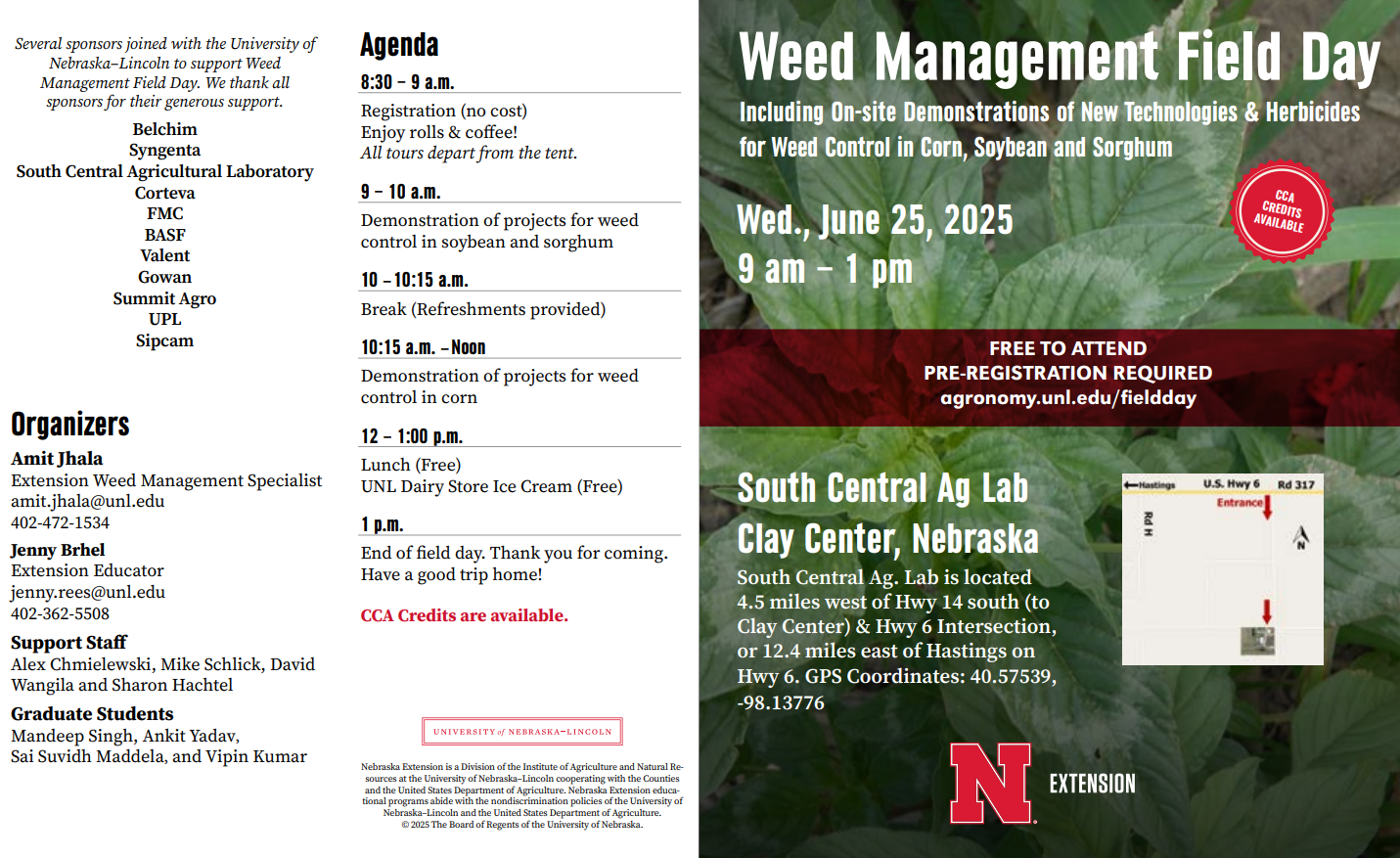
Weed Management Field Day at UNL’s South Central Ag Lab is this week on June 29th near Clay Center (9 a.m.-1 p.m.). Great information including a second year research project of the same herbicide programs for corn and soybean when rye is terminated 2 weeks prior to planting vs. 2 weeks after planting. It’s interesting to see in the field, so hope you can join us! No cost, free lunch, please RSVP: https://agronomy.unl.edu/weed-management-field-day-registration.


New soybeans alongside old sticks. Emerged in as little as 3 days. New corn in the old corn grower plot.
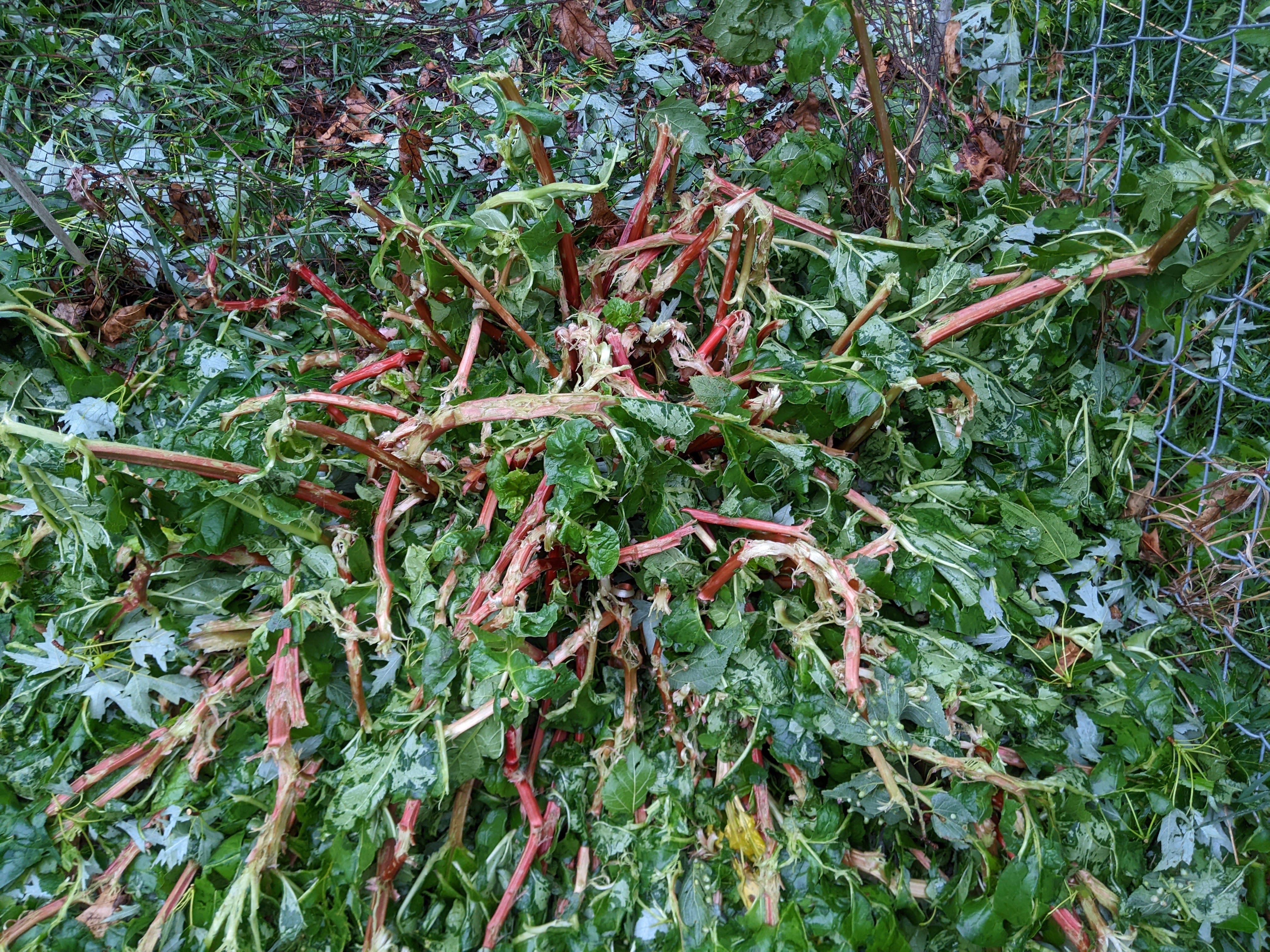

Part of my garden on June 15, 2022 the day after the hail events. I left it alone.


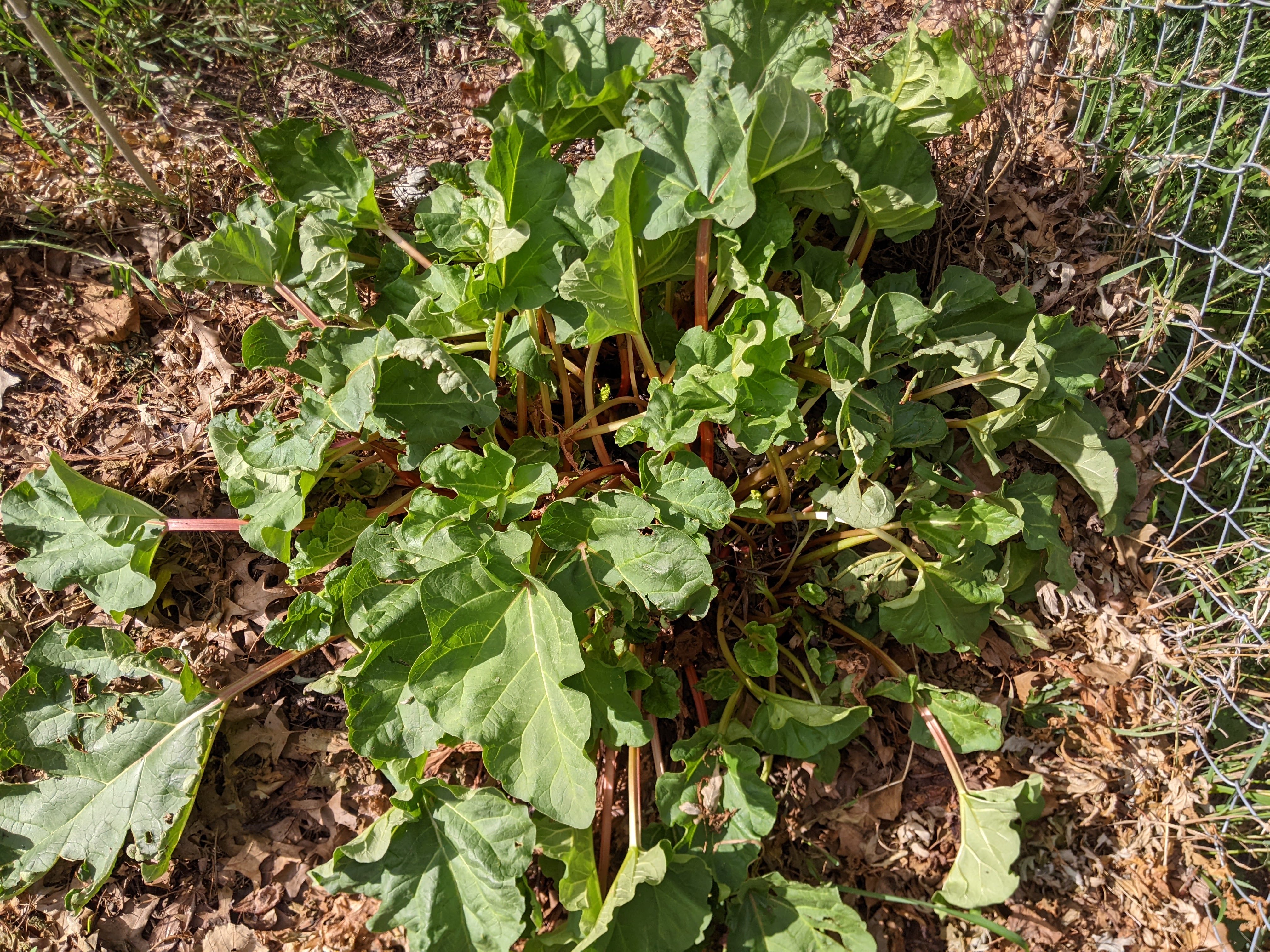

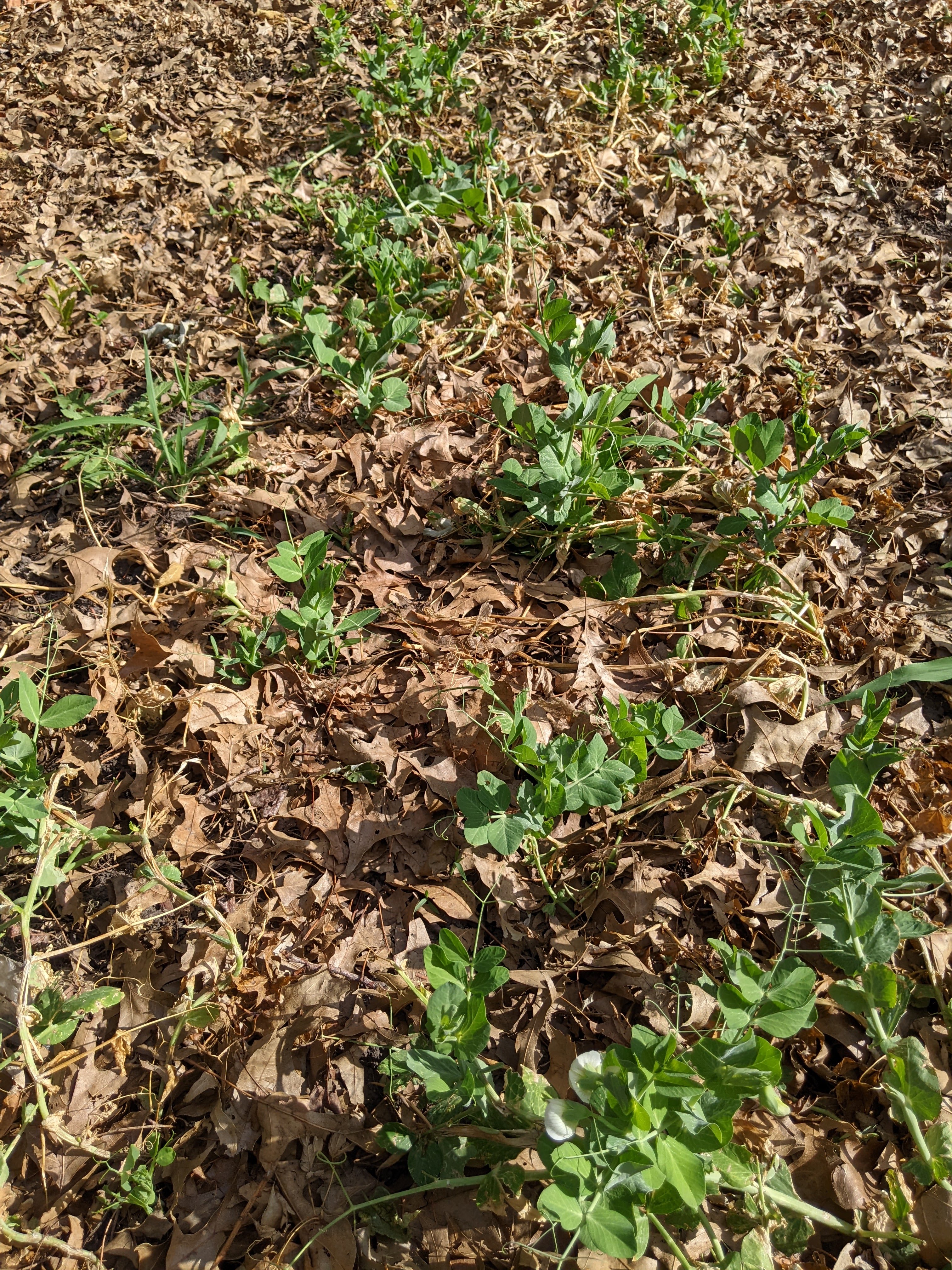
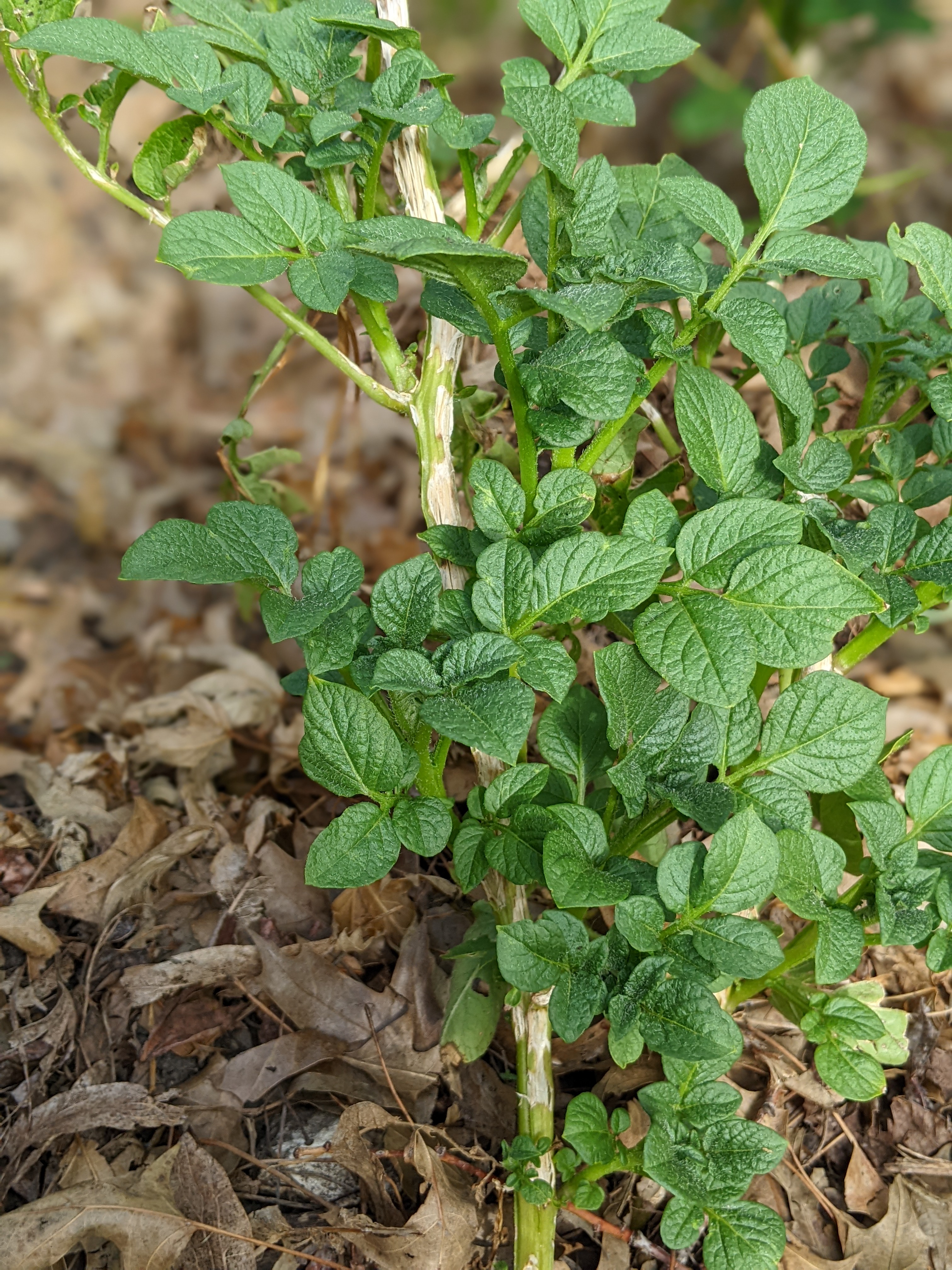
June 25th, 2022: New growth on most everything. Very few beans and none of my carrots survived. Rhubarb looks like a new plant again after removing the mushy, rotted growth and with the new leaves. Tomatoes, potatoes, peppers, eggplant came back from stems. Can see the hail damage on the stems. Onions shot new leaves out the top. Also had a new crop of asparagus come on. Need to re-stake remaining peas and will see what happens with them. Potatoes are all leaned over now instead of growing upright.
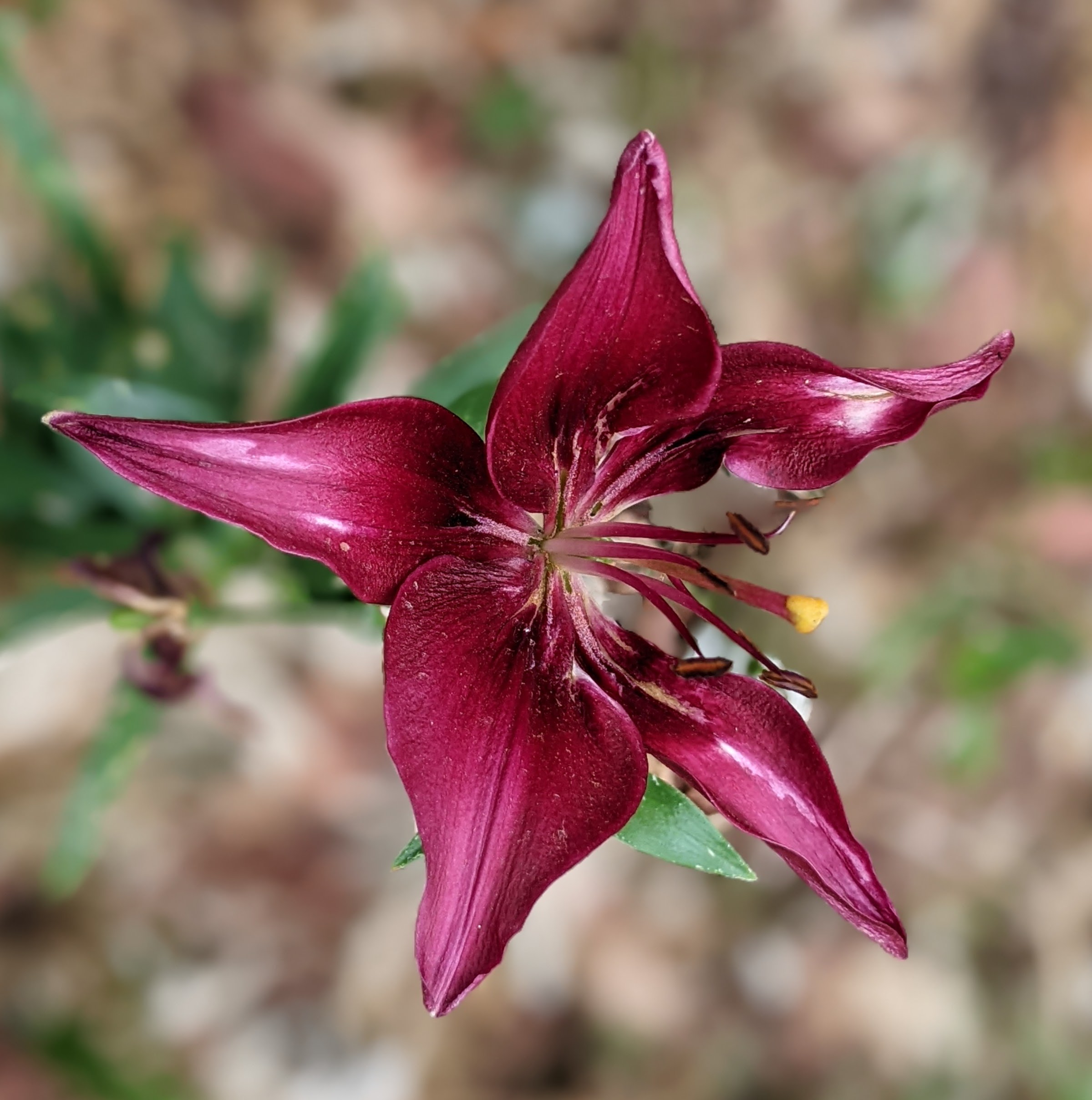
“…to give unto them beauty for ashes, the oil of joy for mourning, the garment of praise for the spirit of heaviness; that they might be called trees of righteousness, the planting of the Lord, that he might be glorified.” Isaiah 61:3 KJV
This is one of my favorite Bible verses and promises from God in the midst of hard things and I like this translation of it since it specifically says ‘beauty from ashes’. May we all look for the beauty in the midst of the ashes around us this week. And, I believe God is also desirous of creating beauty from ashes in all of our lives!
JenREES 2/27/22
Growing Fruit in the Home Garden: The GROBigRed Virtual Learning Series from Nebraska Extension kicked off last week with a 6-week series ‘Growing Fruit in the Home Garden’. Join us at 6:30pm CT each Thursday for two short presentations and an opportunity to ask your pressing garden questions. Register for this free program at https://go.unl.edu/growfruit. Upcoming programs include:
- March 3: Selecting & Buying Fruit Plants and Soil & Fertility
- March 10: Site Selection & Design and Edible Landscapes
- March 17: Brambles (Blackberries, Raspberries, etc) and Grapes
- March 24: Pome Fruits (Apples & Pears) and Stone Fruits (Peaches, Cherries, & More)
- March 31: Strawberries and Unusual Fruits
Soil Temperatures: With March around the corner, a reminder of our CropWatch soil temperature page at: https://cropwatch.unl.edu/soiltemperature.
Farm Bill Decisions: I shared some considerations in the following article if it can be of help as you make these decisions: https://jenreesources.com/2022/01/23/farm-bill-decisions/
Lawns and Gardens: In spite of warm stretches, it’s way too early to consider lawn fertilizer and crabgrass preventer. Wait till April when soil temperatures are expected to be 50F for at least 5 days.
Vegetable planting guide can be found at: https://go.unl.edu/pao8. Kelly Feehan, Extension Educator shares, “For vegetable gardeners, it’s time to think about cool season vegetables. Focus on garden planning, seed buying, and soil preparation, like incorporating compost, if soil is not too wet. Do not let air temperatures trick you into planting too early. It is soil temperature that to determine when to plant. Gardeners who plant too early often end up harvesting later than those who wait. And some gardeners end up replanting since seed can rot in cold soils and seedlings or transplants may be damaged by spring frost. Even if all goes well, seedling emergence can take 10 days or much longer in cold soil. For cool season vegetables like lettuce, radish and peas, wait to plant seed until soil temperatures are above 40 degrees Fahrenheit, with 45 to 50 being ideal.” A meat thermometer designated for soil temperature use is a great way to check soil temperatures.
Small Grain Silage: Last year, four producers allowed me to collect small grain silage samples from rye and triticale so we could get a better understanding of quality in regards to growth stage when cut, moisture, how packed, etc. With short forage supplies, this may be of interest to those who have planted rye/wheat/triticale and have cattle. On March 17h, from 8:30 a.m.-4 p.m., Nebraska Extension, Lallemand Animal Nutrition and Iowa State University Extension and Outreach are hosting the fourth Silage for Beef Cattle Conference. Registration is free and producers have the option to either stream the conference online or attend in-person at the ENREC near Ithaca. Pre-register to join in-person or virtually at: HTTPS://GO.UNL.EDU/SILAGEFORBEEF2022. Topics and speakers will include:
- Agronomic management of small grains for silage, Daren Redfearn, UNL
- When to harvest small grain silage, Mary Drewnoski, UNL
- Sorghum silage: a solution for limited water, Matt Atkins, Wisconsin Dairy Specialist
- Why fermentation analysis is important & what it means, John Goeser, Wisconsin
- Fungamentals of silage harvest management, Becky Arnold, Lallemand Animal Nutrition
- Inoculants for small grain silage, Limin Kung, University of Delaware
- Economics & ROI on quality forage in grower & finishing rations, Jhones Sarturi, Texas Tech
- Making small grain silage work, producer and nutritionist panel

Japanese Beetles
Japanese Beetles: Areas of the State have seen Japanese beetles for a few weeks. They’ve shown up strong in the York/Seward county area this past week with the number of calls I’ve received.
Unfortunately they cause two problems. The larvae are grubs that can impact our lawns.  The adult beetle is ½” in length with a metallic green head and white ‘tufts’ that look like spots on its abdomen. Adults emerge from grassy areas like lawns, ditches, and even fields; however, they don’t emerge at the same time. They emerge over a 4-6 week period beginning in late June and last for around 4-6 weeks. There’s one generation per year. Adult beetles feed, mate, and lay eggs in lawns and grassy areas. The eggs hatch 10-14 days later into grub larvae and feed on turf and grassy areas in the August time-frame. They also over-winter in turf and grassy areas.
Adults feed on 300 plant species, but their favorites are ones that are in many of our
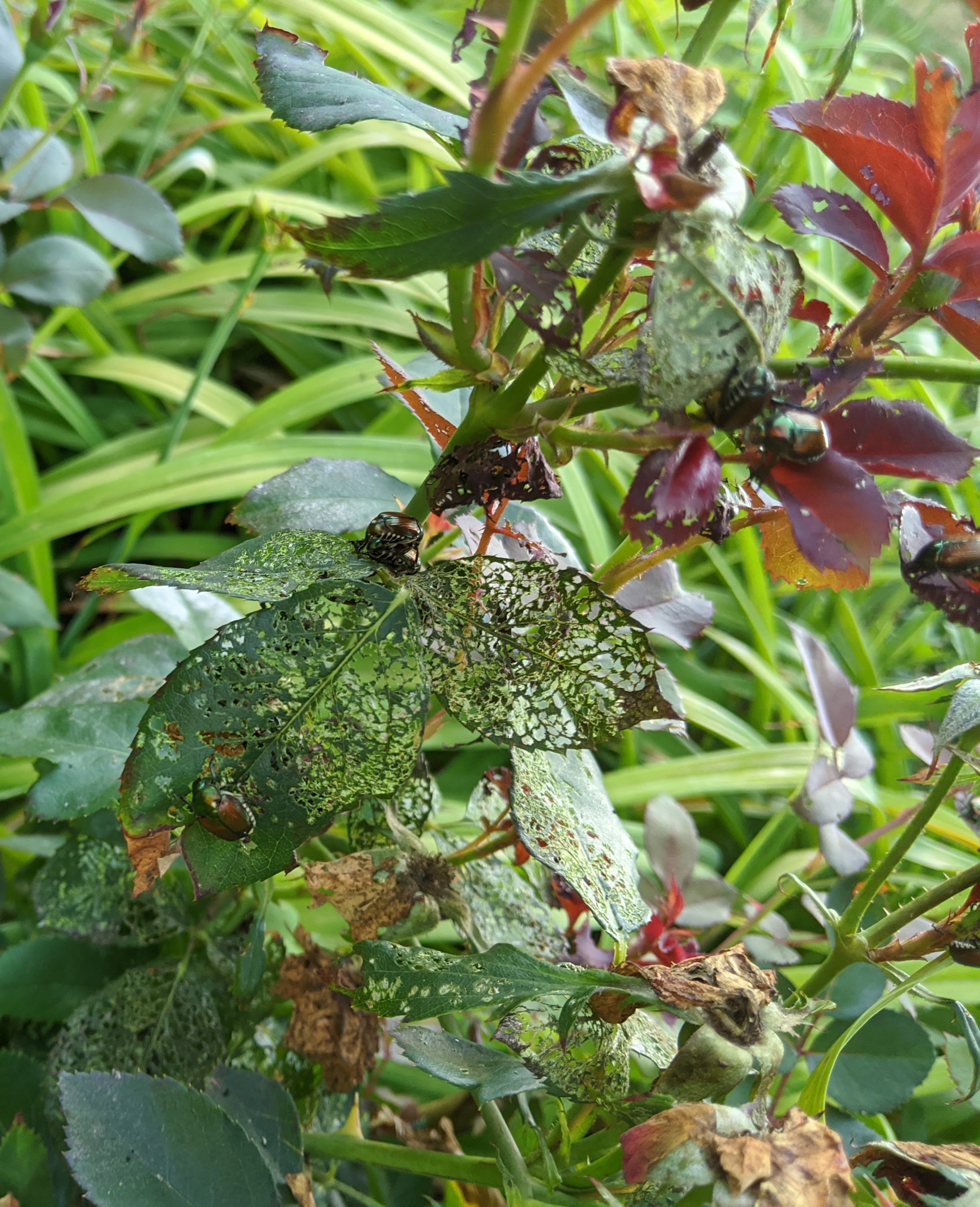
Japanese beetles making quick work of my knockout roses. In this garden area, they are also impacting my cannas but not my lillies, beesbalm, salvia, milkweed, or sunflowers.
landscapes (roses, cannas, marigolds, grapes, Virginia creeper, and trees such as lindens, birch, Japanese and Norway maples, cherry, plum, peach, American elm). They also feed on soybean and corn crops. They love hot weather and full sun and feed on leaf tissue during the day (leaf tissue will look skeletonized or lacy and turn brown). Trees may be severely impacted with browning occurring from the top to bottom. Thankfully healthy trees will re-leaf next year since the underlying twigs and branches aren’t damaged-even if the entire canopy is impacted this year. It’s not recommended to remove branches or trees.
DO NOT use Japanese beetle traps!!! Research shows they attract beetles to the landscape and many homeowners I’ve talked with will attest to this!
Beetle Control: Wait till dusk (7-9 p.m.) before trying to control beetles as they are less
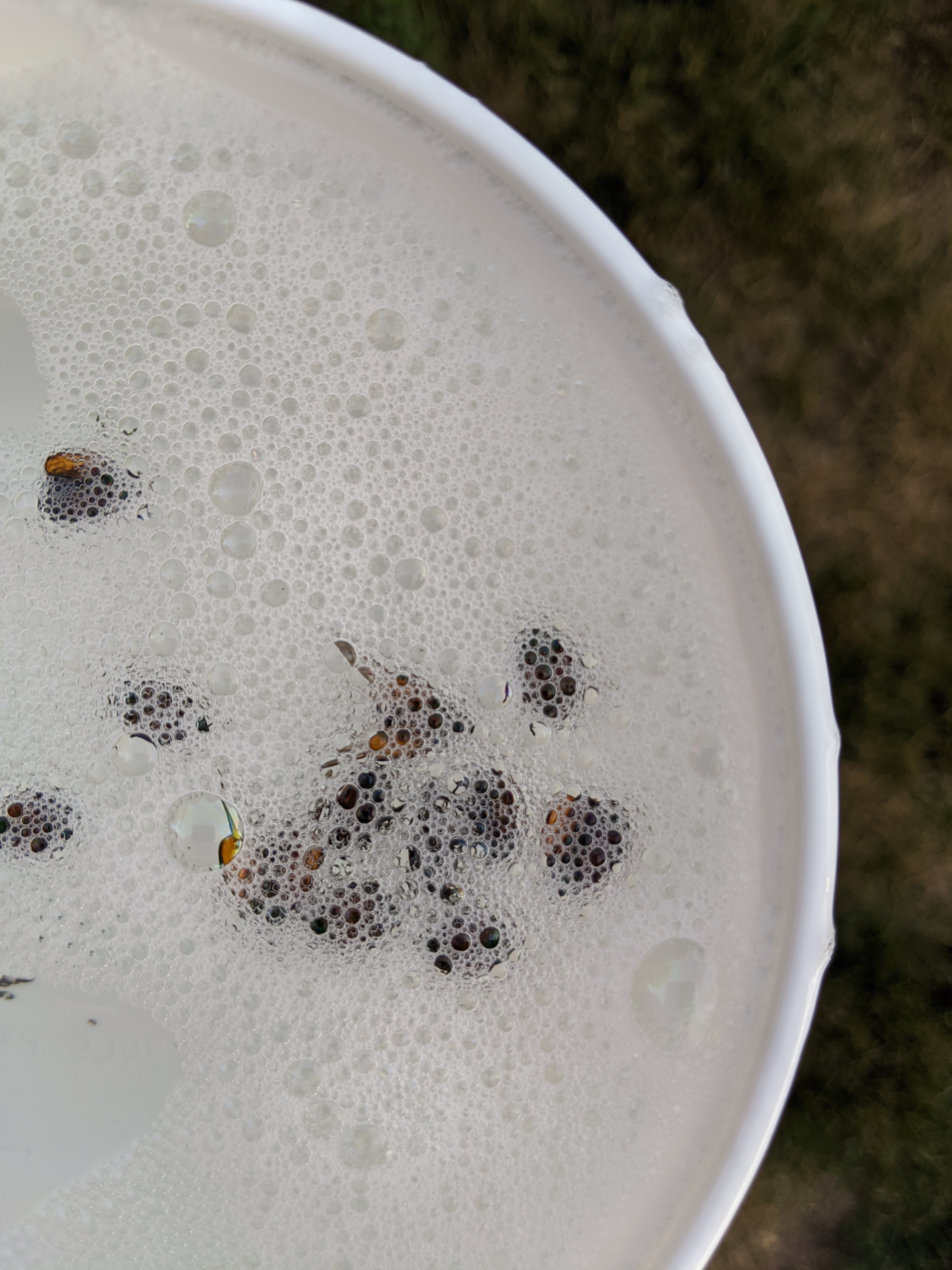
One control option: Wait till 7-9 p.m. then drown Japanese beetles in soapy water after removing them from plants. This method of control takes diligence over several nights.
active then and to reduce impact to pollinators. Organic means include hand-removing beetles by knocking them into soapy water. You can also spray trees with water to knock them down to the ground and then drown in soapy water. This takes diligence over many days. With heavy beetle infestations, it’s not uncommon to literally have scoop shovels full of the beetles when removing from trees. Neem and Pyola are two organic sprays that will protect for 3-7 days. Applying these products regularly (once per week) can also be effective as a repellent.
Japanese beetles often impact the same flowering plants that other pollinators visit. Use insecticide products correctly to avoid damage to pollinators. Avoid spraying insecticides on windy days or when pollinators are present (best to spray late in day near dusk) and be sure to read and follow all label instructions and harvest intervals (for cherries, plums, etc.). Conventional insecticides can provide 2 weeks of control: pyrethroid products like Tempo and Bayer Advanced Lawn & Garden Multi-Insect Killer (cyfluthrin) or Ortho Bug B Gone (bifenthrin). Sevin (carbaryl) is another option although more dangerous for bees.
Grub Control: Turf damage can be evident in Aug./Sept. Products that control common white grub can also provide control of Japanese beetle grubs and should be applied mid-to-late June. Dylox can be used as a rescue treatment if grub control is needed later on and no grub products were applied in the spring.
Next Year: Systemic products like imidacloprid can be used as a soil drench around plants (apply around Mother’s Day). These products can’t be used on Linden trees. You may also wish to swap out more susceptible plants for those less susceptible as you observe which plants they tend to impact most in your backyard.
Also seeing green June beetles and this shows the difference between them and Japanese beetles. Green June beetles don’t have the same impact on leaf damage. They do lay eggs in turf which become grubs as well.

Green June Beetle (left) and Japanese beetle (right). Photo via Purdue Entomology.


 JenResources