Category Archives: JenREES Columns
JenREES 3/5/23
Well, March is here, and we start looking towards the next growing season. It was a great winter programming season, though, and it was great seeing many people!
Nontraditional Products: There’s a number of products on the market with claims of the biology or chemistry within them allowing for reduced nutrient inputs by the producer. The goal is for the biology or chemistry to make unavailable nutrients more available to the plant. Interest in the products stems from the potential to reduce nutrient inputs and enhance environmental stewardship, both of which would be beneficial. Perhaps the more recognized products currently are Pivot Bio PROVEN® and PROVEN®40? These products contain an N-fixing bacterial inoculant that is expected to fix N over the growing season. Use of biological N fixation in cereal crops has potential to reduce the use of synthetic N fertilizer, thus increasing N use efficiency and reducing N losses. We have 11 site-years of on-farm research data on the Pivot Bio products in 2021-2022. We have minimal testing on other biological/chemical products for reducing nitrogen rates. Pivot Bio was applied at 12.8 oz/ac and compared to an untreated check. The nitrogen rates were selected by the growers. Some growers chose the same N rate for both treatments, while others chose to evaluate Pivot Bio at additional reduced rates. It’s helpful to see comparisons at a range of reduced nitrogen rates to better determine nitrogen response to products tested.
Across 64 replications, the Check treatment yielded 234 bu/ac on average and Pivot Bio yielded 235 bu/ac on average, with no statistical difference at a 90% confidence level. When looking across the 64 replications, Pivot Bio had a 5 bu/ac or greater yield increase 27% of the time, a 5 bu/ac yield reduction 17% of the time, and yield difference within +/- 5 bu/ac 56% of the time. When looking at many of the individual locations, the grower-chosen N rates most likely could have been reduced beyond 40 lb/ac. Future on-farm research will focus on testing Pivot Bio PROVEN®40 at a wider range of N rates across different soil textures and landscape positions. One way to test this is by creating prescriptions for N rate blocks for different areas of the field. If you’re interested in testing something like this for Pivot Bio or any other non-traditional product, please let me know.
There’s also interest from producers seeking a regenerative ag path to grow their own microbes for reducing inputs through the use of compost extracts and teas. Compost is built through different processes then microbes are extracted from the compost using water and air. The water/microbe solution is then applied to a field while the compost is added back into a pile to be reused. One compost option is via a Johnson-Su bioreactor which uses a static aerobic composting process. Another is aerobic composting via a Turned Compost process. In 2022, a Seward Co. producer chose to compare a Check treatment of 142 lb N/ac and reduce the nitrogen rates added to the biological products in his study by nearly 40 and 100 lb N/ac. His goal was to push the system to see how the biological products compared and to have low enough nitrogen rates to see what the biological products would do in releasing N. His treatments and yields were: Check (total 142 lb N/ac yielding 235 bu/ac); Johnson-Su Compost High (total 106 lb N/ac yielding 220 bu/ac); Johnson Su Compost Low (Total 48 lb N/ac yielding 167 bu/ac); Turned Compost High (Total 106 lb N/ac yielding 212 bu/ac); Turned Compost Low (Total 48 lb N/ac yielding 164 bu/ac); and Pivot Bio Proven®40 (total 106 lb N/ac yielding 195 bu/ac). The Check treatment yielded the greatest and statistically was not different than the Johnson-Su High and Turned Compost High at the 90% confidence level. The Check treatment was different from the Pivot Bio and the lower rates of the compost extracts. The Johnson-Su and Turned Compost were applied at 8 gal/ac extract in furrow at planting. This study was pivot irrigated in a silt loam soil where the previous crop was soybean. This study will continue on these same strips for three years. Please let me know if you’re interested in testing compost extracts as we seek to obtain more data around this topic.
One thing to consider with any type of biological treatment study is it’s helpful to conduct the study on the same areas of the field for multiple years to better determine any impacts over time. 2022 On-Farm research book at: https://onfarmresearch.unl.edu/.
Sensor-Based N Fertigation
Understanding the Soil Microbiome: For those interested, this Friday, March 3, will be our last Friday conversation on ‘understanding the soil microbiome’ at the 4-H Building in York from 10 a.m.-Noon. Dr. Rhae Drijber, UNL soil microbiologist, will kick off our conversation and I’m looking forward to the discussion. If you plan to attend, please let us know at 402-362-5508.
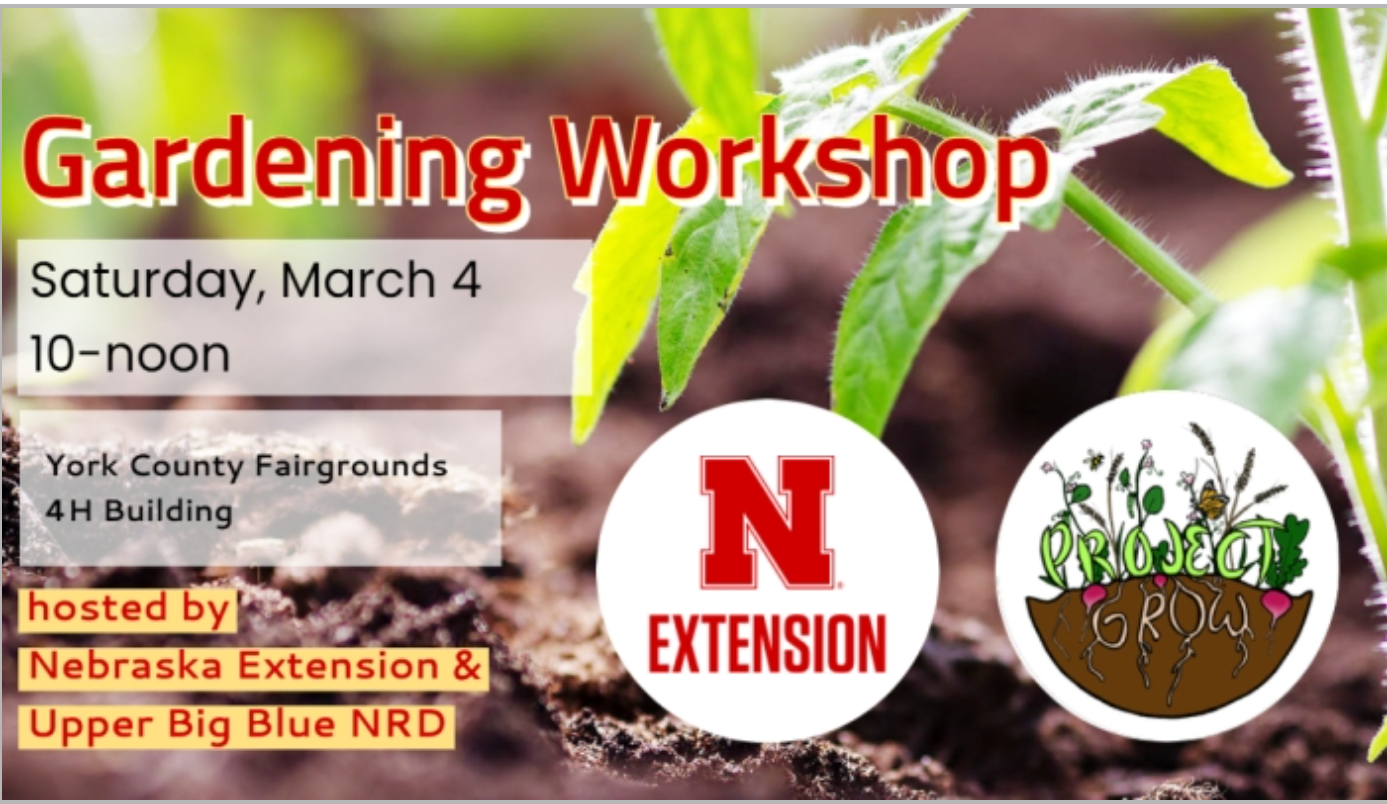
March 4 Gardening Workshop will be held from 10 a.m.-Noon at the 4-H Building in York. Sarah Browning, Extension Educator, will share on vegetable planting basics such as site selection, rotational plan, summer care, and troubleshooting problems such as insects/diseases/weeds. Please bring your questions! This workshop is sponsored by the UBBNRD and Nebraska Extension; there’s no charge and refreshments are provided. No RSVP is required, but it does help with refreshments if you could please let us know at 402-362-6601 or 402-362-5508. If you’re interested in gardening, but don’t have the space at home, check out the Project GROW community garden in York. Plots are available for the 2023 growing season. You can reserve your space now or come to the Gardening Workshop and sign up in person.
Sensor-Based Nitrogen Fertigation: This week also brings the last of our on-farm research updates (Mar. 1 in North Platte, Mar. 2 in Kearney, and Mar. 3 in Beatrice). You can still sign up at https://go.unl.edu/2023ofr.
One of the most impactful on-farm research studies being shared (I feel) is on sensor-based nitrogen fertigation occurring since 2019. It’s similar in concept to Project Sense, for those of you familiar with sensors being retrofitted on ground rigs for in-season nitrogen applications.

Sensors mounted onto a drone could allow for improved nitrogen use efficiency (NUE) by responding to actual plant needs in season. A grower determined base rate was applied to the field across treatments. Then grower fertigation management was compared to the sensor-based approach in 15 degree sectors on half a pivot. Indicator and reference plots in the field received at least 30 lb/ac less N and 30 lb/ac more N respectively and were established around V7. The field was flown weekly with a drone, imagery was analyzed, and fertigation decisions were made for each treatment sector.
The treatments were: 1) Grower rate 2) Risk averse post-establishment (RAP) (fertigation events applied up to R4 but 30 lb N/ac applied when needed between V9-V14) and 3) Risk averse post-establishment Increased Rate (RAP-IR) (fertigation events applied up to R4 but 60 lb N/ac applied when needed between V9-V14).
Since the beginning of this effort, 100% of the RAP-based sensor treatments were more efficient across all sites than the typical N grower management. Encouraging to me about this method is that it’s all based on what the plant needs after what the soil provides to the plant. There’s no determination of an N rate ahead of time based on plant removal, yield goal, etc.
There were 4 studies in 2022, but I will share on two of them. In a Hall county field with silt loam soils, both sensor based fertigation treatments triggered a total application of 95 lb N/ac vs. grower applying 196 lb N/ac. The grower treatment resulted in a yield of 277 bu/ac at 0.71 lb N/bu NUE. The two sensor based treatments resulted in yields of 271 and 274 bu/ac at only 0.35 lb N/bu NUE! That was pretty incredible for me to see 0.35 NUE and those kind of yields! It shows there is opportunity to consider further reductions in nitrogen applications. At a Saunders county field, no grower rate was used and the beginning base rate was only 33 lb N/ac. The RAP sensor treatment had 108 lb N/ac total applied yielding 258 bu/ac with 0.42 lb N/bu NUE. The RAP-IR sensor treatment had 101 lb N/ac total applied yielding 274 bu/ac with a 0.37 lb N/bu NUE.
You can read more details of this study via the online version of the 2023 On-Farm Research book found at: https://on-farm-research.unl.edu/ (beginning on page 80). For 2023, growers interested in trying this via on-farm research can receive monetary support through a Conservation Innovation Grant to help with purchasing fertigation equipment and/or for the aerial imagery services through Sentinel Fertigation. I would love to see 5 of these in our area of the State this coming year. Please let me or Laura Thompson (laura.thompson@unl.edu) know if you’re interested!

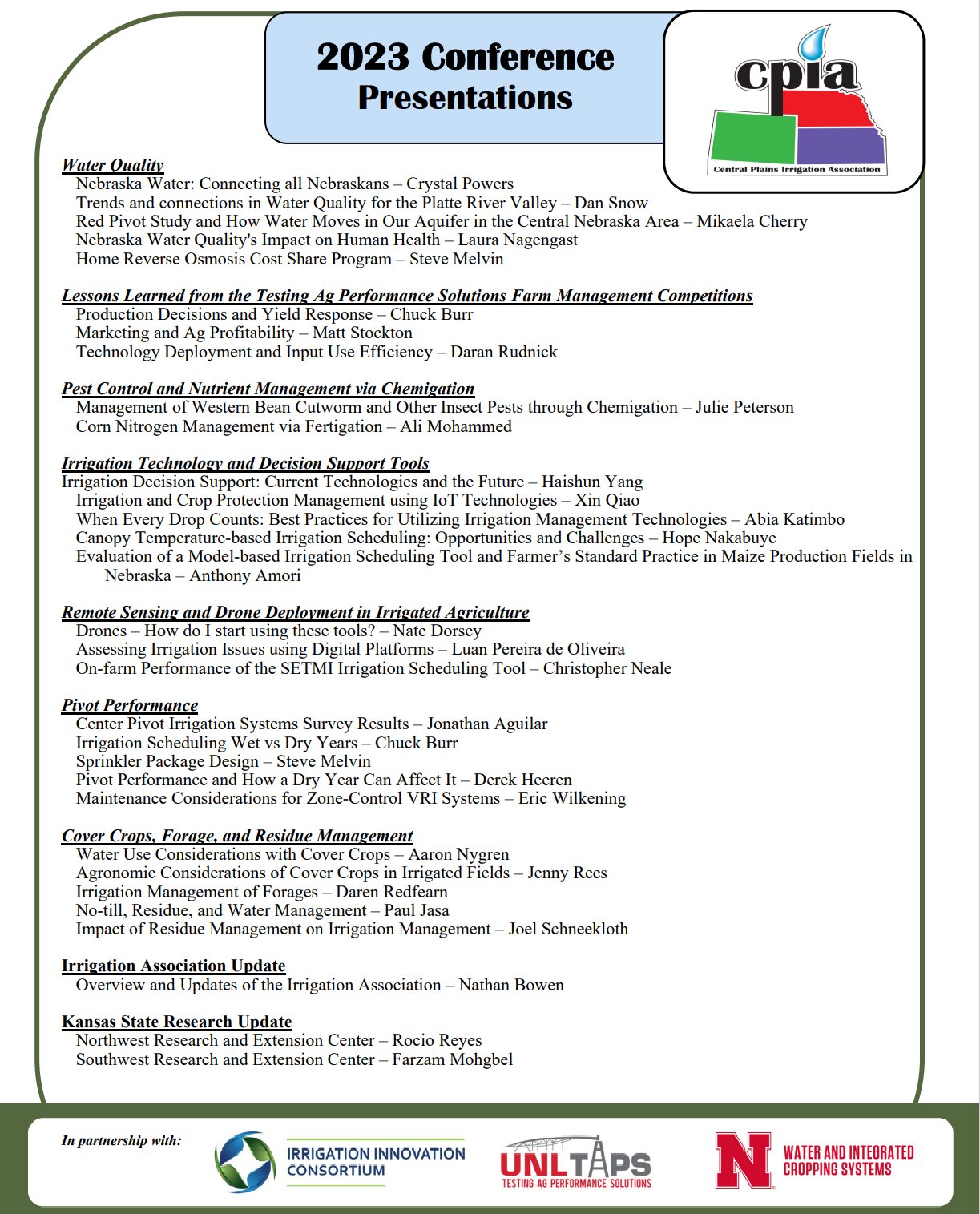
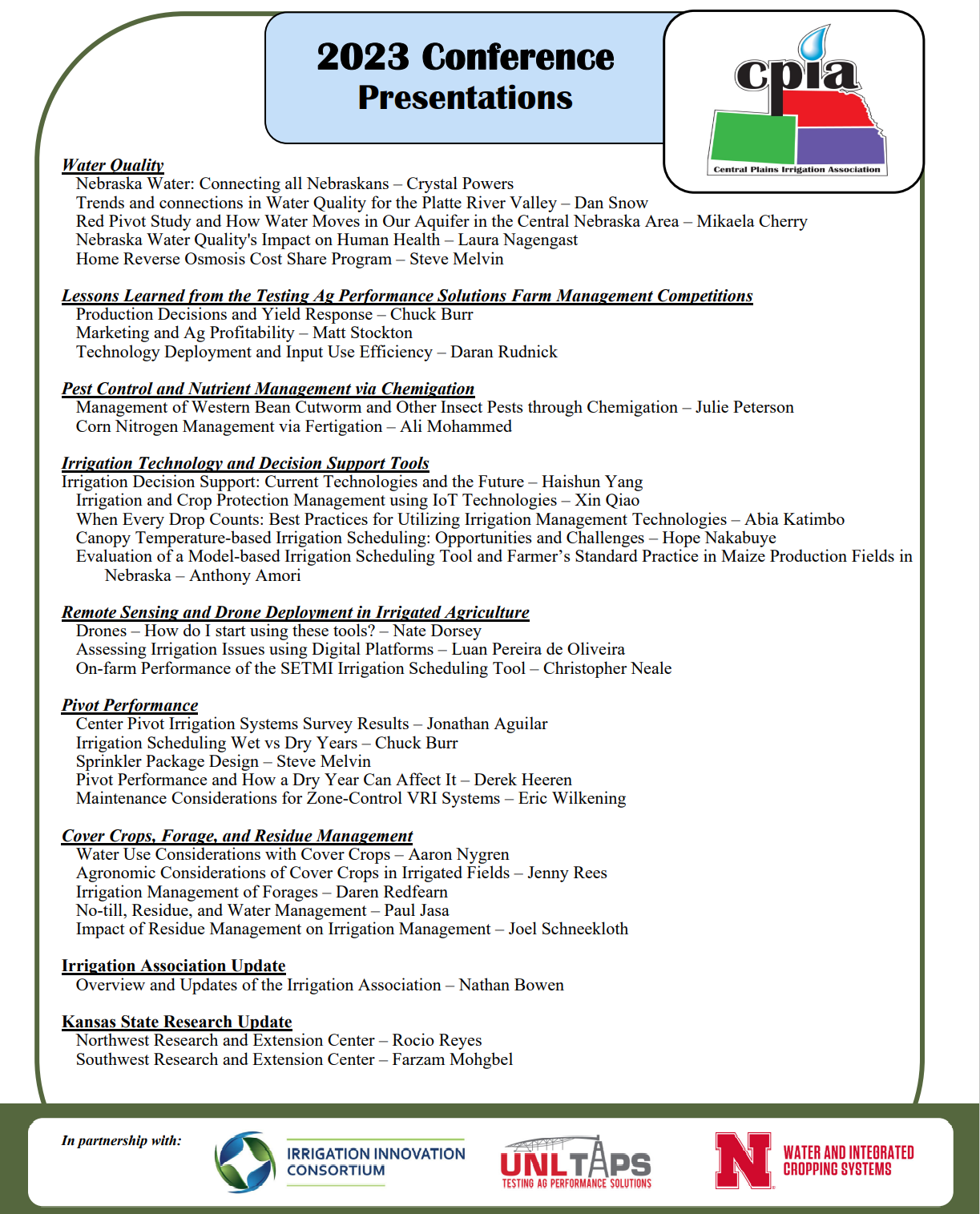
You can still register for the CPIA Conference or walk-in the day of the event. Really practical info. for growers and ag industry!

Farm Bill 2023 Elections
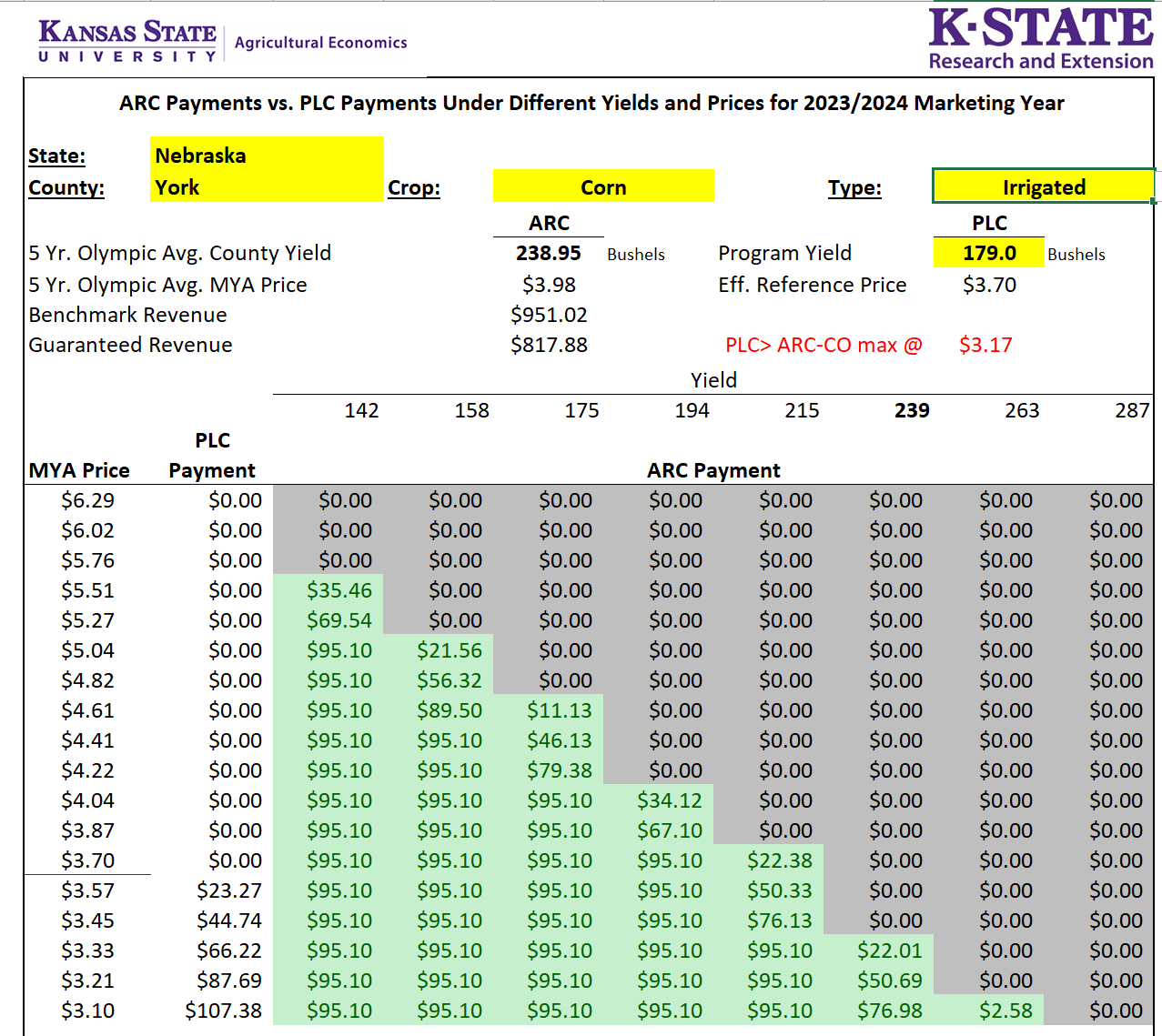
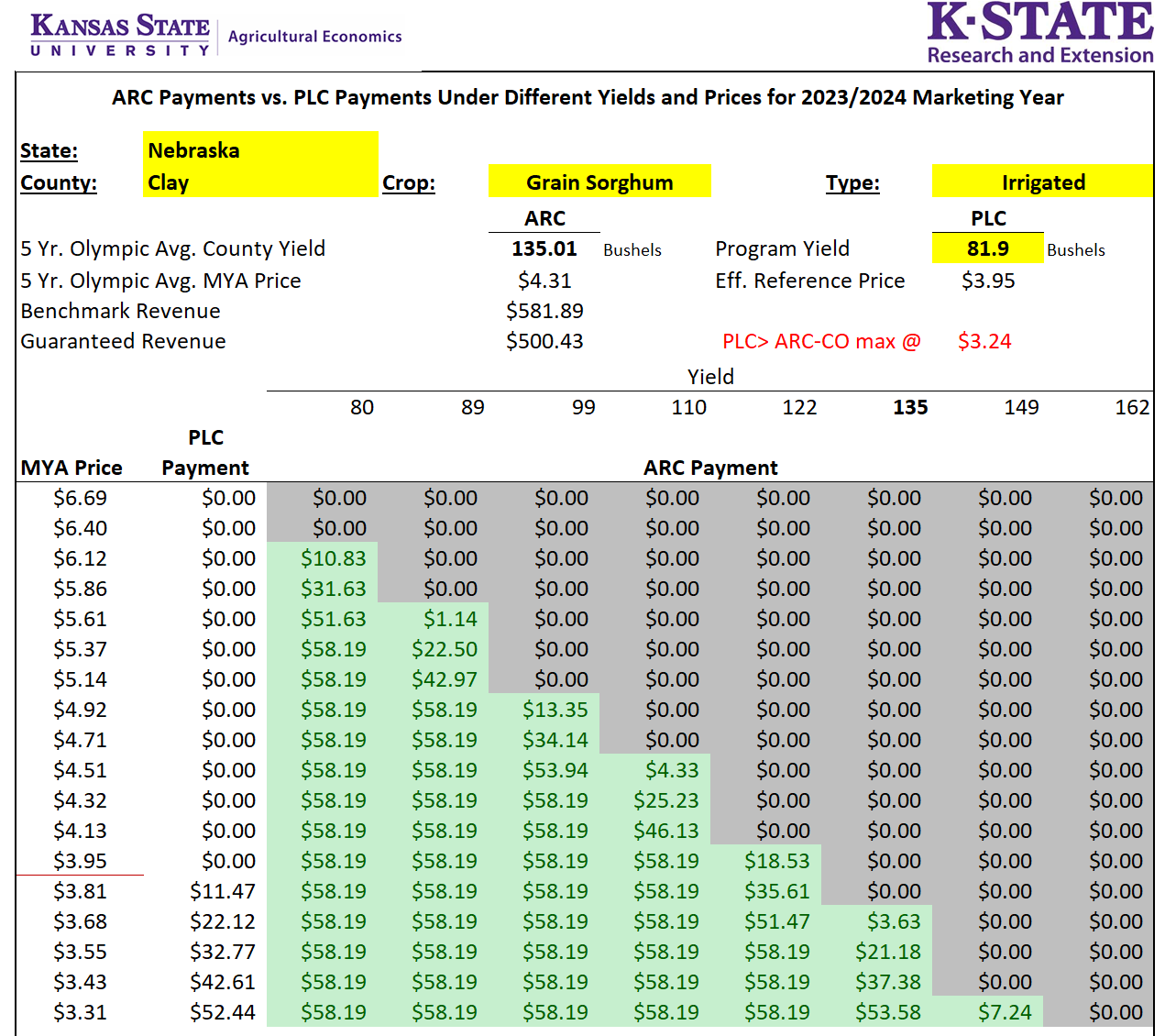
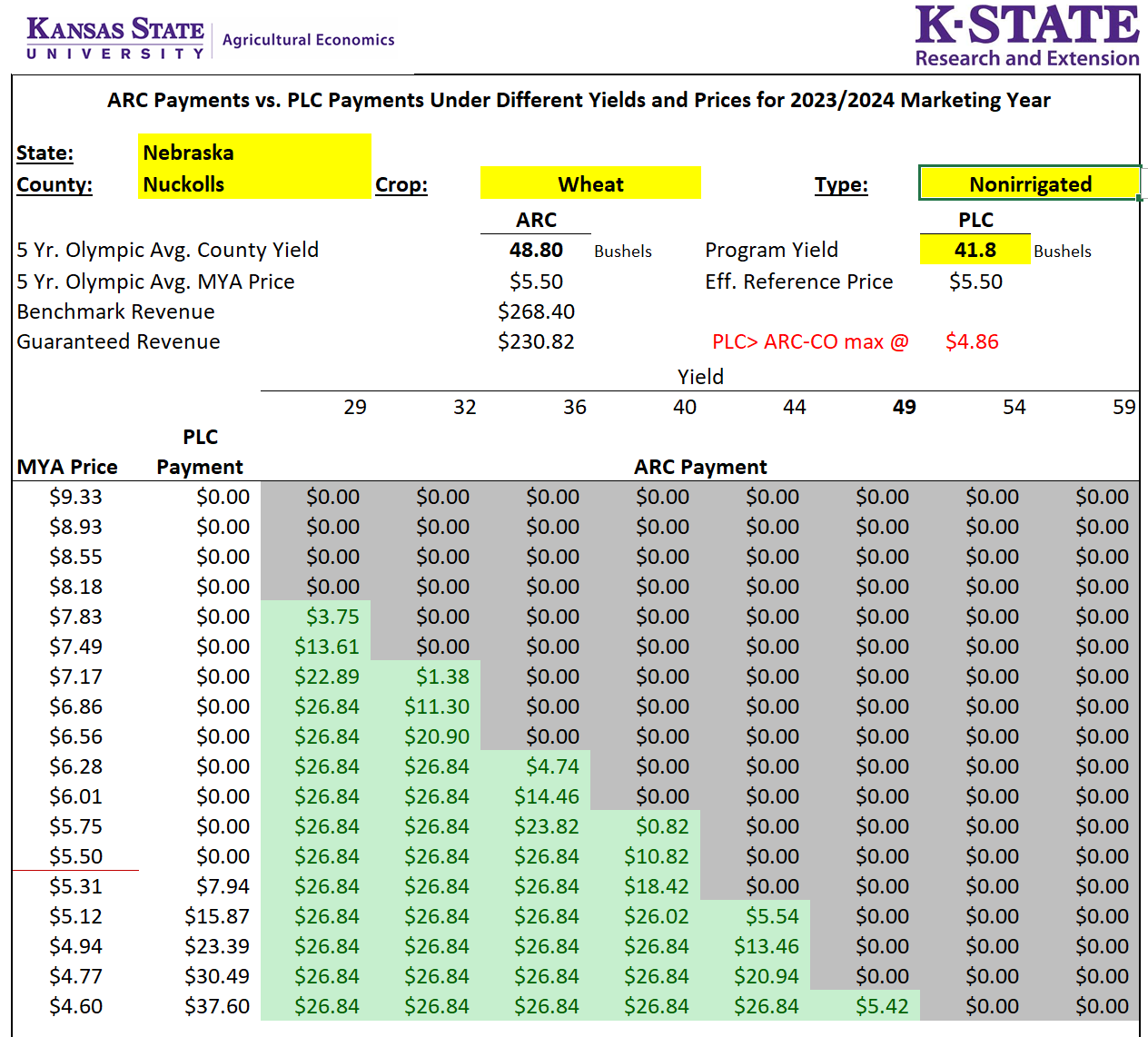
During our on-farm research meeting last Wednesday, several farmers received text message reminders to make their ARC/PLC enrollment/election by March 15, 2023, and were asking about this after the meeting. Regardless of whether you choose to make a new election or not, a new enrollment (contract) is required, so please contact the FSA office to take care of that. You can view the UNL/FSA farm bill webinar at: https://go.unl.edu/mbhy. No need to run simulations. You can download the spreadsheet from K-State that shows price/yield options for PLC/ARC-Co triggers: https://www.agmanager.info/ag-policy/2018-farm-bill/tradeoff-between-20222023-arc-and-plc.
Bottom Line: For 2023, neither ARC-Co nor PLC would be anticipated to trigger for corn, soybean, wheat, sorghum with current USDA projected prices. If you’re concerned about price decline and want to protect that downside, PLC can be selected. If you think high prices will remain, ARC-Co provides a better likelihood of payment in the event of disasters such as drought and hail impacting county average yields. These are risk management tools, and ultimately, crop insurance will be important again in 2023. Different election decisions (ARC-Co or PLC) can be made for crops in different FSA farm numbers if you’d like to spread risk. Fields with higher PLC yields could be more favorable for your PLC decisions.
But how do you choose between PLC and ARC? ARC-CO would only be anticipated to pay with a catastrophic yield loss, such as county-wide hail and/or drought.
PLC Reference Prices are: $3.70 for corn, $3.95 for milo, $8.40 for soybean, and $5.50 for wheat. Because market year average prices are much higher than these reference prices at this time, barring any major disaster causing price reduction, PLC payments wouldn’t be anticipated for any of these crops in 2023. Reasons to consider PLC: if you feel prices have the potential to decline or if you choose to use Supplemental Coverage Option (SCO) through crop insurance. Both the UNL and K-State webinar links on my blog go into more detail about SCO.
The following patterns hold true for every county I ran for both irrigated and non-irrigated. If you feel prices will stay high, then ARC-Co will only trigger if county average yields decline. If you feel prices will decline, PLC will mostly only trigger before ARC-Co. at county average yields. I think most of us would prefer good crops and decent prices to having either of these programs trigger. I’ve shared additional photos with explanations and reference links at my blog: jenreesources.com if seeing this explanation is helpful.
Corn: at county average yields, price would have to fall to $3.33 to trigger an ARC-Co. payment while it will trigger PLC payment at $3.70. When county average yields decline, ARC-Co triggers before PLC.
Soybean: at county average yields, price of $8.11 would trigger ARC-Co compared to $8.40 for PLC. When county average yields decline, ARC-Co. triggers before PLC.
Wheat: at county average yields, price of $4.60 would trigger ARC-Co compared to $5.50 for PLC. It takes more reduction in county average yields for ARC-Co to trigger before PLC. Please run these for yourself if you’re looking at wheat.
Milo (Sorghum): at county average yields, a $3.68 price would trigger ARC-Co compared to $3.95 for PLC. When county average yields decline, ARC-Co triggers before PLC.
For ARC-IC (individual), if any of us knew we’d get the hail damage we did last year, it may have been a great decision for last year’s election for those hardest hit with all/majority of fields. Because we can’t make this decision looking backward, ARC-IC tends to be more favorable for those with diversified crops or situations where yields wouldn’t reflect county average yields.
References:
- K-State spreadsheet tool: https://www.agmanager.info/ag-policy/2018-farm-bill/tradeoff-between-20222023-arc-and-plc
- UNL Webinar: https://go.unl.edu/mbhy
- K-State Webinars: https://www.agmanager.info/news/recent-videos/managing-risk-arc-plc-and-sco-2023-webinar-recording-and-slides
- USDA Prices/Yields: https://www.fsa.usda.gov/programs-and-services/arcplc_program/arcplc-program-data/index
- K-State Prices/Yields: https://www.agmanager.info/crop-insurance/risk-management-strategies/projections-and-sources-myaprices-arc-and-plc-commodity



Interseeded Cover Crops Results
Studies such as this will be shared by area farmers starting this week at On-Farm Research Updates (Feb. 15 at Holthus Conv. Center in York)! RSVP at: go.unl.edu/2023ofr. Since 2019, a group of area farmers have been interseeding cover crops into early season corn (V3-V4) and soybean (VE-V2). The goals for interseeding cover crops into cash crops include: providing nutrients for the cash crop, weed control, erosion control, diversity, reducing inputs such as fertilizer and chemicals, and providing forage for grazing after harvest. Interseeding of cover crops can also occur at other growth stages, such as at male row destruction in seed corn or at senescence in late-season corn and soybean. This article will focus on our results from early-season interseeding of cover crops into corn and soybean.
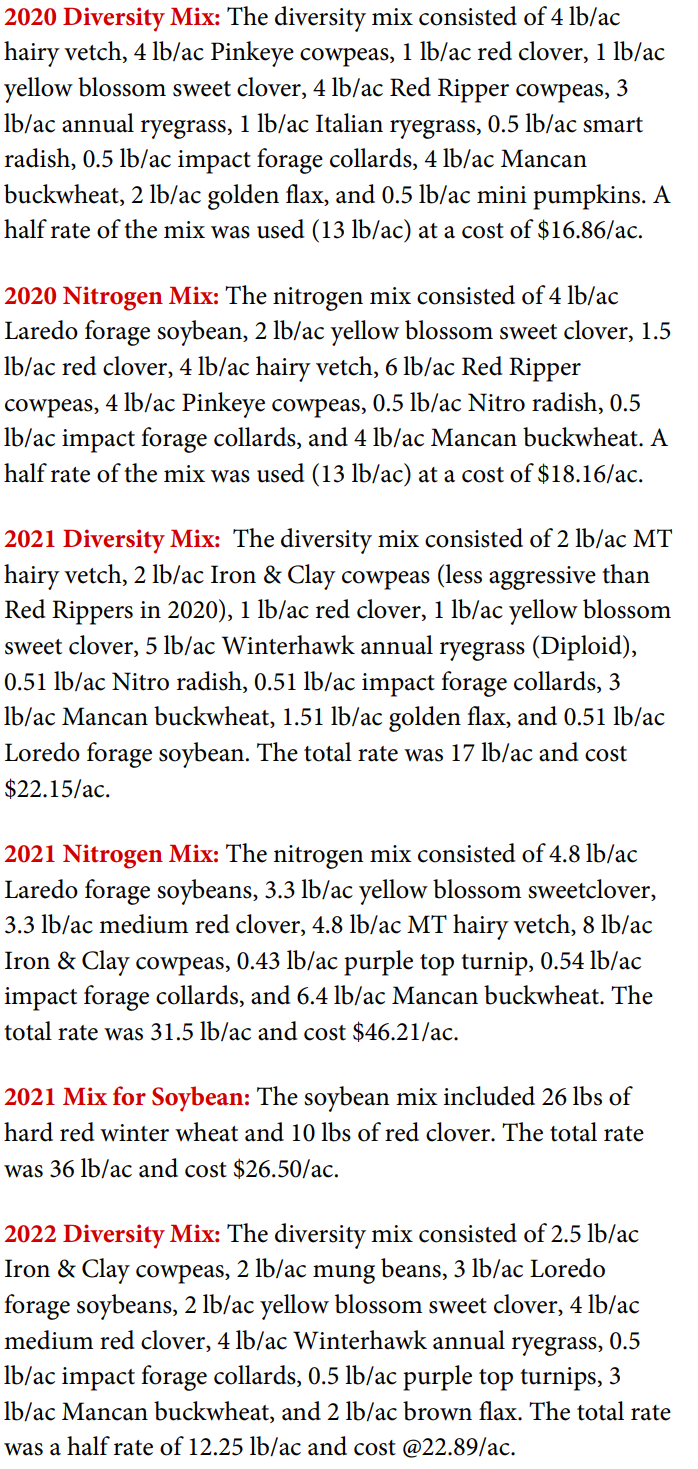
In 2019, two farmers interseeded cover crops (one drill interseeded and one broadcast) into corn in York and Seward counties. Both got establishment and showed no yield differences between interseeded and check. In 2020, a partnership formed between The Nature Conservancy, Upper Big Blue NRD, Extension, Kelloggs and area farmers. A four row interseeder was purchased. Six farmers chose to conduct studies via on-farm research where they maintained the same field-scale strips of interseeded cover crops and check treatments for 3 years. The different cover crop mixes and rates can be viewed at jenreesources.com.
From 2020-2022, fields were impacted by July 9, 2020 and 2021 wind events and June 14, 2022 hail. We had 12 site-years of corn studies and 2 site-years of soybean studies. Biomass samples of the cover crops and also weeds were taken each September. Cover crop biomass ranged from 200 lb/ac to 4 tons/ac depending on the location, hybrid, irrigation, and storm events. In 10 of 12 site-years, interseeded cover crop had more biomass than the check treatment (weeds).
Yield: No corn yield difference between check and interseeded in 6 of the 12 site-years. Yield losses ranged from 2-10 bu/ac in the remainder. No soy yield difference between the interseeded and check.
Net Return: In 10 of the 12 corn site-years, and 1 of the soybean site-years, the check treatment had a higher net return. (However, no benefit to grazing, reduced inputs, etc. was given to interseeding).
Soil Health Values (PLFA & Haney): Large numerical increases in soil health numbers when all 6 sites were combined (as well as some individual sites). Significant increase in the Check from 2020 to 2022. Significant increase in the Interseeded from 2020-2022. However, because this happened for both treatments, when comparing Check vs. Interseeded from 2020 vs. 2022, there is no difference. Why? All farmers were incorporating additional soil health practices across their entire fields (planting rye each fall, grazing, adding biological products, etc.) that would have impacted both cover crop and check treatments. Good news: all increased their overall soil health (soil microbial pops and scores) in 3 years.
Soil Nutrient Values: There were no differences between OM, pH, P, S, K, and base saturations between Check and Interseeded from 2020 to 2022 across sites. Numerical changes occurred at individual sites.
Our studies proved that drill interseeding of cover crops into early season corn and soybeans can be achieved for establishment that lasted after harvest with regrowth of perennial covers into the spring. We also showed this in spite of a number of PRE- herbicides used. We increased beneficial insects and saw pest insects feeding on cover crop instead of cash crop. We increased diversity in the fields and had additional cover aiding erosion control. We also showed reduced water use in the corn where the diverse cover crop was used compared to the check treatment. The disappointment to me was the low amount of forage for those desiring to graze after harvest and the spotty survival of perennials in the spring. However, those who grazed said there was value in the amount of green material present at harvest coupled with the corn residue. Additional challenges can include the fact that it does look ‘messy’, one needs to think through herbicide options ahead of time, and we need to put dollars to additional benefits that are harder to calculate (soil erosion, etc). Next week I’ll share our next steps in where we’re headed.
JenREES 2/5/23
Sharing more February events this week. Will share more on-farm research results in future weeks.
Looking forward to hearing farmers and livestock producers share at two opportunities this week. Reminder of the Eastern NE Soil Health Conference at Eastern NE R&E Center near Mead on Feb. 9th beginning at 9 a.m. (Reg. at 8:30 a.m.). Also a reminder of our Conversations around Rethinking Grazing-Strategies for nutrient distribution on Feb. 10th from 10-noon at the 4-H Building in York. I’ve asked a few producers to kick off the conversation on how they’re grazing cornstalks, cover crops, pastures for the purpose of better nutrient distribution. If you’re interested in this topic, please plan to attend to share your perspectives, what you’re doing, and questions!
For those reading this planning on attending pesticide recertification trainings in Hastings in Feb. and Mar., the location is at the Extension Office (2975 S. Baltimore Ave.) in Hastings and NOT at the fairgrounds as listed in the winter program brochure.
Farm Bill Webinar: Nebraska USDA Farm Service Agency (FSA) is reminding producers now is the time to make elections and enroll in the Agriculture Risk Coverage (ARC) and Price Loss Coverage (PLC) programs for the 2023 crop year. The signup period is open through March 15, 2023.
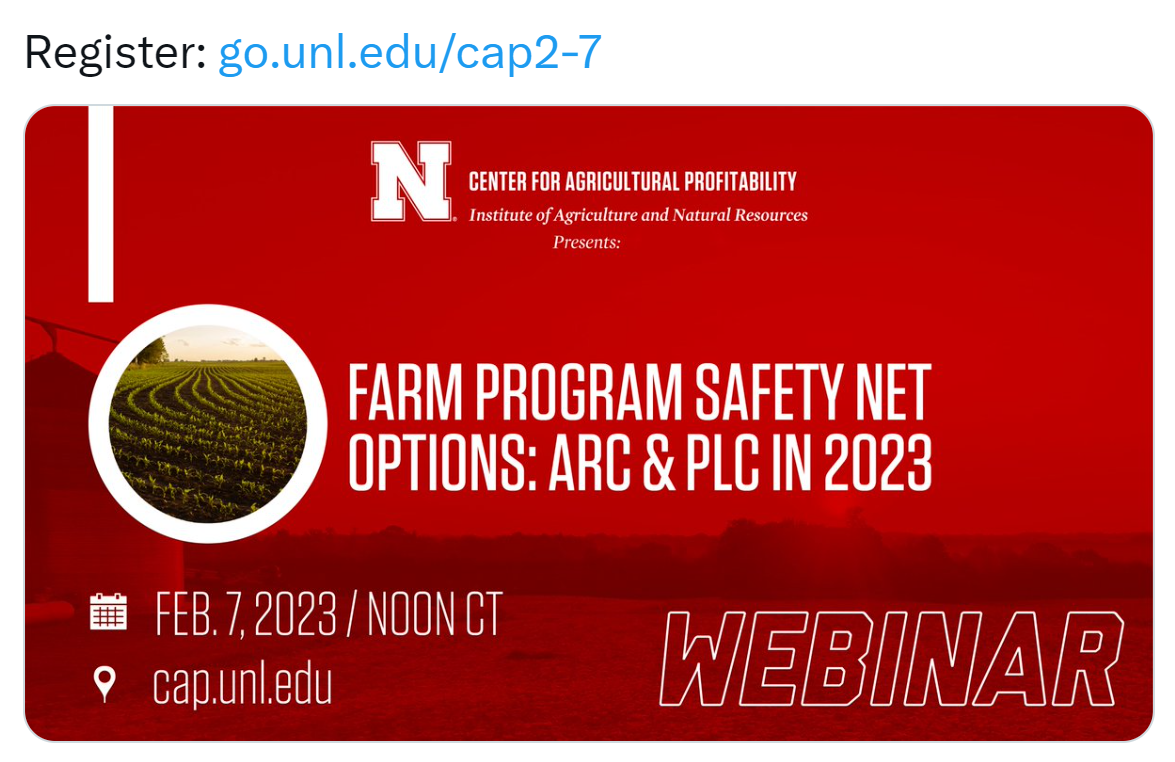
Producers can learn about the ARC and PLC options during a UNL Center for Agricultural Profitability webinar scheduled for 12 p.m. CT on Tuesday, Feb. 7. Cathy Anderson, production and compliance programs chief for the Nebraska Farm Service Agency, and Brad Lubben, extension policy specialist in the University of Nebraska-Lincoln’s Department of Agricultural Economics, will present and share information relevant for producers, ag professionals and ag stakeholders. Registration for the webinar is free and can be found at: https://go.unl.edu/cap2-7.
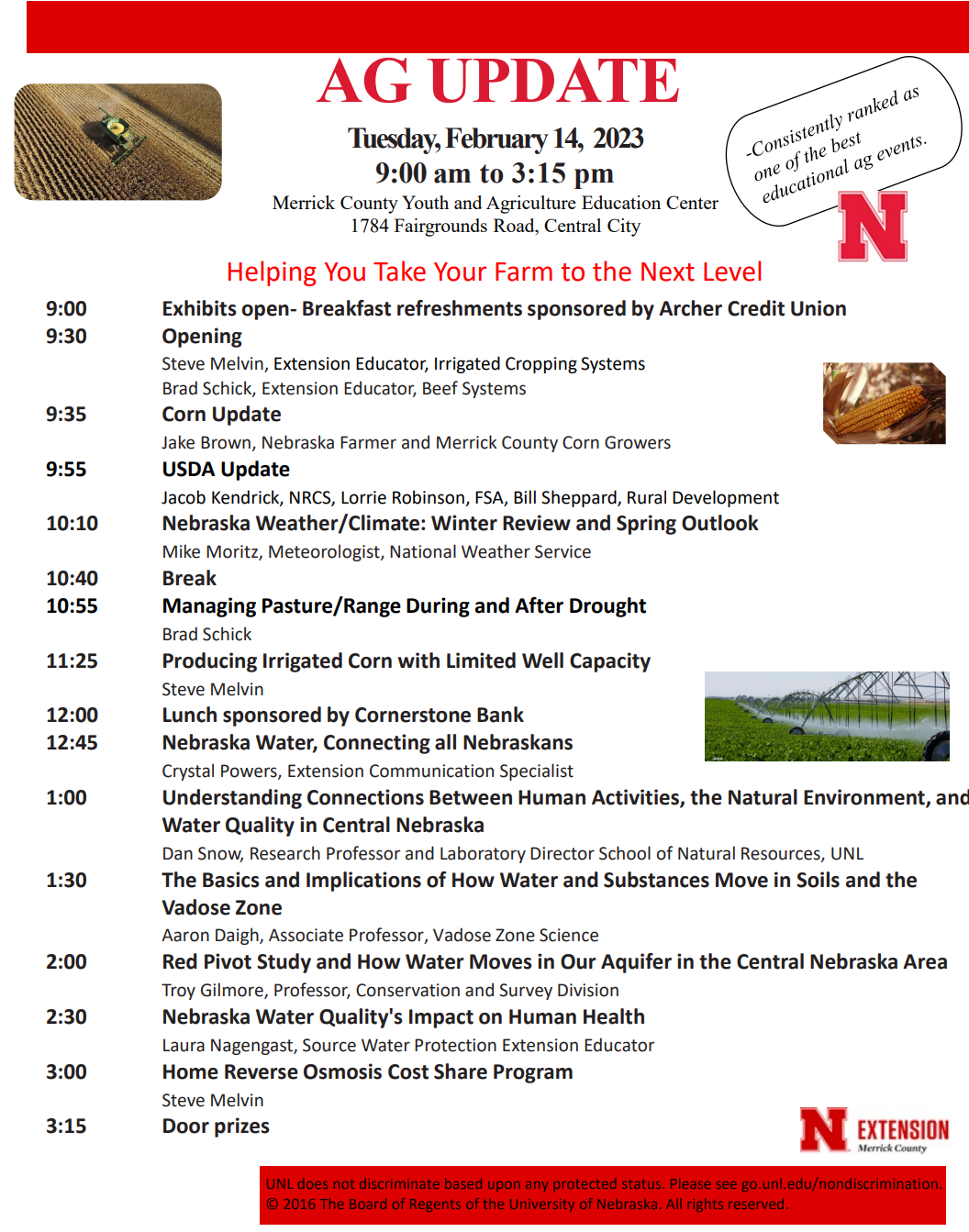
Feb. 14 Ag Update Merrick Co.: Nebraska water quality’s impact on human health and more, Ag Update 2023 will be held Tuesday, Feb. 14 at the Merrick County Youth and Agriculture Education Center, 1784 Fairgrounds Rd, Central City. It will start with breakfast refreshments provided by Archer Credit Union and exhibits opening at 9 am. The event has a great lineup of speakers and exhibits, including “Nebraska Water, Connecting all Nebraskans” with Crystal Powers, “How Water and Substances Move in Soils and the Vadose Zone” with Aaron Daigh, and “Home Reverse Osmosis Cost Share Program” with Steve Melvin. Lunch will be provided and sponsored by Cornerstone Bank. The day will wrap-up about 3:15 p.m. with door prizes. RSVP to Steve Melvin at (308) 946-3843 or at the Merrick County Extension site.
Feb. 28-Mar. 1 Central Plains Irrigation Conference: The event will take place at the Kearney Holiday Inn Convention Center. This is an educational event and opportunity for networking among producers, university officials, industry leaders and other stakeholders. Irrigation in the Central Plains region will be the focus of the conference with topics such as, but not limited to: Getting the most out of your technology and irrigation support tools; Cover crops and residue management; Remote sensing and drone technology; Pivot performance; “Ogallala Aquifer’s Story: Human, Environment and Production”; Insect and nutrient management via chemigation; “TAPS: Effects of Participant Decisions on Profitability & Efficiency”. The conference will be from 9 a.m. to 5 p.m. on Tuesday, Feb. 28 and then 9 a.m. to 12 p.m. on Wednesday, March 1. The cost to attend the event is $55 in advance or $65 at the door. Registration cost does include the lunch meal on Tuesday. Registration is available online, and payment ahead of the conference is appreciated via check or credit card. CCA credits are pending. A vendor show will be available and if your business or organization is interested in having a booth, please contact Donna Lamm at 785-462-7574.

February 2023 Events
January just flew by! Sharing upcoming February events.
Friday Conversations-Focus on Nutrients: These meetings will all be held 10 a.m.-Noon on Feb. 3, 10, and 24 in the 4-H Bldg in York. I started Friday in February conversations last year, and attendees shared to continue them. My goal is to connect farmers and ag industry to share practical info. on what is working and hasn’t worked around specific topics in their operations. These are informal meetings where I’ve asked some farmers to start the conversation and it builds from there. Last year the focus was on cover crops. This year, it’s around nutrient management. Please join us if interested for a time of connection, conversation, and learning! RSVP isn’t required but helps me with preparing (402-362-5508 or jrees2@unl.edu). Topics include:
- Feb. 3: Understanding the soil microbiome (featuring Dr. Rhae Drijber, UNL soil microbiologist). Discussion around soil microbes and our expectations of what they can/can’t do.
- Feb. 10: Rethinking Grazing-Strategies for nutrient distribution. Producers share how they graze cornstalks, cover crops, pastures for the purpose of better nutrient distribution & value of this.
- Feb. 24: Nutrient balancing in conventional, regen, and organic systems. What does the term ‘nutrient balance’ mean to you, what does that look like, and how does one achieve it?
Feb. 9 Eastern NE Soil Health Conference is back at the Eastern NE R&E Center near Mead from 9 a.m.-3 p.m. (Registration at 8:30 a.m.). Topics include: Rediversifying crop rotations via Marshall McDaniel, ISU; Chad Dane (Clay Co. Farmer) and Jay Goertzen (York Co. Farmer) will share their experiences after 3 and 4 years interseeding cover crops into early season corn/soybeans on a farmer panel with me; Mary Drewnoski will share practical tips for selecting and grazing forage cover crops; A farmer panel will share on diversifying and intensifying crop rotations (Angela Knuth (Saunders County), Garret Ruskamp (Cuming County), Kyle Riesen (Jefferson County), and Haldon Fugate (Gage County) moderated by Nathan Mueller, NE Extension; and emerging topics will include biochar, kernza, and what’s new in the cover crop industry. There’s no charge, RSVP to: https://go.unl.edu/z7rx.
On-Farm Research Updates: They’re my favorite because the farmers share about research conducted on their own farms. If you haven’t attended in awhile, the York meeting has been designed around conversation with the goals of connection and learning from each other. Come hear farmers share their experiences on production practices such as soybean rates and maturities, nutrient management studies, cover crops, and products such as Pivot Bio PROVEN, Source N, and Xyway. There’s no charge, but RSVP is required for meal planning: https://go.unl.edu/2023ofr. All locations begin at 9 a.m. (Reg. at 8:30 a.m.). Locations: York (Feb. 15, Holthus Convention Center); Beatrice (Feb. 16, Holiday Inn); Fremont (Feb. 17, Extension Office); North Platte (Mar. 1 West Central REEC); Kearney (Mar. 2, Extension Office).
Certification Trainings Dates for programs listed below are listed at: https://jenreesources.com/upcoming-events/
- Pesticide Trainings: For those who have missed pesticide trainings, I still have some left in Geneva, Deshler, York, David City, Seward.
- Chemigation: I failed to remind people we were doing chemigation trainings last week in our area. If you still need this, you can do this online or attend in-person in Aurora, Central City, Grand Island, Columbus, Lincoln, or Beatrice.
- RUP Dicamba training is no longer provided by Extension. You need to take the trainings provided by the companies. Direct links at: https://jenreesources.com/upcoming-events/
Additional Meetings: Feb. 14 is the Ag Update in Central City with a focus on drought and water; Feb. 23-24 is Women in Ag in Kearney; and the Central Plains Irrigation Conference is in Kearney on Feb. 28-Mar. 1.
Balancing Species Protection and Soybean Production workshop on Feb 9th and 10th in Lincoln, NE. For individuals (soybean growers, crop consultants, and ag professionals) across Nebraska and Iowa interested in participating. This is an important opportunity to communicate the impact of the Endangered Species Act on ag production and to find solutions that work for farmers and the species in our communities. Goal is to bring together a diverse group of stakeholders to discuss the impacts of national pesticide decisions on a local level and identify the potential consequences and co-benefits of conservation practices for pesticide mitigation measures, endangered species protections, and soil and water conservation. Discuss current ag productivity stressors and listed species needs to work towards developing local adaptive management solutions that can ultimately feed into national pesticide decisions. Having these conversations at a local level can potentially provide greater flexibility in managing new or emerging production issues. Please email Dr. Justin McMechan by Feb. 2 if you’re interested in attending or have comments to share: justin.mcmechan@unl.edu.


Nitrogen Rate and Timing Studies
Many farmers are interested in finding ways to grow the same or more bushels with less inputs. Nebraska On-Farm Research has been working with farmers to test different studies, including nutrient management ones, on their farms since the 1990’s. Area on-farm research cooperators and I started the 2022 season with 35 studies, but only 15 made it to harvest with the hail.
While there’s numerous nutrient management studies throughout Nebraska, I’ll focus on local data. Since 2020, one farmer in the Henderson area has been testing nitrogen rate and timing studies. Fields were impacted by July 9 windstorms in 2020 and 2021 and the June 14 hailstorms in 2022. His goals include testing any benefits (yield and nitrogen carryover) to split applying nitrogen vs. applying it mostly up front, and also testing his nitrogen rate vs. +/- 50 lb N/ac. He’s currently amassed 7 site-years worth of data of which only 3 have shown a difference when reducing his grower rate by 50 lb N/ac. For reference, the soil type is silty clay loam/silt loams and his yield goal is around 240 bu/ac. These studies received partial sponsorship from the Upper Big Blue NRD. All the data is shown in charts at jenreesources.com.
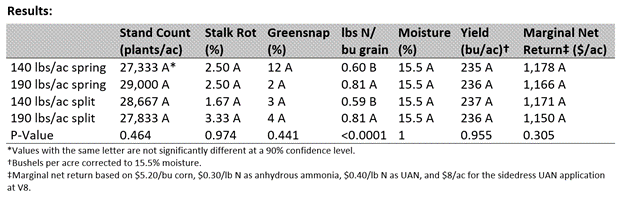
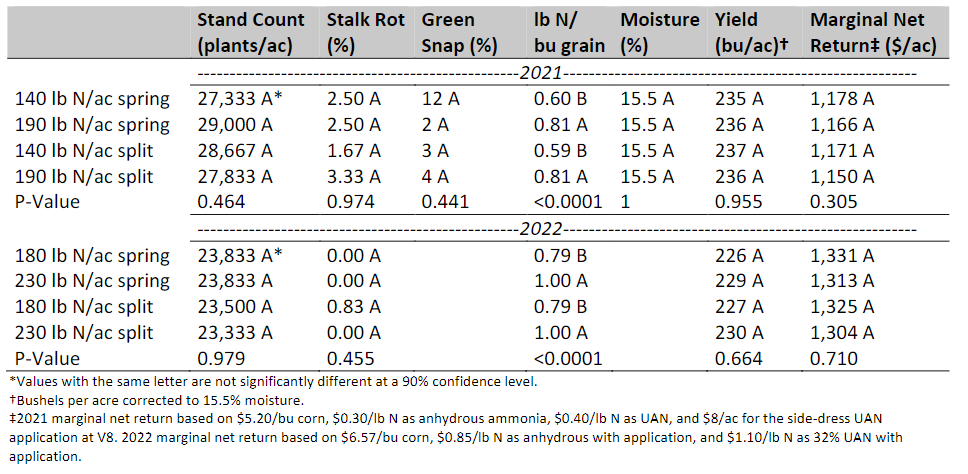
In 2022, his nitrogen timing study was conducted on the same strips as in 2021. This study looked at spring vs. split application of nitrogen at 50 lb rate differences. Treatments were: Spring anhydrous of 180 lb N/ac, Spring anhydrous of 230 lb N/ac, Split 180 (120 lb N as spring anhydrous + 60 lb 32% UAN sidedress), and Split 230 (170 lb N as spring anhydrous + 60 lb as 32% UAN sidedress). The field received 35% hail damage at V5 with harvest stands reduced to around 23,000 plants/ac. Yields from the four treatments listed above respectively: 226, 229, 227, and 230 bu/ac with no yield differences amongst the treatments. In 2021, on the same strips of spring vs. split, treatments of 140 vs. 190 lb N/ac were compared. There again were no yield differences with yields ranging from 235-237 in 2021.
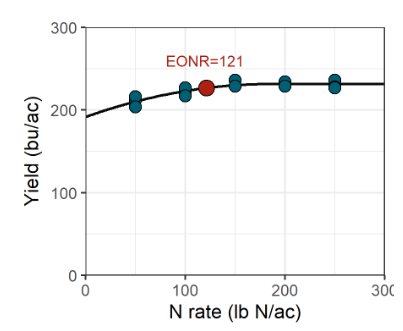
In 2022, he also conducted a study testing the economically optimum nitrogen rate on irrigated corn. The previous crop was soybean and this field had 25% hail damage at V6 on June 14, reducing harvest stands to an average of 23,500 plants/ac. Fall anhydrous in November 2021 was applied at rates of 0, 50, 100, 150, and 200 lb N/ac. All treatments then received a sidedress application of 50 lb N/ac as 32% UAN at V8. The sidedress was surface applied and didn’t get incorporated until a rain 10 days later. 2022 was a high mineralization year, but it’s still incredible to see that with only 50 lb N/ac, he achieved 211 bu/ac! The 100 lb N/ac received 222 bu/ac. There were no yield differences between the 150, 200, 250 lb N/ac treatments with respective yields of 231, 232, and 230 bu/ac. The economically optimal nitrogen rate was determined to be 121 lb N/ac for this field. Studies like this are interesting to show what our farmers are trying. They’re also helpful for examining and rethinking nutrient application rates and timing to our fields. If you’re interested in learning more, would encourage you to RSVP for our on-farm research update held Feb. 15 at the Holthus Convention Center in York at: RSVP: https://go.unl.edu/2023ofr.
Hamilton Co. Ag Day: Steve Melvin has put together great opportunities for the Hamilton and Merrick Co. Ag Days this year! Jan. 31 is Hamilton Co. Ag Day at Fairgrounds in Aurora with registration at 9 a.m. and program beginning at 9:30 a.m. with Corn and USDA updates. Additional morning topics include corn and soybean insect and disease updates and irrigation scheduling info. Lunch is sponsored by AKRS equipment. The afternoon is focused on a Farm/Ranch Transition Succession Workshop with Al Vyhnalek, UNL Farm succession specialist and Tom Fehringer, Attorney. I’ve heard a lot of farm succession speakers and this duo of Al and Tom is extra helpful. They are so practical and share in a way that is easily understandable and relatable. I could relate to the family stories they shared and have seen some people in tears for two main reasons: wishing they had heard the info. earlier and also grateful they had the info. now to change things for the future. Please consider attending!
2020 York County Spring Anhydrous Nitrogen Rate on Corn
This study essentially showed what the previous studies had: that less nitrogen can be applied without hurting yield or net return. 50 lb/ac N above the grower rate resulted in reduced profit. Field yields were impacted by the July 9, 2020 wind storm. This study is sponsored in part by the UBBNRD.
| Pre-Plant | In-season | lbs N/bu grain | Yield | Marginal Net Return |
| 110 lb N/ac spring NH3 (March) | 25 lb N/ac as UAN May | 0.73 C | 184 A | $599.14 A |
| 160 lb N/ac spring NH3 (March) | 25 lb N/ac as UAN May | 0.98 B | 189 A | $600.38 A |
| 210 lb N/ac spring NH3 (March) | 25 lb N/ac as UAN May | 1.23 A | 191 A | $594.88 A |
2020 Hamilton County Evaluating Nitrogen Rate and Timing on Corn
This study showed no difference in nitrogen timing nor rate on yield and showed less nitrogen can be applied without impacting yield. Yields were impacted by the July 9, 2020 windstorm. This study is sponsored in part by the UBBNRD.
| Pre-Plant | In-season | lbs N/bu grain | Yield | Marginal Net Return |
| 180 lb N/ac Fall NH3 | 25 lb N/ac as UAN May | 1.03 B | 199 A | $629.85 A |
| 230 lb N/ac Fall NH3 | 25 lb N/ac as UAN May | 1.27 A | 201 A | $625.49 A |
| 180 lb N/ac Spring NH3 | 25 lb N/ac as UAN May | 1.02 B | 201 A | $638.30 A |
| 230 lb N/ac Spring NH3 | 25 lb N/ac as UAN May | 1.24 A | 206 A | $641.70 A |
| 120 lb/ac N Spring NH3 | 25 lb N/ac as UAN May 60 lb N/ac side-dress V8 | 1.00 B | 205 A | $645.69 A |
| 170 lb/ac N Spring NH3 | 25 lb N/ac as UAN May 60 lb N/ac side-dress V8 | 1.24 A | 206 A | $633.50 A |
2021 Hamilton County Spring Anhydrous N Rate Study
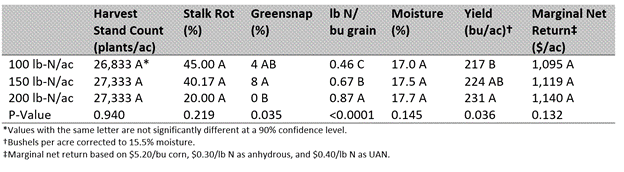
This study showed no reduction in yield of grower rate vs. 50 lb N/ac under the rate; however, the yield from the -50 lb rate treatment was different from the 50+ rate. There were no differences in marginal net return. This field received 20% wind damage from July 9, 2021 storm. Partially sponsored by UBBNRD.
2021 York County Spring Anhydrous N Rate Study
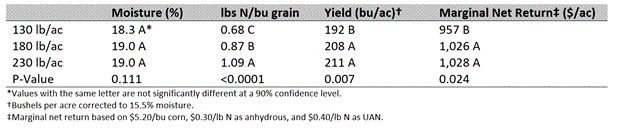
This study showed no yield difference between the grower rate and 50 lb N/ac over the grower rate but they yielded significantly more than the 50 lb N/ac under treatment and had greater marginal net return. This field received 20% wind damage from July 9, 2021 storm. Study partially sponsored by UBBNRD.
2021 York County Timing by N Rate Study
(Sponsored in part by UBBNRD)
Spring 140 lb/ac: 110 lb/ac N as anhydrous and 30 lb/ac N with herbicide
Spring 190 lb/ac: 160 lb/ac N as anhydrous and 30 lb/ac N with herbicide
Split 140 lb/ac: 50 lb/ac N as anhydrous, 30 lb/ac N with herbicide, and 60 lb/ac N sidedressed at V8
Split 190 lb/ac: 100 lb/ac N as anhydrous, 30 lb/ac N with herbicide, and 60 lb/ac N sidedressed at V8
2022 York County Timing by N Rate Study (same strips as 2021)
(Sponsored in part by UBBNRD)
35% hail damage on June 14, 2022 at V5
Spring 180 lb/ac: 180 lb/ac N as anhydrous
Spring 230 lb/ac: 160 lb/ac N as anhydrous and 30 lb/ac N with herbicide
Split 180 lb/ac: 120 lb/ac N as anhydrous and 60 lb/ac N sidedressed at V8
Split 230 lb/ac: 170 lb/ac N as anhydrous and 60 lb/ac N sidedressed at V8
2022 Economically Optimum Nitrogen Rate
(Sponsored in part by UBBNRD)
25% hail damage on June 14, 2022 at V6
Treatments: Fall anhydrous applied November 2021. Sidedress application of 50 lb N/ac 32% UAN at V8.
50 lb N/ac (0 lb anhydrous, 50 lb sidedress)
100 lb N/ac (50 lb anhydrous, 50 lb sidedress)
150 lb N/ac (100 lb anhydrous, 50 lb sidedress)
200 lb N/ac (150 lb anhydrous, 50 lb sidedress)
250 lb N/ac (200 lb anhydrous, 50 lb sidedress)

2022 Soybean Production Studies
Ag Conference: Thank you to everyone with the York Chamber, Holthus Convention Center, Chamber Ag Committee and Ambassadors, York Visitors Bureau, Sponsors, Vendors, Newspaper and Radio for all their work and help with the York Ag Conference last week! It takes a great team to pull off a successful event. Several individuals were very helpful to me with the pesticide certification trainings; I’m grateful to each of you for your help! Grateful for all the farmers who attended and it was great to catch up with several of you!
Crop Production Clinic Clarification: Both commercial and non-commercial applicators in the ag plant and research and demonstration categories can renew at any of the crop production clinics. The York clinic is reformatted compared to the other clinics, but recertification can be received at any CPC. You can pre-register or walk-in that day for same cost. Info: https://agronomy.unl.edu/cpc.
This week I’ll share on soybean production studies. Our on-farm research update with farmers sharing their results will be Feb. 15 at the Holthus Convention Center in York. Pre-registration at: https://go.unl.edu/3j8q. Grateful for all the cooperators who work with me via on-farm research!
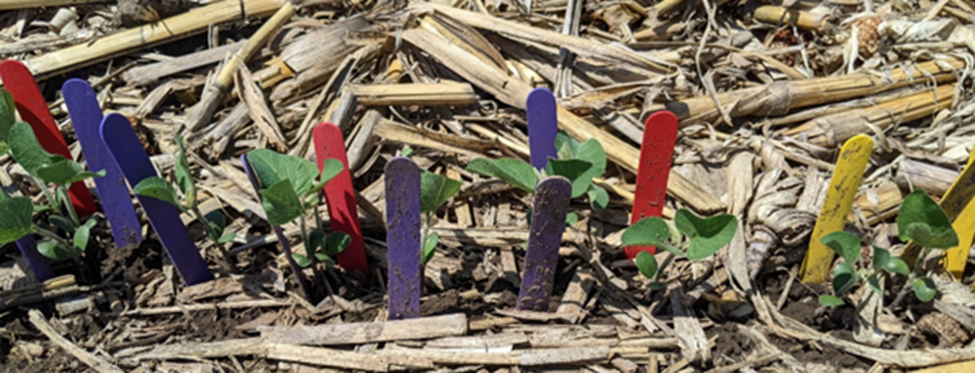
Soybean Seeding Rates: A first-year cooperator from the Utica area chose a soybean seeding rate study of 100,000 vs. 130,000 vs. 160,000 seeds/ac. He planted April 18 with NK 28-T3XF strip-tilled into corn. I started emergence counts May 9 when cotyledons had pulled just above the soil surface. 68% of the 130K, 52% of the 160K, and 48% of the 100K had emerged on Day 1. By Day 9 when I took the last counts, 95% of the 160K, 93% of the 130K, and 94% of the 100K had emerged. The May 22 frost with heavy residue reduced stands in areas of the field down to 35,000 plants/ac. The farmer decided not to replant a large portion of the field including where I had taken these initial emergence counts. This field missed the June 14 hail. The data shared doesn’t include the areas of the field down to 35K. At harvest, 81% of 160K (129,000 plants/ac), 79% of the 130K (103,000 plants/ac), and 86% of the 100K (86,000 plants/ac) remained. There were no yield differences with the 100K yielding 71 bu/ac, 130K yielding 72 bu/ac, and 160K yielding 73 bu/ac. The study results follow 17 years-worth of on-farm research results showing no yield loss when reducing seeding rates of 160-180K down to 120-140K in heavier textured soils. Our Nebraska data also shows that soybean planting rates of 80,000 to 120,000 seeds/ac resulted in the highest profitability.
Soybean Maturity Studies: Seth Naeve, University of Minnesota shared that compared to lower yielding varieties, highest yielding varieties produce between 20 to 40% greater yields. Thus, variety selection is the greatest factor for impacting soybean yield. Third-party information is limited in Nebraska. If there’s interest in a soybean grower plot in the area (particularly someone willing to host this), please let me know. Some third-party resources include: F.I.R.S.T Soybean Testing Program (https://www.firstseedtests.com/), and data from Universities such as Iowa State, K-State, South Dakota State, and Missouri. Seed companies have numerous locations with data. When possible, look at how a variety performs over multiple years at multiple locations.
We now have 13 site-years worth of data from Seward and York counties comparing Group 2 and Group 3 maturity soybeans. Reasons for considering a Group 2 variety in our area include spreading out harvest, opportunity for planting cover crops for greater fall growth, and spreading risk from weather events. In 10 of the 13 site-years, there were no yield differences between high-yielding Group 2 and 3 varieties when planted mid-April to early May. In the other three site-years, the Group 3 varieties had higher yields than the Group 2 varieties. One reason was late season rains benefited Group 3 soybeans in non-irrigated environments in two site-years. In the gravity irrigated ridge-till environment, harvesting the Group 2 variety sooner may have helped reduce plants from lodging down into furrows that are difficult to pick up at harvest.
Jan. 2023 Programs
Happy New Year! This week I’m providing an update on upcoming January 2023 meetings.
Private Pesticide Applicator Trainings: This is the year where a number of us need to recertify. If you plan to attend an in-person training, please RSVP to the local Extension office in the county you plan to attend. Cost for training is $50, whether one takes the training in person or online. For those who are recertifying online at pested.unl.edu, there is an option that allows you to skip the training and go straight to the test if you prefer. If you fail the test, you are allowed to go back through the training.
RUP Dicamba Training is not being provided by Extension. Attend a training through Bayer, BASF, or Syngenta. Direct links to their training info. at: https://jenreesources.com/upcoming-events/.
Commercial/Non-Commercial Pesticide Applicator Trainings: For those seeking initial trainings, the easiest way to obtain certification is go to https://pested.unl.edu/certification-and-training, click on ‘commercial/non-commercial’, and follow the instructions for purchasing materials and signing up for a training class and/or testing location. For Recertification in Ag Plant (Category 01), please plan to attend one of the Crop Production Clinics (CPC) throughout the State. On Jan. 20th CPC in York, we’ve redesigned the recertification training to include hands-on stations including a sprayer, nozzle spray table, etc. We will also have the crop/soil/water room in York but we will not have the traditional disease, insect, weed sessions. For CPC full agenda, please go to: https://agronomy.unl.edu/cpc.
York Ag Conference: This will be held January 12th from 8 a.m.-6 p.m. at the Holthus Convention Center. It’s been redesigned as a one-day conference with ‘expert’ discussions on meteorology/trees/soil health/ag markets/autonomous ag, etc., farmer coffee chats, in addition to exhibitor booths. I’m hosting two private pesticide training sessions (9 a.m. and 1 p.m.) at the Conference and am requiring RSVP to 402-362-5508. Free ag appreciation lunch sponsored by Cornerstone Bank will be served from 11:30-1:30 p.m. There will also be a Celebrating Ag Happy Hour beginning at 3:30 p.m. sponsored by the York County Corn Growers. Additional major sponsors include CVA, Rural Radio Network, York Co. Visitors Bureau, Midwest Bank, York News Times, Kroeker & Kroeker Insurance & Real Estate, and Nebraska Extension. For more information, please visit: https://yorkchamber.org/york-ag-conference/.
Chemigation Trainings are for those who apply fertilizer and/or pesticide through irrigation systems. There is no fee for these trainings. They can be done online or in-person. Area in-person trainings in January include: Jan. 25 at 1:30 p.m. at Fairgrounds in Hastings, Jan. 26 at 1 p.m. at the Community Center in Davenport, Jan. 26 at 1:30 p.m. at Community Center in Blue Hill, and Jan. 27 at 9:30 a.m. at the Cornerstone Event Center at the Fairgrounds in York.
The Power of Negotiation and Communication is provided via Women in Ag focusing on women, but men are welcome to attend. It is a 4-part workshop held Jan. 18, Jan. 25, Feb. 1 and Feb. 8 from 5:30-8:30 p.m. Topics include: Lease Agreement Basics; Landlord/Tenant Relations; Negotiation/ Communication Skills; and Conservation Practices. Locations hosting include: Ext. Office in Geneva, Fairgrounds in Central City, and Ext. Office in Lexington. More info: go.unl.edu/negotiation.
York-Hamilton Cattlemen Banquet will be Tues., January 31 at the Holthus Convention Center in York. Doors open at 6:30 with cash bar followed by prime rib meal, entertainment, and recognition of honored guests. Rex Havens is the evening entertainment. He’s a former college professor who has made the transition to standup comedian. Tickets are $25 per person, or banquet sponsorships that include two banquet tickets and the business recognition at the banquet are available for $150. Cattlemen’s Banquet tickets can be purchased from any of the York-Hamilton County Cattlemen’s Directors or at the UNL Extension Offices in Hamilton and York Counties.


2022 Reflections, 2023 Renewed Hope
I’ve been reflecting a lot since harvest. There were many hard things, particularly in agriculture, that happened in 2022. Quick recap list were: Dec. 15, 2021 tornadoes and wind storm that began pivot destruction, dry winter and spring, high input costs and difficulty finding chemicals, wildfires, endless wind and dust storms, dry and cold planting season, numerous hailstorms, replanting crops, pivots throughout state needing replaced, drought, more wildfires, more wind, avian influenza, deep cold, and blizzards out west. There were also those who lost loved ones or had family/friends get sick or hurt. It seemed to be the year that kept on giving.
There were many blessings though too! Good crop prices and the benefit of insurance to help with homes, buildings, vehicles, crops were large blessings. Family and friends pulled together to cleanup destruction, patch homes, and get crops in the ground. For those who replanted crops, we witnessed a miracle in the fact that an entire growing season was re-started in mid to late June in two weeks! Seriously, think about that. With all the moving parts in ag, how chem was in short supply, the large area impacted, it truly was a miracle. I was so proud of how ag industry pulled together to make that happen! This year was taxing on mental health, and I heard and watched people reach out to each other to talk through the difficulties of the year. I’m also so grateful for our livestock and ethanol industries in Nebraska as markets for our crops. The feedlots were an extra blessing with the wet corn that was prematurely froze. There also was much learned, in spite of the fact it may not be what most of us set out to learn for the year!
Many of us have wanted to get to the end of 2022 and it’s now here. We each dealt with the year in different ways. Did we finish well? Each year will have its challenges and opportunities. How we choose to work through them can help us with perspective and build resilience for future hard times.
In reflecting on the way home from church one day, the word ‘character’ came to mind. 2022 was truly a character-building year!

Those thoughts were reinforced as I walked into the grocery store to find two farmers discussing the year with one mentioning the exact same thing. I googled the definition of character. It said, “the mental and moral qualities distinctive to an individual.” I’ve thought about the good things built in my character from the difficulties of 2022 and also areas I need to improve for the future. Reflecting on 2022 has helped me with personal and professional goal setting for 2023.
As you reflect:
- How did your character build in 2022?
- What areas could use improvement?
- What did you learn in 2022 about yourself and the situations you went through?
- How can you use what was learned in 2022 to plan for 2023?
Wishing you and your family blessings in 2023; a new year with new opportunities and renewed hope!
End of Year Reporting: The end of the year also means report time for those of us in Extension. Each year we need to justify the things we do in trying to help people. This year, I’d particularly appreciate any comments if you felt my blog posts or farm visits helped in regards to the hail damage. I know we get bombarded with surveys! So, if you’d consider taking time for this 5 question survey I’d greatly appreciate it. For those of you who’ve responded in the past, re-reading your comments encourages me throughout the year. Thanks! https://app.sli.do/event/tPSXB8muP9hDm8M42qkRER


 JenResources