Category Archives: JenREES Columns
JenREES 4-22-18
Planting Considerations: This email newsletter reaches a wide area of the State, so soil temps vary quite a bit and some of you may be in better planting conditions than others. We still recommend planting into soil temps as close to 50°F as possible, check weather conditions for next 48 hours to hopefully maintain temps 50°F or higher, and avoid saturated soil conditions. If planting a few degrees less than 50°F, make sure to check with seed dealers on more cold-tolerant seed. This is most likely common sense, but I still feel worth mentioning. Everything we do at planting sets the stage for the rest of the year. We’re blessed to have equipment that can allow for many acres to be planted in a short amount of time. And…we also have the ability to mess up a lot of acres in a short amount of time.
Planting depth is also key. Aim to get corn and soybean in the ground 1.5-2” deep. This is critical for correct root establishment in corn to avoid rootless corn syndrome. Rootless corn syndrome is when the nodal (crown) roots don’t get well established and successive brace roots can’t establish either. This allows the seedling to whip around in the wind, potentially being dislodged, become weak or die. With center-fill planters, when adjusting down-pressure on the go, sometimes the planter ends may not always be seeding as deep as the center. Too often I’ve seen that resulting in seed 1” or less and the field pattern can be observed the entire growing season with potential yield impacts. So don’t just rely on the monitor. Take the time to dig up seed behind the planter and at spots along the whole planter length to ensure the proper seeding depth. And do this with every field, particularly with different tillage/residue situations. I realize this takes time, but you’ll be glad you did to catch any issues before too many acres are planted incorrectly.
With cold temps or higher soil moisture conditions, it’s still important to get that seed at least 1.5-2” in the ground. Planting 1.5-2” deep helps both corn and soybean to have that seed in even soil temperature and moisture conditions. You may be surprised on that recommendation for soybean, but I think it’s even more critical with planting early. In fact, UNL research near Mead compared planting depths of 1.0, 1.25, 1.5, 1.75, 2.0, 2.25, and 2.5 inches in 2011 and an additional planting depth of 2.75 inches was added in 2012 and 2013. The study found lowest yields when soybean was planted 1.25” or less or 2.25” or greater with the highest yield at 1.75” deep. One of that study’s hypotheses was that planting deeper would buffer soil temperature and moisture and protect newly emerged seedlings from frost and freeze damage, particularly when planting early in the season.
Hopefully planting soybean early is still something you’re considering for this year! We wrote a CropWatch article this week at http://cropwatch.unl.edu to provide some updated research on amplifying the effects of planting early. There’s so much research regarding how early soybean planting increases yield that we wanted to share new research regarding maturity groups, etc. Essentially, what it appears from the research thus far, is that it’s more important to choose a consistent, high-yielding soybean for your area, regardless of specific maturity group. We’d like to get more specific data and have on-farm research protocols available to compare MG2.4-2.5 vs. MG3.0-3.5 and Dr. Jim Specht would also like to collaborate with us on documenting various factors. Please let me know if you’re interested in this! There’s also a protocol for comparing early vs. late planting of soybean.
Soil moisture conditions didn’t improve this week at the six sites I’m monitoring in Webster, Nuckolls, Thayer, and Clay counties. You can find the chart comparisons on my blog at http://jenreesources.com. Last weekend’s bizzard didn’t provide significant moisture in this area. With pastures slow with growth and drought increasing in Kansas, discussions with farmers have included cover crop termination, grazing rye that’s had anhydrous ammonia applied to it (with the original intention of termination and planting to corn), and grazing wheat. Most of these topics are included in this week’s UNL CropWatch at http://cropwatch.unl.edu. The articles are too long with too many considerations for me to add them in this news column, so please do check them out if you’re interested in these topics. Another topic I’ve had several questions about is regarding how temperature and rain affect burndown herbicide applications. Dr. Amit Jhala, Extension Weed Specialist, addresses that in this week’s CropWatch as well, so please check that out. Here’s wishing everyone a safe planting season with conditions to get #plant18 and #grow18 started off well!
JenREES 4-15-18
Well, winter seems to be sticking around. My thoughts and prayers have been with those of you calving with the difficult conditions this year.
I provided an update regarding soil moisture status in non-irrigated fields both in this week’s UNL CropWatch at cropwatch.unl.edu and my blog at jenreesources.com. We’ll see what happens with moisture in the next few weeks and I’ll post updates to my blog.
Very few have tried planting in this part of the State that I know of. Grateful for all of you who keep me updated on what’s going on through your questions and comments! In this week’s UNL CropWatch, Dr. Roger Elmore took the lead on an article addressing corn planting. The message is to ideally wait till soil temperatures reach 50F with weather conditions allowing soil temperatures to remain at 50F or higher for the next 48 hours. We’ve observed when seed was planted and a cold snap with cold rains was received within 48 hours, some problems with seed germination and emergence. Hybrids vary in cold tolerance and seed companies are a great resource for that information as to which hybrids could be planted first in colder soils. Soil temperature information can be found at the UNL CropWatch site at: https://cropwatch.unl.edu/cropwatchsoiltemperature. We’d also recommend you take the soil temperature in the field before you plant and can do so by using a meat thermometer.
Last year I remember receiving questions from April 21-24 regarding planting corn and soybeans with an anticipated cold snap later that week. At that time, I was recommending growers switch to soybeans. The reason? Soybeans imbibe (uptake) water more quickly than corn seeds and while we hear 48 hours to be on the safe side, the critical period is more like 24 hours. Also, several years of both small plot and on-farm research in Nebraska has shown the primary way to increase soybean yields is to plant early. Dr. Jim Specht’s research showed soybeans produced a new node every 3.75 days once V1 occurs. The nodes are where pods and seed occur. Our on-farm research planting date studies also showed regardless if the spring was cold/wet or warm/dry, the early planted soybean always out-yielded the later planted with a total average across trials of 3 bu/ac. The data ranged from 1-10 bu/ac. We never planted early without using an insecticide/fungicide seed treatment to protect that seed, so we recommend you add that if you do plant early.
Our recommendation would be to plant the last week of April or as close to May 1 as conditions allow. We’ve also seen good results after April 20 in years if the soil temperatures were around 50F with good weather conditions at least 24-48 hours after planting to maintain that soil temp. It’s important to know your level of risk, though. Crop Insurance planting date for replant considerations is April 25 and there may also be replant options from your seed suppliers. We never replanted any of our studies and I have only observed frost on soybean cotyledons one year where growers planted early with soybeans coming out of it. We had the largest number of acres I’ve seen planted by April 24 last year with thankfully no issues and they were able to take advantage of a high-yielding bean year. Perhaps this is something you wish to try for yourself this year? Consider planting some passes of soybeans early and come back with some passes three weeks later. You can use this Soybean Planting Date Protocol if you’re interested in trying this for yourself. Please let me know if you’re interested in this!
Depending on the number of acres you have, some growers are now planting soybeans first. Others are planting corn and soybeans at the same time by either running two of their own planters/drills or custom hiring someone to plant soybeans for them. This also spreads risk and can help with harvest. Regarding maturities, a study conducted at UNL East Campus compared a 2.1 vs. 3.0 maturity group variety at 10 day intervals beginning April 23 through June 19. Yield was highest for early planted soybean and a yield penalty of 1/8 to 1/4 bu/ac per day of delay in planting for MG2.1 and MG3.0 varieties, respectively was found. The study also indicated that yield of the MG3.0 variety was higher relative to the MG2.1 variety in early plantings (late April and early-mid May), but the opposite (greater yield in MG2.1 versus MG3.0 variety) was found for late plantings (late-May and June). In our part of the State, we’ve observed really high yields from strong genetics in the MG2.4-2.5 varieties when planted early; so I have a hard time automatically recommending later MG varieties without more data. Thus, I would love to work with anyone interested in planting early comparing a high yielding MG2.4-2.5 vs. a high yielding MG3.0-3.5 to obtain more data. Here’s a Soybean Maturity Group Comparison with Early Planting protocol to consider and please let me know if you’re interested in this!
Wheat: My colleague, Dr. Nathan Mueller in Dodge County, has taken the lead on

Nebraska crop reporting districts for wheat. The yellow area is considered ‘Eastern Nebraska’.
sharing wheat information for Eastern Nebraska. He’s put together an excellent resource on his blog at http://croptechcafe.org/winterwheat/. Every Friday he’s sharing an update called “What’s up this Wheat“. He also started an Eastern NE wheat listserv and his website explains how to subscribe to it. Grateful for his effort in this as we both have goals of increasing crop diversity in the areas we serve and there are many benefits to wheat in rotation!
Crabgrass prevention in Lawns: Just a quick note that while our Extension lawn calendars promote applying crabgrass preventer in mid-April, our horticulture experts say to wait till soil temperatures are 55F on a seven day average and we are currently far from that! Check out https://cropwatch.unl.edu/cropwatchsoiltemperature for soil temp info.
JenREES 4-8-18
Reducing Soybean Seeding Rates: Can I reduce soybean seeding rates and still maintain yield? It’s a common question from soybean growers, especially those seeking to reduce input costs. Every year during winter meetings I share what our growers have found. We now have 11 years of On-Farm Research proven data.
The findings? Reducing soybean seeding rates from 180,000 or 150,000 seeds/acre to 120,000 seeds/acre doesn’t statistically reduce yields in 30- or 15-inch rows in silty clay loam and silt loam soils in south-central and eastern Nebraska. Results of 18 studies showed for seeding rates of 180K, 150K, and 120K seeds per acre, average yields were 69.0, 68.7, and 68.4 bu/ac, respectively (Figure 1). The early studies within this dataset all had seed germination of at least 90% listed on the seed bag. In all but two situations (seeded at 180,000 and achieving 88% germination), the growers were able to achieve 90% or greater of their planted stand.
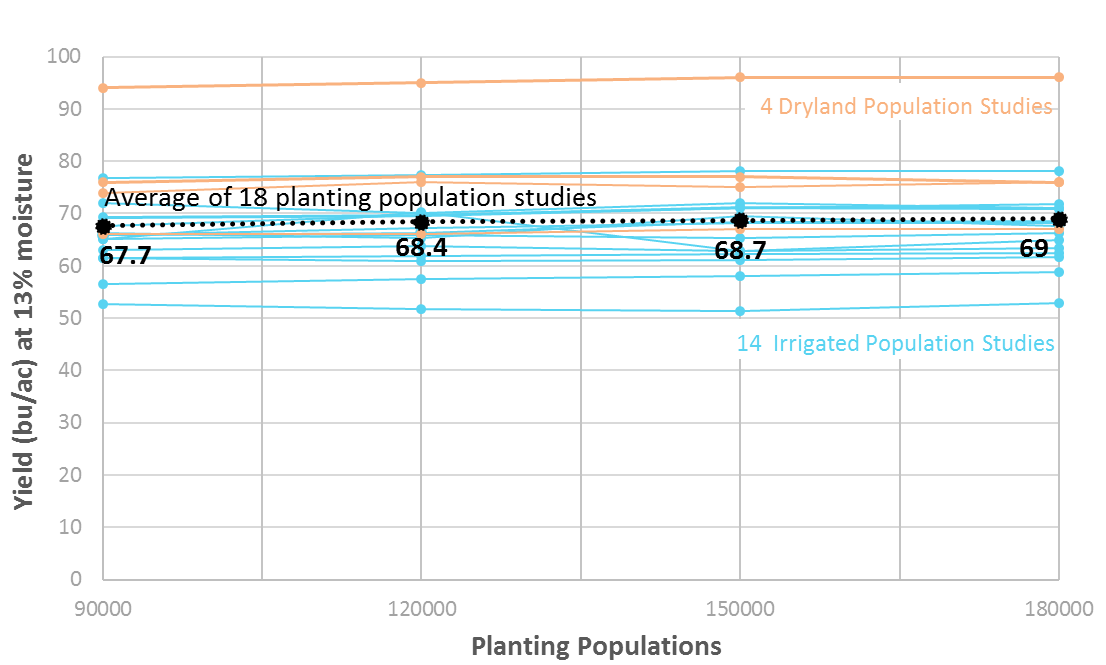
Figure 1. Yield results of on-farm seeding rate studies from 2006 to 2017 (15″ and 30″ rows). Average final stands: 90,000 = 83,067 plants per acre (ppa); 120,000 = 106,863 ppa; 150,000 = 132,700 ppa; and 180,000 = 157,924 ppa
As I share this data, I’ve often heard “but I seed higher rates because of X, Y, or Z…”; however, this dataset includes a lot of those reasons without negative yield consequences! I’ve worked closely with these studies in walking the fields; taking notes and pics; counting plants, pods, and seeds; so I’m really confident of the research and the fact that soybeans truly compensate for reduced populations! Outside of this research, I’ve also observed this in many soybean hail, crusting, and PPO inhibitor seedling damage situations. This dataset includes:
- The latest soybean varieties as the research was conducted from 2006-2017.
- Erect and bushy type varieties in growth architecture.
- Higher and lower yielding situations.
- Fourteen irrigated fields and four non-irrigated.
- Hail events occurring from cotyledon stage to R2 in some of these fields.
- Crusting in some non-irrigated fields.
- Seed treated in some fields and others without (determined by grower’s planting date).
- In some years, pod and seed count data were also collected; the data showed similar numbers of seeds/acre and ultimately yield per acre.
- Observations of increased plant branching at lower seeding rates and difficulty in telling the seeding rate treatments apart as the season progressed.
Our research data for 11 years shows no statistical yield differences in seeding rates from 120,000-180,000 seeds/acre in 15- or 30-inch rows in silty clay loam or clay loam soils. Thus, reducing seeding rates is a way to consider reducing input costs for 2018 without impacting your yield. If you dropped your seeding rate from 150,000 seeds/acre to 120,000 seeds/acre, you could save $10.08/acre, assuming a yield loss of 1 bu/ac, a seed cost of $60 per 140,000 seeds, and a savings of $25.71/ac on seed.
- Thus, if you plant between 140,000-160,000 seeds/acre, consider dropping your seeding rate to 120,000 and aiming for a final plant stand of 100,000 plants/ac based on our research findings.
- If you plant at 180,000 or more seeds/acre, consider dropping your seeding rate to 140,000 seeds/acre as a step-wise increment.
Still hesitant? Consider trying this yourself for your location! Consider using either this Two Population Treatment Design or Four Population Treatment Design. You also can download the Nebraska On-farm Research app, available in Apple and Android, to help you set up your plot design to obtain scientific results. If you have questions or need help setting up your research project, please contact me or anyone involved with our Nebraska On-Farm Research Network. To view all the graphs and additional data regarding 15″ row spacing with reduced seeding rates, please check out this week’s UNL CropWatch at http://cropwatch.unl.edu.
Beginning Soil Moisture: On Good Friday, I installed soil moisture sensors down to 4′ in  non-irrigated no-till fields at Bladen and Lawrence. Last week I added three more sites at Clay Center, Superior and Byron. Thus far, the 3′ and 4′ are dry in all those locations other than Clay Center (only dry at 4′). At Superior, I could only get the soil probe in the ground 6″ into actively growing rye and 1′ in cover that winter-killed. I was just curious what kind of moisture existed currently in the southern tier of counties. I realize planting plans are in place and that we often receive rains in April/May. Hopefully it provides information that can be helpful in how to use that soil moisture. If we don’t get necessary rains, you may consider switching to a different crop, growing feed if you have cattle, or not terminating actively growing rye as originally planned but perhaps using it for feed. Will share graphs next week and I appreciate the growers allowing me to install these in their fields!
JenREES 4-1-18
Hope you had a blessed Easter! The Wheat Stem Maggot in Cover Crop Webinar can now be viewed at: https://www.youtube.com/watch?v=XGjuzMlrjhQ&feature=youtu.be. The link for the survey mentioned in the webinar is no longer available but you are welcome to contact Dr. Justin McMechan for additional comments/questions. He goes through a number of insects to watch for and his ultimate message is to scout to determine termination timing.
Cover Crop Interseeding: A few weeks ago I attended the interseeding cover crops field day which had a really good attendance for March! For those of you considering this, I learned it’s best to start earlier than V6…consider V3 and if it’s wet, you have a better chance of actually getting interseeding accomplished by V6. This is year 3 of their study. The first year they used a spreader to seed the mixes. The second year they found utilizing insecticide boxes for the seeding when they cultivated worked the best. The third year they used a Hiniker inter-row seeder which they purchased.
Regarding mixes, most of them included annual ryegrass or cereal rye. There’s a Penn State mix (27# total of annual ryegrass, red clover, and hairy vetch) that has been successful in northern U.S. states. Very little cover was observable this spring, but from a photo provided, it appeared growth came on during corn senescence and after harvest last year. Fall biomass wasn’t measured last year which will hopefully be measured in the future to obtain more data on the success of the mixes. My take, if your goal is early spring grazing or early spring cover, I’m unsure that much can beat cereal rye, even if it was dormant seeded. If you’re looking for a way to get some cover established prior to corn harvest for either fall grazing or just fall soil cover, interseeding with a mix containing the annual ryegrass looked good from the pictures they showed. If you’re interested in any cover crop or other on-farm research studies this year, please let me know!
Tree Care Workshop: Trees are very valuable in our landscapes. They provide us with beauty, shade, oxygen, and better resale on our homes. These trees need our help to ensure they have healthy growth. When they have a disease or insect problem, it is up to us to manage those pests to help them live many years. On Wednesday, April 18th from 5:30-7 p.m. at the Fairgrounds in Clay Center, Nicole Stoner will teach us what to do with our trees. Nicole is a Horticulture Educator from Gage County. This tree program is $5.00 and will cover light refreshments and your educational materials. Nicole will cover watering, insect and disease problems, general care, and planting of trees. Please pre-register by April 13th with Nebraska Extension in Clay County by calling 402-762-3644 or emailing dpeshek2@unl.edu.
Spring Affair Plant Sale: Spring Affair, the Midwest’s largest plant sale and gardening event, will be Saturday, April 28 at the Lancaster Event Center in Lincoln from 9 a.m. to 2 p.m. More than 700 different varieties of perennials, herbs, grasses, trees, shrubs and other plants will be available. They are selected for regional suitability, uniqueness, popular demand and provided by Bluebird Nursery, Inc., of Clarkson, Neb. It is sponsored by the Nebraska Statewide Arboretum as an educational tool, fundraising event and to promote regional plants. For information and inspiration, half hour plant talks will be offered at:
- 10:00 – “Nebraska Native Plants for Birds” by Jason St. Sauver, Spring Creek Prairie Audubon Center
- 11:00 – “Gardening 101: I’ve got my plants, now what?” by Justin Evertson, Green Infrastructure Coordinator for the Nebraska Statewide Arboretum
- 12:00 – “The Guilt-free Garden” by Mark Canney, Park Planner & Designer for Lincoln Parks & Recreation
Admission to the sale is free. The plant sale, presentations, educational booths and vendors of garden-related items are all in Pavilion I of the Lancaster Event Center with plenty of free parking. For more information, visit https://plantnebraska.org/spring-affair.
DriftWatch/BeeCheck: Nebraska Department of Ag (NDA) encourages pesticide applicators to check out DriftWatch/BeeCheck at http://driftwatch.org to minimize pesticide drift. It’s important for those with sensitive sites such as organic, bees, vegetables, grapes, etc. to add them to this website and important for all applicators to check this website for sensitive locations around our fields. Several states have been added to DriftWatch/BeeCheck in the last year and a few more are in the works, making it more beneficial to applicators working near the state line or those working in multiple states. FieldWatch, the company that manages DriftWatch/BeeCheck, now offers data subscriptions for obtaining data files for GIS maps or live stream data through several mapping software providers. It will be rolling out a new mobile app very soon, FieldCheck, for applicators who have registered as an applicator (which is free to do). You can also view the most recent edition of NDA’s Plant Health Protection Update at: https://us14.campaign-archive.com/home/?u=eb13611bfcca17410ce5c5f52&id=10756f8d33.
JenREES 3-18-18
On-Farm Research: It’s been fun discussing on-farm research projects and putting together protocols with growers the past few weeks! Some have asked if there’s already projects for which we need cooperators. We do have those and we also custom develop protocols depending on the question(s) you wish to look at. For those curious about protocols developed, you can view some at: https://cropwatch.unl.edu/farmresearch/extensionprotocols.
One question I’ve received quite a bit the past few years is about establishing cover crops into V5-6 corn. We don’t have on-farm research data yet for this study topic, but perhaps this year a few of you will consider it! The thought is to get the cover established, even though it won’t grow much during growing season, and hopefully provide for faster growth after harvest. I have developed an on-farm research protocol if growers are interested in trying this (it can be found at the same website listed above). In our brainstorming session, growers talked about interseeding via retrofitting equipment to put seed on similar to Y-drops, using a coulter, or seeding during cultivation. There is also a field day on March 21 to discuss what one farmer has tried the past three years regarding different seeding mixes and ways of establishing the cover at V6. If you’re interested in attending, it will be held at 4th Ave and 1/4 mile north on Arthur Road near St. Libory, NE from 1:30-3:30 p.m. The following website has more information regarding this field day: http://cpnrd.org/wp-content/uploads/2018/03/Cover-Crop-Field-Day-Flyer-March21.pdf. If you’re interested in attending, please RSVP Dean Krull: dkrull1@unl.edu. Please let me know if you’re interested in the V6 cover crop protocol as well! Also just a note, this protocol can also be adapted for any of you looking at applying nutrients during that V5-V6 time-frame. The plot pattern would be the same; the objective and perhaps some of the data collection would change.
Soil Moisture Status in Non-Irrigated Fields: This week I plan to install soil moisture sensors into some non-irrigated fields in the southern area of counties I serve. I’m just curious where we’re truly at for soil moisture deeper in the soil profile knowing Kansas is in drought and moisture this winter has been spotty. I did this in 2013 as well to see where we were at after the drought of 2012; it showed we didn’t have a full soil profile going into the growing season. If you have moisture sensors, you may wish to consider doing this as well for your fields or pastures to know where you’re at. It may influence cropping decisions for 2018. If you connect sensors to dataloggers, you will want to also install a temperature sensor to allow the datalogger to base the moisture readings on the current soil temperature.
Check out this week’s UNL CropWatch at http://cropwatch.unl.edu for information on averaged land values dropped by 3% from 2017, negotiating fair leases, assessing alfalfa winterkill, interseeding into thin alfalfa stands, and more.
Innovative Youth Corn Challenge: Nebraska Extension and the Nebraska Corn Board are offering the seventh Innovative Youth Corn Challenge contest. This contest, open to 4-H members (age 10 & older as of Jan. 1st) or FFA members (in-school members), guides participants through all aspects of corn production, as well as agricultural careers related to corn production. As a team (2 or more participants), youth will be challenged to implement a production practice different than normal to determine if they increased their yield. Economics and sustainability of the practice will also be considered. Yields, cropping history, and production information will be collected in the Corn Yield Challenge management summary. Cash prizes and plaques are given. First place receives $1,000, second place receives $500, and third place receives $250. Sustainability, crop scouting and “extra mile” awards are also given as cash awards. To participate in 2018, youth must complete and return an entry form by APRIL 1st to the Fillmore County Extension Office in Geneva, NE. Forms can be downloaded at https://cropwatch.unl.edu/youth/cornchallenge. For more information, contact Brandy VanDeWalle at brandy.vandewalle@unl.edu.
Horticulture Information from Kelly Feehan, Platte County: “Interested in getting an early start on vegetable gardening? You don’t need a greenhouse; just check out row covers that can be placed over plants to provide some protection from cold temperatures. Row covers are spun-bonded or woven polyester or polypropylene material that can be placed over plants to extend the growing season by retaining heat. Row covers are permeable and allow in light, water and air for plant growth. Depending on the weight of material used, between 2 and 8 degrees of frost protection can be gained, allowing earlier planting in spring or later planting in fall to move the harvest season up by a week or two or extend it a week or two later in the fall. Row covers can be draped over plants and secured with bricks; or they can supported by hoops, in which case they’re called low tunnels. Low tunnels are an easy and good season extender for home gardeners to use.
Rhubarb is a perennial that can live for years; however, plants should be dug and divided every 5 to 10 years. This is best done from late March into early April. Dig rhubarb plants, then use a sharp knife or axe to cut crowns into sections, each containing two pinkish buds. Incorporate organic matter into soil; then replant divisions 2 to 3 feet apart. Plant shallow so buds are only one-half to one inch below soil. Do not harvest newly divided or planted rhubarb the first year to allow plants to establish roots and recover from division or transplanting. During the second season, harvest only a few stalks to allow plants to continue to build up energy reserves. For three year or older plants, the harvest season can last up to 8 weeks. Harvest the largest rhubarb stalks by pulling them slightly to the side so they break away from the plant. Avoid harvesting more than one-third of rhubarb stalks at one time so plants are not weakened.”
JenREES 3-11-18
Crop Insurance and Tax Information: This week’s UNL CropWatch at http://cropwatch.unl.edu has several timely articles regarding crop insurance and tax information. Please be sure to check them out!
Wheat Stem Maggot Webinar: For those of you with small grain cover crops with plans to plant corn into them, a reminder of the wheat stem maggot webinar we’re having this Wednesday, March 14 from Noon-1 p.m. CST. The webinar link to join is: https://unl.zoom.us/j/976118766. There’s also an article from Dr. Justin McMechan, who will also be presenting the webinar, in this week’s CropWatch regarding reasons to not use an insecticide application during time of termination. Basically he and Dr. Bob Wright share that in doing so, there’s no guarantee the wheat stem maggot is present and one may just kill off beneficial insects. Instead, it’s encouraged to scout fields for the wheat stem maggot adults or larvae. There’s also not good data regarding when the maggots leave the cover crop and move into the wheat; thus, it’s hard to ensure an insecticide will have enough residual for that time period. Instead, they’re recommending if finding wheat stem maggots via scouting, to terminate the cover crop at least 14 days prior to planting. If weather or other circumstances don’t allow for that, they’re recommending to apply the insecticide around 11 days after the glyphosate application. This recommendation has been shown effective for common stalk borer and they’re hoping it may work for wheat stem maggot as well, but it’s not guaranteed. Justin and Bob will be sampling for the next several weeks and will continue to post updates to the CropWatch website, their Twitter and the CropWatch Twitter accounts.
Economics of Annual Forages Recording is now available for all who’ve been asking! You can find it at: https://beef.unl.edu/economics-producing-forage-cropland along with excel spreadsheets and resources mentioned in the webinar. While this didn’t appear incredibly favorable with the scenarios presented, it’s encouraged to look at the numbers for your own operations. I still feel this can be economical/comparable when you look at scenarios of a few forage crops/year on a piece of ground and look at ways to spread out the cost of equipment (such as custom farming, etc.). When I was working on budgets with individual farmers, I didn’t account for fewer acres covered on the equipment dedicated to corn, so that’s where my numbers differed the most in addition to including the value of the cattle. As individuals, you can be more specific for your operations than they could do in the scenarios that were being generalized for the purposes of the webinar. I still think this is something for consideration, especially if you have cattle and own ground. With Nebraska being surrounded by drought in states around us, it may be helpful to have some additional feed grown this year.
Frogeye Leaf Spot Fungicide Resistance in Iowa: For those of you who’ve attended my pesticide trainings, I spend time on resistance management because it’s so important. I had mentioned that Cercospora sojina that causes Frogeye leaf spot in soybean was found to be resistant to the strobilurin (quinone outside inhibitor Qol, Group 11) chemistry of fungicides in several Southern U.S. states. This winter, Iowa State and the University of Kentucky confirmed this resistance in Iowa as well. You can read the full article here: https://crops.extension.iastate.edu/cropnews/2018/02/frogeye-leaf-spot-fungicide-resistance-confirmed-iowa-soybean. This is a difficult situation because the strobilurin chemistry can be found in a number of fungicide products we use in corn, soybean, and wheat and has a high ability for fungal resistance to occur. Frogeye tends to occur more regularly in eastern Nebraska where there’s higher humidity.
I’ve been watching updates on this situation because Cercospora is the genus to which the fungus Cercospora zeae-maydis causing gray leaf spot in corn also belongs. We definitely don’t wish to see Cercospora zeae-maydis develop resistance to the strobilurin chemistries! Thus, besides the reason that Nebraska research doesn’t show an automatic yield response to fungicide application at tassel in corn, it’s also a resistance management strategy to not apply a fungicide unless you need it. The same goes for soybean and wheat; only use fungicides when we really need them in order to prolong their effectiveness against fungal pathogens.
Worker Protection Standard: Also in pesticide training we shared updates to the Worker Protection Standard. This applies to those who hire workers or handlers in your operations (outside of immediate family members) when the Worker Protection Standard is mentioned on pesticide labels (often in the Agricultural Use Requirements section). The Pesticide Resources Educational Collaborative (PERC) has developed a library of information on their front page to make it easier to train workers/handlers. You can find these resources at: http://www.pesticideresources.org/. There’s also a course by Certified Training Institute (CTI). You may have received a postcard from them in the mail regarding online private applicator training. Technically, they are not the only approved online training option for private applicator training in Nebraska as UNL also has an online training option for $60. But CTI also has an online training option for the Worker Protection Standard and cost varies depending on number of employees; UNL doesn’t have an online option for that. So you may wish to look them up if you don’t wish to do the training yourself or use the PERC website.
JenREES 3/4/18
Grateful March is here! With the warm weather the past few days and geese flying, spring will be here before we know it.
Wheat Stem Maggot Webinar: With that in mind, several with cover crops have asked if we have an update on wheat stem maggot and the timing of termination. If you recall, last year we saw wheat stem maggot move from wheat and rye cover crops into newly emerged corn in some fields where the cover was terminated at or after planting. We’ve had several farmers in the area who have went to the later termination and it seemed to have worked well prior to last year. While I wonder if it was more of a fluke due to a warm February in 2017, Dr. Justin McMechan, Extension Crop Protection Specialist, collected maggots from infested fields and reared them to better understand their life cycle. I asked him to share a webinar on what he’s learned including recommendations and information on insects of cover crops in general. If you’re interested, please join us Wednesday, March 14th from Noon-1 p.m. at the following weblink: https://unl.zoom.us/j/976118766.
Dicamba and 2,4-D: Also received a number of calls last week regarding clarification on training required for dicamba and 2,4-D. There is no required additional training to apply 2,4-D products or any dicamba products other than the RUP dicamba products XtendiMax, Fexapan, and Engenia.
National Spray Drift Webinar: Join pesticide spray applicators from across the nation on March 15 for a webinar on “Strategies for Managing Pesticide Spray Drift” being presented by Nebraska Extension Weed Scientist and Application Technology Specialist Greg Kruger. The webinar is tailored to growers, pesticide applicators and other interested stakeholders who use pesticides and pesticide application equipment. It will be held from 10:30 to noon CT on that Thursday. Pesticide spray drift is the movement of pesticide dust or droplets through the air — at the time of application or soon after — to any site other than the area intended. Spray drift can affect people’s health, damage nearby crops, and pose a risk to non-target organisms. Kruger manages the Pesticide Application Technology Laboratory at the university’s West Central Research and Extension Center in North Platte, where he uses a wind tunnel to test pesticides and spray adjuvants for drift. Kruger has a BS from the Ohio State University, where he studied agribusiness and applied economics, and an MS in plant pathology and a PhD in weed science from Purdue University. This EPA program is geared toward reducing spray drift from pesticide applications to crops, fruits and vegetables, and aerial applications. It will cover general pesticide applications with a focus on agricultural applications. The EPA program is free, but participants are asked to register in advance here: https://register.gotowebinar.com/register/1526938365731023875.
Kiwanis Club of Seward and SCCDP Ag Banquet: The 50th Annual Kiwanis and SCCDP Agricultural Recognition Banquet will be held Monday, March 19, 2018 at the Seward County Ag Pavilion at the fairgrounds in Seward, NE. The banquet is held during this time in honor of National Ag Week, March 18-24, 2018. The event kicks off with a social hour of wine and cheese beginning at 5:30 p.m. followed by a Prime Rib Dinner beginning at 6:30 and Awards Presentation beginning at 7:00. Mike Meyer, radio announcer, will serve as the evening emcee with Governor Pete Ricketts as the featured speaker. Cast Family Farms (Roy, Doug, David, Patrick, Nathan, and Dustin) will be honored as the 2018 Seward Kiwanis Outstanding Farm Family of the Year. Bill White with The Austin Company, will be honored as the Seward County AgriBusiness of the Year. Tickets cost $25.00 and can be obtained by contacting Shelly Hansen at the Cattle Bank at 402-643-3636.
Farmer Appreciation Open House will be held for the public at the York County USDA Service Center in York March 5-8 from 8:00 a.m.-4:00 p.m. The Farm Service Agency, Natural Resources Conservation Service, Upper Big Blue NRD, and Nebraska Extension will have informational booths. Light refreshments and door prizes will also be available.
Pruning Trees: Kelly Feehan, Extension Educator in Platte County shares, “With shade tree pruning commonly started in March, there is a general rule for when to start pruning young trees. After planting a tree, avoid pruning for a few years; especially avoid removing the lowest limbs. Leave lower limbs until they are about one inch in diameter. It is fine to remove double leaders and dead or damaged branches at planting, but otherwise avoid pruning newly planted trees for about three years. From four to ten years after planting is the most important time for pruning young trees to develop a strong branching structure and to remove branches when small. Ideally, prune branches before they reach two to four inches in diameter. Smaller wounds seal and callus over quicker than large wounds and more efficiently produce chemical walls that prevent the spread of decay within a tree. It is important to avoid pruning too much at any one time so remove a few branches each year.”
JenREES 2-25-18
On-Farm Research: Last week a team of us did a series of meetings throughout the State regarding on-farm research updates. It’s always great to have the farmers presenting their research and adding in additional details that we didn’t have when the results booklet was published! Two more meetings continue in western Nebraska this week.
Perhaps my biggest reason for strongly promoting on-farm research is because there often is no better way to obtain answers to some of the questions you all have. These types of studies are often difficult to obtain funding (or can take months to obtain funding, resulting in a lost window of opportunity) and by conducting this research on your farms, we obtain the answers for your specific situations. Sometimes challenges such as storm damage also become opportunities to answer a question via on-farm research. Growers tend to appreciate research conducted on other growers’ farms when we share this research at various meetings, field days, and in articles. A variety of topics are researched every year including nutrient management, various products, row spacing, and new technologies including multi-hybrid planters, use of drone sensors, etc.
In this week’s UNL CropWatch at http://cropwatch.unl.edu, three on-farm research cooperators are featured. One of these is Ken Herz along with sons Zach and Aaron in the Lawrence, NE area as first-time cooperators. Ken approached me with several questions the winter of 2015. As growers with a non-irrigated, no-till wheat/corn/soybean rotation and a cattle operation, his family was curious about the impacts of grazing cover crops for cattle gains and improving soil organic matter. They were also curious about the trade-offs of the cover crop vs. any soil moisture loss or impact on the successive corn yield. They also wanted this study to be something that would be applicable to what farmers in this area did and something they could all learn from together. Thus, it was decided to not plant cover crops into the corn or soybean residue as that isn’t common and this would need to be a long-term study. Dr. Mary Drewnoski and I met with the Herz family to develop a plan for this study. Also thankful for Dr. Suat Irmak for his help in providing additional soil moisture equipment and advice I needed, to the Little Blue NRD in partnering with reduced cost of soil moisture equipment and also for the partnership of Green Cover Seed.
In 2016-2017, this study evaluated four treatments on the effects of successive corn yield: 1-ungrazed wheat stubble 2-grazed wheat stubble 3-ungrazed cover crop 4-grazed cover crop. Wheat was harvested July of 2016 and a five-species cover crop mix of spring triticale, winter peas, oats, collards, and purple top turnips was planted August 14, 2016 (they wanted a mix that would winter-kill). The cover crop received moisture within a week of planting that allowed for germination. Some additional fall moisture allowed for good growth and cover crop biomass was measured (3401 lb/ac) prior to grazing 28 (1100 lb) first-calf heifers for 22 days resulting in the cover crop carrying 2.4 animal unit months (AUM)/ac. The goal was not to graze too heavy to allow for ground cover and any long-term soil improvements, thus 2177 lb/ac of biomass was present post-grazing. Soil moisture was monitored from after cover crop planting through corn harvest. The soil was so dry after wheat harvest prior to planting the cover crop that it took using a drill to install the second and third foot moisture sensors. Beginning soil health parameters were also taken to be compared long-term in this study.
Corn was planted May 15, 2017. Prior to planting the corn, the soil moisture where the grazed and ungrazed cover crop plots were located were at 35% depletion (top three feet) compared to at field capacity (full soil moisture profile) in the grazed and ungrazed wheat stubble plots. Eight inches of rain in May evened out the soil profile allowing all plots to be at a full profile (top four feet) at the beginning of the corn growing season. As the season progressed, the grazing treatments started separating out from the ungrazed treatments from July through end of the season. I don’t know how to explain that yet.
Corn was harvested the Thursday of the major wind event with a calibrated grain wagon. Yields were not statistically different and were 218 bu/ac, 211 bu/ac, and 213 bu/ac for the ungrazed wheat stubble, grazed cover crop, and ungrazed cover crop respectively. The grazed wheat stubble treatment yielded 212 bu/ac but only had two reps at the end of the growing season so was not included in the statistical analysis. Economically, grazing the cover crop was as competitive as the ungrazed wheat stubble treatment when it came to ensuing corn yields and the spring rains made all the difference in beginning soil moisture. Because of the crop rotation, there wasn’t an opportunity to add a cover crop in this field Fall 2017. The Herz’ feel they lost an opportunity as environmental conditions vary so much every year, and this year, cover crops didn’t have as much growth in area fields. Thus, they’ve chosen to dedicate three fields to this study topic in the future, allowing for one of the fields each year to have wheat/cover crop/grazing to account for environmental variation. Continuing this for the next 5-7 years will better answer their questions while benefiting all of us with what is learned. Perhaps other growers are interested in some variation of this study for your farms?
Most studies are not this in depth and this is just one example of how growers are answering questions they have for themselves via on-farm research. It can take extra time at planting, harvest or other times of the season depending on the study. I believe most growers I’ve worked with would say the effort has been worth it to scientifically answer their questions for themselves. Truly am grateful for all of you I’ve had the opportunity to work with via on-farm research! So, if you’re thinking about a question you’d like to answer on your farm this year, consider reaching out to me or your local Extension educator and we’d be happy to talk with you now about how to set up your study. It is important to talk this through, especially if this is your first time conducting research. If you’d like to learn more about on-farm research, view some protocols, or view results from previous studies, please check out our website at http://cropwatch.unl.edu/farmresearch.
Bake and Take Month: March is Bake & Take month, a time when wheat organizations encourage others to bake a wheat good and share it with family, friends, neighbors, co-workers and shut-ins. In honor of the month, the Nebraska Wheat Board (NWB) is again sponsoring recipe cards and stickers for any 4-H groups or other organizations that wish to participate. This year’s recipes are mini dessert tacos and crockpot cherry chocolate lava cake. Those interested in participating or who have questions can contact the NWB office at (402) 471-2358 or wheat.board@nebraska.gov. There is no cost for the supplies, and no limit on the number that can be requested. Those wishing to preview the recipes before requesting materials can find them listed at http://wheat.nebraska.gov starting March 1.
York County Fair Volunteers: Gary Zoubek asked me to mention he’s looking for a few volunteers that could help with 4-H and Open Class primarily on entry and judging day in Ag Hall on July 31 and August 1st. If you’re interested, please contact Gary at 402-326-8185 or email gary.zoubek@unl.edu.

This study was conducted on a 40 acre field. Plot sizes are the same other than the grazed wheat stubble area which will not be included in the future. Aerial imagery was also taken throughout the growing season. The corn received hail damage on June 12, 2016 but recovered well.


Photo taken Sept. 21, 2016

Photo showing corner of 4 plots after grazing. Cattle were hard on my dataloggers but I had chosen to not fence them off as I wanted the true grazing data! Grazed treatments in background and ungrazed in forefront (cover crop left side and wheat stubble right). The cattle didn’t really graze the wheat stubble-tended to lay there as it wasn’t bumpy like cover crop area. Ultimately this led to bare soil in this area and we will not have this treatment in future years.

Observation showing importance of bare soil on Palmer germination: the grazed wheat stubble treatment turned to bare soil from where the cattle lay (not intended and something we learned). Could tell the treatment difference to the line even at harvest. June 8th: few Palmer plants in ungrazed wheat stubble (forefront) compared to in bare soil area (foreground). June 15 (3 days after June 12 hail storm): still only a few Palmer plants in ungrazed wheat stubble but it exploded in the bare soil area. These observations show what research has also shown regarding importance of light on Palmer germination and bare soil. There was minimal Palmer in the grazed cover crop area and was comparable to the ungrazed wheat stubble and cover crop areas. The Palmer put on 2 leaves from June 12-June 15. The corn barely grew in the whorl in that same time-frame. Corn dicamba product did a great job in killing the Palmer after allowing the corn plants to recover a few days & this situation was common throughout the area in 2017.

Always learning with on-farm research! I didn’t ask how corn fertilizer occurred so we had to remove sensors and re-install upon spring anhydrous application. Beginning soil moisture data shown here is from anhydrous app to day before planting. Cover crop treatments were at or close to 35% depletion (where we would typically trigger irrigation for silt-loam soils). Wheat stubble treatments had full soil moisture profile this entire time period.

Late April and May rain events (8″ of moisture in May) allowed for a full soil profile at corn planting for all treatments with separation of treatments not occurring till mid-July.

2017 vs. 10 year average rainfall for this area of the State-blessed with rainfall in 2017.
JenREES 2/18/18
Dicamba Best Management Practices: Last week I finished pesticide and dicamba trainings for our area. In each of the meetings, off-target injury from dicamba in 2017 was discussed. A few weeks ago in my column, I shared how dicamba applications to corn played a role in our area of the State. I’ve also received questions regarding best management practices for all dicamba applications in 2018. A team of Nebraska Extension Specialists and Educators have been discussing this for several months based on the research we could find in the literature. Grateful for this team working together and you will see three articles in this week’s UNL CropWatch at http://cropwatch.unl.edu. These articles include: best management practices for all dicamba applications in 2018, potential off-target movement from corn applications, and the tricky task of removing dicamba residues from sprayers. Please check them out! This week’s CropWatch also features several student intern reports on soil, forage, and cover crop research.
Farm Bill Meetings: A new federal farm bill is due this year and is under development in Congress. With action completed on a federal budget including some agricultural programs, the farm bill process could pick up quickly with proposals and legislation fully debated in the coming weeks.
Reminder of the last Farmer/Rancher College program Feb. 23 in Geneva (10 a.m.-3 p.m.) at the Fairgrounds on the farm bill and crop insurance. Great lineup of speakers including Steve Johnson from Iowa State University and Brad Lubben with UNL. No charge but please RSVP (402) 759-3712 as they are still taking registrations.
There’s also a series of Farm Bill Meetings upcoming in Nebraska and Kansas in late February/early March. The meetings will provide an overview of the current debate and current economic conditions in agriculture which help frame the discussion and will look at crop and dairy commodity programs, conservation programs, and nutrition programs and other policy issues, as well as proposed crop insurance changes.
Leading the discussion will be Mykel Taylor and Art Barnaby from Kansas State University and Brad Lubben from the University of Nebraska-Lincoln. Taylor is a farm management specialist with expertise in producer decision-making, including in-depth analysis of the 2014 farm program enrollment decision. Her analysis of past decisions and outlook will provide perspective on the commodity programs, the potential changes and the decisions ahead in 2019. Barnaby is a national expert in crop insurance with keen insight on the features and performance of crop insurance. His work will explore the proposed changes and the potential ramifications to the program and to producer crop insurance and risk management decisions. Lubben is a noted expert in agricultural policy with insight on both the farm bill issues and the process. He will help frame the debate and the expectations for new programs and policies to provide perspective on the broader budget and policy challenges facing members of Congress in writing the new farm bill.
Each meeting will run from 9:00 a.m. to 2:30 p.m. Registration will begin at 8:30 a.m. with refreshments and lunch served. The registration fee is $20 if pre-registered five days before the date of each meeting, and will increase to $30 after the deadline or at the door. The fee covers the meal, refreshments and meeting materials. To register, visit http://www.agmanager.info/events/2018-farm-bill-meetings and click on the meeting you wish to attend. Locations include:
• DODGE CITY, KS.: Feb. 28, Knights of Columbus Hall, 800 W. Frontview, Dodge City, KS. Host: Andrea Burns, aburns@ksu.edu or 620.227.4542
• MANHATTAN, KS.: March 1, Pottorf Hall – CiCo Park, 1710 Avery Ave., Manhattan, KS. Host: Rich Llewelyn, rvl@ksu.edu or 785.532.1504
• MEAD, NEB.: March 5, ENREC near Mead, Eastern Nebraska Research and Extension Center, 1071 County Road G, Ithaca, NE. Host: Keith Glewen, kglewen1@unl.edu or 402-624-8030
• HASTINGS, NEB.: March 7, Adams County Fairgrounds, 946 S. Baltimore, Hastings, NE. Host: Ron Seymour, rseymour1@unl.edu or 402-461-7209
Further information is available at http://agmanager.info or http://farmbill.unl.edu or by contacting the meeting host at each location.
Central Nebraska Cover Crops Conference: From grazing cover crops, seeding methods, innovative methods to incorporating cover, and more, the Central Nebraska Cover Crops Conference offers the latest information to help Nebraska growers profitably incorporate cover crops into their operation. The event will be held Friday, March 2 at the Merrick County Fairgounds with donuts provided by Lincoln Creek Seed at 9:00 a.m. The event has a great lineup of speakers including Paul Jasa, Extension Engineer; Keith Berns, Green Cover Seed and Nebraska Farmer; Dean Krull, Extension Demonstration Project Coordinator; Mary Drewnoski, Extension Beef Specialist; Daren Redfearn, Extension Forage Specialist; and Steve Melvin, Extension Educator.
Exhibitor space is still available for anyone wanting a booth. The event is free but please RSVP to (308) 946-3843. More information is available at https://extension.unl.edu/statewide/merrick/.
SE Nebraska Soil Health Conference will be held March 5 at the Kimmel Expo Center in Syracuse, NE. The program begins at 9 a.m. (Registration 8:30 a.m.) with topics including no-till/cover crop research update, best management practices for planting into cover crops, grazing cover crops, and two Iowa farmers sharing on how they utilize cover crops in corn and soybeans and on their farms. This event is free and lunch is included but pre-registration is necessary by calling (402) 274-4755 or at http://go.unl.edu/senebsoilhealth.
A Sprayer Applicator Clinic will be held on Tuesday, March 6, 2018, from 11:30 a.m. to 4:00 p.m. at the Kimmel Ag Expo Building in Syracuse, NE. “By attending this clinic, you will be a better prepared spray applicator,” says Greg Kruger, Weed Science and Pesticide Application Technology Specialist from North Platte, NE. Register by Friday, March 2, 2018, by contacting Nebraska Extension in Nemaha County at 402-274-4755. The cost of the program is $20 per person. Checks should be made payable to University of Nebraska-Lincoln and mailed to the Nemaha County Extension Office, 1824 N St, Ste. 102, Auburn NE 68305. Lunch is being provided by these sponsors: Midwest Farmers Cooperative, Dean Seeds – Syracuse NE, Andy Wellensiek – Channel Seed, Cook, NE, and University of Nebraska-Lincoln Extension. For more details regarding the clinic see the https://extension.unl.edu/statewide/nemaha/unl-sprayer-applicator-clinic/.
JenREES 2-11-18
Palmer Amaranth: I’ve been speaking a lot this winter on palmer amaranth and a few shared it’s fairly depressing. The positive side of this is we have an opportunity to learn from the research conducted in the Southeastern U.S. regarding palmer management so we don’t get to where they’re at! Their top question for cash renting or purchasing ground is “do you have palmer?”…so we have an opportunity to manage it here now!
In order to do that, though, we need to think of a system’s approach. This approach may not be economical for every year, but a system’s approach looks at the long-term benefits as a whole.
The keys for palmer (or any weed) are to keep it from germinating and then, once germinated, keep it from seed production. Palmer germination has been found to be induced more by natural and red light than soil temperature. Thus, bare soil in the first few weeks of May allow for a good situation for palmer germination and emergence. Management to avoid early germination include: keeping the soil covered with residue, small grain, or cover crop; burndown apps and pre-plant herbicide applications. Palmer can continue to germinate throughout the growing season to mid-September. During the growing season, quicker canopy closure and post-herbicide apps with residual are key.
At harvest, management includes seriously considering not running your combine through palmer patches. We’ve had farmer success stories in 2016 when farmers didn’t harvest their soybean endrows but did harvest the rest of their fields. Instead, some chose to disk down endrows with heavy palmer pressure and planted a wheat or rye cover crop in them. In 2017, they shared it made a big difference in reducing palmer in those fields. I’ve also received farmer testimonials sharing the opposite; they wish they didn’t harvest the endrows or the one patch that had palmer in the field as now they’ve spread it throughout the field. Research has shown 99% of the palmer seed going through the combine is still viable; thus we’re just moving it throughout the field and from field to field.
Fire was not found to be effective to get hot enough to kill the seed when the whole field was burned. Instead, crews carry black trash bags, pull the female palmer plants, and haul them out of the fields burning them in burn barrels.

Palmer seed production from soil surface-Clay Co.
The University of Georgia found they had to hoe the plants 2” below the soil surface in order to kill them. An average palmer plant can produce 500,000 seeds/plant. The plant on the edge of the field can produce up to 1.8 million seeds. I had a hard time believing the seed production research from the soil surface (22,000 seeds on average) and 1” stem (36,000 seeds on average), until I saw it walking fields last summer. I remember tweeting out the pictures saying #hatethisweed.
A study conducted in Kentucky compared 1-Wheat with double crop soybean 2-Wheat fallow (no herbicides were applied) 3-Full season soybean. They counted palmer plants in 100 square feet in each replicated treatment. No palmer could be found in the wheat other than in the tram lines; the double crop soybean into the wheat stubble only had 5 plants/100 sq. ft. In comparison, the full season soybean

ranged from 18-40 plants/100 sq. ft. while the fallow ground had 80 plants/100 sq. ft. A system’s approach is considering adding a small grain like wheat back into the system. Or, at least consider wheat/rye as a cover crop to help reduce light interception onto the soil surface in early spring.
We’ve also heard more about tillage in the southern states. Palmer is a small seeded plant and the seed can actually germinate within the top two inches of soil. Spring tillage doesn’t appear to significantly reduce palmer germination compared to fall tillage. So the following is all from fall tillage research. Research has found that burying palmer seed at least 2” can reduce densities similar to control with pre- and post-herbicide applications. Research from at least three studies has shown burying palmer seed with a plow to 4” or using inversion tillage reduced palmer germination anywhere from 50-80%. Leaving the seed
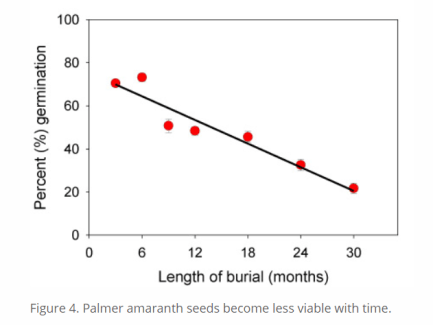
buried for three years reduced palmer germination further. So, the suggestion is if you deep till, do it once and then get a small grain cover on the field to knock out the early spring light interception. At least two studies showed that fall inversion tillage followed by cover crop resulted in 85% reduction of palmer the next spring. I share this knowing we can’t afford plowing for soil loss, soil moisture loss, and tillage doesn’t fit some of your systems. It is a management option to consider if other options aren’t working for you. Summary: fall tillage once, get a cover on it, and then leave it alone.
Ultimately, the management keys are to ‘start clean and stay clean’ using burndowns, pre’s, several effective modes of action, keeping the ground covered to reduce light interception, and incorporating a small grain and/or cover crop into your system. Hopefully this helps as we think about managing palmer this coming growing season.
On-Farm Research Updates: One of my favorite winter programs is our Nebraska On-Farm Research Updates because of our growers presenting the research they conducted with us. These are upcoming next week starting Feb. 19 at former ARDC near Mead and Feb. 21 at College Park in Grand Island. Programs most days run from 9 a.m.-4:30 p.m. with registration beginning half an hour before each day’s program. Full details of dates, locations, and RSVP can be found at: https://cropwatch.unl.edu/2018/growers-statewide-share-farm-research-5-sites. Over 80 on-farm research projects will be presented this year including a wide range of topics: cover crops, variable rate seeding, planting populations, multi-hybrid planting, starter fertilizer, etc. Certified Crop Advisor Credits are applied for. Growers take an active role in the on-farm research project sponsored by Nebraska Extension in partnership with the Nebraska Corn Growers Association, the Nebraska Corn Board, the Nebraska Soybean Checkoff, and the Nebraska Dry Bean Commission. To learn more about the Nebraska On-Farm Research Network, visit http://cropwatch.unl.edu/farmresearch. Hope you consider attending!
Crop Insurance, Farm Bill Policy Update: Also reminding you about the final “Farmers and Ranchers College” program for our area this year to be held Feb. 23 in Geneva at the Fairgrounds. This workshop on Crop Insurance, Farm Bill Policy Update and More, will run from 10 a.m.-3 p.m. with registration beginning at 9:45 a.m. You can view the whole agenda and speakers at: https://vandewalleviews.wordpress.com/2018/02/02/crop-insurance-farm-bill-and-more/
Introductory Beekeeping Classes: Was asked to share about upcoming beekeeping classes. There are two course levels: one for beginning beekeeping and one for those who are currently keeping bees and want information on colony health and maintenance. Workshop details can be found at: https://entomology.unl.edu/bee-lab#tab2.
Mixer/Loaders and RUP Dicamba: Mixer/loaders are now required to have RUP dicamba training; however, they may not have a pesticide applicator license. On the RUP dicamba training registration sheets, just put “mixer/loader” instead of a pesticide applicator number. New pesticide applicators who haven’t received their number yet can just put “pending”.


 JenResources