Category Archives: JenREES Columns
Farm Finances and Succession
Finances was the third week’s topic of the “Leaving a Lasting Legacy” series. A statistic was shared that surprised me. Did you know that only 27% of land is inherited or gifted? I was surprised this number wasn’t higher. It was suggested that with cost of living, nursing homes, etc., it may not be feasible for owners to “gift” land when they’re in their sunset years (meaning, the final years of a person’s life that may include retirement or “slowing down”). A UNL survey in 2017 asked farmers why they were retiring later: 62% said they can’t afford to retire. That’s a sad statistic as well.
Regarding the other ways land is obtained, 4% is purchased at an auction, 18% is purchased from a relative, with 50% being purchased from a non-relative. So, the question for those hoping to farm in the future becomes, How are you preparing yourselves to financially buy land…including buying out siblings, etc.?
For the owner generation, “sunsetting” means to step back and support without necessarily stepping away. It’s important to know your ultimate goal for the farm/ranch for the future. If you desire succession of the farm/ranch, documents need to be in writing and everyone on your team needs to know your goals and what the documents say. Your family also needs to know.
Your “team” can include people like a lawyer, tax professional, banker, financial planner, and others such as a facilitator/mediator. The key: You Know them, Like them, Trust them. These professionals should provide options but not tell you what to do. Your situation is unique. Not every tool in the toolbox is the right tool for you and your situation. Of importance, the term “financial advisor” is not regulated. They recommended to look for a designation called “Certified Financial Planner” (CFP).
Transitioning is a balancing act. The owner generation can’t bring the next generation into the operation at financial jeopardization of the owners. An income statement (profit-loss) statement is a way to know the profitability of the farm and the ability to support two families or not. This is not what is in the bank account. An income statement shows the net farm income, which is the profitability of the business.
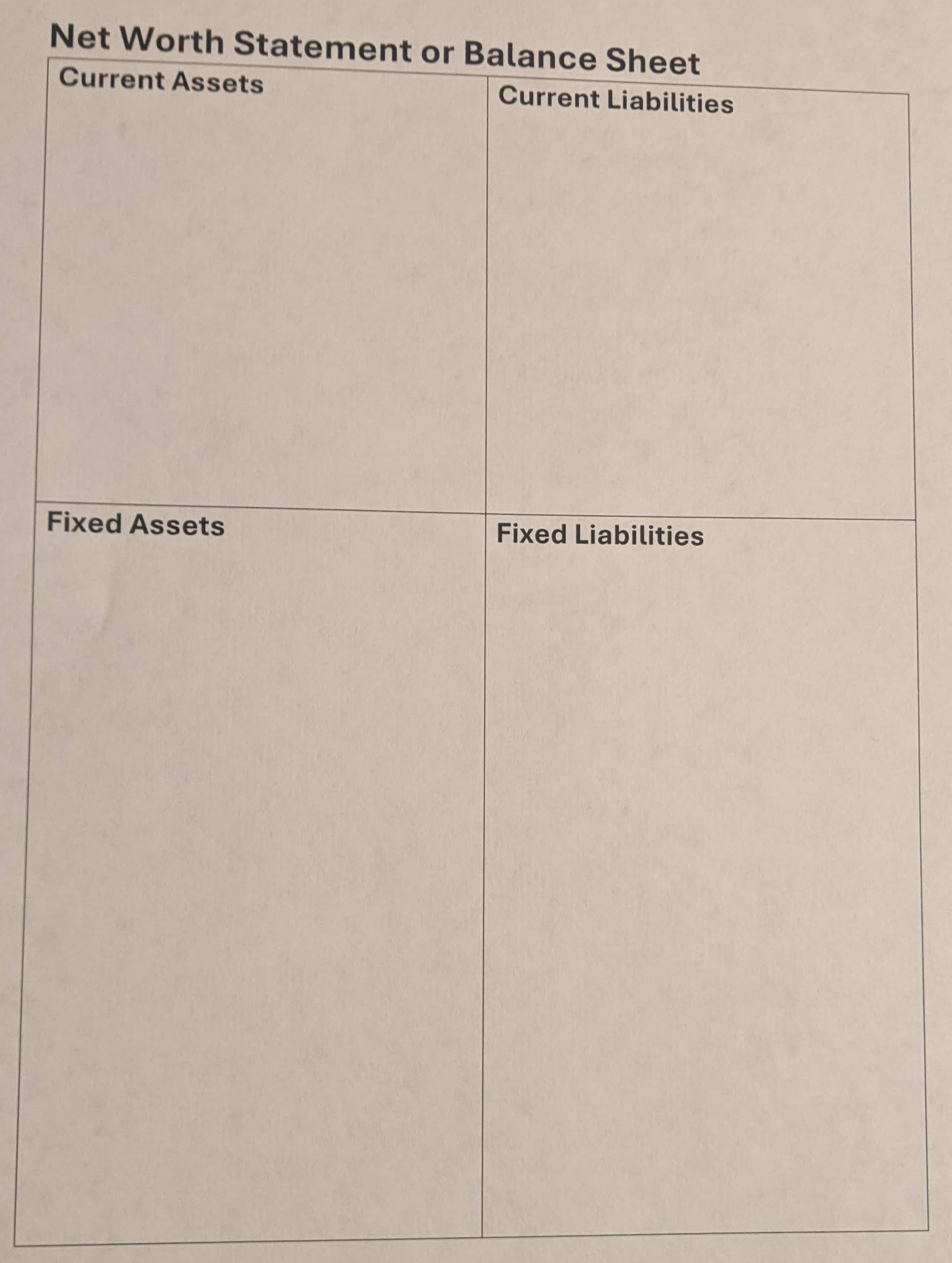
We also walked through balance sheets (also known as net worth statements). Balance sheets don’t show profitability; they show what we OWN (assets) or OWE (liabilities) and are a snapshot of the situation for a moment in time. While this may not be new to some, I appreciated a visual activity we did where we split assets and liabilities into quadrants that included current (the current year) or fixed (more than one year). I think for many not involved with the day-to-day operations of a farm or business, it’s hard to visualize the large numbers being mentioned. I have an example photo of this more visual way of looking at a balance sheet on my blog at jenreesources.com.
On-Farm Research Update will be held on February 18, 2025 at the Holthus Convention Center in York. It’s one of my favorite meetings of the year to hear from the farmers themselves about why they tried the studies they did and what they learned. Often the results will show no differences compared to the check treatment, which can frustrate people. However, that’s important information to test it on smaller acres first before investing a lot of money on larger acres. We did have some studies with promising results as well, though. If you’re interested in attending, please call (402) 362-5508 to pre-register as we need RSVP for lunch count.

Communication
The information we’re learning about in the “Leaving a Lasting Legacy” program is important for every person. Communication was the topic of last week’s program. It’s so important as with each conversation we either build or break trust and relationships.
How we speak counts more than what we say. I was reminded of that this past week.
- 7% is WHAT we say…the actual words
- 38% is the tone of voice…HOW we say it
- 55% is body language…also HOW communication comes across
Communication (or lack thereof) is the #1 issue raised by families in general. Why is family communication so difficult, especially when a family business is involved? Four potential reasons include: we don’t understand different perspectives, we’ve had difficult past experiences trying to talk about family and/or business affairs, the threat of loss of control, and a reluctance to change. How we can improve is by seeking to listen to understand and also understanding different personality traits and perspectives of others.
I find personality tests fascinating as I really like to know what makes each individual unique. One free tool that was recommended to us that is science-based was the DISC personality assessment at: https://www.123test.com/disc-personality-test/ . Perhaps consider each person in your family take this and then discuss your results as a family. These tools help provide insights into others.
When it comes to communicating with people of different generations, it’s important to know what they value. To engage Baby Boomers (born 1945-1964), encourage them to provide mentorship and learn together. Gen Xers (born 1965-1980) are independent, resilient, and adaptable. To engage them, give them opportunities for leadership. To engage Millennials (born 1981-1996), include them in management and allow autonomy and flexibility as family and social impact is important to them. Generation Z (born 1997-2015) are naturally adapted to technology and are financially driven. To engage them, show them opportunities for work-life balance and career advancement.
They spoke a lot about family meetings. Originally, I thought this was more complicated. However, it can be as simple as touching base via the phone or having breakfast/lunch together a few times a month. Family meetings can be as simple as talking through the coming week’s plans, any goals for the farm, prioritizing bills to pay, etc. It’s also really important to be a family beyond whatever role each person plays in the farm or business! Check out https://cap.unl.edu/succession/ for additional resources.
Friday February 7th Conversation: Relay Cropping and Double Cropping: There’s been increasing interest of how to improve the economics of small grains with either relay cropping or double cropping soybeans with either rye or wheat. Hear from growers who are trying this in a variety of ways and what they have learned. Conversations are held each Friday from 10 a.m.-Noon at the 4-H Building in York. Please RSVP to 402-362-5508
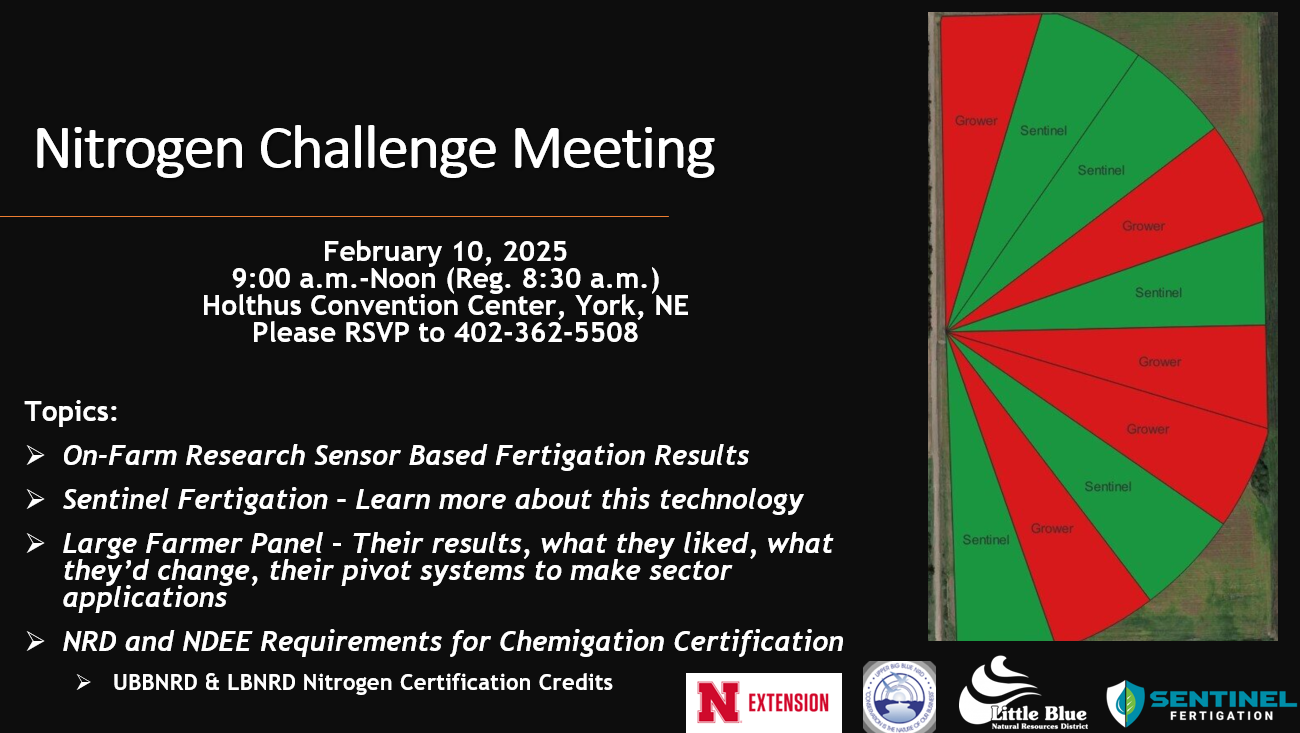
Nitrogen Challenge Meeting will be held Monday, February 10th at the Holthus Convention Center in York from 9 a.m.-Noon. Hear the latest on-farm research results, about the technology from Sentinel Nutrient Management, information about chemigation certification, and from a larger farmer panel. There’s no charge for this meeting, but please RSVP to (402) 362-5508.

Life is Not Guaranteed
Last Tuesday night was our first Farm Succession Program “Leaving a Lasting Legacy”. That night was an incredibly impactful night for me. We heard from two women who became widows in their 30’s with young children. They were incredibly courageous in sharing their stories of loss, grief, difficulty navigating bills and decisions, etc. I left that night with so much on my mind. My husband and I have talked much since then. I’ve also shared with my siblings as we talked through how would our next of kin be able to navigate our accounts, passwords, etc. if something would happen to us.
The ladies shared several things that I felt would be beneficial to all for me to share here.
- At minimum, have a will in place that shares your desires for who receives your belongings, guardians for your children, etc.
- All vehicles and property should be listed as “joint tenancy with right of survivorship”.
- Both widows nearly dealt with probate. One widow lost both her father and husband in a plane crash and both were part of the family dairy business. The trust had been started but never completed by the father. They were able to avoid probate on the things the father had in the part of the estate plan written down but are still paying hefty fees on the parts that weren’t written in order to keep the family business. She emphasized the importance of finishing estate plans!!! Then review them every 2-3 years.
- In the case of the other widow, the husband had an off-farm job as a life insurance agent in addition to the farm. She shared the blessing of how well he provided for her by having such a large life insurance policy that helped her pay off debt and keep/manage the farm while raising her children at home.
- All accounts need to have both people listed. For example, the family phone plan was listed under the husband. She wasn’t able to access it with the phone company since she wasn’t listed and had to start over with new phones and accounts.
- The husband’s work email was used for several accounts at home (electric, heat, etc.). When he passed, his email was discontinued and the wife had no access to the accounts, nor was she listed on them. They both shared the difficulty paying bills and keeping their homes because they weren’t listed on accounts, on top of the immense grief they experienced.
- Ensure all account usernames and passwords are in a place where your next of kin can access them. There are tools for this including Nokboxes from Dave Ramsey.
- Medical: Many lawyers have templates for this, but if not, one document tool (paper or digital) you can use is from 5 Wishes. One wife whose husband was non-responsive had no idea if he would want experimental drugs used, if he wanted to be on dialysis for the rest of his life, and then if he wanted to remain on life support. She shared how having to make those decisions for him still haunts her, especially discontinuing life support.
There’s so much more I could share. Life is so short. Tomorrow, our next moments, nothing is guaranteed. My hope is that this column creates conversations amongst loved ones. Do you and your spouse/next of kin have a will in place? Do you have access to each others’ bank accounts, have a place where usernames/passwords are stored, have the names necessary on all accounts?
If you’re interested in attending, we will still take people each Tuesday night for the next three weeks. Please contact the Extension Office closest to you if you’re interested. More info: https://wia.unl.edu/succession25/.

Pesticide Safety
Pesticide Safety: I remember first getting my pesticide license in college. Since then I’ve taught safety training each year for the past 21 years as an Extension Educator. It’s not my favorite thing to teach, but it is important. After teaching 8 trainings this past week, I got to thinking that beyond those trainings, I never have shared that information broadly. So, sharing, what I feel is, impactful safety information.
During training, I share that we’re there as private pesticide applicators receiving safety training so that we can keep ourselves, our families, and everyone in our operations safe.
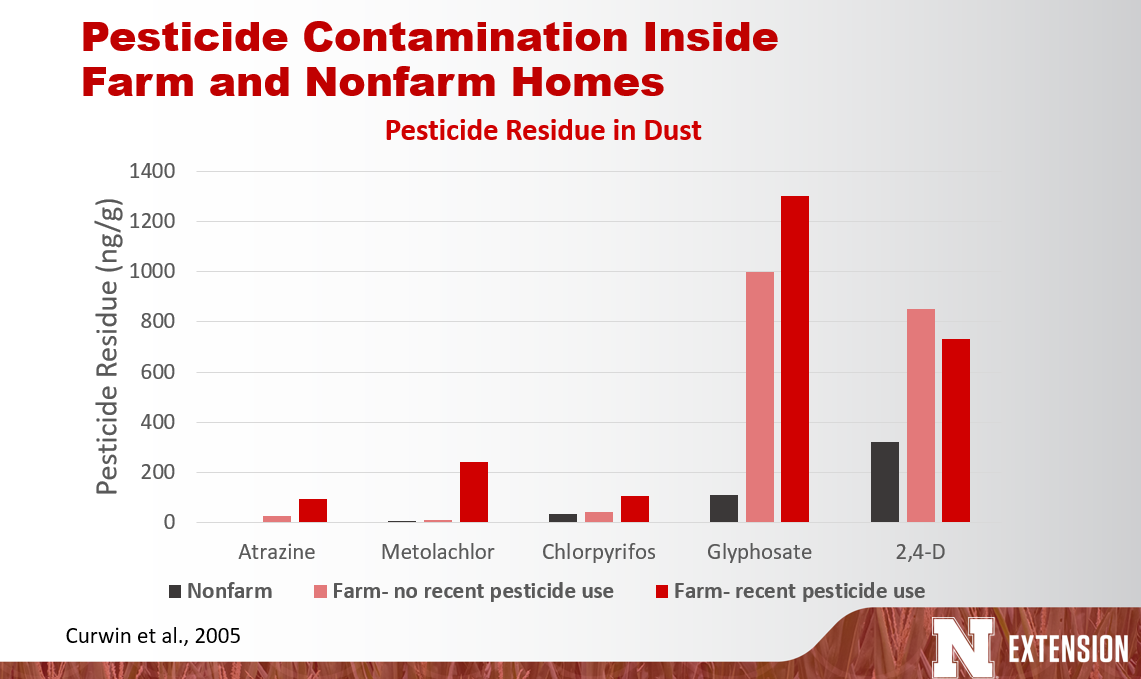
An Agricultural Health Study was conducted where carpet dust from various places in the home was collected. The researchers were looking for pesticide residues in the dust. They collected residues from non-farm homes, farm homes without recent pesticide use, and farm homes with recent pesticide use. In all cases, they found: metolachlor and chlorpyrifos at very low levels and 2,4-D and glyphosate (Roundup) at medium to high levels. I then ask each group of applicators where they think the most residue would be found in the home. Logically, most of us would say the laundry room or the entryway of our homes. The answer? The Father’s Changing Area…the bedroom. I think that’s a sobering thought for a lot of us. Even more sobering is an update to this information. Pesticide residues, specifically atrazine, was also found in the child’s bedroom, only in farm homes.

This information is important as we think about how any of us can be tracking pesticides through our homes. Pesticides are applied to fields but also to our lawns and sometimes even to driveways. Think about our shoes walking through all these areas.
- Do we always remove our shoes at the entranceway before walking through homes?
- Do we always remove pesticide contaminated clothing in an area where we’re not walking through the home first?
- Are we then leaving that clothing separated from the family laundry in a plastic trash bag?
Laundering pesticide contaminated clothing correctly is also super important. We talk about this during pesticide training. But I wonder how many homeowners using general use pesticides are aware of how to properly launder clothes after they’ve applied products like roundup, 2-4D, or things like weed and feed to lawns?
The following are basic steps for laundering pesticide contaminated clothing. I also have magnets that you can put by the washer machine and you can contact me if you’re interested in having one.
- Separate clothing with heavy plastic bag (trash bag)
- If the clothing is heavily contaminated, hose it off or pre-soak outdoors…or consider tossing heavily soiled clothing and shoes.
- Wash contaminated clothing daily.
- Use Hot water, liquid detergent, and the biggest wash load size possible.
- NEW: Add 1 cup of salt to the washer if washing clothing where paraquat was used.
- If possible, line dry clothing. Otherwise, use the regular drying setting.
- Run an empty cycle through the washing machine before washing family/regular laundry.
Nitrogen Challenge Meeting 2025
Nitrogen Challenge Meeting Feb. 10: In November of 2023, I issued a nitrogen challenge. As a reminder, my challenge was to everyone with irrigated ground who applies fall anhydrous or spring pre-plant fertilizer:
- Leave 1 piece of ground with a base rate of 70-100 lb N/ac
- Goal is to apply the rest of N in season using a tool like Sentinel Fertigation that senses what the plant needs.
- Only asking to consider for 1 field. Are you willing to join me in this?
Sixteen area producers took the challenge on 4718 acres in 2024. I haven’t heard the combined nitrogen savings yet, but if each reduced nitrogen by 40 lb/ac, that’s a savings of 188,720 pounds of nitrogen. And the greatest impact is that nitrogen use efficiency continues to be improved to on average around 0.6 lb N/bu produced with minimal residual soil nitrate remaining post-season in soil samples. The comments I’ve heard from the growers so far are that they’re so surprised how the technology can see when the crop needs nitrogen before they can and how much nitrogen they saved using the technology while obtaining similar yields.
I don’t have the 2024 on-farm research results yet. The 2023 on-farm research data showed that on average, 57 lb/ac less nitrogen was applied in the Sentinel Fertigation sectors than the grower sectors with similar average yields of 253 bu/ac for the Sentinel sectors and 255 bu/ac for the grower sectors. Average nitrogen use efficiency was 0.57 for Sentinel and 0.77 for the growers (which was actually really good for these growers to begin with!)
My goal for nitrogen management is to see an increasing number of producers use sensing technologies such as this that have been research-proven to help with nitrogen management. The updated Extension Circular published by UNL Nutrient Management Specialists also recommends using sensing technologies and in-season nitrogen applications vs. recommending a rate or even recommending using nitrogen equations. There’s just too much uncertainty with weather conditions to know what a crop will need in any given year.
So, I’m hosting another Nitrogen Challenge Meeting this year. It will be February 10, 2025 from 9 a.m.-Noon at the Holthus Convention Center in York. It will be a similar format to last year where on-farm research results will be presented in addition to an explanation of how the sensing technology works from Sentinel Fertigation. We will hear from NRD staff regarding chemigation requirements and this training qualifies for nitrogen recertification credits for both the UBBNRD and LBNRD. I think the most impactful part of last year’s program was the larger farmer panel, which I will have again. There’s so much we can learn from the growers using the technology and from the differences each of them have in their pivot and chemigation systems. You’ll hear from them about the successes and challenges they had.
For non-irrigated acres, there’s increasing interest to use the satellite imagery to also make applications in season. You’ll learn more about this as well. There is no charge for this meeting but please RSVP to me or to 402-362-5508 so we can plan for refreshments and materials. I hope to see more growers trying the Nitrogen Challenge in 2025!
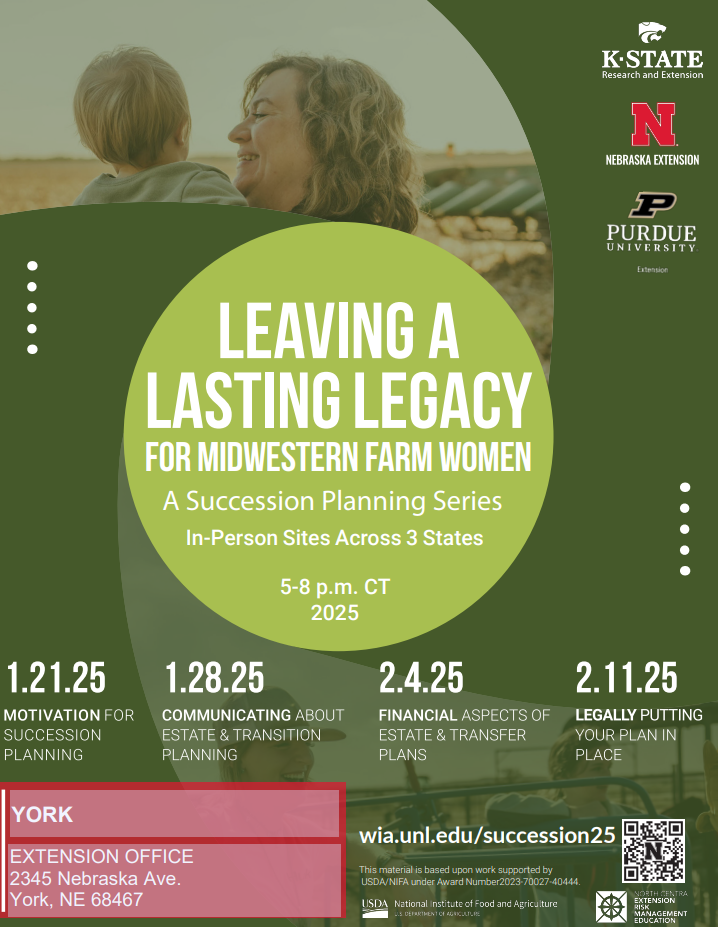
Farm Succession Meetings: As a reminder, our farm succession meetings begin on Tuesday nights for four weeks beginning Jan. 21. It’s a great opportunity and men are welcome in addition to women. More info: https://wia.unl.edu/succession25/
Fridays in February 2025
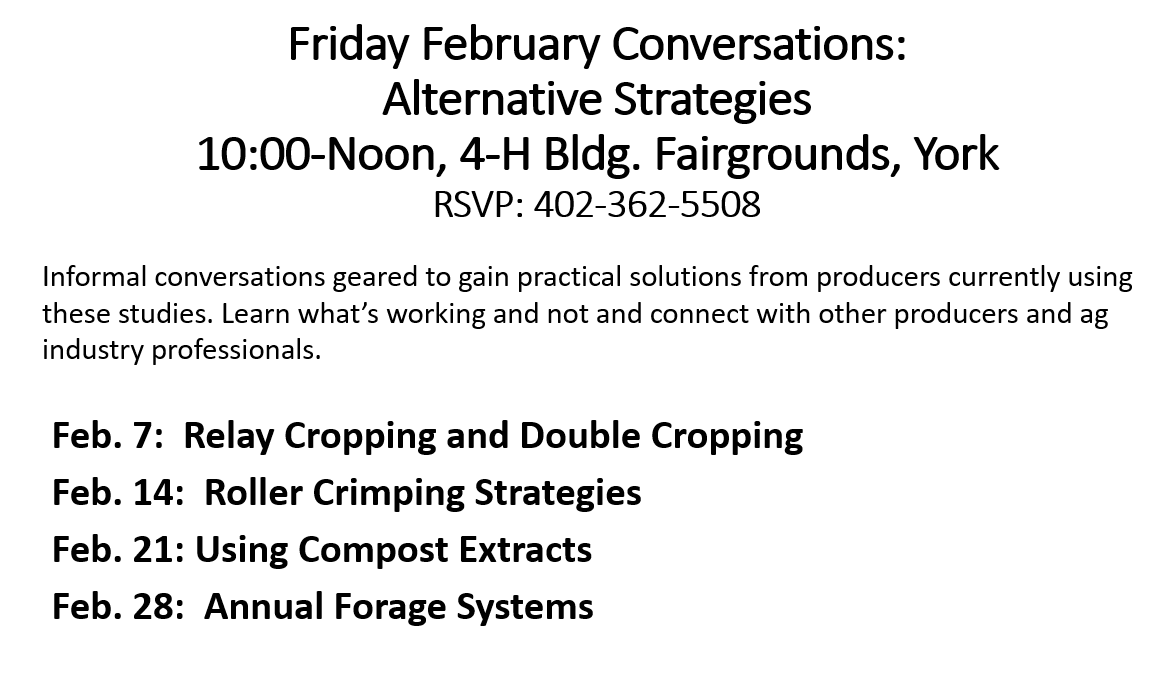
2025 Fridays in February Conversations: For the past few years I’ve hosted “Fridays in February” conversations with the goals for producers and ag industry to gather and have informal, practical conversations, and share experiences/solutions around topics ag is facing. With the downturn in commodity prices and tight economics, I’ve been thinking about alternative strategies. I’ve also received increased questions and interest around some common topics. So, they will be the topics of conversation this year. With every conversation, I will invite a few producers and/or ag industry to share their experiences. Then all engage in informal conversation. Please consider joining us for coffee, cookies, and conversation around any/all these topics if you’re interested! Conversations are held each Friday from 10 a.m.-Noon at the 4-H Building in York. Please RSVP to me or to 402-362-5508 so I can have enough materials prepared for each conversation.
February 7 – Relay Cropping and Double Cropping: There’s been increasing interest of how to improve the economics of small grains with either relay cropping or double cropping soybeans with either rye or wheat. Hear from growers who are trying this in a variety of ways and what they have learned.
February 14 – Roller Crimping Strategies: Small grains have huge benefits in our crops regarding reducing soil erosion, weed control, and breaking pest cycles. There’s also been an increase of growers planting corn or soybeans green into small grains. Hear from growers on the equipment they’re using, different strategies on roller crimping small grains and what they’ve learned.
February 21 – Using Compost Extracts: There’s an increased interest in using biology to help release soil nutrients to the plants while reducing the amount of synthetic nutrients applied. Instead of purchasing biological products, the growers using compost extracts are “growing their own biology” from composts using various methods, then adding water to the compost to extract the microbes and applying them to fields. Hear about the different methods growers are using for creating compost, extracting microbes, and what they’ve learned. On-Farm Research results will also be presented.
February 28 – Annual Forage Systems: With low commodity prices and high cattle markets, there could be opportunity for more producers to consider annual forage systems instead of traditional commodity crops. There’s also increasing interest in trying “regen” years on a piece of ground that includes cover crops and grazing to build diversity. Hear from growers who are incorporating annual forage systems into their crop rotations and what they’ve learned.
Reporting Survey: It’s reporting season for Extension. If you’d kindly like to share how my Extension work impacted you in 2024, please go to slido.com and use the code 4EXT. It’s anonymous and only 5 questions. Thanks!


January 2025 Events
Hoping you and your family had a blessed Christmas season and wishing you a wonderful 2025! Winter program brochures have been mailed and can also be viewed at: https://jenreesources.com/upcoming-events/. Please contact the Extension Office hosting the event you’re attending. Also, UNL converted to a new content management system for all websites before Christmas. We know there’s a lot of issues with broken links, etc. Please be patient with us and please let us know if you’re having difficulty accessing any of our info.
Crop Production Clinics offer recertification for pesticide applicators (commercial, non-commercial, and private applicators) in addition to updated crop and pest management information. The closest to this area include: Jan. 15 near Mead, Jan. 17 in Beatrice, Hastings on Jan. 22, York on Jan. 24, and Kearney on Jan. 28. Info. and RSVP at https://agronomy.unl.edu/cpc.
Pesticide Training: I’m teaching the trainings at York, Seward, Fillmore, Clay, Nuckolls, and Thayer counties. It is helpful for RSVP even though you can also walk in. For example, last year during the snowstorm, I was able to contact the farmers who RSVP to see if they still were able to attend or not and to update them on the location changes. Please RSVP to the county you wish to attend training.
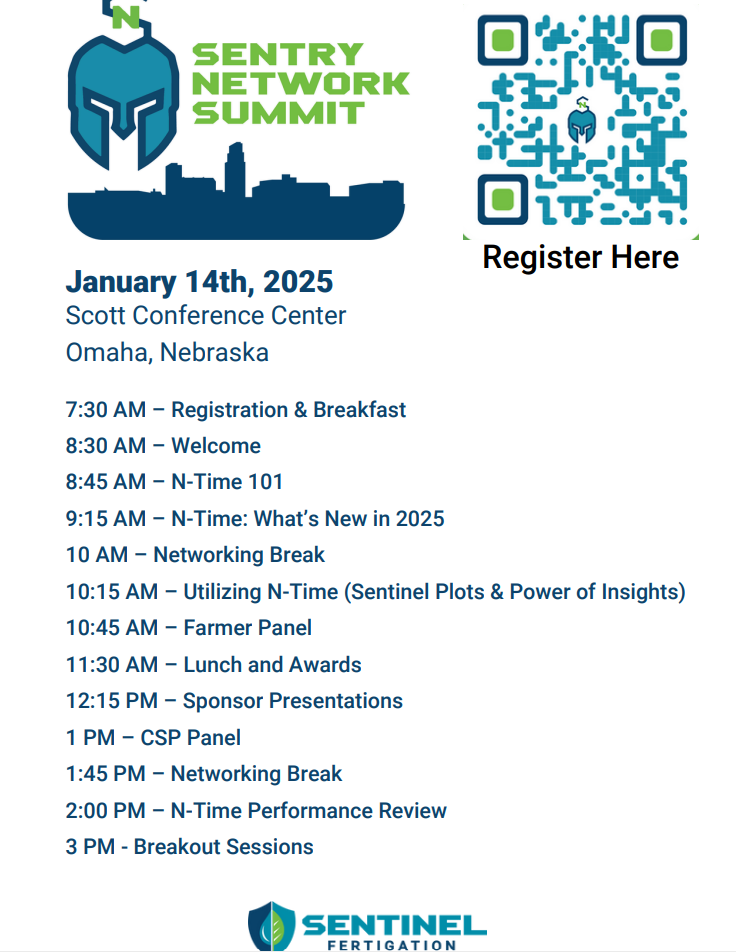
Sentinel Fertigation Meeting: I’ve shared on my Nitrogen Challenge. If you’d like to hear more about this technology, consider attending the Sentry Network Summit on January 14th at the Scott Conference Center in Omaha, NE. There will be a day full of nitrogen management conversations and will give away 5 free fields for 2025. Every attendee will be entered once. Individuals that pre-register by Jan. 6th and attend get an additional entry in the free field giveaway. More info. and RSVP at: https://www.sentinelfertigation.com/sentry-network-summit.
Farmers and Ranchers Cow-Calf College will take place at the U.S. Meat Animal Research Center near Clay Center. Registration will be at 10 a.m., and the program will run from 10:30 a.m. to 2 p.m.
Succession Planning Workshop for Farm Women: Reminder of this 4-part workshop series from 5-8 p.m. on Tuesday nights (Jan. 21, Jan. 28, Feb. 4 and Feb. 11). I will be hosting this workshop at the Extension Office in York and there are other area locations in Geneva, Lincoln, Central City, Columbus, Blue Hill, and Auburn. The workshop is geared towards women but men are also welcome, and I’d encourage couples to attend if it works. Topics covered will include motivation for succession planning, communicating with family, the financial aspects of estate and transition plans, and the legal aspects of putting a plan in place. A keynote speaker will be simulcast to every workshop location during each meeting, with time for questions and a hands-on activity for participants. A meal will be provided on each date. Registration fee for in-person attendance is $60 before Jan. 13 and increases to $75 on or after Jan. 13. A virtual option is available for $75. Participants are encouraged to attend all four sessions. More information and registration is available on the Nebraska Women in Agriculture website, https://wia.unl.edu/succession25.
Corn/Soybean Expo will take place on Thursday, Jan. 23 at Christensen Field in Fremont located at 1730 W. 16th St., Fremont, NE 68025. The event opens with coffee and waffles by The Waffleman and the opportunity to view equipment and exhibitor booths at 8 a.m. Speakers start at 9 a.m.
Austin Schroeder, president of Schroeder Commodity Marketing, LLC is the keynote speaker. His presentation, “Corn and Soybeans, What to Expect Next”, will take a dive into the corn and soybean markets, covering the current market situation including rising competition from the rest of the world, a new presidential administration, and other major market factors. Other timely topics include: Optimizing Nitrogen Use in Corn Production, Corn Disease Surprises in 2024 and Preparing for 2025, TAPS participant panel discussion, and On-Farm Research Opportunities. There’s a complimentary noon lunch and registration is available the day of the expo at the door.
The Gift of Time

I’ve been reflecting a lot recently, particularly about time. Time can seem like an eternity when one is in a difficult situation, waiting for an answer or waiting for healing for oneself or a loved one. Time can also seem to fly by when we are enjoying people and activities, when there’s a lot going on in life, or when we want to hold on to a moment or season in life.
I was also thinking about time being a gift. While often not thought of this way, not receiving answers or resolution of difficulties can be a gift in shaping character and perspective. I’ve seen this in my life, and although none of us desires difficulties, they can result in gratitude. On the flip side, receiving an answer, resolution, or additional time in the midst of an illness can also be a gift of time.
Time can also be a tangible gift given. Whether through times of money being tight or available, my memories of time spent with family and people are some of the most precious gifts I have. Years ago I drew my grandma’s name for Christmas. That year, I wrote her a short note sharing I wanted to give her the gift of time…time to connect about life and hear her stories growing up. We spent a few hours each Sunday afternoon talking and laughing on the phone. That gift lasted for several years until she passed away. The result was precious connection and memories that I will always cherish and a book that I was able to share with family at her funeral.
As we think about gifts this Christmas season, perhaps a gift to consider is that of time? It’s easy for all of us to feel strapped for time. I think many would desire to spend more time helping others or spend more intentional time for family, but don’t know how to fit it in.
In reviewing research on the gift of time, I found some interesting results. A 2013 article in Psychological Science shared that those who intentionally take time to help or spend with others had increased feelings of “time affluence” which alleviated feelings of “time famine”. The “time” in the different studies ranged from 5-30 min. per day of writing notes, volunteering, or intentionally visiting with someone. The other group studied who didn’t use their time to help others but instead were given “various tasks” or “free time” found they wasted time and felt “time famine”. So, they titled their journal article “Giving Time Gives You Time”.
Other journal articles found that when people gave time to others, daily stress appeared to be more buffered in their lives. They also had reduced effects of social isolation. Another article found those who gave of their time had lower blood pressure, arterial pressure, and lower depression. The individuals giving of their time also reported greater self-esteem.
So as we head into this Christmas season, perhaps a gift for each of us to consider giving is being more intentional with time-whether that’s with those closest to us or with others? Perhaps whatever that gift is becomes a goal to keep for the coming year? Wishing you and your family Christmas blessings as we celebrate the Ultimate gift we’ve been given in Jesus being born to die that we might live!
Winter Program Brochures have been mailed by several area counties or will be mailed after Christmas. Please RSVP to the county office where you’d like to attend the meeting being hosted.
This is my favorite Christmas song and this rendition is so beautifully done! Merry Christmas!
Estate and Succession Planning
Transition/Estate Planning: This topic is perhaps one of the most important topics for all families to discuss, especially in agriculture. Many have shared stories of heartbreak with me. I’ve also heard an increasing number of farmers share with me they weren’t sure who the farm will transition to as there’s not an interested heir returning. The following are a few workshops to aid in beginning conversations and in the transition process. Perhaps this may be a goal for your farm the coming year? The first workshop allows for farm women (and in York I’m also encouraging couples) to gather to form connections and learn together. The second workshop is one my family participated in. It was special to connect with the other families who attended and talk through the questions/situations each family was facing and the advice/tools lawyers provided for varying situations. I’d highly encourage your family to consider attending one of these opportunities this winter if you haven’t started the farm transition discussion/process.
Succession Planning Workshop for Farm Women: This workshop is a 4-part series from 5-8 p.m. on Tuesday nights (Jan. 21, Jan. 28, Feb. 4 and Feb. 11). I will be hosting this workshop at the Extension Office in York and there are other area locations in Geneva, Lincoln, Central City, Columbus, Blue Hill, and Auburn. The workshop is geared towards women but men are also welcome, and I’d encourage couples to attend if it works. Topics covered will include motivation for succession planning, communicating with family, the financial aspects of estate and transition plans, and the legal aspects of putting a plan in place. A keynote speaker will be simulcast to every workshop location during each meeting, with time for questions and a hands-on activity for participants. A meal will be provided on each date.
The registration fee for in-person attendance is $60 before Jan. 13 and increases to $75 on or after Jan. 13. A virtual option is available for $75. Participants are encouraged to attend all four sessions. More information and registration is available on the Nebraska Women in Agriculture website, https://wia.unl.edu/succession25.
Returning to the Farm 2025 is a workshop series for families who are in the transition process of bringing members back to the farm or ranch. It will begin with a two-day workshop for multi-generational families on March 7 and 8, at Central Community College in Hastings, 550 S. Technical Blvd. The series also includes two follow-up workshops, to be held virtually after the in-person meetings.
The series assists families and agricultural operations with developing financial plans and successful working arrangements to meet their unique needs. It will guide families in developing estate and transition plans, setting personal and professional goals and improving the communication process between family members. Presenters will include extension experts as well as agribusiness and legal professionals.
The workshop fee is $75 per person on or before Feb. 28. March 1, the fee increases to $85 per person. Registration includes dinner on March 7 and lunch on March 8. It also includes two follow-up workshops, to be held virtually (dates/times TBD). Hotel accommodations are not included. https://cap.unl.edu/rtf25.
The In-Season Nitrogen Publication I had mentioned in the previous columns has now been published and can be found: https://go.unl.edu/tp7c.
UNL Nitrogen Equation
UNL Nitrogen Equation: Soil tests are a tool to determine residual soil nitrate and other nutrients. Various equations are used depending on the specific soil test lab, advising company, or university. None are perfect as none can predict the weather. As soil test recommendations come in, people ask me questions about the UNL Nitrogen Equation or sometimes make misinformed statements. Sharing more about it in this column. The information in quotations is from a revised Extension Circular on nitrogen management that will be published shortly.
“The accuracy of the Nebraska nitrogen algorithm for corn has been generally validated through many demonstration projects, on-farm research, and detailed research studies in Nebraska from 2004 through 2023. On average the algorithm produces a nitrogen fertilizer recommendation approaching the economic optimum fertilizer N rate (EONR), though the accuracy will vary with location and year. For the majority of fields in Nebraska, the Nebraska algorithm will be within ± 30 lb N/acre of EONR.” This shows the inability for any of us to predict the correct N rate due to the inability to predict weather the upcoming growing season. Thus, why soil tests are a tool to be used with a reactive approach like in-season nitrogen sensing technologies like Sentinel Fertigation.
The UNL N recommendation for corn grain (lb/ac) = [35 + (1.2 × EY) – (8 × NO3-N ppm) – (0.14 × EY × OM) – other N credits] × Priceadj × Timingadj where:
EY = expected yield (bu/ac) which should be about 105% of the five-year yield average
NO3-N ppm = average nitrate-N concentration in the root zone (2–4 foot depth) in parts per million
OM = percent soil organic matter (with a minimum of 0.5 and a 3 percent maximum)
Priceadj = adjustment factor for prices of corn
N Timingadj = adjustment factor for fall, spring, and split applications
I often hear, “UNL says it’s 1.2 lb of N/bu of corn produced”. But that’s an incorrect statement. The UNL nitrogen equation does have a 1.2 factor in it. But the equation never stopped there. UNL was one of the few universities that took the soil into account by subtracting off additional factors. “The value of 1.2 lb N uptake/bu of corn is often mistakenly viewed as a fertilizer N requirement, which is inaccurate. The current UNL N rate algorithm for corn starts with corn uptake of 1.2 lb N/bu, then credits N from various sources. These N credits include soil residual inorganic N, N mineralized from soil organic matter, N contributed from irrigation water, N released from decomposing legume plant materials, and N from manure. Once N credits from these various sources are accounted for, the remaining N requirement is filled with inorganic fertilizer.”
The UNL equation credits soybean as the previous crop for 45 lb of N due to decomposition of the plant material due to the low carbon to nitrogen ratio. On-farm research studies in this part of the State found, in irrigated soybean, we could credit more: 1 lb of nitrogen for every bushel of soybean raised up to 60 bushels (so up to 60 lb N ‘credit’ from soybean).
Irrigation water often contains a significant amount of nitrate-N (and other nutrients including sulfur) that is readily available to corn. In the past, Dr. Charlie Wortmann shared, for every 10 acre-inches of water applied, one can take ppm in the sample X 2.265 to determine pounds of the nutrient applied via irrigation. Because yearly irrigation varies, one could take a 3-year average.
I use the equation without the price and timing adjustment. Higher corn prices will show that one can apply more nitrogen economically. However, the research curve will show little to no yield increase for that additional nitrogen. The timing adjustment assumes nitrogen loss in the fall, building in N for that, and assigns a small reduction if applying nitrogen in-season. Hopefully this helps as you receive soil test recommendations this fall and consider adjusting them to the UNL N equation. Also, a reminder to consider a base rate of 70-100 lb N applied pre-plant.


 JenResources