Soybean Seed Treatments
Appreciated everyone who attended and shared at our on-farm research update in York last week! I’m so grateful to all the farmer-cooperators who have worked with me through the years and who continue to do so! We wouldn’t have as much innovative and practical research without them!
Soybean Seed Treatment Comparison: This week sharing on a soybean seed treatment study. Some producers are interested in alternative methods of protecting seed from insects and disease beyond traditional insecticide/fungicide seed treatments. This can be due to cost, impacts to pollinators, soil microbes and the environment, and/or human safety.
The grower tested three fields in York, Seward, and Hamilton counties via a split planter design for a total of 21 reps. The biological seed treatment consisted of a blend of: 2 oz PhycoTerra® ST, 1 oz Heads Up®, 1 oz N-Gage Ultra ST, 0.75 oz Bio ST VPH in 100 gal solution. In a second tank, 2 oz of Exceed Soybean inoculant was used per 100 gal. The biological seed treatment was applied by the grower. Cost was $9.20/ac for the full biological seed treatment.
The biological seed treatment was compared to Pioneer’s full seed treatment on two fields and Golden Harvest’s full seed treatment on one field. These treatments were applied by the seed dealers. Cost was $28/ac for Pioneer’s seed treatment and $16.63 for Golden Harvest’s seed treatment.
Field 1: Pioneer’s full seed treatment (62 bu/ac) vs. biological seed treatment (61 bu/ac) No difference. Field 2: Pioneer’s full seed treatment (65.7 bu/ac) vs. biological seed treatment (67.1 bu/ac) Significant difference. Field 3: Golden Harvest’s full seed treatment (69 bu/ac) vs. biological seed treatment (68 bu/ac) No difference. Combining the three locations, the standard seed treatment yielded 65.6 bu/ac vs. 65.4 for the biological seed treatment.
Soybeans were planted green into rye in all three fields. The original plan was to roller crimp the rye, but the soybeans were too elongated due to stretching for sunlight in the tall rye and we were concerned about them being damaged with a roller crimper. Irrigation was also necessary to get the soybeans out of the ground and growing with the tall rye in Fields 1 and 2. However, it was interesting for me to see these fields in the summer in a high white mold pressure year, especially in the fields with previous white mold pressure. I never saw white mold impact the soybeans. Any fungal structures on the ground that germinated seemed to be trapped by the rye mat. Biological products like Heads Up® have been shown by other Universities to help reduce white mold and SDS incidence while ILeVO® and Saltro® have been shown to reduce SDS and soybean cyst nematode incidence.
Hopefully this information is helpful for those who are rotating fields to soybeans this year that have had incidence of disease in the past or who are interested in seed treatment options. If you’re interested in trying a seed treatment study for on-farm research, please let me know.
Also, if you didn’t plant rye due to the dry fall, you can consider planting oats this month if you’re growing soybeans this year in a field with SDS and SCN pressure. Oats was the best small grain to reduce the pathogens causing those diseases according to Iowa State research.
Tree Care and Fruit Tree Basics Workshop will be held Sat. March 9 from 10 a.m. to Noon at the 4-H Building in York. Extension Educator Sarah Browning is joining us again! Refreshments will be provided and there is no cost to attend, but registration is requested to Upper Big Blue NRD at 402-362-6601. Bring your questions! For those interested in gardening but don’t have the space at home, check out the Project GROW community garden in York. Plots are available for the 2024 growing season. You can reserve your space now or come to the Tree Care and Fruit Tree Basics Workshop and sign up in person.
Wildfire Resources and Donation Options: https://go.unl.edu/dpar.

JenREES 2/25/24
Spring Fertilizer: It’s hard to believe March begins this week! With the approaching of March 1st and the nice weather, some may be thinking about fertilizer applications. Three quick reminders:
1-Soil temperatures can be viewed at: https://cropwatch.unl.edu/soiltemperature. Soil temperatures below 50F allow for a slower conversion of ammonium to nitrate by soil microorganisms.
2-There was a high amount of mineralization that occurred last growing season due to the warm soil temperatures. Higher soil residual nitrate was common in soil samples in the area; thus, you can believe the fact that there’s a higher amount of soil residual nitrate and adjust fertilizer recommendations accordingly. If you’re unsure or if the soil samples didn’t pull well due to the dry fall conditions, soil samples can be pulled again this spring to gain confidence in recommendations.
3-Reminder of my nitrogen challenge! The higher residual nitrate provides a great opportunity in putting down a lower base rate and use a tool like sensor based fertigation via Sentinel Fertigation to apply only what the plant says it needs throughout the growing season. You could also consider an on-farm research study using a few different rates. Please let me know if you’re interested in these options.
Pruning Tips: With the coming of March also comes questions regarding pruning. My horticultural colleague, Elizabeth Killinger, shares some tips with some updated research on pruning timing for different plants. Full article: https://huskerhort.com/2024/02/25/a-pruning-primer/#more-1466.
“The first step to pruning is surveying the plant. This will ensure whether or not pruning is needed. Look for and remove any dead, diseased, damaged, rubbing, or crossing branches first. Remove suckers, little saplings at the base of the tree, and water sprouts, small vertical stems on the main branches. Also look at the plant in terms of safety. Be sure the plant is not blocking vehicle sight lines or covering sidewalks. Remove any low hanging branches that are hanging over a sidewalk.
Pruning Tools: In order to make cuts that heal correctly on plants, the proper tools are needed. When pruning small branches, those that are 1” in diameter or smaller, hand pruners are recommended. If you have to twist the pruners or take multiple ‘bites’ at the branch, a different tool is needed. For branches that have a diameter greater than 1”, loppers are recommended. Pruning saws are extremely sharp and work well to get into the tight places that the pruners and loppers don’t fit. They can also cut branches that are larger than 1.5” in diameter. The last tool of the trade is the hedge shears. They are used for shearing hedges or shaping plants and shouldn’t be used as substitutes for other pruning equipment.
Deciduous shade trees, It was previously recommended the best time to prune most shade trees was during winter dormancy. New research shows the optimum time to prune living branches is late spring and early summer because pruning at this time promotes the quickest sealing of pruning wounds, known as CODIT or Compartmentalization of Decay in Trees. Late spring and early summer is when tree cells are most active during the growing season, hence sealing occurs the quickest.
Evergreen Trees keep their leaves throughout the winter. Pine trees rarely need to be pruned, if you choose to do so it is best done June into July, or when the new growth is between half and fully grown. If pine trees are pruned too early, the tree could be deformed and pruning too late could cause the tree to be stunted. Be sure to prune only the current years’ growth. If the trees are pruned too far back onto older growth, new growth will be delayed a year. Spruce and fir are two evergreen trees that rarely need pruning. If pruning is needed, they can be pruned between November and April.
Evergreen Shrubs, like arborvitae, Japanese yew, and juniper, are best pruned in late winter between November and April. The cuts will heal quickly and will be covered by new growth.
Deciduous Shrub pruning depends on blooming time. If the shrub blooms in the spring, before June 15th, wait to prune until after it flowers. Lilac, forsythia, and dogwoods are considered spring bloomers. If the shrub is a summer bloomer, like a potentilla, flowering quince, or privet, then late winter to early spring is the best time to prune.”


JenREES 2/18/24
This week sharing on some additional February meetings. Our last Friday February conversation occurs this Friday Feb. 23 on the topic of pesticide resistance and integrated pest management. Dr. Matheus Ribeiro and Dr. Travis (TJ) Prochaska are going to lead us in discussion sharing insights from research and experience. If you’re dealing with pest (weed/insect/disease) issues in a particular field and interested in the topic of resistance management, this conversation will be of interest and helpful. It will be from 10-noon at the 4-H Bldg in York. Please let me know if you’re interested in attending (402-362-5508).
On-Farm Research Updates begin this week depending on which location works best for you. At these meetings, the farmers share on the research they conducted with Extension. That along with the discussion is what makes this meeting so meaningful and one of my favorite winter meetings. Topics include: nutrient management studies, biological products, cultural practices, cover crops, product and production practice studies, RegenAg, and include studies using the latest precision ag technologies. The meetings at all locations begin at 9 a.m. (Registration at 8:30 a.m.). Locations include: ENREEC near Mead (Feb. 20); Beatrice Holiday Inn (Feb. 21); York at Holthus Convention Center (Feb. 27); and Kearney at the Extension Office (Feb. 28). There is no charge, but please RSVP for our meal count and to ensure enough materials at: https://go.unl.edu/2024ofr.
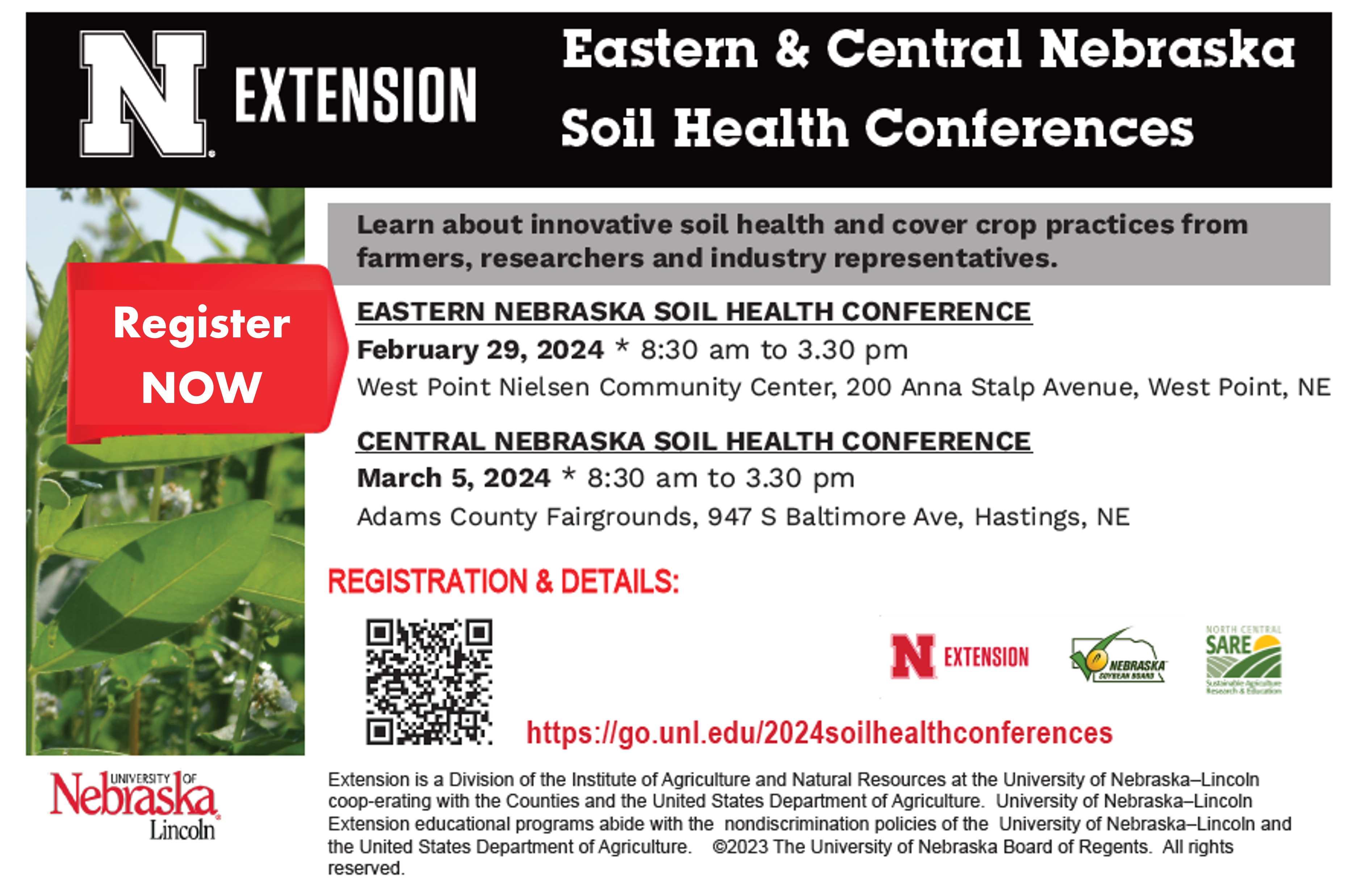
The 2024 Nebraska Extension Soil Health Conferences are being held at two locations this year: West Point at the Nielsen Community Center on Feb. 29 and the Fairgrounds in Hastings on March 5th. Speakers differ for the two conferences but the themes of leading researchers sharing, farmers and industry panel discussions, networking opportunities, and exhibitor area will be at both locations. At the Hastings location, I’ll be sharing our on-farm research efforts with using clover in corn/soybeans with two farmers: Mike Spray of Clay Center and Jay Goertzen of Henderson. The conferences begin at 9 a.m. (Registration at 8:30 a.m.) and CCA credits are available. There is no charge but RSVP is needed for lunch. You can find more details on the speakers and can register at: https://extension.unl.edu/statewide/enreec/nebraska-soil-health-conference/.
Regenerative Ag Conference will be held Feb. 28th at Concordia University in Seward at the Janzow Campus Center Cattle Conference Room (Building #21 on Campus Map). The program begins at 9 a.m. (Registration at 8:30 a.m.). This event for producers and crop consultants will be an opportunity to learn about regenerative ag practices, what funding is available for these practices, and how to utilize them to be more profitable and sustainable. It will feature speaker Mitchell Hora, farmer and CEO of Continuum Ag, Keith Berns of Green Cover Seed, and a farmer panel: Dennis Fitzke (Edgar), Aaron Studebaker (Davey), and James ‘Hank’ McGowan (McCool Junction). The day will also include a screening of the film To Which We Belong. It’s hosted by the Upper Big Blue, Little Blue, Lower Big Blue, and Lower Platte South NRDs, in collaboration with Green Cover Seed. There is no charge but RSVP is needed as space is limited: https://www.upperbigblue.org/regenerative-ag.
Returning to the Farm is a workshop series for families who are in the transition process of bringing members back to the farm or ranch. It’s one of the more important programs Extension offers and I can say it was helpful for me and my family to attend. It will begin with a two-day workshop in Kearney for multi-generational families on March 8 and 9 at the office of Nebraska Extension in Buffalo County, 1400 E 34th St. The series assists families and agricultural operations with developing financial plans and successful working arrangements to meet their unique needs. It will guide families in developing estate and transition plans, setting personal and professional goals, and improving the communication process between family members. The workshop fee is $75 per person on or before March 1. March 2, the fee increases to $85 per person. Registration includes dinner on March 8 and lunch on March 9; it also includes two follow-up virtual workshops. More info. and registration at: https://cap.unl.edu/rtf24.
2024 Farm Bill Decisions
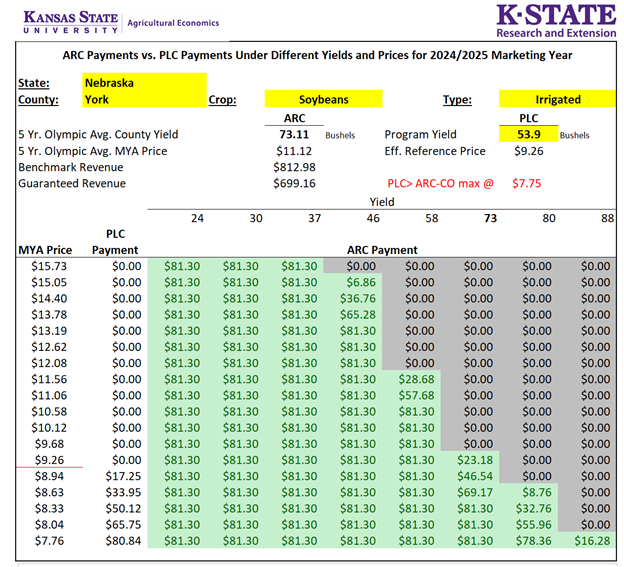
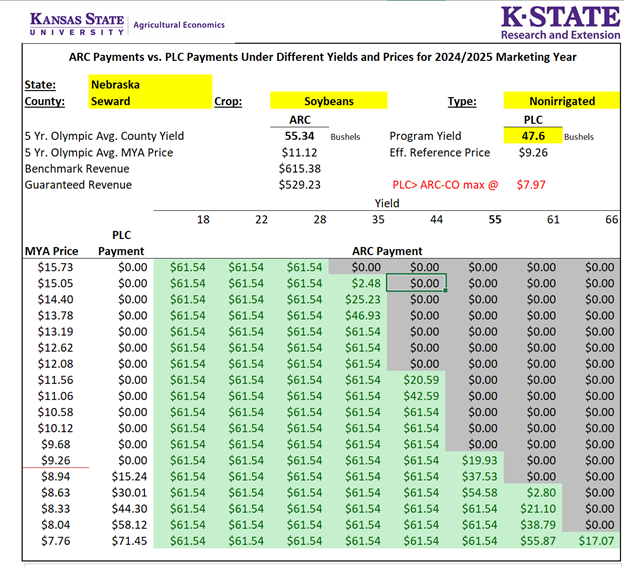
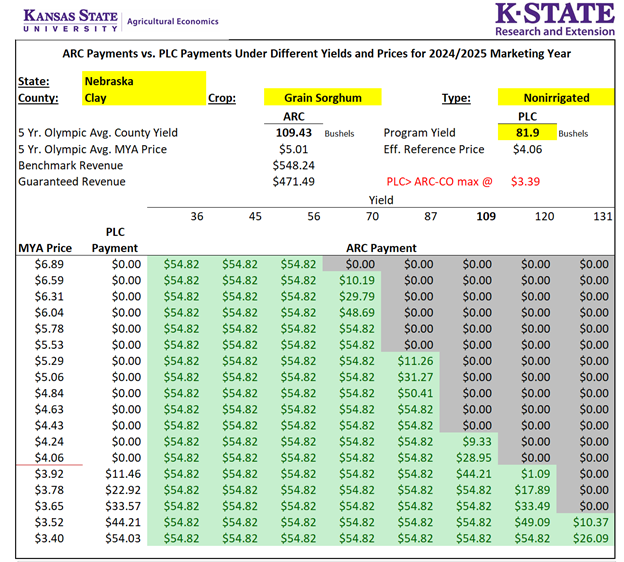
Perhaps this year’s farm bill election decision takes more thought than in the past. Part of this is because the reference price for PLC (Price Loss Coverage) and ARC-CO (Agriculture Risk Coverage) finally increased (due to a couple of higher marketing year average prices with only the highest year being thrown out for the Olympic average). Thus, the trigger potential increases. Most of the decisions could really go either way depending on what happens and how you wish to manage risk. ARC-CO will often trigger faster with a higher price and lower yields, but the maximum payment caps out faster. PLC, when triggered, provides greater payments faster. There’s also the potential of using Supplemental Coverage Option (SCO) via crop insurance with PLC, which was very attractive for some producers in non-irrigated situations hit by drought last year. It could be worth your time to read this article from K-State on SCO and ECO (Enhanced Coverage Option): https://agmanager.info/crop-insurance/crop-insurance-papers-and-information/supplemental-coverage-option-sco-and-enhanced if you’re not familiar with these options. Sign up deadline with FSA for farm bill decisions and with Crop insurance for those decisions are both March 15.
PLC effective reference prices for 2024 are:
Corn: $4.01; Beans: $9.26; Wheat: $5.50 (stayed the same); Grain Sorghum: $4.06
ARC-CO effective references prices for 2024 are:
Corn: $4.17; Beans: $9.56; Wheat: $5.34; Grain Sorghum: $4.31
Projected Prices for 2024 based on projections from FAPRI as of August 2023:
Corn: $4.47; Beans: $10.94; Wheat: $6.38; Grain Sorghum: $4.31
So, at first glance, comparing the prices for each commodity, ARC-CO triggers first for all crops except for wheat when county average yields are maintained. In fact, for those with milo base acres, ARC-CO would already trigger with current projected price and the ARC-CO effective reference price of $4.31.
If you want to protect yield variation, ARC provides protection sooner than PLC. If you want protection for lower prices, PLC provides larger payments once it triggers.
It also depends on crop insurance. For example, if you choose 75% revenue protection and want to add SCO on top up to 86%, then you need to take PLC as SCO is not available with ARC.
Another thought that I’ve often brought up, although it’s not feasible for everyone, is to consider splitting your risk. Corn, to me, is the harder decision here that could go either way. If you have a field or two with higher PLC proven yields, then perhaps consider a few farms in PLC and a few others in ARC-CO to split your risk and provide some protection to you whether either program triggers. It also helps split risk regarding payment caps should they be hit. Some helpful resources are included below:
K-State Ag Manager Excel Spreadsheet Tool (download and run for your specific county/crop info.): https://agmanager.info/ag-policy/2018-farm-bill/tradeoff-between-20242025-arc-and-plc
Understanding PLC, ARC, SCO, ECO for 2024 (videos and ppt presentations): https://agmanager.info/news/recent-videos/managing-risk-arc-plc-and-sco-webinar-slides-and-recording
2023 ARC-Co Payments Nationally (shows 2023 payments): https://agmanager.info/ag-policy/2023-county-yields-trigger-arc-co-payments/2023-county-yields-trigger-arc-co-payments-0
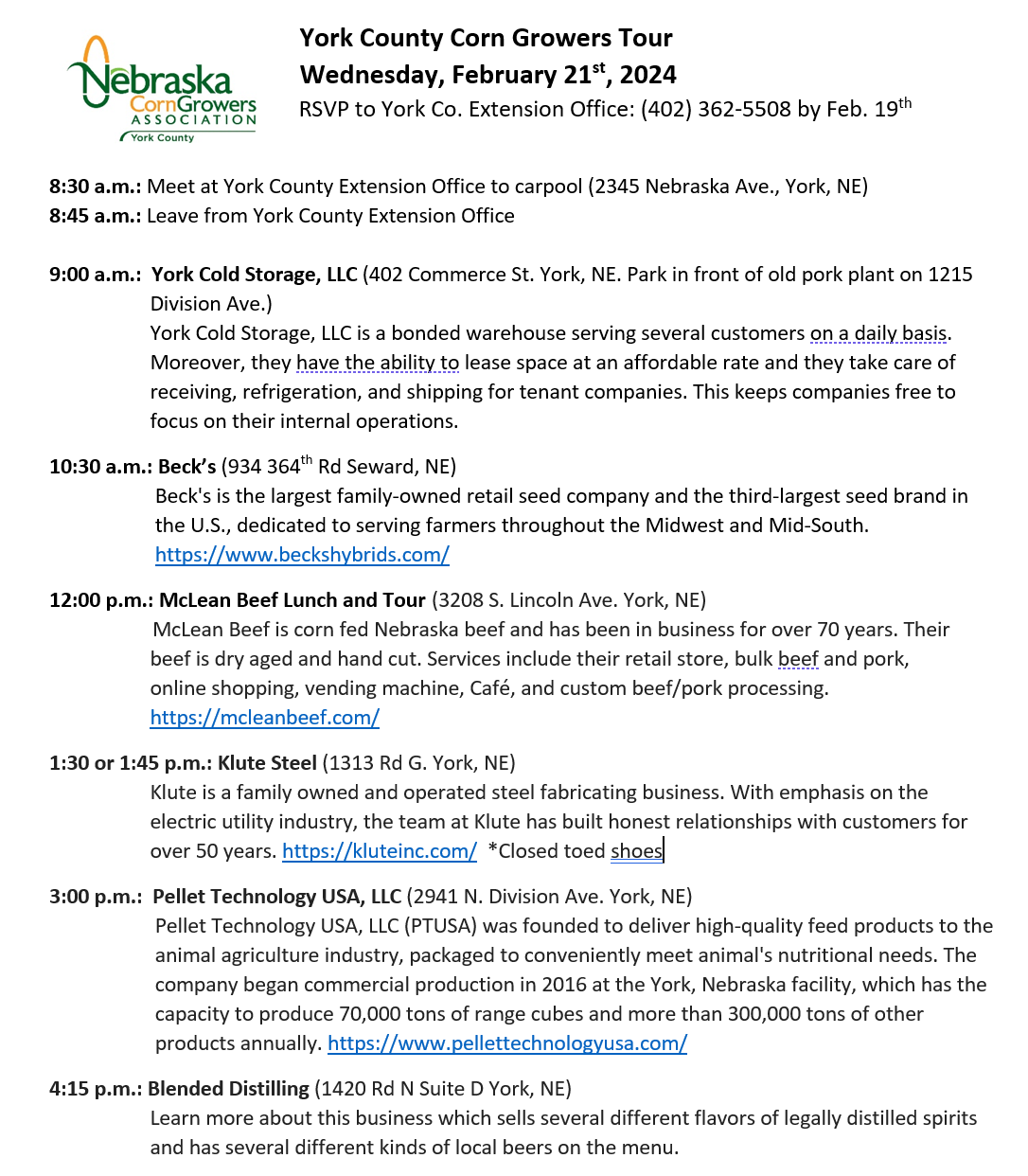
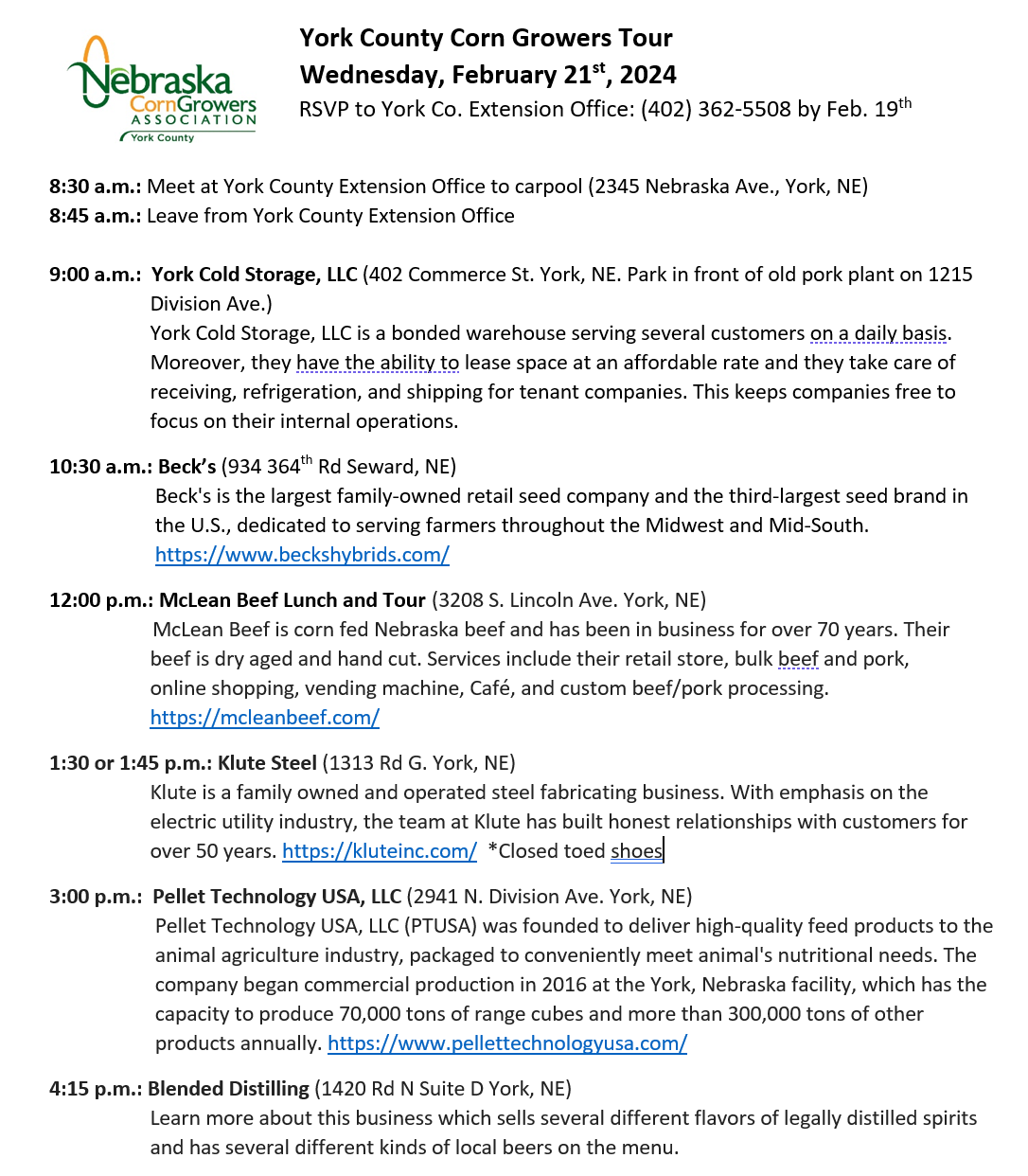
Upcoming Events: Friday (16th) conversation on economics of RegenAg from 10-noon at 4-H Bldg in York. RegenAg Conf. Feb. 28th at Concordia College in Seward (RSVP to 402-362-6601). On-Farm Research Update in York at Holthus Convention Center Feb. 27th (RSVP: https://go.unl.edu/bhdw). Also, York County Corn Growers is having our tour on Feb. 21st (RSVP to 402-362-5508 if interested).





Rethinking Crop Rotations
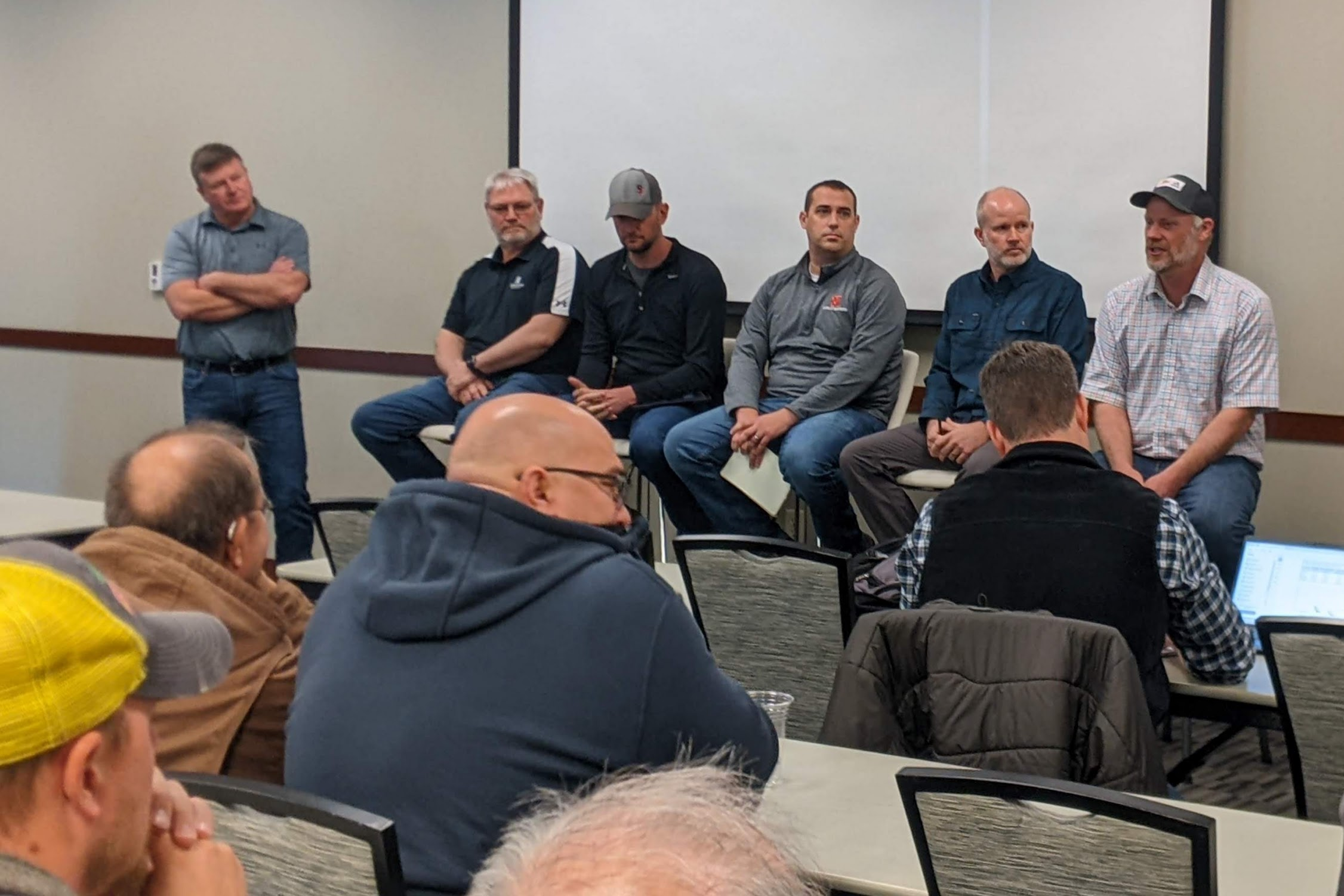
Thank you to all who attended the nitrogen challenge meeting last Monday, to all the presenters and farmers who shared their experiences, and to those who are choosing to join me in the challenge! A lot of great information was presented that day. The following is a snapshot of the combined on-farm research data using sensor-based fertigation via Sentinel Fertigation across 13 locations:
- Grower: 255 bu/ac yield with 195 lb N/ac applied, NUE of 0.77 lb N/bu, $1152.54 profit
- Sentinel: 253 bu/ac yield with 138 lb N/ac applied, NUE of 0.56 lb N/bu, $1177.89 profit
Crop Rotations: Appreciate those who attend the Fridays in February Conversations! We had a rich discussion on the topic of crop rotations and I appreciate the ideas brought forward by growers. We unfortunately didn’t have industry representation. I’ve heard frustration from some farmers raising seed corn with palmer, tracking up fields, low soybean yields and soybean disease issues. A handful of farmers have told me they recently gave up seed corn because of these challenges. Both seed corn and soybeans are important crops to our area of the state, so my hope was to discuss potential solutions. Small grains are also mentioned often below to help with pests, which can take looking at economics over years.
- Requiring extra communication and planning for isolation is to consider a 3-year rotation of seed corn/corn/soybean to allow for more carbon in the system and a longer rotation from soybean.
- I suggest a small grain before and/or after soy to help with erosion control, palmer control, and reduction in soil-borne pathogens impacting soybeans. Research from K-State showed significant reduction in palmer biomass when using either oats or wheat without the use of a residual herbicide (and with residual too). Rye wasn’t in that study; it helps significantly too.
- Red light on bare soil stimulates palmer/waterhemp germination. Keeping the soil covered with residue, cover crops and/or residual herbicide helps. Planting soybean green to allow for more cover crop biomass before termination is helpful (have to consider soil moisture).
- Oats is the best way to reduce soybean cyst nematode and sudden death syndrome in soybean. All small grains help but oats is proven to be the best for reducing those soil-borne pathogens. Planting either spring or fall helps and is an option for those who don’t want an overwintering small grain.
- Cover crop hosts for Sclerotinia sclerotiorum that causes white mold in soybeans include brassicas (turnips/radishes/collards). So, if the field has a history of white mold, consider adding a small grain (oats/rye/wheat) in combination with brassicas or only using small grains. This adds cost/more loads to spread, but a small grain in seed corn fields are critical to help with pests/erosion in my opinion.
- It was suggested to allow cover crops including small grains to be broadcast seeded at detasseling instead of at male destruct to allow more time for establishment and growth once canopy is opened at male destruct. The thought is the small grains can help hold the soil better when it’s wet with equipment. Small grains also help hold the soil from erosion after grazing as not much is left after grazing turnips/radishes. Some are choosing to drill a small grain after harvest.
- Some growers are allowed to plant seed corn green while others aren’t. Growers doing this are plugging drill units where seed is going to be planted. Whether growers terminated early or not, they all shared the small grain roots before seed corn held the soil during winds and held equipment better in wet fields.
- Group of growers in Archer/Central City area are relay cropping wheat/beans in year after seed corn. Something to consider for making small grains work better economically. Several growers doing this allowed for market to develop for taking small grains in that area.
- Much discussion on relay cropping beans using hybrid rye, grain sorghum, rye, wheat for economics. Also discussed the need for bankers to allow a 2-3 year balance sheet to show economics of small grain outside of one year. Will share thoughts mentioned on economics in another column.
If interested, our next topic on February 9th (10-noon at the 4-H Bldg in York) is Strategies for integrating livestock on crop ground both in the off-season and during the growing season.
JenREES 1/28/24
It’s incredible how quickly January flew by! The following are programs occurring next week. Reminder of the Friday February Conversations (10-Noon 4-H Bldg. York). The February 2nd conversation is around crop rotations, specifically diving into pest management issues with soybeans and seed corn and discussing ideas to help. It’s going to take farmers and ag industry working together on these discussions, so please invite/encourage those who have input/ideas to attend!
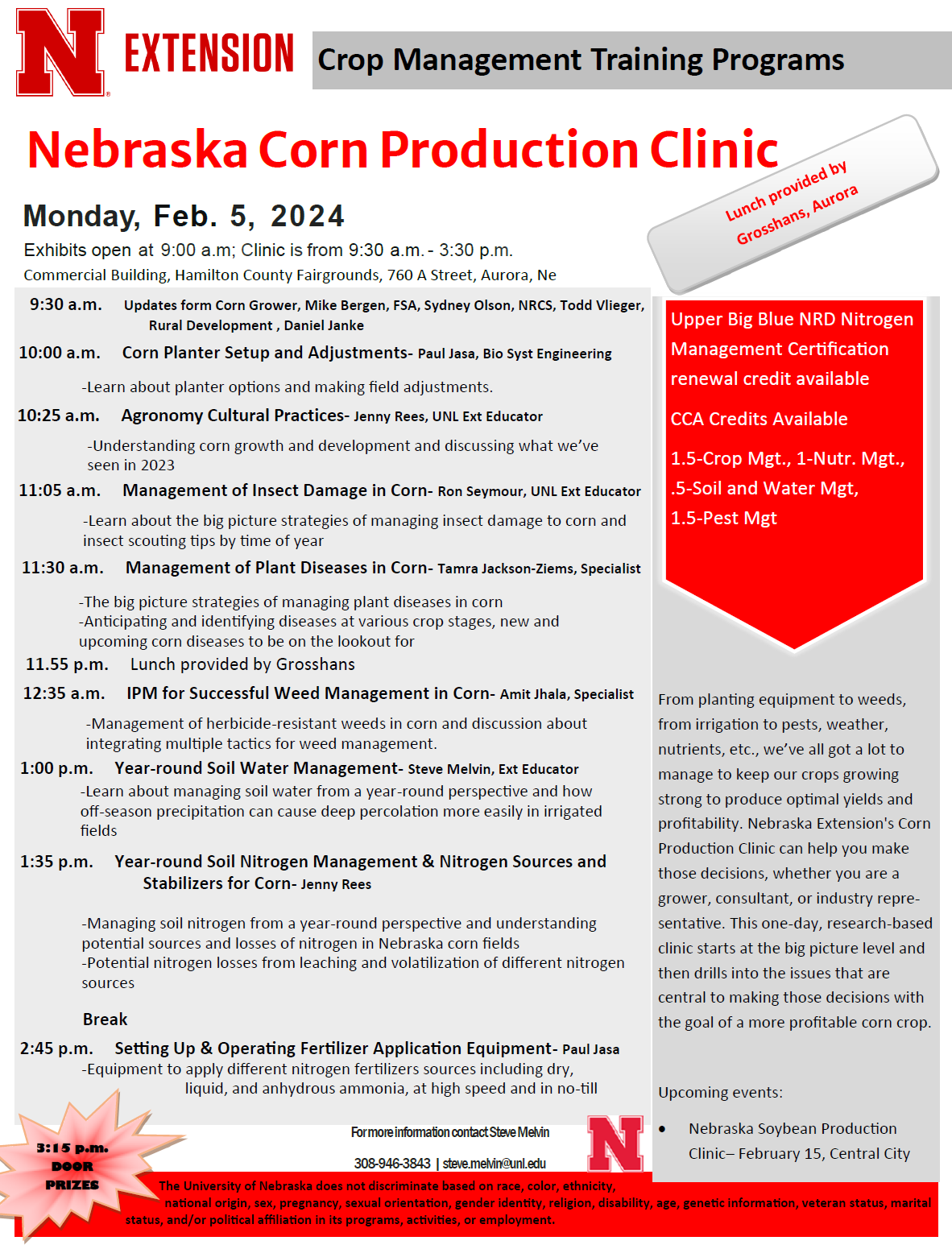
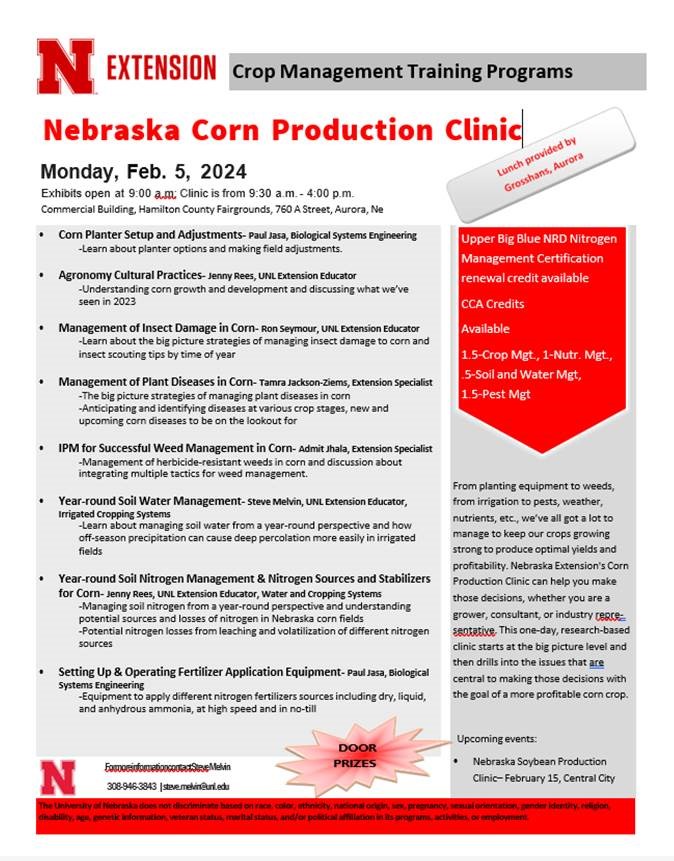
Nebraska Corn Production Clinic Feb. 5 at the Commercial Building, Fairgrounds in Aurora, starting at 9 a.m. with breakfast and time to visit with the vendors at the display booths. Presentations will start at 9:30 a.m. with Corn Growers and USDA updates, and conclude about 3:45 p.m. with door prizes. The event has a great lineup of excellent speakers focusing on all things corn, plus several ag display booths.
Topics include: Corn Planter Setup and Adjustments; Advanced Agronomy Cultural Practices; Management of Insect Damage in Corn; Management of Plant Diseases in Corn Including Tar Spot; IPM for Successful Weed Management in Corn; Year-round Soil Water Management; Year-round Soil Nitrogen Management and Nitrogen Sources and Stabilizers for Corn; and Setting Up and Operating Fertilizer Application Equipment. CCA credits are available.
The ag day event is consistently ranked by the farmers who attend as one of the best educational ag events. The day is free of charge to the participants thanks to sponsors and exhibitors. The noon meal sponsor is Grosshans in Aurora. More information is available https://merrick.unl.edu or by calling Steve Melvin at (308) 946-3843.
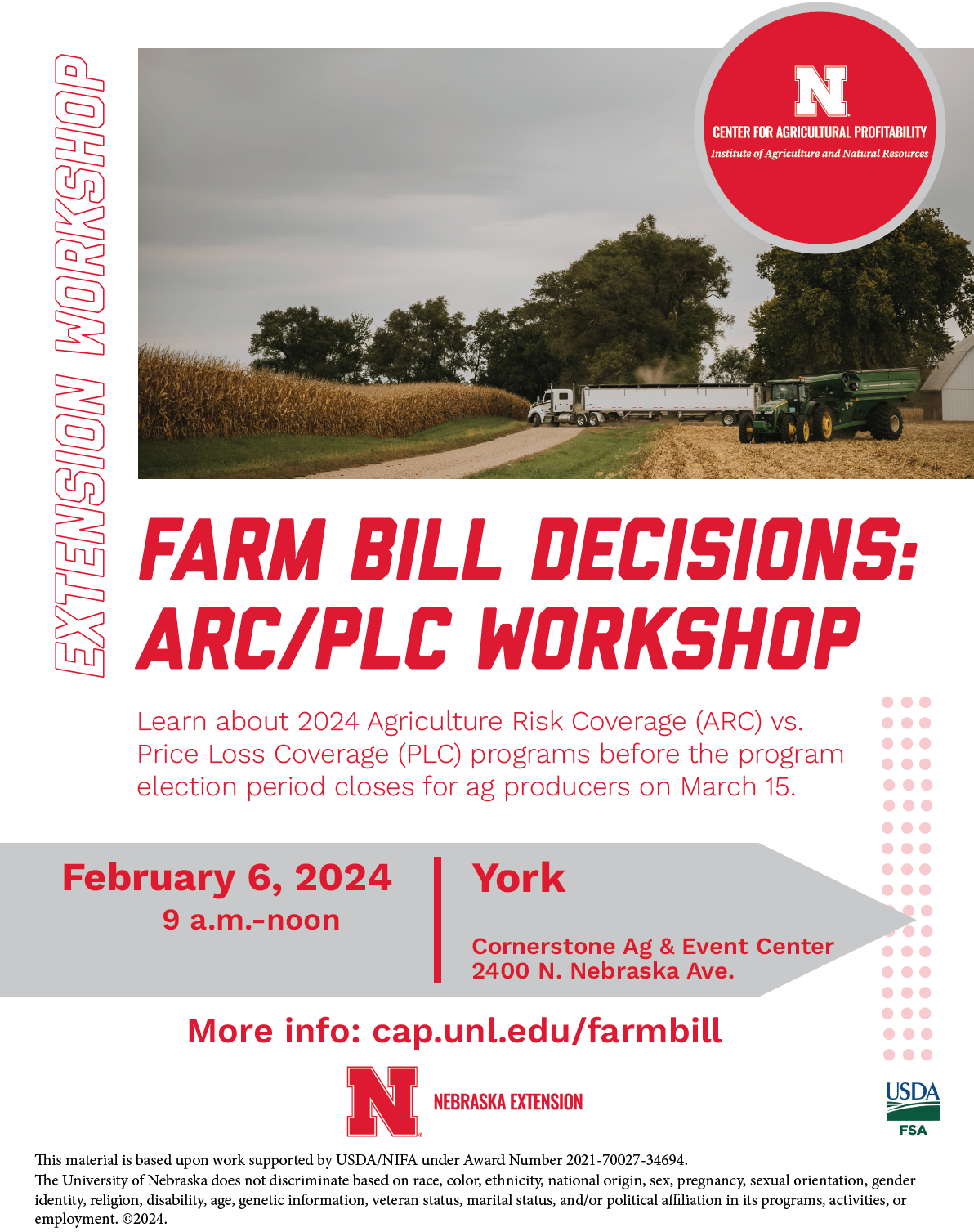
Farm Bill (ARC/PLC) program workshop for ag producers will be in York on Feb. 6 from 9 a.m.-Noon at the Cornerstone Ag & Event Center at the Fairgrounds in York. Nebraska USDA Farm Service Agency (FSA) is reminding producers now is the time to make elections and enroll in the Agriculture Risk Coverage (ARC) and Price Loss Coverage (PLC) programs for the 2024 crop year. The signup period is open through March 15, 2024, and producers are encouraged to begin working with their USDA county Farm Service Agency (FSA) office to complete the process. Although election changes for 2024 are optional, enrollment (signed contract) is required for each year of the program. If a producer has a multi-year contract on the farm, it will be necessary to sign a new contract for the farm by the March 15th deadline if a 2024 election change is desired. If an election is not submitted by the deadline of March 15, 2024, the election defaults to the current election for crops on the farm from the prior crop year.
Producers can learn about the ARC and PLC options for 2024 during a series of workshops hosted by the University of Nebraska-Lincoln’s Center for Agricultural Profitability (CAP) and Nebraska FSA that will be held across the state in February. Area workshops include:
- Feb. 6, 9 a.m.-Noon, Fairgrounds in York
- Feb. 7, 1-4 p.m., Community Building in Columbus
- Feb. 9, 9 a.m.-Noon, ENREEC near Mead
- Feb. 9, 1-4 p.m., Extension Office in Beatrice
- Feb. 14, 1-4 p.m., Extension Office in Hastings
The meetings have no charge and are open to the public. More information and a full schedule are available on the Center for Agricultural Profitability’s website, https://cap.unl.edu/farmbill.
Feb. 6-7 Nebraska Soils School: There’s also an incredible opportunity for learning and CCA credits through this soils school in partnership with the Nebraska AgriBusiness Association. More details here: https://cropwatch.unl.edu/2023-CW-News/2024-Soils-School-Agenda.pdf.
Feb. 7 Part 107 course training to help you pass the test for flying drones will be held at ENREEC near Mead. More info: 402-460-0742.
Fridays in February 2024
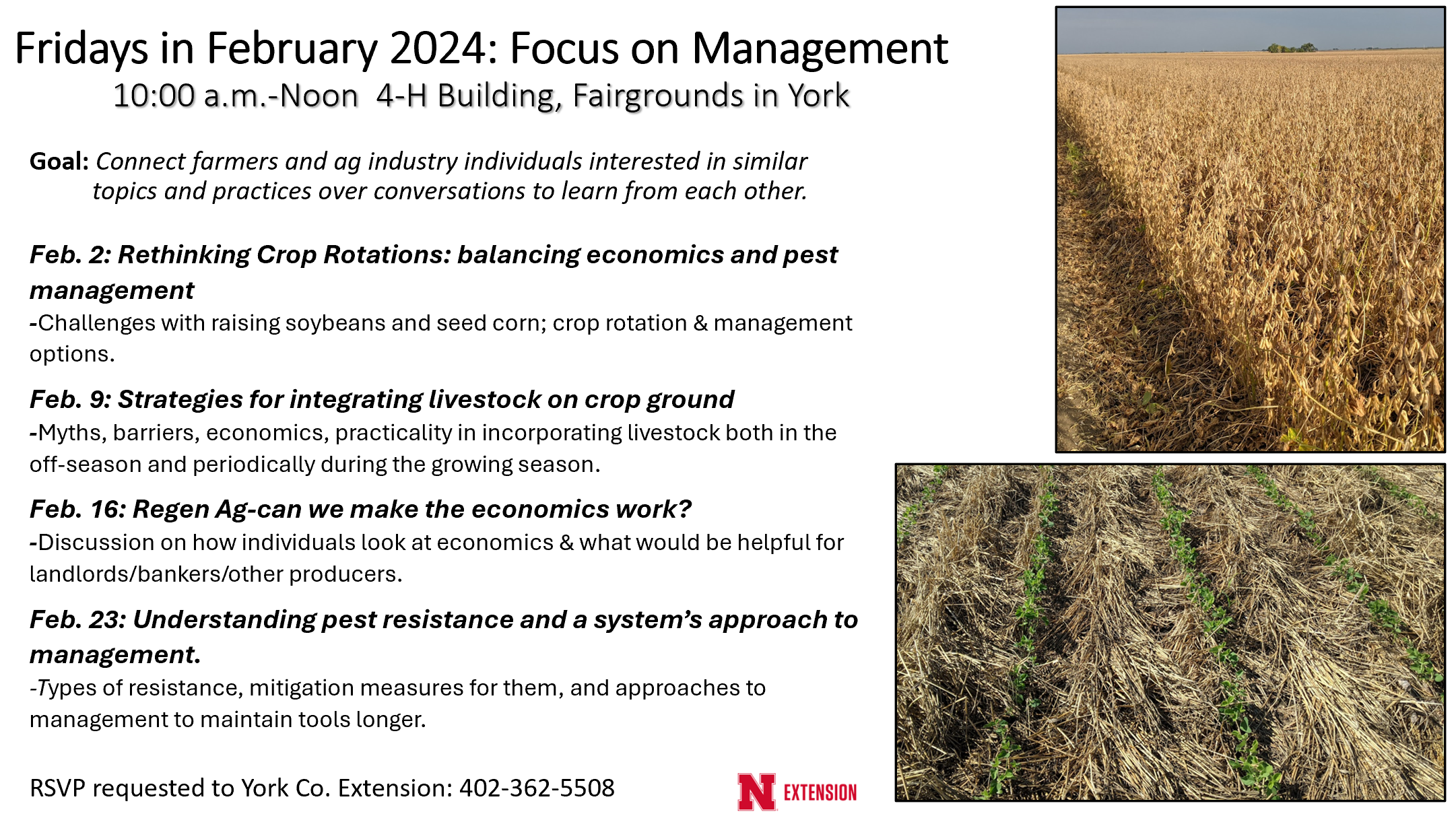
Fridays in February Conversations-Focus on Management: As an Extension educator, I prefer discussion, interaction, and co-learning vs. lecturing. This program started a couple years ago as an opportunity for producers and ag industry to gather and have informal, practical conversations, and share experiences/solutions around topics ag is facing. As I thought about last year and conversations people shared, the following topics surfaced. Each conversation is on Fridays in February from 10 a.m.-Noon at the 4-H Building in York. Please join us for coffee, cookies, and conversation around any/all these topics if you’re interested! Please RSVP to me or 402-362-5508.
Feb. 2: Rethinking Crop Rotations: balancing economics and pest management. A number of producers are frustrated with soybean yields, the problems with raising soybeans, and a handful have given up seed corn with others considering this. Both are important crops to this area so we’ll discuss crop rotation/management options to do things differently.
Feb. 9: Strategies for integrating livestock on crop ground. There’s many benefits of having livestock on crop ground. We’ll discuss some myths, barriers, economics, and what could be practical in incorporating livestock both in the off-season and periodically during the growing season.
Feb. 16: Regen Ag-can we make the economics work? There’s quite a bit of interest in Regen Ag and trying things differently. This is good yet the economics still need to work. As I’ve worked with producers in this space, I feel we need to have a discussion on how individuals look at economics and what we need better numbers around for landlords, bankers, and other producers.
Feb. 23: Understanding pest resistance and a system’s approach to management. Pest resistance is a topic we are currently and will continue to face in the future. We’ll discuss types of resistance, mitigation measures for them, and approaches to management to maintain tools longer.
Eastern NE Corn and Soybean Expo will be held on Jan. 25th at the Eastern NE R&E Center near Mead with viewing of vendor booths at 8:30 a.m. and program beginning at 9:10 a.m. This event combined the former Fremont Corn Expo and the Soybean Days in Wahoo. Mike Zuzolo, president of Global Commodity Analytics and Consulting LLC, is the keynote speaker. He will speak on “Navigating 2024 Commodity Markets — Funds vs. Fundamentals”. His presentation will include: Assessing 2024 Prices For Grains and Cattle — Look at Top 3-5 Drivers; Factors To Focus Upon — U.S. and Global S/D Fundamentals (Micro-Conditions) vs. Funds and Investment Flow Drivers (Macro-Conditions); Project 2024 “Overvalue” and “Undervalue” Levels For Corn/Soybeans/Cattle Through March 31. Many additional topics are included. More info. at: https://go.unl.edu/jmh7.
Chemigation Training In York Jan. 26: For anyone interested in applying chemicals (fertilizer or pesticides via irrigation systems, a chemigation certification is required. Steve Melvin is doing this training Jan. 26th at 1 p.m. at the 4-H Building in York if you need initial or recertification training. RSVP to 402-362-5508.
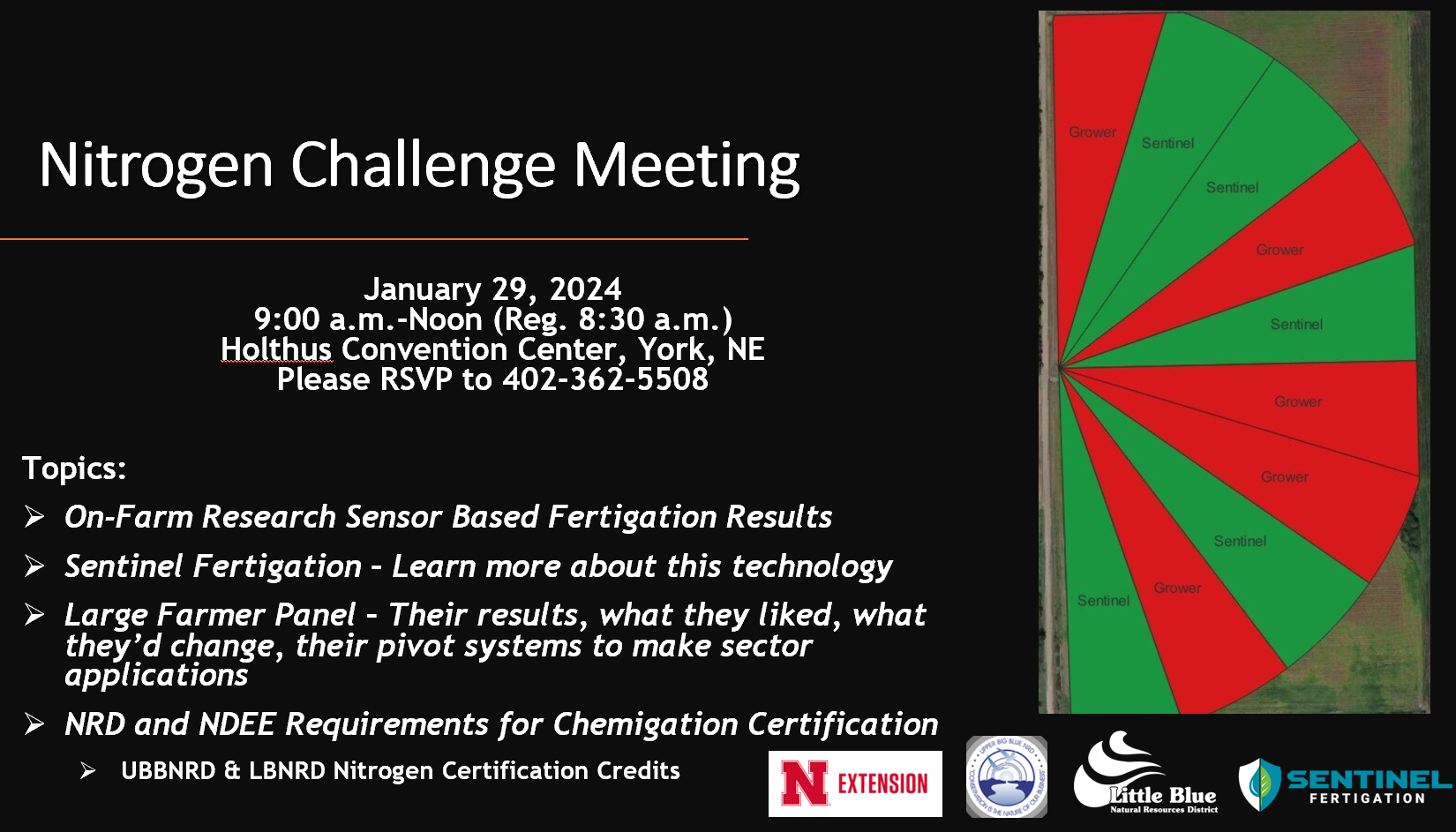
Nitrogen Challenge Meeting Jan. 29th: Reminder of my nitrogen challenge meeting at the Holthus Convention Center in York from 9 a.m.-Noon on January 29th. This training does qualify for nitrogen certification training requirements from the NRD. You can walk in that day but RSVP is helpful for planning purposes to me or 402-362-5508.

Cattle and Cold Resources
Well that was quite a week to remember! Grateful for and maintained thoughts and prayers for all those clearing roads, in law enforcement, firefighters, emergency management, first responders, and livestock producers. Thank you for all you do!
Crop Production Clinics: Quick reminder of Crop Production Clinics this week in Hastings (Jan. 17) and York (Jan. 19). RSVP at https://agronomy.unl.edu/cpc is very helpful as we’re trying to make food and room arrangement decisions. Also, RSVP has been extremely helpful to me this winter already as it’s allowed me to contact attendees and let them know of program info. with all the weather we’ve had this winter. So, please do RSVP to the local Extension Office for the programs you wish to attend. Thanks!
Farm Bill Meeting will be held February 6th at the Cornerstone Event Center at the Fairgrounds in York from 9 a.m.-Noon. Dr. Brad Lubben with UNL and representatives from the Farm Service Agency will be presenting. RSVP to 402-362-5508 if interested in attending.
Livestock and Cold Resources can be found here: https://beef.unl.edu/cow-management-and-cold-weather. The following is a Q/A from the resources written by Dr. Rick Rasby, UNL Beef Extension Specialist.
“Q. How do a cow’s energy requirements change with cold weather? How much more feed does she need?
A. Moisture, high winds, and cold temperatures all increase the cow’s energy requirements. Cows in an optimal body condition score (BCS 5 to 6) are better able to withstand adverse environmental conditions than thin cows. The lower critical temperature of a beef cow is the lowest temperature a cow can be exposed to before she needs to have changes metabolically to help her cope with cold stress.
Lower critical temperature for beef cows is influenced by hair coat condition (dry or wet/muddy), body condition (thin, moderate, fleshy) and hair coat description heavy/winter, winter, fall, or summer. As hair coat changes from summer to winter, BCS changes from thin to fleshy, and hair coat changes from dry to wet, lower critical temperature decreases which means cows can withstand harsher conditions without an increase in energy needs. Magnitude of coldness is equal to Lower Critical Temperature – Wind Chill Index. Energy requirement increase about 1% for each degree of cold stress. As an example, cows that have a heavy winter hair coat that is dry and are in condition score of 5 have a lower critical temperature of 19°F.
Be very careful if you plan to use grains (corn) to increase the energy density of the diet during severe condition as you may do more harm than good. Feeding more than 2-3 lb/hd/day of corn to cows on a forage based diet will decrease fiber digestion. When cows are on a forage-based diet and supplemental energy is needed, consider the use of high energy, non-starch feed stuffs such as distillers grains and soy hulls to meet cow energy requirements. It would not be advisable to change rations daily, but if is predicted that weather conditions will be severe over a period of time then ration changes may be warranted.
A webinar titled Caring for Cattle in Cold Weather highlights the effects of cold weather on cattle and management practices to help mitigate these effects.”
Jan. 15th Pesticide Trainings are on!
-9:00 a.m. Extension Office in Seward.
-2:00 p.m. *NEW LOCATION* Extension Office in Geneva. Please let others know as fairgrounds are not cleared out.
Jan. 16th Pesticide Trainings:
-9:00 a.m. in Clay Center *NEW LOCATION* Community Bldg. (219 W. Fairfield Ave.)
-2:00 p.m. in Nelson at Auditorium
Be safe and many other options for training available in the area! https://jenreesources.com/upcoming-events/
Nitrogen Challenge Meeting
Nitrogen Challenge Meeting Jan. 29: In November I issued a nitrogen challenge. The full article can be found here: https://jenreesources.com/2023/11/12/my-nitrogen-challenge/. My goal is to have an increasing number of producers use sensing technologies such as this that have been research-proven to help with nitrogen management.
Ultimately my challenge was to everyone with irrigated ground who applies fall anhydrous or spring pre-plant fertilizer:
- Leave 1 piece of ground with a base rate of 70-100 lb N/ac
- Goal is to apply the rest of N in season using a tool like Sentinel Fertigation that senses what the plant needs. I will share 2023 research results from area producers this winter. If you decide you don’t wish to try a tool like Sentinel Fertigation, you can apply the rest of N the way you’d like.
- Only asking to consider for 1 field. Are you willing to join me in this?
On January 29th, I’ll be having a Nitrogen Challenge Meeting. It will be from 9 a.m.-Noon at the Holthus Convention Center in York. As promised, on-farm research results from sensor-based fertigation will be shared in addition to learning more about Sentinel Fertigation as a tool for nitrogen management. I also wanted you to hear directly from the area farmers who have used this tool the past few years. Some of the farmers have used this technology in on-farm research fields and some just tried it on fields. In fact, a few of the top 6 National Corn Yield Contest winners who applied 180 lb N/ac or less used Sentinel Fertigation in 2023. A larger farmer panel will share what they liked, what they’d change, and their pivot setup for managing sectors (as there’s different ways of managing this for individual pivots). Information will also be shared about chemigation requirements.
There is no charge for this meeting and the UBBNRD and LBNRD are providing nitrogen certification credits for those who attend this meeting. Please RSVP to 402-362-5508 so we know how to plan if you’re interested in attending. I’m truly hoping to see many producers interested in learning more and joining me in this challenge!
Three State Beef Conference: Re-evaluating today’s management practices for future success: On Jan. 18th in Syracuse, NE from 6-9 p.m. (Registration at 5:30 p.m.), learn more about re-evaluating management of corn residue grazing, development of heifers and management of young cows to help ensure success. Location: Fair Center building, Otoe County fairgrounds, 135 Plum St, Syracuse, Nebraska
Topics include: Corn residue grazing: current recommendations and adjustments based on new data, Dr. Mary Drewnoski, beef systems specialist, University of Nebraska; Developing heifers for the future, Dr. Kiernan Brandt, professional services technician, Trans Ova Genetics; and Managing young cows for longevity and profitability, Dr. Thiago Martins, asst. professor, beef reproduction extension & research, University of Missouri.
Pre-registrations are appreciated for planning purposes. The registration fee is $30 per person which includes a meal and a copy of the conference proceedings. RSVP to: Connor Biehler, Extension Educator, 402-624-8007, cbiehler2@unl.edu.
Also: Reminders of meetings that begin this week including Cow-Calf College, some Crop Production Clinics, and pesticide trainings.

January 2024 Events
Whether your holiday was filled with family and/or friends, plans changed due to weather, or whether holidays are difficult for various reasons, I hope you were able to find something for which to rejoice over during Christmas! Normally I write a column reflecting on the past year at the year’s end, but I feel like we’ve talked about 2023 enough! Each year we will face new challenges, many outside our control. As we look towards 2024, may we be intentional to rest, rejuvenate (reminder to think about goals for this year, our ‘why’, and what would making faming more fun), reflect, and anticipate 2024 with renewed hope! Here’s wishing you blessings in 2024 and the wisdom and resilience for whatever the year may hold!
January Winter Meetings: Tis the season of winter meetings! Winter program brochures have been mailed. If you didn’t receive one, you can contact your local Extension Office or view it at: https://jenreesources.com/upcoming-events/. Please contact the Extension Office hosting the event you’re attending so we know how to plan.
Successful Farmer Series: January 4th from 9-11:30 a.m. is the last program in this series. They’ve been excellent topics and sessions so far and the previous meeting recordings in addition to the Jan. 4th RSVP can be found at: https://lancaster.unl.edu/ag/successfulfarmerseries. The Jan. 4th session is about Nitrogen Management Tools, Water Quality, and Nitrate Management. Topics/speakers: Nitrogen & Nitrate Issues (Tim Mundorf, Central Valley Ag); Best Nitrogen Management Practices to Improve Nitrogen Use Efficiency and Water Quality (Javed Iqbal, UNL); Optimizing Nitrogen Use Efficiency Using Image Based Fertigation Scheduling (Shane Forney, Sentinel Fertigation). The event is held in person at the Extension Office in Lincoln and also via webinar. Please RSVP at the link above.
Crop Production Clinics offer recertification for pesticide applicators in addition to updated crop and pest management information for anyone interested. The closest to this area include Jan. 10 near Mead, Jan. 11 in Beatrice, Hastings on Jan. 17, and York on Jan. 19. It’s back to the original format and I mention that so you’re not expecting the new format at York this year. Info: https://agronomy.unl.edu/cpc.
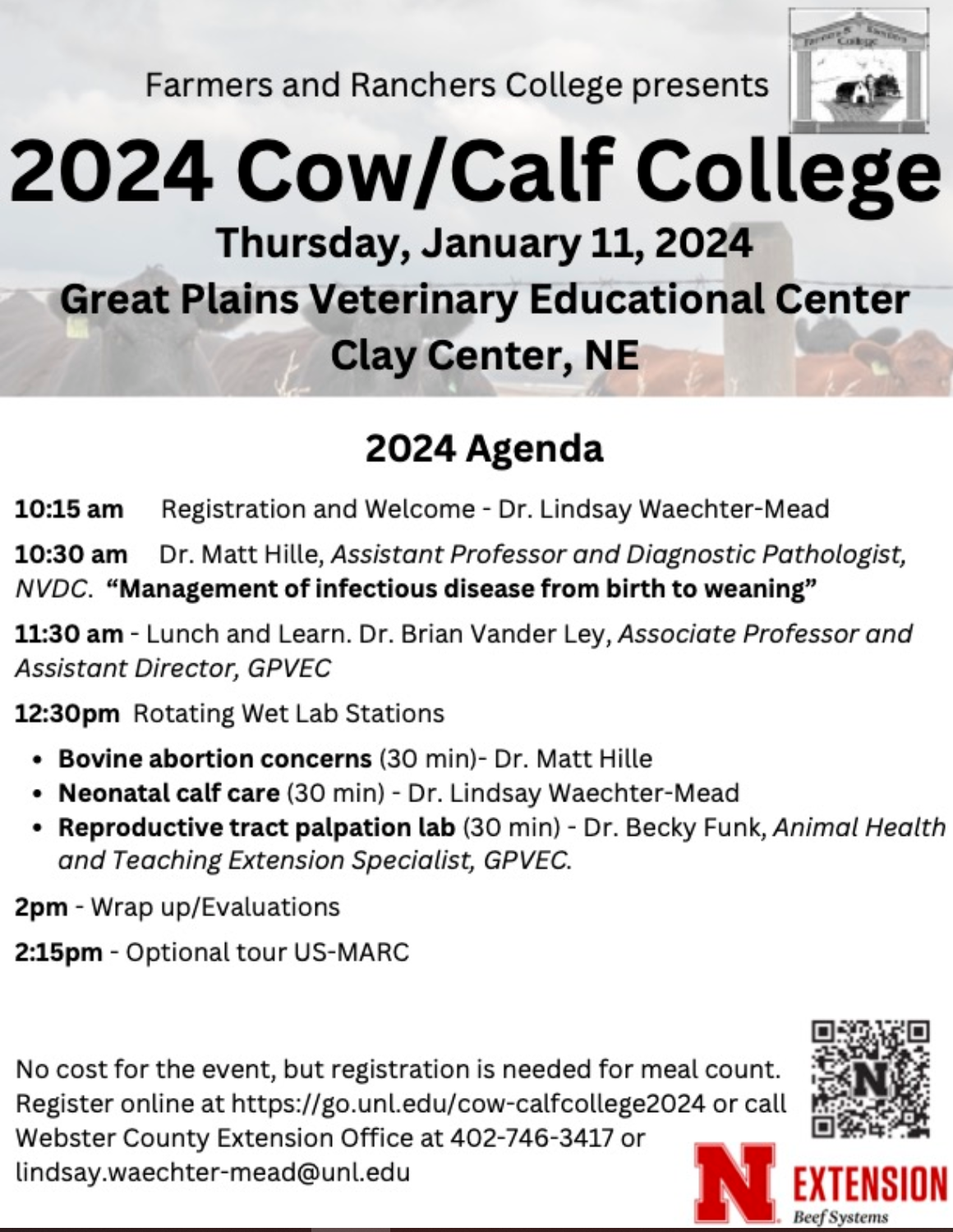
Farmers and Ranchers Cow-Calf College is Jan. 11 at the Great Plains Veterinary Educational Center, near Clay Center, NE. Registration at 10:15 a.m. with program from 10:30 a.m. – 2:00 p.m. This year’s focus is on strategies to enhance cow/calf health from birth to weaning. The hands-on format will allow participants to engage with specialists and peers throughout the day. Dr. Matt Hille, Assistant Professor and Diagnostic Pathologist at Nebraska Veterinary Diagnostic Center will provide an in-depth look at common infectious diseases affecting calves. Topics include scour prevention and treatment techniques, and when it may be worthwhile to pursue diagnostics. Discussion will also include pinkeye disease background, treatment, and prevention strategies.
The afternoon will be comprised of three mini-workshops. Dr. Becky Funk, GPVEC Extension Specialist will host a hands-on palpation wet lab utilizing bovine reproductive tracts and Dr. Hille will continue the cow health discussion with potential causes of abortion and when diagnostics are needed. Dr. Brian Vander Ley, Associate Professor and Assistant Director of GPVEC will provide an overview of activities at the Center while participants enjoy a catered lunch. The program will conclude with an optional tour of US-Meat Animal Research Center (weather permitting). There is no cost; however, registration is required due to limited space. Pre-registration can be made by calling the Webster County Extension office at 402-746-3417 or online at https://go.unl.edu/cow-calfcollege2024.
Nitrogen Challenge Meeting will be held Jan. 29th from 9-Noon at the Holthus Convention Center in York. I’ll share more on this next week, but for now, please hold this on your calendars.
Reporting Survey: It’s also reporting season for Extension. If you’d kindly like to share how my Extension work impacted you in 2023, please go to slido.com and use the code 4EXT. Thanks!


 JenResources