JenREES 12/19/22
In some ways, it’s hard to believe that Christmas is this coming week; wishing you and your family a very blessed Christmas! For holiday food safety tips, please check out: https://food.unl.edu/article/holiday-food-safety-tips.
Extension is an interesting career that’s hard to explain what all it entails. Many people realize we’re involved with the fair and 4-H. Beyond this, the responsibilities just change with each season. For me, January and February are filled with winter meetings where I have the opportunity to teach and learn throughout the state each day. This past month was spent scheduling and planning for those meetings. Pesticide letters and winter program brochures should be mailed from local Extension offices in the next few weeks. The winter program brochure is also here: https://jenreesources.com/upcoming-events/.
Winter meetings mostly entail certification training and learning opportunities to discuss the past year and preparing for the coming one. Anyone who applies restricted use pesticides take pesticide certification training every three years to handle and apply pesticides safely. Those who apply chemicals and fertilizer through irrigation systems take chemigation training to do so safely. Nitrogen certification training is taken for those who farm in areas of NRDs that have groundwater nitrate levels higher than 7 ppm. Livestock operations of designated sizes take training on the proper handling, storage, and application of manure. Organic producers also go through a certification process. All the certifications mentioned above require our farmers, applicators, and livestock producers to keep records of what they are doing, and random inspections can occur for some of the certifications to ensure they’re in compliance.
Beyond the required trainings, many attend meetings throughout the winter to continue learning and improving efficiencies in their operations. While there’s always a few outliers in any industry, the majority of farmers I know are seeking increased nitrogen use efficiency (applying less nitrogen per bushel of grain received). We can’t change the past for what wasn’t known back then of fertilizer and water applications that would eventually impact nitrates in groundwater. In general, while there are some outliers, practices have changed and farmers seek to be increasingly efficient with fertilizer and water use.
UNL Soil Specialists share of these improved efficiencies in an article found at https://go.unl.edu/mxu0, “Partial factor productivity (PFP) is a measure of efficiency of input use…PFP is commonly expressed as yield per unit input, e.g. bushels of corn per pound of fertilizer nitrogen (N) applied (bu/lb N). PFP can be adapted to units of nutrient removed in grain harvest to units of nutrient applied, such as corn N harvested relative to fertilizer N applied (PFPN, lb/lb).
The PFPN used for the analysis in this article was derived from growers’ practices statewide with the assumption that growers’ N use was aimed at profit maximization. The average PFP of fertilizer N for corn in Nebraska was estimated to average 1.16 bu/lb N in 2012 compared to 0.57 bu/lb N in 1965 (Ferguson, 2014). This represents a doubling in PFP for fertilizer N applied to corn. The trend of increase was linear from 1965 to 2012.” (What they’re showing is increased nitrogen use efficiency between 1965-2012 of more corn produced per pound of nitrogen applied). The ratio can also be flipped to look at how many pounds of N are being used to produce 1 bushel of grain.
Most farmers I talk with, for the yields they are receiving compared to nitrogen applied, have nitrogen use efficiencies of 0.8-1.0 lb of N per bushel of grain produced. There’s an increasing number of farmers I know who are working to push that further to 0.6-0.8. There’s also those above 1.0 who could improve.
In my nearly 19 years of Extension, I have yet to meet a farmer or livestock producer that didn’t care about the future of his/her land, about water, about making improvements for the next generation. An increasing number of producers are testing ways to improve nitrogen and other input efficiencies via on-farm research. I will share results from these studies on what our growers are learning over the first few months of next year.
Dr. Kohl Recap
Walking in the misty rain Thursday, it just felt wonderful to get some moisture, even though it became ice! Sharing some things learned from Dr. David Kohl that day. His overall theme was to “Be in the black (profitable) without the government”. Many illustrations he likened to sports in needing to stick to fundamentals such as knowing cost of production, our marketing plan, staying the course with what we can control vs. getting derailed by what we can’t. Media headlines can rapidly change things thus the extra importance to stay the course. Ag is such a global market. With all the politics, he emphasized the need to have a fuel and fertilizer input cost strategy as China will more directly trade with Brazil/Argentina first. And, because of the world dynamics, he emphasized several times to “Never bet your farm or ranch on an authoritarian government”. Another thing that’s kept me thinking was “People who are successful are 5% better in a lot of little areas”.
My colleague, Brandy VanDeWalle, wrote the following in her column, “Recently at a Farmers & Ranchers College program, Dr. David Kohl emphasized the importance of maintaining working capital or cash for businesses and families, among other important business principles. As always, his global knowledge of events and how they impact U.S. agriculture is fascinating.
One of the mega-trends for producers to pay attention to is the increased focus on healthy soil and water. Healthy soil and water quality creates healthy plants, animals, humans, and environment. Likely there will be paid incentives for producers who excel in these areas. Continuing to reassure consumers where and how food is produced, processed, and distributed remains important. It is also crucial to know your cost of production to plan best, average, and worst-case scenarios. Kohl also recommends overestimating capital expenditures by 25%.
His “Rule of 78” caught the attention of a lot of participants. When most people reach 78 years of age, usually health starts to decline unless you practice 8 habits. Those eight habits to have a quality of life included taking care one oneself physically by drinking water, exercising regularly, eating healthy and getting enough sleep. Mentally, people should have a support network, life purpose, engage in mental activities such as reading or meditating and practice your faith/spiritual life. He emphasized the importance of allowing oneself 2 hours per day with no technology.
Farmers and ranchers should also manage things that can be controlled and manage around those that cannot be controlled. He reinforced the idea that for a successful operation, you must plan, strategize, execute, and monitor. Examine monthly or at least quarterly financials to ensure you are on track. Those with a written business plan are four times more profitable than those without a plan. Also, the mental health of those with a business plan have two times the mental health as those without a written plan.
Kohl reminded participants of his business IQ exercise that ANY business should undertake. The areas in the business IQ included cost of production knowledge, cost of production by enterprise, goals (business, family, personal), record keeping system, projected cash flow, financial sensitivity analysis, financial ratio/break evens, those who work with an advisory team/lender, those whom have a marketing plan and execute, those whom have a risk management plan and execute, modest lifestyle habits, strong people management plan, transition plan, those whom attend educational seminars, and their attitude.
To determine what your cost of production is, a hands-on training will be held at the Fillmore County Fairgrounds on Thursday, December 15th from 1-3:00 p.m. This program is free, but registration is preferred for planning. Register at cap.unl.edu/abc/training. Attendees are encouraged to bring their own laptop or tablet to the workshop.”
Nebraska Mesonet are the weather stations located throughout our State with the data shared in our UNL CropWatch site for ET, soil temperature, precipitation, etc. But beyond farmers/ranchers and Extension using it, the data’s also used by National Weather Service, NOAA, Drought Monitor, etc. Please consider reading this article to become more familiar with what the Mesonet is and its importance regarding what shutting down locations means for Nebraska: https://go.unl.edu/a64h.
JenREES 12/4/22
Pesticide certification trainings are currently being scheduled. We’ll share those dates towards the end of the month.
Ag Land Management Quarterly Webinar: Here’s the recording for those interested: https://go.unl.edu/ydhc. It covered recent findings from the 2022 USDA-National Agricultural Statistics Service county-level cash rent survey and trends in farm programs influencing operations across the state. It also included a segment on landlord-tenant communication issues related to closing out 2022 leases and review leasing considerations for 2023.
Farm Tax Guides are now available in many local county Extension Offices for free if you’d like one.
Nebraska Crop Budgets: A recent recorded webinar highlighted 2023 crop budget updates at: https://go.unl.edu/e9rj. My colleague Glennis McClure, who assembles the UNL Crop budgets, shares, “The Nebraska crop budgets found at https://cap.unl.edu/cropbudgets were recently updated. All of the 84 budgets indicate cost of production increases. Estimated average economic or total costs per bushel for 2023 corn production are expected to be at least 23% to 25% greater than last year. Soybeans are estimated to be 13% to 19% more in economic costs per bushel, with wheat production costs having jumped over 20% compared to last year and running as high as 63% higher over the last two years combined. Cost scenarios for individual producers can vary based on their timing of input purchases and price variabilities. Ownership costs of land and rental rates are factors adding to cost increases as well, with the all-land average value in Nebraska rising 16% for the year ending February 1, 2022.
Along with increased costs come increased financial risk exposure associated with yield or market changes. It is important to develop cost of production baseline information to utilize market opportunities as they are available, consider input decisions, and make timely risk management decisions. Knowing projected enterprise costs can provide confidence in decision making.” A UNL Agricultural Budget Calculator (ABC) found at https://agbudget.unl.edu/ aids in creating enterprise budgets. Online and in-person training sessions can be accessed at https://cap.unl.edu/abc. A nearby in-person training session will occur on December 15 from 1-3 p.m. at the Fillmore Co. Fairgrounds in Geneva as part of the Farmers/Rancher’s College. This is hands-on and you are welcome to bring your laptop. Please contact Fillmore Co. Extension to RSVP and more for info: 402-759-3712.
CropWatch Survey: For those of you who utilize our UNL CropWatch website, we ask you to share your thoughts on how we did in 2022. You can provide comments here: https://ssp.qualtrics.com/jfe/form/SV_5AA8iYvCHQVfz9A
Houseplant Browning: If the leaf edges of your houseplants have been turning brown like mine, my colleague Kelly Feehan offers some tips. “When the tips and edges of houseplant leaves turn brown, it’s usually due to low humidity or fluoride in water. Most houseplants are injured when humidity is under 20 percent. Humidity levels between 40 and 60 percent are preferred for houseplants. The best way to increase humidity is to use a room humidifier or a whole-house humidifier attached to the furnace. Syringing (spraying plants with clean water) removes dirt from leaves and increases humidity, but only to a small degree. High humidity areas such as bathrooms and kitchens are often ideal for plants. Excessive fluoride levels in water can cause tip and leaf scorching. Sensitive plants like Dracena, Cordyline, and Chlorophytum are best watered with rain water if possible. Tap water can be used but let it stand for at least 24 hours in containers to allow chlorine and fluorine to dissipate. When watering houseplants, room temperature water is best.”

JenREES 11/27/22
Hope you had a blessed Thanksgiving! With the end of harvest begins winter meeting season. Sharing this week on some upcoming December events that my colleagues are hosting.
Dec. 1: Solar Electric for Farms, Homes and Businesses will be held from 6-8 p.m. at the Lancaster Co. Extension Office in Lincoln. It will also be held on Dec. 15 from 6-8 p.m. at the Fairgrounds in Central City. This workshop is for homeowners, farmers, and business owners who are interested in exploring solar PV systems. The workshop will help you decide if solar is right for you by learning about how systems work, safety, the value of electricity, value of incentives, and how to evaluate quotes from installers. Cost is $10. More info and registration at: https://go.unl.edu/solarworkshops2022.
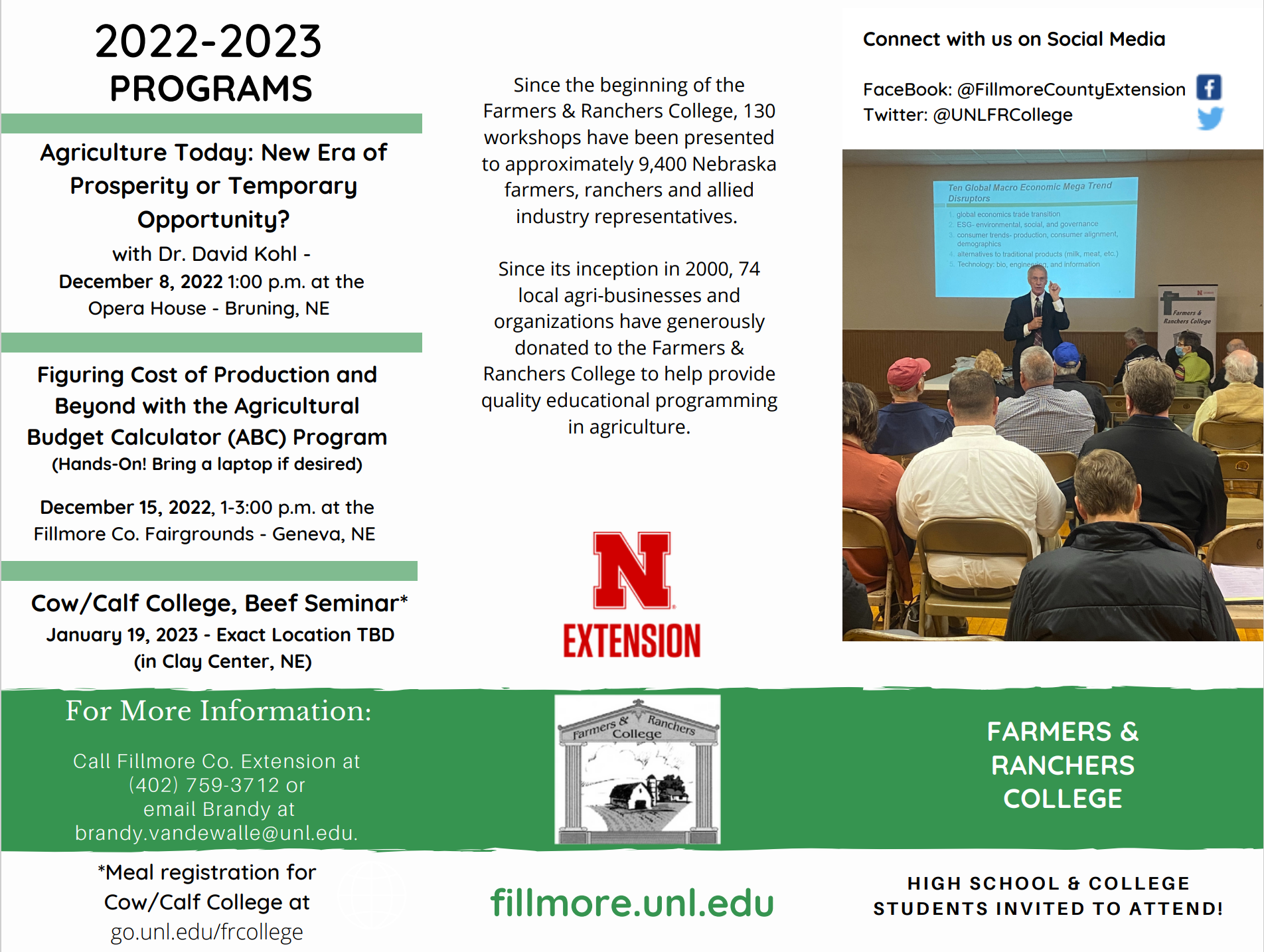
Dec. 8: Farmers and Ranchers College will kick off with its traditional program featuring Dr. David Kohl. Registration will start at 12:45 p.m. and the program will start at 1 p.m. at the Opera House in Bruning, Nebraska. The program is titled, “Agriculture Today: New Era of Prosperity or Temporary Opportunity?”. Dr. Kohl is always a popular speaker. Don’t miss out on this engaging session that applies the big picture variables to your business, family and personal life.
Dec. 9-10: I mentioned this last week, but a reminder, Returning to the Farm workshop will be held Dec. 9-10 at the Holthus Convention Center in York. More information here: https://cap.unl.edu/rtf22 .
Dec. 14: The Confronting Cropping Challenges program will help producers make decisions for the 2023 growing season and they can renew their private pesticide applicator license. The program will be offered in five locations across northeast Nebraska in December. The closest location to this area will be held Wed., Dec. 14 at the Butler Co. Event Center in David City from 1-4 p.m. Program topics include tar spot of corn, drift management/boom sprayer calibration, and drought considerations. Attendees can join the first three informational sessions or if you need to renew your private pesticide applicator license in 2023, please attend the whole program. This training will only offer recertification of private pesticide licenses; those needing initial training will need to attend a training course offered in early 2023. The cost for the program is $10 if you are only attending the first three sessions. If you are being recertified for your private pesticide applicators license, the cost will be $60. The additional $50 is the same as you would pay to be recertified at a traditional private pesticide applicator training. Pre-registration online is appreciated but not required.
Dec. 15: In collaboration with the Farmers and Ranchers College, the University of Nebraska Lincoln’s Center for Agricultural Profitability has scheduled a hands-on workshop for Thursday, Dec. 15, 2022, in Geneva. This workshop is for ag producers, farm managers, bankers and anyone interested in learning more about utilizing the free online Agricultural Budget Calculator (ABC) for enterprise budgeting. The workshop will run from 1-3 p.m. at the Fillmore County Fairgrounds, 641 N Fifth St., Geneva, Nebraska.
Dec. 15: Nebraska Soybean Day and Machinery Expo will be held at the fairgrounds in Wahoo from 8:30 a.m. (view exhibits with program beginning at 9:10 a.m.) to 2:15 p.m. Alan Brugler will be the keynote speaking on “Tricks and Tools to Survive Drought, War, Inflation, and Long Tails”. Additional topics include: Farm transition or succession-there is a difference and Soybean stem borer. The Pancake Man will serve lunch. There’s no cost but the Saunders Co. Soybean Association requests each attendee bring 1 or 2 cans of non-perishable food for the food pantry.

JenREES 11/21/22
I’m so grateful that harvest is mostly complete at this point! When so much of the crop was replanted in late June/early July, I wasn’t anticipating harvest to get rolling till mid-November for the replant crop. The early frost ended up being beneficial in that way. With Thanksgiving approaching this week, I realized how much I needed to take time and reflect on the year; perhaps you do too? I realize many want to forget it, but it can be healing to think through what one experienced and look for the positives amid the challenges. We ran from what seemed to be one issue to another which led to an extra exhausting year with minimal time to process. I’m not ready to share thoughts yet, but it has been helpful for me to reflect. Hoping you can take time this Thanksgiving to reflect on the blessings amidst the hard things. There truly are so many! Wishing you and your family a blessed Thanksgiving!
Thanksgiving resources: For Thanksgiving turkey prep, fun recipes, and family activities, check out: https://food.unl.edu/article/thanksgiving-central. En español: https://go.unl.edu/z7di. My colleague Brandy VanDeWalle also shares some gratitude research in this post: https://vandewalleviews.com/2022/11/04/gratitude-improves-health-well-being/.
Returning to the Farm Workshop Dec. 9-10 at Holthus Convention Center in York: Only 50% of farm families have an estate plan in place. Billions of dollars will be transferred in the next 10 years in agriculture. Does your family have a plan in place to ensure that assets are transferred the way you desire? Being in Extension, I’ve heard and watched stories of heartbreak when one generation passed and the next wasn’t able to farm or ranch on ground the way either generation hoped. It’s happened in my family and perhaps some of you have experienced this too? So much of this comes down to communication. Most of us don’t communicate well and sometimes we need tools to help. Legal tools can then help with putting communicated goals and desires into place.
I highly recommend this workshop! It assists families and agricultural operations with developing financial plans and successful working arrangements to meet their unique needs. It will guide families in developing estate and transition plans, setting personal and professional goals and improving the communication process between family members. Sometimes the greatest barriers in life are our ability to communicate effectively with each other. As I’ve sat in the room during these workshops, I’ve watched barriers break down as different members listened long enough to learn what another person was saying (or not saying). I’ve watched a neutral environment where hard things were discussed and honesty was shared.
It really is intended for multiple generations to attend together. My colleagues have families work through scenarios/questions as multiple generations set around tables…things like what happens if different people pass unexpectedly, what happens in the event of a divorce or remarriage and what does asset transfer look like if that happens, who is all included and who isn’t included, fair and equal and are they the same, etc. My colleagues share numerous genuine stories, both humorous and hard, to drive home points. And, I’ve watched the different families represented in the room become friends, bouncing ideas off each other throughout the workshop and staying in touch months and years later. The workshop fee is $70 per person which includes meals and all the materials. It also includes two follow-up virtual workshops in the evenings on Jan. 12 and Feb. 2. Registration is due by early Dec. With this opportunity so close and with the main speaker and farm transition educator, Al Vyhnalek planning to retire this coming spring, I truly hope your family can take advantage of this! More info: https://cap.unl.edu/rtf22.
JenREES 11/14/22
This week, I’m sharing information I learned at last week’s weed science school. One thing that was new to me, perhaps I should’ve known it but never really thought about it, waterhemp is a shade tolerant plant! We talk about palmer being so incredibly efficient with sunlight that I never thought about waterhemp being so efficient in the shade.
Dr. Kevin Bradley, weed scientist at the University of Missouri gave a great presentation. He had three main points which I share below.
1-More complex herbicide labels: get used to new labels for the future. Those who read the new Enlist® label would be more familiar with them. The labels are based on hydrologic soil groups (determined by soil texture which influences water infiltration and holding capacity). Depending on those hydrologic soil groups, the land manager/applicator needs to meet a minimum number of credits specified by complying with various management practices. This is similar to requirements EPA was proposing in their review of atrazine. Kevin shared this appears to be the way new labels will be formulated for the future.
2-Integrated approaches for weed control: ones he mentioned included cover crops, robots, releasing sterile weed pollen, electrocution, flaming, tillage practices, crop rotation, and chemicals. He did some work with Weed Zapper™ on electrocution of weeds. It has a copper boom attached to the front of the tractor which electrocutes any plant it contacts with up to 15,000 volts. It does this with a 110,000 watt generator attached to the back of the tractor. He shared that it had the best application on weed escapes later in the season that were at flowering or beyond (as a seed control mechanism) vs. trying to control smaller weeds. It provided decent control of marestail, giant ragweed, and waterhemp but not palmer and grasses. His team looked at any impacts to seed viability later in the season. On waterhemp with viable seed, the electrocution reduced that seed viability by 67%.
He also shared on combine seed destroyers where companies are hoping to provide this technology as an add-on feature to kill weed seed. He shared Redekop™ has a deal with Deere in Canada while Seed Terminator™ is planning to work with all brands right now. In the south where there’s typically green palmer at harvest, he said there’s an issue with clogging when using seed destroyers but didn’t see that issue as much in Missouri. His team put cameras on the ground and on the combine to show how it worked and they also collected seed during harvesting. The video from the cameras showed around 30% of weed seed shatters prior to entering the combine header…so there’s a portion that will never have a chance to be destroyed. However, it did an incredible job of separating weed seeds and funneling them into the seed destroyer where damaged waterhemp seed exiting the combine ranged from 66-83%. Across the 7 locations over two years, fuel consumption was 3 gal/hour greater, engine load was 5.6% higher, and speed was 0.24 mph slower when the Seed Terminator™ was on. They saw a significant reduction of waterhemp in the soil. It just depended on if it took 1 or 2 years to achieve it.
3-Zero tolerance for resistant weeds was an interesting topic to discuss with the audience. Ultimately, he was sharing that we’re in a new era of resistant weeds in which plants are able to break down the herbicide at increased rates using ‘metabolic resistance’. I need to dig into this to better understand these mechanisms, but he talked about ‘target site resistance’ where weeds in the 1990’s-early 2000’s conferred resistance by overcoming a specific site of action so the herbicide couldn’t bind. Since 2010 through today, weeds are able to use ‘metabolic resistance’ in which they can confer resistance to other herbicides in same group and possibly to herbicides in other groups. No one had good answers on how to get to a ‘zero tolerance for resistant weeds’ but one thing we all agreed upon was that it would take integrated approaches in order to do so.
JenREES 11/7/22
Fall Herbicide is one management tool besides seeding small grains to control winter annual weeds and marestail (horseweed); it may not be necessary for every field. It’s important to scout fields for current weed pressure. Also consider targeting fields that have a history of winter annual weeds or marestail. Nebraska research shows up to 95% of marestail germinates in the fall, so fall application can aid management. Most products contain 2,4-D and/or dicamba. Tank-mixing a residual herbicide with a burndown product will improve marestail control because the residual activity will control marestail emerging after herbicide application.
Some winter annual weeds also serve as hosts for pathogens like soybean cyst nematode (SCN): purple deadnettle (strong host), henbit (strong host), field pennycress (moderate host), shepherd’s-purse (weak host), small-flowered bittercress (weak host), and common chickweed (weak host). SCN can reproduce in the field on henbit and purple deadnettle. We have no research to show that a fall application helps with palmer even though some feel it does.
Regarding temperatures, Dr. Amit Jhala has shared the ideal temperature for applying most post-emergence herbicides is between 65°F and 85°F. Herbicides can be applied at 40°F to 60°F, but weeds may be killed slowly. When the temperature is below 40°F for an extended time after burndown, weed control will most likely be reduced, specifically for a systemic burndown herbicide such as glyphosate. Additionally, weed control may be reduced under cloudy conditions following an initial temperature drop below 40°F. With late-fall herbicide applications be sure to add labeled adjuvants to improve herbicide efficacy.
Frosts of less than 25°F usually cause leaf damage to annual plants, making them poor targets for herbicide applications; however, winter annual weeds may tolerate a frost up to 20°F and continue growing when conditions improve, with little tissue damage. After weeds experience frost, active growth may not begin again for a few days. Growers should wait until new leaf tissue is produced, scout the field, and then consider applying herbicide. Generally, this would be when nighttime temperatures are 35°F or greater and daytime temperatures are at least 50°F for two consecutive days. Additionally, sunshine is needed for plants to recover.
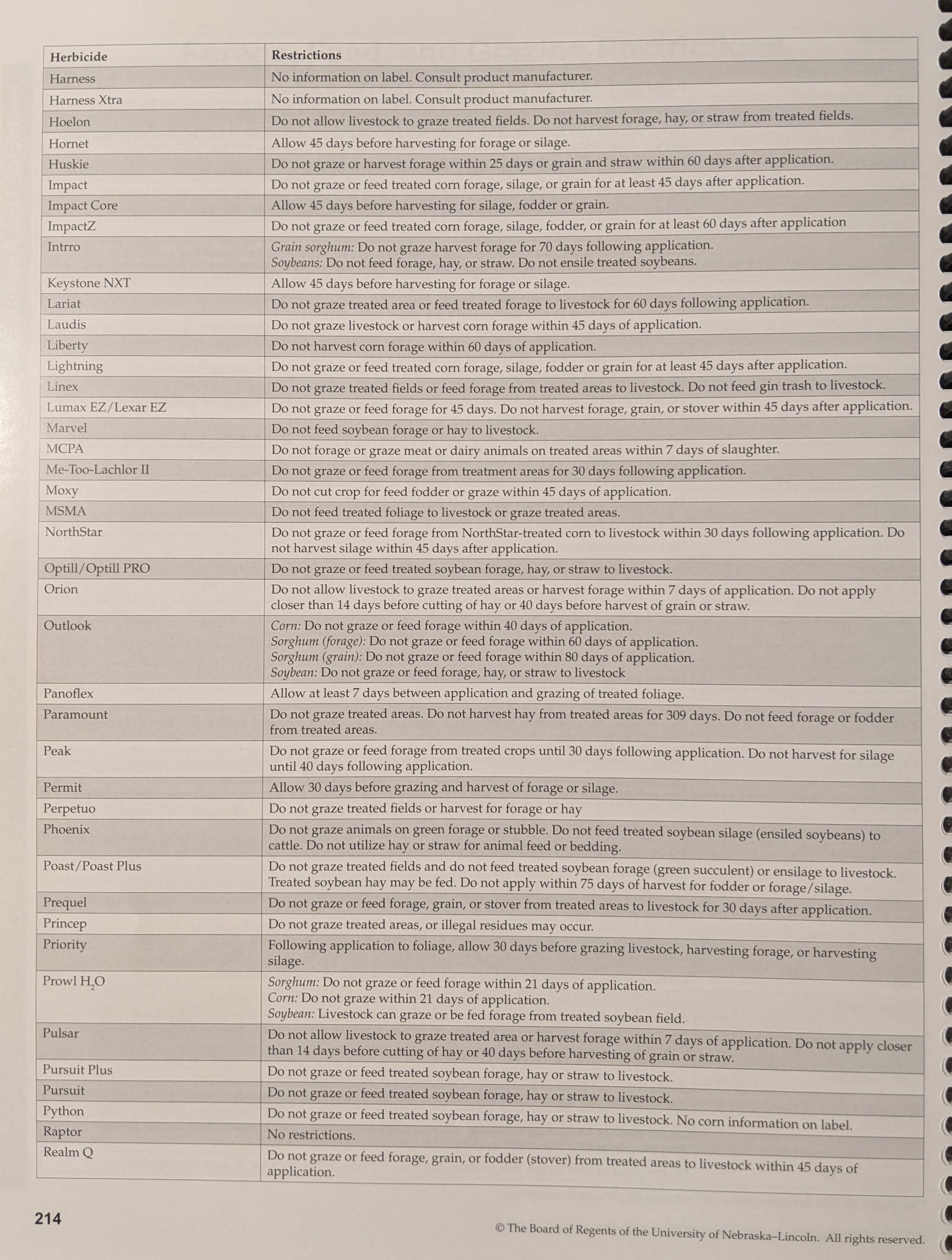
Grazing Restrictions: Be sure to check labels for any grazing restrictions if livestock will graze cornstalks after a fall herbicide application (I’ve added photos of the grazing restrictions from the 2022 Weed Guide on my blog jenreesources.com). If the label doesn’t specify and you want to be on the safe side, a rule of thumb is to use the pre-harvest interval for the amount of time to wait before grazing stalks.
Water Testing Kits from UBBNRD: The following is a small excerpt from the UBBNRD Blueprint newsletter on this helpful program for rural residents. For the full article and information, please see: https://www.upperbigblue.org/%E2%80%8B-free-water-quality-test-kits-offered-rural-residents. “Consuming water with elevated levels of nitrate-nitrogen can have significant health risks, especially for younger people. (EPA guideline for safe drinking water is less than 10 parts per million of nitrate.) Annual testing of your water is an important way to protect the health of everyone in your home—and a new test kit now available through the Upper Big Blue Natural Resources District makes that even easier to do. Thanks to a partnership with the University of Nebraska Lincoln, the Upper Big Blue NRD can now mail simplified at-home test kits to district residents for free. To request a kit, call (402) 362-6601 or email info@upperbigblue.org with your home mailing address. The at-home kits are not as sensitive as having a sample tested in the lab, but they do provide a simple way to determine if additional testing is required to identify what further steps need to be taken to improve drinking water quality, such as installing a reverse osmosis filter.”
2022 Nebraska Ballot Initiatives are explained by Dr. Dave Aiken in this document https://agecon.unl.edu/2022-nebraska-ballot-issues and webinar https://go.unl.edu/n2pw.




JenREES 10/30/22
Grateful to hear the corn moisture is dropping and to see more replant corn being harvested! As November 1st is around the corner, some may be thinking about fall fertilizer. It’s important to consider soil temperatures regardless of the date one can apply fall fertilizer in area NRDs. Soil microbial activity and the conversion rate of ammonium to nitrate is very low when the soil temperature is less than 50oF. Thus, apply anhydrous ammonia (and manure) when the soil temperature at the 4” soil depth is below 50°F and trending cooler. We’re currently hovering above that mark and probably will be above it with the warmer air temperatures this week. You can view soil temps at: https://cropwatch.unl.edu/soiltemperature.
With the dry conditions, make sure there’s a good seal. One may also wish to consider if the anhydrous is deep enough and consider how it may impact your seed zone next spring if we remain in dry conditions. Be aware that soil nitrates are typically higher than normal after a dry growing season, especially in non-irrigated fields and even more so in non-irrigated fields that had wildfire damage.
As one looks at soil test results this fall, also be aware that soil pH and potassium (K) results are often lower than expected due to dry conditions, particularly in non-irrigated situations. It is true that below-normal yields result in lower phosphorus and potassium removal from the soil. However, as Dr. Antonio Mallerino from ISU shares, “a couple of processes may counteract this possible increase and most likely will result in lower soil-test P and K results than expected.
- Below normal rainfall from the time of physiological plant maturity until the time of soil sampling results in much less K recycling to the soil than normal, and consequently lower soil-test K levels than with normal fall rainfall.
- While a small soil-test P reduction is possible, it is also less likely.
- Scarce or no rainfall since early September slows down the normal reactions between soil nutrient pools, which often results in lower soil-test K levels. Plants are like pumps taking up P and K from the soil, but the uptake decreases sharply a couple of weeks before the crop reaches physiological maturity. Normal rainfall allows for the replenishment of the available nutrient pools from the less available pools.
- Soil pH values likely will be less than normal (more acidic) with drought, with differences ranging from 0.1 to 0.4 pH units being common. This is because small concentrations of soluble salts normally present in the soil solution are not leached to deeper layers by rainfall, which results in higher hydrogen ion concentration and greater acidity in the topsoil. On the other hand, drought has little effect on the soil buffer pH, which is used to estimate the lime requirement.”
He suggests, if possible, to wait on soil sampling until at least a week after a ‘meaningful’ rain event occurs; he suggests that would be one that wets the profile at least 6”. Since that’s not looking likely, if obtaining soil samples this fall, it’s important to obtain a full soil core when sampling and be aware that the K results will be low, P should be fairly on track, and pH will also be low.
Returning to the Farm Workshop Dec. 9-10 at Holthus Convention Center in York: This is a workshop series for families who are in the transition process of bringing members back to the farm or ranch. The series assists families and agricultural operations with developing financial plans and successful working arrangements to meet their unique needs. It will guide families in developing estate and transition plans, setting personal and professional goals and improving the communication process between family members. The workshop fee is $70 per person. It also includes two follow-up virtual workshops in the evenings on Jan. 12 and Feb. 2. Registration & more info: https://cap.unl.edu/rtf22.
Fire and Wind Damage to Fields
Fire Damage to Fields
Am grateful for reports of few people hurt, many homes saved, and I think most cattle saved too from Sunday’s fires. I really can’t imagine how all that works with that many firefighters, first responders, and farmers showing up with equipment driving blind into smoke/dust/fires and everyone staying safe, but am grateful. With Sunday’s winds and the fire damage throughout the State, have received questions on what to do next in these damaged fields and what to anticipate for soil impacts.
For fields that were harvested with residue burned, we’re recommending to get rye or wheat planted into them to potentially get some cover on these fields. I know it’s dry. We keep hoping for moisture with each of these potential rains forecasted (including this week). But if there’s any chance to get some cover, I’ve seen 1″ tall rye produce up to 3″ roots and watched how that size of rye helped this past spring with the winds and in 2019 in helping hold soil during the floods. Rye can germinate down to 32F soil temperature and wheat can germinate down to 39F. So that’s our recommendation. If you have smaller areas where you can get manure on that has any type of bedding in it, that also could help.
A few calling from Nuckolls Co. have wondered about fire damage to long-term no-till. Fire itself won’t damage no-till from the standpoint of the soil structure built. It will remove residue and the organic matter from the residue, but the fire itself doesn’t impact organic matter. Fire and the resulting ash does impact water infiltration as the ash can clog soil pores. Wind erosion can also ‘seal off’ the soil surface which can reduce water infiltration. Thus another reason why drilling a small grain in hopes of disturbing the ash and getting cover established may help.
Nitrogen and sulfur to a small extent are released to the atmosphere during fire, and nitrogen and other nutrients become more available in the soil due to quick mineralization from the fire. Nutrients from the residue will be contained in the ash which can be lost to wind erosion, but those nutrient losses are fairly minimal overall. To read more on soil impacts, see this resource from Montana State. It has an interesting chart showing the amount of N, P, K in the top 6″ of soil and then compares how much is removed from stover that’s harvested or burned. The numbers for residue removal aren’t exactly the same as what we share for Nebraska, but they’re in line.
Plan on soil testing, may be wiser next spring, to determine nutrient levels in these fields prior to planting. The combination of drought + fire may result in greater nitrogen availability than what one may think.
Fire can often aid grasslands, so would say to let pastures work to recover on their own for now.
I hope all the fields impacted were harvested, but if you have a field that wasn’t, please give me a call and we can talk through that. Ultimately, what we’ve been recommending for fields in this situation in northeast Nebraska has been to harvest the fields as normal and send in grain samples to get a feed value and also quality value. All those fields have been corn fields so far. Dr. Mary Drewnoski has put together information on feeding burned corn that we can share for anyone who needs that.
Wind Damage to Replant Corn Fields
I had been watching different forecasters talking about last weekend for a few weeks. Grateful it wasn’t like they were originally predicting. So last Friday I had popped into fields to see how stalks were holding up. From what I was seeing in the replant corn, I figured a lot of the tops would blow out as plants were quickly losing strength above the ears. Was seeing up to 35% stalk rot (base of plants) in irrigated fields and over 50% in non-irrigated. So far, have seen good shank attachment and ear attachment within the shanks. Grateful for how the ears have held on and the bottoms of plants have held up thus far!
In saying this, it’s honestly a matter of time before these replant corn plants will go down and/or potentially drop ears. I seek to be positive, but I also want to be honest with what I’m seeing. I’m hearing the wind dried corn down compared to last week. Please be checking moistures in your fields. I realize everyone’s situations vary with bins, etc.; it may be wise to keep harvesting a little at a time and drying in between instead of waiting for it to dry in the field this year.
If you’re willing to share your replant corn test weights anonymously, please do so here: https://docs.google.com/forms/d/e/1FAIpQLSfpgVRce5VJ6ytg1S2gZlqBfFAa10qINVhWIkVFSpaFh89-7A/viewform?usp=sf_link.
JenREES 10/23/22
With each of these red flag days, am grateful for our firefighters, first responders, and all involved helping fight fires; praying for all of them and those who are impacted. Sharing this week on some upcoming November programs and a grain question I received when it was cold last week.
Should low moisture corn be cooled in bins? Will running air remove much more moisture? Dr. Ken Hellevang with NDSU answered the following question. “The temperature of the corn will change many times faster than any moisture content change. We can estimate the cooling time by dividing 150 by the airflow rate. So, if the airflow rate is 1.0 cfm/bu, it will only take about 15 hours to cool the corn. To change the moisture content of all the corn at that airflow rate will take about 40 days. Even at a typical aeration airflow rate of about 0.2 cfm/bu it only takes about 3 days to cool the corn.
Anytime we cool the corn, there will be a minor (fraction of a percent) reduction in moisture. Therefore, with dry corn running the fan at night during higher humidity conditions is beneficial. I would run the fan all day and night for the most rapid cooling and just at night if willing to be controlling the fans.
I encourage farmers to cool the corn whenever outside temperatures are 10-15 degrees cooler than the corn, so they certainly could utilize the cooler air to cool the corn.
With the corn at moisture contents of 13% or less, it will store at the warmer temperatures for a while, so there is not a problem with waiting. They will need to cool the corn for winter storage at some time to limit the potential for moisture migration and wet corn at the top of the bin. This occurs if there is consistently at least a 20 degree difference between outdoor air temperature and the corn temperature.”
2022 Nebraska Ballot Initiatives are explained by Dr. Dave Aiken in this document https://agecon.unl.edu/2022-nebraska-ballot-issues and webinar https://go.unl.edu/n2pw.
Cover Crop Grazing Conference will be held November 1st at the Nebraska Research and Extension Center near Mead (1071 Co. Rd. G). This conference is designed for crop and livestock producers with a trade show, speakers, producer panel, and cover crop field demonstrations. The day begins at 9 a.m. with registration and a trade show with the program running from 10 a.m. to 2:45 p.m. Speakers include Ben Beckman (Rotational/Strip Grazing) and Brad Schick (Grazing of Perennial and Annual Forages). There is a $10 registration fee payable via cash or check at the conference to cover lunch and refreshments. RSVP at: https://enrec.unl.edu/covercropgrazingconference/. If interested in exhibiting in the trade show, please contact Connor Biehler at cbiehler2@unl.edu or 402-624-8007.
Nebraska Extension Weed Science School will be held Nov. 9 at the Eastern NE Research and Extension Center near Mead (1071 Co. Rd G). Registration begins at 8:30 a.m. with program from 8:45-2:30 p.m. CCA credits are available. Speakers and topics include: Amit Jhala (Nebraska Weed Management Survey Results); Kevin Bradley with University of Missouri (Future of Weed Management in 2023 and Beyond); Jenny Rees (Herbicide options when interseeding cover crops into corn and soybeans); Nahar Neta with Greeneye Technology (Spot herbicide application technology for weed management in corn and soybean); Bob Klein (Spray quality and carrier rate-how they affect herbicide efficacy and spray drift?); Stevan Knezevic (Soybean response to 2,4-D and dicamba); Sam Wortman (Off target injury of dicamba or 2,4-D in specialty crops). No fee but please RSVP for lunch: go.unl.edu/weedscienceschool.
Central NE Regenerative Ag Conference will be held Nov. 18 at the Tassel Performing Arts Center in Holdrege, NE from 1-4:30 p.m. with Gabe Brown as the featured speaker. Fee is $15 if pre-register by Nov. 14; otherwise the fee is $25. Registration is through Central Community College in Holdrege. Register online or you can call them at 308-995-8133. Just FYI, it gave me a confirmation email saying I registered for “Entrepreneurship”, but the day and time were correct. More information at: https://greencover.com/event/soil-health-and-regenerative-agriculture-conference/.



 JenResources