JenREES 5-27-18
Crop Update: Wheat is mostly in various stages of heading through pollination in this part of the State. The wheat scab risk prediction model (http://www.wheatscab.psu.edu/) was forecasting higher potential for scab in portions of Nebraska last week with a relax in the model this week due to higher temperatures and no moisture. Please keep an eye on your growth stages, the weather, and the model for risk of scab in your wheat.
Don’t have too much in the way of corn and soybean updates other than it’s good to see guys finishing planting and getting herbicide applications down. Waterhemp and palmer range in size from emergence to 4 inches from what I was seeing this past week.
Also a reminder to install irrigation scheduling equipment soon. It’s always easier to install earlier than when plants get larger! Check out this week’s CropWatch article at https://go.unl.edu/n0u0 which shares additional information about ET gage sites; reminders and tips for installing ET gages and watermark sensors.
Wheat and Field Pea Field Days: There are 11 upcoming wheat field days throughout the State, many of them coupled with field pea/pulse/cover crop field days as well. During the field visits participants will be able to learn more about different varieties of wheat, field peas, chickpeas and forages. Depending on the location, field visits will also include demonstrations of other specialty crops (lentils, winter canola, forages, cover crops) and effects that different agronomic practices (planting dates, seeding rates, fertilizer management, etc.) have on crop yield and yield quality.
Besides field visits, the field days will feature indoor sessions with a free lunch, a 30-minute networking session, and brief research updates. Networking sessions will allow participants to meet with seed, processing, and marketing businesses critical to pulse cop industry development in Nebraska. The research updates will include: Production and marketing of pulse crops, Incorporating cover crops in wheat and field pea cropping systems, and Wheat production – management for higher yield and grain protein. Area dates/locations are listed below and all flyers with additional information can be viewed at: https://go.unl.edu/vto8.
- May 30: Wheat Field Day, 6:30 p.m. at Fairbury, RSVP rpryor1@unl.edu
- June 12: Wheat and Pulse Crops, 9 a.m. at the UNL ENREC near Mead, RSVP nathan.mueller@unl.edu
- June 18: Wheat and Pulse Crops, 9 a.m. near Callaway and at North Platte (UNL WCREC), RSVP sstepanovic2@unl.edu
- June 19: Wheat and Pulse Crops, 8:30 a.m. near Grant (UNL Stumpf Wheat Center), RSVP sstepanovic2@unl.edu
- June 20: Wheat and Pulse Crops, 9 a.m. near Alma and Bladen RSVP sstepanovic2@unl.edu
Nebraska Field Pea Field Days are free, thanks to sponsorship by the Sustainable Agriculture and Research Education (SARE) in Nebraska, the Nebraska Environmental Trust, and the pulse crops seed and processing industry.
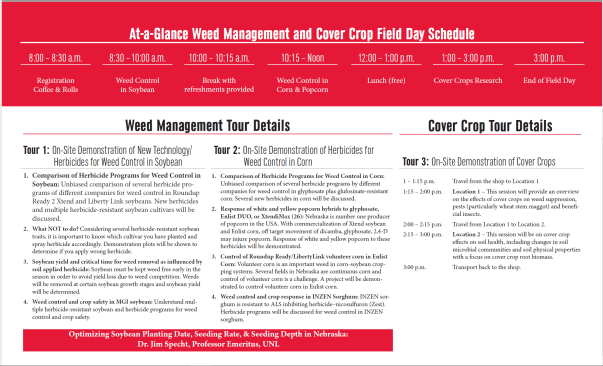
South Central Ag Lab (SCAL) Weed Science and Cover Crop Field Day: View demonstrations of new technologies and herbicides for weed control in corn, soybeans, and sorghum and effects of cover crops on soil health and pest management at the June 27 Weed Management and Cover Crops Field Day. It will be held at the South Central Ag Lab near Clay Center. The day begins with registration and rolls at 8 a.m., followed by weed management tours from 8:30 a.m. – noon, and cover crop demonstrations from 1 to 3 p.m. A free lunch will be served. In addition to the field demonstrations, Jim Specht, University of Nebraska-Lincoln professor emeritus, will presented on “Optimizing Soybean Planting Date, Seeding Rate, and Seeding Depth in Nebraska.” CCA credits will be available. Please pre-register at: https://agronomy.unl.edu/fieldday. The South Central Ag Lab is 4.5 miles west of the intersection of Hwy 14 south (to Clay Center) and Hwy 6 or 12.4 miles east of Hastings on Hwy 6. GPS coordinates: 40.57539, -98.13776.
Tours Include:
- Comparison of Herbicide Programs for Weed Control in Soybean including Roundup Ready 2 Xtend and Liberty Link Soybean, Examples of spraying the wrong herbicide on wrong soybean herbicide-resistant cultivar, Weed removal at different growth stages and yield impacts, and Understanding multiple herbicide-resistant soybean herbicide programs.
- Comparison of Herbicide Programs for Weed Control in Corn including glyphosate and glufosinate-resistant corn in addition to several new corn herbicides, response of white and yellow popcorn to various herbicide chemistries and off-target movement, control of volunteer corn in Enlist Corn, and Weed Control and Crop Response in INZEN sorghum.
- An Overview of the Effects of Cover Crops on weed suppression, pests (particularly wheat stem maggot) and beneficial insects. Cover Crop Effects on Soil Health, including changes in soil microbial communities and soil physical properties with a focus on cover crop root biomass.
Soil Moisture 5-23-18
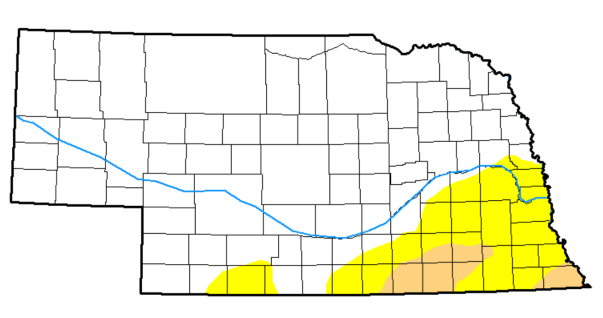
Drought monitor as of 5/22/18: The tan area of moderate drought increased to 3.67% (from 1.88 a week ago) this week while the yellow abnormally dry area decreased to 18.34% (from 22.57% a week ago).
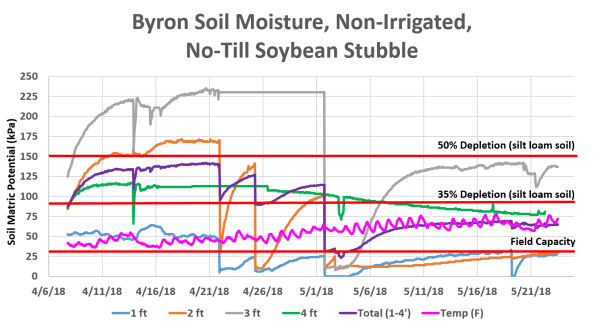
The Byron area received around 0.28″ which allowed for a brief drop in the first foot sensor but didn’t stay there. Both the first and second foot are around field capacity, and there also seemed to be moisture in these feet from probing this field. Total soil moisture depletion is remaining steady.

This site received 0.65-.70 last week and the sensors were re-installed once planting occurred. There were some strange readings in the sensors so I didn’t show the graphs last week. In probing the field, there seemed to be moisture in the top two feet. Thus, I couldn’t understand 2 foot readings shown here. I had reprimed the 2′ sensor last week so I knew it was working. It got installed deeper than 24″ and in probing the soil, it is dry and cumbly below 24″ which seems to be reflected here. Thus why I put 2+’ in the graph for the sensor reading.
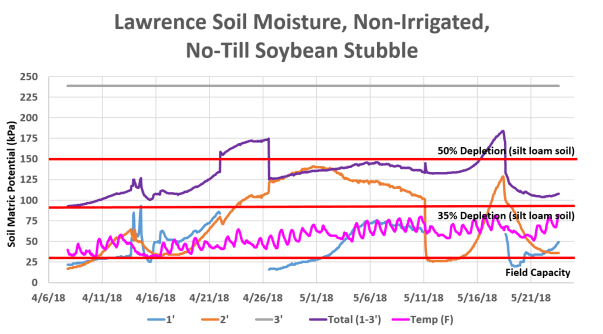
This site, across the road from the corn site, also received 0.65-0.70″ of rain. I also probed this field this week. Total soil moisture depletion is around 40% for this field. The second foot where these sensors are located is in a heavy clay in this field compared to the corn field.
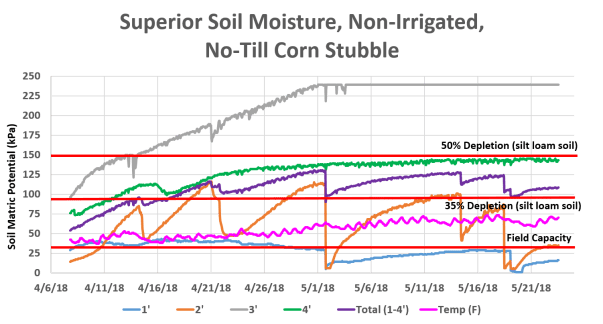
At Superior, a moisture event of 1.05″ was received May 18. This helped add moisture into the top two feet with the second foot around field capacity now. Total soil moisture depletion is around 37%. I also probed this field and there appeared to be moisture in the top two feet and it got dry after that.
Soil Moisture 5-17-18
Hoping these graphs change for us after this past weekend’s rain events! These readings were taken as of 5/17/18.

As of 5/17/18, total soil moisture depletion in this field stayed fairly steady. The top two feet are nearing field capacity.

At the Superior location as of 5/17/18, total soil moisture depletion remained around 40%. The first foot is nearing field capacity with the second foot nearing 35% depletion.
At the Lawrence location I’m just sharing last week’s graphs from 5/10/18. Soybean was planted into the corn stubble on 5/11/18 and the sensors were removed and re-installed with the readings needing time to adjust. The farmer said it was so dry he had to use a drill to re-install the moisture sensors. I have no idea what happened in the soybean stubble field but the readings this past week were crazy so decided to share new graphs on the Lawrence location next week.


JenREES 5-20-18
Crop Update: So grateful for rain and truly hope those who wanted and needed rain received it! An update to soil moisture profile as of 5/17/18 can be found at http://jenreesources.com.
A number of crop issues surfaced this week. One being root burn and wilted-looking corn seedlings from anhydrous ammonia applications with the dry winter/spring we’ve had thus far. Anhydrous ammonia can expand in soils 2.5-3” in all directions and potentially more in dry soils. Pivots were running to help with that and hopefully rain events will help non-irrigated fields that were suffering in this way. Another problem observed in some non-irrigated corn fields has been fomesafen carryover injury from products such as Flexstar, Reflex, Prefix, etc. These products have a 10 month planting window back to corn which is fine in most years, but dry conditions didn’t allow for the herbicide to break down in all situations from applications last June. This active ingredient is in Group 14 (PPO inhibitors) and the injury from this particular active ingredient is unique in that it causes yellow/brown striping of the veins themselves instead of interveinal chlorosis/necrosis. Seedlings most affected right now are found on field edges or wherever there was overlap of application. Hopefully corn should grow out of this injury in time. Herbicide carryover may be a something to watch for in soybean as well from other active ingredients. We also saw regrowth occurring on plants affected by wind/dust/debris damage but there are situations where replanting will be needed on endrows, etc. Roger Elmore has a photo gallery explaining regrowth in this week’s CropWatch at http://cropwatch.unl.edu.
Another situation that surprised me this year was finding seed corn maggot damage in

Seed corn maggot feeding on soybean seed. No insecticide was included in the seed treatment.

Seed corn maggot affecting soybean seedlings by feeding on cotyledons and hypocotyls. The brown grain-like structure in the bottom of the picture is a seed corn maggot that is pupating. These seeds did not have an insecticide in the seed treatment.
soybean. At first I was puzzled as the beans were clearly treated but then learned the beans didn’t have an insecticide added to the seed treatment. In scouting a number of fields, I’ve actually seen quite a bit of seed corn maggot damage, particularly in tilled fields and those with manure applied or those with cover crops that were green or where termination included tillage. I’ve also been surprised how many have told me they don’t use an insecticide seed treatment on early planted beans. We didn’t have any research in our early soybean planting studies without insecticide + fungicide seed treatment so we just automatically recommend both. Unfortunately this year we’re seeing what can happen without it with higher insect pressure in some fields. For seedlings with the insecticide seed treatment, I’m seeing light scarring on the cotyledons and hypocotyls but no maggot penetration. In fields without the seed treatment, I’m actually seeing penetration of the cotyledons and hypocotyls. The good news is that most of the maggots were also pupated, pupating or will be soon. But it is something to watch for, particularly in fields that have been tilled and especially if manure was applied or they were tilled and had a cover crop on them. They are not as attracted to no-till fields. Regarding stands, from my experience with soybean pops and stand loss due to crusting, hail, herbicide injury, etc., I keep stands of 60,000 plants/acre or more. It really stinks to talk about replanting anything right now with guys still trying to finish planting. If you choose to replant soybeans, consider proving it to yourself by planting strips and leaving strips. If you’re interested in that, I’d be happy to work with you. You can learn more about seed corn maggots here: https://crops.extension.iastate.edu/cropnews/2016/04/look-seedcorn-maggot-corn-and-soybean.
Wheat in the area ranges from boot to flowering. A couple of wheat fields I know of

Wheat field cut at boot stage for hay.
were taken for hay. For those still considering silage, check out the CropWatch article this week where Todd Whitney shares data on wheatlage (wheat silage): https://go.unl.edu/qkbr. The rainfall will greatly help our wheat right now. And, rainfall at heading to flowering makes me think about the potential for Fusarium Head Blight (scab). The wheat scab prediction monitor http://www.wheatscab.psu.edu/ is predicting medium to high risk for scab in Nebraska for the next 48-72 hours. Some years I feel the model is delayed in prediction, but I still feel it’s a good tool and resource. Scab is caused by Fusarium graminearum and is favored by warm (70-80°F temps), humidity, and rain events before and during flowering. Once wheat begins flowering (Feekes 10.5.1), many foliar wheat fungicides are off-label. In fact, recent research presented at the 2017 Fusarium Head Blight meetings shows that in general, strobilurin products can actually increase the presence of deoxynivalenol (DON) in wheat if applied at full heading (Feekes 10 or 10.5). Thus, your better fungicide options for preventing scab are Caramba and Prosaro and these products can also kill any fungal diseases present on leaves (such as powdery mildew, tan spot, and rust). These products aren’t 100% for scab prevention due to the variation of heading and flowering that occurs in so many fields. Better efficacy is obtained with more uniform plants which begins at seeding time. So I would recommend watching the growth stage in your fields, the weather, and the prediction tool regarding if you feel you need to treat any fields this year to prevent scab. Research has shown best efficacy to be obtained when at least 50% of the plants are at 1/3 flowering. Flowering begins with yellow anther sacs in the middle of the head with flowering continuing throughout the head from there. Once the pollen is released, the anther sacs turn white.
LBNRD Open House Public Hearing: The Little Blue Natural Resources District (LBNRD) is hosting a public hearing on May 29th from 6:30-9:00 p.m. at the Davenport Community Center in Davenport, NE. The purpose of the hearing is to provide information and receive testimony on proposed amendments to Groundwater Management Rules and Regulations. The hearing will be an open house format allowing individuals to ask questions of the NRD staff, look at exhibits, and offer testimony. The proposed rule changes and additional information can be found on the LBNRD website at: http://www.littlebluenrd.org/. Please contact the NRD with any questions at (402) 364-2145.
Not part of my news column: on a more positive note after mentioning all the crop problems, the lilacs in general were beautiful and smelled amazing!!!


Soil Moisture 5-10-18
The area of ‘abnormally dry’ or ‘moderate drought’ was reduced by 5% in Nebraska as of 5/8/18 compared to the previous week.
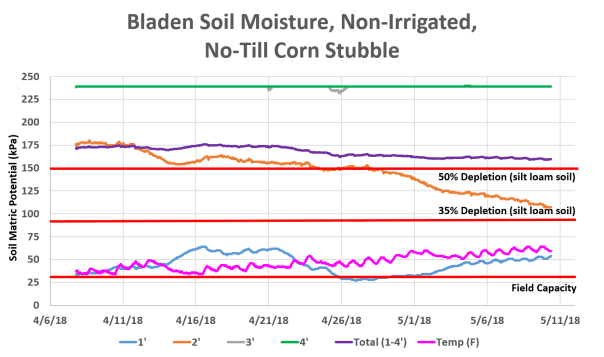
This site has continually missed the rain. The first foot can be observed as slowly drying out as well this week with total soil moisture (1-4′) remaining above 50% depletion. This site was removed due to corn being planted in this field.

Last week’s rains did help the first and second feet remain below field capacity. However, the third foot did not remain wet after the rainfall event and can be seen climbing in depletion in the graph this week. I did probe this site this week and there appears to be good moisture now just past 2 feet, but it gets dryer after that.
This site continues to remain steady with total soil moisture depletion around 35%.
The first foot sensor has leveled off after being reprimed on 4/26. Total soil moisture depletion (1-3′) remains around 45%.

Last week’s rains helped with the first foot and somewhat with the second foot at this site. Total soil moisture depletion is around 40%.
JenREES 5-13-18
It was great to see so many fields of corn and even soybean emerging throughout the


area this past week! Also grateful for the rain we received in York and for those who received some in other areas. There are still areas who continue to miss rains and I remain concerned about the soil moisture situation. I have another soil moisture update this week at http://jenreesources.com if you’re interested in checking that out.
Thursday night/Friday morning’s high winds caused some damage with overturned pivots/corner systems and tree damage. We also saw newly emerged corn and even soybean cut off or
Corn plants were buried or cut off by blowing residue/soil. A few remaining plants in this area of the field can be seen.
buried due to blowing debris/soil, particularly in soybean stubble. It will be important to watch the plants in these fields the next several days. By late Friday afternoon, I was already seeing new growth occur, which is good. Typically, that has been the response in the past-new regrowth in corn as the growing point is still below ground. However, it will be important to watch the corn plants for any bacterial issues that may kill seedlings. One can also split open a few plants and look for a healthy growing point. Regarding the soybean, I have seen soybean lose cotyledons due to hail, crusting, freeze, and wind damage, and still produce a plumule at the top of the soybean stem. It’s just hard to know for sure what will happen so it’s best to watch the plants in the fields.
Wheat in Nuckolls, Thayer, and Webster counties ranges from elongation to near boot and is turning blue-gray from moisture stress. Wheat is a crop that I’m always learning about-it can look really bad (or really good) and then end up surprising a person regarding yield either way. Lower leaves


in fields are turning yellow-brown. Some of this is due to moisture stress while there’s also powdery mildew pretty thick in lower canopies of wheat that had more tillers. A few have talked with me about using the wheat for hay or silage and then potentially going in with short season corn, sorghum, or a forage crop. Our forage specialists would recommend that if the wheat variety has awns, it’s best to either take for hay or silage at the boot stage so the awns don’t cause issues with livestock feeding. Todd Whitney, Extension Educator in Phelps/Gosper counties, had worked with a feedlot using an awnless wheat variety. Because of the additional growth that occurs in wheat (and other small grains) from boot to full head elongation, they found biomass production may be increased 25% if the forage was harvested during the later pollination period.
Evergreen Trees: There’s also been a lot of evergreen tree questions. For those noticing spruce trees looking kind of yellow with early morning sunlight, spruce spidermites have been working hard with the cooler, dry weather. They tend to build populations in spring and fall. You can check for spidermites by taking a white piece of paper and banging the needles on it. Then look for the presence of tiny dark green to nearly black spidermites crawling on it. Rainfall is a great way to wash them off of trees as are strong streams of water (easier done with smaller trees). There are also a number of miticides available that homeowners can purchase from lawn and garden stores (look for products that say they can be applied to trees for control of spidermites). A great brochure on insect pests of evergreen trees can be found at: https://nfs.unl.edu/documents/foresthealth/insectevergreen.pdf.
Many of us also noticed our spruce trees turning red/brown/purple/yellow in color last fall. This is most likely a disease called needle cast of spruce and can be prevented by spraying trees now (mid-May) with a product containing copper sulfate. Regarding Ponderosa or Austrian pines, if you look closely at the needles and observe dark bands or rings on them followed by death of the needle either direction from the band, the tree problem is most likely due to a fungal needle blight like dothistroma or brown spot in Scotch pines. They can all be prevented by spraying a fungicide containing copper sulfate now. The following brochure on diseases of evergreen trees is really helpful: https://nfs.unl.edu/documents/foresthealth/diseasesevergreen.pdf. Sometimes the problem is finding the products listed on these brochures in our smaller towns as these brochures were developed in Lincoln. If these specific products aren’t available from your local lawn/garden store, box store, or coop, I would recommend looking at the products available and look for a product that says it is effective against needle blights on trees. Not all the products I’m seeing have copper as an active ingredient, but other fungicides are listed and the key would be the fact that the site (trees) and even better, the site with problem (trees with needle blights), is listed on the label.
We also continue to see pine wilt affecting our Scotch (short needles in groups of 2) and Austrian pines (long needles in groups of 2). Pine wilt disease is caused by the pinewood nematode that is carried within the gut of a long-horned beetle. The beetle is what creates the ‘shotholes’ often seen in bark of infected trees. The nematode is native to Nebraska, as are Ponderosa pines (long needles in groups of 2 and 3). This is why we don’t see the problem in Ponderosa pines but do in Scotch and Austrian, which are non-native to Nebraska. A tip, if you’re trying to distinguish Ponderosa vs. Austrian pines, anytime you see needles with a group of 3 it’s a Ponderosa. Pine wilt is caused by beetles carrying pinewood nematodes vomiting them into the water-carrying vessels of the tree (xylem). The tree senses the nematodes and essentially blocks water to those branches. Often you will observe a branch then perhaps a side of the tree and eventually complete death of the tree within 6-9 months. While I have diagnosed many samples of pine wilt, more often when I visit homeowners the tree problems are due to fungal diseases which occur on the needles.
Lawns: Please remember the importance of sweeping or blowing fertilizer and pesticide products back into the lawn instead of leaving them on sidewalks. Leaving them on the sidewalks puts them in contact with people and pets walking on sidewalks and moves them into storm water systems via rain that can eventually end up in streams. I’m also seeing a number of 2,4-D/dicamba products being sprayed around tree bases to kill weeds which is affecting the new growth emerging on trees. Consider applying a wood mulch layer around the base of trees to help avoid this situation in the future and be sure to read and follow all pesticide labels.
JenREES 5-6-18
What a beautiful weekend! It was a welcome change from the winds we received last weekend and early week. The high winds early in the week created difficult situations from many perspectives-soil loss, visibility, accidents, and drying out the seed bed.
Great to see several on-farm research plots going in and to have some new cooperators this year! I also started a very small soybean planting date demo at the York County Fairgrounds on April 24. A farmer on Twitter was encouraging other farmers to try planting a few seeds every week for yourselves in a garden plot and count the nodes and pods. Thought it was a great idea and will have it signed at County Fair regarding soil temps for first 48 hours and nodes. Thanks to Jed Erickson from Pioneer for the seed!
Rain events on May 1-2 allowed for some soil moisture recharge in the first and second feet in some locations. Unfortunately, the rainfall was still fairly spotty. We could really use rain overall for getting moisture back into drying seedbeds, activating herbicides, and settling dust. Pivots are running in some fields because of these factors. I provided an update on the locations I’m monitoring regarding soil moisture as of 5/3/18 on my blog at http://jenreesources.com. The farmers were interested in continuing this monitoring throughout the growing season this year, so will continue sharing as often as I can.
Wheat: Wheat’s joined in the area and ranges in height depending on soil moisture. For the past few weeks we’ve been noticing yellowing leaves. Some of that may have been due to cold temperatures. I was also seeing powdery mildew within the canopy of several fields I looked at. No rust has been observed yet in Nebraska fields. I also noticed tan spot in wheat on wheat fields. One concern was the cool weather has allowed for bird cherry oat aphids in area wheat. My concern is that they can vector barley yellow dwarf virus which is one we see when the flag leaf emerges. According to K-State, there’s not strong developed thresholds. They’re recommending if 20 or more aphids are observed per tiller with lady beetles observed on fewer than 10% of tillers, spraying may be justified.
Lawn and Garden Information: With this year’s cool spring, crabgrass preventers can still be applied the first few weeks of May. Germination begins with soil temperatures around 55F but prefers warmer soil temps. UNL Lawn calendars for Kentucky Bluegrass, Tall Fescue, and Buffalograss and all UNL lawn resources can be found at https://turf.unl.edu/turf-fact-sheets-nebguides. Mowing heights should be maintained at 3-3.5″ for the entire year. We also recommend just mulching clippings back into the lawn to allow for nutrient recycling. If you like to use mulch for your gardens, it’s important to read pesticide labels on products applied to your lawn. Some labels say it is not safe to use the clippings as mulch. Others say to wait at least three mowings before using the clippings as mulch.
Garden centers have been busy with the warmer weather and some have asked about temperatures for hardening off transplants. Kelly Feehan, Extension Educator in Platte County shares, “May is planting time for most annual flower and vegetable transplants. To avoid transplant shock and stressing young plants, wait for soils to warm up and take time to harden off transplants. Soils are colder than average this year so waiting to plant will be beneficial. And then, plants moved directly from a warm, moist greenhouse to windy and cooler outdoor conditions will be stressed by transplant shock. This can negatively affect plant growth, flowering, and vegetable production. Harden off transplants by placing them outdoors, in a protected location, for at least a few days before transplanting outdoors. Another way to harden transplants is to plant them in the garden, then place a cardboard tent or wooden shingle around them for a few days to protect them from full exposure to wind and sun. Planting young transplants on an overcast, calm day or during the evening also reduces transplant shock.” Specifically when it comes to tomatoes, it’s best to wait till mid-May otherwise “gardeners who plant earlier need to be prepared to protect tomato plants with a floating row cover or light sheet if cold threatens. To help tomato transplants establish quickly, begin with small, stocky, dark green plants rather than tall, spindly ones. Smaller plants form new roots quickly and establish faster than overgrown transplants. Do not plant too deep or lay tomato stems sideways. Although roots will form on stems below ground, this uses energy better used for establishment. Use a transplant starter solution after transplanting tomatoes to be sure roots are moist and nutrients are readily available in cool soils. Wait until plants are growing well before mulching or mulch will keep soils from warming and may slow tomato growth.”
Soil Moisture 5-3-18
Today was interesting driving my route through the southern tier of counties I serve. Wearing overboots and walking instead of driving to the sensors was welcome at Byron and Superior where heavier rain events occurred this week. However, Lawrence and Bladen had largely missed the rains. The Clay Center location received 1″ the past two days, but other areas of Clay County received very little. The farmers who have allowed me to monitor pre-plant soil moisture thus far were interested in watching this throughout the growing season. Thus, sensors will remain in most of these fields. Where fields have been planted thus far (other than Clay Center), planters have planted around the sensors and seeds have been hand-planted between sensors.

The Nebraska Drought Monitor Map updated 5/1/18 (before the rain events the past few days) showed expanded areas of ‘abnormally dry’ (yellow) and ‘moderate drought’ (tan). Stars show the locations of soil moisture monitoring equipment.
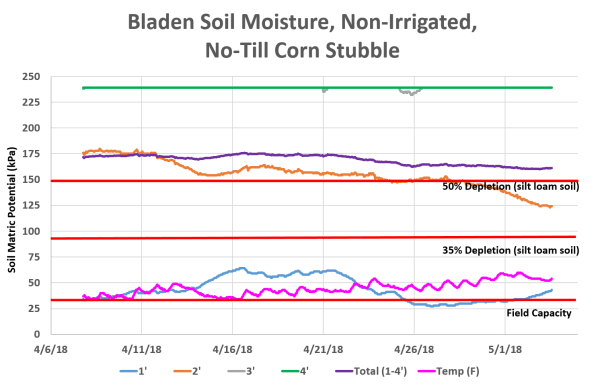
This location essentially missed the rains this week with the top foot remaining around field capacity and 2-4′ near 40% depletion or above. Wheat near this location had jointed but was shorter than at Lawrence and Superior.
This location has been interesting to monitor. Last week I mentioned that moisture received wouldn’t be enough to maintain the second foot near field capacity after 4/26 (which is true from the climb observed in the second foot). This location received 1.5″ the past two days. With the top foot at field capacity, it makes sense that today it is showing near saturation with the second foot dropping below field capacity as well. I should have probed the soil to see if moisture truly reached the third foot or not. The chart shows the third foot also filling below field capacity. We will know more from next week’s graphs. Being a no-till field, the rain soaked in well even though it appeared to come hard from the way the road had washed in spots and was super soft.

This location received some misting as I was collecting this data, but the sun soon came out and steam began rising from this field and the soybean field across the road (next graph). Essentially 0.05″ of rain was received at this location and the graph remained unchanged this week for the most part other than increasing soil temperature.

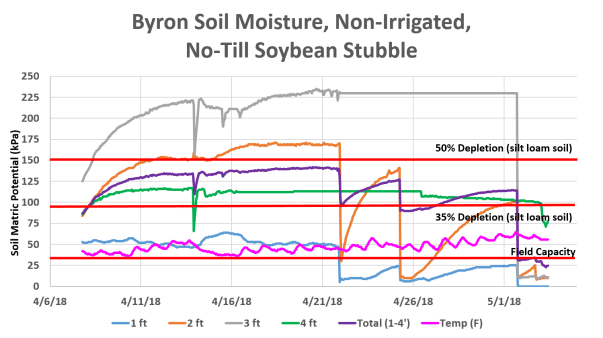
At this soybean location, something had caused for a disconnection in the 1st foot sensor last week, so I reprimed the sensor on 4/26. I didn’t take out the first 48 hours in this graph (which we say is normal time to acclimate to the soil). The first foot is currently showing over 15% depletion this week with total soil moisture depletion near 50%.
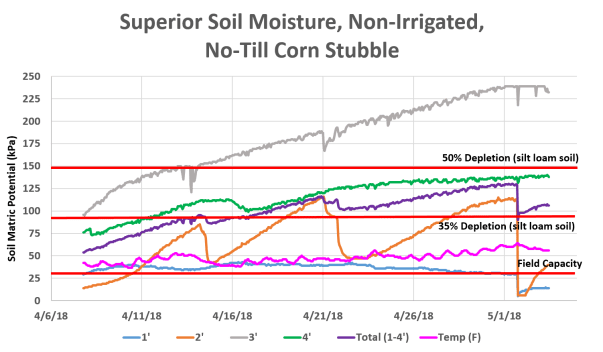
This location received 1.25″ of rainfall the past few days which helped the second foot recharge to near field capacity and the total soil moisture (1-4′) be near 35% depletion. Wheat near this location had jointed and elongated a great deal compared to last week.
Beginning Soil Moisture 4-26-18
Some rains helped with the top foot profile at some of these locations last week. One thing to keep in mind when viewing these graphs is we don’t always know what’s going on below the soil surface. One farmer had a good point regarding my “blips in the graphs” in my last blog post. I mentioned they could be due to a soil crack along the PVC pipe-which we do see occur and can be true. However, he also had a good point that it could be a worm hole, root channel, etc. that water may have followed for a brief time period, which could also be true, especially in these long-term no-till fields. As you look at the charts this week, it’s important to keep in mind that soil water also moves via gravity (termed ‘gravitational water’). Thus, sometimes why we can see changes in soil moisture in the successive drier layer with small amounts of precipitation.

Nebraska Drought Monitor as of 4/26/18 showing increasing ‘abnormally dry’ areas of the State. The ‘moderate drought’ area has expanded further into Webster and Thayer counties. Stars show locations where I’m taking pre-plant soil moisture status.
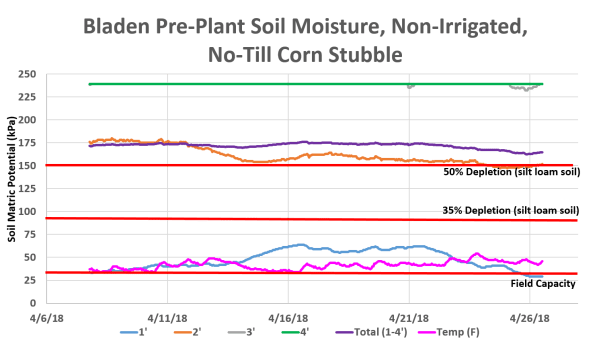
Beginning soil moisture at Bladen remained relatively unchanged last week. The top foot went back to around field capacity with some rain events. Total soil moisture depletion is above 50% at this site as are all soil layers from 2′-4′).
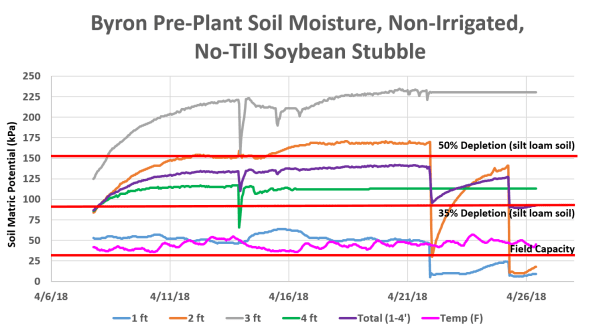
Moisture last week did appear to re-wet the top 2 feet. I even probed the soil in the same area to ensure there was truly moisture in the second foot, which there was. Yet as you can see from the graph, the second foot was starting to climb when I took these readings. My guess is without additional precip, the second foot will be above field capacity again next week.
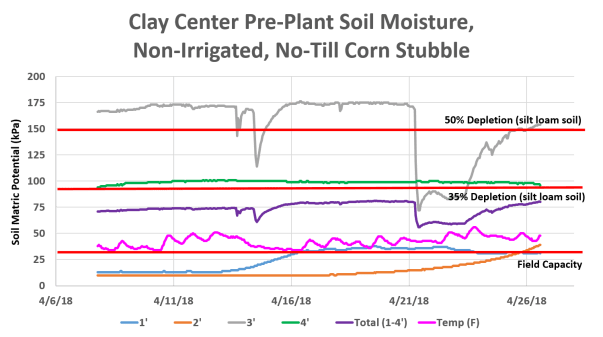
Because the top two feet were already around field capacity, gravitational water along with moisture received last week may have created the dip in the third foot readings seen over a few days. It was rising back up to above 50% completion on 4/26. The sensors were removed on 4/26 as the field was planted to soybean that day.

This location received 0.20″ of rain last week with essentially no change in soil moisture status from the previous week. Total soil moisture (1-4′) is steady around 35% depletion.
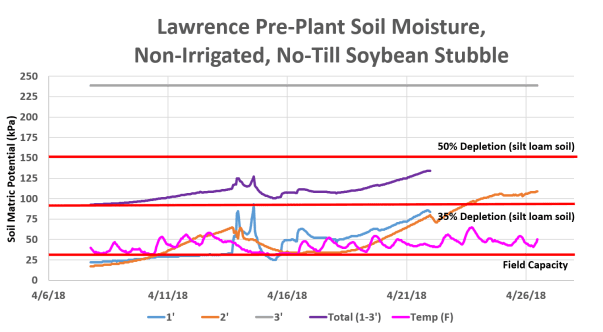
This location also received around 0.20″ of rain last week. Something happened to create a short in the top foot sensor, thus, the lack of data for 1′ and total (1-3′) after 4/22. It was fixed on 4/26.

This location received around 0.60″ of rain last week. The top foot remained steady and there was a gradual decrease followed by increase in soil moisture in the second foot. This would make sense from the combination of gravitational water and the precipitation moving through the first foot into the second, but the moisture wasn’t enough to maintain the second foot at a wetter moisture level.


 JenResources