Early Corn Growth Stages
Determining Corn Growth Stage: Grateful for the rain showers! With the cooler weather, corn plants appear shorter due to shortened internodes but are further along in development than one may think. Correct growth staging of corn using the collar method is important. Some herbicides have application restrictions of V8 (8 leaves), particularly when certain adjuvants are used. These restrictions are in place to protect developing corn ears.
Be sure to growth stage plants correctly counting collars (leaves pull away from the main stem like a collar around one’s neck). Start counting leaves at the base of the plant with the smallest rounded-tip leaf with a collar as #1. From there count every leaf with a true collar. Leaves that are still wrapped in the whorl around the main stem without exposed leaf collars are not counted. Plants around V6 (6 leaves) start losing the lowest leaf.

The growing point emerges above ground between V5-V6. After that point, splitting the stalk becomes the most accurate way to determine plant growth stage when lower leaves are absent. To stage using this technique, dig a plant inside the field (past the endrows) without breaking the stalk. Carefully split the stalk down the middle through the root ball. At the base of the stalk is an inverted triangle that contains Nodes 1-4 (but they can’t be differentiated). Next look for the white area above that (about ½-3/4”) followed by the next visible band. The white area is the internode with the band being the 5th node (V5). There’s about an inch of internode between V5 and V6. After that, internode length is more dependent upon air temperature instead of soil temperature. Every leaf is attached to a node. Pull off the fully collared leaves and follow them back to where they break off at a specific node. Count the nodes on the stalk to the highest collared leaf that breaks off at a node to determine the growth stage. Once you determine the correct growth stage, you can consider painting a known leaf stage on certain plants (ex. paint the 6th leaf) and then count successive leaves from there when the field is checked. This avoids you having to split more stalks in the future.

Crop Share Survey: The economics team is asking landowners and tenants for input into a Crop Share Survey to better understand lease structure, shared expenses, and educational needs for those utilizing crop share leases in Nebraska: https://go.unl.edu/2025cropshare.
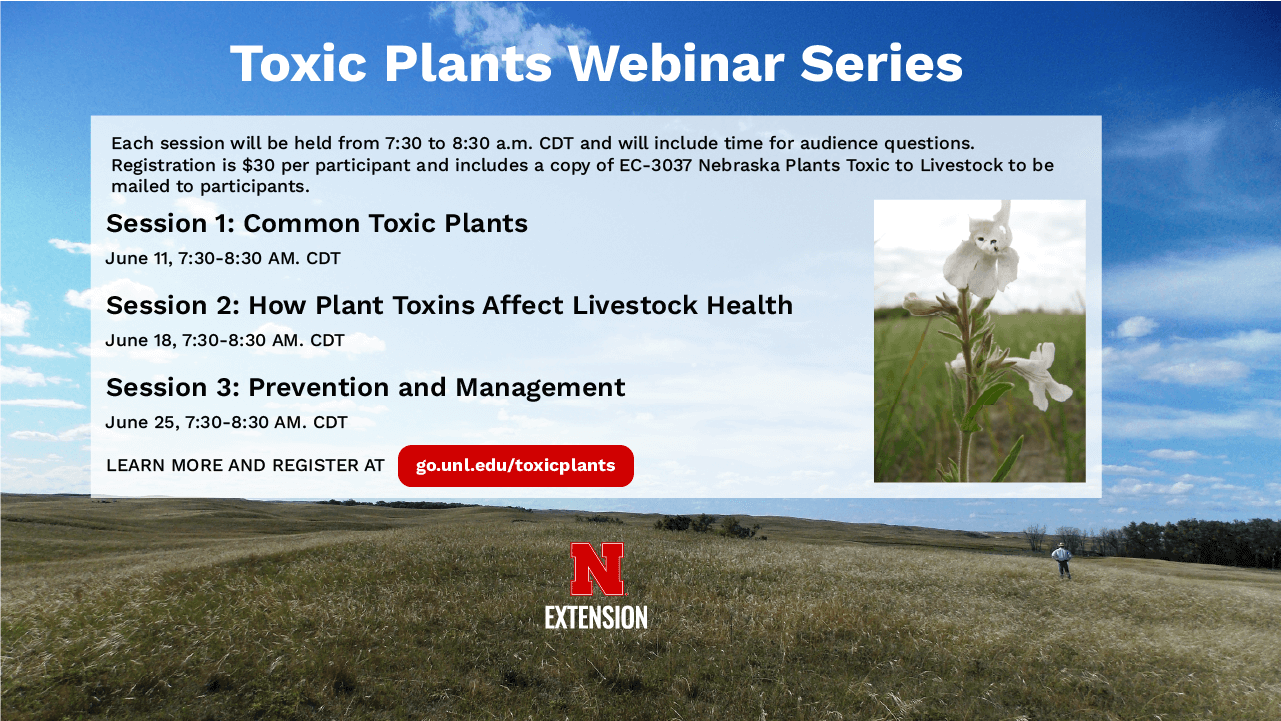
Toxic Plants Webinar Series regarding how the plants impact livestock health will be held June 11, 18, and 25 from 7:30-8:30 p.m. each evening. More info. and register at: go.unl.edu/toxicplants
June 17-18 Tractor Safety Training in York: This is an opportunity for youth to learn how to safely operate farm machinery and receive a farm husbandry certification if they’re 14-15 years old. For more information and to register, please visit: go.unmc.edu/tractor-safety-training
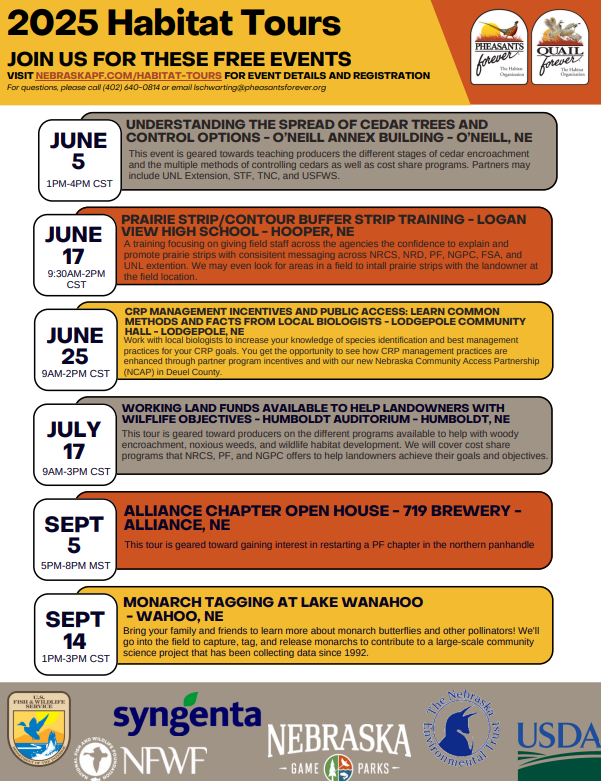
June 17th Prairie Strips Tour: Pheasants Forever is hosting a field day at Logan View School near Hooper in conjunction with UNL Extension from 9:30 AM to 2:30 PM, focused on prairie strips and their role in agricultural productivity and natural resource outcomes. RSVP at: nebraskapf.com/habitat-tours.
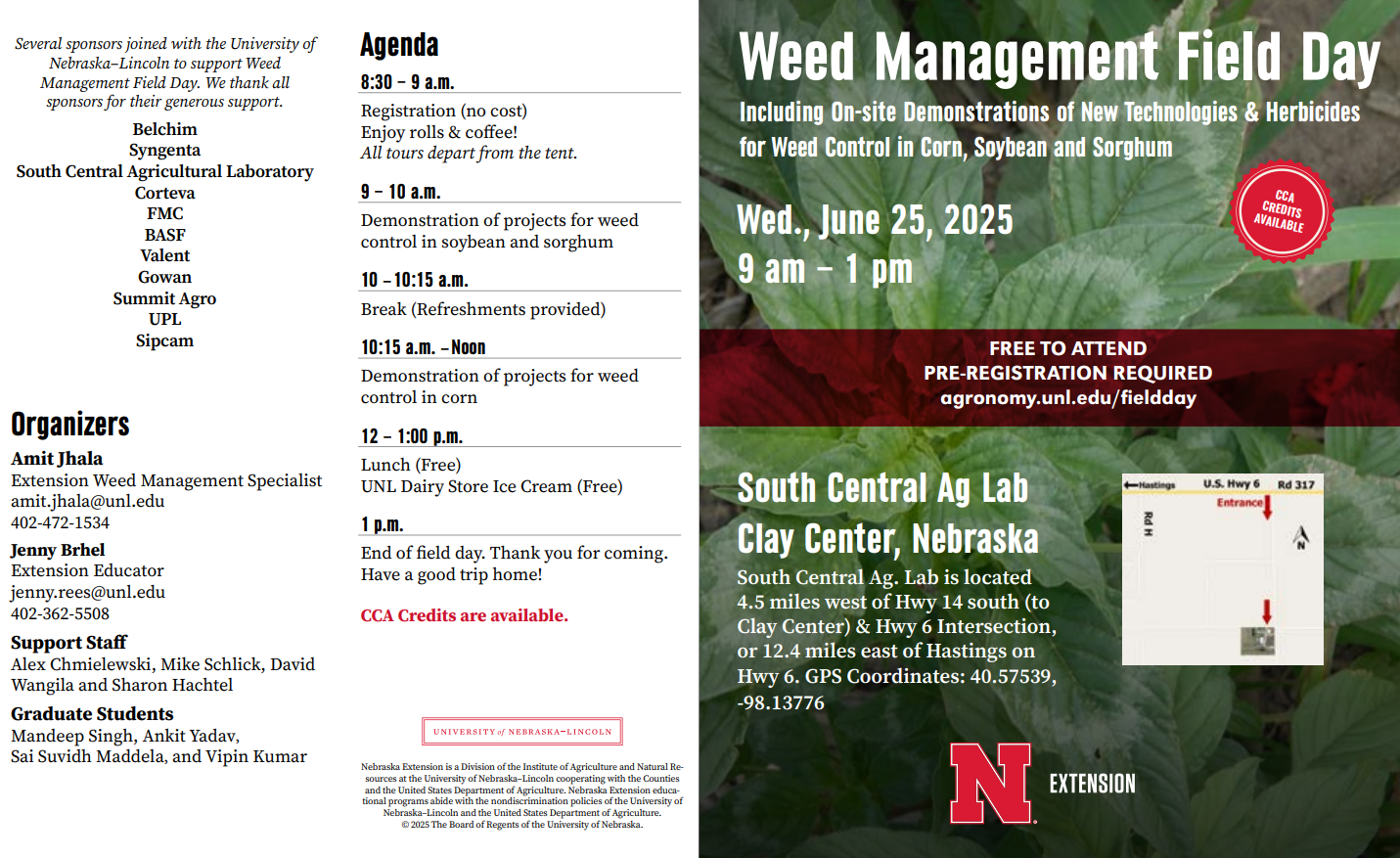
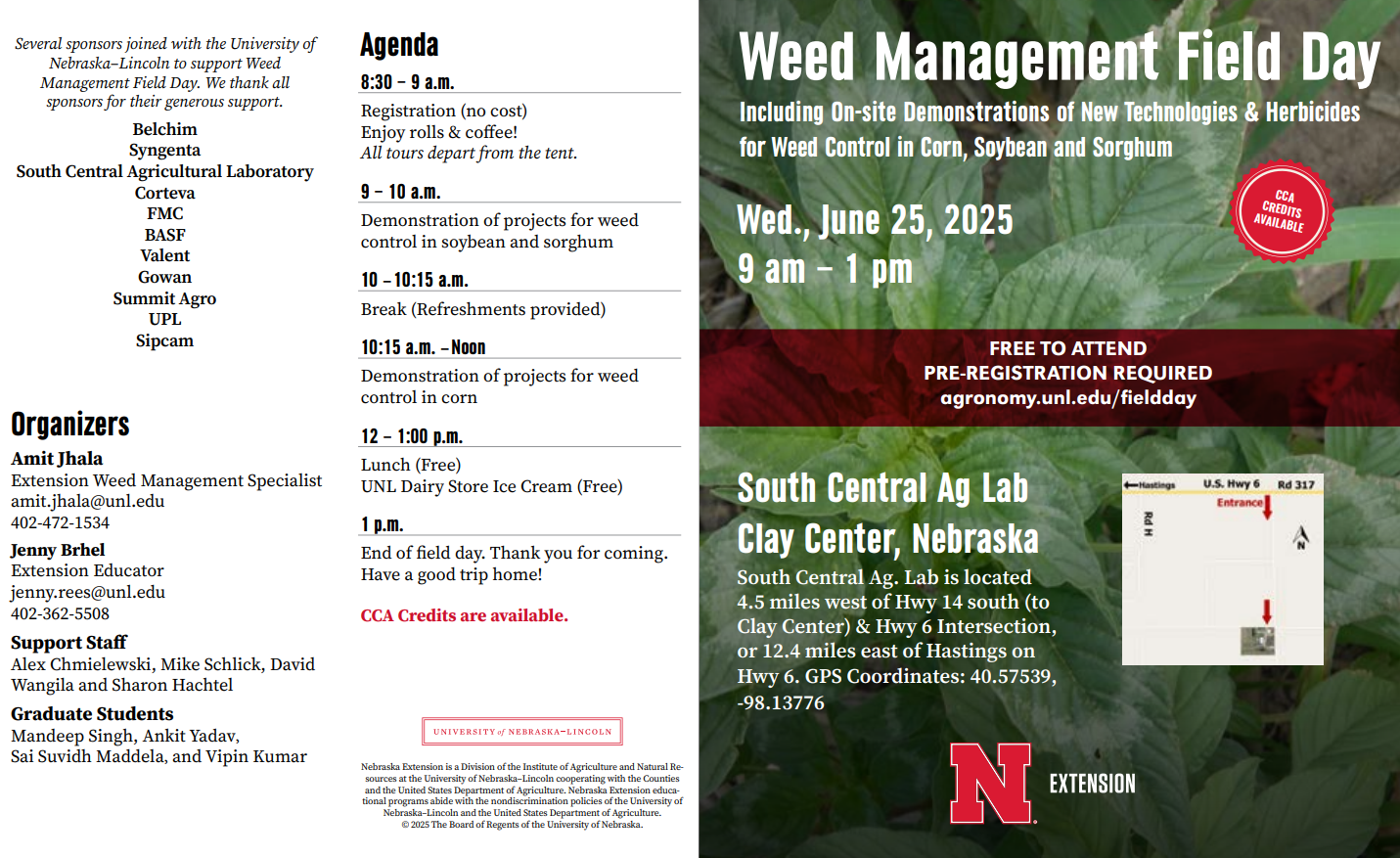
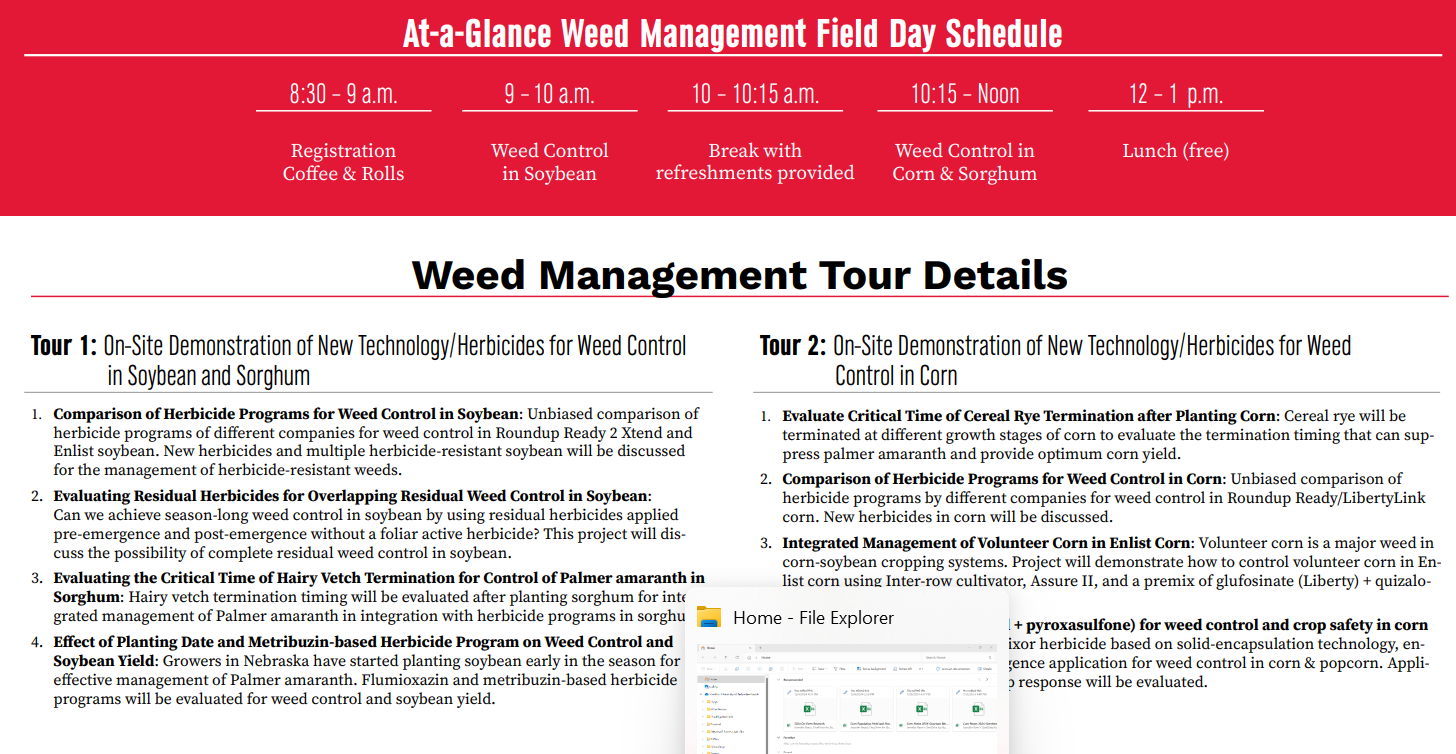
June 25 Weed Management Field Day will be held from 9 a.m.-1 p.m. (Reg. 8:30 a.m.) including lunch at UNL’s South Central Ag Lab near Clay Center. The event is free but pre-registration is needed for lunch count at: https://go.unl.edu/qemk. The event will demonstrate weed control options in soybean, corn, and sorghum. Management options that will be demonstrated include: various herbicide programs including ones with overlapping residual, timing of hairy vetch termination for weed control in sorghum, planting date and metribuzin based herbicide program in soybean, termination timing of cereal rye after corn planting, volunteer corn management in Enlist corn, and evaluating Surtain for weed control and crop safety in corn and popcorn.


Compost Extracts Part 2
With Memorial Day this weekend, grateful for all those who gave the ultimate sacrifice for our freedom and to the families left behind.
Last week, I shared some information on compost extracts. Curt Arens, editor of Nebraska Farmer magazine, responded sharing an article he wrote of a group in northeast NE working with compost extracts: https://www.farmprogress.com/soil-health/1113f1-1400-slideshow.
The “why” behind using compost extracts is to build a diversity of locally grown biology. The goal is to reduce synthetic nitrogen and other nutrients on their farms by allowing the biology to process the currently unavailable nutrients in the soils. The hope is to also increase microbial activity to naturally ward off insect and pathogen pests to reduce chemicals in the system.
The extraction process of removing the microbes from the compost has been done a number of ways. One farmer used 5 gallon buckets of compost, paint screens, water in a stock tank and an air hose to agitate. I’ve seen other farmers agitate and screen 5 gallon buckets of compost various ways into cleaned out plastic totes or cone bottom tanks. Extraction equipment can also be purchased. It does take time and is often made the morning or night before of planting and/or foliar application.
A tool I use more often is my microscope. Until a few years ago, I never thought to look at soil under my microscope; it takes practice and time. It’s opened my eyes to a whole new world of understanding and questions. With the compost extracts, I’ve seen great diversity: bacteria are common, but also fungal spores, amoebas (protists), and nematodes. I’ve learned by dunking seeds and looking at how chemical seed treatments interact and don’t interact with biology. I’ve looked at various products from a jug. I’ve dunked roots of young seedlings. It’s incredible how some biological products provide much life to the roots with microbial diversity while also viewing how chemical seed treatments did their job and the minimal associations with microbes formed. It’s a tool that I think more farmers would find helpful if time was scheduled to observe and learn.
The on-farm research studies with compost extracts were complicated studies including various nitrogen rates. So, I will share highlights and you can view the full reports beginning on page 162 of the 2024 on-farm research book.
Seward Study 1 (pg 171): In this 3-year study, the grower had two years of corn and one year of soybeans with a Check treatment, compost extract treatments, Pivot Bio (in the corn years) on the same strips. In 2022, there were no yield differences between the Check and the two compost extract + 106 lb N/ac nitrogen rates. In 2023, there were no yield differences for any of the treatments in spite higher and lower N rates. In 2024, there was no yield difference between the Check and Johnson Su compost extract areas. Encouraging is no lower yield with the reduced N and compost extracts.
York Study 2 (pg 167): In this 2-year study, there were no yield differences between any treatments in 2023 in spite of a 20% reduced N rate. The grower questioned if he was going low enough with N, and in 2024, did a nitrogen ramp study with compost extract. There were no differences between the 190 lb N/ac full N rate, 120 lb N/ac reduced N rate, and 120 lb N/ac + compost extract. Analyzing just the 120 lb N/ac rate vs. 120 lb N/ac + compost extract resulted in the a significant yield advantage to the compost extract, which was encouraging to the grower.
Lancaster Study 3 (163): In this non-irrigated study, nitrogen was the primary limiting factor amongst the treatments. The conclusion was biology needs moisture in the midst of drought.
Grateful for all who gave the ultimate sacrifice for our freedom!
Compost Extracts Part 1
During the winter months, farmers often called asking if we had research on X biological product. I heard a few of them deem 2025 as “the year of the biologicals” with how often different products would show up in ads and be discussed in meetings. It seems like the majority of companies are adding some type of biological or biostimulant to their product line. Why? I think mostly because there may come a day when we have to rely less on chemicals for ag production. We also have an increasing number of growers who are trying to reduce the amount of chemicals and synthetic fertilizer they use. Maybe there’s something to “it feels right or good” as well.
While we don’t have research on the majority of the products on the market, we are gaining more on-farm research results in homemade biologicals called “compost extracts”. If you search for this term, you will find the terms “compost extracts” and “compost teas” which are often mentioned for gardening settings. In recent years, some farmers seeking a regenerative ag path are trying this on a commercial scale for ag as well. I’ve been following Jay Young for years (YoungRedAngus on YouTube) if you want to learn more about what he’s doing.
Compost is defined by Merrium-Webster as: “a mixture that consists largely of decayed organic matter and is used for fertilizing and conditioning land”. There’s many different methods of making compost and various materials can be used. Gardeners may use materials like vegetable scraps, coffee grounds, egg shells, leaves and grass clippings. Farmers may use materials like manure, straw and hay, deceased animals, leaves, and wood chips. For ag, you may hear terms such as turned compost, windrow compost, Johnson-Su compost…there’s a number of methods that farmers are using to make compost on their farms.
Compost is known to improve soil by adding organic material, nutrients and micronutrients, soil microbes and earthworms. Hundreds to a thousand pounds of compost would be added to ag ground to improve it. Most farmers don’t have that amount nor access to that amount of material.
Thus, the interest in “compost extracts” and “compost teas” in which a small amount of compost (2 lb/ac) is used. The compost is added to water in a tank with a way to agitate it to allow the nutrients and microbes to move into the muddy water solution. For compost extracts, the solution is agitated for 20 minutes to 2 hours (depending on the farmer’s system), filtered, then the liquid is pumped to a tank for the farmer to apply to the field.
We’ve had 7 on-farm research studies in this part of the state using compost extracts as seed treatments, applied in furrow or via foliar application thus far. We kept these studies (other than seed treatment) on the same strips over time. The growers have appreciated “growing their own biological diversity” with costs ranging from $1-6/ac, depending on what else is added. Their desire is to use the extracts to lower nitrogen and other fertilizer use in addition to reducing chemical apps on their farms.
I only have room to share on the compost extract seed treatment for this column. The grower has used compost extracts for years and chose to do a seed treatment study in 2024. The corn had a commercial ShieldCoat seed treatment. He compared that to the ShieldCoat + compost extract seed treatment. This field was impacted by greensnap in July and also Fusarium crown rot. The compost extract seed treatment (215 bu/ac) statistically out-yielded the Check (206 bu/ac). The cost of the compost extract was estimated at $1/ac. There will be another compost extract seed treatment study in 2025. To determine the quality of his compost, the grower sent it in for DNA analysis from Biome Makers and it was microscopically analyzed by Living Soil Compost Lab LLC. This study can be viewed in more detail on page 167 of the 2024 On-Farm Research Results Book.
JenResources 5/11/25
Drought: While it’s sometimes difficult to write a column each week, the record of information on my blog through the years has been of help to me. I was thinking about this spring…how the rye and pastures weren’t growing, and now how the rye and wheat went to head in non-irrigated ground weeks earlier than normal. Why are they heading so early this year? I think it’s because we’ve had such warm soil temperatures coupled with low surface and subsoil moisture in non-irrigated fields. I think the plants are stressed and went into reproductive mode.
I’m concerned that pastures will also be short and head out early too. It’s good to be prepared in the event that livestock producers need additional forage. In mid-April, a Drought Preparation Webinar was held and the recording can be found here: https://go.unl.edu/2025_drought_prep_webinar. There’s also a recent CropWatch article by Aaron Berger, Livestock Educator, sharing the economic tradeoffs of grazing wheat vs. taking it for grain for those with non-irrigated acres that are drought stressed or dealing with virus diseases. You can find the full article here: https://go.unl.edu/mrny.
I know irrigating crops like what is occurring is reminiscent of 2023 in watering crops up and activating herbicide. No one wants the irrigation season to start this early. For curiosity, I pulled the Drought Monitor maps from this week in 2023, 2024, and 2025. 2023 is the year I think of most closely to 2025 so far, even though the drought monitor map in 2023 was much more severe than what 2025 shows. For a planting season, 2025 reminds me more of 2012 with how early everything went into the ground with a warm growing season and no cold snaps. The drought monitor map for the area of the state I serve is similar to 2024, but we also know that mid- to late-May rains changed conditions from dry to too wet in areas north and east of here. Curious as to what year(s) any of you would compare this year to?
Ultimately, we’re not in control of the weather. For the livestock producers in particular, it may be wise to have a forage plan in place in the event that forage resources run short for your operation.
Seed Swap: On a lighter note, we have some interesting on-farm research projects this year! One we’re calling a Seed Swap. This will be my 10th year with the York Co. Corn Grower plot. Any extra seed that we vacuum out of planter boxes is mixed together and planted out. While it’s not a part of the official plot, that area has always beaten the highest yielding number in the plot by 5-10 bu/ac. And, it may not always work this way, but a handful of others also commented they’ve seen something similar. One farmer who had hosted the plot in the past had the idea of trying this via on-farm research. A group of farmers also liked the idea and they all decided on a “seed swap” where they each contributed a hybrid to be mixed together. The mix is compared to each farmer’s hybrid(s) of choice. So in 2025, we’ll have non-GMO and GMO seed swap studies. There’s also a grower who wanted to try this with soybeans, so he has a study combining different maturity groups.
A 2009 study in Ohio compared 5 hybrids vs. mixes of the hybrids. “No significant difference was seen when comparing the yield of a mixed hybrid stand to the average of the two hybrids that were used in the mixed planting. However, there was an observed tendency for the mixed hybrid treatments to out yield their single hybrid counterparts by an average of 4.2 bushel per acre.”
I realize the concept perhaps goes against what many are trying to do with increasing uniformity in fields. My hypothesis in what we’ve seen in the corn grower plot is that the range of maturities (110-120 days) allowed to catch any stragglers for pollination, there was increased diversity in disease/insect packages in combination with more defensive and racehorse hybrids. For those interested in soil health, I also think there’s something to diversity of root structures resulting in more sharing of nutrients and different microbial associations with roots. Those are just hypotheses and we’ll share what we see for results next winter!


JenResources 5/4/25
Crop Updates: I was reminding myself to count my blessings that we have received any rain falling from the sky! The rainfall has been spotty and I can appreciate it’s been frustrating and tiring with the winds and lack of rainfall. We’ve also been blessed with incredible planting conditions this season. It’s interesting to hear a number of farmers share they were completely done with planting in April this year. It’s also nice to see the green crops emerging in fields.
Have heard reports of alfalfa weevils being higher incidence in Kansas and the southern border counties of Nebraska. Please be scouting alfalfa. More info. here: https://crops.extension.iastate.edu/encyclopedia/alfalfa-weevil.
For wheat, there’s been very little rust (stripe or leaf rust) found in Kansas through Texas. With recent rains and dew, it’s good to be scouting for these diseases. While I’m not aware that we have any wheat flowering yet, wheat development does vary throughout the area receiving this information. To check on the Fusarium Head Blight (scab) risk, check out this tool: https://www.wheatscab.psu.edu/.
I’ve had some questions on what to expect for insects this year. No one can know for sure, but our Extension entomologists shared on this topic a few weeks ago in a CropWatch article found here: https://go.unl.edu/2zmn. The following are some excerpts from the article:
“Soil Temperatures: Despite frigid temperatures in February 2025, Nebraska soil temperatures at insect overwintering depths (around 4 inches) remained relatively stable due to insulating snow cover and crop residue. The cold event likely had minimal impact on most overwintering insect pests, as the soil didn’t freeze deep enough or stay cold long enough to kill them.
Unfortunately, temperatures at most locations where western corn rootworm, western bean cutworm, and wheat stem sawfly typically overwinter have not reached sustained periods of low enough temperatures to cause considerable mortality. The exception would be the chance for higher mortality of WCR and WBC in January in the Scottsbluff region.
We recommend that scouting and management practices are continued as planned in 2025, and as informed by pest pressures observed in 2024, rather than relying upon this winter’s weather to provide adequate control of pests. However, weather between now and summer could still impact insect survival; for example, very wet soil conditions in spring can reduce WCR survival as larvae hatch out and potentially drown.”
Crabgrass preventer in lawns: With the warm soil temperatures, it’s time to get crabgrass preventer on lawns if you’re interested in doing this and haven’t already done so.
Field bindweed has been another pest people have asked about. It produces deep roots and it spreads by seeds, rhizomes and stolons. For homeowners, Kelly Feehan shared that “If hand-pulling or hoeing is the chosen control, studies show if bindweed is pulled before it grows five leaves, you may have better success. It may take up to three or four growing seasons to kill a plant, but it’s possible if one stays on top of removing plants before they have five leaves. If herbicides are used, spot treat weeds before they bloom and avoid getting herbicide on desirable plants. Tryclopyr and glyphosate can be used carefully in landscapes on bindweed.” Another tip has been to apply glyphosate to a nitrile glove and run the gloved hand on the vine so the herbicide is applied to the vine and not the desirable plant. That also takes diligence but can help over time.
JenResources 4/27/25
The weather and soil temperatures have been incredible for planting progress in this part of the State! The main agronomic question I’ve received the past few weeks has been from those with small grain cover crops around termination timing. We share more details in this article, although decisions are based on individual producers’ goals and the situation in each individual field: https://cropwatch.unl.edu/2021/cover-crop-termination-tradeoffs/.
It’s been a very different spring with small grain and pasture growth. In some ways, it reminds me of 2023, but in others, it seems worse. There was a period of time I was watching small grains, especially in non-irrigated fields, just “set” and not grow. Pastures were doing the same thing. Now in non-irrigated fields, I’m seeing rye that’s fairly short and in boot to heading stage, far earlier than it should be. My biggest concern for non-irrigated fields is soil moisture. It’s a field by field assessment and I recommend that growers be digging in fields to have a better idea of soil moisture and depth of moisture. Even for some growers that typically plant green, we’ve made the call to terminate prior to planting or at planting to conserve what moisture we can.
For the irrigated fields, the rye is also maturing quicker than expected, and for some, has gotten taller than they had desired before planting. For those who were planning on planting soybeans green into the rye, I’m not concerned about the rye “getting too tall”. You will observe the soybeans “stretching” for sunlight once they emerge. They will be longer between the soil surface and the cotyledons and also first unifoliates compared to if they were planted without a small grain. My concerns would be:
- Ensuring the soybean is planted into even moisture or able to be irrigated after planting. If you’re concerned about soil moisture and won’t get beans planted this week, you can always terminate before planting.
- The seed vee is closed if a PRE herbicide is applied. Sometimes I’ve seen difficulty in getting the seed vee closed and if that’s the case, avoid a PRE herbicide to avoid injury to the seed/germinating seedlings. Often I don’t recommend a PRE herbicide when planting green due to the tradeoff in cost between the PRE and the cost of cover crop seed and seeding. But for those who still want to use one, it’s important to ensure that seed vee is closed.
- For both corn and soybean, be aware that the taller the rye gets, the greater the Carbon:Nitrogen ratio becomes. This ratio impacts nutrient tie-up and results in longer break-down time of the small grain. For corn, it’s important to add nitrogen some way during planting to help off-set the nutrient tie-up early on in that seedling’s life. For both corn and beans, sulfur is also tied up. Purdue University found adding 20 lbs of sulfur anytime from pre-plant to V3 resulted in a yield increase. Oh, and when planting green with taller rye, we’ve found it helpful to not use residue removers.
Alfalfa Weevils: I’ve also been noticing alfalfa weevils at low incidence in alfalfa fields thus far and recommend scouting your fields. Cut 10 stems at ground level at 5 different sites in the field. Then, beat the stems in a 5 gallon bucket and count the total number of larvae with a black head. Determine the average number of larvae per stem. There’s a couple of charts with economic thresholds at: https://crops.extension.iastate.edu/encyclopedia/alfalfa-weevil. There’s also a tradeoff of harvesting early vs. spraying depending upon when economic thresholds are reached.

JenResources 4/21/25
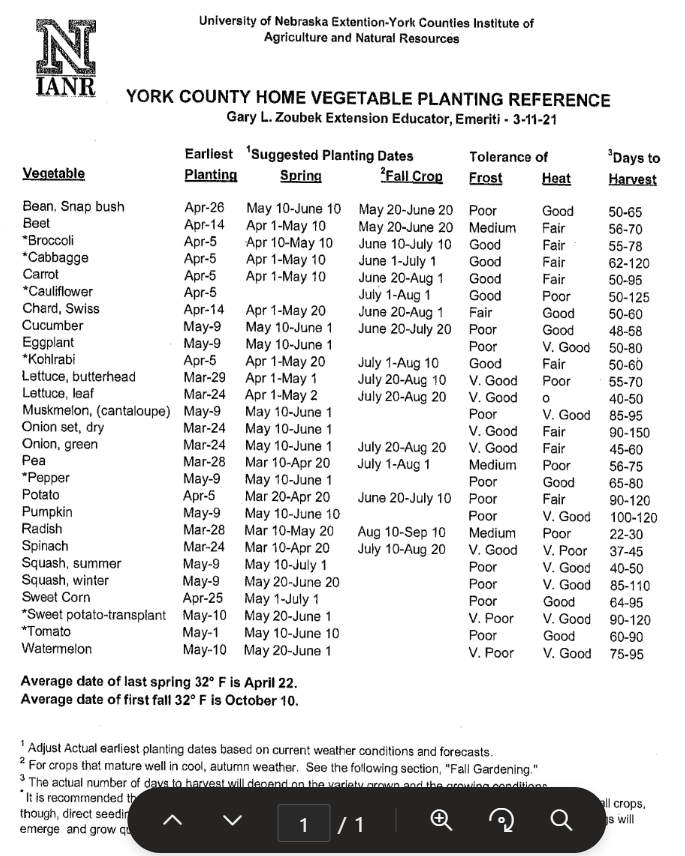
Hope you had a blessed Easter with your families/friends! It was wonderful for those who also received some rain! Quite a bit got planted last week with the warmer soil temperatures. Continue to monitor soil moisture for individual fields to have proper seeding depth into moisture. Eric Hunt, Extension Meteorologist, mentioned March 2025 had the highest wind gusts on record in Nebraska. That’s not a desirable stat, but it does help explain why so many asked if it’s normally this windy, why the surface soil moisture dried so quickly, and why small grains and pastures haven’t grown much in spite of warm soil temps. For vegetable gardens, I placed the planting guide at: https://jenreesources.com/2025/04/14/vegetable-planting-reference/.
Crabgrass Preventer for lawns is best applied when soil temps have been 55F at 4” depth for several days. Last week we were fairly close; watch soil temperatures this week at: https://cropwatch.unl.edu/soil-temperature/. For new lawn seedings, there’s options of a couple products to prevent crabgrass. Siduron (commonly sold as Tupersan) and mesotrione (found in Scotts Turf Builder Triple Action Built for Seeding) are available options.
Roundup Products for Homeowners: It’s important to read the active ingredients on the label when shopping for products. “Typical Roundup” contains the active ingredient glyphosate which is non-selective and will kill any green plants not resistant to it. Any product containing glyphosate that is sprayed on the lawn will kill the lawn.
The product labeled “Roundup for Lawns” does not contain glyphosate, which can be confusing. Active ingredients in this product include MCPA, quinclorac, dicamba and sulfentrazone. These herbicides are effective on a broad range of weeds that might infest the lawn such as dandelion, crabgrass and nutsedge, without harming the lawn when used properly.
“Roundup 365” is a product that contains glyphosate, imazapic, and diquat. This product can provide 12 month control of weeds and is labeled for use on driveways, patios, sidewalks, and gravel areas. Just know that nothing can be safely planted back into that area for at least 12 months.
To remove undesirable trees that grow within evergreen trees or hedges like lilacs, use glyphosate instead of Tordon on the cut stumps. This is because the glyphosate doesn’t have additional soil activity and stays within the root system of the plant it’s been applied to. Just be careful to only use a product with glyphosate with nothing else added to it. Ultimately, please read the labels to ensure you’re using a product that is labeled for the place you wish to use it, for any restrictions on the product, and what pests it lists to control.
Tree Planting: With Arbor Day this week, it’s important to not plant trees too deep. Kelly Feehan shares, “If a tree is planted at the same depth it was in its container, and the soil in the planting hole beneath the root ball is loosened, odds are very good the tree will be planted too deep. Since planting trees at the same depth they are in their containers and loosening soil in the bottom of planting holes is often done, too deep of planting occurs frequently. To plant a tree at the correct depth, wait to dig the hole until after a tree’s first lateral root at the base of the trunk is located. Soil may need to be scraped off the top of the root ball to do this. Only then dig the hole just deep enough so the root ball will sit on firm, undisturbed soil and the first root is just below ground level. Dig planting holes one to two times wider than the root balls diameter to loosen soil and encourage outward tree root growth.”
For those who have put their faith, trust, and repentance in Christ alone for salvation, Easter, and every single day, holds gratitude of the price that was paid in full for sin. We serve a Risen King! “All Praise to the Name Above All Names!”
Planting 2025 Considerations
Planting Considerations: The warmer air, wind, and warming trend of soil temperatures are allowing for planting to begin. The winds have removed a great deal of surface moisture making for dry conditions where seed will be placed. I recommend putting corn and soybeans in the ground at 2” (our research recommends 1.75” for soybean). This allows for buffered soil moisture and temperature conditions when planting. Bob Nielsen, emeritus professor at Purdue said corn can be seeded 2.5-3” deep if that’s where uniform soil moisture is located in order to achieve uniform germination and emergence, particularly for non-irrigated fields. In the droughts of 2023 and 2024, we had farmers successfully plant corn at 3.5” deep just to be in uniform soil moisture. We don’t recommend planting soybean deeper than 2.5”.
Seed germination occurs in two stages. The first is imbibition in which the seed takes up water quickly. Soybean needs to uptake 50% of its seed weight during this stage and this typically occurs in less than 24 hours if the seed is placed into good soil moisture. Corn uptakes 35% of its seed weight which can occur in 48 hours when placed into good soil moisture. It’s this phase where we get concerned if we receive a cold rain or snow within 24-48 hours of planting as the soil temperature can be reduced the seed can imbibe cold water leading to cold shock, reduced germination, and potentially death.
The second phase of germination is the osmotic phase. In this phase, a much slower uptake of water occurs. Seedlings in this phase are quite tolerant of soil temps as low as 35-40°F. Extended low temperatures and/or saturated excess moisture can lengthen the germination to emergence timeframe and can lead to greater soil-borne pathogens.
Agronomically we’ve come a long way with genetics and seed treatments. Because of this, some don’t worry about soil temps. Yet every year I think most agronomists would say we can trace various problems back to a specific planting date(s) or planting window. So, I still feel they’re an important consideration.
We often hear a preference of planting corn and soybeans in as close to 50°F or greater soil temperatures as possible. Below 50°F, I prefer to see corn planted on a warming trend of 5-7 days. The consideration is for soil temps in the mid-40’s on a warming trend with no chance of a cold snap (cold rain/snow) within 8-24 hours for soybean and 48 hours for corn. The time-frame is due to the imbibition (critical water uptake) time-frame for corn and soybean mentioned above. Soil temps for your field can be monitored by using a thermometer or checking out CropWatch soil temps at: https://cropwatch.unl.edu/soiltemperature.
Since 2004, we’ve shared the importance of planting soybean early (mid- to late-April or first week of May) to increase yields. We’ve seen a shift to planting soybean earlier than corn or at least at the same time as corn, which is encouraging to me. A question I have and that an increasing number of producers have, is around soybean seed treatments. With tight economics and reasons including impacts to pollinators, some growers have tested full seed treatments vs. a biological seed treatment vs. untreated seed. We have 6 site-years of data in York, Seward, Polk, and Hamilton Counties thus far showing no yield differences between these treatments. Planting dates ranged from May 2 to May 22. I’m hoping to have more studies on this topic in 2025. Please let me know if you’re interested in trying a few strips of untreated or biological treated soybeans compared to your treated seed so we can obtain more local data.

JenResources 4/6/25
Storm Damaged Trees have been an increasing concern for homeowners. The cedar windbreaks seem to be the greatest affected and it’s hard to know how much damage has been done until you start the cleanup process. This is a resource from the Nebraska Forest Service on storm damaged trees: https://nfs.unl.edu/snow-and-ice-damage-trees/ and https://nfs.unl.edu/immediate-care-storm-damaged-trees/. Additional resources: https://nfs.unl.edu/pruning-large-trees/ and all Forest Service Resources at: https://nfs.unl.edu/nfs-publications/.
When I look at each tree situation, I look at the overall structure of the tree, if there’s any shelf fungi (look like dinner plates) on the trunk or main branches (indicator of heart rot), any other major signs of decay/disease, and seek to visualize how the tree will look upon being properly pruned. I’m not a forester, but these are quick things I’m looking for. Most of the trees I’ve recommended to keep unless they had obvious heart rot or other issues. Of key importance is to trim the trees back to the bark branch collar to allow for sealing over the pruning cut. There are places in trees with large gaping wounds from the sheer weight of branches tearing and falling. I don’t know how they will all heal and seal, but trees are pretty amazing at what they can withstand. Some of these trees have an odd-shape after pruning, but you can always make the decision to remove them later.

There have been some fungus gnat outbreaks after removing trees, especially entire windbreaks. The decaying organic matter in the soil in addition to exposed moist soil can allow for fungus gnats to thrive. They typically only live 7-10 days, but in that time-frame, the female can unfortunately lay hundreds of eggs multiple times. Thus, why a few are reporting “millions” of gnats in their farm yards. I don’t have a good answer for you on managing this. Numbers will be reduced once the soil dries out in the top two inches or so. Unfortunately, this situation will most likely take three to four weeks to potentially resolve until the gnats find a new home and/or die. If they get into your home, you can use yellow sticky traps to catch them and also shallow pans of dishwater.
Vegetable Planting Guide that was compiled by emeritus Extension Educator Gary Zoubek can be found at: https://go.unl.edu/vegetableguide.
Ground covers: The following is information from April’s ProHort Update at:https://hles.unl.edu/update042025/. Ground covers can be a great alternative to mulching the landscape bed while providing habitat for pollinators and season-long interest. They will spread and cover the ground via rhizomes or stolons while also reducing soil erosion. That makes them a great option instead of grass on a steep slope where it is hard to maintain turf. There are many native or well adapted groundcovers to choose from. Here are a few groundcover options for spring color:
- Prairie smoke (Geum triflorum), grows great in sunny, dry locations, blooms from May to July
- Sweet woodruff (Galium odoratum), grows great in dry shade, blooms April-May
- Carpet bugleweed (Ajuga reptans), grows in moist shade with blue blooms from May to June
- Creeping phlox (Phlox stolonifera), good bloomer in shade with purple blossoms in spring
- Pasque flower (Pulsatilla patens), very early spring bloomer with purple blossoms in full sun
- Candytuft (Iberis sempervirens), showy April-May bloomer in full sun
- Lungwort (Pulmonaria officinalis), small pink-blue blooms in April-May in part to full shade


 JenResources